

Nearly one in three property transactions that proceed to survey stage are later renegotiated or abandoned — often because the buyer received a report they could not interpret, rather than one they could act on. Moving from a 'defect list' to clear advice is not just good practice; it is the difference between a buyer making a confident decision and a buyer walking away from a perfectly sound property in a panic.
This article explores how UK building surveyors should present findings to help buyers actually make decisions — covering structure, language, prioritisation, and the professional standards that underpin it all.
Key Takeaways 📋
- RICS standards already require clear, jargon-free advice — not just lists of defects — and these rules govern all regulated surveyors in 2026.
- Prioritisation is everything: buyers need to know what is urgent, what is manageable, and what is cosmetic — not just that something is wrong.
- Cost and time context transforms a defect list into a decision-making tool.
- Plain English is not dumbing down — it is a professional obligation.
- The surveyor's role is to advise, not just document; the report should read like guidance from a trusted expert, not a legal disclaimer.
Why the Traditional Defect List Falls Short
The conventional building survey report has a long history in UK property transactions. For decades, surveyors produced dense schedules listing every crack, damp patch, and missing roof tile they encountered. In some cases, these schedules ran to dozens of pages. One notable example involved a property survey that uncovered 781 separate issues — a figure that, while impressive from a thoroughness standpoint, left the buyer with no clear sense of what actually mattered [10].
This approach has a fundamental flaw: volume is not the same as value.
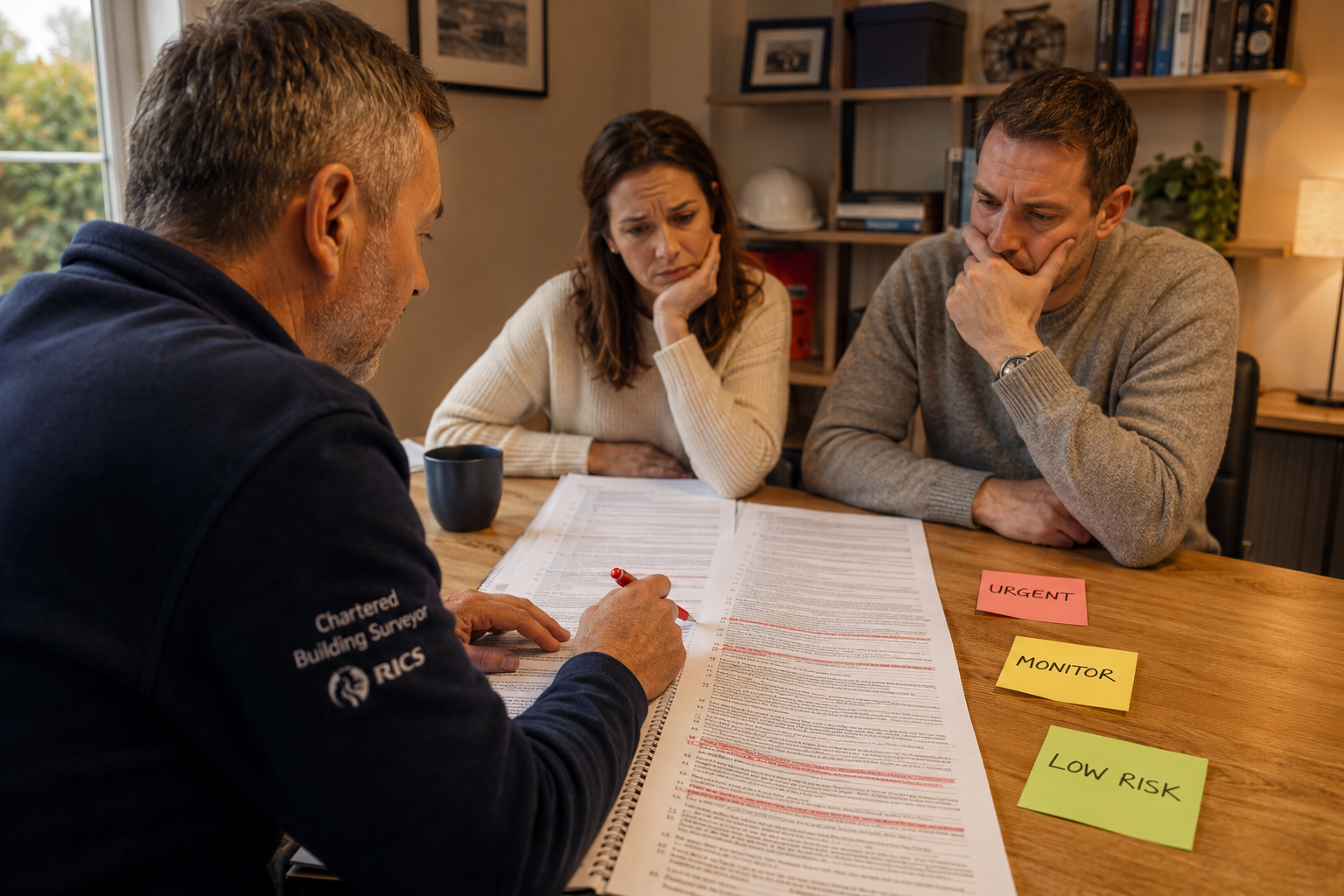
A buyer reading a 40-page report filled with technical terminology, condition ratings, and caveated disclaimers is not better informed. They are overwhelmed. Research and professional commentary consistently show that buyers struggle to distinguish between a cracked render (cosmetic) and a cracked lintel (structural) when both appear in the same undifferentiated list [3].
💬 "The purpose of a survey is not to catalogue every imperfection — it is to help the buyer understand what they are buying and what it will cost them to own it."
The shift from 'defect list' to clear advice is not about reducing rigour. It is about translating technical findings into human decisions.
What RICS Standards Actually Require in 2026
The Royal Institution of Chartered Surveyors (RICS) sets the professional framework for all regulated building surveyors in the UK. Its standards are unambiguous: reports must be clear, jargon-free, and genuinely useful to the client — not just technically accurate [8].
RICS survey levels are structured to match the depth of advice to the complexity of the property:
| Survey Level | Typical Use | Depth of Advice Required |
|---|---|---|
| Level 1 (Condition Report) | New builds, modern homes | Condition ratings only |
| Level 2 (HomeBuyer Report) | Standard properties | Condition + brief advice |
| Level 3 (Building Survey) | Older, complex, or altered properties | Full advice, costs, priorities |
For a RICS Building Survey, the expectation is the highest level of communication. The surveyor must not only identify defects but explain their significance, likely cause, and recommended course of action [3].
Yet in practice, many reports still default to the defect-list format — partly through habit, partly through a misguided belief that more caveats mean less liability. This misreads the professional obligation entirely.
The Liability Myth
Some surveyors pad reports with disclaimers and hedge every finding to protect themselves from complaints. The irony is that vague, uncommitted advice is more likely to generate complaints, not fewer. If a buyer cannot understand what action to take, and later discovers a problem they feel the surveyor should have flagged clearly, the professional relationship has failed [6].
Clear, prioritised advice — even when it includes uncertainty — is both better practice and better protection.
The Architecture of a Decision-Ready Report
Moving from a 'defect list' to clear advice requires a deliberate change in how reports are structured. The following framework reflects best practice for UK building surveyors who want their findings to actually help buyers make decisions.
1. Executive Summary First
Every report should open with a plain-English executive summary of no more than one page. This summary should answer three questions:
- What are the most significant issues?
- What do they mean for the buyer's decision?
- What are the estimated costs and timescales involved?
Buyers — and their solicitors — read the summary first. If it is clear, the rest of the report provides supporting detail. If the summary is buried at page 15 or absent entirely, the report has already failed its primary purpose.
2. A Prioritised, Three-Tier Defect Hierarchy
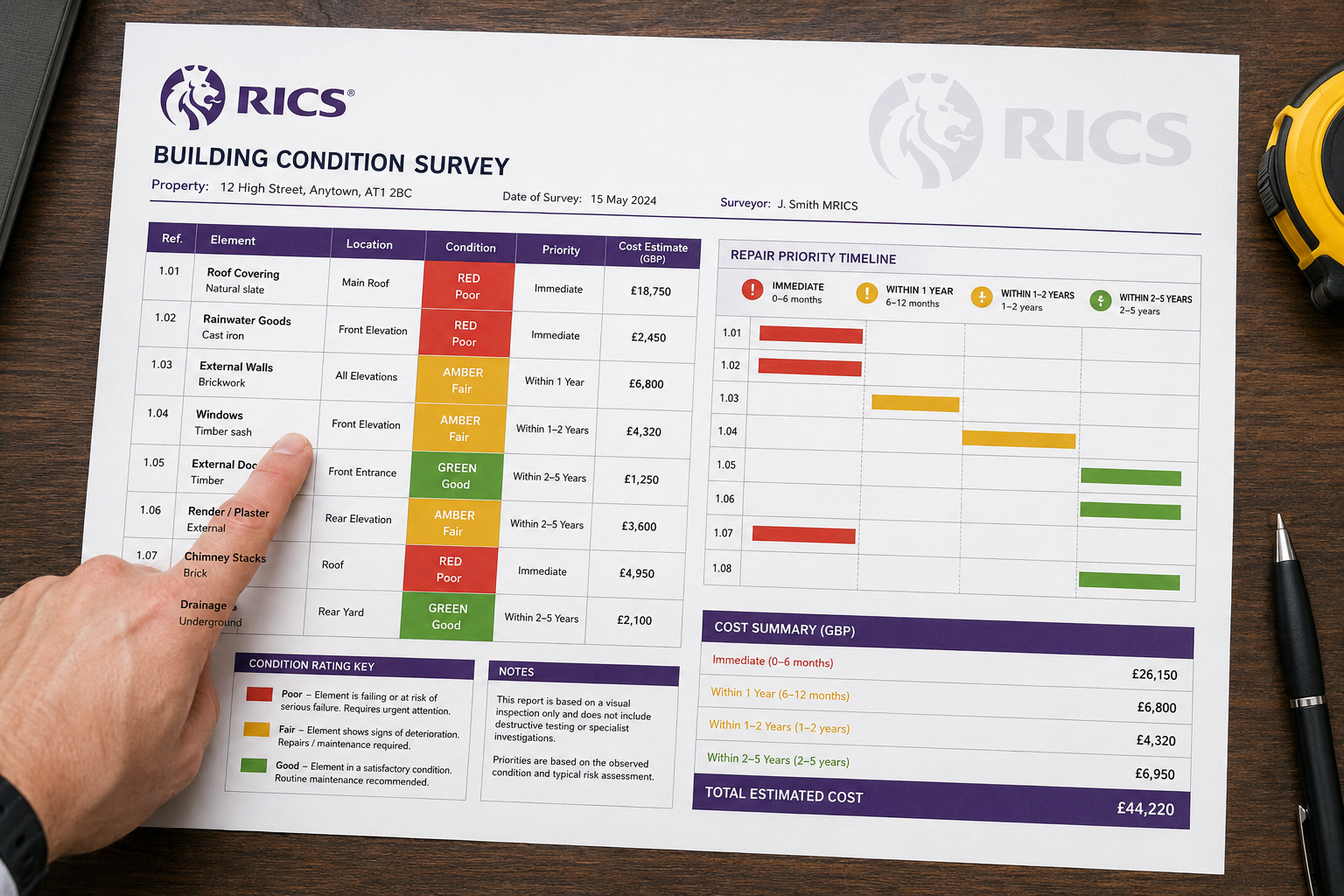
Rather than listing defects in the order they were encountered during the inspection, surveyors should organise findings by urgency and significance:
- 🔴 Tier 1 — Urgent / Deal-breaker potential: Structural movement, active water ingress, unsafe electrical systems, serious subsidence. Requires immediate specialist investigation or action before exchange.
- 🟡 Tier 2 — Significant but manageable: Roof covering deterioration, chimney repointing, outdated heating systems. Should be costed and factored into the purchase price negotiation.
- 🟢 Tier 3 — Routine maintenance: Minor cracking, worn decorations, standard wear and tear. Normal for the property's age; no action required before purchase.
This structure mirrors how buyers actually think. It answers the question: "Should I still buy this house?" before it answers "What is wrong with the roof?"
For properties with complex or unusual defects, a specific defect survey can provide deeper analysis on a single issue — a useful complement to a full building survey when a particular concern warrants specialist attention.
3. Cost Estimates and Time Horizons
One of the most common complaints about building survey reports is the absence of cost context [2]. A surveyor who notes "the roof covering is at the end of its serviceable life" without indicating that replacement might cost £8,000–£15,000 has given the buyer half the information they need.
Best practice in 2026 includes:
- Indicative cost ranges for all Tier 1 and Tier 2 items (not precise quotes, but informed professional estimates)
- Time horizons — is this a problem to address before moving in, within 12 months, or within five years?
- Consequences of inaction — what happens if the buyer does nothing? This is critical for prioritisation.
It is worth noting that cost estimates carry inherent uncertainty and should be presented as ranges with appropriate caveats. The goal is informed decision-making, not a binding contractor quote.
4. Plain English Throughout
Technical language has its place — in the detailed body of the report, where precision matters. But every section heading, summary point, and recommendation should be written for a non-specialist reader.
Compare these two versions of the same finding:
| ❌ Jargon-heavy | ✅ Clear and actionable |
|---|---|
| "Spalling brickwork noted to the north elevation parapet, consistent with freeze-thaw deterioration of the masonry substrate." | "The brickwork at the top of the north-facing wall is crumbling due to frost damage. This needs repointing within the next 12 months to prevent water getting into the wall. Estimated cost: £500–£1,200." |
The second version does not sacrifice accuracy — it adds it. The buyer now knows what it is, why it matters, and what to do.
For buyers who want to see how a well-structured report looks in practice, reviewing a sample homebuyers report can help set expectations before commissioning a survey.
From 'Defect List' to Clear Advice: Common Defects and How to Present Them
Understanding how to communicate specific defects is where the principles above become practical. The following are among the most frequently encountered issues in UK residential surveys [4][5], with notes on how surveyors should frame them for buyers.

Damp and Moisture Ingress
Damp is one of the most misunderstood findings in any survey. The word alone triggers alarm — yet the causes and consequences vary enormously, from a failed mastic seal around a window (trivial) to rising damp through an inadequate DPC (significant).
How to present it: Identify the likely source, distinguish between penetrating damp, rising damp, and condensation, and give a clear view on severity. Avoid vague statements like "damp was noted" without context. Buyers who receive a damp and timber report as a follow-up investigation will be better placed to negotiate or plan remediation.
Structural Movement and Cracking
Not all cracks are equal [9]. Diagonal cracking above a window opening may indicate differential settlement — potentially serious. Horizontal hairline cracks in plaster are almost always cosmetic.
How to present it: Use the BRE crack classification system (Categories 0–5) and explain what each category means in plain terms. If further investigation by a structural engineer is needed, say so explicitly — and explain why, not just that it is recommended.
For buyers concerned about subsidence specifically, a detailed guide to subsidence provides useful background on what triggers it and how serious it can be.
Roof Condition
Roof defects are among the most costly to remedy and among the most commonly misunderstood by buyers [4]. A surveyor who notes "the roof covering shows signs of wear" without indicating whether this means five years of life remain or five months is not helping anyone.
How to present it: Estimate remaining serviceable life, identify specific areas of concern (e.g., ridge tiles, flashings, valley gutters), and give a cost range for repair versus full replacement.
Electrical and Heating Systems
Outdated electrical installations (pre-17th Edition wiring regulations) and ageing boilers are Tier 2 issues at minimum — they affect safety and running costs. Yet they often appear buried in a list of minor items.
How to present it: Flag these prominently, recommend specialist testing where appropriate, and note the likely cost of upgrading. Buyers need to know this before they budget for the purchase.
The Surveyor's Role: Advisor, Not Just Inspector
The move from 'defect list' to clear advice reflects a broader shift in how the profession understands its purpose. A building surveyor is not simply a camera — recording what is visible and leaving interpretation to others. The professional obligation, enshrined in RICS standards, is to advise [8].
This means:
- Giving a view, not just presenting options. If the evidence points to a particular cause or course of action, say so.
- Contextualising findings within the property's age, type, and location. A 1930s semi-detached in South London has different baseline expectations than a 2010 new-build in the Home Counties.
- Being honest about uncertainty. If something cannot be confirmed without opening up a floor or removing a ceiling, say what the surveyor suspects and why further investigation is recommended.
Buyers who receive this kind of report — one that reads like advice from a knowledgeable professional rather than a legal disclaimer — are far better equipped to negotiate, plan, or walk away with confidence [6].
For those navigating a difficult report, practical guidance on what to do after a bad building survey can help buyers understand their options and next steps.
Practical Checklist: Does Your Report Meet the Standard?
Use this checklist to assess whether a building survey report genuinely helps buyers make decisions:
- ✅ Plain-English executive summary on page one
- ✅ Defects organised by urgency (not inspection order)
- ✅ Cost estimates provided for significant items
- ✅ Time horizons stated for all recommended actions
- ✅ Consequences of inaction explained
- ✅ Technical terms explained when used
- ✅ Clear recommendation on whether further specialist investigation is needed
- ✅ Report reads as advice, not just documentation
Conclusion: The Standard Buyers Deserve in 2026
The gap between a defect list and clear advice is not a technical gap — it is a communication gap. UK building surveyors have the knowledge, the professional framework, and the RICS standards to produce reports that genuinely help buyers make decisions. What has sometimes been missing is the deliberate commitment to structure, language, and prioritisation that transforms raw findings into actionable guidance.
Actionable next steps for buyers and surveyors in 2026:
-
Buyers: Before commissioning a survey, ask the surveyor how they structure their reports. Request an example. Look for evidence of prioritisation, cost context, and plain-English summaries. You can explore RICS survey options to understand which level is right for your property.
-
Surveyors: Audit your last five reports against the checklist above. If a buyer could not determine the three most important actions from your executive summary alone, the report needs restructuring — not expanding.
-
Both: Recognise that a well-communicated survey report is not just a professional nicety. It is the foundation of a confident, informed property transaction — and the clearest demonstration of what chartered surveying expertise is actually worth.
The property market in 2026 is complex, competitive, and high-stakes. Buyers deserve reports that help them act — not ones that leave them guessing.
References
[1] Major Defects Survey – https://www.eastonbevins.co.uk/building-surveying/residential-surveys/major-defects-survey/
[2] What To Do After A Bad Home Survey – https://www.gowers.co.uk/news/what-to-do-after-a-bad-home-survey/
[3] Understanding RICS Level 3 Building Surveys In The UK: Striking The Right Balance In Reporting Defects – https://www.rectorysurveyors.co.uk/post/understanding-rics-level-3-building-surveys-in-the-uk-striking-the-right-balance-in-reporting-defec
[4] Watch Out For These Top 10 Property Defects – https://hardingsurveyors.co.uk/watch-out-for-these-top-10-property-defects
[5] 10 Common Home Defects Found In Property Surveys And How To Fix Them – https://lmsurveyors.co.uk/10-common-home-defects-found-in-property-surveys-and-how-to-fix-them/
[6] Bad House Survey Report – https://hoa.org.uk/advice/guides-for-homeowners/i-am-buying/bad-house-survey-report/
[7] Level 2 Survey Thrown Up Issues: Are These Normal? – https://www.reddit.com/r/HousingUK/comments/16icfmo/level_2_survey_thrown_up_issues_are_these_normal/
[8] Building Surveying Standards – https://www.rics.org/profession-standards/rics-standards-and-guidance/sector-standards/building-surveying-standards
[9] Structural Defects In Building Survey For House Purchase Help – https://forums.moneysavingexpert.com/discussion/6184245/structural-defects-in-building-survey-for-house-purchase-help
[10] 781 Issues Found During A Property Survey – https://www.pettyson.co.uk/about-us/our-blog/781-issues-found-during-a-property-survey