

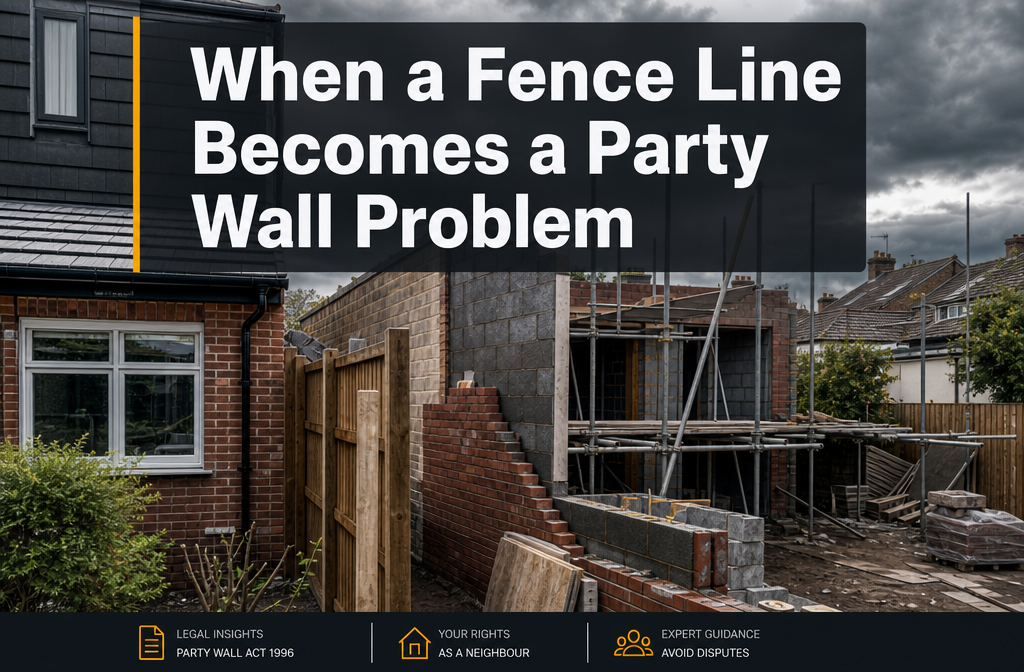
Nearly one in three party wall disputes in England and Wales originates not from a loft conversion or basement dig, but from a seemingly modest garden project — a new wall, a garage, or a rear extension that sits right on the boundary line. What starts as a straightforward planning application can quickly unravel into a legal and neighbourly minefield the moment a builder's spade crosses the line of junction.
Domestic Extensions Built on the Boundary: When a Simple Fence Line Becomes a Party Wall Surveying Problem is not a niche concern for large developers. It is an everyday reality for homeowners who want to replace a rotting fence with a brick wall, add a garden store to the back of the plot, or extend their kitchen flush with the boundary. Each of these scenarios can trigger obligations under the Party Wall etc. Act 1996 — and missing those obligations can halt construction, generate costly disputes, and damage relationships with neighbours for years.
Understanding where the fence line ends and the party wall regime begins is one of the most valuable things a surveyor can communicate at the pre-planning stage.
Key Takeaways 📌
- Building on or at the boundary triggers specific legal duties under the Party Wall etc. Act 1996, even for small domestic projects.
- A fence line is not a legal boundary — the actual boundary can differ, and assuming otherwise is a common and expensive mistake.
- Party wall notices must be served before work begins, not after a dispute arises.
- A party wall surveyor should be consulted at the pre-planning stage, not as a last resort.
- Failing to comply with the Act can lead to injunctions, delays, and significant financial liability.
The Fence Line Is Not the Legal Boundary — Why This Matters
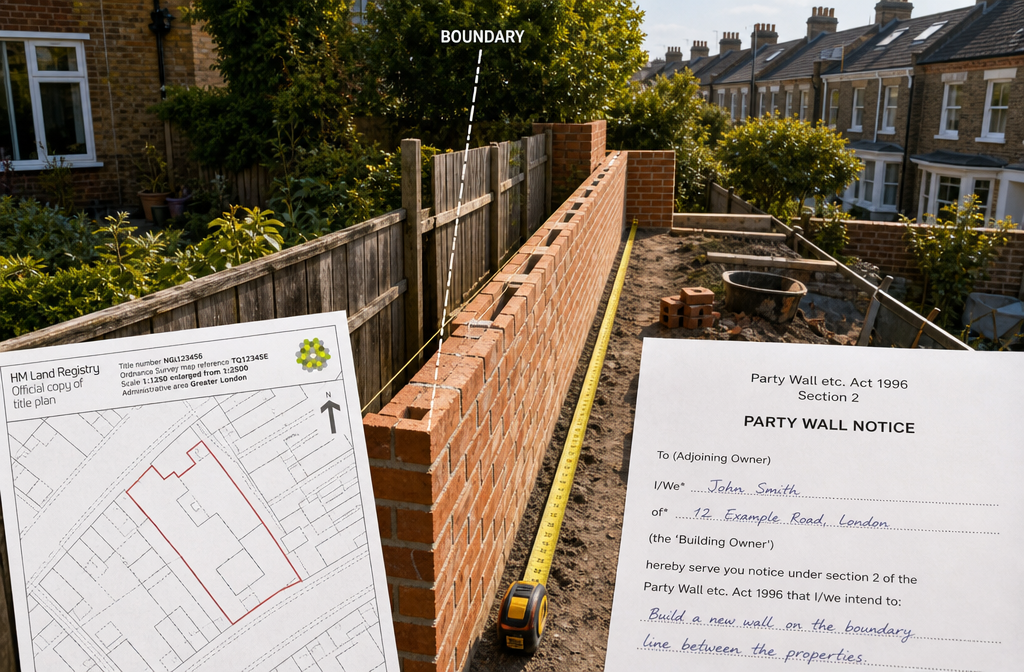
Most homeowners assume the fence at the bottom of the garden marks the legal boundary of their property. In reality, a fence is simply a physical structure. The legal boundary is an invisible line defined by the title deeds, Land Registry title plan, and — in cases of dispute — historical conveyance documents.
This distinction matters enormously when planning a domestic extension. Consider these common scenarios:
| Scenario | Common Assumption | Legal Reality |
|---|---|---|
| Replacing a timber fence with a brick wall | "It's my fence, so it's my wall" | The wall may straddle the boundary, making it a party fence wall |
| Building a garage against the boundary | "I'm building on my land" | Foundations may cross the line of junction, triggering the Act |
| Raising a garden wall height | "It's an existing wall — no issue" | Raising a party fence wall is notifiable work under the Act |
| Rear kitchen extension to the boundary | "Permitted development, no party wall" | The Act applies independently of planning permission |
💬 Pull Quote: "Planning permission and party wall compliance are entirely separate legal requirements. Getting one does not excuse you from the other."
For a deeper dive into UK boundary wall rules and how they interact with party wall law, it is worth reviewing the specific obligations that apply to each type of boundary structure.
How the Party Wall etc. Act 1996 Applies to Boundary Extensions
The Party Wall etc. Act 1996 covers three distinct categories of work, each with its own notice requirements:
Section 1 — New Walls on the Line of Junction
This is the section most directly relevant to domestic extensions built on the boundary. If a building owner wishes to build a new wall astride the boundary line (i.e., with half the wall on each property), they must serve a Line of Junction Notice on the adjoining owner at least one month before work begins.
If the adjoining owner consents, work can proceed. If they dissent — or fail to respond within 14 days — a party wall dispute is deemed to have arisen, and surveyors must be appointed.
Alternatively, if the building owner wants to build entirely on their own land but up to the boundary, no notice is required under Section 1 — but the foundations must not encroach.
Section 2 — Works to an Existing Party Wall or Party Fence Wall
This section covers:
- Cutting into a shared wall to insert beams or joists
- Raising the height of a party fence wall
- Underpinning a shared wall
- Demolishing and rebuilding a party wall
Many homeowners are surprised to learn that simply raising the height of a shared garden wall — perhaps to improve privacy — is notifiable work under Section 2.
Section 6 — Excavations Near Neighbouring Foundations
If excavation for an extension foundation is within 3 metres of a neighbouring structure (and deeper than the neighbour's foundations), or within 6 metres under a 45-degree line, a notice must be served.
For a comprehensive overview of when you need a party wall agreement, the specific thresholds and triggers are set out clearly.
Relatable Boundary Scenarios That Trigger the Act 🏡
Scenario 1: Replacing a Fence with a Masonry Wall
A homeowner in a London terrace decides to replace a dilapidated timber fence with a smart new brick wall. The fence has always "felt" like theirs. But the title deeds show the boundary runs down the centre of the old fence posts.
If the new wall is built astride that centre line — even by a few centimetres — it becomes a party fence wall under the Act. The homeowner needed to serve a Line of Junction Notice before the first brick was laid.
What should a surveyor advise at pre-planning stage?
- Commission a boundary check against the title plan before any design work begins.
- Decide whether to build astride (requiring consent) or entirely within the curtilage (avoiding Section 1 but losing some usable land).
- If building astride, prepare and serve the notice early — before planning application is submitted.
Scenario 2: Building a Garage or Garden Store on the Boundary
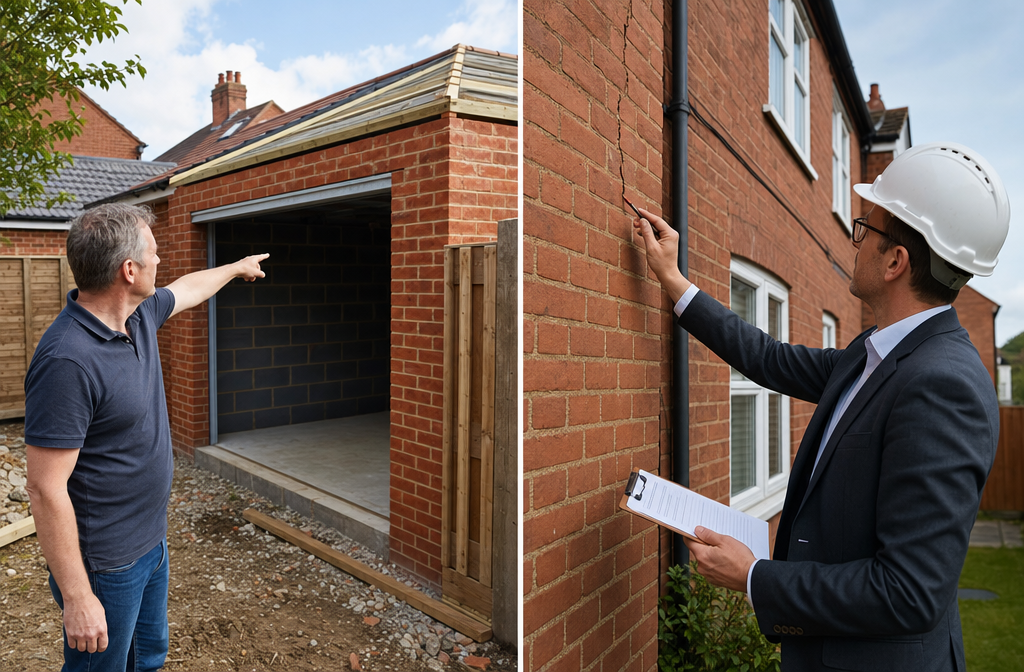
A homeowner wants a new single-storey garage running along the side boundary. The structure will sit right on the line of junction, with its flank wall forming the boundary itself.
This is one of the most common situations where Domestic Extensions Built on the Boundary: When a Simple Fence Line Becomes a Party Wall Surveying Problem becomes a real and pressing issue. The new wall will be built on the owner's land, up to but not astride the boundary — so Section 1 may not apply. However:
- Excavation for strip foundations may fall within 3 metres of the neighbour's structure, triggering Section 6.
- If the new wall is to be built against an existing party fence wall, Section 2 works may be involved.
- The neighbour's right of light and potential for vibration damage during construction must be assessed.
⚠️ Key Point: Even if the structure itself does not straddle the boundary, the construction process — particularly excavation and foundation work — can independently trigger party wall obligations.
Scenario 3: Raising a Garden Wall for Privacy
A homeowner wants to raise an existing 1.2m brick boundary wall to 2.1m for privacy. The wall was built many years ago and sits on the boundary — making it a party fence wall shared with the neighbour.
Raising the height of a party fence wall is explicitly covered by Section 2(2)(a) of the Act. A Party Wall Notice must be served at least two months before work begins. If the neighbour dissents, a party wall award must be agreed before any work proceeds.
Failing to serve notice here is not a technicality — it can result in the neighbour obtaining an injunction to halt the work, even if the raised wall looks perfectly reasonable.
For guidance on party wall notices and the correct procedure, understanding the notice timelines is essential.
Scenario 4: A Rear Kitchen Extension to the Boundary
A rear single-storey extension — one of the most popular home improvement projects in the UK — often runs to or close to the side boundary. When the new flank wall of the extension is built on the line of junction, or when its foundations are close to the neighbour's existing structure, the Party Wall etc. Act is engaged.
Surveyors dealing with London party wall agreements frequently encounter this scenario in terraced and semi-detached properties, where the geometry of the plot makes boundary proximity almost inevitable.
The Surveyor's Role at Pre-Planning Stage
The most effective — and least expensive — time to address party wall issues is before the planning application is submitted. At this stage, a surveyor can:
✅ Review the title plan and identify the precise legal boundary
✅ Assess which sections of the Act are likely to be triggered by the proposed design
✅ Advise on notice timelines so that construction is not delayed
✅ Recommend design adjustments that reduce party wall exposure (e.g., moving foundations to avoid Section 6 thresholds)
✅ Prepare a Schedule of Condition of the neighbour's property before work begins, protecting both parties
This pre-planning advice is where a qualified party wall surveyor adds the most value — not after a dispute has already erupted.
💬 Pull Quote: "The cost of a pre-planning party wall review is a fraction of the cost of an injunction, a delayed build, or a damaged neighbourly relationship."
What Happens If You Ignore the Act?
Ignoring party wall obligations is surprisingly common — and the consequences can be severe:
| Consequence | Impact |
|---|---|
| Injunction | Court order stopping all work immediately |
| Retrospective award | Surveyors appointed after the fact; costs escalate significantly |
| Damages claim | Neighbour can claim for any damage caused during unauthorised works |
| Conveyancing complications | Solicitors will flag missing party wall awards during a future sale |
| Relationship breakdown | Neighbourly disputes can persist for years |
It is also worth noting that the Act provides no criminal sanctions — it is a civil matter. But the civil remedies available to an aggrieved neighbour are powerful enough to make non-compliance a serious financial risk.
For those navigating the full framework, the Party Wall Act 1996 guide provides a thorough breakdown of the statutory obligations involved.
Domestic Extensions Built on the Boundary: Practical Checklist for Homeowners 📋
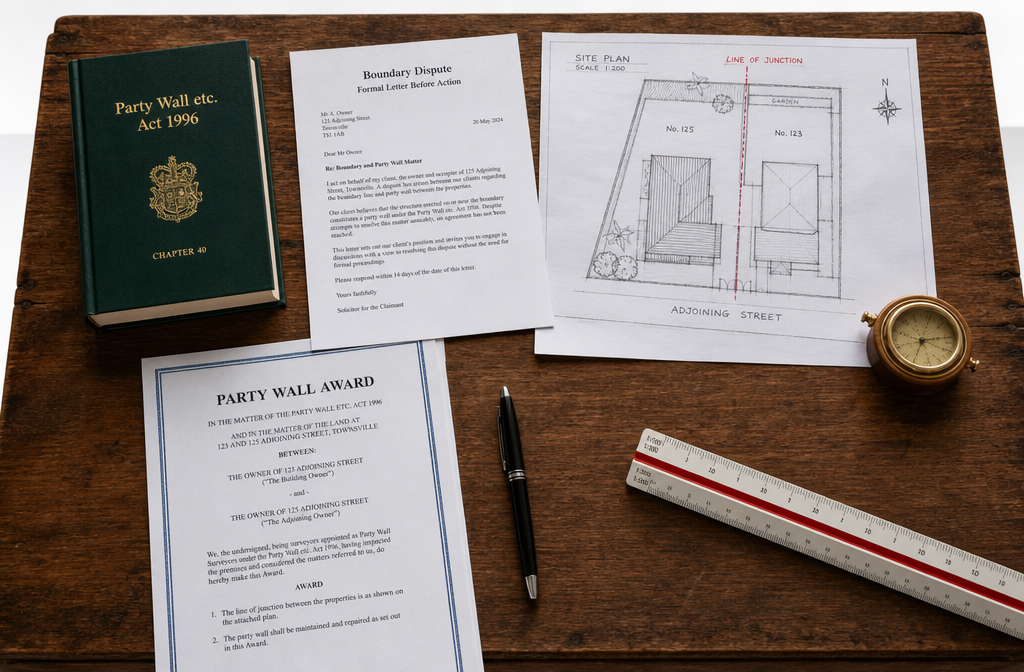
Before starting any boundary extension project, work through this checklist:
- Check the title deeds — confirm the exact position of the legal boundary, not just the fence line
- Identify the type of boundary structure — is it a party fence wall, a garden wall wholly on one side, or an undefined boundary?
- Assess the proposed works against Sections 1, 2, and 6 of the Act
- Calculate notice timelines — Section 1 requires 1 month; Sections 2 and 6 require 2 months
- Appoint a party wall surveyor early — ideally before the planning application is submitted
- Serve notices correctly — incorrect notices can be invalid, restarting the clock
- Prepare a Schedule of Condition of the adjoining property before works begin
- Keep records — retain all correspondence, notices, and awards throughout the project
Understanding how close a neighbour can build to your fence is equally important — the Act works both ways, and knowing your rights as an adjoining owner is just as valuable as knowing your duties as a building owner.
Common Myths About Boundary Extensions and Party Wall Law 🚫
Myth 1: "Permitted development means I don't need to worry about party walls."
False. Planning permission (or permitted development rights) and party wall compliance are entirely separate legal regimes. One does not substitute for the other.
Myth 2: "If my neighbour doesn't respond to the notice, I can just get on with it."
False. A failure to respond within 14 days is treated as a dissent, automatically triggering the dispute resolution process.
Myth 3: "The party wall surveyor works for me, so they'll protect my interests."
Partially false. A party wall surveyor acts impartially in the interests of both parties and the proper execution of the Act — not as an advocate for the building owner.
Myth 4: "I only need a party wall agreement if I'm building a big extension."
False. Even small works — raising a wall by a few courses, cutting a chase for a pipe — can be notifiable under the Act if they involve a party wall or party fence wall.
For those curious about party wall surveyor responsibilities, understanding the impartial nature of the role helps set realistic expectations from the outset.
Conclusion: Act Early, Build Confidently ✅
Domestic Extensions Built on the Boundary: When a Simple Fence Line Becomes a Party Wall Surveying Problem is a challenge that catches thousands of homeowners off guard every year in England and Wales. The gap between a physical fence and a legal boundary is where disputes are born — and where early professional advice pays dividends.
The Party Wall etc. Act 1996 is not a bureaucratic obstacle. It is a framework designed to allow construction to proceed while protecting the legitimate interests of neighbours. When used correctly — and early — it enables projects to move forward with confidence, clear records, and protected relationships.
Actionable Next Steps:
- Before designing your extension, instruct a surveyor to confirm the legal boundary position from the title deeds.
- At the design stage, ask your surveyor to assess party wall exposure and advise on notice requirements.
- Allow sufficient lead time — party wall notices require 1–2 months before work can begin.
- Appoint a qualified party wall surveyor rather than relying on the builder or architect to manage compliance.
- Serve notices properly — use a professional to draft and serve them, ensuring they are legally valid.
Taking these steps transforms a potential dispute into a straightforward process — and keeps a simple fence line from becoming an expensive problem.