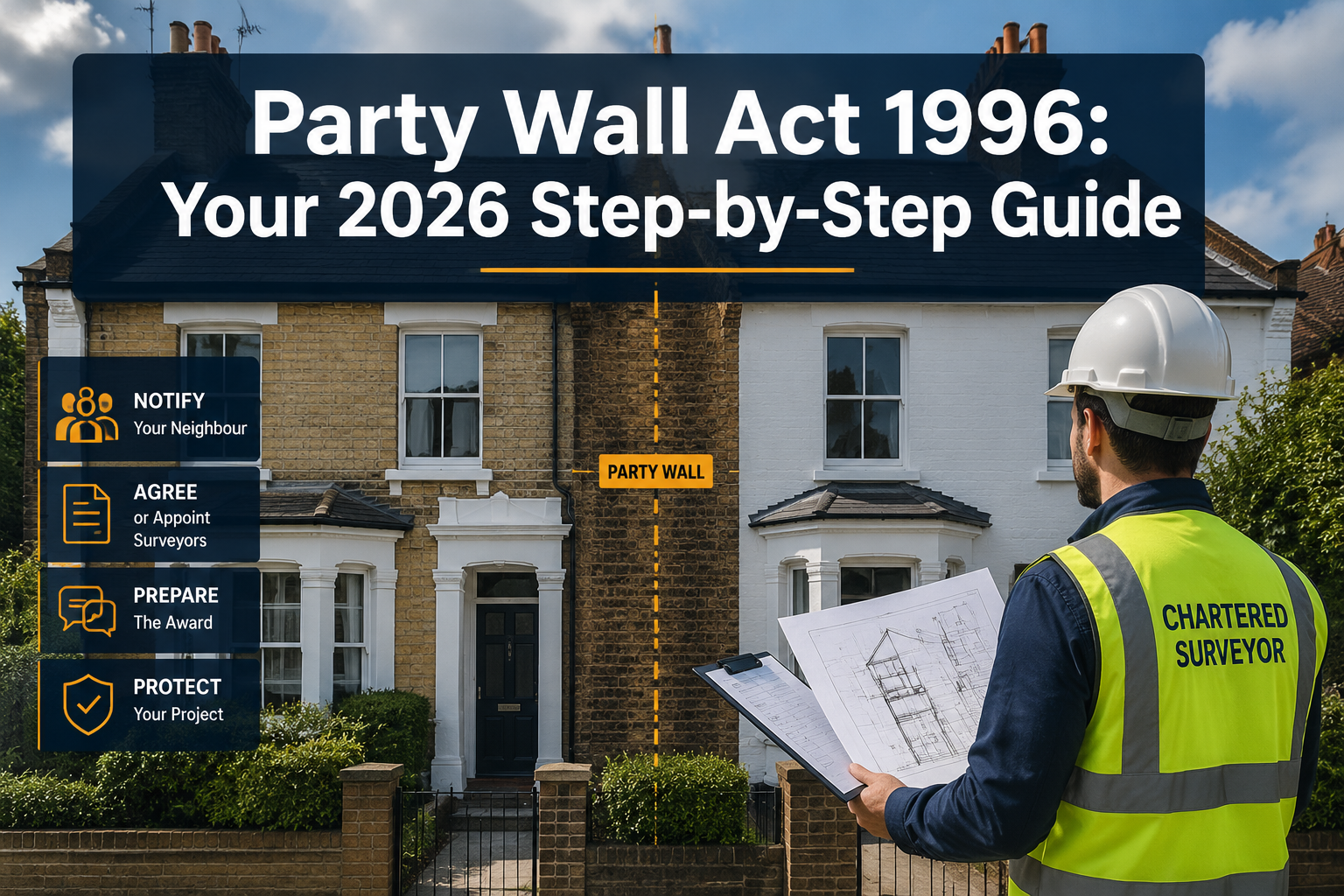
Nearly one in three UK homeowners who carry out building works adjacent to a shared boundary fail to serve the correct notices — exposing themselves to injunctions, costly delays, and legal liability. For anyone planning construction in 2026, the Party Wall Act 1996: Step-by-Step Guide to Notices, Awards, and Surveyor Models for 2026 Projects is not optional reading — it is essential protection.
This guide breaks down every stage of the statutory process, from identifying which notice applies to choosing the right surveyor model and understanding exactly what a Party Wall Award must contain.
Key Takeaways 📌
- The Party Wall etc. Act 1996 requires three distinct notice types depending on the nature of the works.
- Notice periods are statutory minimums — one or two months depending on the notice type.
- Neighbours have 14 days to respond; silence is treated legally as dissent, not consent.
- Two surveyor models exist: the Agreed Surveyor model (faster, cheaper) and the Two-Surveyor model (with a third surveyor on standby).
- The building owner pays all reasonable costs, including the adjoining owner's surveyor fees.
- A Party Wall Award typically takes four to six weeks to finalise after surveyors are appointed.
What Is the Party Wall etc. Act 1996?
The Party Wall etc. Act 1996 is a piece of UK legislation that provides a framework for preventing and resolving disputes between neighbours when one party intends to carry out building works that could affect a shared wall, boundary, or structure. It applies across England and Wales and covers three broad categories of work.
💡 Pull Quote: "The Act does not stop you from building — it ensures your neighbour's rights are protected while you do."
The Act is separate from planning permission and building regulations. A project can have full planning consent and still require compliance with the party wall process. For 2026 projects, understanding this distinction early prevents costly last-minute delays.
For a broader overview of how party wall agreements work in practice, see this guide to party wall agreements.
The Three Notifiable Work Types Explained
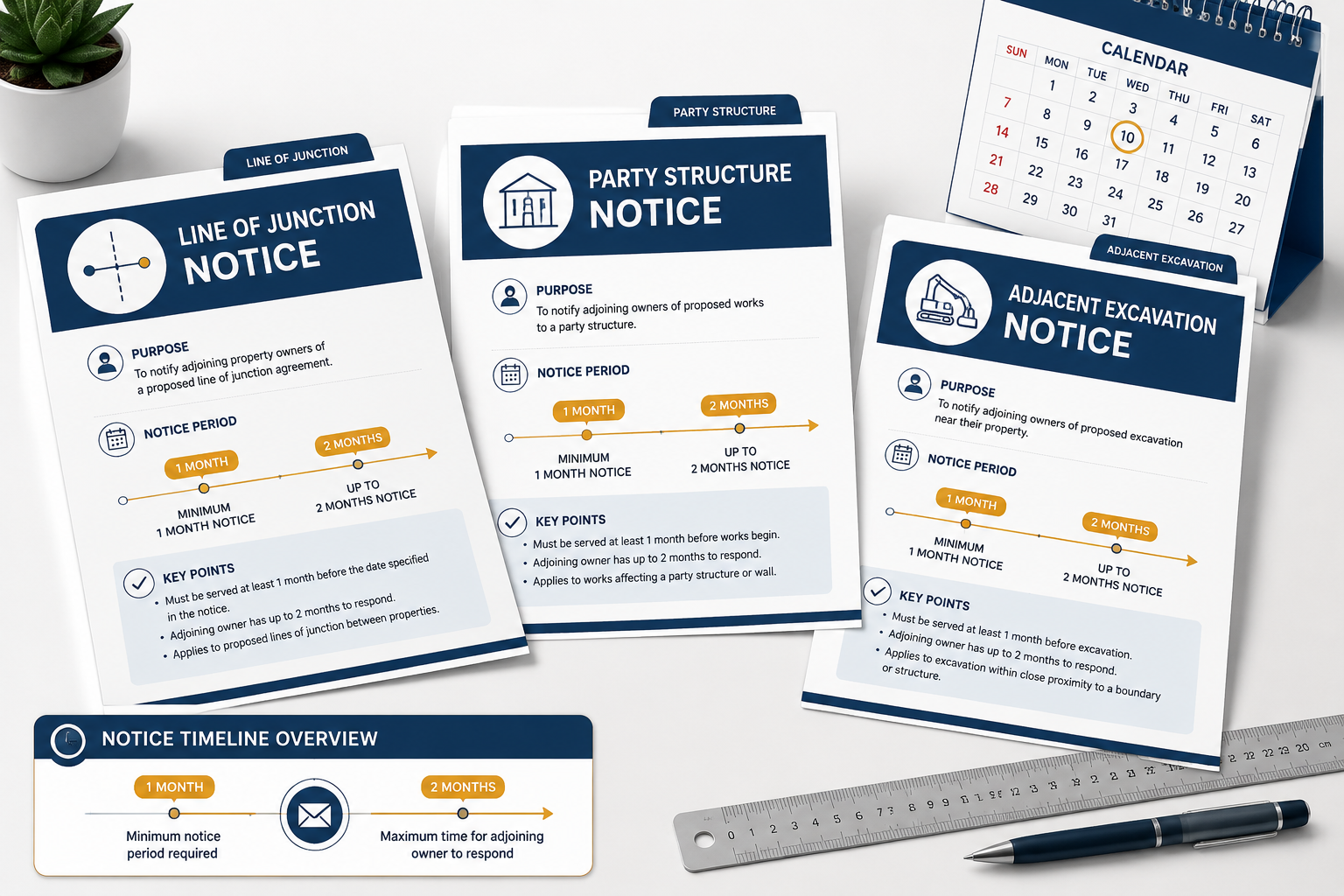
One of the most common sources of confusion — and legal risk — is not knowing which notice applies to which type of work. The Party Wall Act 1996 establishes three distinct notice categories [1]:
1. 🏗️ Party Structure Notice (Section 3)
This notice applies when work directly affects a shared wall or structure, such as:
- Cutting into a party wall to insert a steel beam
- Raising the height of a shared wall
- Demolishing and rebuilding a party wall
- Inserting a damp-proof course
Notice period required: 2 months before works begin [2].
2. 📐 Line of Junction Notice (Section 1)
This notice is required when a building owner intends to build on or near the boundary line between two properties, including building up to or astride the line of junction.
Notice period required: 1 month before works begin [2].
3. ⛏️ Adjacent Excavation Notice (Section 6)
This notice applies when excavation work is planned within 3 metres of a neighbouring structure (where the excavation goes deeper than the neighbour's foundations), or within 6 metres where the excavation line would cut a 45-degree plane drawn from the bottom of the neighbour's foundations.
Notice period required: 1 month before works begin [2].
Quick Reference Table: Notice Types at a Glance
| Notice Type | Section | Trigger | Notice Period |
|---|---|---|---|
| Party Structure Notice | Section 3 | Work on shared wall | 2 months |
| Line of Junction Notice | Section 1 | Building on/near boundary | 1 month |
| Adjacent Excavation Notice | Section 6 | Digging near foundations | 1 month |
The 14-Day Response Rule and Conditional Consents
Once a notice is served, the adjoining owner has 14 days to respond [7]. The response options are:
- ✅ Consent — Works may proceed without a formal Award (though a Schedule of Condition is still advisable)
- ❌ Dissent — Triggers the surveyor appointment process
- 🔇 No response (silence) — Legally treated as dissent, not consent [1]
Conditional Consents
Adjoining owners may also grant conditional consent — agreeing to the works subject to specific requirements, such as:
- Restricting working hours
- Requiring protective measures for their property
- Requesting notification before certain stages of work begin
Conditional consents are not formally part of the Act's dispute resolution framework but are increasingly common in 2026 practice, particularly in densely built urban areas. If conditions cannot be agreed, the matter reverts to the formal surveyor appointment process.
Important: Notices have a validity period of 12 months from the date of service. If works do not commence within that window, a fresh notice must be served [7].
Agreed Surveyor vs. Two-Surveyor Model: Choosing the Right Approach

When dissent is recorded — or silence is treated as dissent — both parties must appoint surveyors. The Party Wall Act 1996 offers two distinct surveyor models, each with different cost and timeline implications.
🤝 The Agreed Surveyor Model
Both the building owner and the adjoining owner jointly appoint a single surveyor to act impartially for both parties [6].
Advantages:
- Significantly lower cost (one set of fees rather than two)
- Faster Award preparation
- Reduced risk of surveyor disagreement
Considerations:
- Requires mutual trust in the surveyor's impartiality
- Either party can withdraw consent and appoint their own surveyor at any time
For straightforward projects with cooperative neighbours, this is often the most efficient route. Many expert party wall surveyors in London are experienced in acting as Agreed Surveyors.
⚖️ The Two-Surveyor Model
Each party appoints their own independent surveyor. The two surveyors then work together to produce the Party Wall Award.
Advantages:
- Each party has dedicated representation
- Clearer advocacy for each owner's specific interests
Considerations:
- Higher overall cost (building owner pays both sets of fees) [2]
- Greater potential for disagreement, which may require a third surveyor
The Third Surveyor: Statutory Dispute Resolution
Under Section 10 of the Act, both parties must jointly select a third surveyor at the time of initial appointments — not during a dispute [2]. This is a critical procedural requirement that many overlook.
The third surveyor is called upon when:
- The two appointed surveyors reach deadlock on award terms
- There is a fee dispute or scope disagreement
- One surveyor fails to engage within a reasonable timeframe
⚠️ Key Point: The third surveyor operates under statutory powers from the Party Wall Act 1996 — not under the Arbitration Act 1996. Their written determination is binding on the specific matter referred, without requiring a formal hearing [2].
Step-by-Step: The Statutory Process from Notice to Works
The legally mandated workflow under the Party Wall Act 1996 follows a clear sequence [1]:
Step 1 — Serve the Correct Notice
The building owner (or their surveyor) serves the appropriate notice with full details of the proposed works, including drawings where relevant.
Step 2 — Neighbour Response (14-Day Window)
The adjoining owner consents, dissents, or fails to respond (treated as dissent).
Step 3 — Surveyor Appointments
In cases of dissent, each party appoints a surveyor. The third surveyor is also jointly selected at this stage.
Step 4 — Property Survey and Schedule of Condition
Surveyors inspect the adjoining property and document its existing condition in a Schedule of Condition — a photographic and written record that serves as the baseline for any future damage claims [3].
Step 5 — Party Wall Award Drafted and Signed
The surveyors prepare and sign the Award. This typically takes four to six weeks beyond the original notice period [2].
Step 6 — Works Begin
Works commence in accordance with the Award's terms.
Timeline Summary
Notice Served
    ↓ 14 days
Neighbour Response
    ↓ (if dissent)
Surveyor Appointments + Third Surveyor Selected
    ↓ 4–6 weeks
Schedule of Condition + Award Drafted
    ↓
Award Signed → Works Begin
What Must a Party Wall Award Contain?
A Party Wall Award is a legally binding document. For 2026 projects, surveyors must ensure the Award includes all mandatory elements [1][3]:
Essential Award Components ✅
| Element | Purpose |
|---|---|
| Property and owner details | Identifies both parties and their properties |
| Description of proposed works | Defines the exact scope covered by the Award |
| Surveyor appointments and signatures | Confirms authority and legal validity |
| Schedule of Condition | Baseline record of pre-works property state |
| Rights and responsibilities | Clarifies obligations of both parties |
| Working hours | Restricts noisy or disruptive work to agreed times |
| Access arrangements | Permits surveyors/contractors to enter adjoining property |
| Safety measures | Protective requirements during works |
| Damage and dispute resolution procedures | Process for raising and resolving claims post-works |
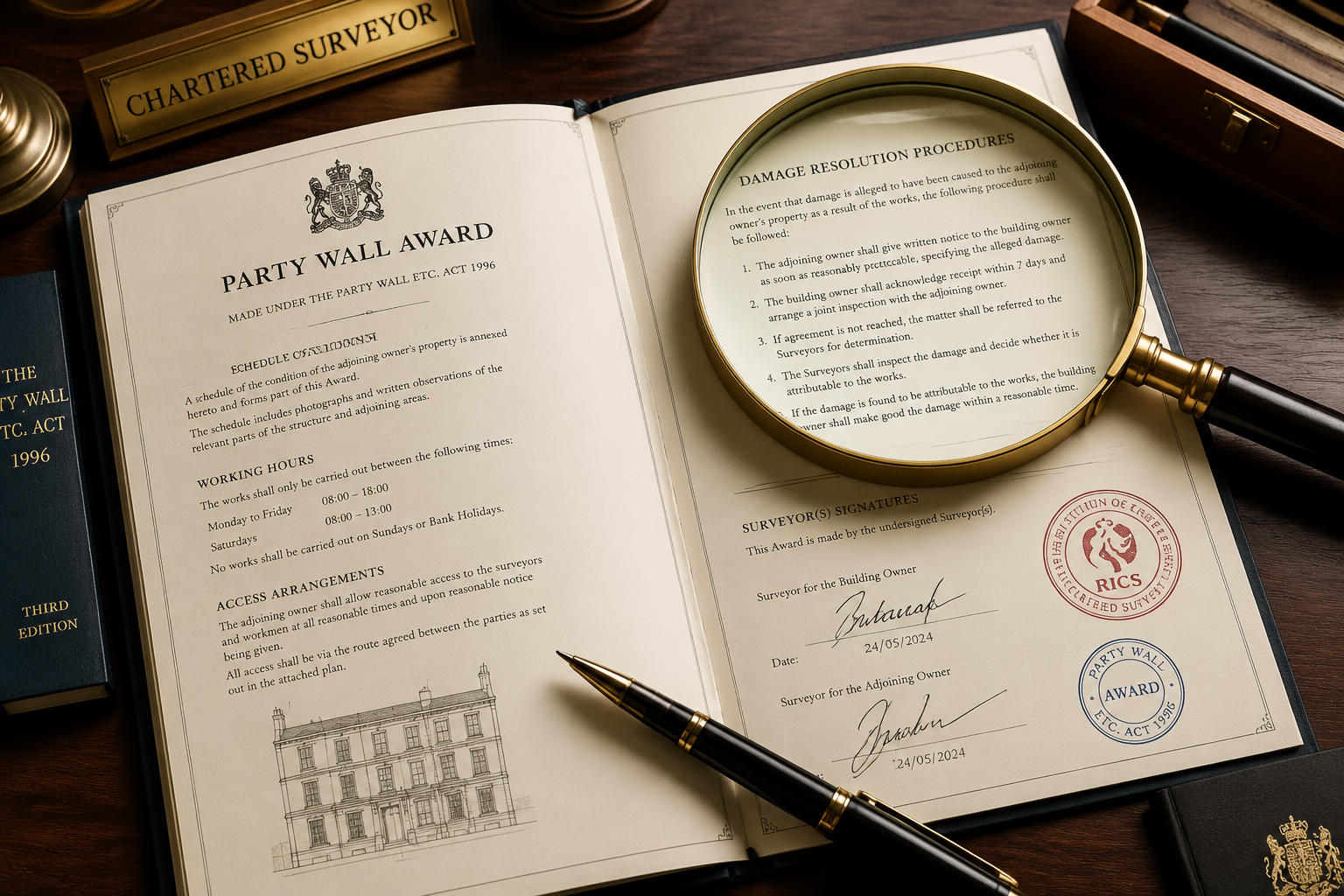
Working Hours: A Critical Safeguard
The specification of permitted working hours is one of the most practically significant elements of any Award. Standard provisions typically restrict noisy works to:
- Monday to Friday: 8:00am – 6:00pm
- Saturday: 8:00am – 1:00pm
- Sundays and Bank Holidays: No noisy works
These restrictions protect adjoining owners from unreasonable disruption and are enforceable under the Award's terms.
The Schedule of Condition
The Schedule of Condition is arguably the most important document for protecting both parties after works complete [3]. It records:
- Existing cracks, settlement, or structural issues
- The condition of walls, ceilings, floors, and external surfaces
- Photographic evidence with timestamps
Without a Schedule of Condition, it becomes extremely difficult to attribute post-works damage to the building works rather than pre-existing conditions.
Who Pays? Understanding Party Wall Costs in 2026
The building owner bears all reasonable party wall costs [2], including:
- Their own surveyor's fees
- The adjoining owner's surveyor's fees
- Award preparation costs
- Third surveyor fees (if applicable)
- Land Registry search fees (currently £8 per search per property) for identifying legal owners and leaseholders [2]
Party Wall Awards typically start at upwards of £1,000, with costs rising for complex schemes involving multiple properties or excavation works [3].
For a detailed breakdown of what to expect, see this resource on party wall agreement costs.
Cost-Saving Tip 💰
Opting for the Agreed Surveyor model reduces overall fees to a single set cost rather than two separate surveyor bills. For straightforward loft conversions or single-wall projects, this can represent a significant saving.
Common Pitfalls and How to Avoid Them in 2026
❌ Incomplete Documentation
Incomplete architectural drawings or structural engineering details are the single biggest cause of Award delays [2]. Surveyors cannot assess impact without full plans. Submit complete documentation from the outset.
❌ Serving the Wrong Notice
Serving a Line of Junction Notice when a Party Structure Notice is required — or vice versa — invalidates the process and restarts the clock. Always confirm the correct notice type with a qualified surveyor before serving.
❌ Assuming Silence Means Consent
Many building owners proceed after receiving no response, assuming tacit agreement. Under the Act, silence always means dissent [1]. Proceeding without an Award in this scenario creates significant legal exposure.
❌ Not Selecting the Third Surveyor Upfront
Failing to jointly select a third surveyor at the time of initial appointments — rather than during a dispute — is a procedural error that can stall the entire process [2].
❌ Starting Works Before the Award is Signed
Works must not commence until the Award is formally signed and served. Starting early can result in an injunction to stop works, regardless of how far along they are.
For guidance on boundary disputes and related neighbour issues, additional specialist advice may be needed alongside the party wall process.
Working with RICS-qualified surveyors ensures compliance with both the Act's requirements and professional standards throughout.
Applying the Party Wall Act 1996: Step-by-Step Guide to Notices, Awards, and Surveyor Models for 2026 Projects in Practice
To bring this together, consider a typical 2026 London scenario: a homeowner in a terraced property plans a rear extension requiring excavation within 3 metres of the neighbour's foundations and work on the shared party wall.
This project triggers two notices:
- A Party Structure Notice (Section 3) — 2-month notice period
- An Adjacent Excavation Notice (Section 6) — 1-month notice period
The building owner serves both notices simultaneously. The neighbour dissents. Both parties appoint surveyors; the Agreed Surveyor model is rejected by the neighbour, so two separate surveyors are appointed and a third surveyor is jointly selected.
The surveyors conduct a Schedule of Condition survey, review the structural drawings, and produce an Award within five weeks. The Award specifies working hours, protective hoarding requirements, and a clear process for reporting any cracking to the neighbour's rear wall.
Works begin on schedule — protected, documented, and legally compliant.
For projects across London, specialist support is available from property surveyors in Merton, Camden, Fulham, and many other boroughs.
Conclusion: Actionable Next Steps for 2026 Projects 🏁
The Party Wall Act 1996: Step-by-Step Guide to Notices, Awards, and Surveyor Models for 2026 Projects makes clear that compliance is not bureaucratic box-ticking — it is genuine legal protection for both building owners and their neighbours.
Here is what to do before breaking ground in 2026:
- Identify the correct notice type(s) for your specific works using the table above.
- Serve notices at the right time — remember the 2-month period for Party Structure Notices.
- Prepare complete drawings and structural details before serving notices to avoid Award delays.
- Discuss the Agreed Surveyor model with your neighbour early — it saves time and money.
- Jointly select a third surveyor at the same time as initial appointments, not later.
- Never start works until the Award is signed and served.
- Retain the Schedule of Condition throughout and after the project.
Engaging a qualified, experienced party wall surveyor from the outset is the single most effective way to keep a 2026 project on time, on budget, and free from neighbour disputes.
References
[1] Difference Between Party Wall Notices And Awards – https://www.partywallslimited.com/blog/difference-between-party-wall-notices-and-awards
[2] Party Wall Dispute – https://onlinearchitecturalservices.com/party-wall-dispute/
[3] What Is A Party Wall Agreement And Party Wall Award – https://westvilleassociates.com/blog/what-is-a-party-wall-agreement-and-party-wall-award
[4] Sample Party Wall Documents – https://collier-stevens.co.uk/resources/sample-party-wall-documents/
[5] Party Wall Surveys For Infrastructure Projects 2026 Protocols In High Demand Regions Like Staffordshire – https://nottinghillsurveyors.com/blog/party-wall-surveys-for-infrastructure-projects-2026-protocols-in-high-demand-regions-like-staffordshire
[6] The Agreed Surveyor How To Save Time And Money On Your Party Wall Award – https://www.partywallslimited.com/blog/the-agreed-surveyor-how-to-save-time-and-money-on-your-party-wall-award
[7] When How Tell Them – https://www.gov.uk/party-walls-building-works/when-how-tell-them