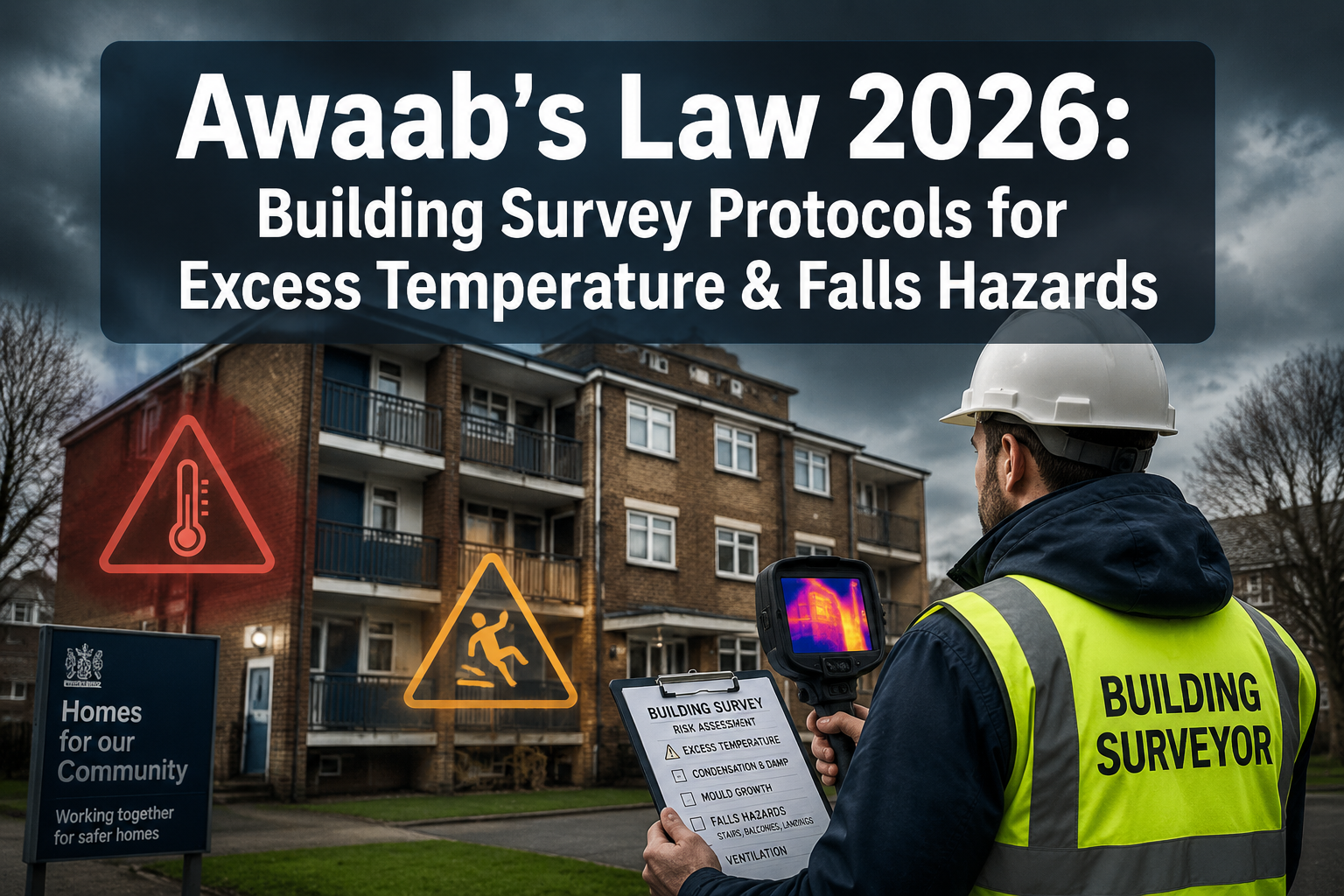
Over 10,000 social housing tenants in England report excess cold or heat hazards annually — yet until 2026, landlords faced no statutory deadline to act on them. That changes with the October 2026 Phase 2 expansion of Awaab's Law, which brings building survey protocols for excess temperature and falls hazards into the same enforceable framework that already governs damp and mould. For building surveyors, housing associations, and local authorities, this shift demands updated assessment methods, new documentation standards, and a broader understanding of the Housing Health and Safety Rating System (HHSRS).
This guide explains what the 2026 expansion covers, how surveyors must adapt their protocols, and what practical steps landlords and professionals need to take now.
Key Takeaways 📋
- Awaab's Law Phase 2 takes effect October 2026, extending mandatory hazard response timelines beyond damp and mould to include excess cold/heat, falls, fire, electrical hazards, and structural collapse [1]
- Falls hazards now covered include risks on stairs, baths, level surfaces, and between levels — requiring specific structural and design assessments [3]
- The HHSRS framework underpins all Phase 2 hazards, meaning surveyors already familiar with this system can adapt existing skills to the expanded scope [5]
- Repair and maintenance data must be treated as a compliance intelligence asset, shifting organisations from reactive complaint handling to proactive hazard identification [2]
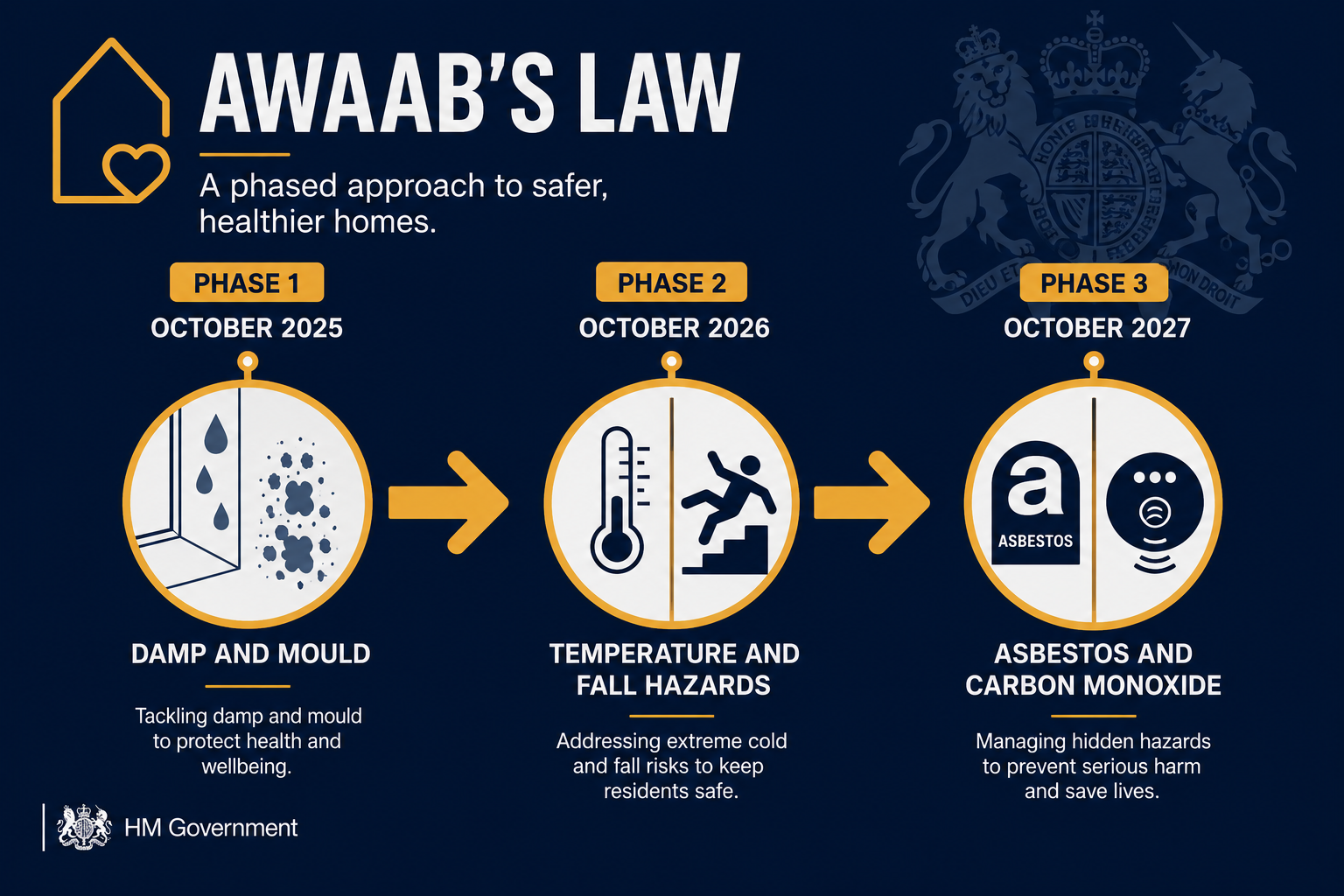
- Phase 3 (October 2027) will add asbestos, carbon monoxide, and fuel combustion products — making early protocol investment now a long-term compliance strategy [5]
What Awaab's Law Phase 2 Actually Covers in 2026
Named after two-year-old Awaab Ishak, who died in 2020 from respiratory complications caused by prolonged exposure to damp and mould in his social housing flat, Awaab's Law was born from a systemic failure to protect tenants [6]. Phase 1, which came into force on 27 October 2025, established enforceable statutory timeframes requiring landlords to investigate emergency hazards within 24 hours [2].
Phase 2, scheduled for October 2026, dramatically expands this scope. The seven hazard categories now entering the statutory compliance framework are [1]:
| Hazard Category | Examples |
|---|---|
| Excess Cold | Inadequate insulation, broken heating systems |
| Excess Heat | Poor ventilation, no cooling provision |
| Falls on Stairs | Worn nosings, inadequate handrails |
| Falls on Level Surfaces | Uneven flooring, slippery tiles |
| Falls Between Levels | Balcony barriers, window fall risks |
| Falls in/from Baths | Grab rail absence, slippery surfaces |
| Structural Collapse | Foundation defects, subsidence |
💬 "A significant hazard is one presenting a significant risk of harm to a tenant's health or safety — a risk that a reasonable landlord would treat as requiring urgent action." — Hazards in Social Housing (Prescribed Requirements) (England) Regulations 2025 [5]
This "significant harm risk" legal test is critical. It removes subjective landlord interpretation and replaces it with an objective standard. Surveyors must now document not just the presence of a defect, but its likelihood of causing harm and the severity of that potential harm — language directly borrowed from HHSRS methodology [5].
The law is delivered through the Hazards in Social Housing (Prescribed Requirements) (England) Regulations 2025, made under Section 42 of the Social Housing (Regulation) Act 2023, giving enforcement bodies statutory authority to impose fines and penalties [5].
Building Survey Protocols for Excess Temperature and Falls Hazards: Awaab's Law 2026 Expansion Beyond Damp and Mould — The Assessment Framework
Adapting survey protocols to meet the Phase 2 requirements means integrating HHSRS hazard assessment logic into standard building inspection workflows. This is not a separate process — it is an extension of existing Level 3 survey methodology applied to a broader set of risk categories.
Excess Temperature: Cold and Heat Assessment Protocols 🌡️
Both excess cold and excessive heat are now recognised as serious hazards requiring statutory investigation and response timelines [4]. This moves the profession beyond reactive boiler repair calls into proactive thermal performance assessment.
Key assessment checks for excess cold:
- U-values of walls, roofs, and floors against current Building Regulations standards
- Condition and continuity of insulation (loft, cavity wall, underfloor)
- Heating system capacity relative to room volume and orientation
- Presence of thermal bridging at junctions (window reveals, floor/wall junctions)
- Draught sealing at doors, windows, and service penetrations
Key assessment checks for excess heat:
- Ventilation provision (natural and mechanical) in south-facing rooms
- Solar gain through glazing, particularly in flats with limited opening windows
- Roof space insulation and ventilation preventing heat transfer into living spaces
- Evidence of overheating complaints in maintenance records
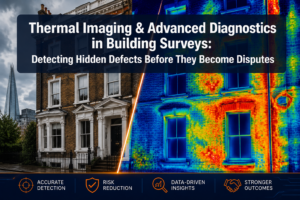
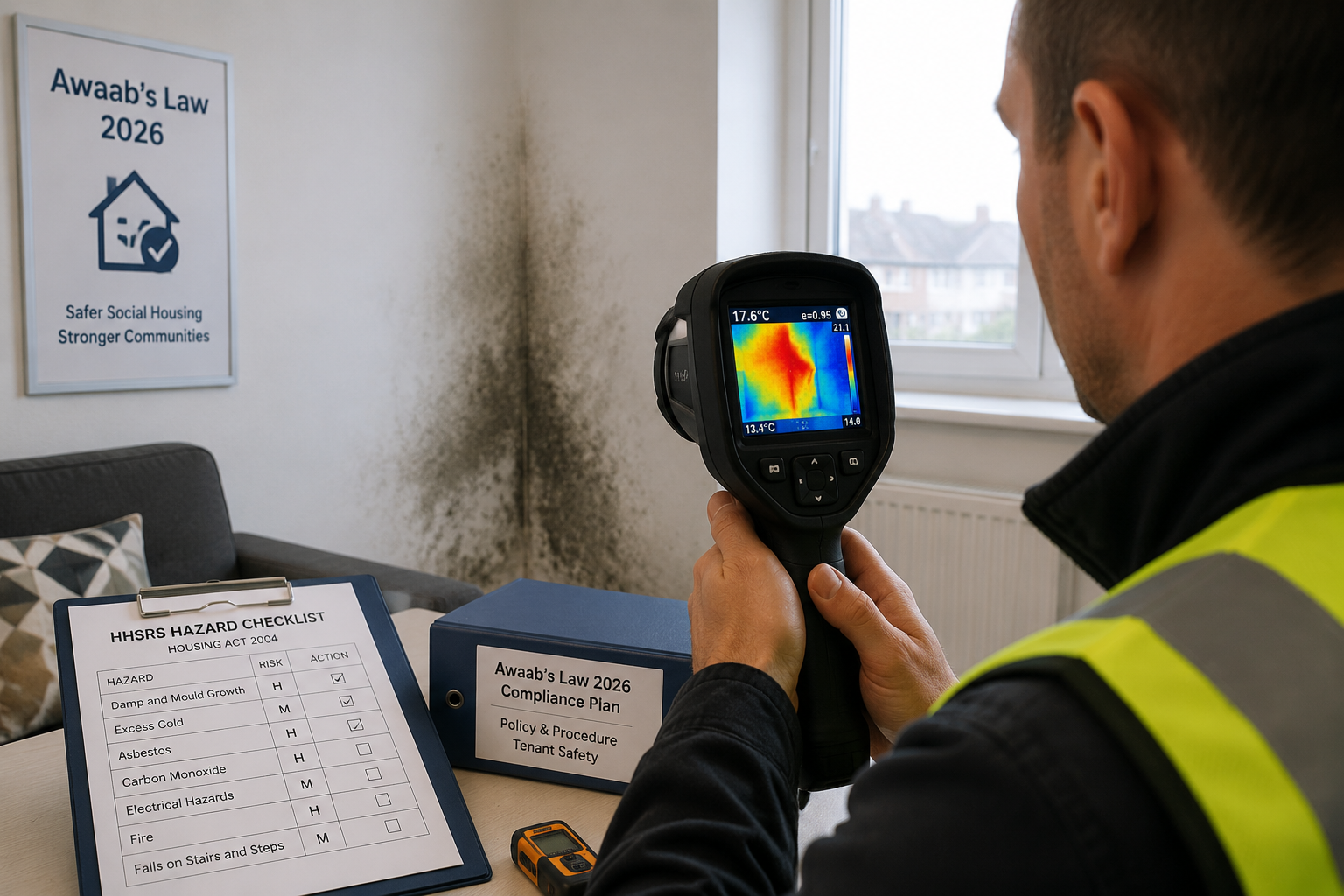
⚠️ Pro tip: Thermal imaging cameras are no longer optional equipment for compliance-grade surveys. They provide documented evidence of cold bridging, insulation voids, and heat loss pathways that written descriptions alone cannot adequately capture.
Surveyors should cross-reference physical findings with the property's Energy Performance Certificate (EPC) rating and any existing stock condition data. Organisations must now treat repair and maintenance data as a compliance intelligence asset, using patterns in reported heating failures and cold complaints to identify systemic hazards before serious incidents occur [2].
For properties requiring detailed thermal assessment, a stock condition survey provides the structured framework to capture portfolio-wide temperature hazard data efficiently.
Falls Hazards: Structural and Design Assessment Protocols 🚶
Falls hazards in Phase 2 specifically target stairs, baths, level surfaces, and falls between levels [3]. These categories require surveyors to assess both structural condition and design adequacy — a distinction that matters legally.
Staircase assessment checklist:
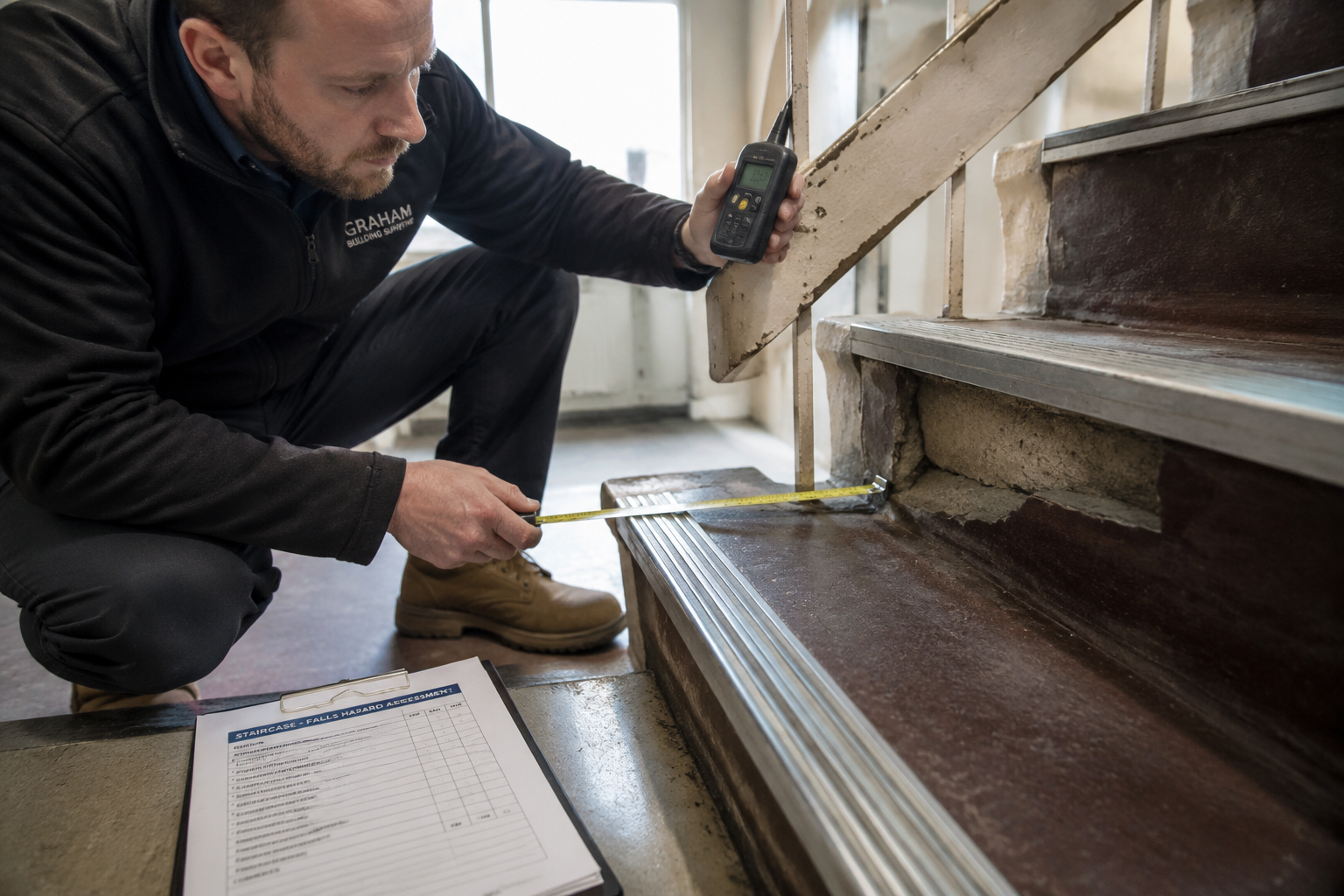
- ✅ Tread depth and riser height consistency (Building Regulations Part K)
- ✅ Condition of stair nosings (worn, loose, or missing)
- ✅ Handrail continuity, height (900mm–1000mm), and fixing security
- ✅ Balustrade infill spacing (max 100mm to prevent child entrapment)
- ✅ Headroom clearance (minimum 2m)
- ✅ Lighting adequacy at all stair levels
Level surface assessment checklist:
- ✅ Floor surface evenness (use spirit level; record deviations >3mm over 1m)
- ✅ Threshold transitions between different floor materials
- ✅ Slip resistance of wet-area flooring (bathrooms, kitchens)
- ✅ Condition of external paths, steps, and ramps
Falls between levels (balconies, windows, landings):
- ✅ Balcony barrier height (minimum 1100mm for residential)
- ✅ Climbability of barrier design (horizontal rails create footholds)
- ✅ Window restrictor presence in rooms above ground floor
- ✅ Mezzanine and gallery edge protection
For bath/shower falls, surveyors should note the absence of grab rails, assess bath surround stability, and record floor surface slip resistance. These findings must be documented with photographs and measurements — not just narrative descriptions.
Understanding the difference between Level 2 and Level 3 surveys is essential here: falls hazard documentation to Awaab's Law standard requires the depth of investigation that only a Level 3 building survey delivers.
Integrating Phase 2 Protocols into Existing Survey Workflows
The practical challenge for surveyors and housing organisations is not understanding what to look for — it is embedding these checks systematically into existing workflows without creating parallel bureaucracies.
Updating Survey Templates and Reporting Standards
Standard survey report templates need updating to include dedicated sections for:
- Thermal performance findings (with thermal image attachments)
- Falls hazard register (categorised by type: stairs, level, between levels, bath)
- HHSRS hazard scoring for each identified risk
- Compliance status relative to Awaab's Law Phase 2 thresholds
- Recommended remediation timeline (emergency/24hr, urgent/within 7 days, routine)
The HHSRS scoring methodology — already familiar to local authority environmental health officers — provides the severity classification system that underpins Phase 2 enforcement [5]. Surveyors who are not yet proficient in HHSRS scoring should treat upskilling in this area as an immediate priority.
A specific defect survey can be commissioned to focus exclusively on identified falls or temperature hazards, providing targeted documentation for compliance purposes without the full cost of a whole-property assessment.
Staff and Contractor Training Requirements 🎓
Awaab's Law Phase 2 compliance is not solely a surveyor responsibility. Social housing organisations must now train frontline staff, surveyors, and contractors to recognise excess temperature hazards and falls risks in everyday repair reports [2]. This means:
- Repairs operatives flagging thermal comfort complaints as potential hazard triggers
- Housing officers recognising falls risk indicators during routine property visits
- Call centre staff applying triage protocols that distinguish routine repairs from potential Awaab's Law-triggering hazards
The transition from specialised damp/mould expertise to holistic building assessment requires investment in training programmes aligned with HHSRS hazard categories. Organisations that invested early in damp and mould training for Phase 1 have a template to follow — but the broader hazard scope of Phase 2 demands wider staff engagement.
Using Repair Data as a Compliance Tool 📊
One of the most significant operational shifts required by Phase 2 is treating repair and maintenance records as compliance intelligence [2]. Patterns in reported data can reveal systemic hazards:
- Multiple heating failure reports in a block → potential excess cold hazard requiring investigation
- Repeated slip/trip reports from a specific staircase → falls hazard requiring formal HHSRS assessment
- Cluster of overheating complaints in top-floor flats → excess heat hazard requiring ventilation review
Organisations should implement data review protocols — ideally quarterly — that scan repair logs for hazard patterns triggering Phase 2 investigation requirements. This predictive approach is far less costly than responding to enforcement action after a serious incident.
For landlords and surveyors working across London, resources like building surveyor services can support compliance-grade assessments across diverse property types.
The Broader Awaab's Law Timeline: Planning Beyond 2026
Understanding Phase 2 in isolation misses the strategic picture. The full legislative timeline is [1][5]:
| Phase | Date | Hazards Covered |
|---|---|---|
| Phase 1 | October 2025 | Damp and mould |
| Phase 2 | October 2026 | Excess cold/heat, falls, fire, electrical, structural collapse |
| Phase 3 | October 2027 | All remaining HHSRS hazards (excl. overcrowding) incl. asbestos, CO |
Phase 3 in October 2027 will bring asbestos, carbon monoxide, fuel combustion products, and other HHSRS hazards into statutory scope [5]. Organisations that build robust survey protocols now — rather than scrambling to comply with each phase individually — will be significantly better positioned.
💡 Strategic insight: The investment in updating survey templates, training staff, and implementing data review processes for Phase 2 creates the infrastructure that Phase 3 compliance will also require. Build once, use repeatedly.
For properties where multiple hazard categories may be present, a comprehensive home survey level 3 provides the most thorough baseline assessment against which future compliance monitoring can be measured.
Practical Documentation Standards for Awaab's Law Phase 2 Compliance
Surveyors producing reports intended to demonstrate Awaab's Law compliance should follow these documentation principles:
📸 Photographic evidence:
Every identified hazard must be photographed with a scale reference. Temperature readings should be captured on thermal imaging displays. Falls hazard measurements (handrail height, tread dimensions) should be photographed alongside a tape measure.
📝 Narrative precision:
Avoid vague language. Instead of "staircase in poor condition," write: "Three stair nosings on the upper flight (treads 4, 7, and 9) are worn to less than 5mm depth, presenting a significant trip hazard. Handrail is secure but terminates 300mm short of the bottom newel post."
⏱️ Remediation prioritisation:
Each hazard must be assigned a remediation urgency category consistent with the Awaab's Law response framework:
- Emergency (24 hours): Immediate risk of serious harm
- Urgent (within 7 days): Significant hazard requiring prompt action
- Routine: Hazard present but risk manageable within planned maintenance
🔗 HHSRS cross-referencing:
Link each finding to its corresponding HHSRS hazard category and likelihood/severity score. This creates a legally defensible audit trail demonstrating that the "significant harm risk" test was applied objectively [5].
For landlords seeking to understand how survey findings translate into negotiating power or remediation priorities, guidance on average price reduction after survey illustrates how documented defects carry real financial weight.
Conclusion: Acting Now on Awaab's Law 2026 Expansion
Building survey protocols for excess temperature and falls hazards under Awaab's Law 2026 expansion beyond damp and mould represent the most significant shift in social housing safety assessment in a generation. The October 2026 deadline is not a distant horizon — it is a present operational challenge requiring immediate action on survey templates, staff training, and data management systems.
Actionable next steps for surveyors and housing organisations:
- Audit current survey templates — add dedicated sections for thermal performance and falls hazard assessment aligned with HHSRS scoring
- Invest in thermal imaging equipment — thermal cameras are now essential tools for compliance-grade temperature hazard documentation
- Train all frontline staff — not just surveyors, but repairs operatives and housing officers who may first encounter Phase 2 hazard indicators
- Implement quarterly repair data reviews — scan maintenance logs for hazard patterns triggering Phase 2 investigation requirements
- Commission Level 3 surveys for properties with known or suspected temperature or falls hazards before the October 2026 deadline
- Begin Phase 3 planning now — the infrastructure built for Phase 2 compliance will serve as the foundation for the 2027 expansion
The law named after Awaab Ishak exists because systemic failures — not isolated oversights — cost a child his life. The 2026 expansion is an opportunity to build survey and compliance systems that make such failures structurally impossible. That work starts with protocols, and it starts now.
References
[1] Awaabs Law Timeline – https://www.glplaw.com/2026/01/23/awaabs-law-timeline/
[2] Awaabs Law Phase 2 Is Coming What Social Landlords Need To Know About Additional Hazard Compliance In 2026 – https://www.mobysoft.com/resources/blogs/awaabs-law-phase-2-is-coming-what-social-landlords-need-to-know-about-additional-hazard-compliance-in-2026/
[3] Awaabs Law Policy Web Version 10 – https://www.southernhousing.org.uk/media/cxvlllnp/awaabs-law-policy-web-version-10.pdf
[4] Awaabs Law 2026 A Complete Guide – https://prbge.co.uk/awaabs-law-2026-a-complete-guide/
[5] How Awaabs Law Will Be Stress Tested In 2026 – https://theintermediary.co.uk/2026/02/how-awaabs-law-will-be-stress-tested-in-2026/
[6] Awaabs Law Technical Compliance Hvac Ventilation – https://www.arm-environments.com/resources/awaabs-law-technical-compliance-hvac-ventilation