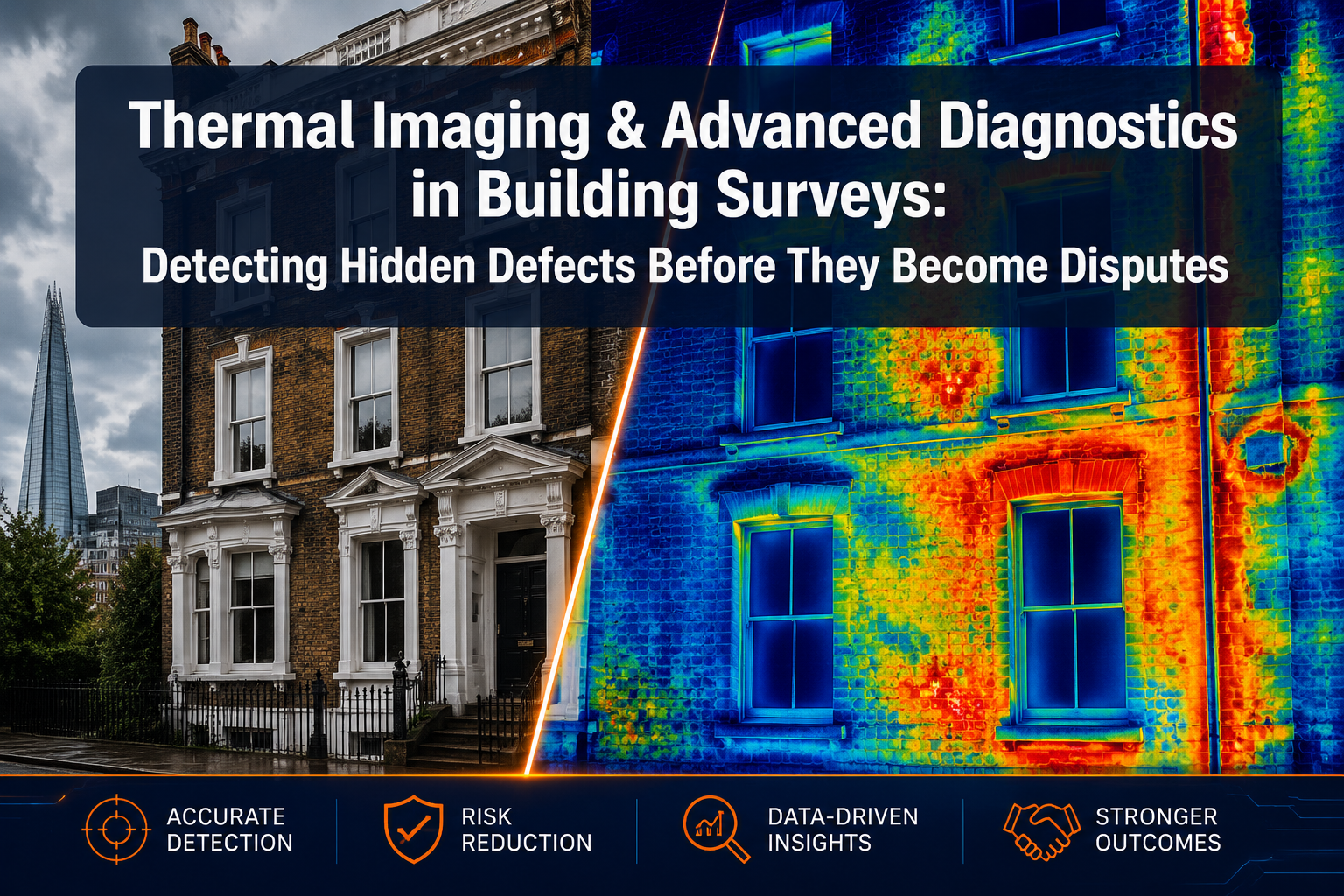
Nearly one in three property transactions in the UK stalls or collapses after a survey reveals unexpected defects — defects that a standard visual inspection simply cannot see. As buyer caution intensifies in Q2 2026, the gap between what the naked eye observes and what advanced diagnostic technology uncovers has never been more commercially significant. Thermal imaging and advanced diagnostics in building surveys: detecting hidden defects before they become disputes is no longer a specialist niche — it is fast becoming the benchmark for professional property assessment.
Key Takeaways 📋
- Thermal imaging reveals what visual surveys miss — moisture, heat loss, and structural anomalies hidden behind finished surfaces
- Early detection prevents disputes — identifying defects pre-exchange reduces transaction fall-throughs and costly legal conflicts
- Wet insulation conducts heat faster than dry, making thermographic roof scans a reliable early-warning system for leaks [4]
- Drone-mounted thermal sensors now enable large-scale façade and rooftop surveys safely and efficiently [1]
- Commercial case studies show up to 18% energy usage reductions when infrared scans target high-loss areas before retrofit works [1]
Why Visual Inspection Alone Is No Longer Enough
A surveyor's trained eye remains invaluable. But walls don't reveal their secrets willingly. Damp lurking behind plasterboard, insulation voids concealed by a fresh coat of paint, or a slowly failing roof membrane — none of these announce themselves visually until significant damage has already occurred.
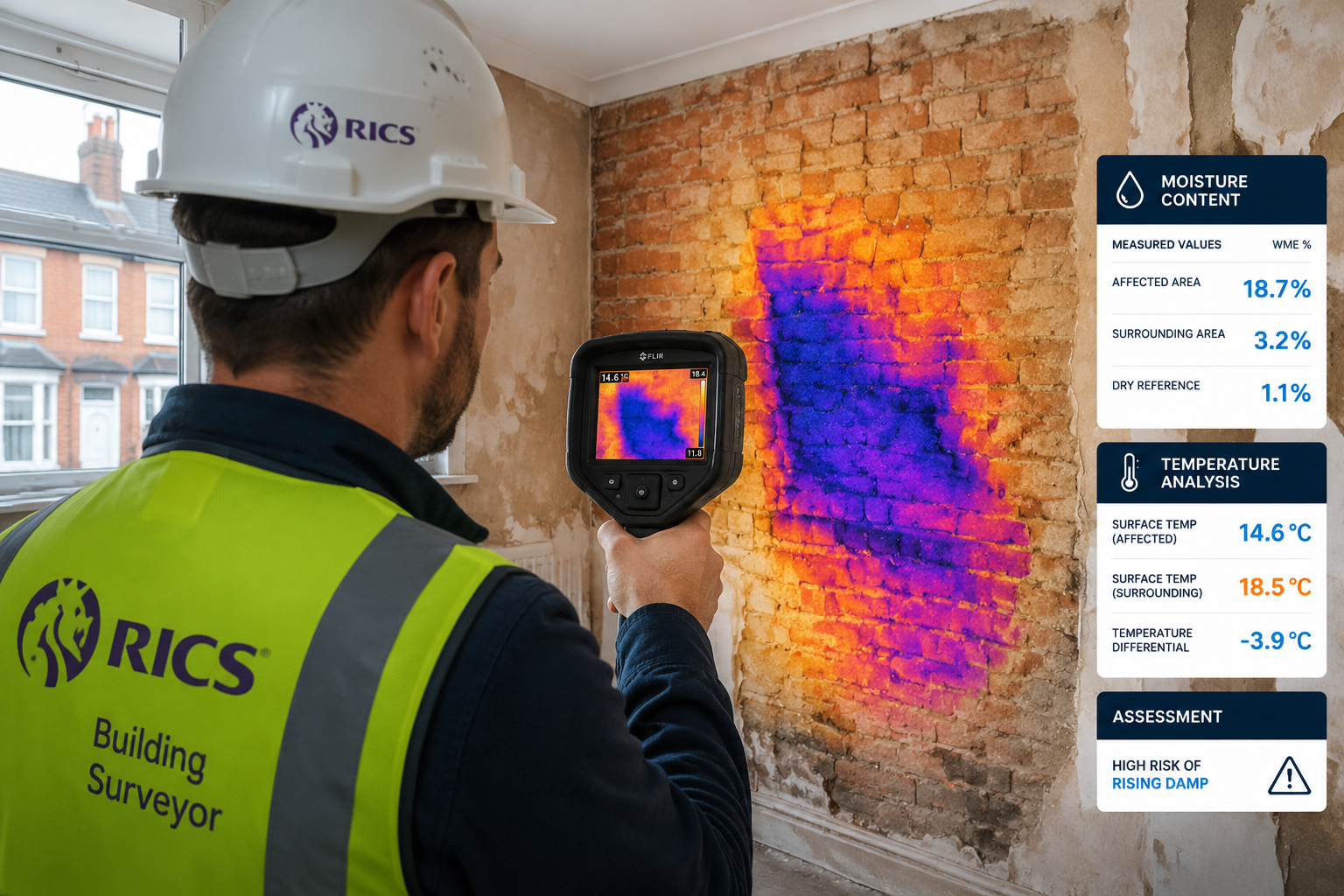
This is the core problem that thermal imaging and advanced diagnostics in building surveys are designed to solve. Thermographic inspection works on a straightforward physical principle: different materials and moisture levels emit heat at different rates. A high-resolution infrared camera captures these temperature differentials as a false-colour image, turning invisible problems into visible evidence [2].
💡 Pull Quote: "The most expensive defects are the ones nobody saw coming — thermal imaging changes that equation entirely."
For buyers, sellers, and surveyors alike, this matters enormously. A structural defects survey that incorporates thermographic data doesn't just describe what a surveyor can see — it documents what the building is telling us through heat signatures.
What Thermal Imaging Actually Detects
The primary application categories for thermographic inspection in building surveys include [1][2]:
| Defect Type | What Thermal Imaging Reveals |
|---|---|
| Moisture intrusion | Water accumulation in walls, roofs, floors — before visible staining appears |
| Thermal bridging | Cold spots where heat escapes through poor insulation or structural weaknesses |
| Roof leaks | Wet insulation conducts heat faster than dry, showing as warm zones on night scans |
| Electrical hot spots | Overloaded circuits, failing connections in panels — fire risk indicators |
| Air infiltration | Gaps in the building envelope causing draughts and energy loss |
| Structural voids | Cavities, delamination, or missing insulation within wall assemblies |
Because wet insulation conducts heat faster than dry insulation, thermographic roof scans can reliably detect active or historic leaks — a critical early-warning mechanism that prevents disputes over water damage causation [4]. This single capability alone can save buyers thousands of pounds in post-purchase remediation costs.
The Technology Stack: From Handheld Cameras to Drone Surveys
Modern building diagnostics has moved well beyond a single thermal camera. In 2026, a comprehensive advanced diagnostic survey may incorporate several complementary technologies working in combination.
Handheld Thermal Imaging Cameras
Professional-grade thermal cameras used by building surveyors today offer resolutions that would have been considered research-grade equipment a decade ago. These devices detect temperature differentials as small as 0.05°C, making subtle moisture gradients and insulation voids clearly visible in the thermogram output [2].
It is worth noting that equipment costs have been affected by broader supply chain pressures. From March 2025, a 25% US tariff on steel and aluminium imports increased input costs for thermal camera manufacturers — since these devices rely on aluminium housings, precision steel optics, and semiconductor components. These cost pressures have been partially absorbed and partially passed through to procurement budgets [1]. Despite this, the return on investment remains compelling.
Drone-Based Thermographic Surveys 🚁
Drones equipped with high-resolution thermal sensors have transformed façade and rooftop surveys. They eliminate the safety risks associated with manual access to elevated or fragile surfaces, and complete complex inspections in a fraction of the time previously required [1].
For a large commercial building or a multi-storey residential block, drone thermography can survey an entire roof plane in a single session — identifying moisture ingress, membrane failures, and insulation voids across hundreds of square metres with GPS-tagged precision. This data integrates directly with London building inspections reporting workflows, producing georeferenced defect maps that are far more actionable than written descriptions alone.
Moisture Mapping and Damp Surveys
Thermal imaging works most powerfully when combined with contact moisture meters and capacitance surveys. Where a thermogram flags a suspect area, a moisture meter confirms the reading with a quantitative measurement. This two-stage approach is central to a professional damp survey in London, providing defensible evidence rather than subjective observation.
Thermographic inspection reveals moisture accumulation in walls, roofs, or equipment that can lead to structural damage, mould growth, or system inefficiency — all of which are common triggers for post-completion disputes [2].
Structural Scanning Technologies
Beyond thermal imaging, advanced diagnostics now includes:
- Ground-penetrating radar (GPR): Maps reinforcement, voids, and anomalies within concrete slabs and walls without breaking the surface
- Endoscopic inspection: Micro-cameras inserted through small access points to inspect cavities, voids, and inaccessible structural elements
- Acoustic emission testing: Detects micro-cracking and delamination in masonry and concrete through sound wave analysis
Together, these tools form a diagnostic toolkit that transforms a condition survey report from a snapshot of visible conditions into a comprehensive picture of the building's actual state.
How Advanced Diagnostics Prevents Property Disputes
The connection between undetected defects and legal disputes is direct and well-documented. When a buyer discovers significant damp, structural movement, or failing insulation after completion — defects that were present but invisible at the time of survey — the consequences range from renegotiation and price reductions to formal legal action.
Thermal imaging and advanced diagnostics in building surveys: detecting hidden defects before they become disputes addresses this risk at the source. By surfacing evidence before exchange of contracts, thermographic surveys shift the entire dynamic of a transaction.

Pre-Exchange: The Critical Window
The period between survey and exchange is where diagnostic data has maximum leverage. A thermogram showing active moisture ingress in a rear elevation gives a buyer three constructive options:
- Negotiate a price reduction reflecting the cost of remediation
- Request the seller undertakes repairs before completion
- Make an informed decision to withdraw — avoiding a far more costly post-completion dispute
This is significantly preferable to discovering the same defect six months after moving in, at which point establishing causation, liability, and the pre-existing nature of the defect becomes an expensive legal exercise. For those navigating property disputes or legal disputes arising from undisclosed defects, the costs — financial and emotional — are substantial.
The Financial Case for Advanced Diagnostics 💰
Commercial case studies consistently demonstrate that deploying infrared scans prior to retrofit works can target high-loss areas, resulting in energy usage reductions of up to 18%, with return on investment typically achieved within twelve months [1]. For residential buyers, the calculation is different but equally compelling:
- Average cost of a thermal imaging survey add-on: £300–£600
- Average cost of undiscovered damp remediation: £2,000–£15,000+
- Average cost of a property dispute legal claim: £10,000–£50,000+
The risk-adjusted value of advanced diagnostics is unambiguous.
Building a Defensible Survey Record
For surveyors, thermographic data provides something equally valuable: a defensible, time-stamped record of the building's condition at the point of inspection. In an era of increasing professional liability claims, a survey supported by thermal imagery, moisture maps, and structural scan data is far more robust than one relying on visual observation alone.
This matters for surveyor responsibilities in an environment where buyers are more informed, more litigious, and more likely to challenge survey conclusions when defects emerge post-completion.
Practical Guidance: Getting the Most from Thermal Diagnostics
When to Commission a Thermographic Survey
Thermal imaging is most effective under specific environmental conditions:
- ✅ Temperature differential of at least 10°C between inside and outside (typically autumn through early spring in the UK)
- ✅ After a period of rainfall — moisture defects are more pronounced when recently activated
- ✅ Before any cosmetic renovation work — fresh plaster or new paint can mask thermal signatures temporarily
- ✅ On properties with a history of damp complaints, flat roofs, or solid wall construction
What to Look for in a Diagnostic Survey Report
A high-quality thermographic building survey should include:
- False-colour thermograms with annotated temperature scales
- Corresponding visible-light photographs for each flagged area
- Quantitative moisture readings from contact/capacitance meters
- Clear defect categorisation (severity, urgency, recommended action)
- Georeferenced defect maps for larger properties
Before commissioning any survey, reviewing what to do before an RICS home survey provides useful preparation guidance that applies equally to advanced diagnostic surveys.
Choosing a Qualified Surveyor
Not all thermal imaging services are equal. Look for:
- RICS-chartered surveyors with thermographic inspection training
- Certified thermographers (Level 1 or Level 2 certification under ISO 18436-7)
- Surveyors who integrate thermal data with structural and moisture assessment — not standalone camera operators
The Broader Shift: From Reactive to Proactive Building Management
The adoption of thermal imaging and advanced diagnostics represents a fundamental shift in how buildings are understood and managed. The traditional model — waiting for a failure to become visible before investigating — is being replaced by proactive identification of electrical hot spots in switchgear, failing mechanical components, and moisture ingress pathways before they escalate [1].
This shift has been accelerated by government incentives in multiple markets. In North America, federal incentives for retrofitting commercial facilities combined with Canada's government-backed sustainable infrastructure initiatives have driven rapid deployment of advanced thermography in both new construction and retrofit contexts [1]. The UK market is following a similar trajectory, driven by energy efficiency obligations and the increasing cost of reactive maintenance.
For property owners, landlords, and facilities managers, this means that thermographic surveys are increasingly commissioned not just at point of sale, but as part of regular planned maintenance cycles — typically every three to five years for commercial assets.
Conclusion: Act Before the Dispute, Not After
The evidence is clear. Thermal imaging and advanced diagnostics in building surveys: detecting hidden defects before they become disputes is not a luxury upgrade — it is a professionally responsible approach to property assessment in 2026.
Hidden moisture, thermal bridging, failing roof membranes, and electrical hot spots do not disappear because they are invisible. They compound. They cause structural damage, mould growth, energy waste, and — when they surface post-completion — expensive, stressful disputes between buyers, sellers, and their respective legal teams.
Actionable Next Steps ✅
- For buyers: Request a thermographic survey add-on when commissioning any Level 2 or Level 3 RICS survey — particularly for properties with flat roofs, solid walls, or known damp history
- For sellers: Commission a pre-sale thermographic inspection to identify and address defects before they derail your transaction
- For surveyors: Integrate thermal imaging and moisture mapping into standard survey workflows as a differentiator and professional liability safeguard
- For landlords and facilities managers: Schedule periodic thermographic surveys as part of planned preventative maintenance — the ROI within 12 months is well-documented [1]
- For all parties: Ensure survey reports include thermographic evidence, not just written observations — this creates the defensible record that protects everyone if questions arise later
The technology exists. The evidence base is robust. The cost of not using it — measured in disputed transactions, legal fees, and remediation bills — is far greater than the cost of the survey itself.
References
[1] Thermal Imaging Camera For Building – https://www.360iresearch.com/library/intelligence/thermal-imaging-camera-for-building
[2] Thermographic Inspection – https://mfe-is.com/thermographic-inspection/
[3] Thermal Imaging In Building Surveys Detecting Hidden Energy Leaks And Retrofit Opportunities In 2026 – https://nottinghillsurveyors.com/blog/thermal-imaging-in-building-surveys-detecting-hidden-energy-leaks-and-retrofit-opportunities-in-2026
[4] Thermographic Inspections – https://www.energy.gov/energysaver/thermographic-inspections
[5] Dual Field Of View Cooled Infrared Thermal Imager Market 42520 – https://www.intelmarketresearch.com/dual-field-of-view-cooled-infrared-thermal-imager-market-42520
[6] Thermography Inspection Services Market – https://dataintelo.com/report/thermography-inspection-services-market
[7] Best Thermal Cameras Industrial 2026 – https://reliamag.com/guides/best-thermal-cameras-industrial-2026/