
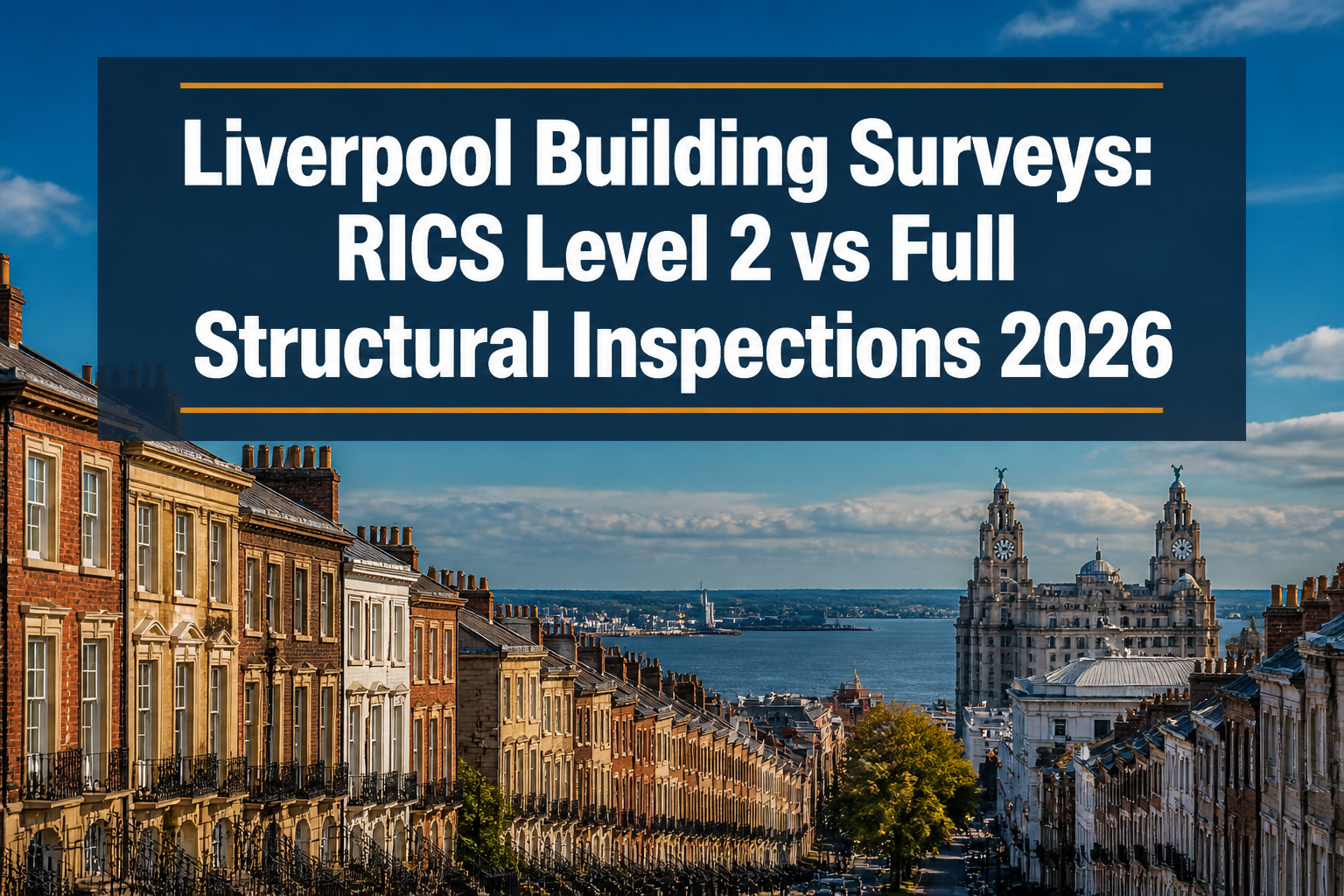
Nearly one in three UK homebuyers who skip a professional building survey later discover defects that cost them thousands of pounds to fix — defects a qualified surveyor would have flagged before contracts were exchanged. For buyers navigating the Merseyside property market right now, understanding Liverpool Building Surveys for Homebuyers: Competitive RICS Level 2 vs Full Structural Inspections in 2026 is not just useful — it is financially essential.
Liverpool's housing stock is unusually diverse. From Georgian townhouses in Rodney Street to post-war semis in Allerton and new-build apartments in the Baltic Triangle, the right survey type depends heavily on the property's age, construction, and condition. This guide breaks down exactly what each survey level covers, what it costs, and how to match the right inspection to the right Liverpool home.
Key Takeaways 📋
- RICS Level 2 (HomeBuyer Report) suits modern, conventionally built homes in reasonable condition — it uses a traffic-light rating system and visual inspection only.
- RICS Level 3 (Full Structural/Building Survey) is recommended for older, larger, or unusual properties — it inspects hidden areas and provides detailed repair cost estimates.
- Liverpool's Victorian and Edwardian housing stock means many buyers will need a Level 3 survey, not just a Level 2.
- Choosing the wrong survey level can leave serious structural defects undetected before purchase.
- RICS accreditation is the gold standard — always verify your surveyor's credentials before booking.
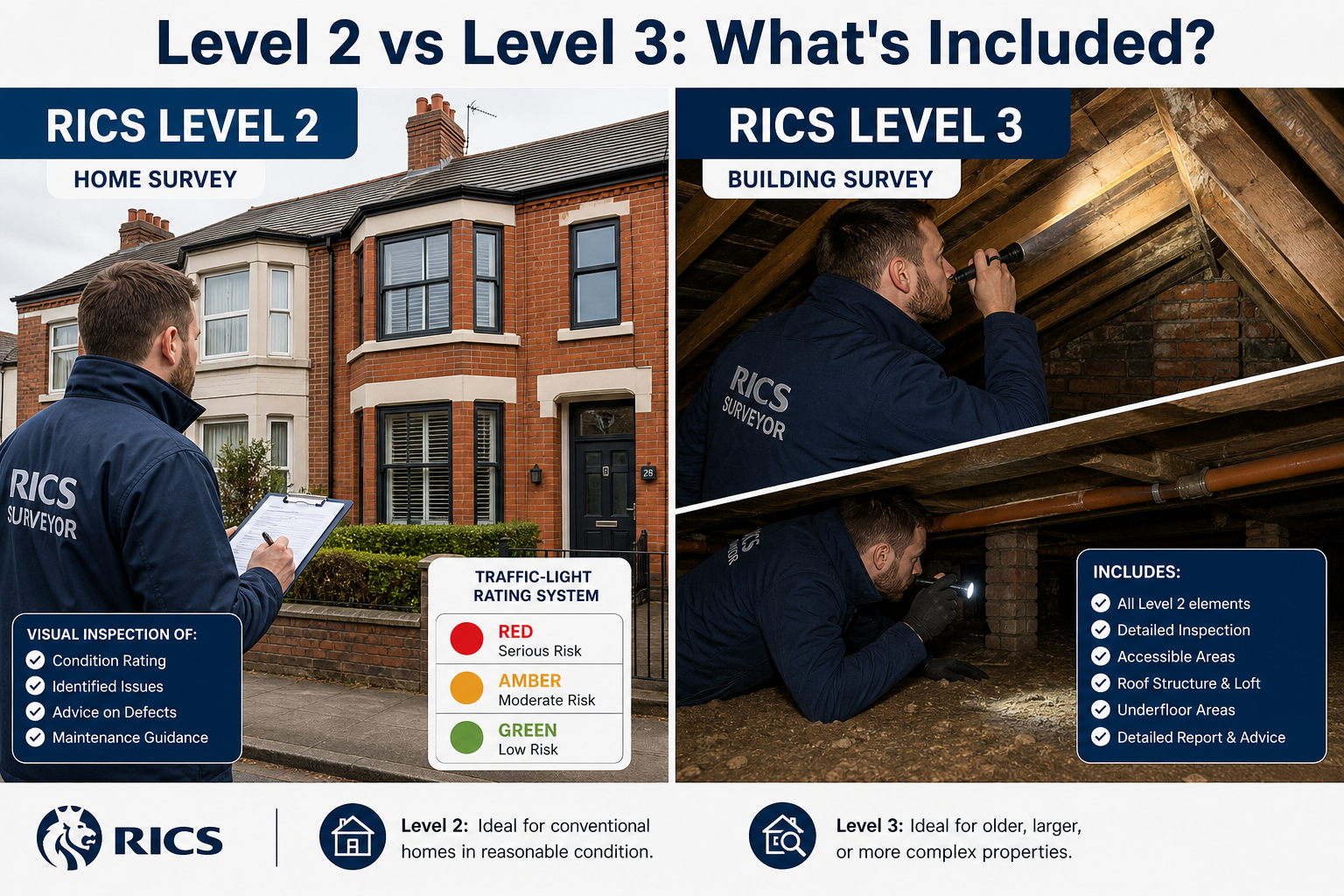
Understanding the Two Main Survey Types for Liverpool Homebuyers
What Is an RICS Level 2 HomeBuyer Survey?
The RICS Level 2 HomeBuyer Survey — formerly known simply as the HomeBuyer Report — is a mid-level visual inspection designed for properties that are modern, conventionally built, and in reasonable condition [7]. It is the most commonly purchased survey in the UK and represents a practical middle ground between a basic mortgage valuation and a full structural assessment.
Key features of a Level 2 survey include:
- ✅ Visual inspection only — non-intrusive, covering accessible interior and exterior areas [4]
- ✅ Traffic-light rating system — conditions rated 1 (no action), 2 (attention needed), or 3 (urgent action required) [2]
- ✅ Roof space and drainage chamber inspection — more extensive than a Level 1 valuation [3]
- ✅ Assessment for subsidence, settlement, and visible defects including roof coverings and chimneys [2]
- ✅ Available with or without a property valuation — the "survey only" option is cheaper [4]
- ❌ Does not include repair cost estimates in most cases [6]
- ❌ Does not confirm building regulations compliance or provide structural calculations [6]
💬 "A Level 2 survey is like a health check — it tells you if something looks wrong, but it won't always tell you how serious the problem is or what it will cost to fix."
For buyers considering a standard post-war semi in areas like Wavertree or Childwall, a Level 2 survey may be perfectly adequate. However, Liverpool's large proportion of pre-1919 housing stock means many buyers will need to think carefully before defaulting to this option.
To understand the full range of what a homebuyer report covers, this complete guide to homebuyer reports and property surveys provides an excellent overview of what to expect from the report format.
What Is an RICS Level 3 Full Structural Survey?
The RICS Level 3 Full Building Survey — sometimes still called a Full Structural Survey — is the most comprehensive residential inspection available [1]. It goes significantly further than a Level 2, examining hidden areas and providing the kind of detailed analysis that older or unusual properties demand.
Key features of a Level 3 survey include:
- ✅ Thorough inspection of all accessible parts including underfloor spaces and roof voids [4]
- ✅ Detailed structural analysis of walls, foundations, timbers, and drainage [1]
- ✅ Comprehensive repair cost estimates — a major advantage over Level 2 [1]
- ✅ Suitable for old, run-down, large, listed, or unusual properties [7]
- ✅ Identifies hidden defects such as timber decay, concealed damp, and structural movement [4]
- ❌ Does not typically include a standard property valuation (though this may be available as an add-on) [4]
- ❌ Higher cost — but often saves far more money by uncovering costly hidden defects
For buyers eyeing a Victorian terrace in Toxteth, an Edwardian townhouse in Sefton Park, or a listed building anywhere in the city, a Level 3 survey is not optional — it is essential. Liverpool's housing market includes a significant proportion of properties over 100 years old, many of which carry hidden structural risks that a visual-only inspection simply cannot detect.
Liverpool Building Surveys for Homebuyers: Competitive RICS Level 2 vs Full Structural Inspections in 2026 — Side-by-Side Comparison
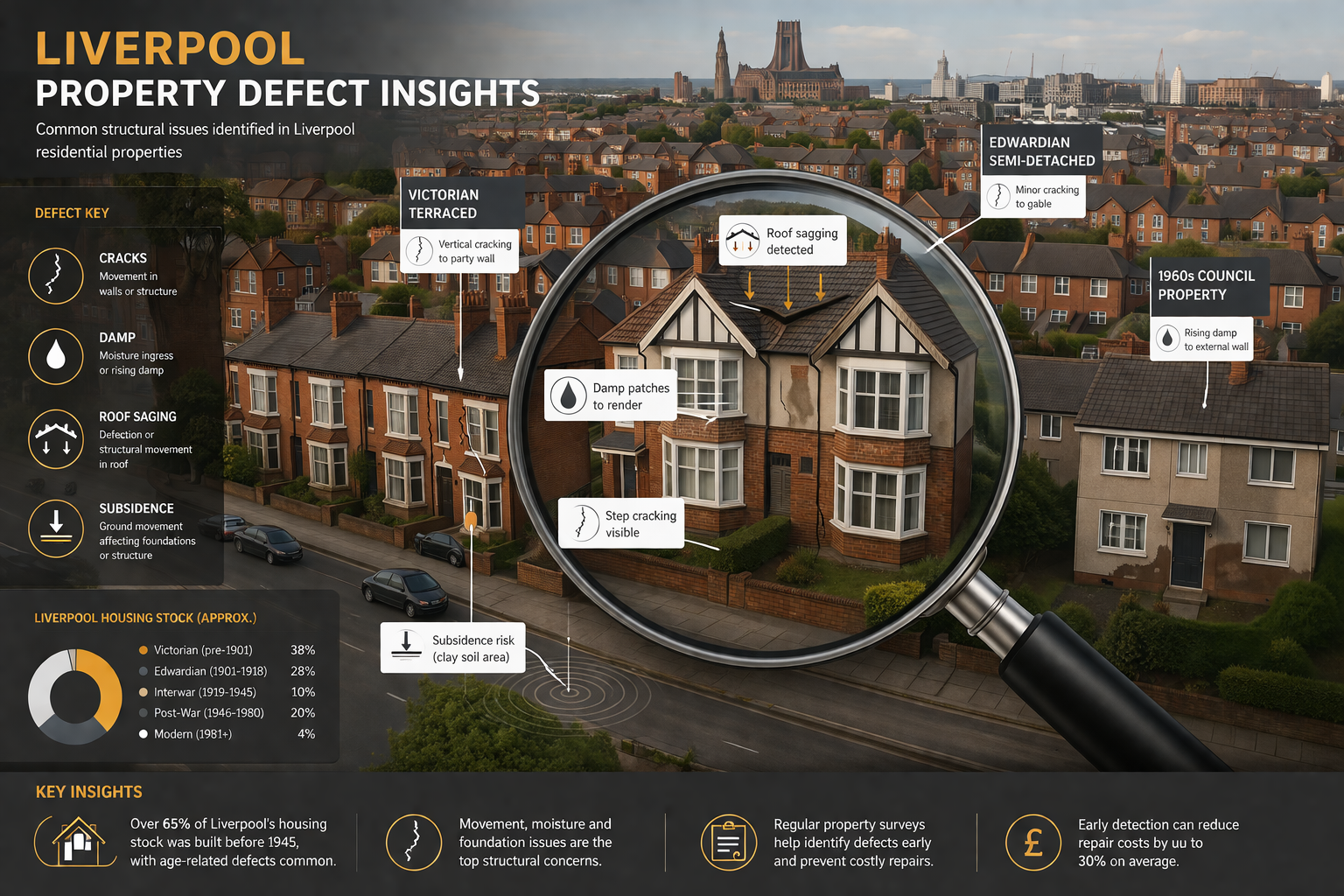
The table below summarises the core differences between the two main survey types relevant to Liverpool homebuyers in 2026:
| Feature | RICS Level 2 | RICS Level 3 |
|---|---|---|
| Inspection type | Visual, non-intrusive | Thorough, including hidden areas |
| Hidden areas inspected? | No | Yes (roof voids, underfloors) |
| Traffic-light ratings | ✅ Yes | Detailed written condition reports |
| Repair cost estimates | ❌ Usually not included | ✅ Comprehensive estimates |
| Building regs compliance | ❌ Not confirmed | ✅ Flagged where relevant |
| Structural calculations | ❌ Not provided | ✅ Included where necessary |
| Best for | Modern, conventional homes | Older, unusual, or complex properties |
| Valuation option | ✅ Available as add-on | Optional extra only |
| Typical cost (2026) | £400–£700 | £700–£1,500+ |
| Liverpool suitability | Post-war semis, new builds | Victorian/Edwardian terraces, listed buildings |
Sources: [1][2][3][4][7]
The Merseyside Market Context 🏘️
Liverpool's property market has specific characteristics that make survey selection particularly important:
- Large Victorian and Edwardian housing stock — many properties in L1–L8 postcodes date from 1850–1914
- Significant variation in condition — some streets have been heavily renovated; others have deferred maintenance for decades
- Active regeneration zones — areas like North Liverpool and Kirkdale include properties that may appear structurally sound but carry hidden risks
- Leasehold complexity — many Liverpool flats are leasehold, adding another layer of due diligence (see this guide on what to check before buying a leasehold property)
Choosing the Right Survey: Matching Property Type to Inspection Level
When a Level 2 Survey Is the Right Choice
A Level 2 HomeBuyer Survey is appropriate when:
- The property was built after 1945 using conventional materials
- The home is in good visible condition with no obvious signs of structural movement
- The property is a standard house or flat without unusual features
- The buyer has already viewed the property and seen no red flags [7]
For Liverpool buyers, this typically applies to:
- 1950s–1980s semis in areas like Woolton, Gateacre, and Aigburth
- Modern apartments in city-centre developments
- New-build properties within their defects liability period
To explore whether a homebuyer survey or full structural assessment is right for your situation, this detailed comparison of homebuyer survey vs full structural survey options is worth reading before booking.
When a Level 3 Full Structural Survey Is Essential
Industry guidance is clear: Level 3 is recommended for old, run-down, large, luxury, listed properties, or those with unusual features [7]. For Liverpool homebuyers, this is a long list.
A Level 3 survey is strongly recommended when:
- The property was built before 1919 (a very large proportion of Liverpool's housing)
- There are visible cracks, damp patches, or uneven floors — issues explored in more detail in this guide on whether to be worried about cracking walls
- The property has been extended, converted, or significantly altered
- The home is listed or in a conservation area (Liverpool has 26 conservation areas)
- The buyer intends to renovate or extend the property after purchase
- The property has non-standard construction such as rendered stone or timber frame
💬 "In Liverpool, the default assumption for any pre-1919 property should be Level 3, not Level 2. The city's older housing stock carries risks that a visual inspection simply cannot detect." [5]
Key Defects Liverpool Surveyors Look For
Common Issues in Liverpool's Older Housing Stock
Liverpool's Victorian and Edwardian terraces are beautiful — but they come with predictable structural challenges. A Level 3 survey will specifically investigate:
🔴 High-priority defects:
- Subsidence and settlement — common in areas with clay subsoils or near old mine workings
- Damp penetration — both rising damp and penetrating damp are widespread in pre-1919 properties
- Timber decay — wet rot and dry rot in floor joists and roof timbers [2]
- Defective pointing and brickwork — especially on exposed gable walls
- Chimney stack instability — a frequent finding in terraced properties
🟡 Medium-priority defects:
- Roof covering deterioration — original Welsh slate may be nearing end of life
- Lead flashing failures — common around chimney stacks and bay windows
- Inadequate insulation — particularly in pre-war properties
- Outdated electrical and plumbing systems
A specific defect survey can be commissioned alongside or after a full building survey if a particular issue requires deeper investigation.
Why RICS Accreditation Matters for Liverpool Homebuyers
Not all building surveyors are equal. RICS-accredited surveyors are bound by professional standards, carry professional indemnity insurance, and produce reports that meet defined quality benchmarks [5]. For Liverpool homebuyers, this matters for several reasons:
- Accountability — RICS members can be reported to a professional body if standards are not met
- Report quality — RICS-standard reports follow a consistent format that solicitors and lenders recognise
- Legal standing — in the event of a dispute, a RICS-compliant report carries greater evidential weight
- Comprehensive coverage — RICS surveyors are trained to identify the full range of defects relevant to Liverpool's housing stock [5]
For more on why accreditation should be a non-negotiable requirement, this article on why choosing RICS surveyors matters sets out the key reasons clearly.
Questions to Ask Before Booking a Liverpool Building Surveyor
Before committing to any surveyor, ask:
- Are you a full RICS member (MRICS or FRICS)?
- Do you have specific experience with Liverpool's Victorian and Edwardian housing stock?
- Will the report include repair cost estimates (Level 3)?
- What is your turnaround time for the completed report?
- Do you carry professional indemnity insurance?
- Can you explain your findings in plain language after the inspection?
Liverpool Building Surveys for Homebuyers: Competitive RICS Level 2 vs Full Structural Inspections in 2026 — Making the Final Decision
A Practical Decision Framework
Use this quick checklist to determine which survey level is right for your Liverpool property purchase:
Choose Level 2 if ALL of the following apply:
- Property built after 1945
- Standard construction (brick, concrete block, standard roof)
- No visible structural concerns during viewing
- Property is in good general condition
- No planned major renovation works
Choose Level 3 if ANY of the following apply:
- Property built before 1919 (or even before 1945)
- Visible cracks, damp, or structural irregularities
- Listed building or conservation area
- Non-standard construction materials
- Planning major renovation or extension
- Property has been significantly altered or extended
- Unusually low asking price (often signals hidden defects)
The Cost of Getting It Wrong
A Level 2 survey costs less upfront — but choosing it for the wrong property type can be extremely expensive. Consider:
- Undiscovered subsidence: Remediation costs of £5,000–£50,000+
- Hidden dry rot: Treatment and replacement of affected timbers: £3,000–£20,000
- Failed roof structure: Full replacement can exceed £15,000 on a Liverpool terrace
- Concealed damp: Structural damp treatment and replastering: £2,000–£10,000
The additional cost of upgrading from a Level 2 to a Level 3 survey — typically £300–£600 — is negligible compared to these potential repair bills. For first-time buyers especially, understanding which home survey is right for you before making a booking decision can prevent costly mistakes.
Conclusion: Actionable Next Steps for Liverpool Homebuyers in 2026
The decision between an RICS Level 2 HomeBuyer Survey and a Level 3 Full Structural Survey is one of the most important financial choices a Liverpool homebuyer will make in 2026. Given the city's distinctive housing stock — dominated by pre-1919 terraces, Victorian townhouses, and properties that have seen decades of variable maintenance — the default choice for most buyers should lean toward the more comprehensive Level 3 inspection.
Here are the key actions to take right now:
- Assess the property's age and condition before booking any survey — if in doubt, upgrade to Level 3.
- Verify RICS accreditation for any surveyor you consider — check the RICS online register.
- Request repair cost estimates as part of your survey brief — essential for negotiating price reductions or budgeting for works.
- Read a sample homebuyer report before your survey date so you understand the format and rating system.
- Act on the findings — use the survey report to renegotiate the purchase price or request remedial works before exchange.
- Consider specialist surveys for specific concerns — damp, timber decay, or structural movement may warrant a specific defect survey alongside the main inspection.
Liverpool's property market offers tremendous value — but only for buyers who go in with their eyes open. A thorough building survey is not an optional extra. It is the single most important piece of due diligence a homebuyer can commission.
References
[1] Rics Surveys – https://www.allcottassociates.co.uk/rics-surveys/
[2] Homebuyer Survey Level 2 – https://www.ashallsurveyors.co.uk/residential/homebuyer-survey-level-2
[3] House Surveys Uk The Costs Types And Benefits Of An Rics Home Survey – https://www.rics.org/consumer-guides/house-surveys-uk-the-costs-types-and-benefits-of-an-rics-home-survey
[4] Understanding The Differences Between Rics Home Survey Level Two And Level Three – https://www.nuvensurveyors.co.uk/blog/understanding-the-differences-between-rics-home-survey-level-two-and-level-three/
[5] What Is A Full Structural Review A Guide For Liverpool Homebuyers – https://liverpoolhomebuyergroup.co.uk/what-is-a-full-structural-review-a-guide-for-liverpool-homebuyers/
[6] Watch – https://www.youtube.com/watch?v=fKTVS0xu9dE
[7] Helping You Choose The Right Survey – https://www.rics.org/content/dam/ricsglobal/documents/surveying/helping_you_choose_the_right_survey.pdf