

Awards challenged in court. Appointments questioned. Jurisdiction disputes causing costly delays. These are not hypothetical risks — they are the real-world consequences that have pushed RICS to launch a comprehensive consultation on the draft 8th edition of its Party Wall Legislation and Procedure guidance in April 2026. [1]
For surveyors working under the Party Wall etc. Act 1996 in England and Wales, this is not a routine update. The RICS 8th Edition Party Wall Guidance 2026: What's Changed and How Surveyors Must Adapt represents a meaningful shift in how the profession is expected to operate — with stronger conduct standards, clearer jurisdictional requirements, and updated practical tools that every practitioner must understand before accepting new instructions.
The consultation window runs approximately eight weeks through May 2026, giving the profession a limited but important opportunity to shape the final document. [1] Whether a surveyor is a seasoned party wall specialist or newly entering this area of practice, understanding what has changed — and why — is essential.
Key Takeaways 📋
- RICS launched the draft 8th edition consultation in April 2026, replacing the 7th edition for all RICS members accepting instructions under the Party Wall etc. Act 1996. [1]
- Jurisdiction verification is now explicitly reinforced — surveyors must confirm a genuine dispute exists before accepting appointments, or risk awards being challenged. [1]
- The personal and statutory nature of a party wall surveyor's appointment is clarified, making it independent of client instruction. [1]
- Updated templates for letters of appointment, terms of engagement, and draft awards align with current best practice. [1]
- Strengthened conduct guidance covers fee practices, Third Surveyor use, notice service, and public engagement protocols. [1]
Why the 8th Edition Matters: The Context Behind the Update
The Party Wall etc. Act 1996 has governed shared wall construction and boundary excavation work in England and Wales for nearly three decades. Yet the professional landscape around it has evolved considerably — and not always in ways that serve property owners or the integrity of the process.
RICS has been explicit that clarity and professional rigour are especially important right now. [1] Cases where awards have been successfully challenged — often because a surveyor accepted an appointment without proper jurisdiction, or because the personal and statutory nature of the role was misunderstood — have highlighted gaps in how the 7th edition guidance was being applied. [1]
The 8th edition is designed to close those gaps. As stated in the RICS consultation launch, the updated guidance aims to support "high standards of competence, conduct and consistency" across the profession. [1]
💬 "The draft 8th edition directly replaces the 7th edition and applies to RICS members accepting instructions under the Party Wall etc. Act 1996 in England and Wales." — RICS [1]
For property owners in London and beyond, this matters too. A surveyor who understands and applies the new guidance correctly provides better protection for all parties involved — whether building owner or adjoining owner. Those seeking a qualified party wall surveyor in London should expect practitioners to be fully conversant with the updated standards.
What Has Changed: A Detailed Breakdown of the 8th Edition
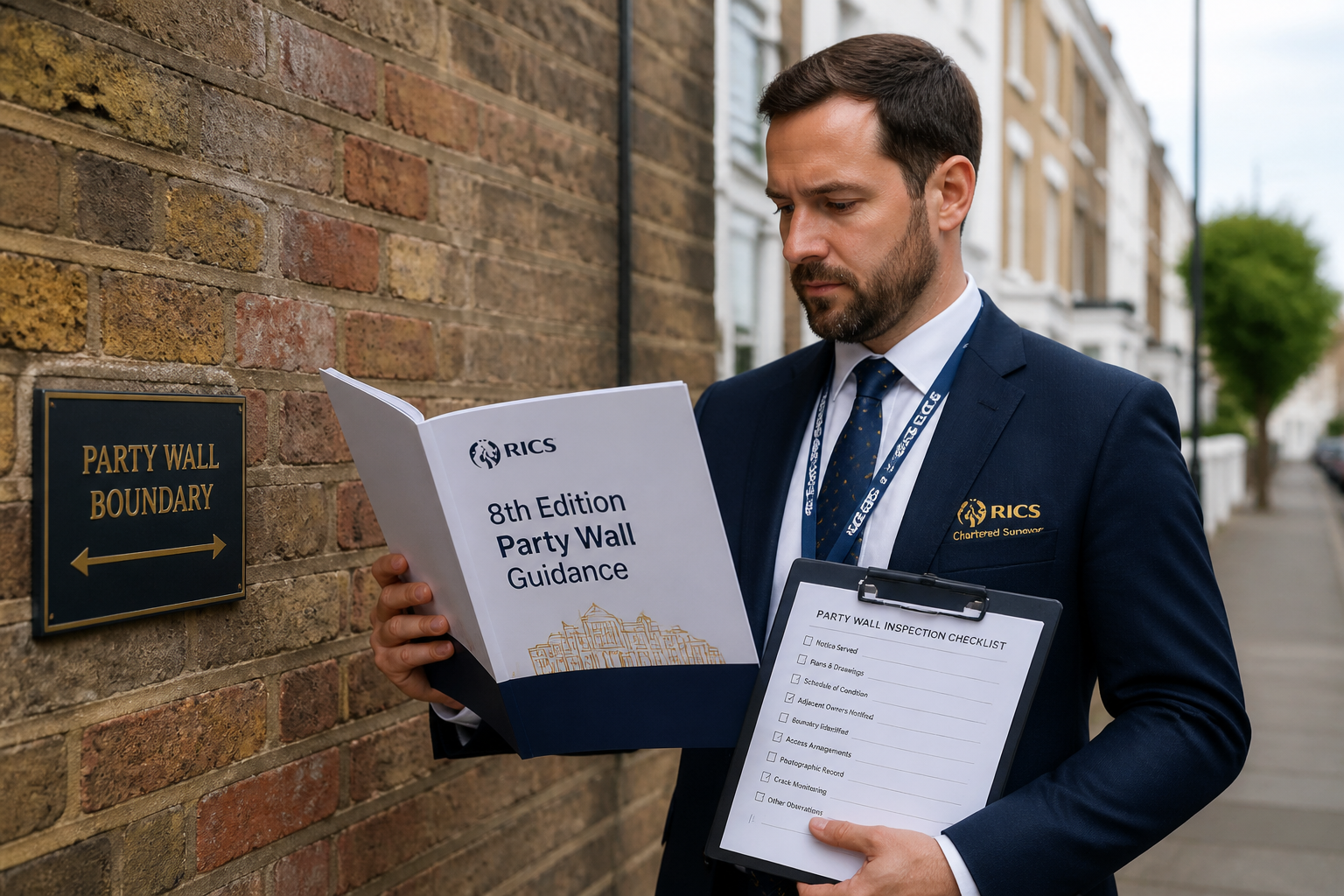
Understanding the RICS 8th Edition Party Wall Guidance 2026: What's Changed and How Surveyors Must Adapt requires looking at each key area of revision in turn. The changes span conduct, procedure, templates, and professional accountability.
1. Jurisdiction Verification: A Non-Negotiable First Step
One of the most significant additions to the 8th edition is the explicit reinforcement of jurisdiction requirements. [1] Awards have been challenged — and overturned — in cases where surveyors acted without proper jurisdiction, particularly where no genuine dispute existed between the parties at the time of appointment. [1]
The updated guidance makes clear that surveyors must verify jurisdiction before accepting any appointment. This is not merely procedural housekeeping. Acting outside jurisdiction exposes both the surveyor and the parties to legal risk, wasted costs, and delays.
Practical implication: Before accepting an instruction, surveyors should ask:
- Has a valid notice been served under the Act?
- Has the adjoining owner dissented, or has the dispute period elapsed without consent?
- Is there a genuine dispute in existence, or are the parties actually in agreement?
If the answer to the last question is "they are in agreement," there may be no jurisdiction for a formal award process at all.
2. Personal and Statutory Nature of Appointment
The 8th edition explicitly addresses a recurring problem: surveyors treating their appointment as if it were a standard client-contractor relationship. [1]
A party wall surveyor's appointment is personal and statutory in nature — it derives from the Act itself, not from the client's instruction. [1] This means the surveyor's duty is to the process and to both parties, not solely to the person who appointed them.
This distinction has significant practical consequences:
- A building owner cannot instruct "their" surveyor to act in a way that prejudices the adjoining owner
- The surveyor cannot be dismissed simply because a client is unhappy with a decision
- Fee arrangements must not compromise the surveyor's independence
This connects directly to concerns about party wall agreement processes in London where commercial pressures have sometimes blurred professional boundaries.
3. Strengthened Conduct Guidance
The draft 8th edition significantly strengthens guidance on regulatory and conduct matters, covering four specific areas: [1]
| Conduct Area | What's Updated |
|---|---|
| Fee practices | Clearer standards to prevent fee arrangements that compromise independence |
| Third Surveyor role | Guidance on appropriate use and when referral is required |
| Service of notices | Updated procedures for valid notice service |
| Public engagement | Protocols for communicating with unrepresented parties |
The inclusion of public engagement protocols is particularly noteworthy. Many adjoining owners are private individuals with no professional knowledge of the party wall process. The 8th edition recognises that surveyors have a responsibility to communicate clearly and fairly with all parties — not just those who are professionally represented.
4. Updated Templates: Appointments, Terms, and Awards
Three sets of practical templates have been revised in the 8th edition: [1]
a) Letters of Appointment
Updated to reflect current best practice and regulatory requirements. These templates help ensure that the terms on which a surveyor accepts an appointment are clear, compliant, and professionally appropriate.
b) Terms of Engagement
Revised to align with current RICS professional standards and to address areas where the previous templates were found to be ambiguous or incomplete.
c) Draft Award Template
A revised award format has been included to align with evolving procedural standards. [1] The award is the central legal document in any party wall dispute, and a poorly drafted award creates risk for everyone involved.
Surveyors should review these templates carefully and update their own standard documents accordingly before the 8th edition takes effect.
5. Enhanced Appendices
The 8th edition includes enhanced appendices providing expanded supplementary materials and resources for practitioners. [1] While the full detail of these appendices will be confirmed after the consultation period, they are expected to cover reference materials, worked examples, and guidance on edge-case scenarios that the main body of the document does not address in full.
How Surveyors Must Adapt: Practical Steps for Compliance
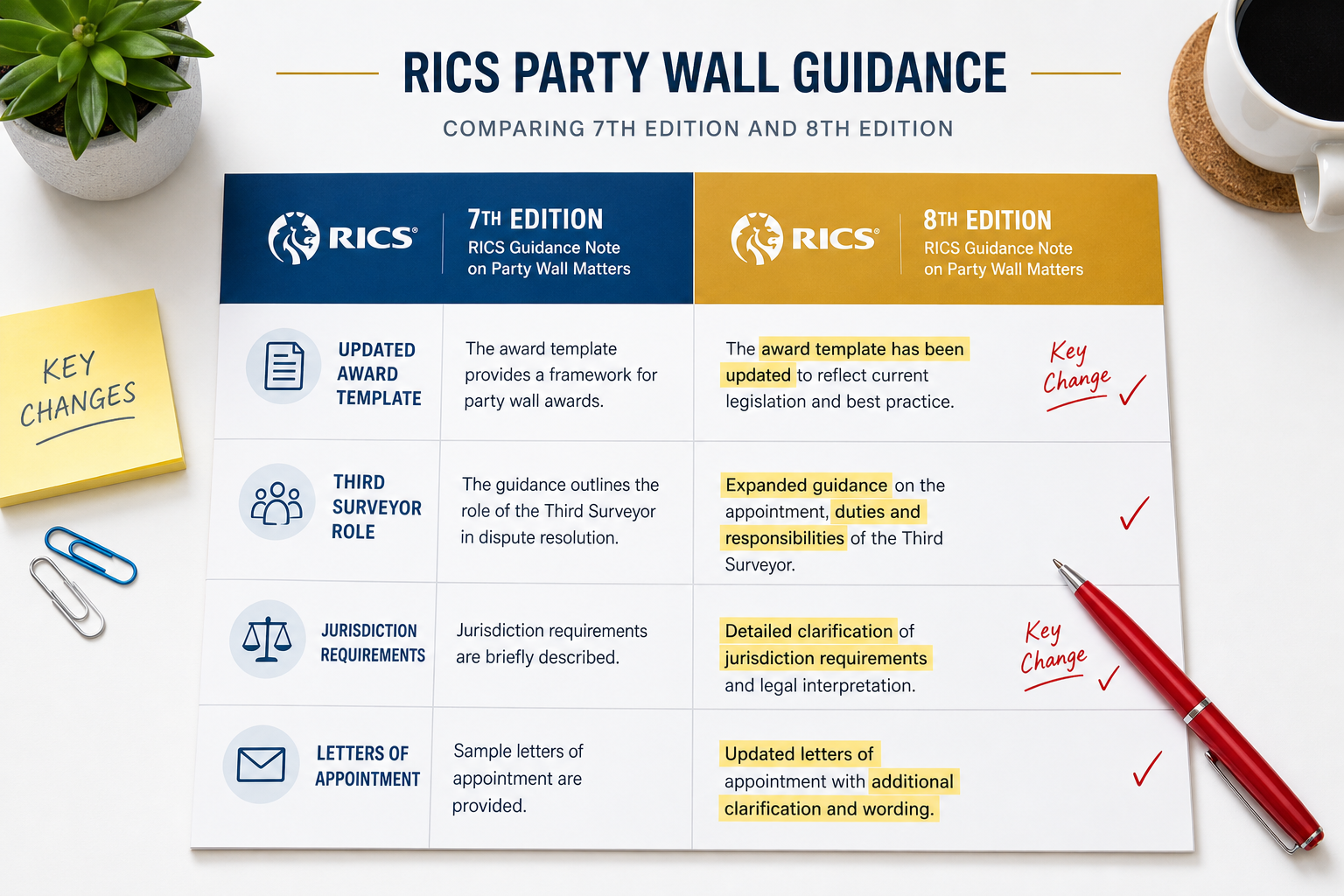
Knowing what has changed is only half the task. The RICS 8th Edition Party Wall Guidance 2026: What's Changed and How Surveyors Must Adapt demands concrete action from practitioners. Here is a structured approach to getting ready.
Step 1: Engage with the Consultation
The consultation period runs through May 2026. [1] RICS has specifically invited feedback from surveyors, legal professionals, dispute resolution practitioners, and other stakeholders. [1] This is a genuine opportunity to influence the final document.
Surveyors who identify areas of ambiguity or practical difficulty in the draft should submit responses. The profession shapes its own standards — but only if practitioners engage with the process.
Step 2: Audit Current Practice Against the New Standards
Before the 8th edition takes effect, every party wall practitioner should conduct an honest audit of their current practice:
✅ Are jurisdiction checks documented before every appointment?
✅ Do current letters of appointment reflect the personal and statutory nature of the role?
✅ Are fee arrangements structured to preserve independence?
✅ Is the Third Surveyor role being used appropriately — and not avoided to reduce costs?
✅ Are notices being served in accordance with updated procedures?
✅ Is communication with unrepresented adjoining owners clear and fair?
Any gaps identified should be addressed before the new guidance applies.
Step 3: Update All Template Documents
The revised templates for letters of appointment, terms of engagement, and draft awards should be adopted as soon as the final 8th edition is published. [1] Using outdated templates after the new guidance takes effect creates professional risk and may undermine the validity of documents produced.
For surveyors working across London — from Kensington to Wandsworth — where party wall work is particularly common given the density of Victorian terraced and semi-detached housing, this update is especially pressing.
Step 4: Review CPD and Training
The 8th edition's emphasis on competence and consistency [1] signals that RICS expects practitioners to maintain up-to-date knowledge. Surveyors should:
- Attend RICS-approved CPD sessions covering the 8th edition once published
- Review any internal training materials or office procedures
- Ensure junior staff and trainees are briefed on the key changes
Step 5: Communicate Changes to Clients
Building owners and developers who regularly commission party wall work should be informed that updated standards apply. This is also an opportunity to reinforce the value of using a qualified, RICS-regulated surveyor — particularly given the 8th edition's emphasis on protecting all parties, including adjoining owners.
For those unfamiliar with party wall surveyor costs in London, it is worth noting that the cost of a properly conducted party wall process is far lower than the cost of a challenged award or litigation arising from procedural failures.
The Broader Professional Context: Why This Matters Beyond Compliance
The 8th edition does not exist in isolation. It sits within a broader RICS drive to raise standards across the surveying profession — and party wall work has come under particular scrutiny in recent years.
Several factors have converged to make this update necessary:
🏗️ Rising construction activity — London and other urban centres have seen sustained demand for extensions, basement works, and conversions, all of which frequently trigger the Party Wall etc. Act 1996.
⚖️ Increased legal challenge — Courts have seen a rise in challenges to party wall awards, often on jurisdictional or procedural grounds. [1]
🔍 Regulatory scrutiny — RICS has faced broader questions about professional standards across its membership, making robust, up-to-date guidance more important than ever.
📋 Consumer awareness — Adjoining owners are increasingly aware of their rights and more likely to challenge processes they perceive as unfair or improperly conducted.
For surveyors who also undertake broader property assessment work — such as RICS building surveys or monitoring surveys — the party wall process often intersects with other professional responsibilities. Understanding the updated guidance ensures consistency across all aspects of practice.
It is also worth noting that party wall work frequently surfaces issues related to structural defects and boundary disputes — areas where the surveyor's role requires both technical competence and clear procedural compliance.
Stakeholder Perspectives: Who Needs to Pay Attention
The consultation has been targeted at a wide range of stakeholders. [1] Each group has distinct interests in the 8th edition:
RICS-Registered Surveyors
Direct obligation to comply once the guidance takes effect. Must update practice, templates, and CPD.
Legal Professionals
Solicitors and barristers advising on party wall disputes need to understand the updated procedural standards — particularly around jurisdiction and the personal nature of appointments.
Dispute Resolution Practitioners
The Third Surveyor role and the award template changes directly affect how disputes are resolved. [1]
Building Owners and Developers
Need to understand that their appointed surveyor operates under statutory duties that cannot be overridden by client instruction.
Adjoining Owners
Benefit from stronger public engagement protocols and clearer conduct standards that protect their interests throughout the process. [2]
Conclusion: Preparing for the 8th Edition Before It Arrives
The RICS 8th Edition Party Wall Guidance 2026: What's Changed and How Surveyors Must Adapt is more than a document update — it is a professional reset for party wall practice in England and Wales. [1] The changes to jurisdiction requirements, appointment clarity, conduct standards, and practical templates collectively raise the bar for what competent, compliant party wall work looks like.
The consultation window through May 2026 is short. [1] Surveyors who engage now — reviewing the draft, submitting feedback, and beginning to audit their own practice — will be far better positioned when the final 8th edition is published and takes effect.
✅ Actionable Next Steps for Surveyors
- Download and read the draft 8th edition via the RICS consultation portal before the May 2026 deadline
- Submit a consultation response if any provisions are unclear or impractical
- Audit current templates — letters of appointment, terms of engagement, and award formats
- Document jurisdiction checks as a formal step in every new instruction
- Book relevant CPD on the 8th edition once the final version is published
- Brief clients and colleagues on the updated standards and their implications
The party wall process exists to protect all parties involved in construction work near shared boundaries. When surveyors apply it with the competence, independence, and rigour the 8th edition demands, it works as intended. The profession's task now is to make sure every practitioner is ready.
References
[1] RICS Launches Consultation on Updated Party Wall Practice Guidance – https://www.rics.org/news-insights/rics-launches-consultation-on-updated-party-wall-practice-guidance
[2] RICS Launches Consultation Updated Party Wall Practice Guidance – https://todaysconveyancer.co.uk/rics-launches-consultation-updated-party-wall-practice-guidance/
[3] RICS Consults on Updated Party Wall Practice Guidance – https://www.lexisnexis.co.uk/legal/news/rics-consults-on-updated-party-wall-practice-guidance