
Institutional landlords now control a larger share of the UK private rented sector than at any point in the past two decades — and their appetite for portfolio growth in 2026 is reshaping the legal landscape around shared boundaries. As large-scale buy-to-let expansions accelerate, Party Wall Surveys for Institutional Buy-to-Let Expansions: Compliance Strategies for 2026's Landlord Investment Surge have moved from a niche procedural concern to a front-line due diligence requirement. Miss a party wall notice on a multi-property acquisition and the resulting disputes can freeze construction timelines, trigger costly awards, and expose institutional operators to reputational damage in an already scrutinised sector [3].
This guide cuts through the complexity. Whether managing a portfolio of ten units or ten thousand, the principles, protocols, and pitfalls covered here apply directly to the compliance challenges institutional landlords face right now.
Key Takeaways 📋
- Party wall compliance is non-negotiable for institutional buy-to-let expansions — legal review of party wall awards costs £500–£1,500 per property [1].
- The 2026 Renters' Rights Act has fundamentally recentred party wall survey procedures around tenant rights, changing how notices must be issued and communicated [2].
- Proactive survey scheduling across large portfolios reduces dispute risk and protects construction timelines.
- Institutional landlords must integrate party wall compliance into standard acquisition due diligence, not treat it as an afterthought.
- Engaging a qualified party wall surveyor early — ideally before planning applications are submitted — is the single most effective cost-control strategy.
Why 2026 Is a Turning Point for Institutional Buy-to-Let Compliance
The UK rental market is experiencing unprecedented transformation in 2026 [3]. Pension funds, real estate investment trusts (REITs), and specialist build-to-rent operators have dramatically increased their buy-to-let acquisitions, drawn by long-term yield stability and rising rental demand. This institutional surge is not simply a volume story — it is a structural shift in how large portfolios are assembled, extended, and managed.
With scale comes complexity. When an institutional landlord acquires a terrace of Victorian houses or extends a block of flats, shared walls, foundations, and excavations are almost always involved. The Party Wall etc. Act 1996 governs these situations, requiring formal notices, potential surveys, and legally binding awards before work can begin. For a single homeowner, one missed notice is a problem. For an institution managing dozens of simultaneous projects, systemic non-compliance can cascade into injunctions, litigation, and programme delays worth millions.
💡 Pull Quote: "For institutional landlords, party wall compliance is not a legal box-ticking exercise — it is a portfolio risk management discipline."
The 2026 regulatory environment has also tightened considerably. The Renters' Rights Act 2026 has recalibrated party wall survey protocols to centre tenant rights in all notices and procedures [2]. This means institutional landlords cannot simply replicate the notice processes used in private residential transactions. Tenants in adjoining properties now have enhanced standing, and surveyors must account for occupier welfare alongside structural concerns.
Understanding the Party Wall Framework for Large-Scale Portfolios
What Triggers a Party Wall Obligation?
Before diving into compliance strategy, it helps to understand exactly what triggers the Act. Three categories of work are covered:
| Trigger Type | Common Examples in BTL Expansions |
|---|---|
| Line of junction works | Building a new wall on or at the boundary |
| Party structure works | Cutting into, underpinning, or raising a shared wall |
| Excavation near a neighbour's building | Digging foundations within 3–6 metres of adjoining structures |
For institutional landlords extending existing properties — adding rear extensions, converting loft spaces, or underpinning foundations across a terrace — multiple triggers often apply simultaneously. A single project can require several distinct notices, each with its own statutory timeline.
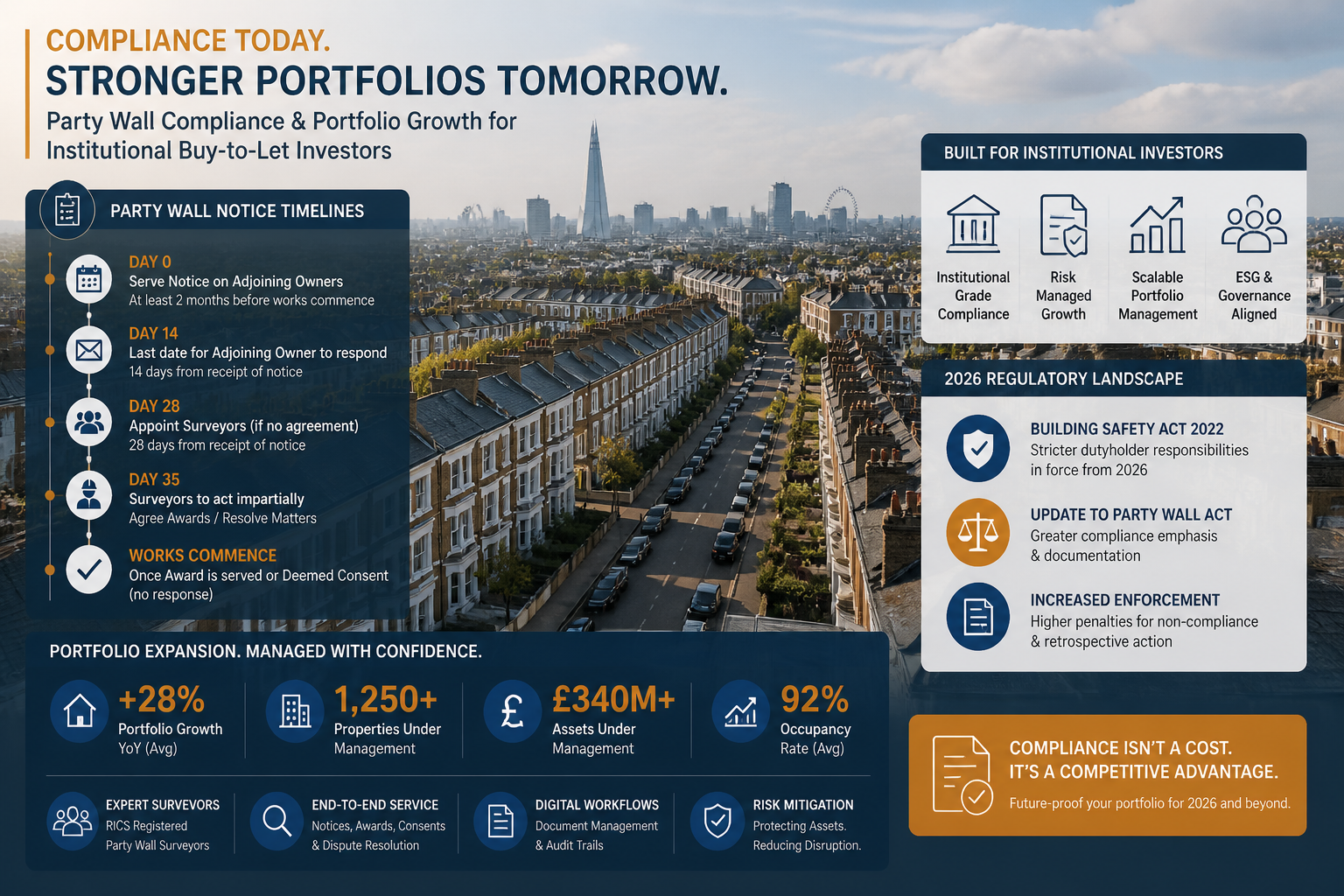
The Notice Process: Timelines That Cannot Be Rushed
The Party Wall etc. Act 1996 sets strict notice periods:
- Party structure notices: Minimum 2 months before work starts
- Line of junction notices: Minimum 1 month before work starts
- Excavation notices: Minimum 1 month before work starts
For institutional portfolios where construction programmes are tightly sequenced, failing to build these timelines into project planning is a common and expensive mistake. Understanding party wall agreements and the costs involved at the outset helps finance teams model compliance budgets accurately.
Agreed Surveyor vs. Separate Surveyors
When an adjoining owner dissents to a notice, the parties must appoint surveyors. Institutional landlords have two options:
- Agreed surveyor — one impartial surveyor acts for both parties (faster, lower cost)
- Separate surveyors — each party appoints their own (more common in contentious cases)
For portfolio-scale operations, the agreed surveyor route often makes commercial sense where relationships with adjoining owners are straightforward. However, where tenants or multiple occupiers are involved — increasingly common under 2026's regulatory framework — separate surveyors may be required to adequately represent all interests [2].
Compliance Strategies for Party Wall Surveys for Institutional Buy-to-Let Expansions: Compliance Strategies for 2026's Landlord Investment Surge

Strategy 1: Build a Centralised Party Wall Register 🗂️
Institutional landlords managing large portfolios need a centralised compliance register that tracks:
- All properties where works are planned or ongoing
- Notice issue dates and statutory deadlines
- Adjoining owner and tenant details (updated for 2026 Renters' Rights Act requirements)
- Surveyor appointments and award status
- Cost accruals per property
This register should integrate with the institution's broader asset management platform. Without it, compliance gaps are inevitable as portfolios scale.
Strategy 2: Integrate Party Wall Due Diligence into Acquisitions
One of the most overlooked compliance failures in institutional buy-to-let is treating party wall obligations as a post-acquisition problem. Smart operators embed party wall due diligence into the pre-exchange checklist. This means:
- Reviewing planning history for any outstanding party wall disputes
- Identifying shared walls, foundations, and boundary structures
- Assessing whether planned refurbishment works will trigger the Act
- Budgeting for survey and award costs before contracts are exchanged
Legal team review of party wall awards typically ranges from £500–£1,500 per property [1]. Across a portfolio acquisition of 50 units, that is a compliance budget line of up to £75,000 — material enough to affect deal economics.
For complex structural assessments during acquisition, a condition survey report from a chartered surveyor can identify party wall risks before they become legal obligations.
Strategy 3: Appoint a Panel of Approved Party Wall Surveyors
Institutional landlords benefit from establishing a pre-approved panel of party wall surveyors who understand the specific demands of large-scale BTL operations. Key criteria for panel selection:
- ✅ RICS membership and party wall specialist accreditation
- ✅ Experience with multi-property institutional portfolios
- ✅ Familiarity with 2026 Renters' Rights Act compliance requirements
- ✅ Capacity to handle concurrent instructions across multiple sites
- ✅ Transparent fee structures aligned with portfolio volumes
A panel arrangement also enables consistent documentation standards across all party wall awards — critical when institutional investors or lenders require portfolio-level compliance reporting.
Strategy 4: Tenant Communication Protocols Under the 2026 Renters' Rights Act
The 2026 Renters' Rights Act has introduced a significant shift: party wall survey protocols must now centre tenant rights in all notices and procedures [2]. For institutional landlords, this has practical implications:
- Notices must be served on both the adjoining owner and any occupying tenant where relevant
- Communication must be in plain English and accessible formats
- Tenants have enhanced rights to raise concerns about construction impact on their homes
- Survey schedules must account for tenant welfare, not just structural timelines
Institutions that fail to adapt their notice procedures to this new standard risk having awards challenged or injunctions granted. Building a robust tenant communication protocol — separate from the legal notice itself — is now considered best practice.
Reviewing what to do when you receive a party wall notice provides useful context for understanding how adjoining parties — including tenants — are likely to respond.
Strategy 5: Schedule Monitoring Surveys Throughout Construction
Party wall compliance does not end when the award is issued. Institutional landlords should commission schedule of condition surveys before work begins and monitoring surveys throughout the construction phase. These protect against spurious damage claims and provide an evidence base if disputes arise post-completion.
For large-scale excavation or underpinning works — common in basement conversions and foundation extensions — continuous monitoring is not just good practice; it may be a condition of the party wall award itself.
Cost Management: Budgeting Party Wall Compliance Across a Portfolio

Breaking Down the Costs
Institutional landlords need to model party wall compliance costs at portfolio level. Here is a realistic cost framework for 2026:
| Cost Item | Typical Range |
|---|---|
| Party wall notice preparation | £150–£400 per notice |
| Building owner's surveyor fee | £700–£1,500 per award |
| Adjoining owner's surveyor fee (if separate) | £700–£1,500 per award |
| Legal review of complex awards | £500–£1,500 per property [1] |
| Schedule of condition survey | £300–£800 per property |
| Monitoring surveys (construction phase) | £200–£600 per visit |
For a portfolio expansion involving 20 properties with party wall obligations, total compliance costs can easily reach £50,000–£150,000. This is not a reason to avoid compliance — it is a reason to plan for it rigorously.
Where Costs Escalate ⚠️
Costs spiral when:
- Notices are served late, compressing timelines and forcing premium-rate surveyor appointments
- Disputes arise because adjoining owners or tenants feel inadequately consulted
- Awards are challenged due to procedural errors in the notice process
- Damage claims emerge post-construction without a pre-work condition survey baseline
Understanding party wall agreement costs in advance allows institutions to build accurate contingency reserves. For properties near boundary walls and property lines, additional specialist input may be required to resolve ambiguities before notices are issued.
The ROI of Early Compliance Investment
The commercial case for proactive party wall compliance is straightforward. A single injunction halting construction on a BTL extension can cost more in programme delay than the entire compliance budget for a 50-property portfolio. Institutional investors increasingly recognise that compliance is a value-protection strategy, not merely a legal obligation.
Navigating Party Wall Surveys for Institutional Buy-to-Let Expansions: Compliance Strategies for 2026's Landlord Investment Surge in Complex Scenarios
Multi-Unit Blocks and Shared Foundations
When institutional landlords extend or convert multi-unit residential blocks, the party wall implications multiply. A single basement excavation may trigger obligations to multiple adjoining owners simultaneously. In these cases:
- Each adjoining owner must receive a separate, correctly addressed notice
- Surveyor appointments may need to be staggered to manage workload
- Awards must address the specific concerns of each affected party
For complex structural scenarios, a specific defect survey can identify structural vulnerabilities before party wall notices are served, reducing the risk of disputes arising from pre-existing conditions being attributed to new works.
Leaseholder and Freeholder Complications
In blocks where institutional landlords hold the freehold but individual leaseholders occupy units, the question of who is the adjoining owner for party wall purposes can be legally complex. Generally:
- The freeholder of an adjoining property is the adjoining owner for party wall purposes
- But long leaseholders (typically 21+ years remaining) also qualify as adjoining owners
- Both may need to be served with notices in certain scenarios
Institutions should seek specialist legal advice on notice obligations in leasehold structures — a common feature of London and urban BTL portfolios.
Boundary Disputes and Party Wall Overlaps
Party wall obligations and boundary disputes sometimes intersect, particularly where the exact line of a shared wall is unclear. Resolving boundary ambiguities before serving party wall notices avoids the risk of notices being challenged as incorrectly addressed. Resources on UK boundary wall rules and property boundary disputes provide useful background for compliance teams navigating these overlaps.
Building an Institutional Compliance Culture
The most resilient institutional landlords in 2026 are those that have moved beyond reactive compliance — responding to notices and disputes as they arise — toward a proactive compliance culture embedded across their acquisition, development, and asset management functions.
This means:
- Training acquisition and development teams on party wall obligations
- Standardising notice templates and surveyor briefing documents
- Reporting party wall compliance status at board and investor level
- Reviewing completed projects for lessons learned and process improvements
The 2026 Renters' Rights Act has made it clear that the regulatory direction of travel favours greater transparency and tenant protection [2]. Institutional landlords that align their compliance culture with this direction will be better positioned for future regulatory changes — and better regarded by the local communities in which they operate.
Conclusion: Actionable Next Steps for Institutional Landlords in 2026
Party Wall Surveys for Institutional Buy-to-Let Expansions: Compliance Strategies for 2026's Landlord Investment Surge represent a genuine competitive differentiator. Institutions that manage party wall obligations systematically — rather than reactively — protect their construction programmes, control costs, and build the stakeholder trust that underpins long-term portfolio performance.
Here are the immediate actions to take:
- 🗂️ Audit your current portfolio for any planned or ongoing works that may trigger party wall obligations — do this before the next acquisition closes.
- 📋 Create a centralised party wall compliance register and assign ownership to a specific team member or external compliance partner.
- 👥 Review your tenant communication protocols against the 2026 Renters' Rights Act requirements and update notice templates accordingly.
- 💼 Establish a panel of approved party wall surveyors with institutional portfolio experience and transparent fee structures.
- 📊 Build party wall compliance costs (£500–£1,500 per property for legal review, plus surveyor fees) into all acquisition financial models [1].
- 🔍 Commission condition surveys before any notifiable works begin to establish a defensible baseline against future damage claims.
The regulatory environment will continue to evolve. Institutions that treat party wall compliance as a strategic asset management discipline — rather than a procedural inconvenience — will be the ones best positioned to capitalise on 2026's landlord investment surge without the costly disruptions that catch less-prepared operators off guard.
References
[1] Party Wall Awards For Buy To Let Expansions In 2026 Protocols Amid Institutional Landlord Surge – https://nottinghillsurveyors.com/blog/party-wall-awards-for-buy-to-let-expansions-in-2026-protocols-amid-institutional-landlord-surge
[2] Party Wall Surveys For Institutional Buy To Let Expansions Managing Notices Under 2026 Renters Rights Act Compliance – https://nottinghillsurveyors.com/blog/party-wall-surveys-for-institutional-buy-to-let-expansions-managing-notices-under-2026-renters-rights-act-compliance
[3] Party Wall Surveys For Institutional Buy To Let Expansions Compliance In 2026s Landlord Investment Surge – https://nottinghillsurveyors.com/blog/party-wall-surveys-for-institutional-buy-to-let-expansions-compliance-in-2026s-landlord-investment-surge