

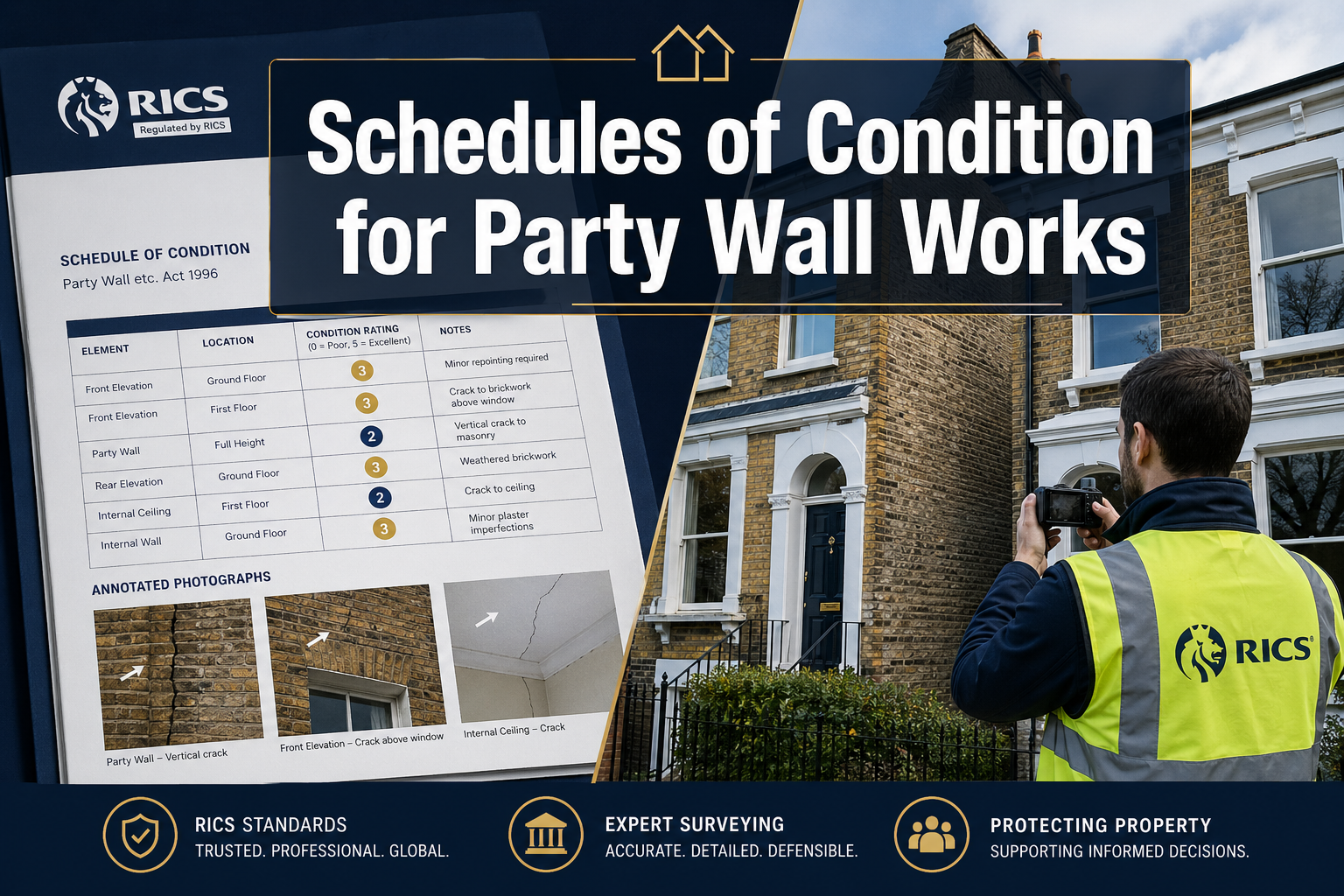
Over 60% of party wall disputes that escalate to formal legal proceedings could have been avoided with a properly prepared schedule of condition — yet many building owners still treat this document as an afterthought. When notifiable works begin without one, the consequences can be costly, contentious, and legally complex.
Schedules of Condition for Party Wall Works: Advanced RICS Templates and Damage Assessment Strategies sit at the heart of responsible party wall practice. They create a defensible, factual baseline of an adjoining property's condition before any construction begins — and in 2026, with RICS updating its practice guidance through a major consultation process, understanding how to prepare these documents correctly has never been more important [3].
Key Takeaways 📋
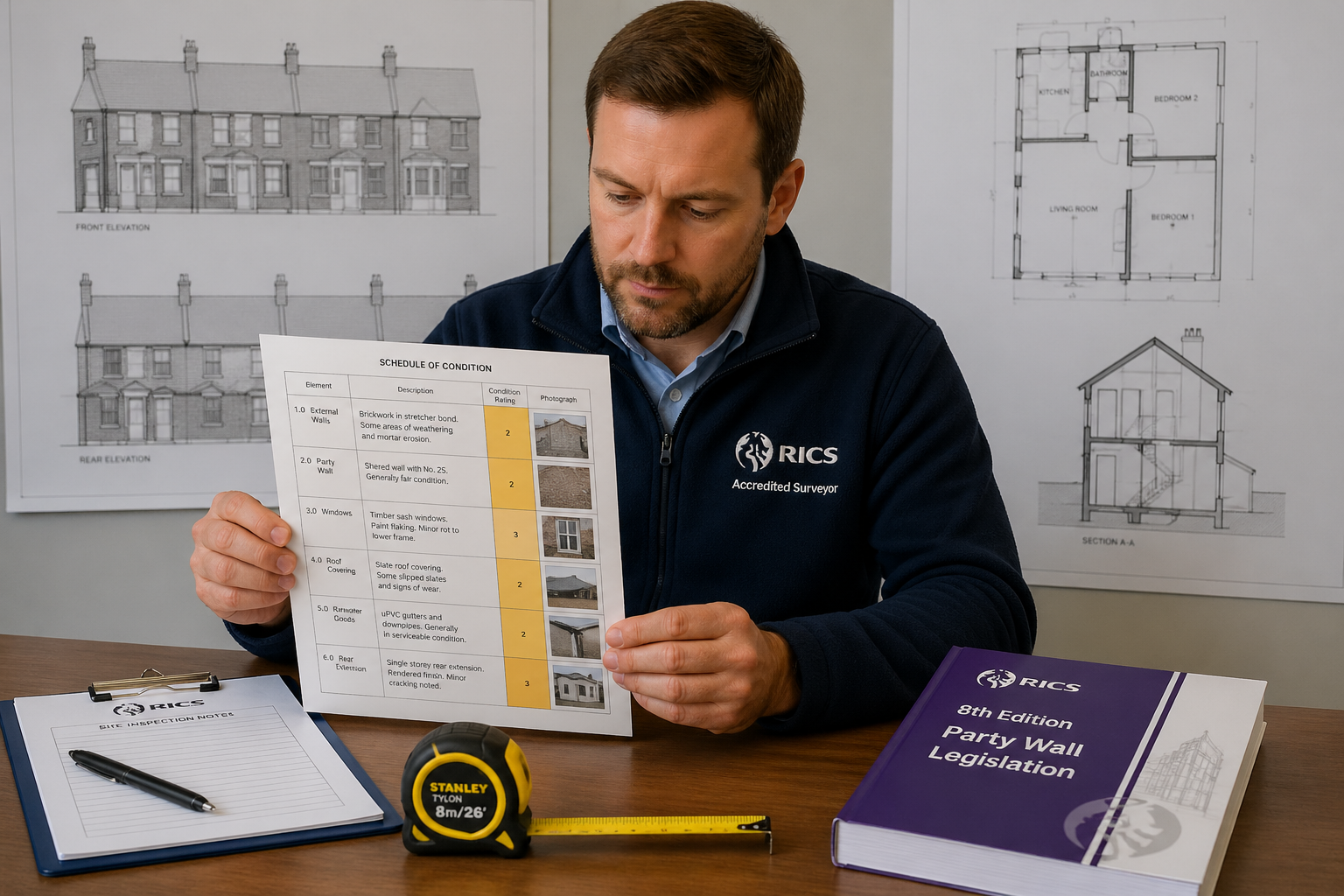
- A schedule of condition is a legally significant document that records the pre-works state of an adjoining owner's property, protecting both parties from unfounded or disputed damage claims [4].
- RICS is currently updating its party wall practice guidance (8th Edition) with enhanced templates, revised appointment letters, and updated draft awards [3].
- Effective schedules use a tabular format covering all building elements, supported by high-quality, geotagged photography [2].
- The document must be completed before works commence — retrospective schedules carry little evidential weight.
- Both the building owner and adjoining owner benefit from a thorough schedule; it prevents overclaiming as much as it prevents underpaying [1].
What Is a Schedule of Condition and Why Does It Matter?
A schedule of condition is a structured survey report that records the existing state of a property — or specific parts of it — at a defined point in time [4]. In the context of party wall works, that point is always before notifiable construction begins.
Under the Party Wall Act 1996, both the building owner (the one carrying out works) and the adjoining owner (the neighbour) have rights and responsibilities. The party wall award — the formal agreement that governs how works proceed — typically includes or references a schedule of condition [2]. This document then serves as the benchmark if the adjoining owner later claims that the works caused damage.
💬 "Party wall awards typically include a schedule of condition to record building condition before work starts, which can be checked in the event of future disputes or allegations of damage." [2]
Without a schedule, any crack, stain, or settlement that appears after works have started becomes a matter of opinion rather than evidence. With one, a surveyor can compare pre- and post-works conditions with precision.
The Dual-Protection Principle
Schedules of condition are not one-sided documents. They protect:
- The adjoining owner — by providing documented proof of pre-existing conditions and any new damage caused by works.
- The building owner — by demonstrating that certain defects existed before the works began, preventing inflated or fraudulent claims [1].
This dual-protection principle is why RICS-trained surveyors treat the schedule as a core professional deliverable, not an optional extra. For more on party wall agreements and their costs, understanding where the schedule fits in the overall process is essential.
Advanced RICS Templates: Structure, Format, and the 2026 Updates
The Standard Tabular Format
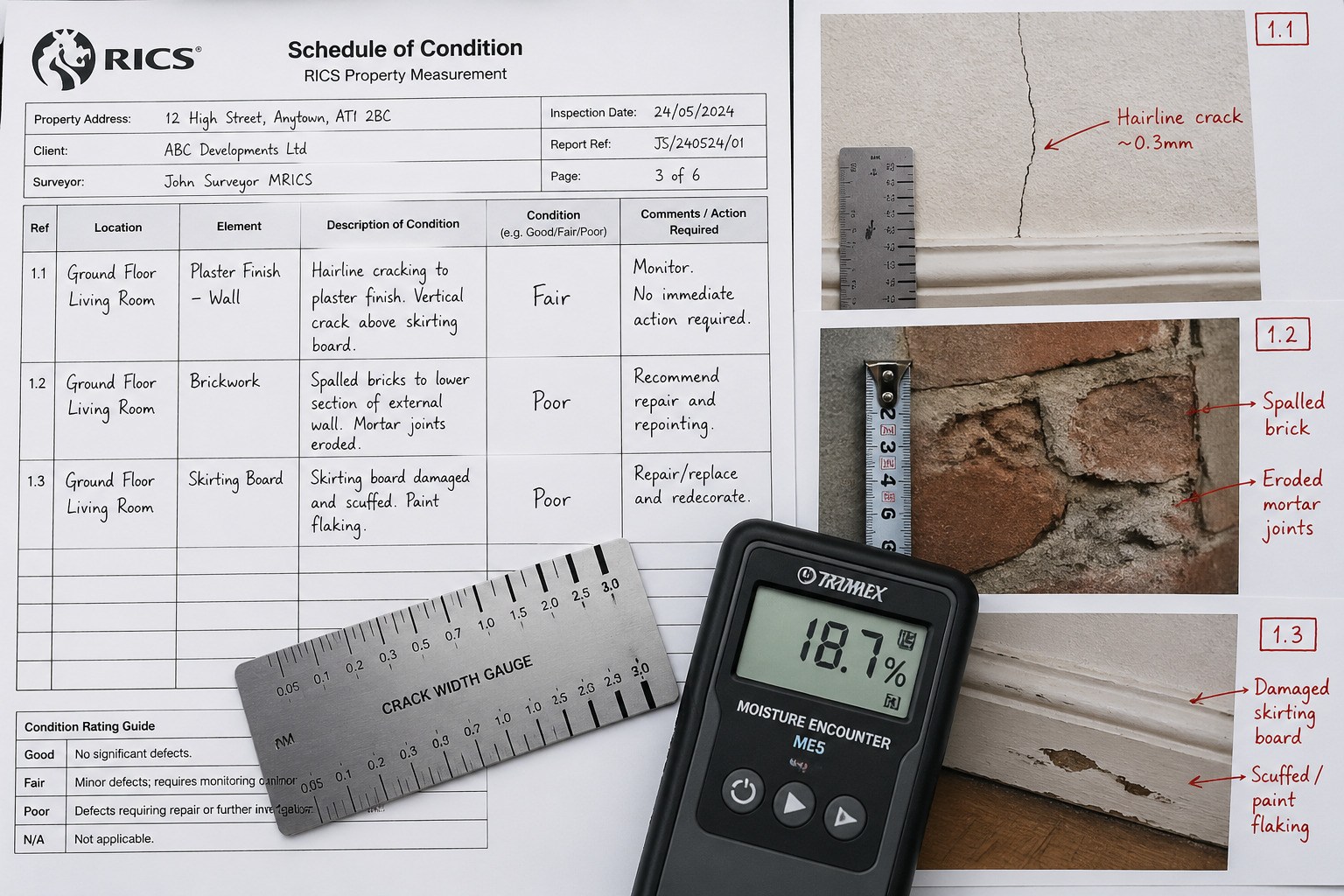
A well-constructed schedule of condition records each building element systematically. The standard RICS-informed format uses a tabular structure with columns that typically include:
| Column | Content |
|---|---|
| Element | Wall, ceiling, floor, window, door, etc. |
| Location | Room or area reference |
| Type/Material | Brick, plaster, timber, etc. |
| Condition | Good / Fair / Poor / Defective |
| Description | Detailed narrative of any defects |
| Photo Reference | Cross-reference to numbered photographs |
This tabular approach ensures nothing is overlooked and that the document is easy to navigate during any future dispute [2]. Elements typically covered include:
- 🧱 External walls and brickwork
- 🪟 Windows, frames, and glazing
- 🚪 Doors and door frames
- 🏠 Ceilings and cornices
- 🪵 Floors and skirting boards
- 🔩 Internal plasterwork
- 🛁 Sanitary fittings (where relevant)
- 🌿 Garden walls, paths, and outbuildings
The RICS 8th Edition Consultation: What's Changing in 2026
In April and May 2026, RICS launched a formal consultation on the draft 8th edition of Party Wall Legislation and Procedure, seeking input from surveyors, legal professionals, and dispute resolution practitioners across England and Wales [3].
The draft 8th edition introduces several significant updates relevant to schedules of condition:
- ✅ Enhanced appendices with more detailed guidance on documentation standards
- ✅ Revised letters of appointment and terms to improve clarity between parties
- ✅ Updated draft award templates to support consistency in professional practice [3]
These changes reflect the profession's recognition that inconsistent documentation has historically been a driver of disputes. By standardising templates and expectations, RICS aims to raise the baseline quality of party wall professional work across the industry.
Surveyors preparing schedules in 2026 should ensure their templates align with the updated guidance once the 8th edition is finalised. The schedule of condition service offered by qualified party wall surveyors should reflect these evolving standards.
Key Sections Every Advanced Schedule Must Include
Beyond the basic tabular format, an advanced RICS-aligned schedule should contain:
- Cover page — property address, date of inspection, surveyor's name and RICS membership number, names of both parties.
- Scope and limitations — what was and was not inspected (e.g., areas behind furniture, roof spaces).
- Methodology statement — how the inspection was conducted, tools used, access arrangements.
- Photographic schedule — numbered, dated, and geotagged images cross-referenced to the tabular record.
- Signature and certification — signed by the surveyor and ideally acknowledged by both parties.
Damage Assessment Strategies: Photography Protocols and Enforcement Tactics
Photography as Legal Evidence
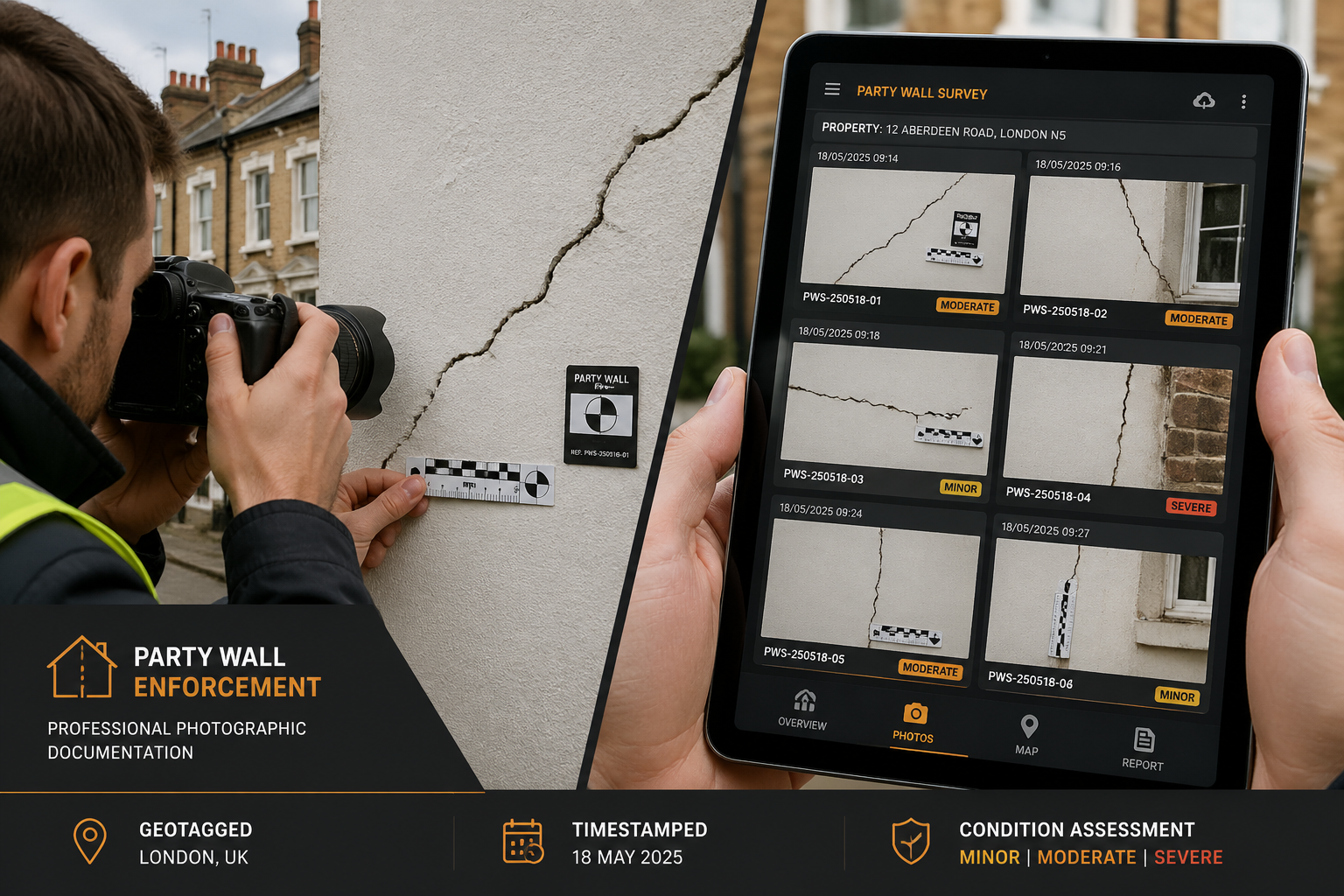
Photographs are arguably the most powerful component of any schedule of condition. A written description of a "hairline crack in plaster above the window" is useful — but a sharp, well-lit, scaled photograph of that crack is irrefutable [6].
Professional photography protocols for party wall schedules should follow these principles:
📸 Technical Standards
- Use a camera capable of at least 12 megapixels (DSLR or high-quality mirrorless preferred).
- Ensure adequate lighting — use supplementary lighting in dark rooms.
- Include a scale reference (crack width gauge or ruler) in all close-up defect shots.
- Capture both wide-angle context shots and close-up detail shots for every defect.
🗂️ Organisation and Metadata
- Enable geotagging on all photographs to record location data automatically.
- Ensure camera date and time are correctly set — timestamps are critical for evidential integrity [6].
- Number photographs sequentially and cross-reference each to the tabular schedule.
- Store originals in RAW format where possible; provide JPEG copies in the report.
📋 Documentation Protocol
- Photograph every room, not just those with visible defects.
- Capture external elevations from multiple angles.
- Record any pre-existing cracks with a crack width gauge — even hairline cracks should be measured and noted.
- Document any pre-existing moisture damage or damp patches with moisture meter readings recorded alongside.
💬 "The photographic record is the schedule's backbone — courts and dispute resolution panels will examine images far more closely than written descriptions when liability is contested."
Crack Classification: A Practical Framework
Not all cracks are equal. Surveyors should classify cracks using a recognised system. The BRE (Building Research Establishment) classification is widely used in practice:
| Category | Width | Description |
|---|---|---|
| 0 | <0.1mm | Hairline — negligible |
| 1 | <1mm | Fine — minor |
| 2 | 1–5mm | Slight — easily filled |
| 3 | 5–15mm | Moderate — requires professional repair |
| 4 | 15–25mm | Severe — structural concern |
| 5 | >25mm | Very severe — urgent action needed |
Recording the category at the time of the pre-works inspection allows a direct, objective comparison after works complete. If a Category 1 crack becomes Category 3, causation becomes a much clearer argument.
For properties where cracking is already present, a specific defect survey may be advisable before the party wall schedule is finalised, to establish whether existing movement is live or historic.
Enforcement Tactics: What Happens When Damage Occurs?
If an adjoining owner believes the notifiable works have caused damage, the process for pursuing a claim is structured but requires a robust schedule to succeed:
Step 1: Post-Works Inspection
Once works are complete (or at any point damage is suspected), the party wall surveyor carries out a post-works inspection, comparing current conditions directly against the pre-works schedule.
Step 2: Causation Assessment
The surveyor assesses whether identified damage is consistent with the type of works carried out — for example, vibration from demolition causing plaster cracking, or excavation causing settlement cracks. This is where the party wall surveyor's expertise becomes critical.
Step 3: Agreed or Disputed Award
- If both surveyors agree on causation and quantum, a supplementary award can be issued requiring the building owner to make good the damage or pay compensation.
- If surveyors disagree, the matter is referred to the Third Surveyor — a mechanism built into the Party Wall Act 1996 for exactly this purpose.
Step 4: Remediation or Compensation
The building owner is typically required to either repair the damage to the standard recorded in the schedule, or pay the reasonable cost of doing so. Without the schedule, proving what "standard" means is nearly impossible.
Understanding why walls crack — and whether cracking pre-dates the works — is central to any fair enforcement outcome.
Common Mistakes That Undermine Schedules of Condition
Even experienced surveyors can fall into traps that weaken the evidential value of a schedule. The most common errors include:
- ❌ Conducting the inspection after works have started — the schedule must be completed before any notifiable works commence.
- ❌ Failing to access all relevant areas — if a room is inaccessible, note it clearly; do not skip it silently.
- ❌ Poor photograph quality — blurry, poorly lit, or unscaled images carry little weight.
- ❌ Vague descriptions — "ceiling in poor condition" is insufficient; specify location, extent, and type of defect.
- ❌ No crack width measurement — estimating crack widths without a gauge introduces subjectivity.
- ❌ Missing the building owner's acknowledgement — where possible, both parties should sign or acknowledge the schedule.
Monitoring surveys during the works themselves can add an additional layer of protection, particularly for longer or more disruptive projects.
Schedules of Condition for Party Wall Works: Practical Checklist for 2026
Use this checklist before submitting any schedule of condition as part of a party wall award:
- Inspection completed before works commence ✅
- All rooms and external areas inspected and documented ✅
- Tabular format used with element, location, condition, and photo reference columns ✅
- Photographs numbered, geotagged, and timestamped ✅
- Scale reference included in all defect photographs ✅
- Crack widths measured and classified using BRE categories ✅
- Moisture readings taken and recorded where relevant ✅
- Scope and limitations clearly stated ✅
- Surveyor's RICS credentials included on cover page ✅
- Document cross-referenced within the party wall award ✅
- Copies provided to both building owner and adjoining owner ✅
Conclusion: Building a Defensible Record Before the First Brick Moves
A schedule of condition is not bureaucratic box-ticking — it is the single most important protective document in any party wall process. When prepared correctly, using RICS-aligned templates and rigorous photography protocols, it transforms potential disputes into straightforward, evidence-based resolutions.
In 2026, with RICS actively updating its party wall practice guidance through the 8th Edition consultation, there has never been a better moment for surveyors and property owners alike to raise their standards [3]. The new templates, revised appointment letters, and updated award formats will provide a stronger framework — but the fundamentals remain unchanged: inspect thoroughly, document precisely, and photograph everything.
Actionable next steps:
- If you are a building owner — instruct a qualified party wall surveyor as early as possible and ensure a schedule of condition is commissioned before any notifiable works begin.
- If you are an adjoining owner — request sight of the schedule before works start and raise any concerns with your own appointed surveyor.
- If you are a surveyor — review your current templates against the RICS 8th Edition draft guidance and update your photography protocols to meet evidential standards.
- For all parties — understand that a well-prepared schedule protects everyone. It is not an adversarial document; it is a shared factual record.
The cost of getting a schedule of condition right is modest. The cost of not having one — when damage occurs and liability is disputed — can be significant. For a full overview of what this process involves and what to expect from professional fees, see the cost of party wall surveyor guide.
References
[1] Schedules Of Condition – https://www.briangalesurveyors.com/schedules-of-condition/
[2] Schedules Of Condition – https://collier-stevens.co.uk/services/schedules-of-condition/
[3] Rics Launches Consultation On Updated Party Wall Practice Guidance – https://www.rics.org/news-insights/rics-launches-consultation-on-updated-party-wall-practice-guidance
[4] Party Walls Specimen Schedule Of Condition – https://www.isurv.com/downloads/download/32/party_walls_specimen_schedule_of_condition
[5] Schedule Of Condition – https://www.isurv.com/info/20/surveying_party_walls/651/schedule_of_condition
[6] Schedules Of Condition In Party Wall Disputes Photography Documentation And Evidence Standards For Surveyors – https://nottinghillsurveyors.com/blog/schedules-of-condition-in-party-wall-disputes-photography-documentation-and-evidence-standards-for-surveyors
[7] Building Surveying Standards – https://www.rics.org/profession-standards/rics-standards-and-guidance/sector-standards/building-surveying-standards