

Over 40% of contested divorce proceedings in England and Wales involve a dispute over the value of the matrimonial home — making accurate, impartial property valuation one of the most consequential professional services in family law. When two parties cannot agree on what a shared asset is worth, the court increasingly turns to a single chartered surveyor to provide a definitive answer. Understanding how Single Joint Expert Valuations in Matrimonial Property Disputes: RICS Best Practices for 2026 work — and what standards govern them — is essential for solicitors, separating couples, and surveyors alike.
This guide explains the role of the Single Joint Expert (SJE), the valuation methodologies applied, the evidence standards required by courts, and how updated RICS professional standards are shaping practice in 2026.
Key Takeaways 📌
- A Single Joint Expert (SJE) is a neutral, court-appointed chartered surveyor instructed by both parties jointly to provide an independent property valuation.
- RICS professional standards — including a newly updated expert witness framework consulted on in late 2025 — set strict requirements for impartiality, integrity, and methodological rigour [3][6].
- Valuations must follow the RICS Red Book (Valuation – Global Standards) and comply with Civil Procedure Rules (CPR) Part 35 [1][7].
- Conditional fees for SJE work are now treated with extreme caution under updated RICS guidance, permissible only in exceptional circumstances [3].
- Real-world disputes often hinge on comparable evidence quality, property condition, and the surveyor's ability to withstand cross-examination.

What Is a Single Joint Expert in Matrimonial Property Disputes?
When divorcing parties disagree on the value of a shared property, the Family Court has two broad options: allow each party to instruct their own expert, or appoint a single expert jointly instructed by both sides. The latter — the Single Joint Expert — is strongly preferred under the Family Procedure Rules and Civil Procedure Rules Part 35 [1].
The SJE's duty is not to either party. It is to the court. This distinction is fundamental. A chartered surveyor acting as an SJE must provide an objective, evidence-based valuation that the judge can rely upon, regardless of which outcome benefits which party.
💬 "The overriding duty of an expert witness is to the court, not to the party who instructs or pays them." — RICS Guidance on Expert Witnesses [6]
Why Courts Prefer the SJE Model
- ✅ Reduces adversarial "battle of the experts" that inflates costs
- ✅ Speeds up proceedings by providing a single agreed evidential baseline
- ✅ Limits the risk of partisan valuations that diverge wildly
- ✅ Aligns with the court's overriding objective of proportionality
The SJE model does not eliminate disagreement entirely. Either party retains the right to challenge the SJE's report through written questions under CPR 35.6, and in exceptional cases, the court may permit a second expert. But the SJE's report carries significant weight — often becoming the definitive figure used in the financial settlement.
For those seeking to understand the broader value of qualified surveyors in property matters, it helps to understand why RICS-accredited surveyors are held to such rigorous professional standards.
RICS Standards Governing SJE Valuations in 2026
The Updated Expert Witness Framework
The professional landscape for expert witnesses shifted significantly in late 2025. RICS published a draft updated standard — Surveyors Acting as Expert Witnesses — for consultation, with the consultation period closing on 7 October 2025 [3][6]. This represents the most significant revision to expert witness guidance in several years and directly affects how Single Joint Expert Valuations in Matrimonial Property Disputes: RICS Best Practices for 2026 are conducted.
Key changes introduced or proposed under the updated standard include:
| Area | Previous Approach | 2026 Updated Position |
|---|---|---|
| Integrity & Impartiality | Core duty stated broadly | Explicitly reinforced with new risk categories [3] |
| Conditional Fees | Discouraged | Permitted only in exceptional circumstances [3] |
| Expert Meetings | Permitted with general guidance | Require prior knowledge and consent of instructing client [3] |
| Technology Risks | Not specifically addressed | New guidance on AI tools and digital evidence [3] |
| Scope of Expertise | General competence requirement | Stricter "working within area of expertise" mandate [6] |
The RICS Red Book and Valuation Standards
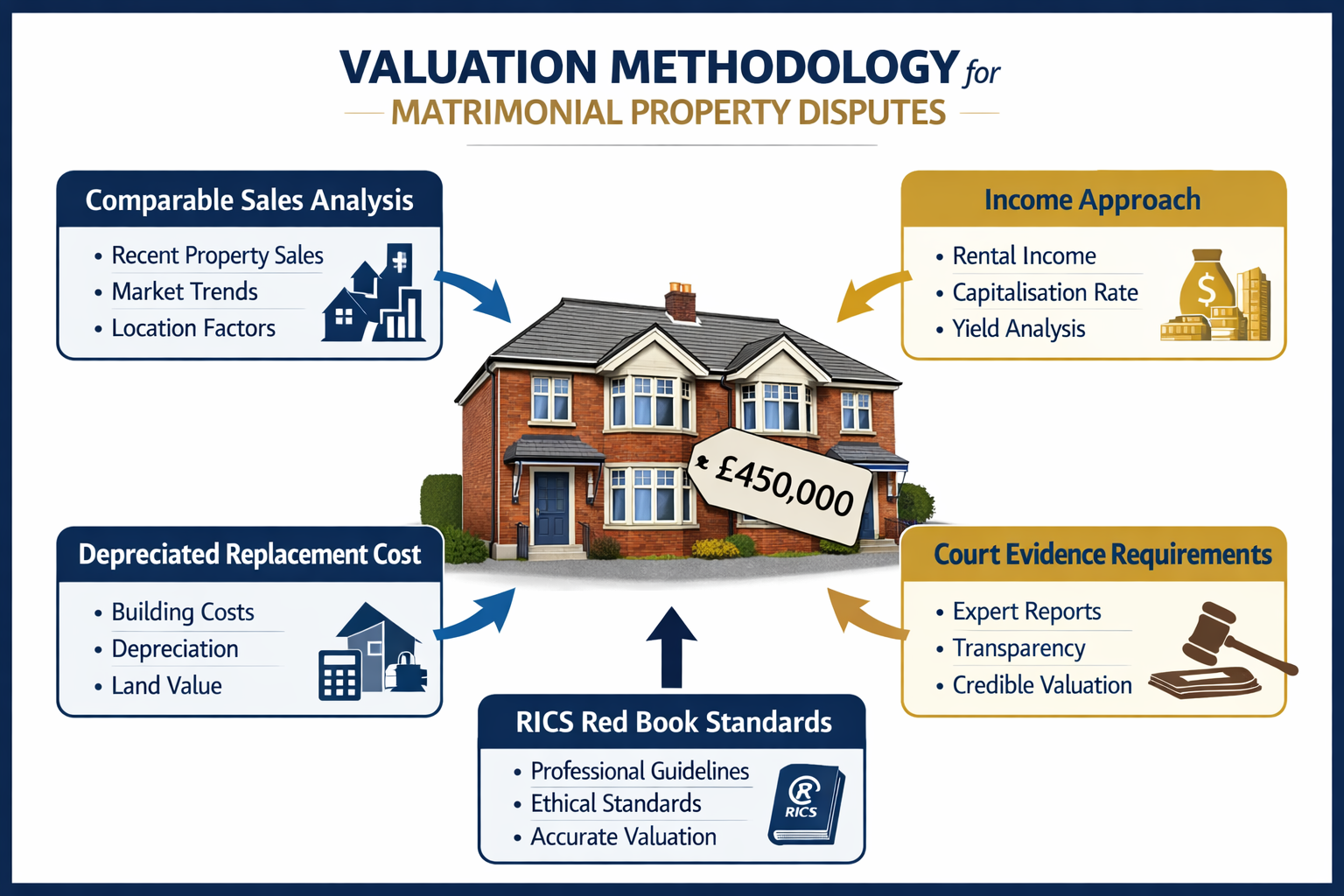
All matrimonial property valuations must comply with the RICS Valuation – Global Standards (commonly called the Red Book), which sets out the basis of value, methodological requirements, and reporting obligations [7]. In matrimonial cases, the relevant basis of value is almost always Market Value — defined as the estimated amount for which an asset should exchange on the date of valuation between a willing buyer and a willing seller in an arm's-length transaction.
The Red Book requires surveyors to:
- Clearly state the effective date of valuation (critical in divorce cases where property values may have changed between separation and hearing)
- Disclose any conflicts of interest before accepting instructions
- Provide a reasoned, evidence-based opinion rather than an unsupported figure
- Comply with UK National Supplement requirements for domestic residential valuations [7]
For context on how RICS surveys support property price negotiations more broadly, see how an RICS survey can help negotiate property prices.
Valuation Methodologies Applied in Matrimonial Cases
The Comparable Sales Method
The comparable sales (or market comparison) approach is the primary methodology for residential matrimonial valuations. The surveyor identifies recent sales of genuinely comparable properties — similar in size, type, location, condition, and tenure — and adjusts for differences to arrive at a supportable value opinion.
In practice, this requires:
- Selecting comparables — ideally within 0.5 miles and sold within 6–12 months of the valuation date
- Adjusting for differences — floor area, condition, garden size, parking, and local amenities
- Weighting the evidence — giving greater weight to the most similar and most recent transactions
- Documenting the reasoning — so that either party's solicitor can scrutinise the logic
In contentious cases, the quality and selection of comparables is frequently the battleground. A surveyor who cherry-picks comparables — whether intentionally or through negligence — risks having their report successfully challenged.
The Income Approach for Investment Properties
Where the matrimonial asset includes buy-to-let properties or mixed-use assets, the income capitalisation approach may supplement or replace the comparable sales method. This involves:
- Estimating the gross rental income achievable at the valuation date
- Deducting void periods, management costs, and maintenance allowances
- Applying an appropriate yield derived from comparable investment transactions
This method is more complex and introduces additional variables — making it particularly susceptible to challenge if the surveyor's yield assumptions are not well-supported by market evidence [4][5].
Depreciated Replacement Cost
The depreciated replacement cost (DRC) method is rarely used in matrimonial residential cases but may be relevant for unusual or specialist properties — such as a converted church, a listed building with limited comparable sales, or a rural property with significant agricultural value. The surveyor estimates the cost of replacing the building at current prices, then applies depreciation for age, condition, and obsolescence.
Leasehold Considerations
Leasehold properties introduce additional complexity. A short lease — typically below 80 years — can significantly reduce market value, and the potential for a lease extension must be factored into the valuation. Surveyors must understand the key considerations when checking a leasehold property and how lease extension valuations affect the overall asset value in a divorce settlement.
Evidence Standards and Court Compliance
CPR Part 35 Requirements
An SJE report submitted to the Family Court must comply with Civil Procedure Rules Part 35 and Practice Direction 35. The report must:
- Be addressed to the court, not to either party
- Include a statement of truth signed by the expert
- Set out the expert's qualifications and experience
- Summarise the instructions received from both parties
- State the facts and assumptions on which the opinion is based
- Acknowledge any range of opinion in the relevant field and explain where the expert's view falls within that range [1][2]
Failure to comply with these requirements can result in the report being inadmissible or given reduced weight.
The Expert's Duty Under the Updated RICS Standard
Under the 2026 RICS framework, surveyors acting as SJEs face stricter requirements around expert meetings. If the court directs a meeting between experts (for example, where a second expert has been permitted), the SJE must now obtain prior knowledge and consent from the instructing parties before attending [3]. Furthermore, if discussions at such meetings suggest that settlement is a realistic prospect, the expert is required to report this back to the instructing solicitors [3].
This change reflects growing judicial concern about experts who negotiate informally without transparency — a risk that is particularly acute in emotionally charged matrimonial proceedings.
Conditional Fees: A Red Line in 2026
One of the most significant practical changes in 2026 is the tightened stance on conditional fees. Under the updated RICS standard, a surveyor whose fee is contingent on the outcome of the case — for example, a percentage of the final settlement — faces serious professional risk [3]. The updated guidance identifies only exceptional circumstances where conditional arrangements might be acceptable, and even then requires full disclosure [3].
This matters in matrimonial cases because parties under financial pressure sometimes seek to defer expert fees until settlement. Surveyors must now be extremely cautious about any arrangement that could be interpreted as outcome-dependent.
Real-World Examples of Contentious Asset Divisions
Case Example 1: The Disputed Renovation Premium 🏠
A couple in South London owned a Victorian terrace that one party had substantially renovated during the marriage. The renovating spouse argued the property was worth £950,000; the other party's solicitors suggested £820,000 based on an estate agent's appraisal. The SJE — a RICS-chartered valuer — inspected the property, reviewed planning records confirming the works, and identified five comparable sales of similarly renovated properties within half a mile. The final valuation of £910,000 was accepted by both parties without further challenge, saving an estimated £30,000 in further litigation costs.
Case Example 2: The Leasehold Trap 🔑
In a North London divorce case, the matrimonial home was a leasehold flat with 74 years remaining on the lease. One party had instructed an estate agent who valued it at £480,000 without accounting for the lease length. The SJE identified that the short lease would deter mortgage lenders and reduce the buyer pool, adjusting the valuation to £435,000 and noting the cost of a lease extension. This adjusted figure materially changed the financial settlement calculation [4].
Case Example 3: The Buy-to-Let Portfolio 📊
A high-net-worth divorce involved a portfolio of five rental properties across Greater London. The parties disagreed on both individual values and the appropriate yield to apply. The SJE produced a portfolio valuation report addressing each property individually, using local rental evidence and investment yield data from comparable transactions. The report withstood written questions from both sets of solicitors — a testament to the depth of comparable evidence assembled [5].
For surveyors covering areas with active matrimonial property disputes, local expertise is invaluable. Teams operating across Redbridge and Havering regularly encounter such instructions given the density of owner-occupied housing stock in those boroughs.

Selecting and Instructing an SJE: Practical Guidance
Criteria for Appointing the Right Surveyor
Both parties' solicitors typically agree on the SJE jointly. Key selection criteria include:
- ✅ RICS membership (MRICS or FRICS) with current practising certificate
- ✅ Specialist experience in residential valuation, not just general surveying
- ✅ Local market knowledge — essential for comparable evidence quality
- ✅ No conflict of interest with either party or their advisers
- ✅ Experience of court work and familiarity with CPR Part 35 [1][2]
- ✅ Professional indemnity insurance adequate for the value of the asset
The Letter of Instruction
The joint letter of instruction should clearly set out:
- The property address and tenure
- The effective date of valuation required
- Any specific issues to address (e.g., development potential, lease length, condition defects)
- The format and deadline for the report
- How fees will be split between the parties
Both parties must agree the letter of instruction before it is sent. Disputes about the scope of instructions should be resolved before the surveyor begins work — not after.
Written Questions Under CPR 35.6
Either party may submit written questions to the SJE within 28 days of receiving the report. Questions must be for clarification only — not an attempt to re-argue the valuation. The SJE's answers form part of the evidence. If a party believes the SJE has made a fundamental error, they must apply to the court for permission to instruct a second expert — a high bar to clear [1].
Understanding the full scope of what professional surveyors do in these contexts is helped by reviewing what a surveyor does and their responsibilities.
Conclusion: Actionable Next Steps for 2026
Single Joint Expert Valuations in Matrimonial Property Disputes: RICS Best Practices for 2026 represent a convergence of legal procedure, professional ethics, and technical valuation skill. The updated RICS expert witness framework — shaped by the 2025 consultation — raises the bar for impartiality, transparency, and methodological rigour. For separating couples, solicitors, and chartered surveyors, the practical implications are clear.
Actionable Steps ✅
-
For solicitors: Always instruct an RICS-qualified valuer with demonstrable residential valuation experience and court familiarity. Agree the letter of instruction jointly before engagement.
-
For separating parties: Understand that the SJE's duty is to the court — not to you. Engaging cooperatively with the process typically produces faster, cheaper outcomes than challenging every finding.
-
For surveyors: Review the updated RICS expert witness standard carefully. Avoid any fee arrangement that could be characterised as conditional. Ensure expert meetings are conducted only with prior client consent and are properly documented [3][6].
-
For all parties: Address leasehold issues, condition defects, and development potential in the letter of instruction — do not leave these to emerge as surprises in the report.
-
Seek qualified advice early: Engaging an experienced RICS-accredited surveyor at the outset of matrimonial proceedings can prevent costly valuation disputes from derailing settlements.
The stakes in matrimonial property valuation are high — financially, emotionally, and professionally. Getting the expert appointment right is not a procedural formality. It is the foundation on which a fair financial settlement is built.
References
[1] Expert Witnesses Single Joint Experts And Independent Experts – https://www.rics.org/dispute-resolution-service/drs-information-hub/expert-witnesses-single-joint-experts-and-independent-experts
[2] 16 Expert Witness Services Ew May 2022 – https://www.rics.org/content/dam/ricsglobal/documents/standards/building-surveying-standards/standard-forms-of-consultation/16-expert-witness-services_ew_may-2022.pdf
[3] New Expert Witness Guidance For Rics Members – https://www.nmrk.com/en-gb/perspectives/new-expert-witness-guidance-for-rics-members
[4] Expert Witness Valuations In 2026s Stabilizing Market Rics Standards For Mortgage Disputes And Property Disagreements – https://nottinghillsurveyors.com/blog/expert-witness-valuations-in-2026s-stabilizing-market-rics-standards-for-mortgage-disputes-and-property-disagreements
[5] Expert Witness Valuations In 2026 Housing Disputes Rics Protocols For North South Price Divergence Cases – https://nottinghillsurveyors.com/blog/expert-witness-valuations-in-2026-housing-disputes-rics-protocols-for-north-south-price-divergence-cases
[6] Surveyors Acting As Expert Witnesses – https://www.rics.org/profession-standards/rics-standards-and-guidance/sector-standards/dispute-resolution-standards/surveyors-acting-as-expert-witnesses
[7] Valuation Standards – https://www.rics.org/profession-standards/rics-standards-and-guidance/sector-standards/valuation-standards