{"cover":"Professional landscape format (1536×1024) hero image with bold text overlay: 'Expert Witness Roles in Awaab's Law Fire Hazard Disputes: 2026 Evidence Standards' in extra large 72pt white bold sans-serif font with dark semi-transparent background panel, centered upper-third composition. Background shows dramatic split scene: left side features ACM cladding panels on a residential tower block with visible fire damage scorch marks, right side shows an expert witness surveyor in hard hat examining electrical panels with clipboard and thermal imaging camera. Color palette: deep navy blue, white text, amber/orange warning accents. High contrast, magazine cover editorial quality, professional legal-property aesthetic.","content":["Landscape format (1536×1024) editorial illustration showing a formal UK courtroom scene from elevated angle, with a professional expert witness surveyor standing at witness box holding CPR Part 35 compliant report documents, judge's bench visible in background, large projected screen displaying cladding cross-section diagrams and fire spread analysis charts. Color scheme: dark oak wood tones, white legal documents, red hazard annotations. Awaab's Law 2026 expansion timeline graphic overlaid in corner. Sharp, editorial quality, legal-professional aesthetic with detailed document close-up.","Landscape format (1536×1024) split-panel technical infographic scene showing left panel: close-up of ACM aluminium composite cladding sample being examined under laboratory conditions with fire test annotations, flame spread arrows, and material composition labels. Right panel: electrical consumer unit with exposed wiring being inspected by gloved hands holding thermal imaging device showing heat signatures in orange-red spectrum. Central dividing element shows Awaab's Law Phase 2 2026 expansion badge. Dark technical blueprint background, amber warning colors, professional forensic investigation aesthetic, high detail.","Landscape format (1536×1024) overhead flat-lay composition on professional desk surface showing organized expert witness evidence bundle: CPR Part 35 report documents with highlighted sections, thermal imaging photographs of electrical failures, cladding material test certificates, building survey floor plans, a gavel, and a laptop displaying a structural defect database. Post-it notes with deadlines '24-hour emergency response' and '2026 fire hazard standards' visible. Color palette: clean white desk, navy document folders, gold legal accents, red hazard stamps. Sharp editorial photography style, high contrast professional legal workspace."]
Over 2.5 million social housing tenants in England live in properties with at least one serious hazard, according to government housing data — and from 2026, the legal framework holding landlords accountable for those hazards has fundamentally changed. The expansion of Awaab's Law into fire and electrical hazards means that expert witnesses are no longer a courtroom luxury; they are an operational necessity for landlords, tenants, and legal teams alike.
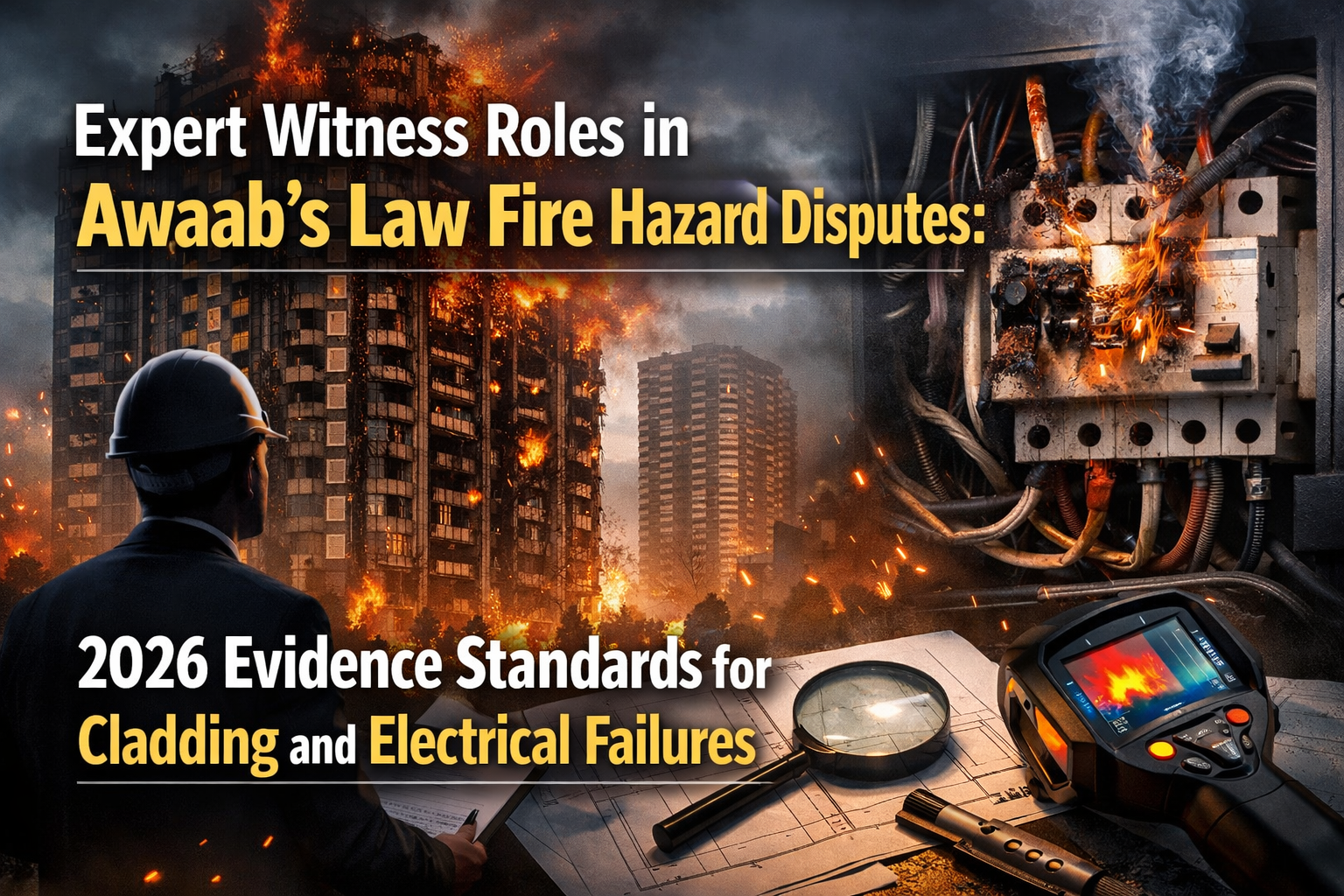
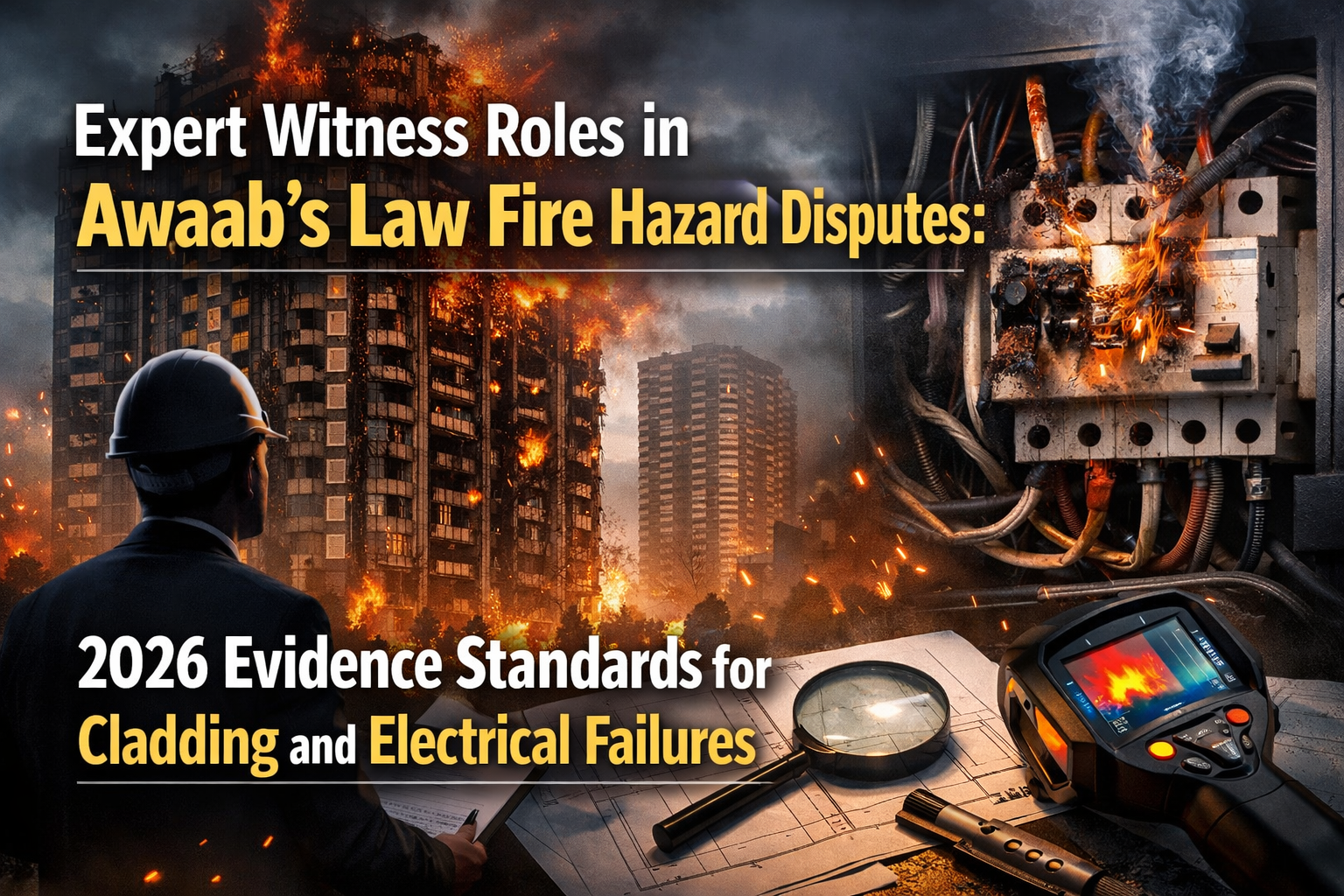
This article examines Expert Witness Roles in Awaab's Law Fire Hazard Disputes: 2026 Evidence Standards for Cladding and Electrical Failures — covering how qualified surveyors prepare CPR Part 35-compliant reports, what courts expect from technical evidence, and how the 2026 phase expansion reshapes liability in the social housing sector.
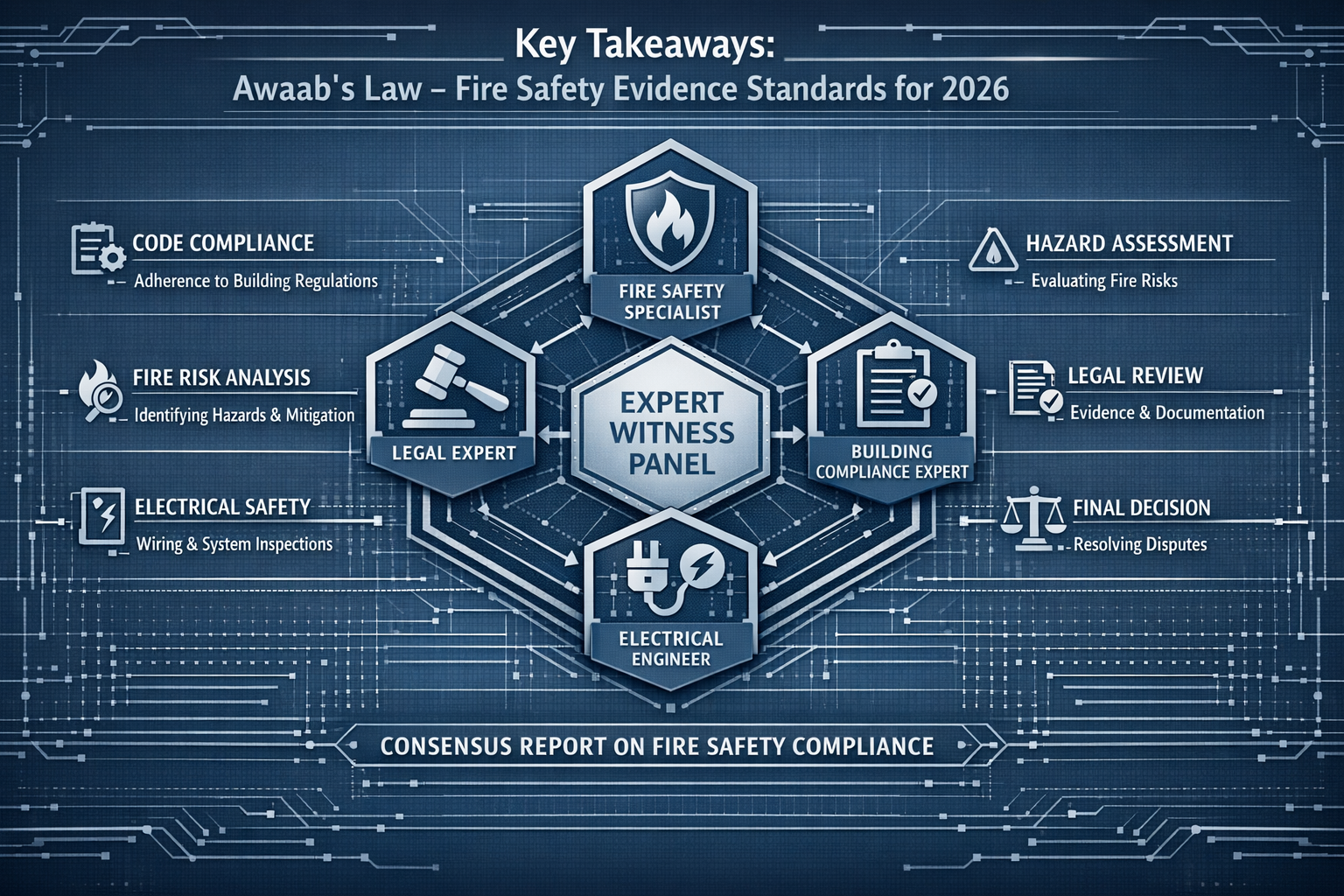
Key Takeaways 📋
- Awaab's Law Phase 2 (2026) expands beyond damp and mould to include fire hazards, electrical hazards, excessive cold/heat, and noise — significantly widening landlord liability [1]
- Cladding issues are explicitly excluded from Awaab's Law regulations; they fall under separate legislation such as the Building Safety Act 2022 [1]
- Expert witnesses in fire hazard disputes must produce CPR Part 35-compliant reports — impartial, court-ready documents that meet strict procedural standards
- Emergency hazards trigger a 24-hour response obligation, defined as risks a reasonable landlord with relevant knowledge would act on immediately [1]
- Awaab's Law currently applies only to social housing landlords (housing associations and local authorities), not private landlords [1]
Understanding the 2026 Expansion: What Changed and Why It Matters
From Damp and Mould to Fire and Electrical Hazards
When Awaab's Law first came into force under Phase One (October 2025), it targeted a narrow but critical set of hazards: damp, mould, and emergency risks. Investigation deadlines were set at 24 hours for emergencies — defined as "a risk of harm to the occupier's health or safety that a reasonable lessor with the relevant knowledge would take steps to make safe within 24 hours" [1].
Phase 2, rolling out from 2026, dramatically widens that scope. Social housing landlords must now respond within statutory timeframes to [1]:
- 🔥 Fire hazards (structural fire risks, inadequate fire doors, blocked escape routes)
- ⚡ Electrical hazards (faulty wiring, overloaded circuits, unsafe consumer units)
- 🥶 Excessive cold or heat (inadequate heating systems, thermal inefficiency)
- 🔊 Noise (structural noise transmission causing health impacts)
- 🧼 Health and hygiene risks (beyond damp and mould)
"The 2026 expansion transforms Awaab's Law from a reactive damp-management tool into a comprehensive hazard accountability framework — one that demands technical expertise courts can rely on."
The Cladding Carve-Out: A Critical Distinction
One of the most important points for legal teams to understand is that cladding issues are explicitly excluded from Awaab's Law regulations [1]. This is not an oversight — cladding remediation is governed by separate legislation, primarily the Building Safety Act 2022 and the associated Leaseholder Protections. However, this does not mean cladding is irrelevant to fire hazard disputes. Where cladding contributes to a fire risk scenario — for instance, where ACM panels increase fire spread risk that affects tenants' safety — expert witnesses may need to address cladding evidence within the broader fire hazard context, even if the cladding claim itself sits under different statutory provisions.
This distinction matters enormously when structuring expert witness reports. A surveyor acting as an expert witness must clearly delineate which findings relate to Awaab's Law obligations and which fall under Building Safety Act frameworks. Conflating the two is a common error that undermines report credibility in tribunal and court proceedings.
For landlords and tenants navigating these overlapping frameworks, understanding legal disputes in property is essential groundwork before engaging expert witnesses.
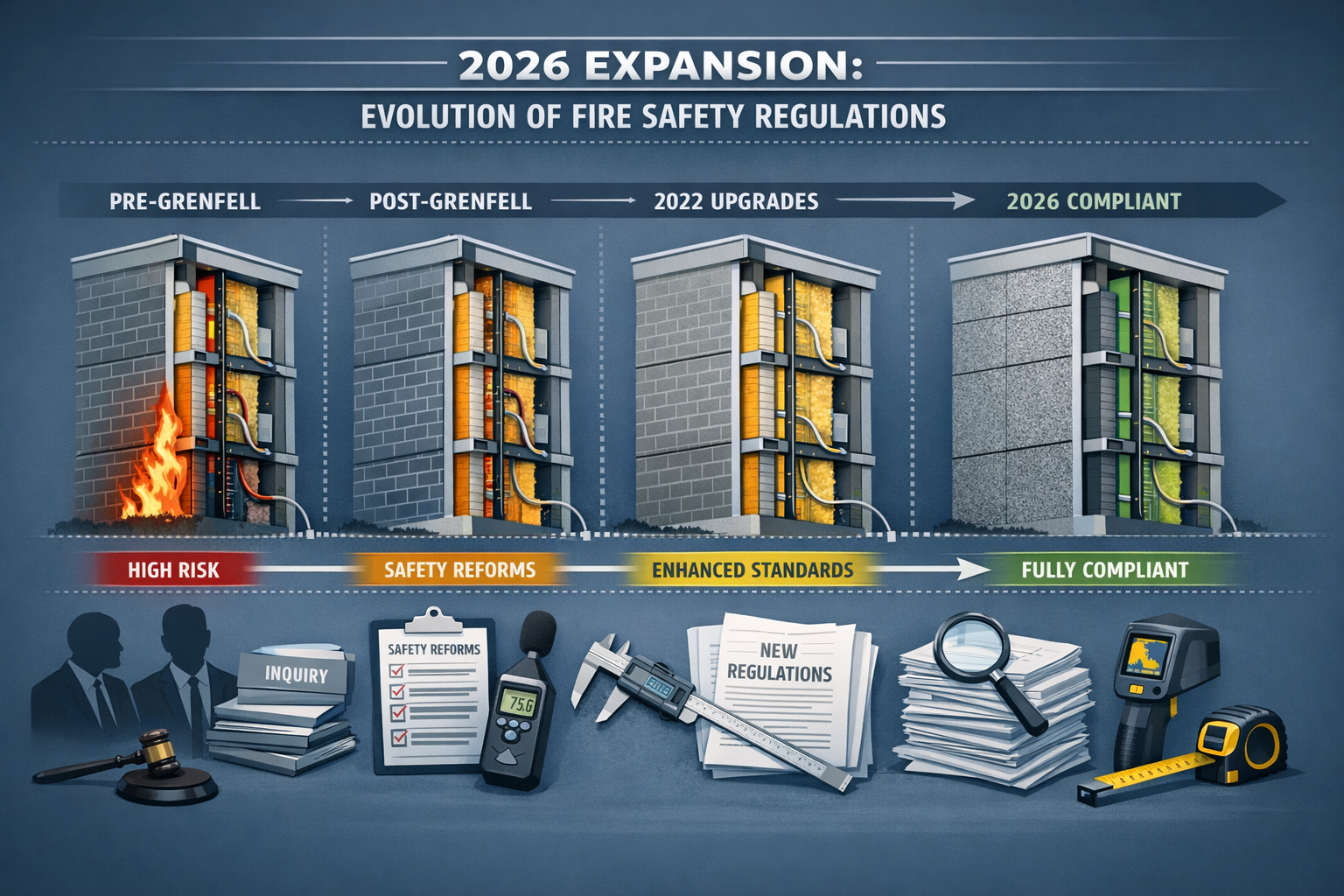
Expert Witness Roles in Awaab's Law Fire Hazard Disputes: 2026 Evidence Standards for Cladding and Electrical Failures — The CPR Part 35 Framework
What CPR Part 35 Requires of Expert Witnesses
Civil Procedure Rules Part 35 governs how expert evidence is presented in English courts and tribunals. For surveyors acting as expert witnesses in Awaab's Law fire hazard disputes, CPR Part 35 compliance is non-negotiable. The rules establish that:
- The expert's primary duty is to the court, not to the instructing party
- Reports must contain a statement of truth and a declaration of the expert's qualifications
- Opinions must be clearly distinguished from facts
- Where there is a range of professional opinion, the report must explain it
- The expert must state whether their opinion could change with additional information
In the context of 2026 fire hazard disputes, this means a surveyor cannot simply state that a property "has fire risks." The report must specify the nature of the hazard, the standard it falls below, the causal link to tenant harm, and the remediation required — all expressed with the impartiality of an officer of the court.
Building Surveyors vs. Electrical Engineers: Matching Expertise to Hazard Type
Not every surveyor is qualified to opine on every fire hazard. Courts increasingly scrutinise whether the expert's specific qualifications match the hazard in question. Here is a practical breakdown:
| Hazard Type | Appropriate Expert | Key Qualifications |
|---|---|---|
| Structural fire risk (e.g., fire doors, compartmentation) | Chartered Building Surveyor | MRICS/FRICS, fire safety training |
| Electrical failures (consumer units, wiring) | Electrical Engineer or Approved Inspector | IET Wiring Regulations (BS 7671) |
| Cladding fire spread (ACM, HPL panels) | Fire Engineer or Façade Specialist | FIFireE, BRE/UKAS accreditation |
| Thermal hazards (excessive cold/heat) | Building Surveyor or Energy Assessor | DEA qualification, SAP/RdSAP experience |
| Combined structural/fire hazard | Senior Chartered Surveyor | MRICS with specialist fire safety CPD |
This table is not exhaustive, but it illustrates a fundamental principle: instructing the wrong type of expert is a procedural vulnerability that opposing counsel will exploit. For properties with structural defects that intersect with fire risks, a chartered building surveyor with fire safety expertise is typically the most defensible choice.
What a CPR Part 35-Compliant Report Must Cover for Fire Hazard Disputes
A robust expert witness report in an Awaab's Law fire hazard case should include the following sections:
- Instructions and Scope — What the expert was asked to assess and by whom
- Inspection Methodology — Dates, access conditions, tools used (thermal imaging, gas detection, electrical testing equipment)
- Factual Findings — Objective observations, photographic evidence, test results
- Applicable Standards — Reference to HHSRS (Housing Health and Safety Rating System), BS 7671, Approved Document B, and relevant Awaab's Law regulations
- Expert Opinion — Whether a hazard exists, its severity, and the landlord's response obligations
- Causation Analysis — The link between the defect and the risk to tenant health or safety
- Remediation Recommendations — What steps are required, in what timeframe
- Declaration and Statement of Truth — As required by CPR Part 35
"A report that identifies a hazard but fails to link it to a specific tenant health risk will not satisfy the causation threshold courts apply under Awaab's Law."
Practical Evidence Standards: Cladding, Electrical Failures, and the 24-Hour Emergency Threshold
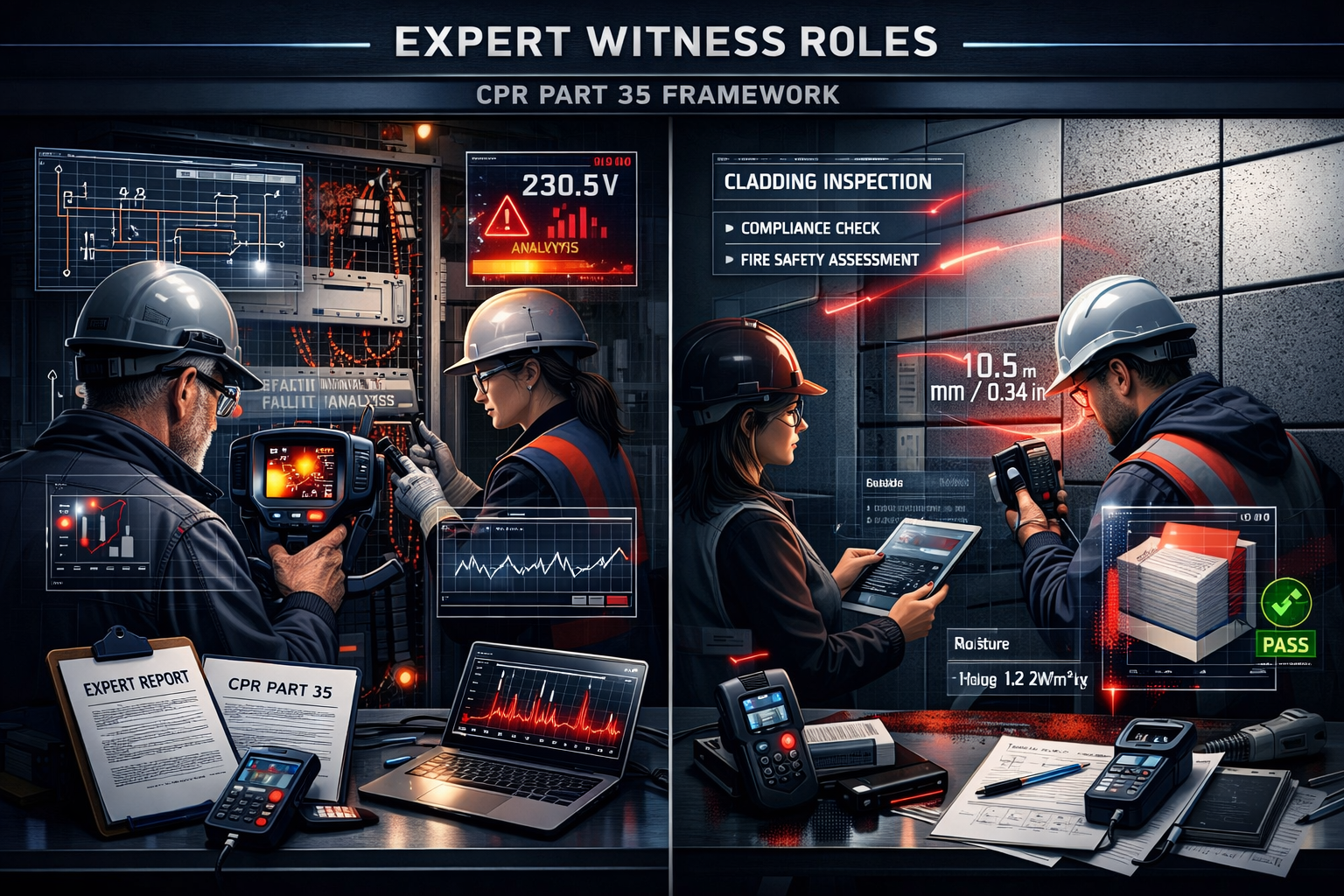
Electrical Hazard Evidence: What Courts Expect in 2026
Electrical failures represent one of the most technically complex categories under the 2026 expansion. Unlike visible damp or mould, electrical hazards are often latent — invisible until they cause harm. This places enormous weight on the expert witness to demonstrate that a hazard existed at the time of the alleged breach, even if it was not immediately apparent.
Key evidentiary elements for electrical hazard disputes include:
- Electrical Installation Condition Reports (EICRs) — These are the baseline. A surveyor must assess whether the landlord had a current EICR, what it found, and whether required remediation was completed [2]
- Thermal imaging evidence — Infrared photography can reveal overheating circuits and connections that are invisible to the naked eye
- Load calculations — Evidence that circuits were overloaded beyond safe capacity
- Manufacturer defect records — Where consumer units or components are subject to known defects or recalls
- Maintenance logs — Demonstrating whether the landlord had knowledge of the hazard and failed to act
Social housing providers who are not prepared for the new legal risks of Awaab's Law's expanded scope face significant exposure [2]. Expert witnesses who can demonstrate a landlord's actual or constructive knowledge of an electrical hazard — combined with a failure to act within statutory timeframes — create the strongest foundation for tenant claims.
Fire Hazard Evidence Beyond Cladding
While cladding sits outside Awaab's Law's direct scope [1], other fire hazards are firmly within it. Surveyors acting as expert witnesses in 2026 fire hazard disputes should be prepared to assess and report on:
- Fire door compliance — Gap measurements, self-closing mechanisms, intumescent strips, and cold smoke seals
- Compartmentation failures — Breaches in fire-resistant walls, floors, and ceilings that allow fire spread
- Means of escape — Obstructions, inadequate lighting, and signage failures
- Sprinkler and detection systems — Whether systems are installed, maintained, and functional
- Communal area risks — Storage of combustible materials, blocked corridors
For properties where structural survey findings reveal compartmentation failures, the expert witness must connect those physical defects to the specific fire spread risk they create — not simply note their existence.
The 24-Hour Emergency Standard: Defining the Threshold
The emergency hazard definition under Awaab's Law is precise: a risk that "a reasonable lessor with the relevant knowledge would take steps to make safe within 24 hours" [1]. For expert witnesses, this creates a specific analytical task — determining not just whether a hazard exists, but whether it meets the emergency threshold.
This is a two-part test:
- Objective severity — Would a reasonable landlord with knowledge of the defect recognise it as requiring immediate action?
- Knowledge attribution — Did the landlord have, or should they have had, knowledge of the hazard?
Expert witnesses who conflate these two elements — or who fail to address the knowledge question — produce reports that are vulnerable to challenge. A building survey report that identified fire risks but was ignored by a landlord can be powerful evidence of constructive knowledge in subsequent proceedings.
How Expert Witnesses Support Landlord Defence as Well as Tenant Claims
It is worth noting that expert witnesses serve both sides of Awaab's Law disputes. Landlords facing claims may instruct experts to demonstrate:
- The hazard did not meet the legal threshold for emergency or standard response
- Remediation was completed within the required timeframe
- The defect was not reasonably discoverable prior to the complaint
- The tenant's own actions contributed to or caused the hazard
For social housing providers, having a qualified property surveyor conduct proactive inspections — and retaining those reports — creates a defensible evidence trail. This is particularly important given that Awaab's Law applies only to social housing landlords [1], making compliance documentation a critical risk management tool.
For landlords and tenants in London seeking specialist inspection support, London property surveyors with experience in fire and electrical hazard assessments are well-positioned to provide CPR Part 35-ready reports.
Preparing for Awaab's Law Disputes: Practical Steps for All Parties
Understanding Expert Witness Roles in Awaab's Law Fire Hazard Disputes: 2026 Evidence Standards for Cladding and Electrical Failures is not just an academic exercise — it has immediate practical implications for landlords, tenants, and legal representatives.
For Social Housing Landlords 🏢
- Commission proactive EICRs and fire risk assessments before complaints arise
- Establish documented response protocols that demonstrate compliance with 24-hour emergency timelines
- Retain qualified surveyors who understand CPR Part 35 requirements for potential expert witness roles
- Maintain comprehensive maintenance and inspection logs as contemporaneous evidence
- Understand the boundary between Awaab's Law obligations and Building Safety Act cladding duties [1]
For Tenants and Tenant Advocates 🏠
- Report hazards in writing to create a documented record of the landlord's knowledge
- Request copies of EICRs and fire risk assessments — landlords are obligated to provide them
- Seek early expert assessment if a landlord fails to respond within statutory timeframes
- Understand that homeowner protection resources and legal aid may be available for Awaab's Law claims
For Legal Representatives ⚖️
- Instruct expert witnesses early — the quality of the initial report often determines case outcomes
- Ensure the expert's qualifications match the specific hazard type (see table above)
- Brief experts on the knowledge attribution question — this is frequently the most contested issue
- Consider whether cladding evidence, while outside Awaab's Law, is admissible as contextual fire risk evidence under other causes of action
For those navigating disputes where survey findings are central to the legal argument, understanding how to renegotiate after a poor building survey result provides useful context on how survey evidence shapes legal and commercial outcomes.
Conclusion: The Expert Witness as the Linchpin of 2026 Fire Hazard Accountability
The 2026 expansion of Awaab's Law represents a watershed moment for housing safety accountability in England. By extending statutory obligations to fire hazards, electrical failures, and thermal risks, the legislation creates a new category of complex technical disputes — disputes where the outcome will frequently turn on the quality and credibility of expert witness evidence.
Expert Witness Roles in Awaab's Law Fire Hazard Disputes: 2026 Evidence Standards for Cladding and Electrical Failures demand a level of technical precision, legal literacy, and procedural compliance that not all surveyors are equipped to provide. CPR Part 35 compliance is not a formality; it is the framework that determines whether expert evidence is admitted and weighted by courts and tribunals.
Actionable Next Steps
✅ Landlords: Commission a comprehensive fire and electrical hazard audit now — before a complaint triggers statutory timelines
✅ Tenants: Document every communication about hazards in writing; this creates the evidence trail that supports expert witness findings
✅ Legal teams: Identify and brief appropriate expert witnesses early, matching their specific qualifications to the hazard type in dispute
✅ Surveyors: Invest in CPR Part 35 training and fire/electrical hazard CPD to position for the growing expert witness market created by Awaab's Law Phase 2
✅ All parties: Understand the cladding carve-out — Awaab's Law and the Building Safety Act create parallel but distinct obligations that require separate expert treatment
The stakes in Awaab's Law fire hazard disputes are high: tenant safety, landlord liability, and the credibility of the social housing sector. Expert witnesses who meet the 2026 evidence standards will be indispensable to achieving just outcomes on all sides.
References
[1] Awaabs Law A New Dawn For Tenant Safety – https://beale-law.com/article/awaabs-law-a-new-dawn-for-tenant-safety/
[2] Awaabs Law Is Now In Force Are Social Housing Providers Prepared For The New Legal Risks – https://haroldandmccormacklaw.com/awaabs-law-is-now-in-force-are-social-housing-providers-prepared-for-the-new-legal-risks/
[3] Building Surveys And Awaabs Law 2026 Extensions Identifying Electrical Fire And Temperature Hazards In Prs Properties – https://nottinghillsurveyors.com/blog/building-surveys-and-awaabs-law-2026-extensions-identifying-electrical-fire-and-temperature-hazards-in-prs-properties