
Over 600,000 heat pump installations are projected across UK homes in 2026 — and a significant proportion of them will trigger legal obligations under the Party Wall etc. Act 1996 that many homeowners simply don't see coming.
As the UK accelerates its net zero agenda through heat network expansion, ground-source heat pumps, and large-scale retrofit programmes, the intersection of energy policy and property law has never been more complex. Party Wall Surveys for Heat Pump Installations in 2026: RICS Protocols Amid UK Heat Network Expansion is no longer a niche concern for specialist surveyors — it is a mainstream issue affecting millions of semi-detached and terraced homeowners across England and Wales.
This guide breaks down what the updated RICS protocols mean in practice, when a party wall notice is legally required, and how surveyors are using cutting-edge tools like vibration monitoring and thermal imaging to resolve boundary disputes efficiently.
Key Takeaways 📋
- Heat pump installations near shared boundaries almost always trigger Party Wall Act obligations, particularly ground-source systems requiring excavation.
- RICS launched a consultation on its 8th edition of Party Wall Legislation and Procedure in April–May 2026, the most significant update to guidance in years. [2]
- Vibration monitoring and thermal imaging are now standard tools in party wall surveys for heat pump retrofits, protecting both building owners and adjoining owners.
- Failing to serve a party wall notice before installation can result in injunctions, costly delays, and neighbour disputes — even where no physical damage occurs.
- RICS-accredited party wall surveyors play a critical role in balancing net zero retrofit ambitions with the legal rights of adjoining property owners.

Why Heat Pump Installations Trigger Party Wall Act Obligations
The Party Wall etc. Act 1996 was designed for a world of extensions, loft conversions, and basement excavations. But the UK's net zero retrofit surge has introduced a new category of notifiable work that the legislation's drafters could not have fully anticipated: heat pump systems installed on or near shared boundaries.
Ground-Source Heat Pumps and Excavation Near Boundaries
Ground-source heat pumps (GSHPs) require boreholes or horizontal ground loops — and this is where the Party Wall Act becomes directly relevant. Under Section 6 of the Act, any excavation within 3 metres of a neighbouring structure (or within 6 metres if the excavation goes deeper than the neighbour's foundations) requires a formal party wall notice.
For a typical semi-detached property, a GSHP borehole drilled in the rear garden can easily fall within these thresholds. The legal obligation to serve notice is absolute, regardless of whether the homeowner believes the work will cause any disruption.
💡 Pull Quote: "Ground-source heat pump boreholes are among the most commonly overlooked triggers for Party Wall Act notices in 2026 — the excavation depth alone can bring Section 6 into play."
Air Source Heat Pumps and Party Wall Considerations
Air source heat pumps (ASHPs) present a different but equally important set of considerations. While they don't typically require excavation, mounting an ASHP unit on or very close to a party wall or party fence wall may constitute notifiable work under Section 2 of the Act. Vibration from the unit's compressor, noise transmission through shared masonry, and the physical attachment of brackets to party structures all require careful assessment.
Understanding when you need a party wall agreement is the essential first step for any homeowner planning a heat pump retrofit.
Heat Networks and Communal Infrastructure
The UK government's heat network expansion programme adds another layer of complexity. District heat networks — which pipe thermal energy from centralised sources to multiple properties — often require pipework to pass through or beneath shared structures. This can trigger Section 1 notices (for new walls on the boundary line) and Section 6 notices simultaneously, making professional party wall surveying essential from the earliest planning stages. [3]
RICS Protocols for Party Wall Surveys for Heat Pump Installations in 2026
The 8th Edition Consultation: What's Changing
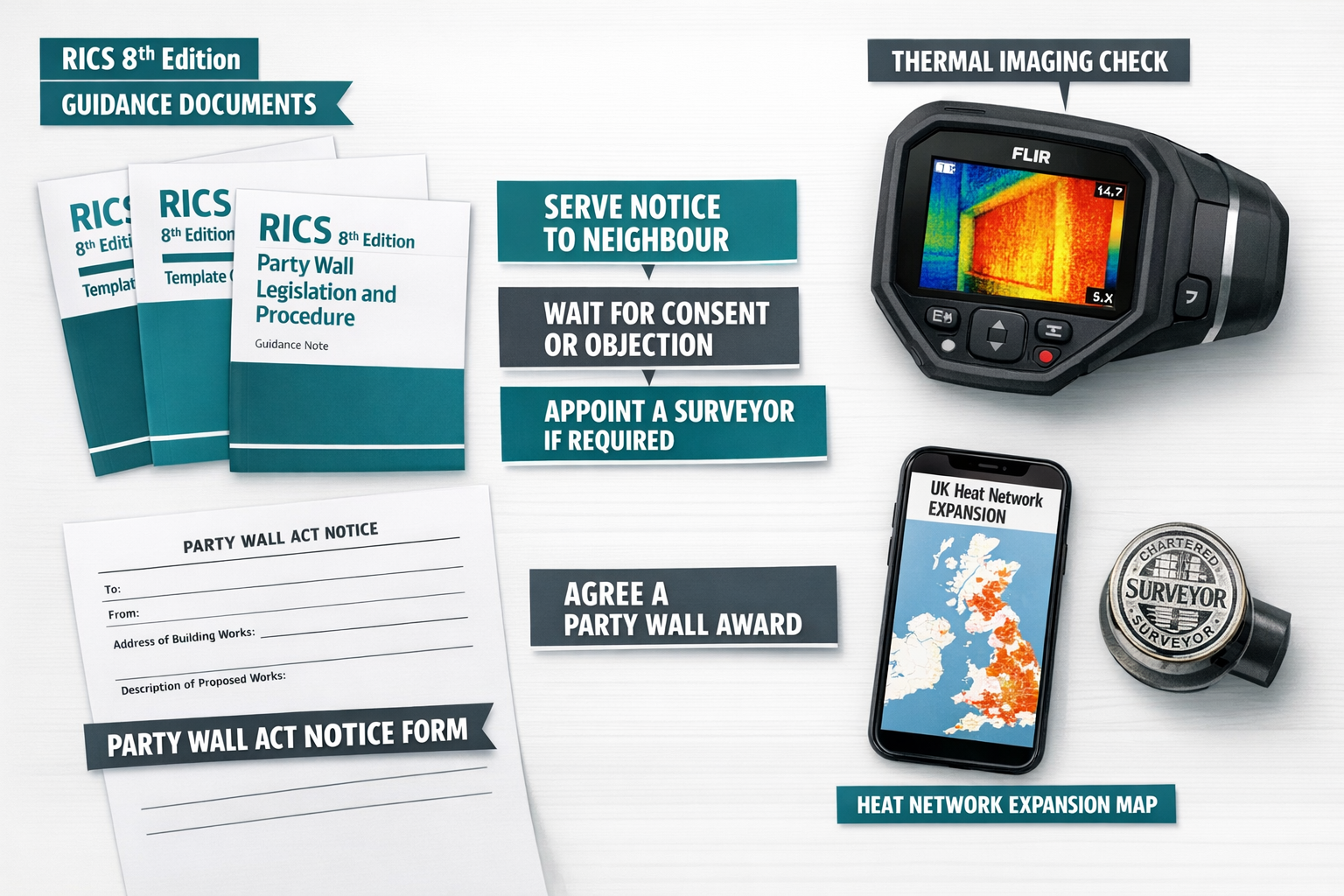
In April 2026, RICS launched a formal consultation on the draft 8th edition of Party Wall Legislation and Procedure — the most significant update to party wall practice guidance in recent years. The consultation, running approximately eight weeks across April and May 2026, actively seeks input from surveyors, legal professionals, dispute resolution practitioners, and other stakeholders across England and Wales. [2]
The updated guidance is specifically designed to support competence and consistency in professional party wall work, with net zero retrofit installations — including heat pumps — identified as a priority area requiring clearer professional standards. [2]
Importantly, heat pumps are explicitly listed as a priority topic in RICS's January 2026 MODUS publication, reflecting the profession's recognition that traditional party wall frameworks need updating for the energy transition era. [4]
Pre-Installation Structural Assessment Protocol
RICS-accredited surveyors now follow a structured pre-installation protocol for heat pump projects that includes: [1]
| Protocol Stage | Key Actions |
|---|---|
| 1. Initial Site Assessment | Review of property deeds, boundary identification, proximity measurements |
| 2. Structural Condition Survey | Assessment of party wall condition before any works begin |
| 3. Notice Preparation | Drafting and serving appropriate notices under the correct Act sections |
| 4. Schedule of Condition | Photographic and written record of adjoining owner's property |
| 5. Award Agreement | Formal party wall award setting out how works will proceed |
| 6. Post-Installation Inspection | Verification that no damage has occurred to shared structures |
The Schedule of Condition is particularly critical for heat pump installations. It creates a legally defensible baseline record of the adjoining owner's property before any drilling, excavation, or structural attachment takes place. Without it, disputes about pre-existing versus installation-caused damage become extremely difficult to resolve.
For a detailed overview of what this process involves, the guide on what a party wall surveyor does and their duties to homeowners provides an excellent foundation.
Vibration Monitoring: A New Standard for GSHP Projects
One of the most significant developments in party wall surveying for heat pump installations is the integration of vibration monitoring during borehole drilling operations. Percussive and rotary drilling for GSHP boreholes generates measurable ground vibration that can cause cracking in adjacent masonry — particularly in older UK terraced housing stock.
RICS-compliant surveyors now routinely deploy vibration monitoring sensors on party walls during drilling operations, with real-time data logged against threshold values specified in BS 7385 and BS 5228. If vibration levels approach agreed thresholds, drilling operations can be paused or modified before damage occurs.
This approach protects both the building owner (from liability claims) and the adjoining owner (from actual structural harm). It also provides an objective, data-driven record that is invaluable in any subsequent dispute resolution process.
Homeowners concerned about existing wall conditions should review guidance on whether cracking walls are a serious concern before any neighbouring works begin.
Thermal Imaging Integration in Party Wall Surveys
Thermal imaging has become an increasingly valuable tool in party wall surveys for heat pump projects, serving two distinct purposes:
-
Pre-installation baseline mapping — Identifying existing thermal bridges, moisture ingress, or insulation deficiencies in the party wall before works commence, ensuring these cannot later be attributed to the heat pump installation.
-
Post-installation verification — Confirming that pipework, refrigerant lines, or heat distribution systems installed near or through party walls are not creating unintended thermal pathways or condensation risks in the adjoining property.
The integration of thermal imaging data into party wall awards is now considered best practice for heat pump retrofits, particularly where systems involve underfloor heating pipework that runs close to shared floor structures. [1]
Resolving Boundary Disputes Efficiently: Surveyor Strategies in 2026
The Three-Surveyor Procedure and Its Limitations
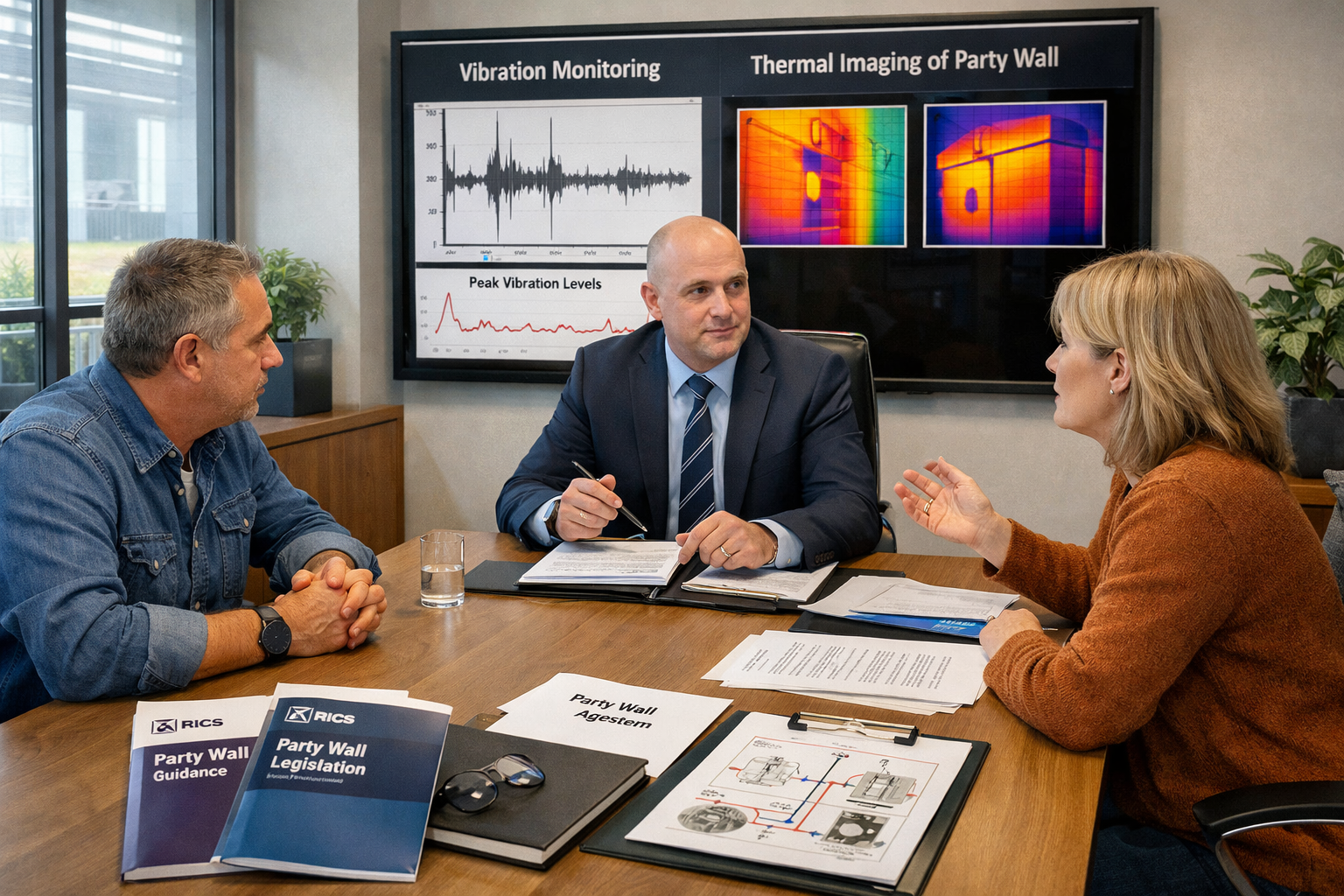
Under the Party Wall etc. Act, if an adjoining owner dissents to proposed works, both parties appoint surveyors (or agree on a single Agreed Surveyor), with a third surveyor available as an umpire. This three-surveyor procedure has served well for conventional building works, but heat pump installations present specific challenges:
- Technical complexity — Many party wall surveyors have limited experience with heat pump system specifications, refrigerant pressures, and ground loop engineering.
- Speed requirements — Heat pump installations are often time-sensitive, tied to government grant windows (such as the Boiler Upgrade Scheme) that have fixed deadlines.
- Noise and vibration concerns — Adjoining owners frequently raise objections based on anticipated operational noise from ASHP units, which falls outside the strict remit of the Party Wall Act but must be managed diplomatically.
The most effective surveyor strategy in 2026 is early engagement — approaching the adjoining owner informally before serving formal notice, explaining the works, and addressing concerns proactively. This approach significantly reduces the likelihood of dissent and the associated delays and costs.
Understanding the Party Wall Act 1996 in full detail helps both building owners and their surveyors navigate this process with confidence.
Case Study: GSHP Installation in South London Terrace 🏠
A homeowner in a 1930s terraced property in South London applied for a Boiler Upgrade Scheme grant to install a ground-source heat pump. The proposed borehole location in the rear garden was 2.4 metres from the party fence wall — well within the Section 6 threshold.
The challenge: The adjoining owner had recently had a new garden room extension built, with foundations extending to 900mm depth. The GSHP borehole was planned to 80 metres depth.
The surveyor's approach:
- Served a Section 6 notice with full engineering drawings attached
- Commissioned a pre-drilling vibration risk assessment
- Installed three vibration monitoring sensors on the party wall and garden room structure
- Agreed a drilling methodology with reduced percussion phases near the boundary
- Produced a comprehensive Schedule of Condition covering the garden room
The outcome: Works completed without incident. The vibration data showed peak levels well below agreed thresholds. The adjoining owner, initially concerned, expressed satisfaction with the process. Total additional cost for the party wall process: approximately £1,400 — a fraction of what a disputed installation could have cost.
Case Study: ASHP Bracket Attachment to Party Wall 🔧
In a Wimbledon semi-detached property, an ASHP installation contractor proposed mounting the unit on a bracket attached directly to the party wall — a common but legally significant choice.
The issue: Any attachment to the party wall constitutes work under Section 2(2)(f) of the Act, requiring formal notice. The contractor had not advised the homeowner of this obligation.
The surveyor's intervention:
- Identified the notifiable work during a pre-installation consultation
- Served a Section 3 Party Wall Notice with full specification of the bracket fixings
- Conducted a thermal imaging survey of the party wall to establish baseline condition
- Included specific provisions in the party wall award limiting drilling to specified locations and depths
The outcome: A potentially injunctable installation was brought into legal compliance. The party wall surveyor fees for this straightforward case were modest compared to the legal costs that an injunction application would have generated.
Managing Operational Noise Disputes
One area where party wall surveyors increasingly act as informal mediators is operational noise from ASHP units. While noise from a running heat pump is not strictly a Party Wall Act matter (it falls under statutory nuisance law), surveyors can include provisions in party wall awards that:
- Specify minimum distances between the ASHP unit and shared boundaries
- Require acoustic barrier installation where units are close to habitable rooms
- Set out agreed noise monitoring procedures if disputes arise post-installation
This proactive approach, increasingly recommended in RICS guidance, prevents disputes from escalating to Environmental Health or court proceedings. [3]
For homeowners wanting broader context on property disputes and their resolution, the party wall surveyors resource hub provides comprehensive guidance.
Costs, Timelines, and Practical Considerations
Typical Party Wall Survey Costs for Heat Pump Projects 💷
| Project Type | Typical Party Wall Cost Range | Timeline |
|---|---|---|
| ASHP bracket on party wall (simple) | £600 – £1,200 | 2–4 weeks |
| GSHP borehole within 3m of boundary | £1,200 – £2,500 | 4–8 weeks |
| Heat network pipework through shared structure | £2,000 – £4,500+ | 6–12 weeks |
| Multi-unit heat network scheme | £4,500 – £10,000+ | 8–16 weeks |
Note: Costs vary significantly by location, complexity, and whether an Agreed Surveyor or two-surveyor procedure is used.
Boiler Upgrade Scheme Grant Timing ⏰
A critical practical point for 2026: the Boiler Upgrade Scheme grant requires installation to be completed within specific windows. Homeowners must factor in party wall notice periods — a minimum of one month for Section 3 notices and two months for Section 6 notices — when planning their installation timeline. Starting the party wall process at the same time as applying for grants is strongly recommended.
Choosing the Right Surveyor
Not all party wall surveyors have experience with heat pump installations. When selecting a surveyor for this type of work, look for:
- ✅ RICS accreditation and membership
- ✅ Demonstrable experience with net zero retrofit projects
- ✅ Familiarity with vibration monitoring equipment and protocols
- ✅ Understanding of heat pump system specifications
- ✅ Clear communication approach for neighbour engagement
The Party Wall Act tag resource provides additional guidance on finding qualified professionals.
Conclusion: Acting Now to Avoid Costly Delays
The convergence of the UK's heat network expansion, the net zero retrofit surge, and the RICS 8th edition consultation makes 2026 a pivotal year for Party Wall Surveys for Heat Pump Installations in 2026: RICS Protocols Amid UK Heat Network Expansion. The legal framework is clear, the professional standards are evolving, and the consequences of non-compliance — injunctions, neighbour disputes, grant deadline failures — are very real.
Actionable Next Steps 🎯
-
Check your installation plan — Identify whether any proposed heat pump works involve excavation within 3 metres of a boundary, attachment to a party wall, or pipework through shared structures.
-
Engage a RICS-accredited party wall surveyor early — Ideally before finalising your installation contractor or applying for grants.
-
Serve notices promptly — Allow for the statutory notice periods in your project timeline, especially if grant deadlines are involved.
-
Request vibration monitoring and thermal imaging — For any GSHP installation or works close to shared boundaries, insist on these as standard protective measures.
-
Communicate with your neighbour — An informal conversation before formal notice is served can prevent dissent and save significant time and money.
-
Stay informed on RICS updates — The 8th edition guidance, once finalised, will set the professional standard for party wall work on heat pump projects across England and Wales. [2]
The UK's energy transition is not optional — but the legal obligations it creates are equally non-negotiable. Getting party wall compliance right from the start is the smartest investment a homeowner or installer can make in 2026.
References
[1] Party Wall Surveys For Heat Pump Retrofits Rics Compliance In 2026s Net Zero Retrofit Surge – https://nottinghillsurveyors.com/blog/party-wall-surveys-for-heat-pump-retrofits-rics-compliance-in-2026s-net-zero-retrofit-surge
[2] Rics Launches Consultation On Updated Party Wall Practice Guidance – https://www.rics.org/news-insights/rics-launches-consultation-on-updated-party-wall-practice-guidance
[3] Party Wall Surveys For Heat Pump And Solar Retrofit Projects Navigating 2026 Net Zero Mandates On Shared Boundaries – https://nottinghillsurveyors.com/blog/party-wall-surveys-for-heat-pump-and-solar-retrofit-projects-navigating-2026-net-zero-mandates-on-shared-boundaries
[4] Modus By Rics January 2026 – https://www.rics.org/content/dam/ricsglobal/documents/to-be-sorted/MODUS-by-RICS-January-2026.pdf