

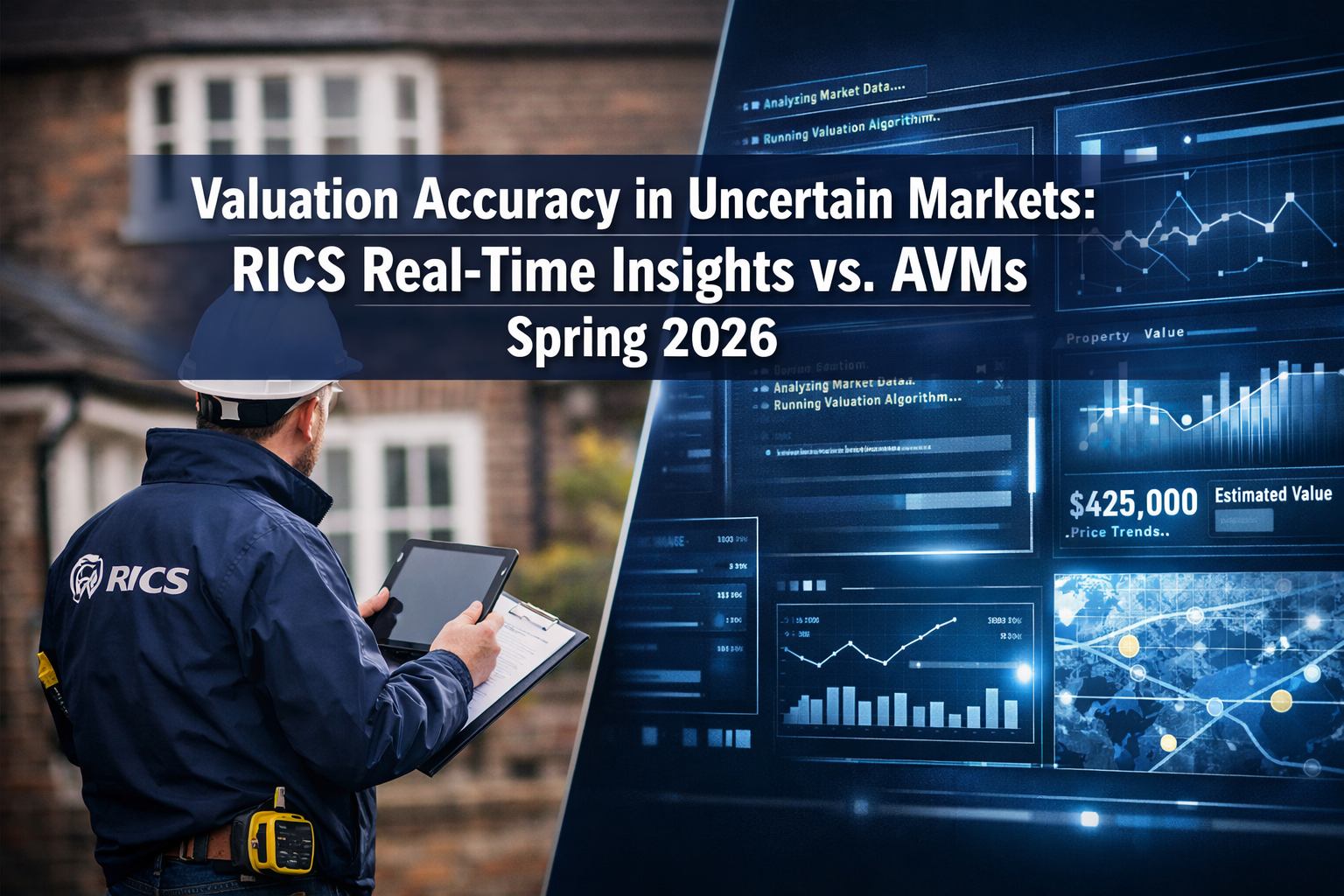
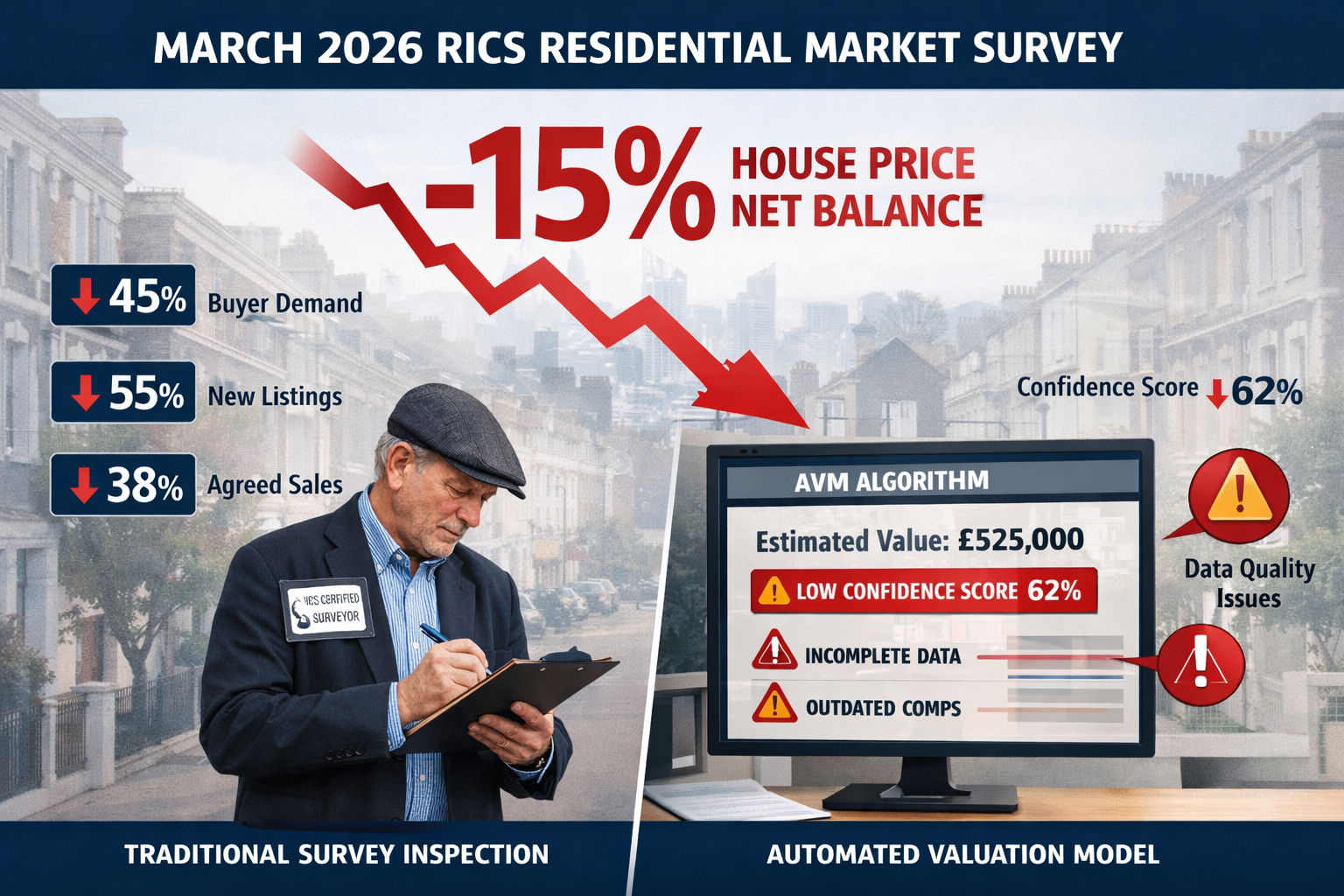
The March 2026 RICS Residential Market Survey reveals a stark reality: house price net balances have plummeted to -15%, marking one of the sharpest declines in recent years.[5] As buyer enquiries weaken and geopolitical tensions continue to ripple through property markets, the question facing investors, lenders, and homeowners isn't whether valuations matter—it's which valuation method can be trusted when market conditions shift beneath our feet. The debate between traditional RICS surveyor-led valuations and Automated Valuation Models (AVMs) has never been more critical than in Spring 2026.
Understanding Valuation Accuracy in Uncertain Markets: Using RICS Real-Time Insights vs. Automated Valuation Models in Spring 2026 requires examining how each approach performs when market signals become mixed, transaction volumes thin, and historical data loses its predictive power. This article explores the strengths and limitations of both methods during periods of market volatility.
Key Takeaways
- 📉 Market conditions in Spring 2026 show significant price pressure with RICS reporting -15% net balance, creating challenging conditions for accurate valuations
- 🤖 AVMs struggle with forward-looking analysis and cannot provide explanatory narratives during periods of extreme market uncertainty
- 👨💼 RICS surveyor-led valuations offer contextual judgment, geopolitical impact assessment, and transparent reasoning that algorithms cannot replicate
- 🔄 Hybrid models combining automated data analysis with professional oversight represent the emerging standard in property valuation
- ⚖️ Data quality remains paramount for both approaches, but human valuers can adjust for incomplete or unreliable comparable data more effectively
Understanding the Current Market Context for Valuation Accuracy in Uncertain Markets
Spring 2026 presents a particularly challenging environment for property valuation. The softening market conditions documented by RICS reflect multiple converging pressures: weakening buyer demand, ongoing geopolitical tensions affecting investor confidence, and interest rate uncertainty that continues to influence affordability calculations.[5]
The Market Turning Point Challenge
Market turning points—those periods when trends shift from growth to decline or vice versa—represent the most difficult conditions for valuation accuracy. Historical data becomes less reliable as a predictor of future values, and transaction volumes often decrease precisely when fresh comparable data is most needed.
Why Spring 2026 is particularly complex:
- 🌍 Geopolitical volatility affecting international investment flows
- 💷 Interest rate uncertainty impacting mortgage affordability
- 📊 Reduced transaction volumes limiting fresh comparable data
- 🏘️ Regional variations creating inconsistent market signals
- 🔮 Forward-looking uncertainty about economic trajectory
When choosing RICS surveyors, understanding how they navigate these complexities becomes essential for stakeholders making high-value decisions.
How Automated Valuation Models Work in 2026
Automated Valuation Models have evolved significantly, but their fundamental approach remains rooted in statistical analysis of historical transaction data. Modern AVMs in 2026 are not purely automated systems—they involve varying degrees of automation, digital data sources, and different levels of human involvement.[1]
The AVM Process Explained
AVMs typically follow this workflow:
- Data Collection: Gathering property characteristics, historical sales, and market indicators
- Algorithm Application: Using statistical models (hedonic regression, repeat sales analysis, or machine learning)
- Comparable Selection: Identifying similar properties based on location, size, and features
- Value Calculation: Computing estimated value with confidence score
- Output Generation: Producing valuation figure with accuracy range
Strengths of AVMs in Stable Markets
AVMs offer several advantages that explain their widespread adoption:
✅ Speed: Valuations generated in seconds rather than days
✅ Cost-effectiveness: Significantly lower cost per valuation
✅ Consistency: Removes individual bias from the process
✅ Scalability: Can process thousands of valuations simultaneously
✅ Data processing: Analyzes vast datasets beyond human capacity
The market views AVMs as providing consistency compared to manual valuations, which can vary based on individual surveyor judgment.[4]
Critical Limitations in Uncertain Markets
However, the January 2026 MODUS publication by RICS highlights a fundamental concern: while AVMs speed up comparisons and produce indicative values, data quality is not necessarily improved by automation.[6] This limitation becomes acute during uncertain market conditions.
Key AVM weaknesses in Spring 2026:
| Limitation | Impact on Uncertain Markets |
|---|---|
| Backward-looking | Cannot anticipate market shifts or turning points |
| Data dependency | Poor quality comparables produce unreliable outputs |
| No explanatory narrative | Cannot explain reasoning behind valuations[3] |
| Limited context | Misses unique property features or local factors |
| Volatility blindness | Struggles with extreme market fluctuations[4] |
| Market distortion risk | May act as market maker rather than market reflector[4] |
AVMs lack the ability to be forward-looking—a significant disadvantage when markets are unpredictable.[4] When transaction volumes thin during uncertain periods, the comparable data that AVMs rely upon becomes scarce and potentially outdated.
RICS Real-Time Insights: The Human Advantage in Valuation Accuracy
Professional RICS surveyors bring capabilities that remain beyond algorithmic reach in 2026. The RICS framework emphasizes maintaining "an F/MRICS in the loop"—ensuring that human professional judgment remains part of the valuation process.[4]
What RICS Surveyors Provide Beyond Algorithms
When conducting property inspections, chartered surveyors offer multiple layers of analysis:
🏠 Physical Inspection: Direct assessment of property condition, structural integrity, and unique features
📍 Local Market Knowledge: Understanding of neighborhood dynamics, development plans, and area-specific factors
🎯 Contextual Judgment: Ability to weigh conflicting data points and assess market sentiment
🔮 Forward-Looking Analysis: Consideration of planned infrastructure, zoning changes, and market trajectory
📝 Transparent Reasoning: Detailed explanations of valuation methodology and assumptions
⚖️ Professional Standards: Adherence to RICS Red Book standards and ethical guidelines
Real-Time Market Intelligence
The RICS Residential Market Survey provides monthly insights that professional surveyors incorporate into their valuations. In March 2026, these insights reveal:
- Weakening buyer enquiries across most regions
- Price expectations softening significantly
- Regional variations requiring localized assessment
- Geopolitical factors affecting investor confidence[5]
Professional surveyors can integrate these real-time market signals into their valuation approach, adjusting methodology based on current conditions rather than relying solely on historical patterns.
The Narrative Advantage
AVMs cannot explain the valuation process in the same way that a human valuer can, limiting transparency when stakeholders need to understand the reasoning behind valuations.[3] This explanatory capability becomes crucial when:
- Lenders need to justify lending decisions to risk committees
- Buyers want to understand price negotiations
- Investors require detailed market analysis for portfolio decisions
- Legal proceedings demand defensible valuation methodology
Understanding what to do before an RICS home survey helps property buyers maximize the value of professional surveyor insights.
Comparing Valuation Accuracy in Uncertain Markets: Data Quality and Confidence Scores
Both RICS surveyor-led valuations and AVMs depend on data quality, but they handle data limitations differently—a distinction that matters significantly in Spring 2026's uncertain conditions.
The Data Quality Challenge
Low confidence scores can result from poor quality and limited quantity of comparable data, and the quality depends heavily on whether the AVM uses completed transactions versus historic transactions.[1] In uncertain markets with reduced transaction volumes, this problem intensifies.
Data quality issues affecting both approaches:
- 📉 Fewer recent transactions to use as comparables
- 🕐 Time lag between transaction completion and data availability
- 🏘️ Increased variation in property-specific circumstances
- 💰 Distressed sales skewing market indicators
- 🌐 External factors (geopolitical, economic) not captured in transaction data
How Surveyors Handle Incomplete Data
Professional RICS surveyors employ several strategies when comparable data is limited:
- Expanded search parameters: Looking at broader geographic areas or longer time periods
- Weighted adjustments: Applying professional judgment to adjust older comparables for market changes
- Multiple valuation methods: Using income approach, cost approach, or residual method as cross-checks
- Market sentiment integration: Incorporating current RICS survey data and market intelligence
- Transparent caveats: Clearly stating assumptions and confidence limitations in reports
When negotiating property prices, having a surveyor who can explain data limitations and adjustments provides significant advantage.
AVM Confidence Scores: What They Mean
Modern AVMs generate confidence scores alongside valuations, typically expressed as:
- Forecast Standard Deviation (FSD): Statistical measure of expected accuracy
- Confidence intervals: Range within which actual value likely falls (e.g., ±10%)
- Data quality indicators: Metrics showing quantity and recency of comparables
However, these confidence scores face limitations in uncertain markets:
⚠️ Backward-looking calculation: Based on historical accuracy, not current market conditions
⚠️ Model assumptions: Assume market behavior patterns continue
⚠️ Data gaps: May not reflect when comparable data is outdated or scarce
⚠️ Black box problem: Users may not understand what drives confidence scores
The Hybrid Approach: Combining RICS Expertise with Automated Tools
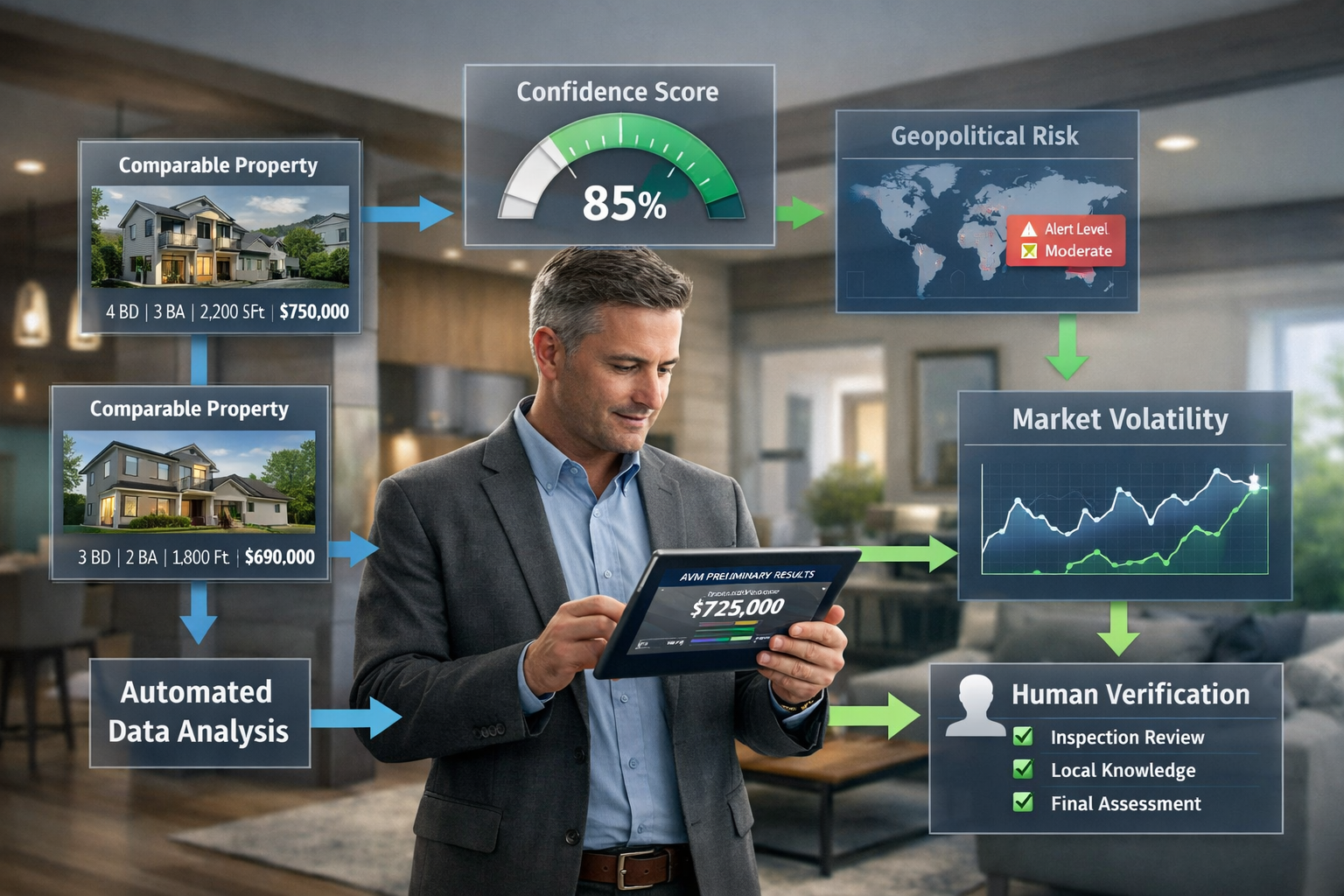
The reality in 2026 is that modern AVMs are not fully automated; they involve varying degrees of automation and different levels of human involvement.[1] This evolution toward hybrid models represents the most promising direction for valuation accuracy in uncertain markets.
How Hybrid Models Work
Effective hybrid valuation approaches combine:
Stage 1 – Automated Data Processing:
- Rapid collection of property characteristics
- Statistical analysis of comparable transactions
- Initial valuation range generation
- Confidence score calculation
Stage 2 – Professional Review:
- RICS surveyor reviews AVM output
- Physical inspection of subject property
- Assessment of market conditions and trends
- Adjustment for unique factors and current uncertainty
- Final valuation with professional certification
Benefits of the Combined Approach
The hybrid model leverages strengths of both methods:
| Advantage | How It's Achieved |
|---|---|
| Speed | AVM provides rapid initial assessment |
| Accuracy | Surveyor corrects for market conditions and property specifics |
| Cost efficiency | Automation reduces time on routine data gathering |
| Professional judgment | Human expertise applied where it matters most |
| Transparency | Surveyor explains reasoning and adjustments |
| Scalability | Automated tools handle volume, surveyors focus on complex cases |
RICS Standards Evolution
RICS is actively working on standards that align with increased automation and digital data impacts across valuation processes.[4] The upcoming Global Valuation Conference on June 9, 2026, will bring together experts and regulators to address "interpreting market uncertainty, meeting regulatory expectations" and "understanding responsible AI use in valuation."[3]
This regulatory evolution recognizes that technology and human expertise must work together, particularly during uncertain market periods.
Practical Implications for Stakeholders in Spring 2026
Understanding Valuation Accuracy in Uncertain Markets: Using RICS Real-Time Insights vs. Automated Valuation Models in Spring 2026 has direct implications for different property market participants.
For Property Buyers
When purchasing property in uncertain market conditions:
✔️ Don't rely solely on online AVMs for purchase decisions
✔️ Commission a professional RICS survey to understand true property value and condition
✔️ Use AVM estimates as initial screening tools, not final valuations
✔️ Request detailed explanations of valuation methodology and assumptions
✔️ Consider market timing and whether current uncertainty affects value
First-time buyers booking building surveys should particularly understand the limitations of automated valuations during market uncertainty.
For Mortgage Lenders
Lenders face increased risk during uncertain market periods:
🏦 Implement hybrid valuation protocols for higher-value or complex properties
🏦 Increase surveyor involvement when AVM confidence scores are low
🏦 Monitor market conditions using RICS monthly survey data
🏦 Adjust lending criteria based on regional market variations
🏦 Document valuation methodology thoroughly for regulatory compliance
For Property Investors
Investment decisions require robust valuation accuracy:
💼 Budget for professional valuations on acquisition and portfolio reviews
💼 Question AVM-only valuations for properties with unique characteristics
💼 Incorporate market uncertainty into investment models and exit strategies
💼 Use RICS market data to time purchases and sales strategically
💼 Understand regional variations rather than relying on national averages
For Estate Agents and Valuers
Professional valuers must adapt their approach:
📋 Clearly communicate methodology and confidence levels to clients
📋 Incorporate current RICS survey insights into market appraisals
📋 Explain limitations of both automated and manual approaches
📋 Use technology as a tool, not a replacement for professional judgment
📋 Stay current with RICS guidance on valuation in uncertain markets
Understanding common myths about property surveys helps professionals educate clients about valuation accuracy.
Case Studies: When Each Approach Excels or Fails
Case Study 1: Standard Suburban Property in Stable Area
Property: 3-bedroom semi-detached house in established London suburb
Market conditions: Moderate transaction volume, consistent pricing
AVM Performance: ✅ Excellent
- Abundant comparable data available
- Property characteristics typical for area
- Market conditions relatively stable
- AVM confidence score: High (±5%)
- Cost: £50-100
- Time: Instant
RICS Surveyor Value-Add: Moderate
- Confirms AVM range accuracy
- Identifies minor condition issues affecting value
- Provides detailed condition report
- Cost: £400-600
- Time: 1-2 weeks
Verdict: AVM appropriate for initial assessment; surveyor recommended for purchase decision to identify defects.
Case Study 2: Period Property During Market Uncertainty
Property: Victorian conversion flat with unique features
Market conditions: Spring 2026 uncertainty, reduced transactions
AVM Performance: ⚠️ Poor
- Limited comparable data for period conversions
- Cannot assess quality of conversion work
- Misses lease length implications
- AVM confidence score: Low (±15%)
- Valuation range too wide to be useful
RICS Surveyor Value-Add: ✅ Essential
- Assesses conversion quality and structural integrity
- Evaluates lease length impact on value[8]
- Applies professional judgment on market conditions
- Provides forward-looking market assessment
- Adjusts for current uncertainty in Spring 2026
- Delivers defensible valuation with reasoning
Verdict: RICS surveyor essential; AVM insufficient for this property type in current market.
Case Study 3: New Build Development Valuation
Property: Multiple units in new residential development
Market conditions: Limited transaction history, developer pricing
AVM Performance: ❌ Fails
- No transaction history for new development
- Cannot assess build quality or developer reputation
- Misses snagging issues common in new builds
- Relies on developer pricing rather than market evidence
RICS Surveyor Value-Add: ✅ Critical
- Inspects build quality and identifies defects[77]
- Assesses whether developer pricing reflects market value
- Evaluates location and future market prospects
- Provides warranty and defect liability assessment
- Considers market absorption rate for development
Verdict: Professional surveyor absolutely necessary; AVMs cannot value new builds accurately.
Future Trends: The Evolution of Valuation Accuracy
As we progress through 2026 and beyond, several trends will shape how Valuation Accuracy in Uncertain Markets evolves:
Artificial Intelligence Integration
Advanced AI models are being developed that can:
- Process unstructured data (photos, descriptions, local news)
- Identify market sentiment from multiple sources
- Adjust for real-time market conditions
- Explain reasoning through natural language processing
However, RICS emphasis on "responsible AI use in valuation"[3] suggests regulatory frameworks will ensure human oversight remains mandatory.
Enhanced Data Sources
Emerging data streams improving valuation accuracy:
🛰️ Satellite and drone imagery for property condition assessment
📱 Social media and local data for neighborhood trend analysis
🏗️ Planning and development databases for forward-looking factors
🌡️ Environmental and climate data for long-term value impacts
💡 Energy efficiency metrics increasingly affecting property values
Regulatory Standardization
The RICS June 2026 Global Valuation Conference[3] signals ongoing work to:
- Standardize AVM disclosure requirements
- Define minimum human oversight levels
- Establish confidence score methodologies
- Create frameworks for uncertain market valuations
Professional Development
RICS surveyors are increasingly required to:
- Understand AVM methodologies and limitations
- Interpret algorithmic outputs critically
- Integrate technology into professional practice
- Communicate valuation uncertainty effectively
Choosing the Right Approach for Your Situation
When deciding between RICS surveyor-led valuations and AVMs in Spring 2026's uncertain market, consider:
Use AVMs When:
✅ Initial property screening for purchase consideration
✅ Standard property types in areas with good comparable data
✅ Portfolio-level valuations where individual accuracy is less critical
✅ Relatively stable market conditions with adequate transaction volumes
✅ Cost constraints make professional surveys impractical for every property
Use RICS Surveyors When:
✅ Making final purchase or lending decisions
✅ Unique, period, or non-standard properties
✅ Uncertain market conditions (like Spring 2026)
✅ Limited comparable transaction data available
✅ Legal, insurance, or regulatory requirements demand professional certification
✅ Detailed condition assessment needed alongside valuation
✅ High-value transactions where accuracy justifies cost
Use Hybrid Approaches When:
✅ Managing large property portfolios requiring both efficiency and accuracy
✅ Lending institutions need scalable yet reliable valuation processes
✅ Initial AVM screening followed by surveyor review for flagged properties
✅ Technology provides data gathering efficiency while retaining professional judgment
✅ Balancing cost control with risk management
For guidance on selecting appropriate survey types, review which home survey is right for you.
Conclusion
Valuation Accuracy in Uncertain Markets: Using RICS Real-Time Insights vs. Automated Valuation Models in Spring 2026 represents more than a technical debate—it's a fundamental question about how we navigate property decisions when market conditions become unpredictable. The March 2026 RICS data showing -15% house price net balances[5] underscores that we are currently in precisely such a period.
The evidence is clear: AVMs offer speed, consistency, and cost-effectiveness in stable markets with abundant data, but they struggle during periods of uncertainty, lacking forward-looking capability and the ability to explain their reasoning.[3][4] RICS surveyor-led valuations provide contextual judgment, transparent methodology, and the professional expertise to navigate market turning points—capabilities that remain beyond algorithmic reach in 2026.
The future lies not in choosing one approach over the other, but in hybrid models that leverage technology's efficiency while preserving human professional judgment. As RICS continues developing standards for responsible AI use in valuation[3], the framework emerging emphasizes that automation should augment, not replace, chartered surveyor expertise.
Actionable Next Steps
For property market participants navigating Spring 2026's uncertainty:
- Property Buyers: Commission a professional RICS survey for any significant purchase, using AVMs only for initial screening
- Lenders: Implement hybrid protocols that increase surveyor involvement when market uncertainty rises
- Investors: Budget for professional valuations and incorporate RICS market data into decision-making
- Professionals: Stay current with evolving RICS guidance and develop skills in interpreting both automated tools and market uncertainty
The March 2026 market conditions remind us that property valuation remains as much art as science—requiring human judgment to interpret data, assess context, and navigate uncertainty. While technology continues advancing, the professional RICS surveyor's role becomes more, not less, critical when markets turn unpredictable.
For expert guidance on property valuation in uncertain markets, get a quote from qualified RICS surveyors who understand both the technology and the market dynamics shaping Spring 2026.
References
[1] Automated Valuation Models – https://www.rics.org/profession-standards/rics-standards-and-guidance/sector-standards/valuation-standards/automated-valuation-models
[3] Valuation Approaches Methods Models – https://ww3.rics.org/uk/en/journals/property-journal/valuation-approaches-methods-models.html
[4] April 2022 Automated Valuation Models Insight – https://www.rics.org/content/dam/ricsglobal/documents/standards/april_2022_automated_valuation_models_insight.pdf
[5] Valuation Adjustments For March 2026 Rics Survey Navigating Softer House Prices And Middle East Conflict Impacts – https://nottinghillsurveyors.com/blog/valuation-adjustments-for-march-2026-rics-survey-navigating-softer-house-prices-and-middle-east-conflict-impacts
[6] Modus By Rics January 2026 – https://www.rics.org/content/dam/ricsglobal/documents/to-be-sorted/MODUS-by-RICS-January-2026.pdf