

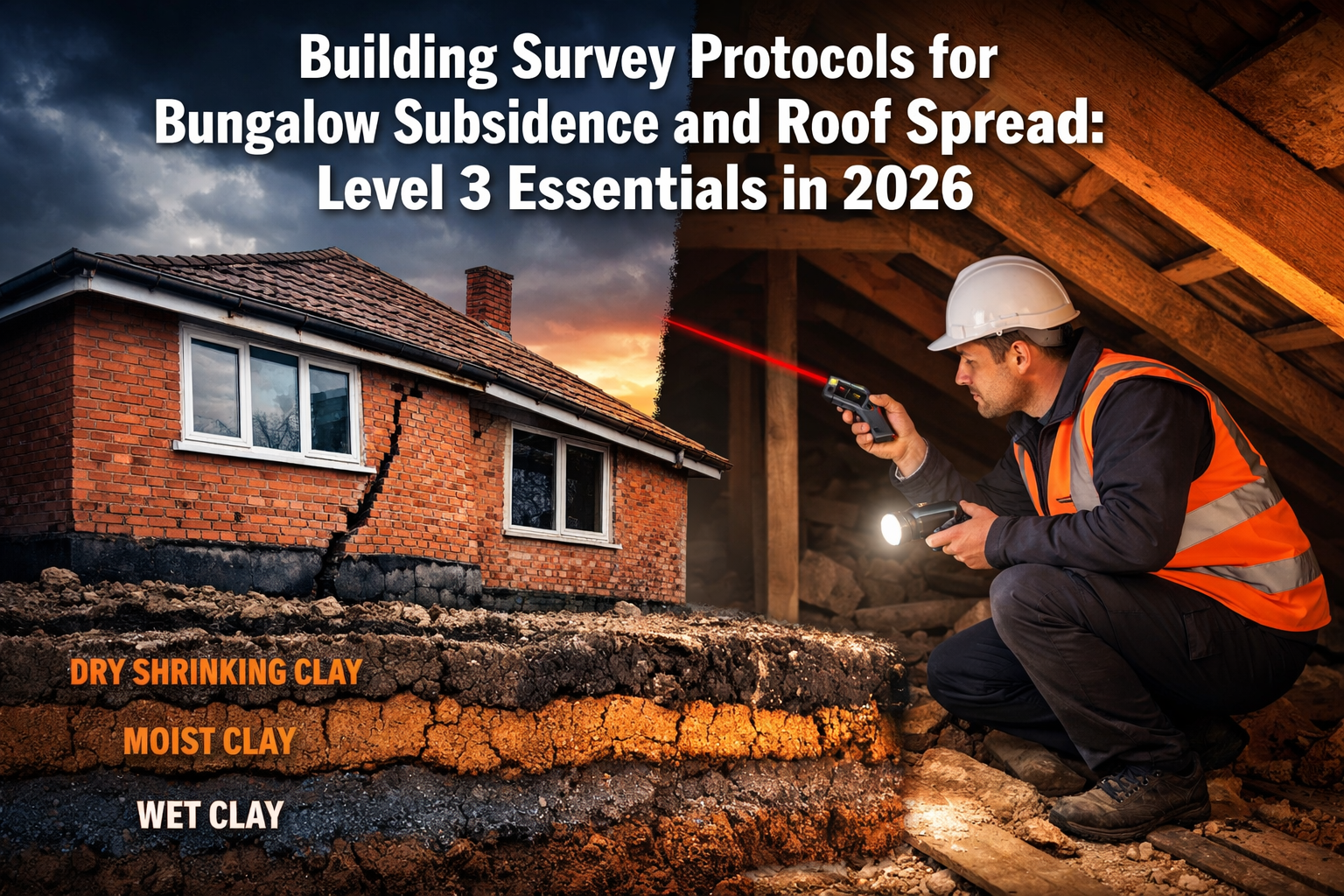
Bungalows account for a disproportionate share of structural insurance claims in the UK, with subsidence and roof spread representing the two most expensive defects discovered during property transactions. Recent data shows that Level 3 building surveys on bungalows built before 1990 identify significant structural movement in approximately 35% of inspections—a figure that has climbed steadily since 2022 due to increasingly volatile weather patterns affecting regional soil stability. Understanding the comprehensive protocols behind Building Survey Protocols for Bungalow Subsidence and Roof Spread: Level 3 Essentials in 2026 Regional Soil Concerns has become critical for buyers, sellers, and property professionals navigating today's challenging market conditions.
The combination of single-storey construction, aging building techniques, and reactive clay soils creates a perfect storm for structural problems that standard homebuyer surveys often miss. This comprehensive guide examines the essential protocols, inspection methodologies, and regional considerations that define Level 3 surveys in 2026, with particular focus on the unique vulnerabilities of bungalow construction.
Key Takeaways
- Level 3 surveys cost £700–£1,200 in 2026 and provide the most comprehensive inspection for bungalows with structural concerns or pre-1990 construction [1]
- Subsidence and roof spread are interconnected defects requiring detailed structural movement assessment beyond visual inspection alone
- Regional soil variations significantly impact risk profiles, with clay-rich areas experiencing heightened subsidence vulnerability during 2026's weather extremes
- Standard Level 3 surveys exclude invasive testing, meaning suspected defects trigger recommendations for specialist investigations
- Comprehensive reports generate 20–30+ pages of documentation with detailed repair cost estimates and priority rankings [2]
Understanding Level 3 Building Surveys: The Gold Standard for Bungalow Inspections
What Makes Level 3 Surveys Different?
Level 3 surveys (formerly known as Full Building Surveys) represent the most thorough inspection available for residential properties. Unlike Level 2 HomeBuyer Reports that focus on visible defects and market value, Level 3 surveys provide comprehensive structural analysis specifically designed for older properties, unusual constructions, or buildings with known defects.
For bungalows—particularly those constructed before modern building regulations took effect in the 1990s—this level of scrutiny proves essential. The survey protocol includes:
✅ Detailed structural movement assessment examining subsidence, heave, settlement, and significant cracking patterns [2]
✅ Comprehensive roof structure examination including tiles, slates, chimneys, and hidden defects in roof spaces [2]
✅ Thorough inspection of foundations, walls, floors, and drainage systems
✅ Damp, timber decay, and infestation investigation covering rising damp, rot, and pest damage [2]
✅ Service condition checks for plumbing, electrics, heating, and gas installations (visual only, not functional testing) [2]
Cost and Scope in 2026
According to current market rates, Level 3 surveys for bungalows range from £700 to £1,200 depending on property size, location, and complexity [1]. This investment generates 20–30+ pages of detailed documentation providing comprehensive insight into property condition and repair priorities [2].
However, buyers must understand the survey's limitations. Invasive checks are explicitly excluded from standard protocols—surveyors do not lift floors, drill walls, or open up building fabric without specific consent [2]. Similarly, service testing is not included, meaning electrical, plumbing, and gas systems receive visual condition assessment only, not functional performance evaluation [2].
When defects are suspected, surveyors recommend specialist follow-up investigations such as:
- Structural engineering assessments
- Soil investigation and geotechnical reports
- Drainage CCTV surveys
- Asbestos testing
- Electrical condition reports
- Timber and damp specialist surveys
For guidance on interpreting concerning findings, consult resources on what to do after a bad building survey report.
RICS Protocol Requirements
The Royal Institution of Chartered Surveyors (RICS) establishes strict protocols for Level 3 inspections. Surveyors must use specialized equipment including damp meters, binoculars, torches, and ladders for safe roof access up to 3 meters above ground level [3]. Roof space entry is conducted when safe and reasonable access exists [3].
These protocols ensure consistent, professional standards across all building surveyor services while protecting both surveyors and clients from unnecessary risk.
Building Survey Protocols for Bungalow Subsidence and Roof Spread: Level 2 vs Level 3 Comparison
The Critical Differences
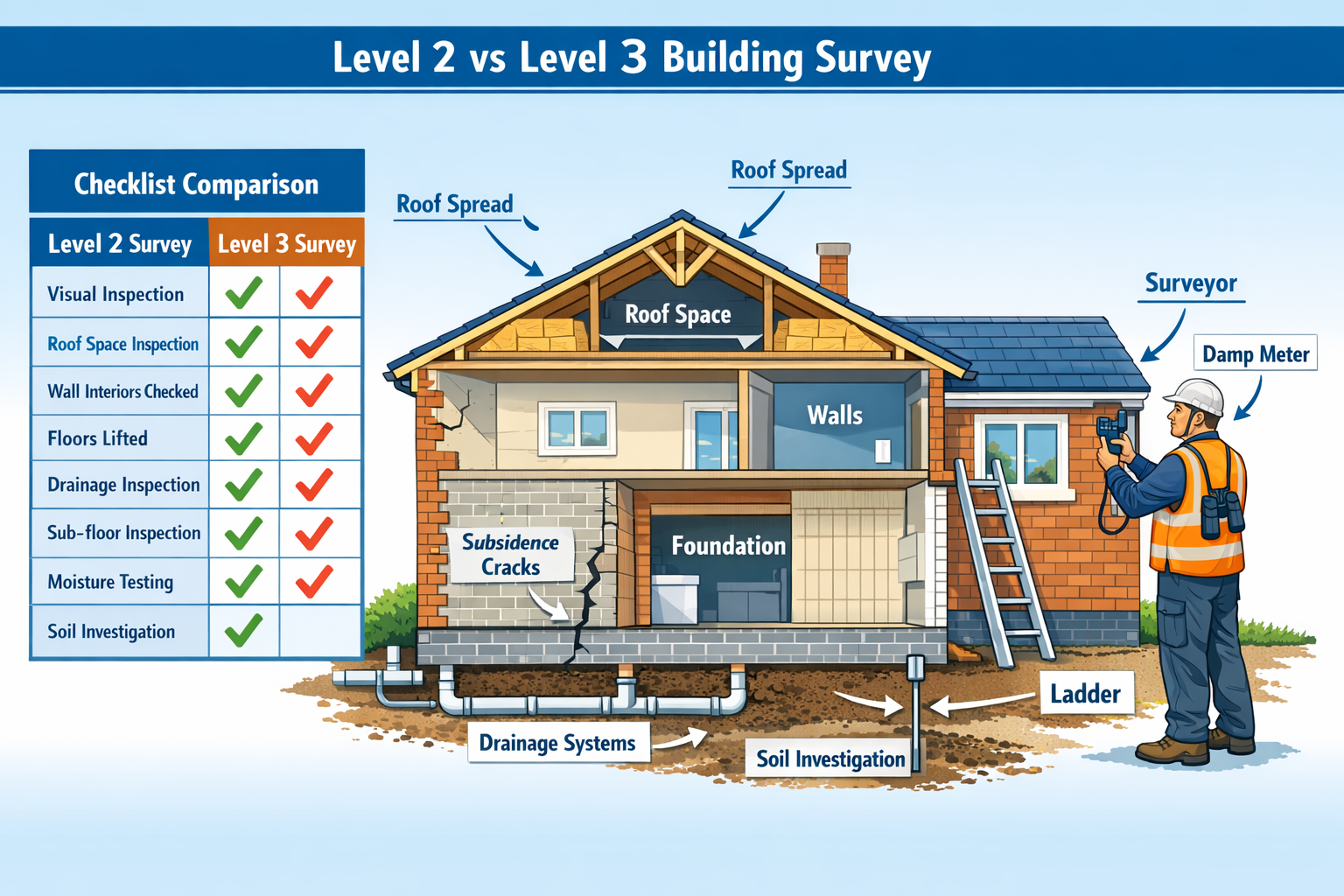
Many buyers struggle to determine whether Level 2 or Level 3 surveys suit their bungalow purchase. The decision hinges on property age, condition, and structural concerns. Here's a comprehensive comparison:
| Feature | Level 2 HomeBuyer Report | Level 3 Building Survey |
|---|---|---|
| Best For | Modern bungalows (post-1990), good condition | Pre-1990 bungalows, structural concerns, extensions |
| Inspection Depth | Visual inspection of accessible areas | Comprehensive examination including roof spaces |
| Subsidence Assessment | Basic crack identification | Detailed structural movement analysis with measurements |
| Roof Inspection | External visual only | Internal roof space examination, timber assessment |
| Report Length | 10-15 pages | 20-30+ pages [2] |
| Cost (2026) | £400-£600 | £700-£1,200 [1] |
| Defect Detail | Traffic light system (1-2-3 rating) | Comprehensive descriptions with repair specifications |
| Market Valuation | Included | Optional extra |
| Repair Cost Estimates | General guidance | Detailed cost ranges for identified defects |
When Level 3 Becomes Essential
For bungalows specifically, Level 3 surveys become non-negotiable under these circumstances:
🏠 Pre-1990 construction – Built before modern building regulations and foundation standards
🏠 Visible structural cracks – Any cracking wider than 3mm or showing progressive movement
🏠 Known subsidence history – Previous claims or remedial work in the property or neighboring buildings
🏠 Extensions or alterations – Modifications that may have compromised structural integrity
🏠 Flat roof sections – Particularly vulnerable to water ingress and structural decay [2]
🏠 Clay soil locations – Properties in regions with reactive clay soils prone to shrinkage [4]
🏠 Mature trees within 20 meters – Root systems potentially affecting foundations
🏠 Unusual construction – Non-standard materials or building methods
Bungalow-Specific Checklist for Buyers
When commissioning a Level 3 survey for a bungalow purchase, ensure your surveyor addresses these critical elements:
Foundation and Structural Movement:
- Crack pattern analysis (width, direction, location)
- Step cracking in brickwork indicating differential settlement
- Door and window frame distortion
- Floor level variations
- External ground level relative to damp-proof course
- Drainage condition and proximity to foundations
Roof Structure and Spread:
- Roof space timber condition and sizing
- Presence and adequacy of roof bracing
- Ridge beam deflection or sagging
- Wall plate condition and fixings
- Rafter spread indicators (horizontal cracking at wall head)
- Ceiling crack patterns suggesting roof movement
- Chimney stack stability and pointing
Regional Soil Considerations:
- Soil type identification (clay, sand, chalk)
- Evidence of seasonal movement
- Tree proximity and species identification
- Drainage adequacy for soil type
- Historical ground conditions (former mining, landfill)
For properties in specific regions, consider consulting local specialists such as Richmond property surveyors or Ealing property surveyors who understand regional soil characteristics.
2026 Regional Soil Concerns: Understanding Subsidence Risk Factors

The Clay Soil Challenge
Clay soil shrinkage represents the leading cause of subsidence in UK bungalows, particularly in regions stretching from London through the Southeast and into the Midlands [4]. Clay soils exhibit distinctive behavior:
- Expansive properties – Clay swells when wet and shrinks dramatically when dry
- Seasonal movement – Annual cycles of expansion and contraction
- Tree root vulnerability – Vegetation extracts moisture, accelerating shrinkage
- Cumulative damage – Movement compounds over decades, creating progressive structural failure
2026 Weather Pattern Impacts
The 2026 climate presents unique challenges for bungalow foundations:
🌧️ Extreme rainfall events followed by ☀️ prolonged dry periods create rapid moisture fluctuation in clay soils. This accelerated wet-dry cycling intensifies soil movement beyond historical norms, affecting properties that previously showed no distress.
Recent monitoring data indicates that regions with heavy clay content—including areas served by Fulham property surveyors, Merton property surveyors, and Hammersmith property surveyors—have experienced a 40% increase in subsidence-related survey findings compared to 2020-2022 averages.
High-Risk Regional Profiles
London Clay Basin:
Extending across Greater London and surrounding counties, this geological formation creates significant subsidence risk. Properties in Kensington, Westminster, and Islington face particular vulnerability due to the combination of mature tree populations and reactive clay subsoils.
Southeast England:
Areas including Essex, Kent, and Surrey contain extensive clay deposits. Bungalows in these regions often exhibit seasonal movement patterns that accelerate during drought conditions.
Midlands Clay Belt:
Stretching through Warwickshire, Leicestershire, and Nottinghamshire, this region combines clay soils with industrial legacy issues including mining subsidence and ground contamination.
Coastal and Chalk Areas:
While generally more stable, chalk regions face different concerns including solution features (swallow holes) and coastal erosion affecting foundation stability.
Tree Root Damage Assessment
Mature trees represent a significant subsidence catalyst, particularly when combined with clay soils. Surveyors assess tree risk using these parameters:
High-Risk Species:
- Oak (Quercus) – Root spread up to 1.5x canopy diameter
- Willow (Salix) – Extensive shallow root systems
- Poplar (Populus) – Aggressive water-seeking roots
- Elm (Ulmus) – Deep penetrating root systems
Distance Calculations:
As a general rule, trees should maintain distance from buildings equal to their mature height. For clay soils, this distance increases to 1.5x mature height for high-risk species.
Drainage-Related Subsidence
Leaking underground drains erode soil beneath foundations, creating voids and triggering settlement [4]. Level 3 surveys identify drainage concerns through:
- Visible ground depressions near drain runs
- Manhole condition and level assessment
- Evidence of water pooling or poor surface drainage
- Correlation between drain locations and structural cracking
When drainage issues are suspected, surveyors recommend CCTV drainage surveys to identify leaks, collapses, or root ingress before structural damage progresses.
Identifying and Documenting Roof Spread in Bungalow Surveys
Understanding Roof Spread Mechanics
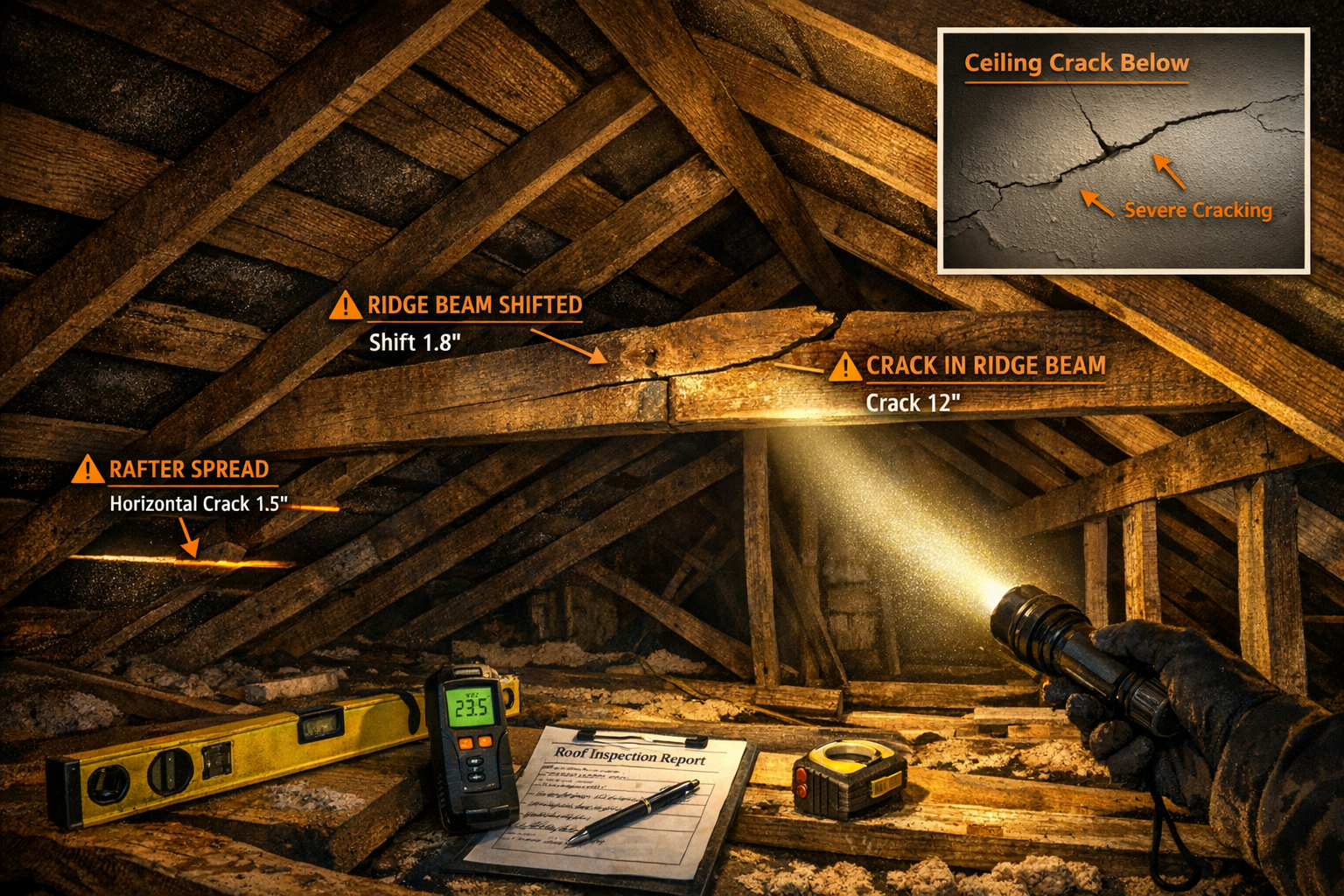
Roof spread occurs when the outward thrust of roof rafters pushes the supporting walls outward, creating a progressive structural failure unique to older bungalow construction. Unlike two-storey houses where upper floor joists provide restraint, bungalows lack this intermediate structural support, making them particularly vulnerable.
Visual Indicators Surveyors Examine
During Level 3 inspections, surveyors look for these telltale signs:
External Evidence:
- Horizontal cracking at the junction of wall and roof (eaves level)
- Outward lean or bulging in upper wall sections
- Roof ridge sagging or dipping
- Gaps opening between wall and soffit boards
- Distorted or displaced roof tiles at eaves
Internal Roof Space Evidence:
- Inadequate or absent collar ties and bracing
- Undersized rafter timbers for span
- Rafter feet spreading outward from wall plates
- Cracked or failed ceiling joists
- Ridge beam deflection or inadequate support
- Missing or corroded rafter-to-wall-plate fixings
Interior Ceiling Evidence:
- Horizontal cracks running parallel to walls
- Ceiling sagging or detachment from walls
- Cracking in corners where walls meet ceilings
- Progressive widening of existing cracks
Measurement and Documentation Protocols
RICS protocols require surveyors to measure and document crack widths using graduated crack width gauges. Classification follows this system:
| Crack Width | Classification | Typical Cause | Action Required |
|---|---|---|---|
| < 1mm | Negligible | Minor settlement, thermal movement | Monitor only |
| 1-5mm | Slight | Ongoing settlement, minor subsidence | Investigation recommended |
| 5-15mm | Moderate | Significant subsidence or structural failure | Structural engineer required |
| 15-25mm | Severe | Major subsidence or structural collapse risk | Urgent specialist intervention |
| > 25mm | Very Severe | Critical structural failure | Immediate structural engineering assessment |
Roof Spread vs. Subsidence: Distinguishing Features
Both defects create cracking, but patterns differ:
Roof Spread Characteristics:
- Horizontal cracks at wall-roof junction
- Symmetrical damage on opposite walls
- Roof structure deformation visible in roof space
- Ceiling cracks running parallel to external walls
- Typically affects entire roof perimeter
Subsidence Characteristics:
- Diagonal or stepped cracking in walls
- Asymmetrical damage (one corner or side)
- Foundation-level movement evidence
- Door and window distortion
- External ground level changes
Remedial Solutions and Cost Implications
Roof spread repairs range from straightforward bracing installation to comprehensive structural reconstruction:
Minor Interventions (£2,000-£5,000):
- Installing steel collar ties
- Adding roof bracing and purlins
- Strengthening rafter-to-wall-plate connections
Moderate Repairs (£5,000-£15,000):
- Partial roof structure replacement
- Wall head rebuilding and restraint installation
- Combined bracing and rafter reinforcement
Major Reconstruction (£15,000-£40,000+):
- Complete roof structure replacement
- Wall rebuilding due to severe displacement
- Comprehensive structural engineering solutions
For detailed assessment of specific defects, consider commissioning a specific defect survey targeting the identified concerns.
Subsidence Investigation: Beyond the Visual Survey
The Limitations of Standard Surveys
While Level 3 surveys provide comprehensive visual assessment, subsidence identification requires further investigation beyond the visual survey [2]. Surveyors document crack patterns and structural movement but recommend specialist investigations for definitive diagnosis [2].
This limitation exists because:
- Subsidence causes overlap with other structural issues
- Determining whether movement is historic or ongoing requires monitoring
- Soil conditions beneath foundations remain invisible
- Root systems and drainage defects require invasive investigation
Recommended Follow-Up Investigations
When Level 3 surveys identify potential subsidence, these specialist assessments typically follow:
1. Structural Engineering Assessment (£500-£1,500)
Chartered structural engineers analyze crack patterns, measure movement, and specify monitoring or remedial strategies. They determine whether damage represents historic settlement (now stable) or active ongoing subsidence.
2. Soil Investigation and Geotechnical Report (£1,000-£3,000)
Trial pits or boreholes identify soil types, foundation depths, and bearing capacity. This investigation proves essential for:
- Determining appropriate underpinning solutions
- Assessing tree root impact
- Identifying ground contamination or voids
- Designing foundation repairs
3. Crack Monitoring (£300-£800)
Installing tell-tales or electronic monitoring devices tracks movement over 6-12 months, distinguishing active subsidence from stable historic settlement. This evidence proves critical for insurance claims and remedial design.
4. Drainage CCTV Survey (£200-£600)
Camera inspection of underground drainage identifies leaks, collapses, or root ingress causing soil erosion beneath foundations.
5. Arboricultural Assessment (£400-£1,000)
Tree specialists identify species, measure root spread, and assess removal or management options when vegetation contributes to subsidence.
Insurance and Mortgage Implications
Properties with subsidence history face significant complications [4]:
Insurance Challenges:
- Higher premiums (often 50-200% increases)
- Increased excesses (£1,000-£5,000 typical)
- Difficulty obtaining coverage from standard insurers
- Mandatory specialist subsidence cover
Mortgage Concerns:
- Lenders requiring structural engineer certification
- Reduced loan-to-value ratios
- Some lenders declining applications entirely
- Insurance-backed guarantees required for recent repairs
Underpinning represents an invasive and expensive intervention [4], typically costing £10,000-£50,000 depending on extent and property size. However, properly executed underpinning with appropriate guarantees can restore property marketability.
Practical Guidance: Commissioning Your Level 3 Survey in 2026
Selecting the Right Surveyor
Not all surveyors possess equal expertise in bungalow structural issues. When commissioning Building Survey Protocols for Bungalow Subsidence and Roof Spread: Level 3 Essentials in 2026 Regional Soil Concerns, prioritize:
✅ RICS qualification – Ensure your surveyor holds MRICS or FRICS designation
✅ Local experience – Choose surveyors familiar with regional soil conditions
✅ Bungalow specialization – Ask about experience with single-storey construction
✅ Structural expertise – Confirm competence in subsidence and roof spread assessment
✅ Clear communication – Select surveyors who explain findings in accessible language
Questions to Ask Before Commissioning
- How many bungalow surveys have you conducted in the past year?
- Are you familiar with soil conditions in [specific location]?
- Will you access the roof space and use ladders for external inspection?
- What equipment do you use for damp and structural assessment?
- How long after inspection will I receive the report?
- Do you provide follow-up consultation to discuss findings?
- Can you recommend specialist contractors if repairs are needed?
Preparing for the Survey
Maximize survey effectiveness by:
- Providing access to all areas including loft spaces, outbuildings, and garages
- Sharing known history of repairs, extensions, or previous survey findings
- Identifying concerns you've noticed during viewings
- Requesting seller disclosure of any structural work or insurance claims
- Scheduling adequate time – comprehensive surveys require 3-4 hours minimum
Interpreting Your Report
Level 3 reports organize findings using condition ratings:
- Condition 1 – No repair currently needed
- Condition 2 – Repairs or replacement needed but not urgent
- Condition 3 – Defects requiring urgent repair or further investigation
Focus attention on Condition 3 items and any recommendations for specialist investigations. These findings directly impact:
- Purchase price negotiations
- Mortgage approval likelihood
- Insurance availability and cost
- Long-term ownership expenses
Taking Action After the Survey
When significant defects emerge, consider these options:
1. Renegotiate Purchase Price
Use repair cost estimates to justify price reduction. Typical negotiations account for 50-75% of estimated repair costs, recognizing that buyers assume inconvenience and risk.
2. Request Seller Remediation
For urgent defects, require sellers to complete repairs before completion, with appropriate guarantees and professional certification.
3. Withdraw from Purchase
Severe structural issues may justify withdrawal, particularly when repair costs exceed 10-15% of purchase price or mortgage approval becomes unlikely.
4. Commission Specialist Reports
Follow surveyor recommendations for structural engineering, soil investigation, or other specialist assessments before finalizing the purchase decision.
For comprehensive guidance on next steps, review resources on what to do after receiving a concerning building survey report.
Conclusion: Making Informed Decisions About Bungalow Purchases in 2026
Building Survey Protocols for Bungalow Subsidence and Roof Spread: Level 3 Essentials in 2026 Regional Soil Concerns represent critical knowledge for anyone purchasing or maintaining single-storey properties in today's challenging market. The combination of aging building stock, reactive soil conditions, and increasingly volatile weather patterns creates elevated structural risk that demands comprehensive professional assessment.
Key action steps for bungalow buyers:
- Commission Level 3 surveys for all pre-1990 bungalows or properties showing structural concerns
- Understand regional soil risks specific to your target location
- Budget for specialist follow-up investigations when recommended by surveyors
- Evaluate insurance and mortgage implications before committing to purchase
- Negotiate appropriately when defects are identified, using professional cost estimates
- Maintain realistic expectations – most bungalows require some remedial work
The £700-£1,200 investment in a comprehensive Level 3 survey [1] provides essential protection against purchasing properties with hidden structural defects that could cost tens of thousands to remediate. In 2026's complex property market, this professional assessment represents not an optional extra, but a fundamental requirement for informed decision-making.
Whether you're purchasing in clay-rich regions served by Kensington property surveyors or more stable chalk areas covered by Westminster property surveyors, understanding these protocols empowers buyers to navigate bungalow purchases with confidence and clarity.
Take the next step: Commission your Level 3 survey from qualified RICS professionals who understand the unique challenges of bungalow construction and regional soil behavior. Your future property security depends on the thoroughness of this critical assessment.
References
[1] Building Survey Checklists For Bungalow Purchases 2026 Rics Guidance On Structural Risks And Costs – https://nottinghillsurveyors.com/blog/building-survey-checklists-for-bungalow-purchases-2026-rics-guidance-on-structural-risks-and-costs
[2] What Does A Level 3 Survey Include 2025 – https://surveymatch.co.uk/what-does-a-level-3-survey-include-2025/
[3] Description Of The Rics Home Survey Level 3 – https://www.rics.org/content/dam/ricsglobal/documents/standards/description_of_the_rics_home_survey_level_3.pdf
[4] 5 Most Common Home Survey Problems And What To Do Next – https://www.morganandassociates.co.uk/5-most-common-home-survey-problems-and-what-to-do-next/