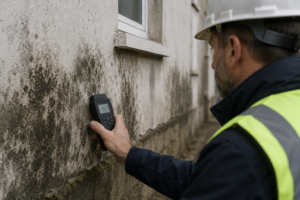

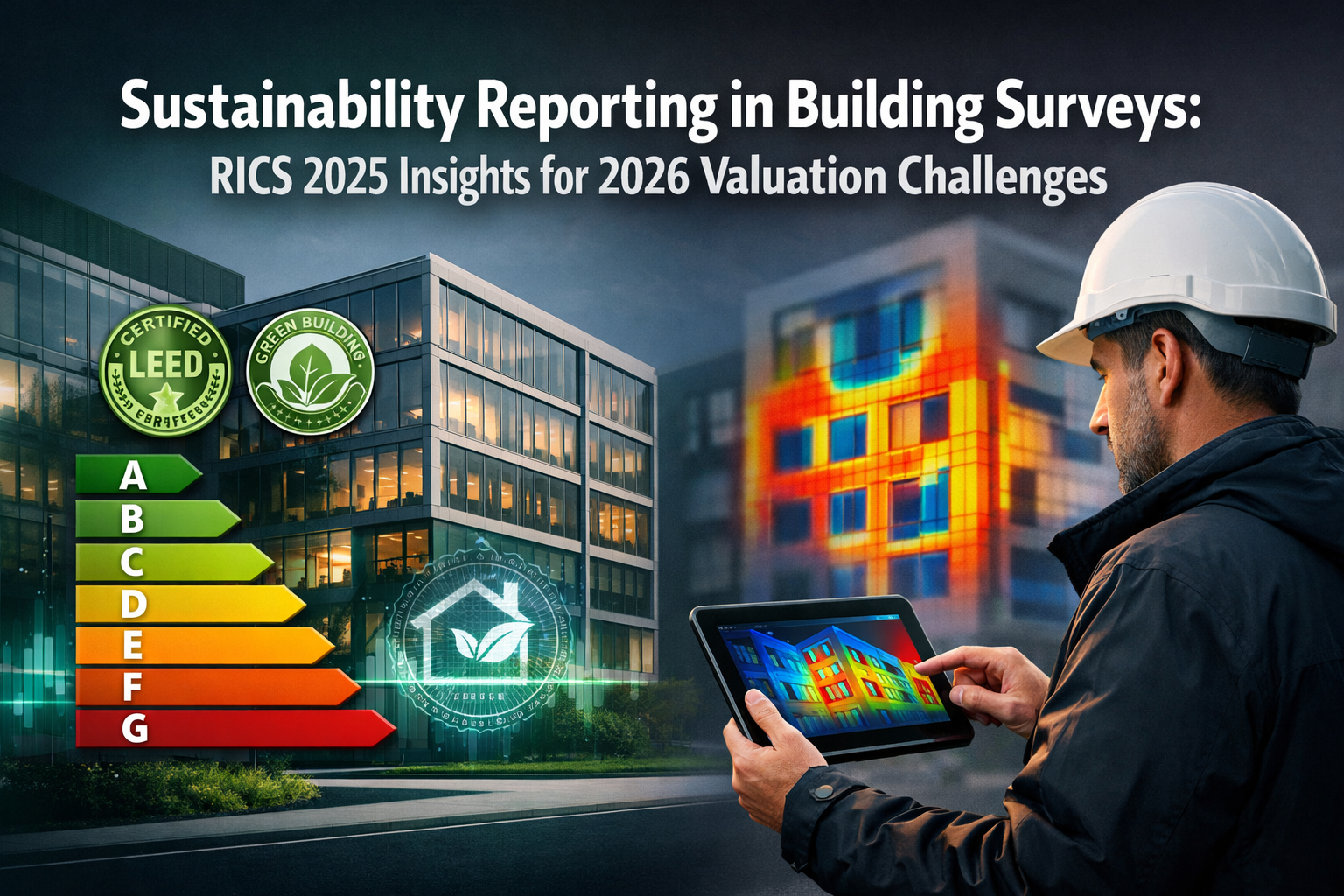
The countdown has begun: ESG standards for commercial property valuations become mandatory in just 20 days (April 30, 2026), yet nearly half of construction professionals still don't measure carbon emissions across their projects. This regulatory collision between new requirements and inadequate industry preparation creates unprecedented challenges for property valuers, building surveyors, and real estate investors navigating the 2026 market landscape.
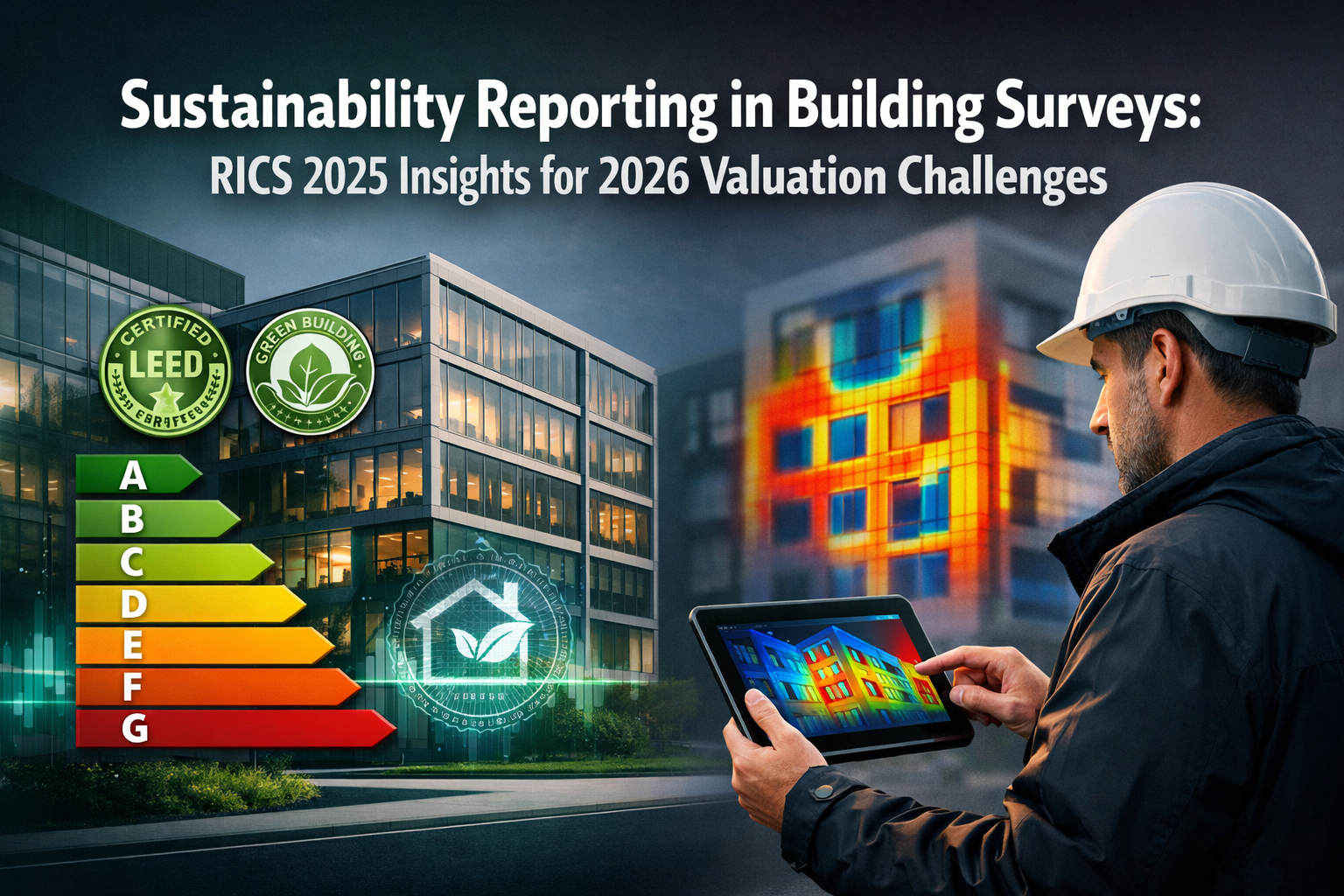
Understanding Sustainability Reporting in Building Surveys: Applying RICS 2025 Insights to 2026 Valuation Challenges has become critical for professionals who must now integrate comprehensive environmental metrics into property assessments while market conditions simultaneously show declining momentum in green building demand. The RICS 2025 Sustainability Report, surveying over 3,500 global professionals, reveals troubling gaps between regulatory expectations and industry capabilities that directly impact valuation accuracy and professional liability [2].
The integration of sustainability metrics into building surveys represents more than regulatory compliance—it fundamentally reshapes how properties are valued, assessed, and positioned in an increasingly environmentally conscious market.
Key Takeaways
- ESG valuation standards become mandatory April 30, 2026, requiring immediate integration of sustainability metrics into commercial property assessments
- 46% of construction professionals don't measure carbon emissions, up from 34% in 2024, creating significant reliability gaps in sustainability reporting [2]
- Green building demand growth has slowed dramatically across most regions, requiring valuers to reassess green premium assumptions in 2026 market conditions [2]
- New RICS AI standards (effective March 9, 2026) establish governance requirements for artificial intelligence deployment in surveying and valuation work [3]
- Level 3 surveys must now incorporate energy efficiency metrics to provide accurate valuations in markets prioritizing environmental certainty
Understanding the RICS 2025 Sustainability Framework for Building Surveys
The RICS 2025 Sustainability Report establishes the most comprehensive framework yet for integrating environmental performance into property assessments. Published in November 2025 after surveying over 3,500 professionals globally, this research identifies critical gaps between sustainability ambitions and actual implementation practices that directly affect valuation reliability [7].
Core Components of the 2025 Framework
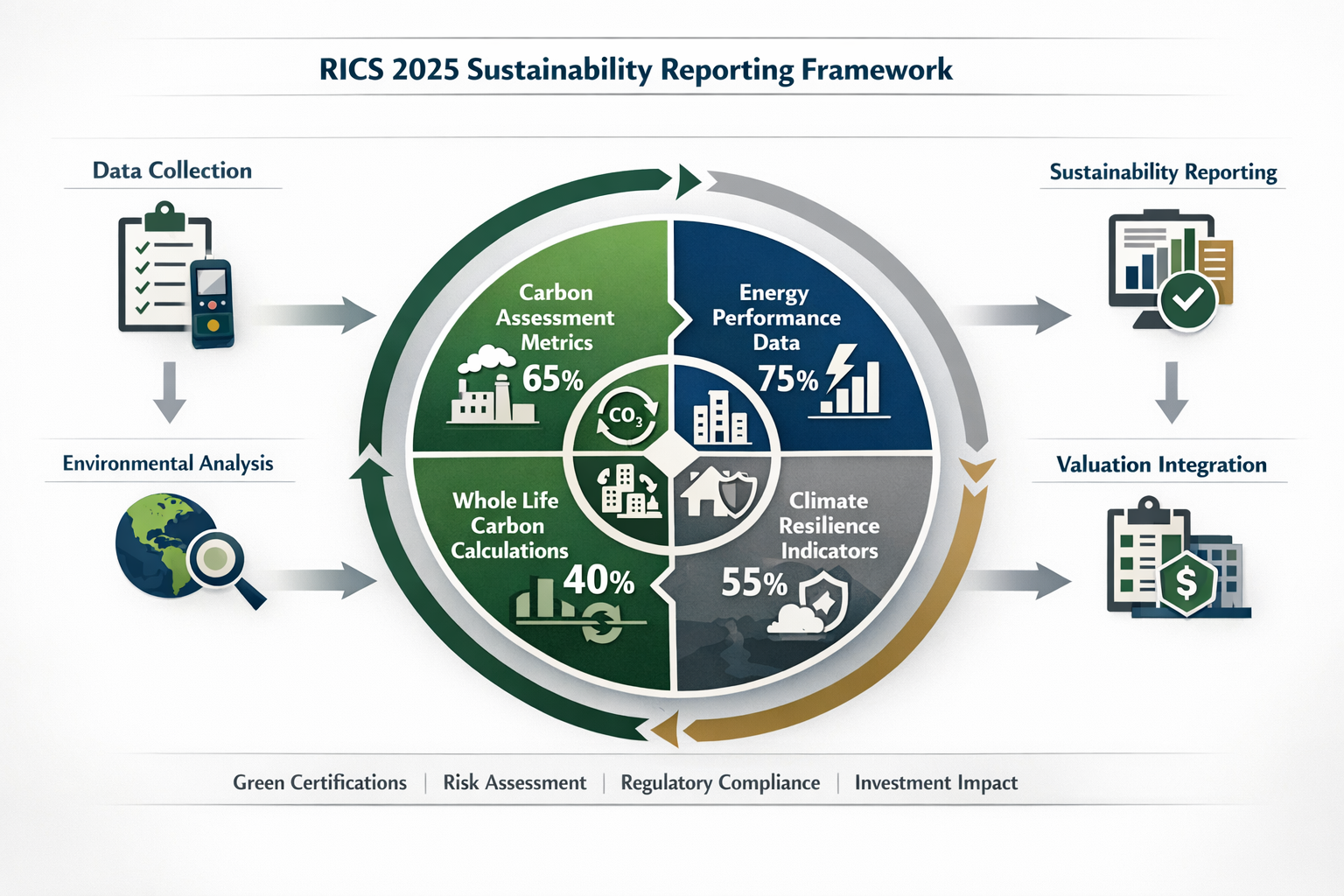
The framework centers on four primary measurement pillars that building surveyors must now address:
- Carbon Assessment Metrics – Whole life carbon calculations across building lifecycles
- Energy Performance Data – Operational efficiency measurements and consumption patterns
- Climate Resilience Indicators – Adaptation capabilities for extreme weather events
- Resource Efficiency Standards – Water usage, waste management, and material sustainability
However, implementation reveals concerning inconsistencies. The 2025 report shows that 60% or more of construction professionals conduct carbon calculations and climate resilience assessments in fewer than half of projects or not at all [2]. This creates significant comparability issues when valuers attempt to benchmark sustainable properties against market standards.
Regional Variations in Green Building Demand
Market dynamics show unexpected divergence from earlier growth projections. The 2025 Sustainable Building Index reveals dramatically slowing momentum across most regions [2]:
| Region | Growth Rate 2025 | Market Implications |
|---|---|---|
| Middle East & Africa | +52% | Strongest expansion; premium valuations justified |
| United Kingdom | +43% | Robust demand; regulatory alignment driving growth |
| Europe | +39% | Steady adoption; established sustainability markets |
| Asia Pacific | +27% | Moderate growth; mixed regulatory environments |
| Americas | +11% | Significant slowdown; reassess green premiums |
The Americas' dramatic deceleration to just 11% growth contradicts earlier expansion expectations and requires valuers to fundamentally reassess green premium assumptions in North American markets. This regional variation means sustainability reporting in building surveys cannot apply uniform valuation adjustments globally.
The Measurement Gap Crisis
Perhaps most concerning for valuation accuracy: 46% of construction professionals do not measure carbon emissions across projects, representing a dramatic increase from 34% in 2024 [2]. This regression in carbon accounting practices directly undermines the reliability of sustainability claims that valuers must verify.
When conducting RICS property valuations, surveyors now face a fundamental challenge: how to assign value to sustainability features when nearly half the industry doesn't consistently measure the underlying environmental performance data.
The RICS Whole Life Carbon Assessment (WLCA) standard provides the unified framework for addressing this measurement inconsistency [1]. Adoption of this standard has become critical for comparative sustainability valuation work, yet implementation remains incomplete across the industry.
Three Primary Investment Barriers
The 2025 report identifies three critical barriers blocking sustainable investment in real estate [2]:
⚠️ Initial Costs – Ranked as the primary obstacle preventing sustainability upgrades
💰 Lack of ROI Evidence – Insufficient data demonstrating financial returns on green investments
📊 Insufficient Awareness – Limited investor understanding and client demand for sustainable features
For building surveyors, these barriers translate into a professional obligation: valuations must now quantify and communicate ROI benefits to justify sustainable building premiums in 2026 market conditions. Generic statements about "green value" no longer suffice—clients demand specific financial projections supported by comparable market data.
Applying RICS 2025 Insights to Enhanced Level 3 Building Surveys
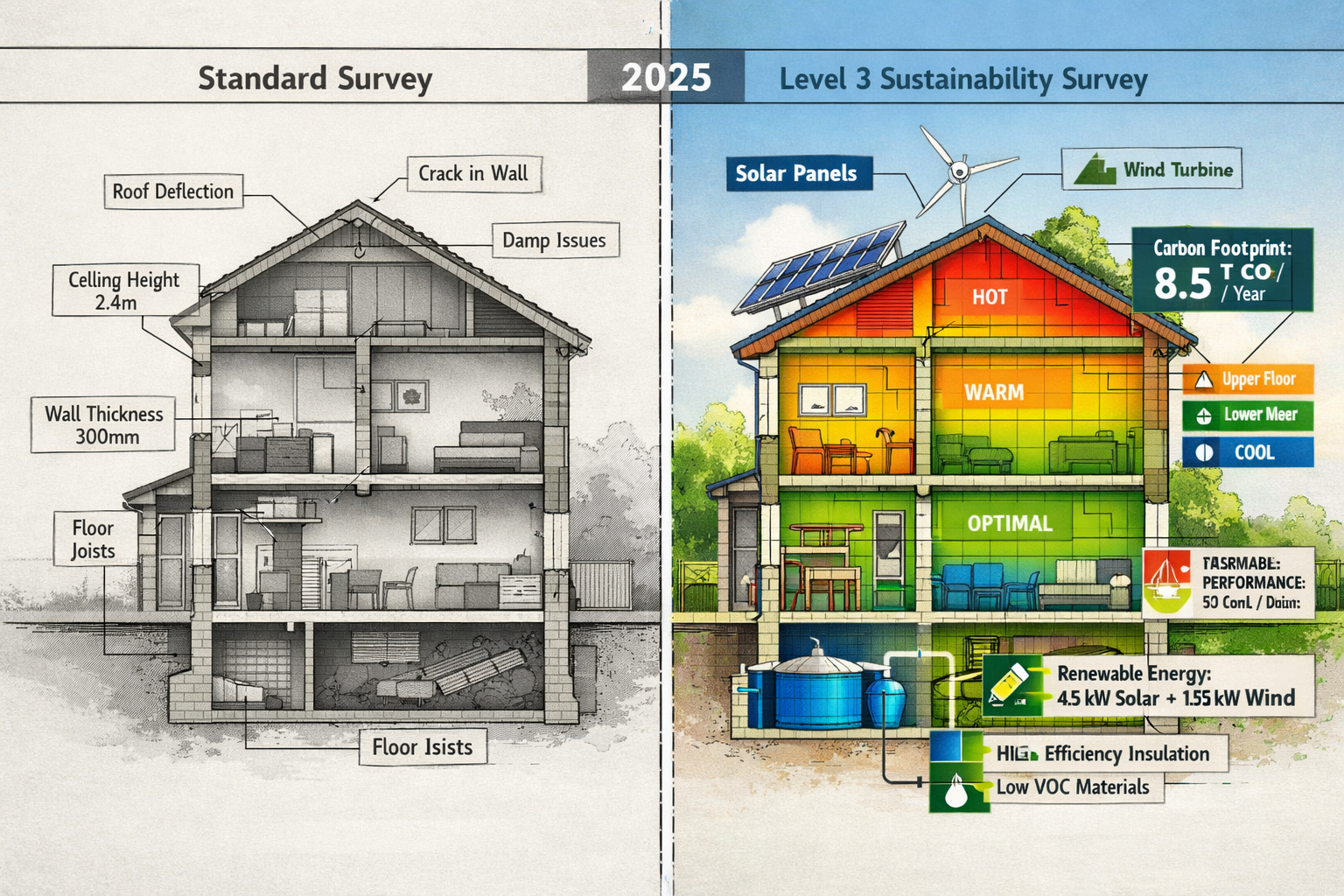
Traditional Level 3 surveys focused primarily on structural condition, defects, and repair recommendations. The integration of Sustainability Reporting in Building Surveys: Applying RICS 2025 Insights to 2026 Valuation Challenges fundamentally expands this scope to include comprehensive environmental performance assessments.
Expanding Level 3 Survey Scope for 2026
Enhanced Level 3 surveys now incorporate five additional sustainability assessment categories:
1. Energy Efficiency Metrics 🔋
- Thermal performance analysis using infrared imaging to identify heat loss patterns
- Building envelope assessment measuring insulation effectiveness and air tightness
- HVAC system efficiency ratings with operational cost projections
- Renewable energy integration evaluating solar, heat pump, or other sustainable systems
- Energy Performance Certificate (EPC) validation confirming accuracy of existing ratings
2. Carbon Footprint Calculations 🌍
Despite 46% of professionals not measuring emissions [2], Level 3 surveys must now include:
- Embodied carbon assessment for existing building materials and construction
- Operational carbon projections based on energy consumption patterns
- Retrofit carbon impact analysis comparing improvement scenarios
- Whole life carbon calculations following RICS WLCA standards [1]
3. Climate Resilience Evaluation ⛈️
With 60% of professionals conducting resilience assessments inconsistently [2], comprehensive surveys must address:
- Flood risk analysis including drainage capacity and water ingress vulnerabilities
- Overheating susceptibility particularly critical for urban properties
- Extreme weather preparedness evaluating structural capacity for climate stresses
- Adaptation potential identifying feasible resilience improvements
4. Resource Efficiency Assessment 💧
- Water consumption patterns and conservation opportunities
- Waste management systems and circular economy potential
- Material sustainability including recyclability and environmental impact
- Biodiversity considerations for properties with significant grounds
5. Regulatory Compliance Verification ✅
With ESG standards becoming mandatory April 30, 2026 [6], surveys must confirm:
- Current compliance status against new ESG valuation requirements
- Gap analysis identifying deficiencies requiring remediation
- Upgrade pathway recommendations with cost-benefit analysis
- Future-proofing assessment evaluating long-term regulatory risk
Practical Integration Challenges
The skills shortage in building surveying and residential sectors creates significant capacity constraints for conducting these enhanced assessments [3]. Many surveyors lack specialized training in sustainability measurement, creating a supply-demand imbalance that increases costs and extends timelines.
RICS has responded by announcing two new professional pathways (residential retrofit and sustainability) with plans for a possible third pilot programme in 2026 [3]. This signals formal recognition that current surveyor competencies in sustainability valuation are insufficient for 2026 requirements.
When conducting homebuyer surveys or more comprehensive building assessments, surveyors must now balance traditional structural analysis with these expanded environmental metrics—a challenging integration requiring both technical expertise and market knowledge.
AI Integration and the March 2026 Standard
The "Responsible use of artificial intelligence in surveying practice" professional standard became effective March 9, 2026, establishing formal governance for AI deployment in surveying and valuation work [3]. This addresses concerns that current AI models operate as "black boxes" incompatible with RICS Red Book Standards transparency requirements.
Critical AI limitations for sustainability reporting:
- AI-derived valuations face ethical concerns related to biased training data—if input data is inaccurate or intentionally weighted, results can be "dramatically skewed" [1]
- AI in property valuation must retain significant human appraiser input to remain compliant with RICS Red Book Standards [1]
- Sole AI-driven valuations currently cannot satisfy transparency and due diligence requirements
- Surveyors bear professional liability for validating AI-generated sustainability metrics
The new standard establishes the regulatory boundary: AI serves as a supporting tool only, not an autonomous valuation method. For sustainability reporting, this means AI can assist with data analysis and pattern recognition, but human professionals must verify environmental performance claims and exercise judgment on valuation implications.
Sustainability Reporting in Building Surveys: Applying RICS 2025 Insights to 2026 Valuation Challenges in Practice
Translating RICS 2025 insights into actionable valuation methodologies requires systematic integration of sustainability metrics into established assessment frameworks. The April 30, 2026 deadline for ESG standards compliance means surveyors must immediately implement these enhanced reporting practices [6].
Quantifying Green Premiums in 2026 Market Conditions
The slowing green building demand growth—particularly the Americas' decline to just 11% [2]—fundamentally challenges earlier assumptions about sustainability premiums. Valuers must now apply region-specific adjustments rather than uniform green value calculations.
Evidence-based premium calculation methodology:
- Establish comparable baseline – Identify similar properties without sustainability features
- Quantify operational savings – Calculate energy cost reductions with documented evidence
- Apply regional demand factors – Adjust for local market sustainability appetite
- Account for regulatory risk – Value compliance advantages against future requirements
- Project obsolescence timeline – Assess how quickly non-sustainable properties lose competitiveness
The lack of ROI evidence identified as a primary investment barrier [2] means valuers must provide specific financial projections rather than generic sustainability claims. This requires accessing comparable transaction data for sustainable properties and documenting actual performance outcomes.
Addressing the Carbon Measurement Gap
With 46% of professionals not measuring emissions [2], valuers face a critical data reliability problem. When sustainability claims cannot be independently verified, several approaches maintain valuation integrity:
Data verification strategies:
✓ Request original assessment documentation – Don't rely on owner representations alone
✓ Conduct independent measurements – Use thermal imaging, energy audits, and consumption analysis
✓ Apply conservative assumptions – When data gaps exist, avoid optimistic sustainability valuations
✓ Document limitations clearly – Transparency about measurement uncertainties protects professional liability
✓ Recommend verification studies – Identify where additional assessment would materially affect value
The RICS WLCA standard provides the framework for consistent carbon assessment [1], but practical implementation requires specialized expertise many surveyors are still developing.
Integrating Sustainability into Negotiation Strategies
Understanding how RICS surveys help negotiate property prices now includes sustainability performance as a key negotiating factor. Enhanced Level 3 surveys identifying energy efficiency deficiencies or climate resilience vulnerabilities provide concrete evidence for price adjustments.
Negotiation leverage from sustainability reporting:
- Quantified upgrade costs – Specific estimates for achieving target EPC ratings or carbon reductions
- Regulatory compliance gaps – Value impact of failing to meet April 2026 ESG standards
- Operational cost differentials – Documented higher running costs compared to efficient alternatives
- Future-proofing requirements – Capital expenditure needed to maintain market competitiveness
- Climate risk exposures – Flood vulnerability, overheating susceptibility, or weather damage potential
When buyers receive disappointing building survey results, sustainability deficiencies now carry additional weight beyond traditional structural concerns. Properties failing to meet emerging environmental standards face both immediate remediation costs and long-term marketability challenges.
Professional Competency Development
The skills shortage in sustainability assessment [3] creates both challenges and opportunities for surveying professionals. RICS's announcement of new qualification pathways signals the profession's recognition that additional training is essential for competent sustainability reporting.
Recommended competency development priorities:
📚 RICS WLCA Standard – Master whole life carbon assessment methodology
📚 Energy Performance Analysis – Develop thermal imaging and efficiency evaluation skills
📚 Climate Resilience Assessment – Understand adaptation strategies and vulnerability analysis
📚 AI Governance – Learn responsible AI deployment within March 2026 standard requirements
📚 Regional Market Dynamics – Track sustainability demand variations across geographic markets
Surveyors who develop these specialized capabilities position themselves advantageously in a market where building surveying sectors face the most significant skills shortages [3].
Case Application: Valuation Scenario
Consider a commercial property valuation scenario illustrating integrated sustainability reporting:
Property: 1980s office building, 5,000 sq ft, city center location
Traditional valuation concerns: Structural condition adequate, minor roof repairs needed, outdated mechanical systems
Enhanced sustainability assessment reveals:
- EPC rating: D (below emerging market expectations)
- Carbon footprint: 45% above comparable modern buildings
- No renewable energy systems installed
- Limited climate resilience (poor drainage, inadequate cooling)
- Estimated upgrade cost to EPC B: £85,000
- Projected energy savings post-upgrade: £12,000 annually
Valuation impact analysis:
The property faces regulatory compliance pressure with ESG standards effective in 20 days [6]. Comparable properties with EPC B or higher ratings command 8-12% premiums in this market [2]. The £85,000 upgrade cost shows positive ROI with 7-year payback from energy savings alone, not including valuation premium or reduced obsolescence risk.
Recommended valuation adjustment: Reduce comparable-based value by £65,000 to account for immediate upgrade necessity, or negotiate upgrade completion as transaction condition.
This scenario demonstrates how Sustainability Reporting in Building Surveys: Applying RICS 2025 Insights to 2026 Valuation Challenges translates into concrete valuation decisions supported by quantified environmental performance data.
Conclusion
The convergence of mandatory ESG valuation standards (effective April 30, 2026), declining green building demand momentum, and persistent carbon measurement gaps creates unprecedented complexity for building surveyors and property valuers. Successfully navigating Sustainability Reporting in Building Surveys: Applying RICS 2025 Insights to 2026 Valuation Challenges requires immediate action across multiple professional dimensions.
The RICS 2025 Sustainability Report's findings—particularly the troubling increase to 46% of professionals not measuring emissions [2] and the dramatic slowdown in Americas green building growth to just 11% [2]—fundamentally challenge earlier assumptions about sustainability's impact on property values. Valuers can no longer apply uniform green premiums or accept unverified environmental performance claims.
Actionable Next Steps for Surveying Professionals
Immediate priorities (before April 30, 2026):
- Review ESG compliance requirements – Ensure valuation methodologies meet new mandatory standards [6]
- Audit current sustainability assessment capabilities – Identify skill gaps requiring training or specialist collaboration
- Implement RICS WLCA standard – Adopt consistent carbon measurement framework [1]
- Develop regional market intelligence – Track sustainability demand variations affecting valuation premiums
- Establish AI governance protocols – Ensure compliance with March 2026 responsible AI standard [3]
Medium-term development (2026-2027):
- Pursue specialized sustainability qualifications – Engage with new RICS pathways in residential retrofit and sustainability [3]
- Build verification partnerships – Develop relationships with energy assessors and environmental consultants
- Create sustainability reporting templates – Standardize enhanced Level 3 survey documentation
- Document ROI evidence – Compile case studies demonstrating financial returns on green investments [2]
- Expand climate resilience expertise – Develop assessment capabilities for adaptation and vulnerability analysis
The skills shortage in building surveying sectors [3] means professionals who develop sustainability competencies gain significant competitive advantages. However, the measurement gap crisis and slowing demand growth require evidence-based, regionally adjusted valuation approaches rather than optimistic assumptions about green premiums.
For property buyers and investors, engaging surveyors who integrate comprehensive sustainability reporting into building condition assessments provides critical intelligence for purchase decisions, negotiation strategies, and long-term asset management planning.
The transformation of building surveys to incorporate environmental performance metrics represents more than regulatory compliance—it fundamentally reshapes how properties are valued, assessed, and positioned in an increasingly climate-conscious market. The 20-day countdown to mandatory ESG standards makes immediate implementation not just advisable, but professionally essential.
References
[1] Rics Apc Hot Topics 2025 Questions Answers – https://resources.apcguide.com/rics-apc-hot-topics-2025-questions-answers/
[2] Sustainability Report 2025 – https://www.rics.org/news-insights/current-topics-campaigns/sustainability/sustainability-report-2025
[3] Surveying Skills Report 2025 – https://www.rics.org/content/dam/ricsglobal/documents/reports/Surveying-skills-report-2025.pdf
[6] Building Survey Standards Evolution How Rics Quality Strengthening Initiatives Impact Surveyor Practice In 2026 – https://nottinghillsurveyors.com/blog/building-survey-standards-evolution-how-rics-quality-strengthening-initiatives-impact-surveyor-practice-in-2026
[7] Sustainability Report 2025 – https://www.rics.org/content/dam/ricsglobal/documents/reports/Sustainability-report-2025.pdf