The UK construction sector accounts for approximately 25% of the nation's total carbon emissions, yet until recently, most property valuations ignored carbon entirely. As Building Regulations Part Z mandatory reporting approaches in 2026-27, UK property surveyors face a fundamental shift: Whole Life Carbon Assessments in Valuation Reports: RICS PAS 2080 Applications for UK Property Surveyors in 2026 are no longer optional considerations but essential components of professional practice. With the RICS Whole Life Carbon Assessment (WLCA) standard fully operational since July 2024 and harmonized with PAS 2080:2023, surveyors must now integrate comprehensive carbon data into valuation methodologies, expert witness testimonies, and client advisory services.
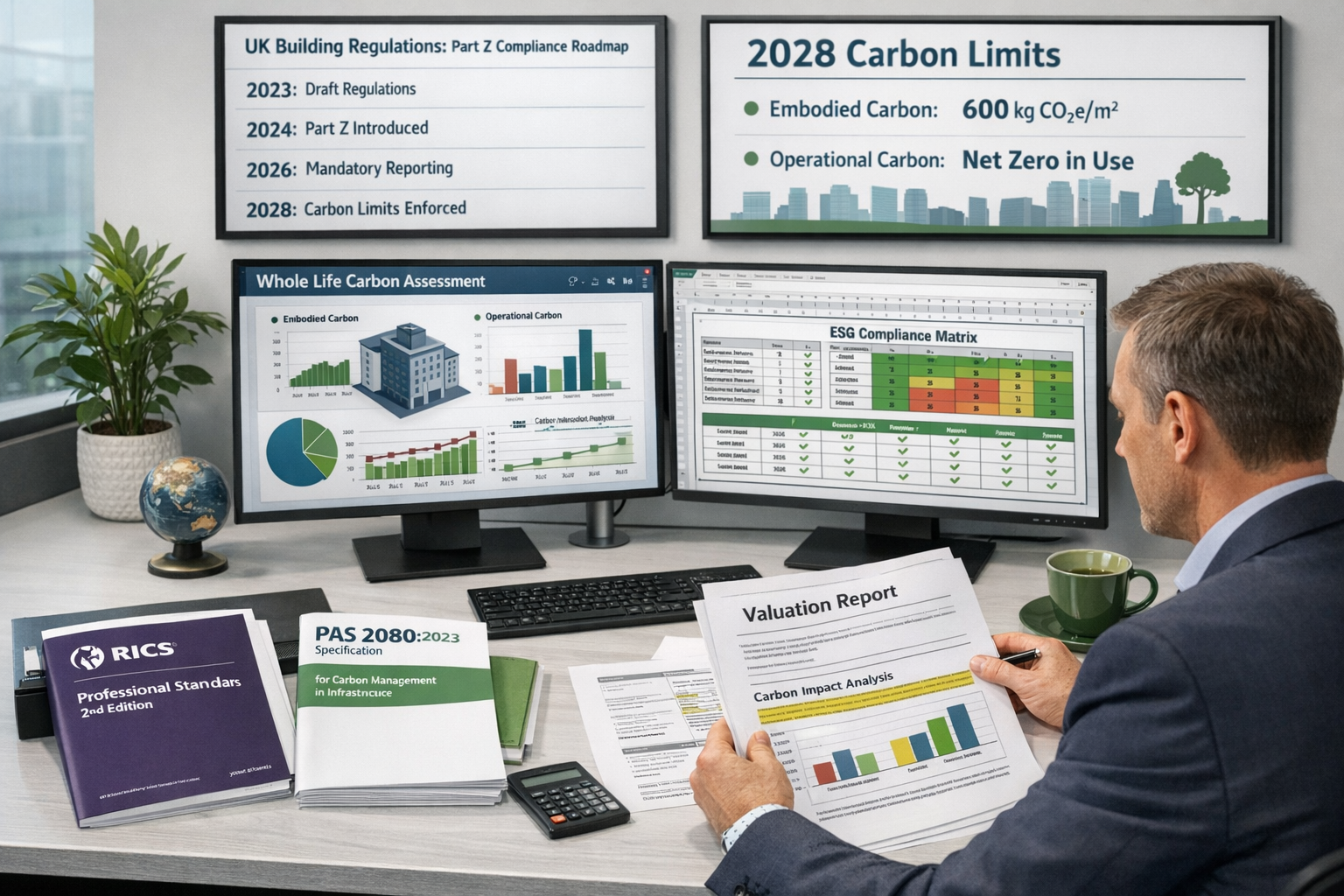
This transformation arrives at a critical juncture. Projects breaking ground in 2026 should expect mandatory WLC reporting requirements, with embodied carbon limits following from 2028 onwards [2]. The dual-standard approach—RICS WLCA providing measurement methodology and PAS 2080 establishing management governance—creates a robust framework that property professionals must master to remain compliant and competitive [4].
Key Takeaways
- 🏗️ Part Z Compliance: UK Building Regulations Part Z will mandate Whole Life Carbon assessment reporting for most new buildings from 2026-27, with embodied carbon limits from 2028
- 📊 Dual-Standard Framework: RICS WLCA (2nd Edition) provides calculation methodology while PAS 2080:2023 establishes carbon management governance and processes
- 💼 Valuation Integration: Property surveyors must now incorporate comprehensive carbon data across embodied, operational, and user-stage emissions into RICS property valuations
- 🎓 Professional Development: The RICS Global Certificate in Whole Life Carbon Assessment offers 140 hours of structured CPD, with 2026 cohorts starting from April [1]
- ⚖️ Expert Witness Role: Carbon assessments are becoming critical evidence in property disputes, ESG compliance cases, and planning appeals
Understanding the RICS Whole Life Carbon Assessment Standard (2nd Edition)
The RICS Whole Life Carbon Assessment standard, updated and fully operational from 1 July 2024, represents the most comprehensive methodology for measuring and reporting carbon emissions across the entire lifecycle of buildings and infrastructure [3]. This second edition provides the calculation framework that UK property surveyors must apply when conducting Whole Life Carbon Assessments in Valuation Reports: RICS PAS 2080 Applications for UK Property Surveyors in 2026.
Complete Lifecycle Coverage
The RICS WLCA methodology assesses three critical carbon categories that distinguish it from simpler operational energy assessments [4]:
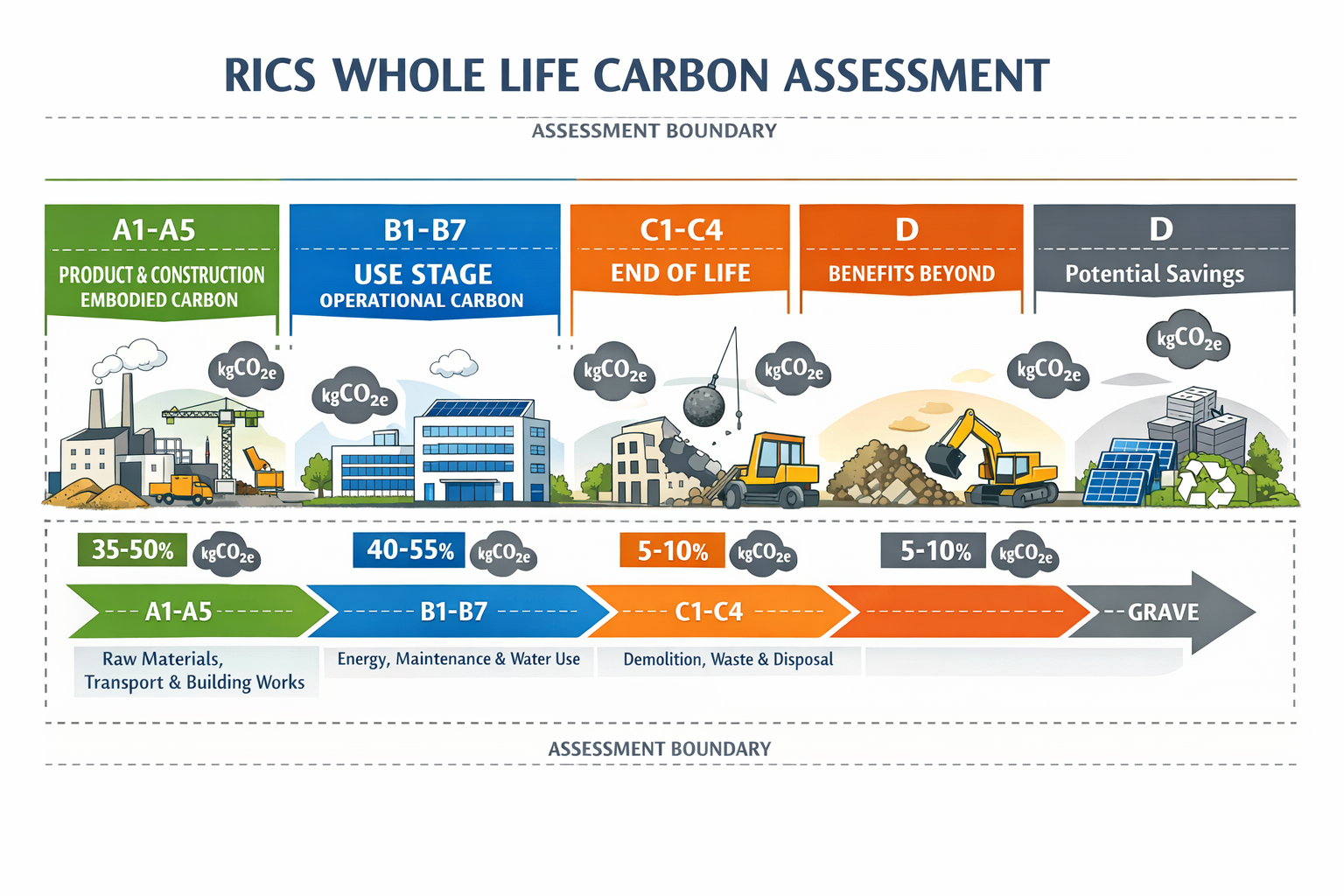
Embodied Carbon (Modules A1-A5, C1-C4): Emissions from materials extraction, manufacturing, transportation, construction processes, and end-of-life deconstruction. This "upfront carbon" often represents 50-70% of total lifecycle emissions in modern energy-efficient buildings.
Operational Carbon (Modules B1-B7): Emissions from building use, including heating, cooling, lighting, and equipment operation over the structure's lifespan. While traditionally the focus of energy performance certificates, operational carbon now requires integration with embodied carbon for complete assessment.
User-Stage Impacts: A unique feature of RICS WLCA, this includes emissions from occupant activities, maintenance, refurbishment, and replacement of building components—elements frequently overlooked but essential for accurate decarbonization decision-making [4].
Global Methodology with UK Application
The RICS WLCA methodology maintains global applicability while providing detailed guidance based on UK locations and standard practices [5]. This flexibility allows UK surveyors to apply consistent principles across international property portfolios while ensuring compliance with domestic regulatory requirements.
For property surveyors conducting assessments across London and the Southeast—from Richmond to Croydon—the standard provides specific assumptions for UK construction practices, material supply chains, and energy grid carbon intensity factors.
Key Calculation Principles
The RICS WLCA standard establishes several fundamental principles that surveyors must follow:
✅ Transparency: All assumptions, data sources, and calculation methods must be clearly documented and defensible
✅ Consistency: Standardized boundaries and modules ensure comparability between assessments
✅ Accuracy: Data quality requirements prioritize actual project-specific information over generic industry averages
✅ Completeness: All material lifecycle stages must be included within defined assessment boundaries
PAS 2080:2023 – The Carbon Management Framework
While RICS WLCA provides the "what" and "how" of carbon measurement, PAS 2080:2023 establishes the "when" and "who"—the governance structure and management processes for controlling whole life carbon across project delivery [3]. Understanding this complementary relationship is essential for UK property surveyors implementing Whole Life Carbon Assessments in Valuation Reports: RICS PAS 2080 Applications for UK Property Surveyors in 2026.
The Five Pillars of PAS 2080
PAS 2080:2023 structures carbon management around five interconnected pillars [7]:
1. Governance and Responsibilities 🏛️
Clear leadership accountability with designated carbon champions at organizational and project levels. Surveyors must identify who owns carbon targets and how decisions are escalated.
2. Targets and Baselines 🎯
Early establishment of carbon budgets and performance metrics. Projects should set targets before detailed design begins, with baseline assessments providing comparison benchmarks.
3. Carbon Consideration in Decision-Making 🔍
Systematic evaluation of carbon impacts at every decision point, from material selection to procurement strategies. This requires surveyors to present carbon data alongside cost and program considerations.
4. Monitoring and Reporting 📈
Regular tracking of actual carbon performance against targets, with transparent reporting to stakeholders. RICS property valuations must now incorporate this ongoing monitoring data.
5. Continual Improvement 🔄
Learning from completed projects to refine future carbon reduction strategies across the supply chain.
Supply Chain Collaboration
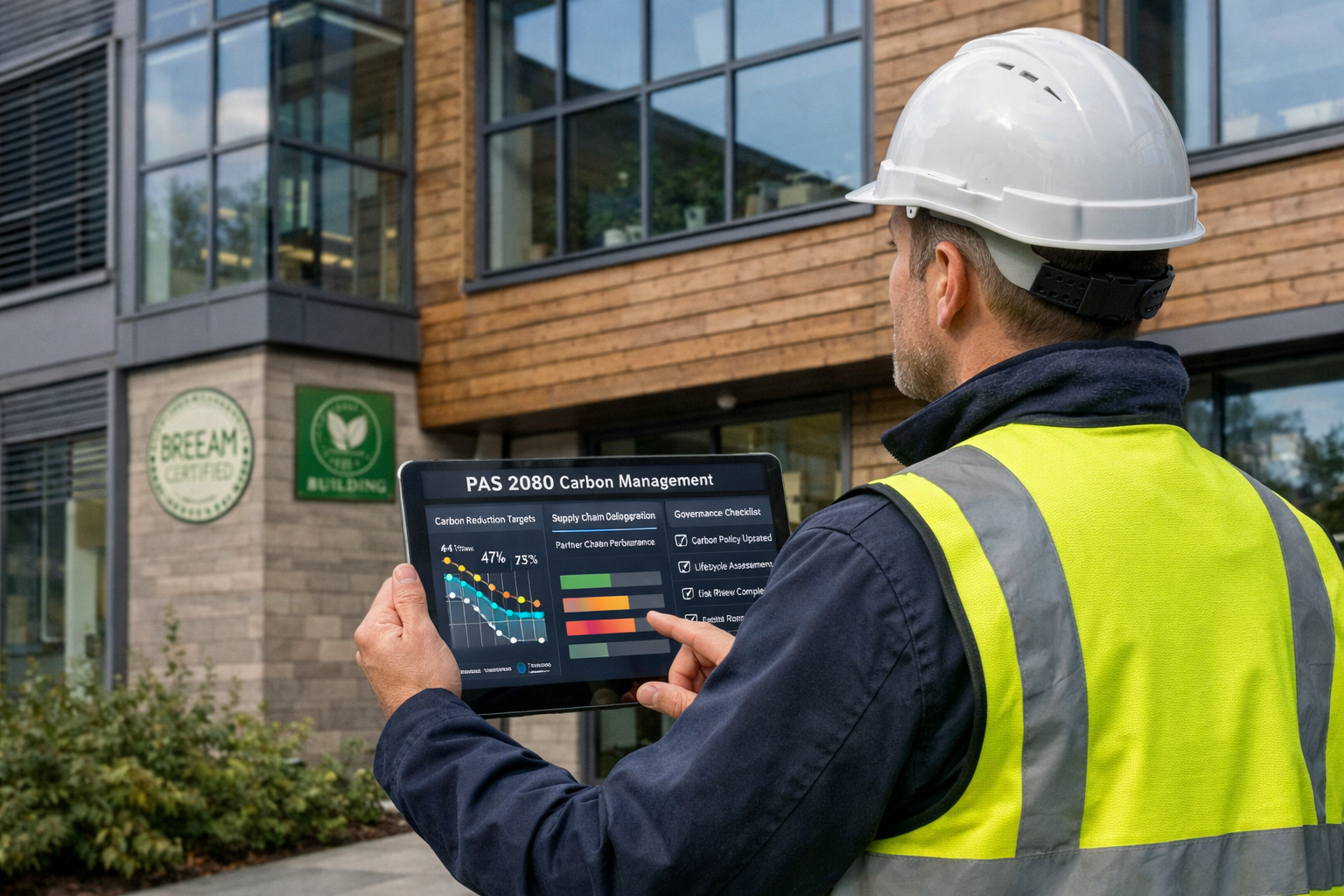
PAS 2080 emphasizes that effective carbon management requires collaboration across the entire delivery chain—from clients and designers to contractors and material suppliers [7]. For property surveyors, this means:
- Requesting carbon data from contractors during tender evaluation
- Verifying supplier carbon declarations and certifications
- Assessing contractor carbon management capabilities
- Monitoring subcontractor compliance with project carbon targets
This collaborative approach transforms carbon management from a compliance exercise into a value-creation opportunity, enabling property evaluation that accounts for long-term sustainability performance.
RICS and ICE Harmonization
The formal harmonization between RICS and the Institution of Civil Engineers (ICE) in 2024 brought crucial clarity to the industry [4][8]. The joint messaging confirms:
- RICS WLCA = Measurement and reporting methodology
- PAS 2080 = Management and governance framework
- Both standards work together, not in competition
- Compliance with one does not automatically satisfy the other
This harmonization gives clients, regulators, and professionals confidence that following both standards provides comprehensive carbon assessment and management coverage [4].
Integrating Whole Life Carbon into Valuation Reports
The integration of carbon data into property valuations represents one of the most significant professional practice changes for UK surveyors in 2026. As ESG mandates intensify and Part Z compliance approaches, Whole Life Carbon Assessments in Valuation Reports: RICS PAS 2080 Applications for UK Property Surveyors in 2026 require systematic methodologies that balance traditional valuation factors with carbon performance metrics.
Surveyor Checklist for Carbon-Integrated Valuations
Property surveyors should follow this comprehensive checklist when incorporating WLC data into valuation reports:
Pre-Assessment Phase ✓
- Confirm client requirements for carbon assessment scope and detail level
- Identify applicable regulatory requirements (Part Z, planning conditions, ESG reporting)
- Determine assessment boundaries (building only, site infrastructure, fit-out)
- Establish data access to design information, material specifications, energy models
- Verify competency requirements and consider specialist carbon consultant engagement
Data Collection Phase ✓
- Obtain architectural and structural drawings with material specifications
- Collect mechanical and electrical system details including efficiency ratings
- Gather construction methodology statements and logistics plans
- Request supplier Environmental Product Declarations (EPDs) for key materials
- Review operational energy performance data (DEC, EPC, actual consumption)
- Document maintenance and replacement schedules for building components
Calculation Phase ✓
- Apply RICS WLCA methodology for embodied carbon (Modules A1-A5)
- Calculate operational carbon over defined assessment period (typically 60 years)
- Include user-stage impacts and maintenance carbon
- Assess end-of-life carbon implications (demolition, recycling, waste)
- Document all assumptions, data sources, and calculation methods
- Conduct sensitivity analysis on key variables
Valuation Integration Phase ✓
- Benchmark carbon performance against industry standards and comparable properties
- Assess carbon impact on rental values and investment yields
- Evaluate future-proofing against 2028 embodied carbon limits
- Consider carbon cost exposure under potential carbon pricing mechanisms
- Identify value-enhancement opportunities through carbon reduction
- Document carbon-related risks and opportunities in valuation narrative
Valuation Adjustment Methodologies
Surveyors can apply several approaches to reflect carbon performance in property values:
Direct Cost Adjustment: Quantify the financial cost of achieving carbon compliance or reduction targets. For example, if a building requires £500,000 of retrofit works to meet 2028 embodied carbon limits, this directly impacts current valuation.
Yield Adjustment: Properties with superior carbon performance may command lower yields (higher values) due to reduced obsolescence risk and enhanced tenant appeal. Early evidence suggests 10-25 basis point yield compression for buildings with verified low carbon credentials.
Rental Value Premium: Occupiers increasingly prioritize carbon performance for corporate ESG reporting. Buildings with comprehensive WLC assessments and strong performance may achieve 3-7% rental premiums in competitive markets.
Depreciation Acceleration: Properties with poor carbon performance face accelerated economic obsolescence as regulatory requirements tighten. This may warrant additional depreciation provisions in valuations.
Expert Witness Applications
Carbon assessments are rapidly becoming critical evidence in property-related legal proceedings. UK surveyors providing expert witness services must now address carbon considerations in:
Planning Appeals: Demonstrating compliance with local authority carbon reduction policies and national planning frameworks
Dilapidations Claims: Assessing whether building alterations have impacted carbon performance and future compliance costs
Professional Negligence Cases: Evaluating whether surveyors provided adequate advice on carbon risks and opportunities
Lease Renewal Disputes: Determining appropriate rent levels considering carbon performance and compliance obligations
When preparing expert reports, surveyors should apply the same rigorous documentation standards required for homebuyers reports or building surveys, ensuring all carbon calculations are transparent, defensible, and compliant with RICS WLCA and PAS 2080 methodologies.
Professional Development and Training Requirements
The rapid evolution of carbon assessment standards creates urgent professional development needs for UK property surveyors. Mastering Whole Life Carbon Assessments in Valuation Reports: RICS PAS 2080 Applications for UK Property Surveyors in 2026 requires structured training that combines technical calculation skills with strategic carbon management capabilities.
RICS Global Certificate Programme
The RICS Global Certificate in Whole Life Carbon Assessment represents the most comprehensive training pathway for property professionals [1]. The 2026 programme offers:
Programme Structure:
- 140 hours of structured CPD content
- Online delivery with flexible scheduling
- Comprehensive introduction to RICS WLCA principles
- Practical application aligned with ISO international standards
- Assessment and certification upon completion
2026 Cohort Dates:
- Cohort 1: 10 April 2026 (currently enrolling)
- Cohort 2: 07 August 2026
- Cohort 3: 04 December 2026
Investment: From £1,982 + VAT [1]
The certificate programme provides the technical foundation that RICS surveyors need to confidently conduct carbon assessments, interpret results, and integrate findings into valuation reports and client advisory services.
Core Competency Areas
UK property surveyors should develop proficiency across these essential competency areas:
Technical Calculation Skills 🔢
- Material embodied carbon quantification
- Operational energy modeling and carbon conversion
- Lifecycle assessment boundaries and modules
- Data quality evaluation and uncertainty analysis
Regulatory Knowledge 📚
- Building Regulations Part Z requirements and timelines
- Planning policy carbon considerations
- ESG disclosure frameworks (TCFD, SECR, SFDR)
- Future carbon pricing mechanisms and compliance costs
Software Proficiency 💻
- Carbon calculation tools (One Click LCA, eTool, others)
- Building information modeling (BIM) for carbon data extraction
- Energy modeling software integration
- Reporting and visualization platforms
Strategic Advisory 🎯
- Carbon reduction opportunity identification
- Cost-benefit analysis of decarbonization interventions
- Whole life cost and carbon optimization
- Stakeholder communication and reporting
Continuing Professional Development
Beyond formal certification, surveyors should maintain current knowledge through:
- Regular review of RICS professional standards updates
- Participation in industry working groups and forums
- Case study analysis of completed carbon assessments
- Cross-disciplinary learning with architects, engineers, and sustainability consultants
- Attendance at conferences focused on net zero construction
For surveyors serving diverse locations—from Islington to Hammersmith—understanding regional variations in building stock, construction practices, and local planning requirements enhances the practical application of carbon assessment methodologies.
Practical Implementation Challenges and Solutions
Despite clear methodological frameworks, UK property surveyors implementing Whole Life Carbon Assessments in Valuation Reports: RICS PAS 2080 Applications for UK Property Surveyors in 2026 encounter several practical challenges. Understanding these obstacles and proven solutions accelerates successful adoption.
Challenge 1: Data Availability and Quality
The Problem: Many existing buildings lack comprehensive material specifications, construction records, or operational energy data. Suppliers may not provide Environmental Product Declarations (EPDs) for specified materials.
Solutions:
- Develop standardized data request templates for clients and contractors
- Build databases of typical carbon factors for common UK construction assemblies
- Establish relationships with material suppliers who provide verified EPDs
- Use conservative assumptions when data gaps exist, clearly documented in reports
- Implement phased assessment approaches, refining calculations as data becomes available
Challenge 2: Software and Tool Selection
The Problem: Multiple carbon calculation platforms exist with varying methodologies, databases, and outputs. Selecting appropriate tools and ensuring consistency proves challenging.
Solutions:
- Prioritize tools aligned with RICS WLCA and PAS 2080 methodologies
- Verify that software databases use current UK carbon factors and EPDs
- Conduct parallel calculations using different tools to validate results
- Maintain detailed documentation of tool selection rationale
- Invest in training for selected platforms to maximize accuracy and efficiency
Challenge 3: Client Understanding and Buy-In
The Problem: Many property clients remain unfamiliar with whole life carbon concepts, questioning the value of assessments or resisting additional costs.
Solutions:
- Develop clear client education materials explaining Part Z requirements and timelines
- Demonstrate financial risks of non-compliance and carbon-related obsolescence
- Present case studies showing value enhancement from strong carbon performance
- Offer tiered assessment services matching client budget and regulatory requirements
- Position carbon assessment as risk management, not just compliance cost
Challenge 4: Valuation Methodology Uncertainty
The Problem: Limited market evidence exists for quantifying carbon performance impact on property values, creating uncertainty in adjustment methodologies.
Solutions:
- Build transaction databases tracking carbon performance and pricing outcomes
- Collaborate with investment clients to understand their carbon valuation approaches
- Apply sensitivity analysis showing valuation ranges under different carbon scenarios
- Reference emerging research on green building premiums and carbon pricing
- Maintain conservative adjustment approaches until market evidence strengthens
Challenge 5: Competency and Resource Constraints
The Problem: Many surveying practices lack in-house carbon assessment expertise and face resource constraints for training and capability development.
Solutions:
- Prioritize training for senior staff who can mentor junior team members
- Establish partnerships with specialist carbon consultants for complex assessments
- Develop internal knowledge-sharing protocols and case study libraries
- Allocate dedicated CPD time for carbon competency development
- Consider recruiting specialists with sustainability or engineering backgrounds
Future Outlook: 2026-2030 Trajectory
The trajectory for Whole Life Carbon Assessments in Valuation Reports: RICS PAS 2080 Applications for UK Property Surveyors in 2026 points toward rapid mainstreaming over the next four years. Understanding upcoming regulatory milestones and market developments helps surveyors prepare strategically.
Regulatory Timeline
2026-2027: Part Z mandatory reporting requirements take effect for most new buildings, requiring WLC assessment submission with Building Control applications [2]
2028: Embodied carbon limits become enforceable, establishing maximum kgCO2e/m² thresholds that new buildings must not exceed [2]
2030: Anticipated tightening of carbon limits and potential extension to major refurbishment projects
Market Evolution
Several market trends will accelerate carbon integration into property valuations:
ESG Investment Mandates 📊: Institutional investors increasingly require comprehensive carbon data for portfolio reporting, making WLC assessments prerequisites for investment-grade properties.
Green Financing Mechanisms 💰: Sustainability-linked loans and green bonds tie interest rates to carbon performance, creating direct financial incentives for strong WLC credentials.
Tenant Demand 🏢: Corporate occupiers with net zero commitments prioritize buildings with verified low carbon performance, influencing rental values and void periods.
Insurance and Risk 🛡️: Property insurers may begin differentiating premiums based on climate resilience and carbon performance, affecting investment returns.
Carbon Pricing 💷: Potential introduction of carbon taxes or emissions trading schemes for buildings would directly monetize carbon performance differences.
Professional Practice Evolution
The surveying profession will continue adapting to carbon integration through:
- Development of specialized carbon valuation expertise within practices
- Enhanced collaboration with architects, engineers, and sustainability consultants
- Integration of carbon assessment into standard survey and valuation workflows
- Expansion of carbon-focused advisory services beyond compliance
- Increased use of digital tools and BIM for automated carbon quantification
For practices serving areas like Camden and Barnet, early adoption of carbon assessment capabilities creates competitive differentiation and positions firms as forward-thinking advisors in an evolving market.
Conclusion
The integration of Whole Life Carbon Assessments into UK property valuation practice represents a fundamental evolution in professional surveying. As 2026 progresses toward Part Z mandatory reporting and the 2028 embodied carbon limits horizon, property surveyors must master both the RICS WLCA measurement methodology and the PAS 2080 management framework to deliver comprehensive, compliant, and valuable client services.
The harmonized dual-standard approach—RICS WLCA for calculation and PAS 2080 for governance—provides a robust foundation that UK surveyors can confidently apply across diverse property types and client requirements. From property valuations to expert witness testimonies, carbon data now constitutes essential evidence that influences investment decisions, planning outcomes, and legal proceedings.
Actionable Next Steps for UK Property Surveyors
-
Enroll in formal training: Register for the RICS Global Certificate in Whole Life Carbon Assessment to build foundational competency [1]
-
Audit current capabilities: Assess your practice's carbon assessment tools, data sources, and expertise gaps
-
Develop implementation protocols: Create standardized workflows for integrating WLC data into valuation reports and survey outputs
-
Build strategic partnerships: Establish relationships with carbon consultants, material suppliers, and software providers
-
Engage clients proactively: Educate property clients about upcoming regulatory requirements and carbon-related value impacts
-
Document case studies: Record lessons learned from early carbon assessment projects to refine methodologies
-
Monitor regulatory developments: Stay current with Part Z implementation details and industry guidance updates
-
Invest in appropriate tools: Select and implement carbon calculation software aligned with RICS WLCA standards
The surveyors who embrace this transformation—developing carbon competency, integrating assessment methodologies, and providing strategic carbon advisory services—will lead the profession through the net zero transition. Those who delay risk professional obsolescence as carbon performance becomes inseparable from property value.
The future of UK property surveying is carbon-conscious, data-driven, and sustainability-focused. The time to prepare is now.
References
[1] Certificate In Whole Life Carbon Assessment Training Programme – https://www.rics.org/training-events/training-courses/certificate-in-whole-life-carbon-assessment-training-programme
[2] Whole Life Carbon Net Zero And The 2028 Horizon – https://www.tsariley.com/news/whole-life-carbon-net-zero-and-the-2028-horizon/
[3] Pas 2080 Carbon Management For Energy Infrastructure One Click Lca – https://oneclicklca.com/en-gb/resources/articles/pas-2080-carbon-management-for-energy-infrastructure-one-click-lca
[4] Rics And Ice Harmonise Messaging On Carbon Assessment And Manage – https://www.rics.org/news-insights/rics-and-ice-harmonise-messaging-on-carbon-assessment-and-manage
[5] Whole Life Carbon Assessment – https://www.rics.org/profession-standards/rics-standards-and-guidance/sector-standards/construction-standards/whole-life-carbon-assessment
[6] Whole Life Carbon Assessment Wlca – https://blue-marble.co.uk/sustainability-guides/whole-life-carbon-assessment-wlca/
[7] Pas 2080 Suppliers Subcontractors Bids Delivery – https://www.seedling.earth/post/pas-2080-suppliers-subcontractors-bids-delivery
[8] Rics And Ice Harmonise Messaging On Carbon Assessment And Management – https://wholelifecarbon.com/article/rics-and-ice-harmonise-messaging-on-carbon-assessment-and-management