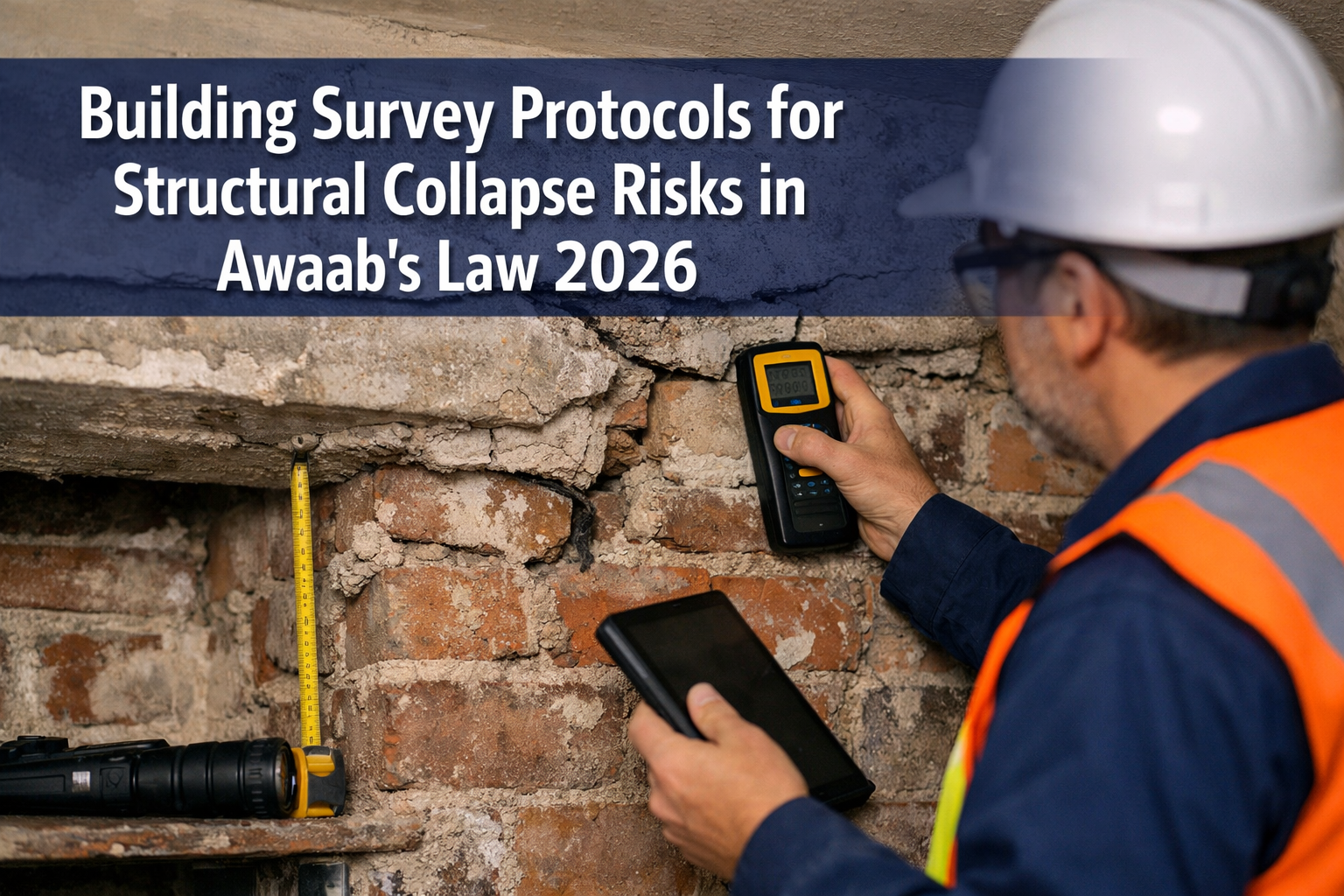
Structural collapse hazards in rental properties will trigger mandatory 24-hour emergency investigations under Awaab's Law Phase 2 extensions rolling out across England in 2026. For the estimated 4.5 million private rental sector properties—many built before modern building regulations—this legislative shift demands immediate protocol development from surveyors, landlords, and property professionals[2][3].
The tragic death of two-year-old Awaab Ishak from prolonged mould exposure in social housing sparked legislative reform that initially focused on damp and mould hazards. Now, Building Survey Protocols for Structural Collapse Risks in Awaab's Law 2026: Rental Property Focus represents the next critical phase, extending mandatory timeframes to life-threatening structural defects including subsidence, structural instability, and explosion risks[2][6]. Private landlords face the same stringent compliance obligations as social housing providers, with enforcement mechanisms including compensation orders and potential rent suspension.
This comprehensive guide provides chartered surveyors and property professionals with detailed Level 3 survey checklists, risk assessment frameworks, and remediation strategies specifically designed for aging rental stock under the new regulatory environment.
Key Takeaways
✅ Emergency structural hazards require investigation and remediation within 24 hours under Awaab's Law Phase 2, with significant hazards requiring action within 10 working days[1][2]
✅ Private landlords enter scope in 2026, facing equivalent obligations to social housing providers for structural collapse risk management[3]
✅ Level 3 building surveys must incorporate enhanced protocols for identifying subsidence, load-bearing failures, and explosion hazards in aging rental properties
✅ Non-compliance consequences include enforcement orders, tenant compensation, legal cost coverage, and loss of rental income for uninhabitable properties[2]
✅ Valuation de-risking strategies require proactive structural assessments before hazards escalate to emergency status, protecting landlord investments and tenant safety
Understanding Awaab's Law Phase 2: Structural Collapse Within Regulatory Scope
Legislative Evolution and Timeline
Awaab's Law initially focused on damp and mould hazards when it came into force for social housing providers in November 2025. The government's Phase 2 expansion—expected throughout 2026—brings structural collapse, explosions, subsidence, and structural instability into the mandatory investigation and remediation framework[2][6].
This expansion reflects growing concern about the condition of England's aging rental stock. Approximately 38% of private rental properties were built before 1945, predating modern structural engineering standards and building control regulations[3]. Many properties exhibit cumulative deterioration from decades of deferred maintenance, creating latent collapse risks that traditional periodic inspections may miss.
Mandatory Investigation Timeframes
The legislation establishes two critical response windows based on hazard severity:
Emergency Hazards (24-Hour Response)
- Imminent structural collapse risk
- Active subsidence causing immediate instability
- Gas leak or explosion hazard
- Severe load-bearing element failure
- Dangerous structural movement requiring evacuation[1][2]
Significant Hazards (10 Working Days)
- Progressive structural deterioration
- Non-emergency subsidence indicators
- Moderate load-bearing element degradation
- Structural movement requiring monitoring
- Foundation settlement patterns[1]
These timeframes begin from the moment landlords become aware of potential hazards—whether through tenant reports, routine inspections, or third-party notifications. The compressed response windows demand pre-established survey protocols and contractor relationships to ensure compliance.
Private Landlord Obligations
From 2026 onward, private landlords must implement the same hazard management systems as registered social housing providers[3]. This represents a fundamental shift from reactive maintenance approaches to proactive risk identification and documentation.
Key obligations include:
🔍 Systematic hazard monitoring through regular inspections
📋 Documented investigation procedures with timestamped records
⚡ Emergency response protocols with 24-hour contractor availability
📊 Tenant communication systems for hazard reporting
💰 Financial reserves for emergency structural repairs
Landlords managing multiple properties should consider professional building survey services to establish baseline structural condition assessments before Phase 2 implementation.
Building Survey Protocols for Structural Collapse Risks in Awaab's Law 2026: Rental Property Focus – Level 3 Survey Checklists

Foundation and Substructure Assessment
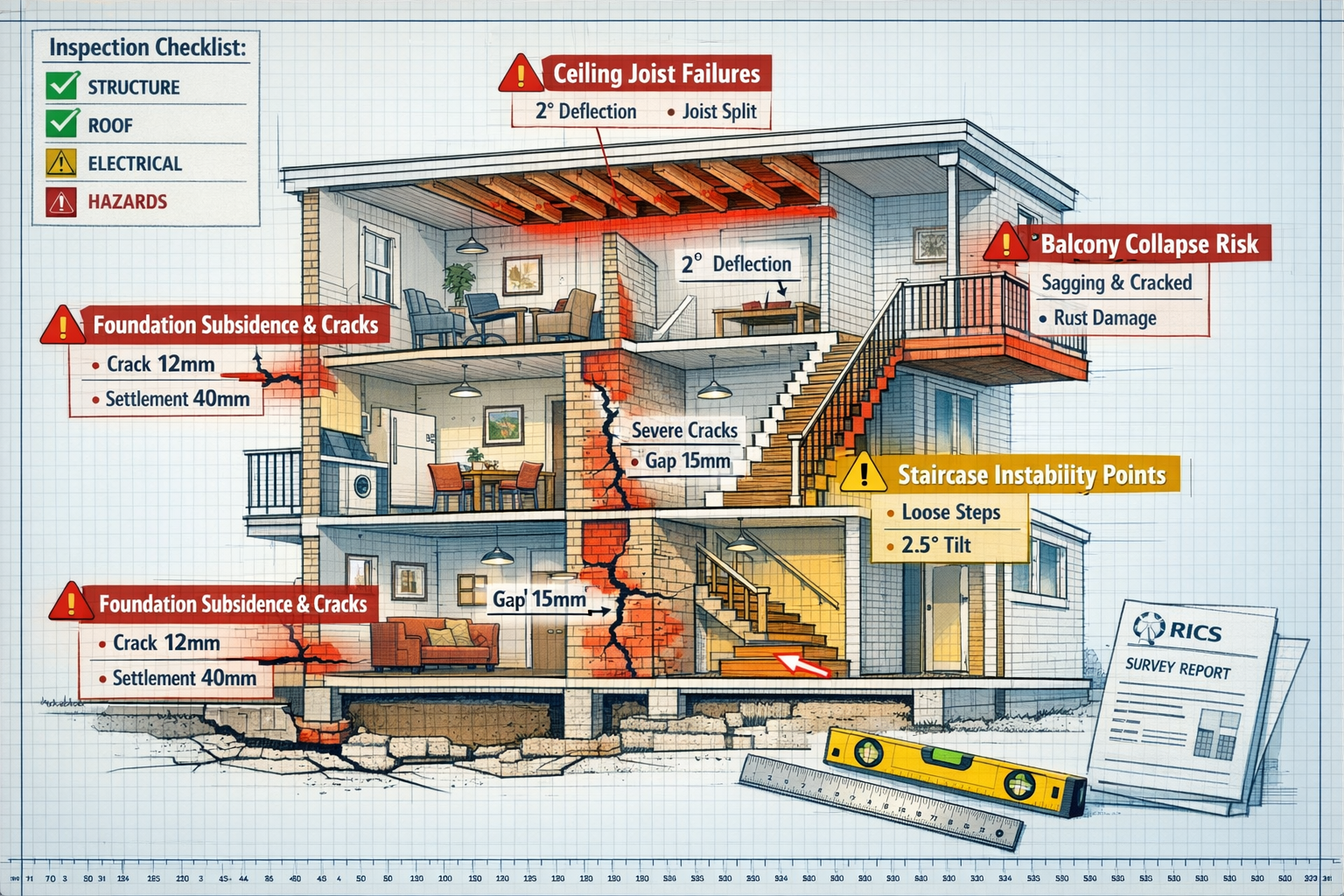
The foundation system represents the critical first line of defense against structural collapse. Level 3 surveys for rental properties must incorporate enhanced protocols beyond standard RICS guidance to identify early-stage failure indicators.
Foundation Inspection Checklist
Visual External Examination:
- ✓ Stepped cracking in external walls (>3mm width requires immediate investigation)
- ✓ Horizontal cracking at damp-proof course level indicating settlement
- ✓ Bulging or leaning external walls (>1:100 deviation from vertical)
- ✓ Separation between wall and ground level
- ✓ Distortion of door and window frames preventing operation
- ✓ Ground level changes around perimeter indicating subsidence
Internal Structural Indicators:
- ✓ Diagonal cracking from corners of openings (classic subsidence pattern)
- ✓ Ceiling-to-wall separation gaps
- ✓ Sloping floors (>1:100 gradient requires investigation)
- ✓ Sticking doors indicating frame distortion
- ✓ Cracked or lifted floor tiles showing movement
- ✓ Visible deflection in floor joists or beams
Subsurface Investigation Requirements:
- ✓ Trial pit excavation to expose foundation depth and construction
- ✓ Foundation depth measurement (pre-1945 properties often <450mm)
- ✓ Soil type identification and bearing capacity assessment
- ✓ Drainage condition around foundations
- ✓ Tree root proximity analysis (>1.5x mature height requires monitoring)
- ✓ Historical ground movement records from British Geological Survey
Properties in areas like Newham, Enfield, and Barnet with clay soil conditions require enhanced subsidence monitoring protocols due to seasonal ground movement patterns.
Load-Bearing Element Evaluation
Load-bearing walls, columns, and beams transfer building weight to foundations. Deterioration or modification of these elements creates immediate collapse risk requiring emergency classification under Awaab's Law.
Structural Element Assessment Protocol
Masonry Load-Bearing Walls:
- ✓ Vertical cracking indicating overloading or foundation movement
- ✓ Bulging or bowing (>10mm over 1m length)
- ✓ Mortar joint deterioration and pointing failure
- ✓ Damp penetration causing brick spalling and freeze-thaw damage
- ✓ Unauthorized removal or alteration of load-bearing walls
- ✓ Inadequate lintels over openings showing deflection
Timber Structural Elements:
- ✓ Rot or decay in load-bearing beams (probe testing required)
- ✓ Woodworm infestation in structural timbers
- ✓ Deflection exceeding L/360 span ratio
- ✓ End-bearing failures at wall plates
- ✓ Inadequate support for floor joists
- ✓ Notching or drilling compromising structural capacity
Steel and Concrete Elements:
- ✓ Corrosion of steel beams and columns (>20% section loss critical)
- ✓ Concrete spalling exposing reinforcement
- ✓ Carbonation depth in concrete (>20mm indicates deterioration)
- ✓ Chloride contamination in coastal or industrial areas
- ✓ Inadequate fire protection on structural steelwork
- ✓ Connection failures at beam-to-column joints
Understanding structural survey importance becomes critical when evaluating whether defects constitute emergency or significant hazards under the legislation.
Roof Structure and Ceiling Integrity
Roof collapse represents one of the most catastrophic structural failures in residential properties. Aging rental stock often exhibits cumulative deterioration from water ingress, timber decay, and inadequate maintenance.
Roof Structure Inspection Requirements
External Roof Assessment:
- ✓ Sagging ridge lines indicating rafter or purlin failure
- ✓ Slipped or missing roof coverings allowing water penetration
- ✓ Gutter and downpipe failures causing wall saturation
- ✓ Chimney stack stability and flashing condition
- ✓ Parapet wall condition and coping stone security
- ✓ Roof valley deterioration creating water traps
Roof Space Investigation:
- ✓ Rafter deflection or splitting
- ✓ Purlin and ridge beam condition
- ✓ Wall plate integrity and fixing
- ✓ Truss plate connector failures (modern truss roofs)
- ✓ Water staining indicating active leaks
- ✓ Condensation damage to structural timbers
- ✓ Inadequate bracing or wind-resistance provisions
Ceiling Structural Condition:
- ✓ Ceiling deflection or sagging between joists
- ✓ Plaster delamination indicating water damage
- ✓ Ceiling joist overloading from storage
- ✓ Inadequate joist sizing for span
- ✓ Connection failures at wall plates
- ✓ Fire damage to ceiling timbers
Staircase and Balcony Fall Hazards
Falls from height represent serious injury risks classified as significant hazards under Awaab's Law. Staircases and balconies in aging rental properties often fail to meet current building regulation standards.
Fall Risk Assessment Protocol
Staircase Structural Evaluation:
- ✓ String deflection or splitting
- ✓ Tread and riser fixing adequacy
- ✓ Handrail security and height (minimum 900mm)
- ✓ Balustrade spacing (maximum 100mm gaps)
- ✓ Landing structural adequacy
- ✓ Headroom clearance (minimum 2m)
Balcony and Elevated Platform Assessment:
- ✓ Cantilever support adequacy
- ✓ Balustrade height and strength (minimum 1100mm)
- ✓ Decking condition and fixing
- ✓ Drainage provision preventing water accumulation
- ✓ Connection integrity to main structure
- ✓ Corrosion of metal balcony supports
Properties requiring detailed assessment can benefit from choosing the right property survey level to ensure comprehensive hazard identification.
Explosion and Fire Structural Hazards
Phase 2 extensions include explosion risks within the regulatory framework, requiring surveyors to identify gas installation defects and structural fire safety failures[2][6].
Gas and Fire Safety Structural Checklist
Gas Installation Structural Risks:
- ✓ Corroded gas pipes within structural voids
- ✓ Inadequate ventilation for gas appliances
- ✓ Gas meter location and emergency isolation access
- ✓ Structural penetrations compromising gas pipe integrity
- ✓ Proximity of gas installations to electrical systems
- ✓ Absence of gas safety certificates
Fire Structural Safety:
- ✓ Fire door integrity and self-closing mechanisms
- ✓ Compartmentation breaches in walls and floors
- ✓ Inadequate fire resistance in structural elements
- ✓ Escape route structural adequacy
- ✓ Smoke alarm installation and coverage
- ✓ Structural alterations compromising fire safety
Valuation De-Risking and Landlord Remediation Strategies
Pre-Acquisition Structural Due Diligence
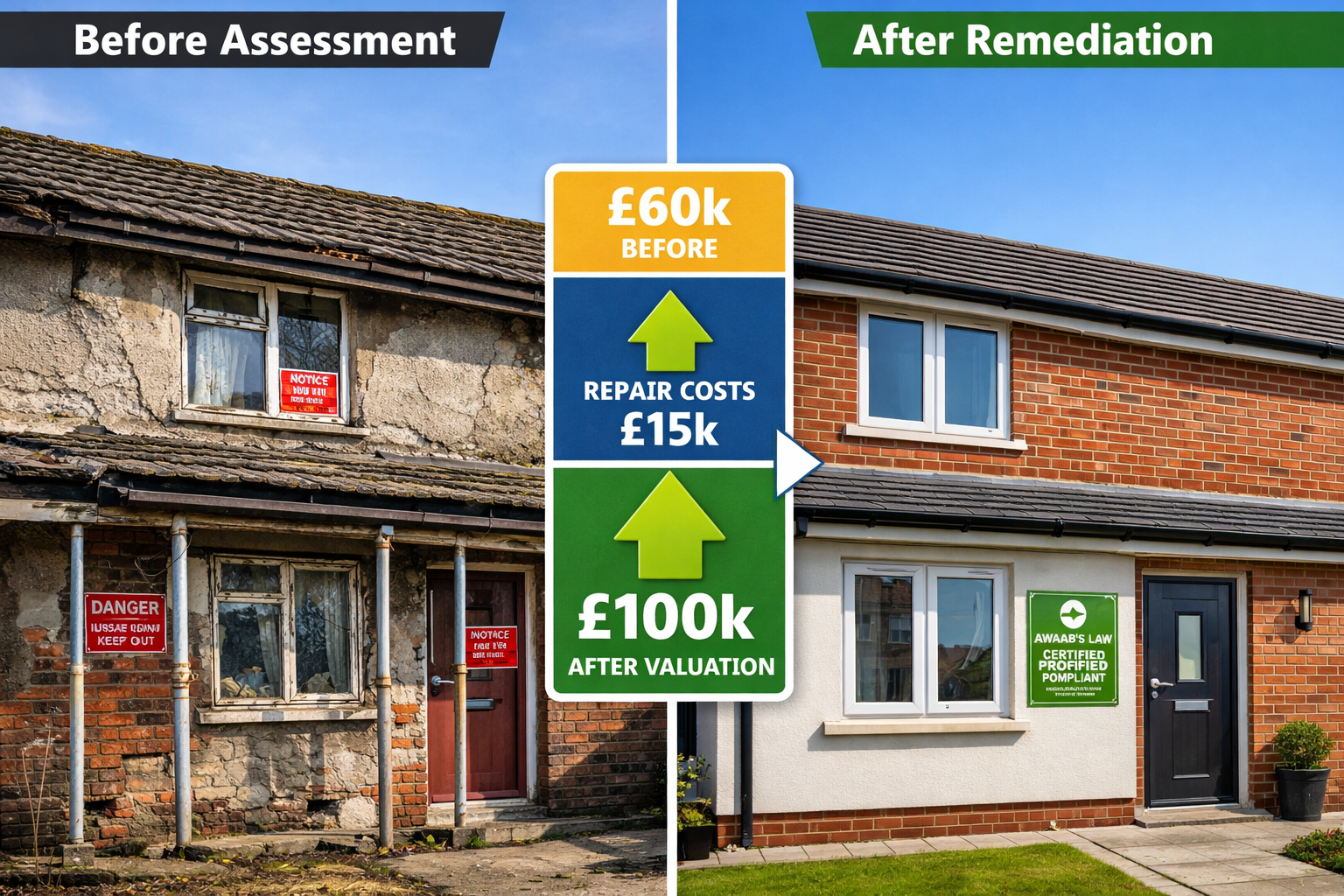
Prospective landlords acquiring rental properties in 2026 must incorporate Awaab's Law compliance assessment into purchase decisions. Properties with unidentified structural hazards represent significant financial and legal risks.
Due Diligence Protocol for Rental Property Purchases
Pre-Offer Assessment:
- Commission Level 3 building survey with specific Awaab's Law hazard focus
- Request all historical structural reports and remediation records
- Review previous tenant complaints regarding structural issues
- Obtain specialist subsidence survey if ground movement indicators present
- Verify gas safety certificates and electrical installation condition reports
- Calculate remediation cost estimates for identified defects
Purchase Price Negotiation:
- Deduct estimated remediation costs from offer price
- Include retention clauses for undisclosed structural defects
- Require vendor indemnities for Phase 2 hazard compliance
- Consider walking away from properties requiring emergency-level repairs
Landlords can leverage professional survey findings to negotiate property prices effectively, protecting investment returns while ensuring tenant safety.
Proactive Maintenance Programs
Landlords with existing rental portfolios should implement systematic inspection programs to identify structural hazards before they escalate to emergency status requiring 24-hour response.
Annual Structural Inspection Schedule
Q1 (January-March) – Post-Winter Assessment:
- External wall and foundation crack monitoring
- Roof structure inspection after winter weather
- Drainage system clearance and testing
- Damp penetration identification
Q2 (April-June) – Pre-Summer Preparation:
- Timber element condition survey
- Balcony and external structure safety checks
- Gas installation annual service
- Fire safety equipment testing
Q3 (July-September) – Mid-Year Review:
- Subsidence monitoring in clay soil areas
- Structural movement crack width measurements
- Tenant feedback review for unreported issues
- Photographic condition documentation
Q4 (October-December) – Winter Preparation:
- Roof weatherproofing verification
- Heating system structural safety checks
- Emergency contractor contact list updates
- Compliance documentation review
Properties showing progressive deterioration should receive comprehensive building surveys before issues reach significant hazard classification.
Emergency Response Planning
The 24-hour emergency response requirement demands pre-established contractor relationships and decision-making protocols. Landlords cannot wait until hazards emerge to develop response capabilities.
Emergency Structural Response Framework
Pre-Approved Contractor Network:
- 24/7 structural engineer availability
- Emergency shoring and propping contractors
- Rapid-response building contractors
- Gas safety emergency services
- Temporary accommodation providers
Decision-Making Protocol:
- Hour 0-2: Hazard identification and tenant safety assessment
- Hour 2-4: Structural engineer emergency site visit
- Hour 4-8: Immediate safety measures implementation
- Hour 8-16: Detailed investigation and remediation planning
- Hour 16-24: Remediation commencement or temporary accommodation provision
Documentation Requirements:
- Timestamped photographic evidence of hazard
- Professional engineer assessment report
- Contractor quotations and instructions
- Tenant communication records
- Remediation progress documentation
Landlords managing properties across multiple boroughs including Westminster, Islington, and Lewisham should establish location-specific contractor networks for rapid response.
Remediation Cost Management
Structural repairs represent significant capital expenditure. Strategic remediation planning can minimize costs while ensuring compliance and protecting property values.
Cost-Effective Remediation Strategies
Prioritization Framework:
| Hazard Severity | Response Time | Typical Cost Range | Funding Strategy |
|---|---|---|---|
| Emergency | 24 hours | £5,000-£50,000+ | Emergency reserves/insurance |
| Significant | 10 working days | £2,000-£20,000 | Planned maintenance budget |
| Moderate | 3 months | £500-£5,000 | Annual maintenance allocation |
| Low | 12 months | £200-£2,000 | Routine maintenance |
Value Engineering Approaches:
- Obtain multiple contractor quotations for non-emergency works
- Consider phased remediation for non-urgent defects
- Explore insurance coverage for sudden structural damage
- Utilize government grants for energy efficiency improvements that address structural issues
- Bundle multiple properties for contractor volume discounts
Valuation Protection:
Properties with documented structural compliance programs maintain higher market values and attract quality tenants. Landlords should retain comprehensive records including:
- Annual structural inspection reports
- Remediation work completion certificates
- Building control approval documentation
- Gas safety and electrical certificates
- Tenant communication logs
Understanding what to do after receiving concerning survey findings helps landlords respond strategically to structural defect identification.
Insurance Considerations
Standard landlord insurance policies may not adequately cover Awaab's Law compliance costs, particularly for pre-existing structural defects or gradual deterioration.
Insurance Coverage Requirements
Essential Policy Components:
- Public liability coverage (minimum £5 million)
- Structural damage coverage including subsidence
- Emergency accommodation costs for displaced tenants
- Legal expenses for regulatory compliance disputes
- Loss of rent during uninhabitable periods
- Professional fees for structural investigations
Policy Exclusions to Address:
- Pre-existing structural defects (consider specialist cover)
- Gradual deterioration from deferred maintenance
- Betterment costs when repairing to current standards
- Regulatory compliance upgrade requirements
Landlords should review policies annually and disclose all known structural issues to insurers to avoid coverage disputes during claims.
Professional Competence and Surveyor Qualifications
Awaab's Law implementation demands enhanced professional competence from building surveyors conducting structural assessments in rental properties. The legislation emphasizes speed and efficiency of operations alongside technical accuracy[2].
Required Surveyor Qualifications
Minimum Professional Standards:
- RICS (Royal Institution of Chartered Surveyors) membership
- Professional Indemnity Insurance (minimum £1 million)
- Continuing Professional Development in structural pathology
- Understanding of Awaab's Law Phase 2 requirements
- Experience with aging residential property assessment
Specialist Expertise for Complex Cases:
- Structural engineering qualifications for load-bearing assessments
- Subsidence investigation experience
- Timber decay and infestation identification
- Damp and condensation analysis
- Building pathology expertise
Landlords should verify surveyor credentials and request evidence of RICS surveyor qualifications before commissioning structural assessments.
Survey Report Requirements
Level 3 building survey reports for rental properties must explicitly address Awaab's Law Phase 2 hazards with clear severity classifications and remediation timeframes.
Enhanced Report Components
Executive Summary Section:
- Emergency hazards requiring 24-hour response (if any)
- Significant hazards requiring 10-day investigation
- Moderate and low-priority defects
- Estimated remediation costs by priority
- Compliance status summary
Detailed Hazard Analysis:
- Photographic evidence with annotated defect locations
- Structural calculations supporting severity classifications
- Progressive deterioration risk assessment
- Recommended monitoring protocols
- Specialist investigation requirements
Remediation Specifications:
- Detailed repair methodologies
- Performance standards for completed works
- Recommended contractor qualifications
- Estimated timeframes for completion
- Follow-up inspection requirements
Properties in areas like Harrow, Kingston, and Wembley with diverse housing stock ages require tailored survey approaches reflecting local building characteristics.
Tenant Communication and Hazard Reporting Systems
Effective tenant communication systems represent a critical compliance component under Awaab's Law. Landlords must establish clear reporting channels and response protocols.
Hazard Reporting Framework
Multi-Channel Reporting Options:
- 24/7 emergency telephone hotline
- Online reporting portal with photographic upload
- Email reporting with acknowledgment systems
- In-person reporting at management offices
- Third-party reporting through letting agents
Tenant Education Requirements:
- Written guidance on identifying structural hazards
- Examples of emergency vs. significant hazards
- Reporting procedure instructions
- Expected response timeframes
- Tenant rights under Awaab's Law
Response Acknowledgment Protocol:
- Immediate automated receipt confirmation
- Initial assessment within 4 hours
- Site inspection scheduling within 24 hours for emergencies
- Regular progress updates during investigation
- Completion notification with remediation details
Landlords should maintain comprehensive records of all tenant communications regarding potential structural hazards, including timestamps and response actions taken.
Legal Protections and Enforcement
Understanding enforcement mechanisms helps landlords appreciate the importance of proactive structural hazard management under Awaab's Law.
Enforcement Consequences
Regulatory Actions:
- Improvement notices requiring specific remediation works
- Prohibition orders preventing property occupation
- Emergency remedial action by local authorities
- Rent repayment orders for non-compliant periods
- Prosecution for serious breaches
Financial Penalties:
- Tenant compensation for delayed repairs
- Coverage of tenant legal costs
- Loss of rental income during uninhabitable periods
- Enforcement action costs
- Potential unlimited fines for serious breaches[2]
Reputational Impact:
- Mandatory publication of enforcement actions
- Tenant review platform disclosures
- Difficulty attracting quality tenants
- Reduced property values
- Mortgage lender concerns
Proactive compliance through systematic building survey protocols represents the most cost-effective risk management strategy for rental property landlords.
Technology and Digital Tools for Structural Monitoring
Emerging technologies offer landlords enhanced capabilities for continuous structural monitoring and early hazard detection.
Digital Monitoring Solutions
Structural Movement Monitoring:
- Crack width monitoring gauges with digital readout
- Laser-based deflection measurement systems
- Automated photographic comparison software
- Subsidence monitoring apps with GPS positioning
- IoT sensors for continuous structural movement tracking
Inspection Management Software:
- Digital inspection checklists with photographic evidence
- Automated compliance deadline tracking
- Contractor management and communication platforms
- Document repository for compliance records
- Tenant portal integration for hazard reporting
Predictive Maintenance Analytics:
- Machine learning algorithms identifying deterioration patterns
- Weather correlation analysis for subsidence risk
- Maintenance cost forecasting models
- Portfolio-wide risk assessment dashboards
- Regulatory compliance status monitoring
While technology enhances monitoring capabilities, it cannot replace professional structural assessments by qualified surveyors. Digital tools should supplement rather than substitute comprehensive building surveys.
Regional Considerations and Local Building Characteristics
Structural collapse risks vary significantly based on regional building characteristics, ground conditions, and local construction practices.
London and Southeast England
Properties in London boroughs face specific structural challenges:
Clay Soil Subsidence Risk:
- High plasticity clay soils throughout much of London
- Seasonal ground movement patterns
- Tree root proximity concerns
- Enhanced monitoring requirements
Victorian and Edwardian Stock:
- Shallow foundation depths (<450mm common)
- Lime mortar deterioration
- Solid wall construction without cavity
- Original timber elements requiring assessment
Conversion Properties:
- Structural alterations for flat conversions
- Inadequate load-bearing support
- Fire compartmentation concerns
- Shared structural elements
Areas including Fulham, Romford, and Brentwood exhibit distinct structural characteristics requiring specialized assessment approaches.
Regional Building Variations
Northern England:
- Stone construction with lime mortar
- Exposed hillside locations with wind loading
- Mining subsidence legacy issues
- Solid fuel heating structural impacts
Coastal Areas:
- Salt exposure accelerating corrosion
- Wind and weather exposure
- Flood risk and foundation undermining
- Specialized construction techniques
Rural Properties:
- Agricultural building conversions
- Non-standard construction methods
- Limited building control oversight historically
- Access challenges for emergency response
Understanding regional variations ensures survey protocols address location-specific structural risks effectively.
Future Regulatory Developments
Awaab's Law Phase 2 represents an evolving regulatory framework with potential future expansions.
Anticipated Legislative Changes
Potential Phase 3 Additions:
- Electrical system hazards (fire risks)
- Ventilation and air quality standards
- Accessibility and fall prevention requirements
- Energy efficiency and thermal comfort
- Noise and acoustic performance
Enhanced Enforcement Mechanisms:
- Property licensing conditions tied to structural compliance
- Mandatory periodic structural certification
- Public registers of non-compliant properties
- Increased penalties for repeat offenders
- Criminal liability for serious breaches
Technology Integration Requirements:
- Digital inspection record mandates
- Automated hazard reporting systems
- Real-time compliance monitoring
- Blockchain-based certification systems
Landlords investing in comprehensive structural assessment and remediation programs today position themselves advantageously for future regulatory expansions.
Conclusion
Building Survey Protocols for Structural Collapse Risks in Awaab's Law 2026: Rental Property Focus represents a fundamental shift in rental property management obligations. The extension of mandatory investigation and remediation timeframes to structural hazards—including collapse risks, subsidence, and explosions—demands immediate action from private landlords entering regulatory scope in 2026.
The 24-hour emergency response requirement for imminent structural collapse risks and 10-working-day timeframe for significant hazards create unprecedented operational demands. Landlords cannot afford reactive approaches when tenant safety and substantial financial penalties hang in the balance.
Actionable Next Steps for Landlords
Immediate Actions (Next 30 Days):
- Commission Level 3 building surveys for all rental properties focusing on structural collapse hazards
- Establish relationships with 24/7 emergency structural engineers and contractors
- Implement tenant hazard reporting systems with clear communication protocols
- Review insurance coverage for Awaab's Law compliance costs
- Create emergency response procedures with decision-making frameworks
Short-Term Implementation (Next 90 Days):
- Develop annual structural inspection schedules for portfolio properties
- Address all identified significant hazards within regulatory timeframes
- Establish digital documentation systems for compliance records
- Train property management staff on hazard identification and response protocols
- Budget for anticipated remediation costs based on survey findings
Long-Term Strategic Planning (Next 12 Months):
- Implement predictive maintenance programs preventing hazard escalation
- Consider strategic disposal of properties requiring extensive structural investment
- Build financial reserves for emergency structural repairs
- Monitor regulatory developments for Phase 3 expansions
- Engage with industry associations advocating for practical compliance frameworks
The rental property landscape in 2026 demands professional competence, systematic risk management, and proactive structural maintenance. Landlords who embrace comprehensive building survey protocols and evidence-based remediation strategies will protect tenant safety, preserve property values, and ensure regulatory compliance in this evolving legislative environment.
For landlords seeking expert structural assessments aligned with Awaab's Law Phase 2 requirements, professional surveyor consultation provides the foundation for compliant, safe, and financially sustainable rental property management.
References
[1] Awaabs Law Guidance For Social Landlords Timeframes For Repairs In The Social Rented Sector – https://www.gov.uk/government/publications/awaabs-law-guidance-for-social-landlords/awaabs-law-guidance-for-social-landlords-timeframes-for-repairs-in-the-social-rented-sector
[2] Awaabs Law Comes Into Force What Does It Mean For Construction – https://www.trowers.com/insights/2025/november/awaabs-law-comes-into-force-what-does-it-mean-for-construction
[3] Awaabs Law Private Landlords 2026 – https://www.idealresponse.co.uk/blog/awaabs-law-private-landlords-2026/
[4] Building Surveys And Awaabs Law 2026 Extensions Identifying Electrical Fire And Temperature Hazards In Prs Properties – https://nottinghillsurveyors.com/blog/building-surveys-and-awaabs-law-2026-extensions-identifying-electrical-fire-and-temperature-hazards-in-prs-properties
[5] Awaabs Law A Guide For Social And Private Landlords – https://cydinnovation.com/knowledge_hub/awaabs-law-a-guide-for-social-and-private-landlords/
[6] Awaabs Law Phase 2 What It Covers And What Housing Providers Should Be Doing Now – https://www.madetech.com/blog/awaabs-law-phase-2-what-it-covers-and-what-housing-providers-should-be-doing-now/