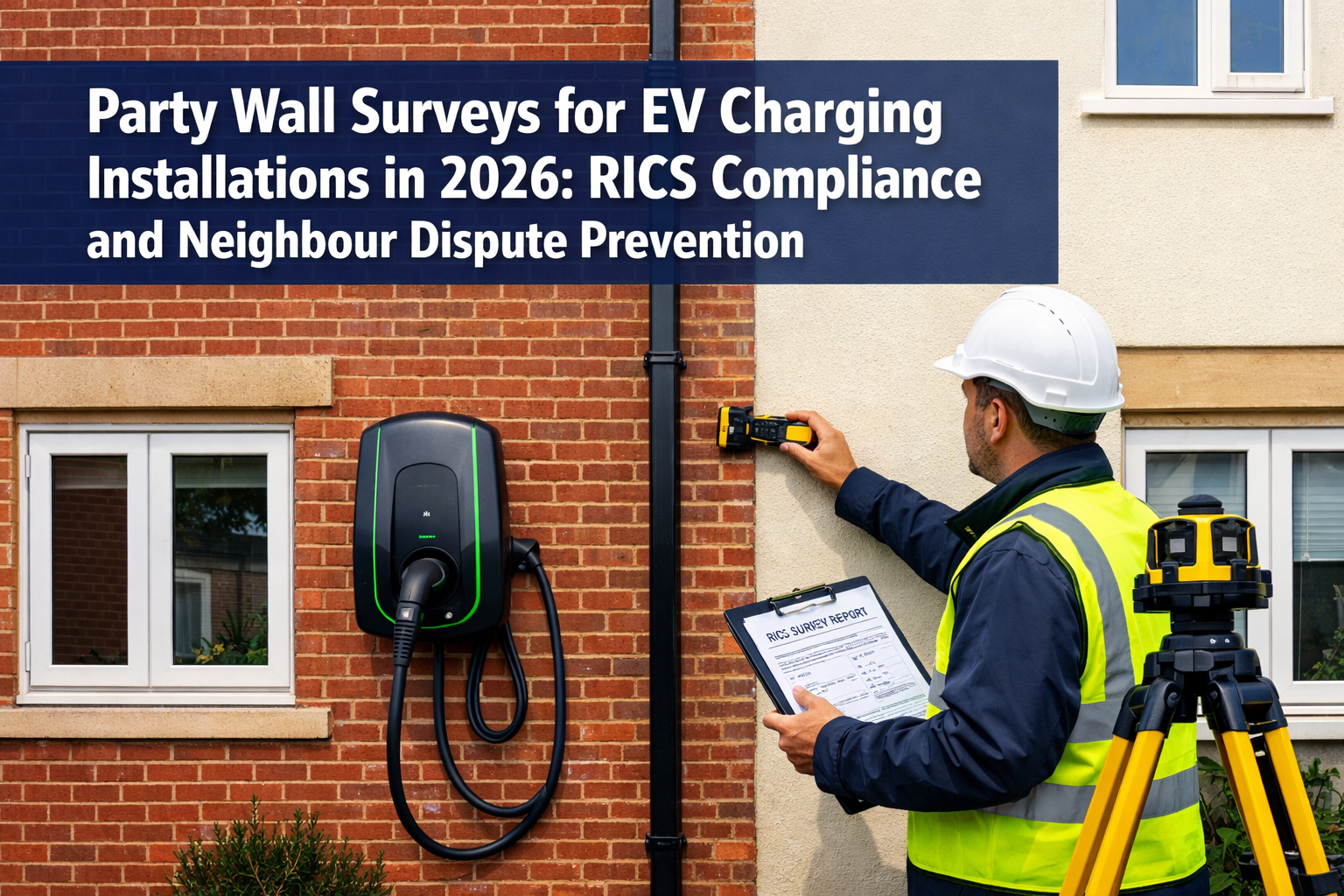
The UK government's 2030 petrol and diesel vehicle ban has triggered an unprecedented surge in home EV charger installations, with over 850,000 residential charging points now registered across England and Wales. Yet beneath this green revolution lurks a legal minefield: thousands of homeowners are unknowingly breaching the Party Wall Act 1996 when drilling through or mounting equipment on shared walls, creating a perfect storm for costly neighbour disputes and potential injunctions that can halt installations mid-project.
Party Wall Surveys for EV Charging Installations in 2026: RICS Compliance and Neighbour Dispute Prevention has become essential knowledge for property owners navigating the intersection of environmental mandates and centuries-old property law. As suburban terraced houses and semi-detached properties rush to install charging infrastructure, the absence of proper surveyor-led protocols is generating litigation that could have been avoided with simple preventative measures.
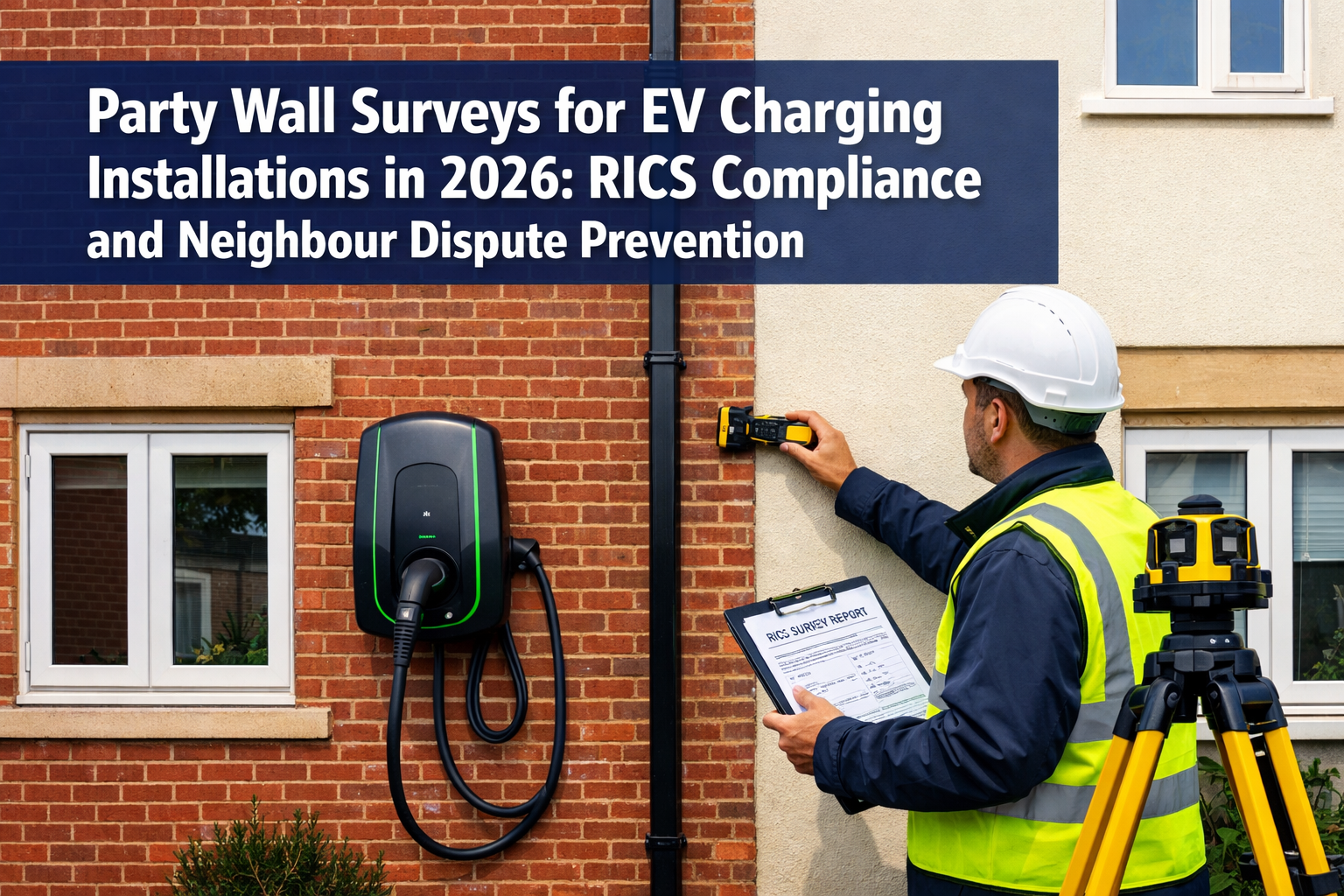
Key Takeaways
- 🔌 Party Wall Act compliance is mandatory when EV charger installations involve drilling, cutting, or mounting equipment on shared walls between properties
- 📋 Two-month notice periods must be observed before commencing work, with RICS-accredited surveyors providing essential documentation and schedules of condition
- ⚖️ Pre-installation surveys prevent disputes by establishing baseline property conditions and protecting both building owners and adjoining owners from liability claims
- 💷 Non-compliance risks costly injunctions that can halt installations, require removal of equipment, and generate legal fees exceeding £10,000
- ✅ Professional surveyor involvement ensures Approved Document S compliance while maintaining neighbourly relations through transparent communication protocols
Understanding Party Wall Act Requirements for EV Charging Infrastructure
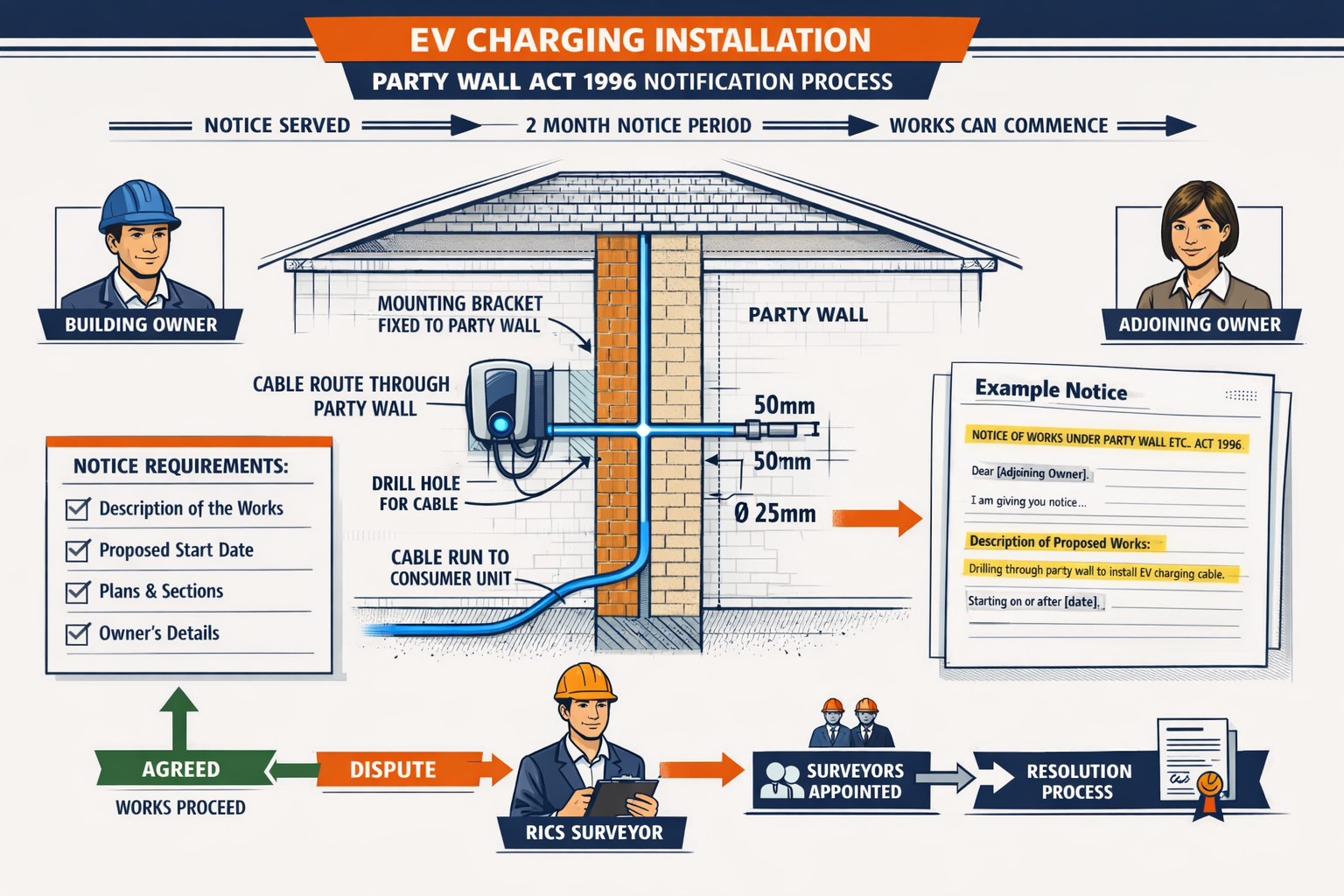
The Party Wall Act 1996 governs any work affecting walls shared between properties, and EV charging installations frequently trigger multiple sections of this legislation. When homeowners mount charging units on external walls that form part of a party structure, or drill through shared walls to route electrical cables, they become "building owners" with specific legal obligations toward their "adjoining owners" (neighbours).
Which EV Installations Trigger Party Wall Notices?
Not every charging point requires formal party wall procedures, but the following scenarios definitely do:
- Wall-mounted chargers on party walls – Any drilling, cutting, or structural modification to a shared wall requires notice under Section 2 of the Act
- Cable routing through party structures – Electrical conduit penetrating shared walls or foundations falls under Section 2 provisions
- Foundation work near boundaries – Excavations within three or six metres of neighbouring structures (depending on depth) trigger Section 6 requirements
- Structural alterations – Installing support brackets or reinforcement that affects load-bearing party walls requires Section 2 compliance
Conversely, standalone charging posts on driveways with no structural connection to party walls, or internal garage installations using existing electrical infrastructure without wall penetration, typically avoid Party Wall Act obligations.
The Two-Month Notice Requirement
Building owners must serve formal written notice to adjoining owners at least two months before commencing EV charger installation work that affects party structures. This timeline is non-negotiable and designed to provide neighbours adequate opportunity to:
- Review proposed work details and technical specifications
- Appoint their own surveyor (at the building owner's expense if they choose)
- Negotiate protective conditions or alternative installation methods
- Document pre-existing property conditions
Many homeowners discover this requirement only after electricians have already begun drilling, creating immediate legal violations that can result in neighbour disputes and court-ordered work stoppages.
RICS Compliance Standards for Party Wall Surveys in EV Charging Projects
The Royal Institution of Chartered Surveyors (RICS) provides the professional framework ensuring party wall procedures meet legal and technical standards. RICS-accredited surveyors bring specialized expertise to EV charging installations, particularly as new regulations like Approved Document S create additional compliance layers.
Approved Document S Integration
Since June 2022, Approved Document S mandates that new residential buildings with associated parking must provide electric vehicle charge points, with installation costs capped at £3,600[1]. While primarily targeting new construction, these standards increasingly influence retrofit projects, particularly regarding:
- Electrical capacity planning – Ensuring existing infrastructure supports charging loads without compromising structural safety
- Fire safety considerations – Maintaining compartmentation in party walls when routing cables
- Accessibility requirements – Positioning chargers to avoid obstructing shared access ways or boundary walls
The RICS offers specialized training through its "UK&I Part S and Electric Vehicle Charging Installation Webinar" specifically designed for building surveyors and building control surveyors to ensure compliance[5]. This professional development reflects the growing intersection between traditional party wall work and emerging EV infrastructure demands.
The Role of Party Wall Surveyors in EV Projects
What does a party wall surveyor do in the context of EV charging installations? Their responsibilities extend beyond simple documentation to include:
Pre-Installation Assessment
- Evaluating structural integrity of proposed mounting locations
- Identifying potential risks to adjoining properties from drilling or cable routing
- Recommending alternative installation methods that minimize party wall impact
- Coordinating with qualified electricians to ensure compliance with 2026 National Electrical Code standards[4]
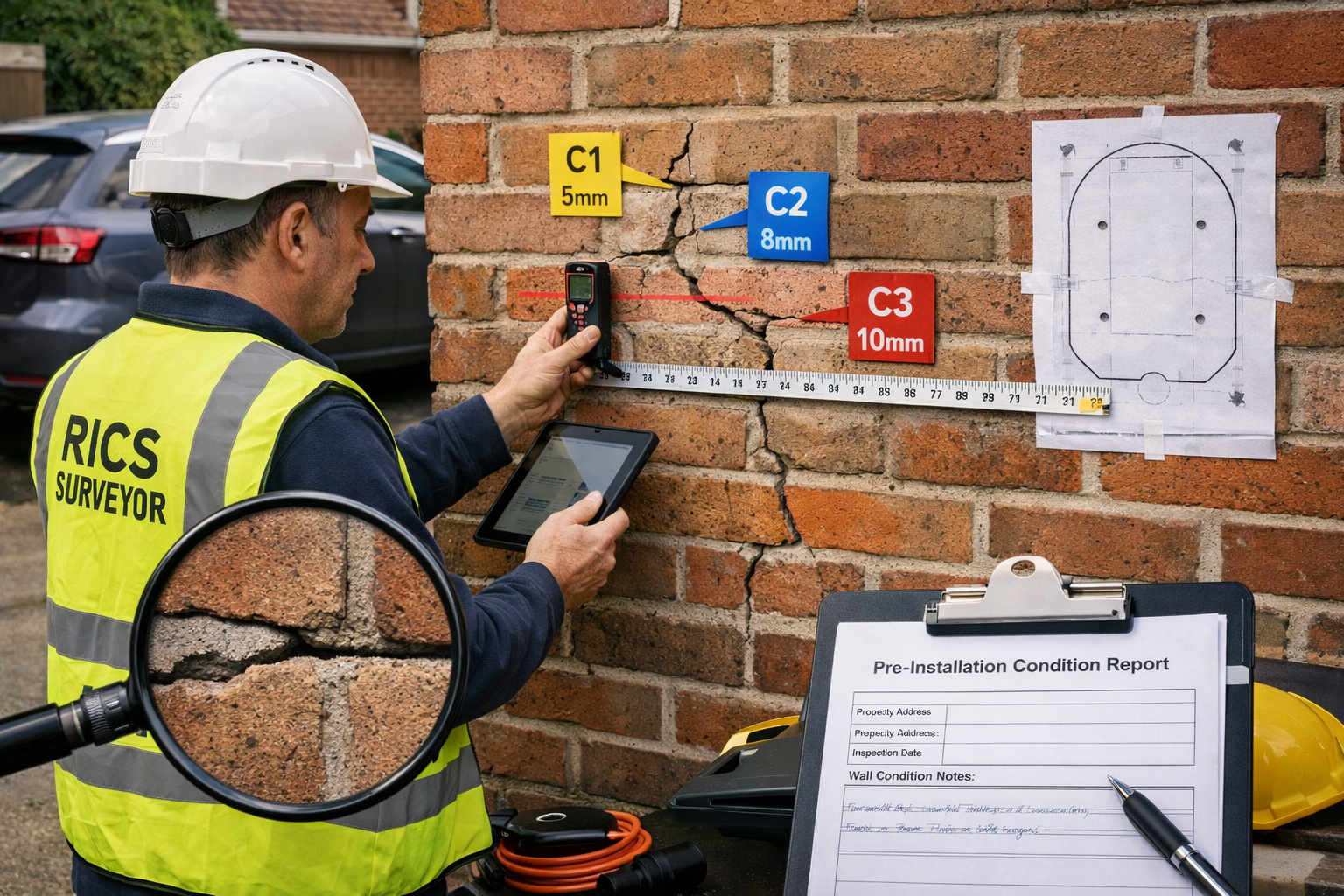
Schedule of Condition Preparation
- Photographically documenting existing cracks, defects, and structural conditions in both properties
- Creating detailed written records of pre-work property states
- Establishing baseline measurements for settlement monitoring
- Protecting building owners from false damage claims
Award Drafting and Negotiation
- Preparing formal Party Wall Awards that specify work parameters, timelines, and protective conditions
- Facilitating agreement between building and adjoining owners
- Including provisions for inspection access during installation
- Setting dispute resolution mechanisms
Post-Installation Verification
- Conducting follow-up inspections to confirm work matches approved specifications
- Documenting any variations from original plans
- Verifying no damage occurred to adjoining properties
- Issuing completion certificates
Practical Surveyor Checklists and Templates for EV Charging Party Wall Notices
Professional surveyors rely on systematic checklists to ensure nothing falls through the cracks during EV charging installation projects. These templates have evolved specifically to address the unique challenges posed by electrical infrastructure work on party structures.
Pre-Notice Site Assessment Checklist
Before serving formal party wall notices, surveyors should complete this assessment:
✅ Boundary and Ownership Verification
- Confirm exact location of party wall using Land Registry documents
- Identify all adjoining owners requiring notice (including leaseholders in some cases)
- Verify whether wall is truly "party" or merely adjacent at boundary
- Check for any existing party wall agreements or easements
✅ Installation Method Review
- Obtain detailed specifications from qualified electrician
- Determine exact drilling locations, depths, and diameters
- Identify cable routing paths through or along party structures
- Assess whether alternative mounting locations avoid party wall altogether
✅ Structural Impact Evaluation
- Inspect wall construction type (brick, block, cavity, solid)
- Identify load-bearing elements that must remain undisturbed
- Check for existing services (gas, water, electrical) within wall cavity
- Evaluate whether drilling compromises damp-proof courses or fire barriers
✅ Regulatory Compliance Cross-Check
- Confirm installation meets Approved Document S requirements[1]
- Verify electrician holds appropriate qualifications per 2026 NEC standards[4]
- Check local planning requirements for external alterations
- Review building control notification requirements
Schedule of Condition Template Components
A comprehensive schedule of condition for EV charging installations should document:
External Wall Conditions
- High-resolution photographs from multiple angles showing proposed installation area
- Detailed descriptions of existing cracks with measurements (length, width, location)
- Mortar joint conditions and any previous repointing work
- Render or cladding defects, staining, or biological growth
- Existing fixings, utilities, or equipment on wall surface
Internal Adjoining Property Conditions
- Photographs of rooms immediately adjacent to proposed drilling locations
- Documentation of existing plasterwork cracks, settlement, or damage
- Ceiling conditions in rooms below proposed cable routes
- Floor conditions in rooms above proposed work areas
- Decorative finishes that could be affected by vibration during drilling
Boundary Features
- Condition of any shared driveways or hardstanding where cables may run
- Fencing, gates, or walls at property boundaries
- Drainage systems that could be affected by excavation
- Landscaping features near proposed work areas
This documentation proves invaluable when resolving boundary disputes or defending against unfounded damage claims post-installation.
Party Wall Notice Template for EV Charging Work
A properly drafted notice under Section 2 of the Party Wall Act should include:
Header Information
- Building owner's full name and address
- Adjoining owner's full name and address
- Date of notice service
- Clear statement: "Notice under Section 2 of the Party Wall etc. Act 1996"
Work Description Section
Proposed work: Installation of electric vehicle charging point requiring:
- Drilling of [number] holes through party wall at [specific location]
- Holes measuring [diameter] mm to depth of [measurement] mm
- Installation of protective conduit for electrical cabling
- Mounting of charging unit bracket using [fixing type]
- Cable routing from consumer unit to charging point
Technical Specifications
- Detailed drawings showing drilling locations and depths
- Electrician's qualifications and certification details
- Proposed start date (minimum 2 months from notice date)
- Estimated duration of work affecting party wall
- Hours of work (typically 8am-6pm weekdays)
Surveyor Appointment Rights
- Statement of adjoining owner's right to appoint surveyor within 14 days
- Clarification that building owner bears surveyor costs
- Contact details for building owner's surveyor if already appointed
Standard Clauses
- Right of access for inspection during work
- Commitment to make good any damage caused
- Insurance details covering party wall work
- Emergency contact information
Neighbour Dispute Prevention Strategies Through Professional Party Wall Management
The most effective dispute prevention occurs before formal notices are served. Professional surveyors employ communication strategies that transform potentially adversarial processes into collaborative problem-solving.
Pre-Notice Neighbour Engagement
Rather than surprising neighbours with formal legal notices, experienced surveyors recommend:
Informal Preliminary Discussion
- Face-to-face conversation explaining the EV charging project in plain language
- Sharing visual aids showing proposed installation location and method
- Addressing concerns about noise, dust, or property damage proactively
- Explaining the Party Wall Act as a protective framework for both parties
Educational Materials
- Providing simple guides explaining how party wall agreements work
- Clarifying that formal notices are legal requirements, not hostile actions
- Explaining the schedule of condition protects their property interests
- Offering to answer questions before formal process begins
This approach, supported by neighbourly communication support, significantly reduces consent refusals and subsequent disputes.
Common Objections and Resolution Approaches
Objection: "I don't want you drilling through our shared wall"
Resolution Strategy:
- Present alternative installation methods (surface-mounted conduit, different routing paths)
- Demonstrate how protective measures prevent structural damage
- Offer enhanced making-good provisions beyond statutory requirements
- Consider sharing installation costs if neighbour also benefits from infrastructure
Objection: "Your surveyor costs are too expensive"
Resolution Strategy:
- Explain that party wall surveyor costs are legally the building owner's responsibility
- Provide transparent fee estimates upfront
- Offer "agreed surveyor" arrangement where one surveyor acts for both parties (with consent)
- Demonstrate how surveyor involvement prevents far costlier disputes later
Objection: "I'm worried about damage to my property"
Resolution Strategy:
- Emphasize the schedule of condition provides comprehensive protection
- Explain insurance coverage and making-good obligations
- Offer additional monitoring provisions (vibration sensors, regular inspections)
- Provide examples of similar successful installations without damage
Objection: "This will take too long and disrupt my life"
Resolution Strategy:
- Provide realistic timelines showing minimal actual work duration
- Explain that two-month notice period is mostly administrative
- Offer flexible scheduling around neighbour's commitments
- Commit to daily cleanup and noise limitation measures
When Disputes Escalate: The Award Process
If neighbours refuse consent or disputes arise over work details, the Party Wall Act provides a structured resolution mechanism through the Party Wall Award. This legally binding document, prepared by appointed surveyors, specifies:
- Exact nature and extent of permitted work
- Protective conditions and working methods
- Access arrangements for inspections
- Making-good obligations and standards
- Dispute resolution procedures
- Cost allocation between parties
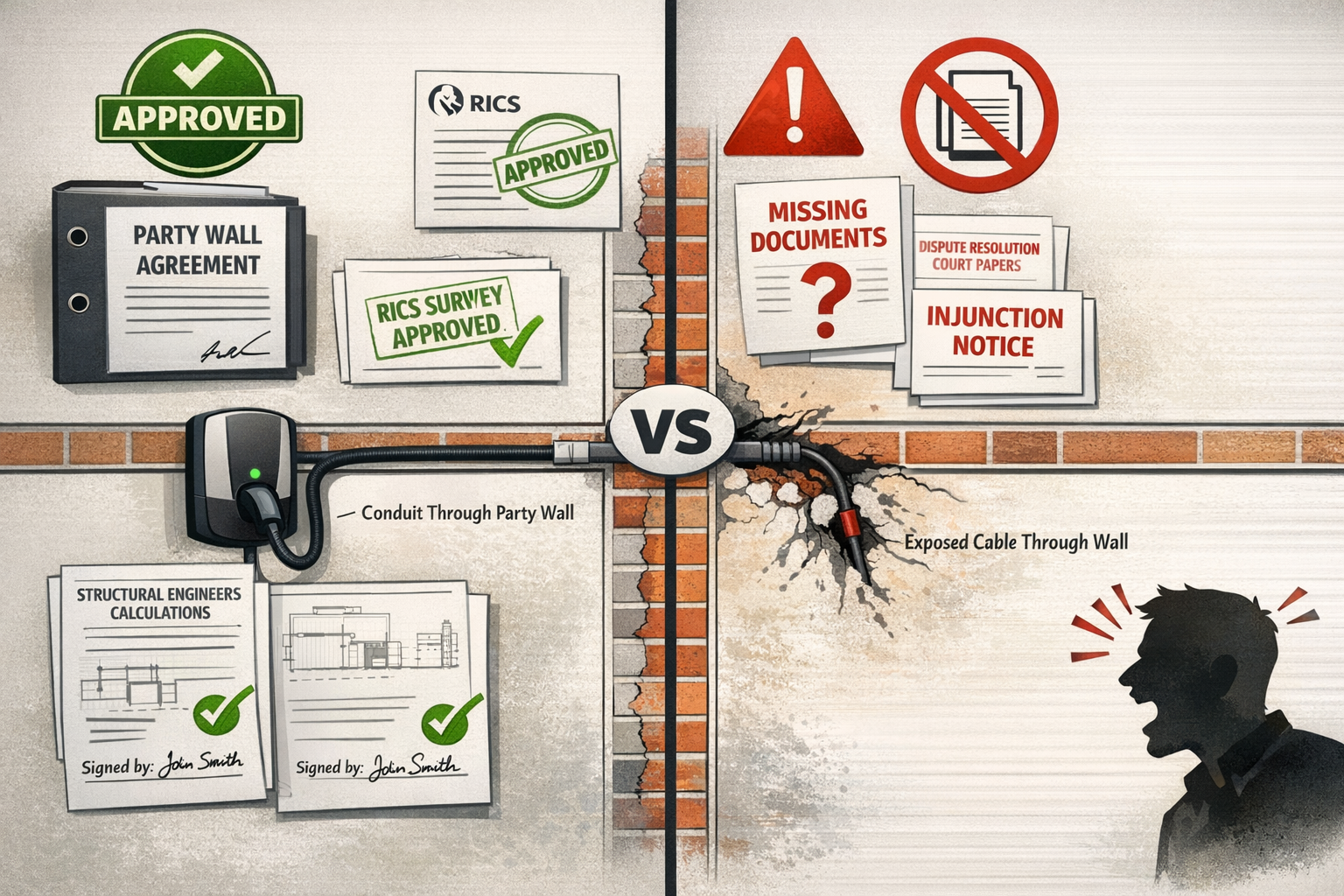
Awards typically resolve disputes without court involvement, but non-compliance can result in injunctions requiring work stoppage and equipment removal. Understanding what to do when you receive a party wall notice helps both building and adjoining owners navigate this process professionally.
Cost Implications and Risk Management for EV Charging Party Wall Compliance
Many homeowners balk at party wall survey costs, viewing them as unnecessary bureaucracy. However, professional risk analysis reveals that non-compliance costs far exceed surveyor fees.
Cost Breakdown: Compliance vs. Non-Compliance
Professional Compliance Costs:
- Party wall surveyor fees: £800-£1,500 for straightforward EV installations
- Schedule of condition documentation: £300-£600
- Party Wall Award preparation: £400-£800 (if required)
- Total compliance investment: £1,500-£2,900
Non-Compliance Risk Costs:
- Legal fees for injunction defense: £5,000-£15,000
- Court-ordered work removal and reinstatement: £2,000-£5,000
- Compensation to adjoining owners for breach: £3,000-£10,000
- Damage claims without schedule of condition protection: £5,000-£20,000
- Project delays and alternative accommodation costs: Variable
- Potential non-compliance exposure: £15,000-£50,000+
The financial case for professional surveyor involvement becomes overwhelming when considering these risk differentials. Additionally, many home insurance policies exclude coverage for party wall disputes arising from non-compliance with statutory requirements.
Insurance Considerations
Building owners should verify their insurance arrangements cover:
- Public liability insurance for the installation work itself (typically held by electrician)
- Party wall specific coverage for disputes arising from the work
- Professional indemnity insurance held by appointed surveyors
- Buildings insurance endorsements covering party wall work
Some insurers now request evidence of Party Wall Act compliance before processing claims related to EV charging installations, recognizing that non-compliance constitutes negligence.
2026 Regulatory Landscape: New Standards Affecting EV Charging Installations
The regulatory environment surrounding EV charging installations continues to evolve rapidly, with 2026 bringing significant changes that intersect with party wall requirements.
2026 National Electrical Code Changes
While primarily applicable in the United States, the 2026 National Electrical Code's requirement for qualified persons (typically licensed electricians) to install permanently installed EV chargers reflects a global trend toward professional installation standards[4]. UK regulations similarly emphasize competent person schemes and Part P electrical safety compliance.
This professionalization benefits party wall compliance by ensuring:
- Proper structural assessment before drilling
- Appropriate fixing methods that don't compromise party wall integrity
- Correct cable routing that maintains fire compartmentation
- Documentation meeting both electrical and party wall requirements
Building Control and Planning Considerations
EV charging installations on party walls may trigger additional regulatory requirements:
Building Control Notification
- Electrical work must comply with Part P of Building Regulations
- Structural alterations to party walls require building control approval
- Fire safety measures must be maintained when penetrating compartment walls
Planning Permission
- Generally not required for domestic EV chargers under permitted development
- Conservation areas or listed buildings may have additional restrictions
- Wall-mounted installations on front elevations sometimes require planning consent
Leasehold Considerations
- Leaseholders must obtain freeholder consent before party wall work
- Lease terms may prohibit structural alterations without permission
- Service charge implications for communal party structures
Coordinating these various regulatory requirements alongside party wall procedures requires professional project management, which RICS-accredited surveyors provide as part of their service.
Practical Case Studies: Lessons from Recent EV Charging Party Wall Disputes
Real-world examples illustrate how proper party wall procedures prevent disputes and how their absence creates costly problems.
Case Study 1: Successful Suburban Semi-Detached Installation
Scenario: Homeowner in Wimbledon wanted to install wall-mounted EV charger on side elevation party wall shared with neighbour.
Approach:
- Engaged party wall agreement surveyor three months before planned installation
- Surveyor conducted preliminary neighbour meeting explaining process
- Comprehensive schedule of condition documented both properties
- Formal Section 2 notice served with detailed technical specifications
- Neighbour consented without appointing separate surveyor
- Installation completed with daily progress updates to neighbour
Outcome: Work completed on schedule without disputes. Post-installation inspection confirmed no damage. Total surveyor costs: £1,200. Neighbour relationship maintained positively.
Case Study 2: Costly Injunction from Non-Compliance
Scenario: Terraced house owner in London hired electrician who drilled through party wall without serving party wall notice.
Complications:
- Neighbour discovered drilling in progress and immediately contacted solicitor
- Court injunction halted work mid-installation with charger partially mounted
- Building owner forced to appoint surveyor retrospectively
- Neighbour appointed separate surveyor (both paid by building owner)
- Schedule of condition revealed pre-existing cracks neighbour claimed were installation damage
- Without baseline documentation, building owner settled damage claim
Outcome: Total costs exceeded £18,000 (legal fees £12,000, surveyor fees £3,500, damage settlement £2,500). Installation delayed four months. Neighbour relationship permanently damaged.
Case Study 3: Proactive Award Preventing Disputes
Scenario: Conversion of Victorian terrace into flats requiring multiple EV charging points on shared external walls.
Approach:
- Developer engaged party wall surveyor during planning stage
- Comprehensive Party Wall Award prepared covering all installations
- Schedule of condition documented entire terrace before work commenced
- Regular inspection regime established with monthly reports to all adjoining owners
- Making-good provisions specified in advance with quality standards
Outcome: All installations completed without disputes despite complex multi-party arrangements. Award provided clear framework preventing misunderstandings. Professional approach enhanced developer reputation with future projects.
Future-Proofing: Preparing for Increased EV Infrastructure Demands
As the 2030 combustion vehicle ban approaches, EV charging infrastructure demands will only intensify, making party wall compliance increasingly critical for property owners.
Anticipating Multi-Charger Installations
Properties may soon require multiple charging points for:
- Households with multiple EVs
- Rental properties providing tenant charging facilities
- Homes preparing for future resale value enhancement
Each additional installation potentially triggers separate party wall procedures unless covered by comprehensive initial Awards that anticipate future expansion.
Shared Infrastructure Solutions
Innovative approaches emerging in 2026 include:
Party Wall Charging Cooperatives
- Neighbours jointly installing shared infrastructure on party boundaries
- Cost-sharing arrangements for surveyor fees and installation
- Single Party Wall Award covering multiple properties
- Reduced per-property costs through economies of scale
Pre-Emptive Party Wall Agreements
- Forward-thinking neighbours establishing framework agreements before specific installations planned
- Agreed-upon installation standards and procedures
- Pre-approved surveyor appointments
- Streamlined future compliance
These collaborative approaches transform party wall procedures from obstacles into opportunities for neighbourly cooperation.
Technology Integration
Emerging technologies affecting party wall considerations include:
- Non-invasive mounting systems that minimize structural intervention
- Wireless power transfer potentially eliminating cable routing through walls
- Modular charging infrastructure allowing upgrades without additional party wall work
- Digital surveying tools improving schedule of condition accuracy and efficiency
Staying informed about these developments helps property owners make future-proof installation decisions that minimize party wall complications.
Conclusion
Party Wall Surveys for EV Charging Installations in 2026: RICS Compliance and Neighbour Dispute Prevention represents far more than bureaucratic box-ticking—it constitutes essential risk management protecting property owners from costly disputes and legal complications. As the UK accelerates toward its 2030 EV mandate, the intersection of environmental infrastructure and traditional property law demands professional navigation.
The evidence overwhelmingly demonstrates that proactive surveyor engagement prevents disputes far more effectively and economically than reactive legal responses. Comprehensive schedules of condition, properly drafted notices, and transparent neighbour communication transform potentially adversarial processes into collaborative problem-solving.
Actionable Next Steps
For property owners planning EV charging installations affecting party walls:
- Engage an RICS-accredited party wall surveyor at least three months before planned installation—get a quote to understand costs early
- Conduct informal neighbour discussions before serving formal notices to build cooperation
- Ensure your electrician holds appropriate qualifications and understands party wall requirements
- Document everything through professional schedules of condition protecting against unfounded claims
- Budget realistically for compliance costs as essential project components, not optional extras
- Verify insurance coverage includes party wall work and potential disputes
- Consider future needs when planning installations to avoid multiple party wall procedures
For adjoining owners receiving party wall notices:
- Respond within 14 days to preserve your rights under the Act
- Consider appointing your own surveyor for complex installations or if concerns exist
- Request detailed schedules of condition documenting your property before work begins
- Maintain communication with building owners to address concerns early
- Understand your rights through resources like the Party Wall Act 1996 guide
The green revolution driving EV adoption need not create neighbourhood conflicts. Professional party wall management ensures that environmental progress and property protection advance together, safeguarding both sustainable transport infrastructure and harmonious community relations for decades to come.
References
[1] Part S Electric Vehicles Charging Infrastructure – https://ww3.rics.org/uk/en/journals/built-environment-journal/part-s-electric-vehicles-charging-infrastructure.html
[4] Breaking Down The 2026 Nec Why Diy Ev Charger Installs Face An Uncertain Future – https://www.apexmechanicalbg.com/breaking-down-the-2026-nec-why-diy-ev-charger-installs-face-an-uncertain-future
[5] Scheduled – https://www.rics.org/training-events/online-training/scheduled