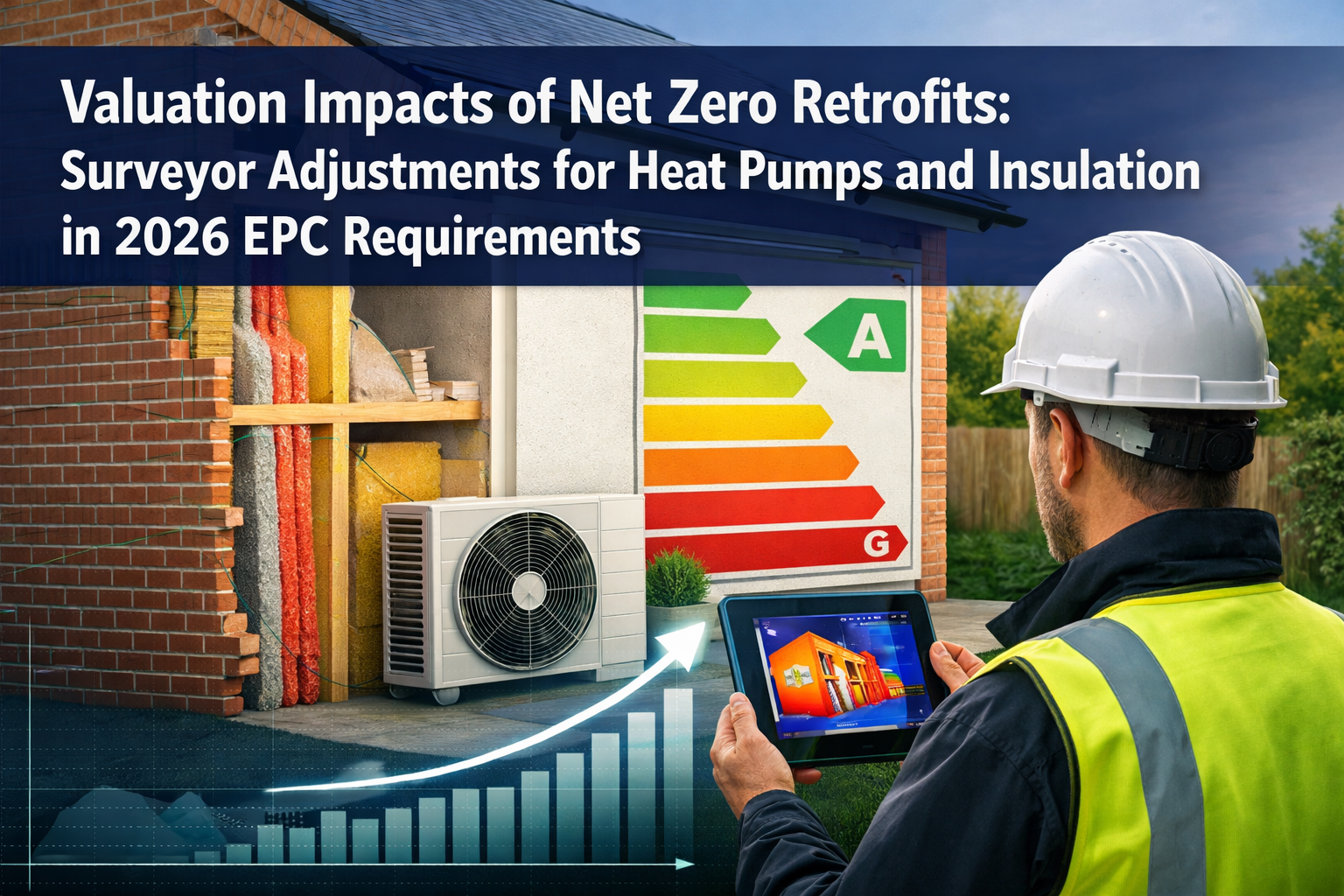
Properties achieving EPC A ratings now command a 2.9% price premium per square meter compared to lower-rated equivalents—a tangible market signal that energy efficiency directly translates to property value. As the UK government rolls out its revolutionary multi-metric Energy Performance Certificate (EPC) framework in October 2026, followed by mandatory EPC C compliance for rental properties by 2030, chartered surveyors face unprecedented challenges in accurately valuing net zero retrofits. The Valuation Impacts of Net Zero Retrofits: Surveyor Adjustments for Heat Pumps and Insulation in 2026 EPC Requirements represent a fundamental shift in how property professionals assess residential assets in an increasingly carbon-conscious market.
The stakes are substantial: with up to £15 billion in public funding allocated through the Warm Homes Plan and landlords facing a £10,000 cost cap per property for compliance investments, understanding how heat pumps, insulation upgrades, and fabric improvements affect property valuations has become essential for investors, homeowners, and property professionals alike [4].
Key Takeaways
- Six new EPC metrics launching October 2026 will fundamentally change how surveyors assess energy-efficient properties, separating fabric performance from heating system efficiency for more accurate valuations
- Heat pump installations no longer penalized under the dual-metric compliance approach, eliminating the previous paradox where low-carbon heating reduced EPC ratings due to electricity costs
- EPC A-rated properties command 2.9% valuation premiums while lower-rated properties trade at discounts, establishing clear financial incentives for strategic retrofit investments
- £10,000 compliance cost cap with fabric improvements prioritized creates a defined investment hierarchy that surveyors must factor into property valuations and risk assessments
- Early compliance incentives through grandparenting provisions reward properties achieving EPC C before October 2029, creating time-sensitive valuation opportunities
Understanding the 2026 Multi-Metric EPC Framework
The Six Headline Metrics Transforming Property Assessment
The government's decision to replace the single-metric EPC system represents the most significant overhaul of energy performance assessment since the framework's introduction. Beginning October 2026, the new multi-metric system introduces six independent headline metrics that surveyors must now evaluate separately [3]:
- Energy Cost 💷 – Running cost implications for occupants
- Carbon Emissions 🌍 – Environmental impact measurement
- Energy Use ⚡ – Total energy consumption patterns
- Fabric Performance 🏠 – Building envelope heat retention capability
- Heating System Efficiency 🔥 – Technology-specific performance ratings
- Smart Readiness 📱 – Digital control and optimization capabilities
This granular approach enables RICS chartered surveyors to conduct more nuanced valuations by isolating specific retrofit components. For example, a property with excellent fabric performance (comprehensive insulation) but an aging heating system can now be valued more accurately than under the previous aggregated methodology.

Eliminating the Heat Pump Penalty
One of the most significant changes addresses a critical flaw in the previous system: heat pumps paradoxically lowered EPC ratings despite being the government's preferred low-carbon heating technology. This occurred because the cost-based methodology penalized properties using electricity (more expensive per unit) compared to gas heating [4].
The new framework solves this through a dual-metric compliance approach:
- Primary compliance criteria: Carbon emissions and fabric performance
- Secondary informational metric: Energy cost (not used for compliance assessment)
This structural change ensures that properties installing heat pumps receive appropriate valuation recognition for their environmental performance without being penalized for operational costs. Property valuation professionals can now accurately assess heat pump installations as value-adding improvements rather than rating liabilities.
Fabric Performance as Independent Valuation Component
The introduction of fabric performance as a standalone headline metric represents a breakthrough for surveyor assessments. This metric specifically measures how well a building's physical structure retains heat through:
- Wall insulation quality (cavity, solid wall, external)
- Loft and roof insulation depth and coverage
- Floor insulation effectiveness
- Window glazing performance (double, triple-glazed)
- Air-tightness and draught-proofing measures
By separating fabric performance from heating system efficiency, surveyors can now assign independent value adjustments to insulation improvements. A property with excellent fabric performance achieves higher valuations even if heating system upgrades remain pending, providing more accurate market pricing [1].
Valuation Impacts of Net Zero Retrofits: Surveyor Adjustments for Heat Pumps and Insulation in 2026 EPC Requirements
RICS Valuation Methodologies for Retrofit Projects
Chartered surveyors employ several established methodologies when assessing properties with net zero retrofits, adapted for the 2026 EPC framework:
Comparative Market Analysis with EPC Adjustments
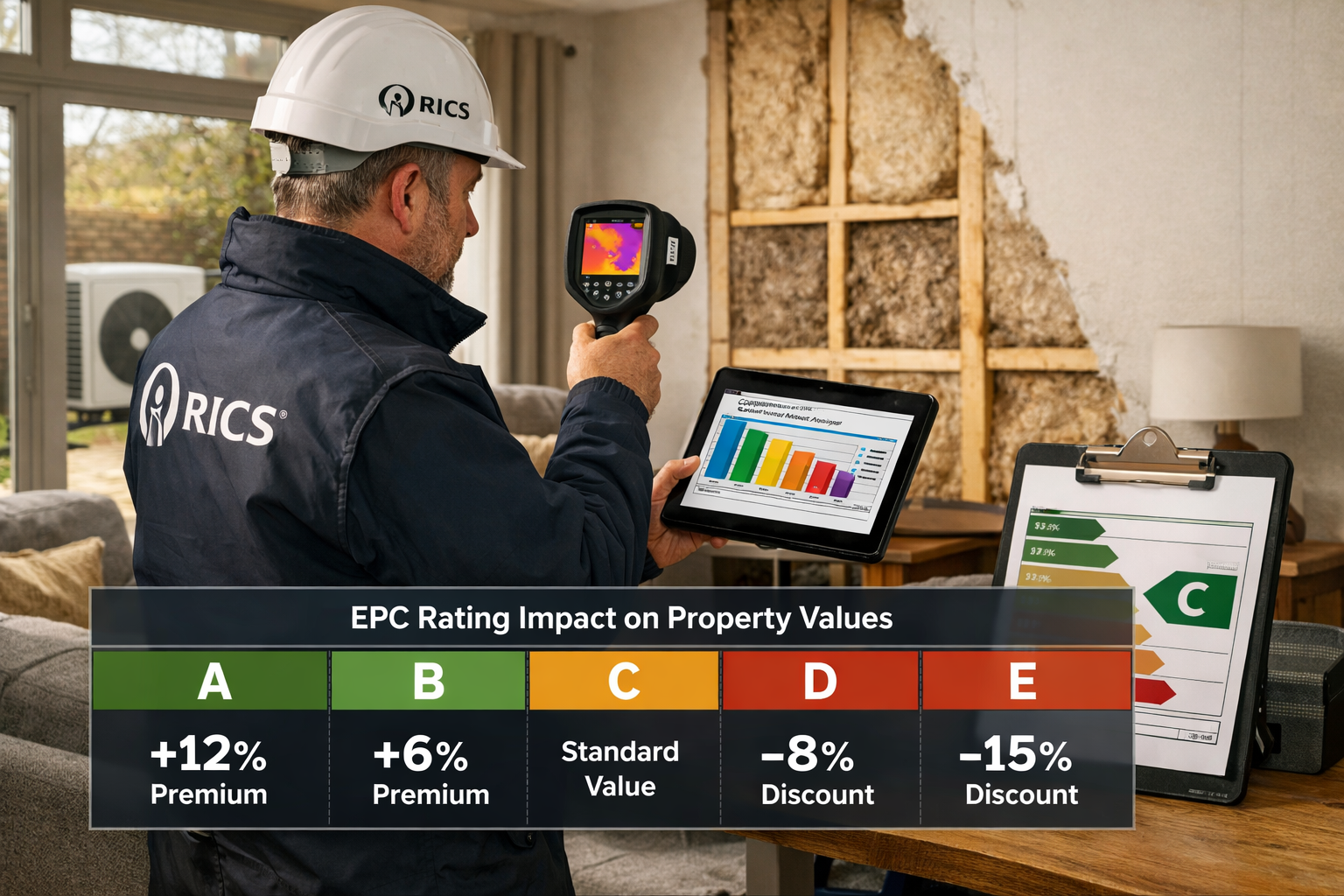
The most common approach involves comparative market analysis with specific adjustments for EPC performance differentials. Current market data demonstrates clear valuation patterns:
| EPC Rating | Price Premium/Discount | Market Impact |
|---|---|---|
| A | +2.9% per m² | Significant premium |
| B | +1.2% per m² | Moderate premium |
| C | Baseline | Target compliance level |
| D | -2.1% per m² | Moderate discount |
| E or below | -4.5% per m² | Substantial discount |
These adjustments reflect buyer willingness to pay for lower operating costs and regulatory compliance assurance [5]. When conducting building surveys, surveyors must now document specific retrofit components contributing to these rating improvements.
Cost-to-Retrofit Valuation Adjustments
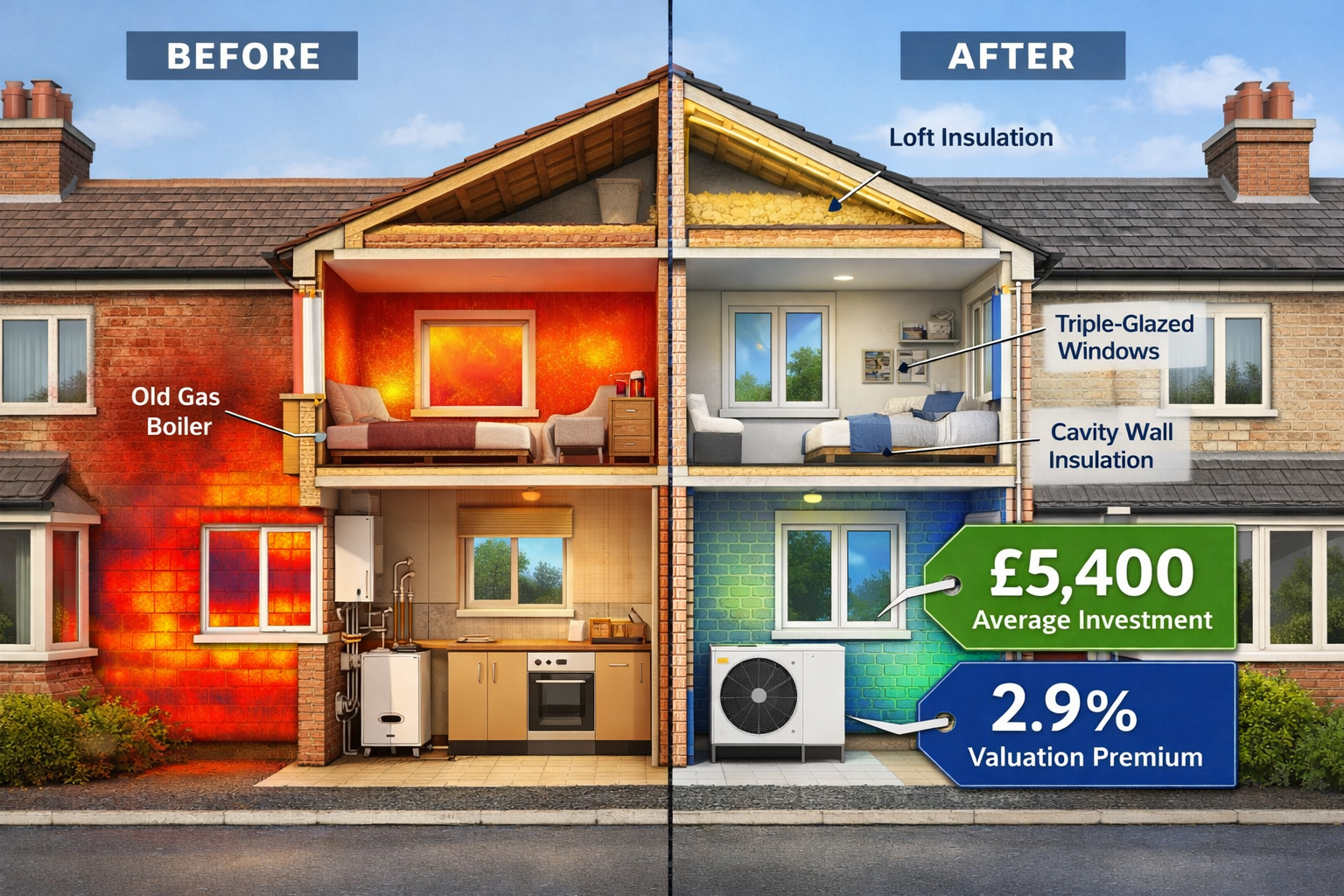
Surveyors also employ cost-to-retrofit analysis when valuing properties below EPC C compliance. With the £10,000 cost cap and government estimates averaging £5,400 per property for compliance upgrades, this methodology calculates:
Adjusted Valuation = Market Value – (Estimated Compliance Costs + Risk Premium)
The risk premium accounts for:
- Installation quality uncertainty
- Potential building fabric complications
- Disruption during retrofit work
- Regulatory compliance verification costs
Properties requiring extensive fabric improvements typically receive 3-7% valuation discounts depending on the scope of required work and property-specific constraints [5].
Income Capitalization for Rental Properties
For buy-to-let investors, surveyors apply income capitalization methodology adjusted for:
- Rental premium potential: EPC C-compliant properties command 5-8% higher rents in competitive markets
- Void period reduction: Energy-efficient properties let faster, reducing vacancy costs
- Compliance risk elimination: Properties meeting 2030 standards avoid future forced sales or rental restrictions
- Tenant retention improvements: Lower utility bills increase tenant satisfaction and retention rates
The formula adjusts net operating income (NOI) projections:
Property Value = Adjusted NOI / (Capitalization Rate – Growth Rate)
Where adjusted NOI incorporates both rental premium potential and reduced operational risk from compliance achievement.
Heat Pump Installation Valuation Considerations
Heat pump installations present unique valuation challenges requiring specialized surveyor expertise:
Technology-Specific Value Adjustments
Different heat pump technologies warrant distinct valuation treatments:
Air Source Heat Pumps (ASHP) 🌬️
- Installation cost: £8,000-£14,000
- Typical valuation uplift: £4,500-£8,000
- Considerations: External unit placement, noise levels, aesthetic impact
- Lifespan: 15-20 years (depreciation factor required)
Ground Source Heat Pumps (GSHP) 🌍
- Installation cost: £18,000-£35,000
- Typical valuation uplift: £12,000-£20,000
- Considerations: Land area requirements, ground loop verification
- Lifespan: 20-25 years (superior longevity premium)
Hybrid Systems ⚡
- Installation cost: £5,000-£9,000
- Typical valuation uplift: £3,000-£5,500
- Considerations: Dual-fuel flexibility, system integration quality
Surveyors must verify installation quality through manufacturer certifications, MCS (Microgeneration Certification Scheme) compliance, and warranty documentation. Poor installations can actually reduce property values by 2-4% due to remediation costs and performance concerns.
Risk Premium for Faulty Installations
A critical aspect of the Valuation Impacts of Net Zero Retrofits: Surveyor Adjustments for Heat Pumps and Insulation in 2026 EPC Requirements involves assessing installation quality risks. Surveyors apply risk-adjusted valuations when:
- Undersized systems: Heat pumps insufficient for property heating load reduce value by £3,000-£6,000
- Poor integration: Inadequate radiator upgrades or cylinder compatibility issues warrant £2,000-£4,000 deductions
- Non-MCS installations: Lack of certification reduces value by 15-25% of installation cost
- Noise complaints: External units exceeding permitted noise levels create £1,500-£3,000 liability
Professional surveyors conducting Level 2 or Level 3 surveys now routinely include heat pump performance assessments, commissioning documentation review, and thermal efficiency verification as standard practice.
Insulation Upgrade Valuation Frameworks
Fabric improvements through insulation upgrades form the priority investment tier under the 2026 cost cap structure, making accurate valuation essential [4].
Wall Insulation Value Contributions
Cavity Wall Insulation 🧱
- Installation cost: £1,000-£2,500
- Typical valuation uplift: £1,800-£3,200
- ROI for valuation: 140-180%
- Considerations: Existing cavity condition, exposure to driving rain
Solid Wall Insulation (External) 🏗️
- Installation cost: £8,000-£15,000
- Typical valuation uplift: £6,000-£11,000
- ROI for valuation: 70-90%
- Considerations: Planning permission requirements, aesthetic impact, property character
Solid Wall Insulation (Internal) 🔧
- Installation cost: £4,000-£8,000
- Typical valuation uplift: £3,000-£6,000
- ROI for valuation: 75-85%
- Considerations: Room size reduction (8-10cm per wall), disruption factor
Loft and Floor Insulation Assessments
Loft Insulation Enhancement ☁️
- Installation cost: £300-£800 (topping up to 270mm)
- Typical valuation uplift: £600-£1,200
- ROI for valuation: 150-200%
- Highest cost-effectiveness ratio among fabric improvements
Floor Insulation 📦
- Installation cost: £800-£2,500
- Typical valuation uplift: £1,000-£2,800
- ROI for valuation: 110-125%
- Particularly valuable for properties with suspended floors or unheated spaces below
Surveyors must document insulation specifications including thermal conductivity (U-values), installation method, and coverage completeness. Partial or inadequate insulation receives proportionally reduced valuation adjustments.
Case Studies: Premium Uplifts in Compliant Properties
Case Study 1: Victorian Terrace Comprehensive Retrofit
Property Profile:
- Location: Merton, London
- Type: 3-bedroom Victorian terrace
- Pre-retrofit EPC: E (rating 42)
- Post-retrofit EPC: B (rating 84)
Retrofit Investment:
- External wall insulation: £12,500
- Air source heat pump: £10,500
- Loft insulation upgrade: £450
- Double to triple glazing: £6,800
- Total investment: £30,250
Valuation Impact:
- Pre-retrofit valuation: £485,000
- Post-retrofit valuation: £518,000
- Absolute uplift: £33,000 (6.8%)
- Net value gain after costs: £2,750
This case demonstrates how comprehensive retrofits exceeding minimum compliance requirements generate valuation premiums that partially offset investment costs. The property achieved faster sale (18 days vs. 47-day local average) and attracted multiple offers, indicating strong market demand for high-EPC properties [5].
Merton property surveyors report increasing requests for retrofit valuation assessments as homeowners seek to capitalize on the compliance deadline.
Case Study 2: Modern Semi-Detached Targeted Compliance
Property Profile:
- Location: Kensington, London
- Type: 2-bedroom semi-detached (2005 build)
- Pre-retrofit EPC: D (rating 58)
- Post-retrofit EPC: C (rating 72)
Retrofit Investment:
- Cavity wall insulation: £1,800
- Loft insulation top-up: £380
- Heating controls upgrade: £650
- Total investment: £2,830
Valuation Impact:
- Pre-retrofit valuation: £625,000
- Post-retrofit valuation: £638,000
- Absolute uplift: £13,000 (2.1%)
- Net value gain after costs: £10,170
This case illustrates the cost-effective compliance pathway for properties requiring minimal improvements. The targeted approach achieved EPC C compliance well below the £10,000 cost cap, generating substantial net value gains. The property qualified for the grandparenting provision, securing compliance until the EPC expires [4].
Kensington property surveyors note that properties in this category represent the most attractive investment opportunities for landlords seeking 2030 compliance.
Case Study 3: Listed Building Exemption Valuation
Property Profile:
- Location: Chelsea, London
- Type: Grade II listed Georgian townhouse
- EPC: F (rating 38)
- Listed building constraints prevent external fabric alterations
Retrofit Strategy:
- Internal wall insulation (limited areas): £4,200
- Secondary glazing: £8,500
- Heating system optimization: £2,100
- Total investment: £14,800
- Post-retrofit EPC: D (rating 56) – Below EPC C target
Valuation Impact:
- Pre-retrofit valuation: £1,850,000
- Post-retrofit valuation: £1,835,000
- Valuation reduction: £15,000 (0.8%)
This case highlights the valuation challenges for constrained properties. Despite significant investment, the property failed to achieve EPC C compliance due to conservation restrictions. The surveyor applied a compliance risk discount reflecting potential future regulatory complications and limited rental market appeal.
However, the property qualified for exemption under the "negative impact on building fabric" provision, which the surveyor documented as a mitigating factor reducing the valuation discount from a potential 3-4% to under 1% [4].
Regulatory Compliance Timeline and Valuation Strategy
Critical Dates for Property Professionals
Understanding the implementation timeline is essential for strategic valuation planning:
| Date | Milestone | Valuation Implication |
|---|---|---|
| October 1, 2025 | Qualifying expenditure begins counting toward £10,000 cap | Immediate investment planning recommended |
| October 2026 | Multi-metric EPC framework launches | Valuation methodologies must adapt to new metrics |
| October 1, 2029 | Grandparenting provision deadline | Properties achieving EPC C before this date secure extended compliance |
| October 1, 2030 | Mandatory EPC C compliance for all rental properties | Non-compliant properties face rental market exclusion |
Grandparenting Provision Strategic Value
The grandparenting provision creates a time-sensitive valuation opportunity: properties achieving EPC C rating against the current methodology before October 1, 2029 will be deemed compliant until that EPC expires (typically 10 years) [4].
This provision generates:
- Extended compliance certainty: Up to 13 years of compliance assurance (2029 + 10-year EPC validity)
- Deferred investment requirements: Landlords can postpone further upgrades until EPC renewal
- Enhanced marketability: Early compliance signals proactive ownership and reduces buyer risk
Surveyors should apply premium adjustments of 1.5-2.5% for properties securing grandparented compliance compared to properties requiring future upgrades under the stricter multi-metric framework.
Cost Cap Exemptions and Valuation Adjustments
Several exemptions affect valuation assessments:
Property Value Exemption 🏚️
- Properties valued below £100,000 have spending capped at 10% of property value
- Surveyor consideration: Reduces compliance cost burden for lower-value properties
- Valuation adjustment: Smaller compliance discounts (1-2% vs. 3-5% for higher-value properties)
Solid Wall Insulation Exemption 🧱
- Properties where solid wall insulation is the only remaining improvement to reach EPC C
- Surveyor consideration: Exemption available if cost exceeds cap
- Valuation adjustment: Exemption documentation adds £2,000-£4,000 to valuation vs. non-exempt equivalents
Building Fabric Impact Exemption 🏛️
- Applies when improvements would negatively impact building fabric (particularly listed buildings)
- Surveyor consideration: Requires professional certification of potential damage
- Valuation adjustment: Exemption certification reduces compliance risk discount by 50-75%
Professional surveyors must verify exemption eligibility and documentation as part of comprehensive property valuation assessments.
Risk Assessment and Valuation Adjustments
Installation Quality Verification Protocols
The Valuation Impacts of Net Zero Retrofits: Surveyor Adjustments for Heat Pumps and Insulation in 2026 EPC Requirements demand rigorous installation quality verification:
Essential Documentation Review 📋
- MCS certification for heat pump installations
- Building Control approval certificates
- Manufacturer warranties and registration
- Commissioning reports and performance testing
- Thermal imaging surveys (pre and post-installation)
- Air-tightness test results
Physical Inspection Requirements 🔍
- Visual assessment of insulation coverage and quality
- Heat pump external unit condition and positioning
- Radiator sizing adequacy for heat pump operation
- Condensation and moisture management systems
- Smart controls integration and functionality
Surveyors conducting structural surveys increasingly incorporate these retrofit-specific assessments as standard practice, recognizing their material impact on property valuations.
Quantifying Installation Risk Premiums
Risk-adjusted valuations account for potential retrofit complications:
High-Risk Scenarios (3-7% valuation discount):
- Non-certified installations lacking MCS approval
- DIY or non-professional retrofit work
- Incomplete documentation or warranty gaps
- Evidence of moisture problems post-insulation
- Undersized or poorly integrated heat pump systems
Medium-Risk Scenarios (1-3% valuation discount):
- Aging retrofit installations (>8 years for heat pumps)
- Partial compliance (some measures completed, others pending)
- Minor installation defects requiring remediation
- Limited warranty coverage remaining
Low-Risk Scenarios (0-1% valuation discount):
- Recent professional installations with full certification
- Comprehensive warranty coverage
- Performance monitoring data demonstrating efficiency
- Regular maintenance records
Surveyors should document risk factors comprehensively, enabling buyers and lenders to make informed decisions. Properties with verified high-quality installations command premiums, while those with uncertain installation quality face significant discounts.
Future-Proofing Valuation Considerations
Forward-looking surveyors incorporate future regulatory trajectory into current valuations:
2030+ Regulatory Outlook 🔮
- Potential tightening of EPC C standards under multi-metric framework
- Possible extension of minimum standards to owner-occupied properties
- Anticipated phase-out of gas boiler installations (2035 target)
- Increasing carbon pricing potentially affecting property operating costs
Valuation Implications:
- Properties with heat pumps and excellent fabric performance receive future-proofing premiums of 2-4%
- Properties reliant on gas heating face stranded asset risk discounts of 1-3%
- Smart-ready properties with integrated energy management systems command additional 1-2% premiums
Professional surveyors increasingly advise clients on surveyor recommendations that consider both current compliance requirements and anticipated future standards.
Practical Implementation for Property Professionals
Surveyor Checklist for Retrofit Valuations
Pre-Inspection Preparation ✅
- Obtain current EPC certificate and historical ratings
- Review planning permission for external alterations
- Request retrofit installation documentation
- Identify property constraints (listed status, conservation area)
- Research comparable properties with similar EPC ratings
On-Site Assessment ✅
- Verify insulation specifications and coverage
- Inspect heat pump installation quality and integration
- Test heating system performance and controls
- Conduct thermal imaging assessment (if equipped)
- Document any installation defects or concerns
- Photograph retrofit components for report
Post-Inspection Analysis ✅
- Calculate cost-to-compliance for sub-EPC C properties
- Apply appropriate valuation adjustments based on EPC rating
- Assess installation quality risk premiums
- Consider exemption eligibility and documentation
- Compare against recent sales of similar EPC-rated properties
- Provide retrofit investment recommendations
Communicating Valuation Adjustments to Clients
Effective communication of retrofit-related valuation adjustments requires:
Transparent Methodology Explanation 💬
- Clearly articulate how EPC ratings affect market value
- Provide comparable evidence supporting adjustment percentages
- Explain regulatory compliance timeline and implications
- Distinguish between current value and future compliance costs
Investment Return Analysis 📊
- Present retrofit investment costs vs. valuation uplift
- Calculate net value gain after retrofit expenditure
- Project rental income improvements for buy-to-let properties
- Estimate payback periods incorporating energy savings
Risk Disclosure ⚠️
- Identify installation quality concerns affecting valuation
- Highlight regulatory compliance risks for non-compliant properties
- Explain exemption eligibility and documentation requirements
- Advise on future-proofing considerations
Many clients benefit from reviewing example homebuyers reports to understand comprehensive surveyor assessments including retrofit evaluations.
Negotiation Leverage from Survey Findings
Retrofit-related survey findings create significant negotiation opportunities:
Buyer Negotiation Strategies 💰
- Request price reduction equal to cost-to-compliance for sub-EPC C properties
- Negotiate retention of funds for verified retrofit work completion
- Seek seller contribution toward heat pump installation costs
- Request extended warranty coverage for existing retrofit installations
Seller Preparation Strategies 🏡
- Complete cost-effective fabric improvements before marketing
- Obtain comprehensive retrofit documentation and certifications
- Commission updated EPC assessment after improvement completion
- Highlight compliance status and future-proofing in marketing materials
Typical Negotiation Outcomes:
- Sub-EPC C properties: 2-5% price reduction or equivalent retrofit contribution
- Poor installation quality: 1-3% price reduction for remediation costs
- Missing documentation: £500-£1,500 reduction for certification costs
- Partial compliance: Pro-rata reduction based on remaining work required
Conclusion
The Valuation Impacts of Net Zero Retrofits: Surveyor Adjustments for Heat Pumps and Insulation in 2026 EPC Requirements represent a fundamental transformation in property valuation practice. As the multi-metric EPC framework launches in October 2026 and the 2030 compliance deadline approaches, chartered surveyors must adapt their methodologies to accurately assess fabric performance, heating system efficiency, and installation quality as independent value components.
Properties achieving EPC A ratings command demonstrable market premiums of 2.9% per square meter, while sub-EPC C properties face increasing valuation discounts as the compliance deadline approaches. The elimination of the heat pump penalty through dual-metric compliance criteria, combined with the £10,000 cost cap and strategic exemptions, creates a complex but navigable landscape for property professionals.
Key success factors for surveyors include:
✅ Comprehensive documentation review – Verify MCS certification, warranties, and commissioning reports for all retrofit installations
✅ Risk-adjusted valuation methodologies – Apply appropriate premiums and discounts based on installation quality and compliance status
✅ Strategic timeline awareness – Leverage grandparenting provisions and exemption frameworks in valuation assessments
✅ Future-proofing considerations – Incorporate anticipated regulatory trajectory into current property valuations
✅ Clear client communication – Transparently explain retrofit valuation impacts and investment return analysis
Actionable Next Steps
For Property Owners:
- Commission a professional survey from RICS chartered surveyors to assess current EPC status and cost-to-compliance
- Prioritize fabric improvements (insulation) before heating system upgrades to maximize ROI
- Ensure all retrofit work includes proper certification and documentation for future valuations
- Consider timing retrofits to qualify for grandparenting provisions before October 2029
For Landlords:
- Conduct portfolio-wide EPC assessment to identify compliance gaps and investment requirements
- Begin qualifying expenditure now (post-October 2025) to count toward the £10,000 cost cap
- Evaluate exemption eligibility for constrained properties to optimize investment allocation
- Factor compliance costs and valuation impacts into acquisition and disposal decisions
For Property Professionals:
- Update valuation methodologies to incorporate the six new EPC headline metrics
- Develop installation quality verification protocols as standard survey practice
- Build comparable evidence databases tracking EPC-related valuation adjustments
- Provide proactive client advisory on retrofit investment strategies and compliance planning
The transition to net zero housing represents both challenge and opportunity. Properties with verified high-quality retrofits achieving EPC C or above will command increasing market premiums, while non-compliant properties face mounting valuation pressure. Professional surveyors equipped with comprehensive retrofit assessment capabilities will provide essential guidance through this transformative period in UK residential property markets.
References
[1] Why An Updated Epc Is Vital To Hitting Net Zero – https://ww3.rics.org/uk/en/journals/property-journal/why-an-updated-epc-is-vital-to-hitting-net-zero.html
[2] The Importance Of Retrofitting In Advancing Net Zero – https://ukgbc.org/news/the-importance-of-retrofitting-in-advancing-net-zero/
[3] Epc Ratings How Are They Changing In 2026 And What Does That Mean For Home Heating – https://ecostrad.com/blog/epc-ratings-how-are-they-changing-in-2026-and-what-does-that-mean-for-home-heating/
[4] Epc C By 2030 What Real Estate Investors Need To Know About The Uks New Minimum Energy Efficiency Standards – https://www.jonesday.com/en/insights/2026/03/epc-c-by-2030-what-real-estate-investors-need-to-know-about-the-uks-new-minimum-energy-efficiency-standards
[5] Valuation Techniques For Uk Net Zero Retrofit Projects Rics Standards Amid 2026 Epc Mandates – https://nottinghillsurveyors.com/blog/valuation-techniques-for-uk-net-zero-retrofit-projects-rics-standards-amid-2026-epc-mandates
[6] Prs Homes Energy Performance Government Response – https://assets.publishing.service.gov.uk/media/69722b193f2908a349040547/prs-homes-energy-performance-government-response.pdf
[7] Reforms To The Energy Performance Of Buildings Regime Partial Government Response – https://www.gov.uk/government/consultations/reforms-to-the-energy-performance-of-buildings-regime/outcome/reforms-to-the-energy-performance-of-buildings-regime-partial-government-response