

Nearly 40% of basement conversion projects in London face delays or disputes due to improperly served party wall notices, with the stakes rising dramatically in 2026 as the Renters' Rights Act fundamentally reshapes landlord-tenant dynamics and periodic tenancy arrangements. Understanding Party Wall Notices for Basement Conversions Under Renters' Rights Act: 2026 Timing and Counter-Notice Strategies has become essential for property owners, landlords, and adjoining owners navigating deep excavation projects in this transformed regulatory landscape.
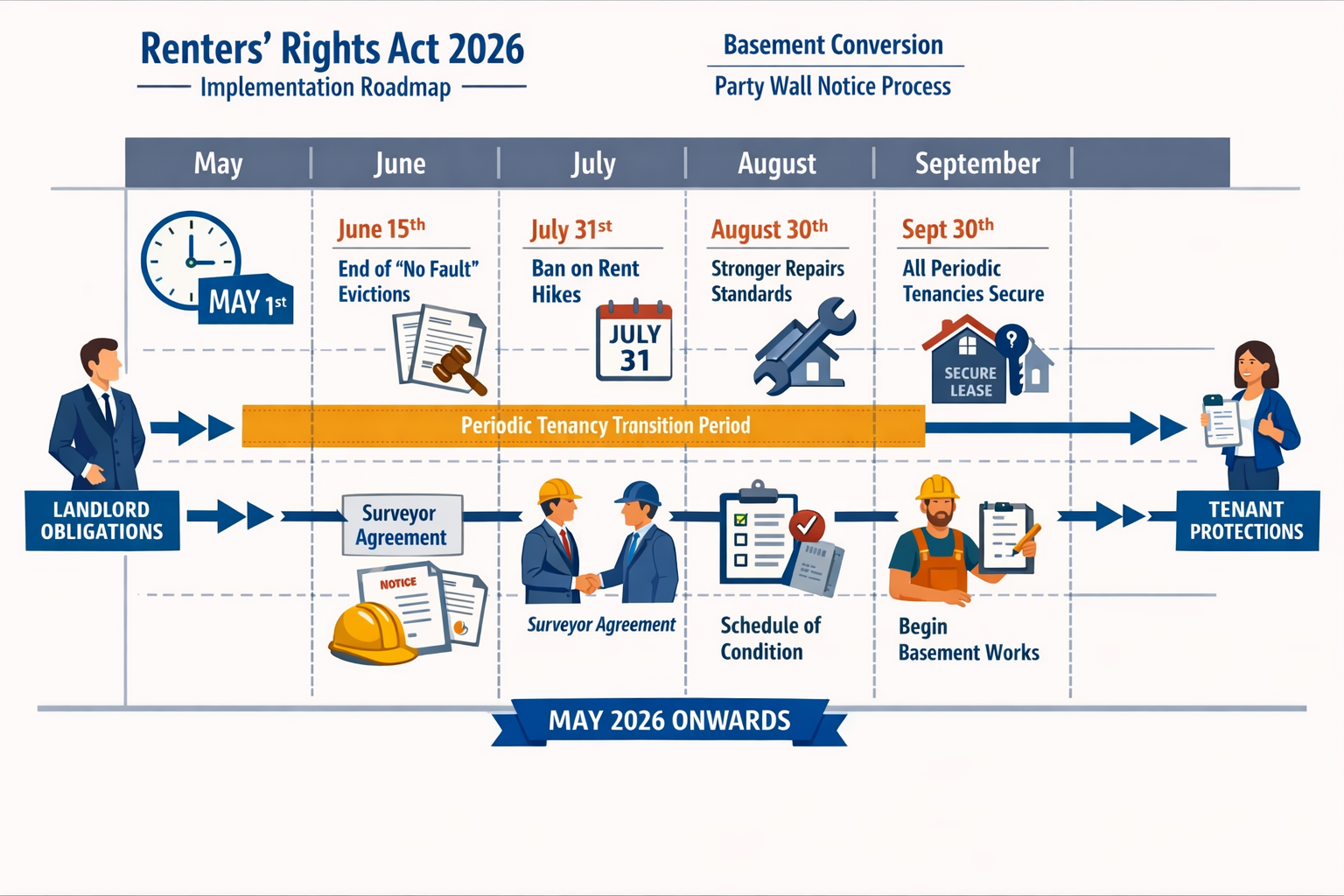
The intersection of party wall procedures with the new tenancy framework creates unique challenges for basement conversions. With the Renters' Rights Act implementation roadmap now published and set to take effect on May 1, 2026 [5], property owners must master both the technical requirements of party wall legislation and the evolving obligations toward tenants in periodic tenancies.
Key Takeaways
- Three distinct notice types apply to basement conversions: Line of Junction, Party Structure, and Section 6 (excavation) notices, each with specific timing requirements
- The Renters' Rights Act 2026 introduces new landlord obligations that affect how and when party wall notices can be served in rental properties with periodic tenancies
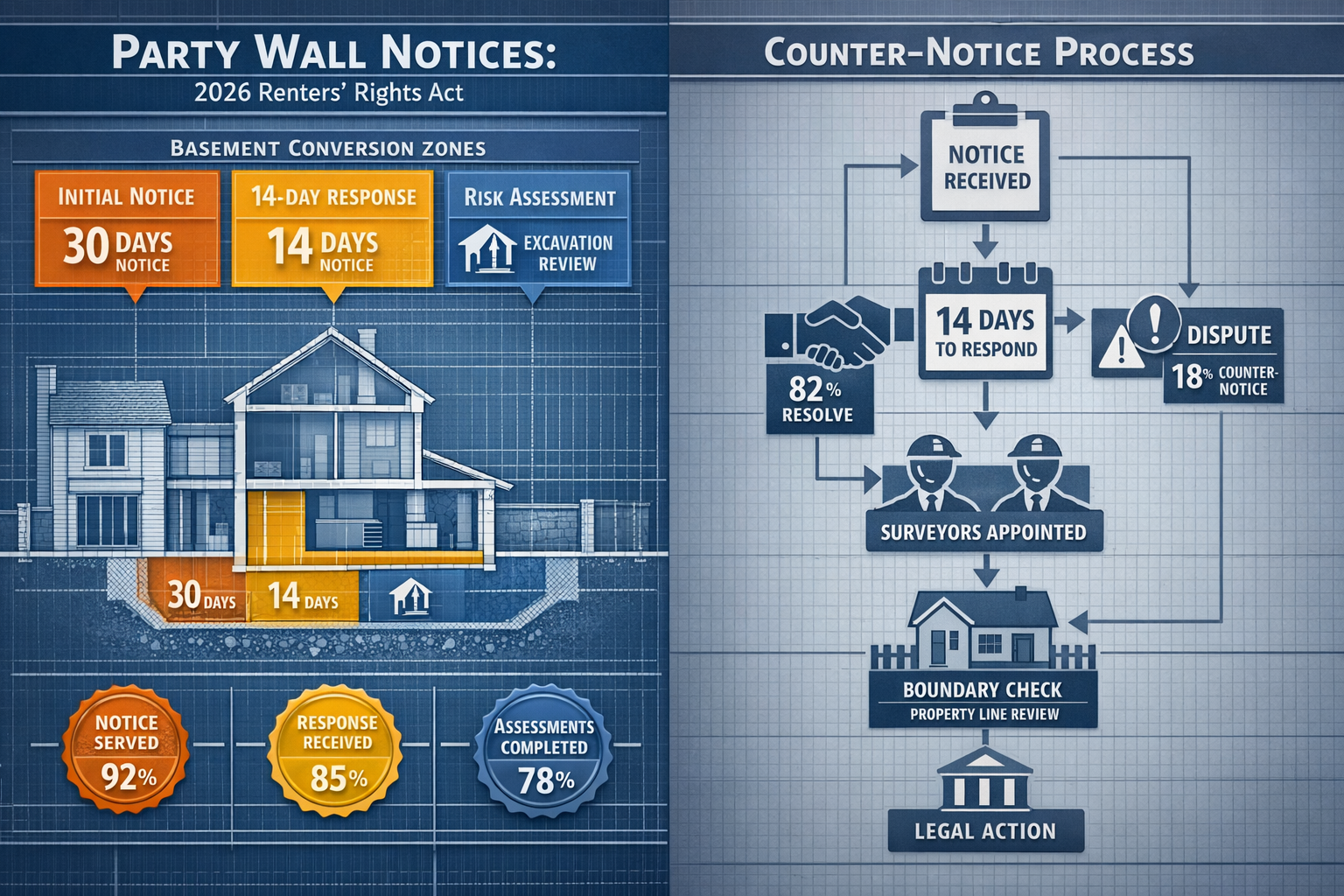
- Adjoining owners have exactly 14 days to respond with counter-notices, triggering surveyor appointment procedures and protective measures
- Deep excavation works within 3 or 6 meters of neighboring foundations require Section 6 notices with detailed technical specifications
- Template documents and strategic timing protect both building owners undertaking conversions and adjoining owners concerned about structural damage
Understanding the Three Types of Party Wall Notices for Basement Conversions
Basement conversions typically trigger multiple notice requirements under the Party Wall etc. Act 1996. Property owners must understand which notices apply to their specific project to ensure legal compliance and avoid costly delays.
Line of Junction Notice (Section 1)
This notice applies when building a new wall at the boundary line between two properties. For basement conversions, this becomes relevant when extending the basement footprint to the property boundary [1]. The notice must:
- Be served at least one month before work begins
- Describe the proposed work in detail
- Specify the intended start date
- Include drawings showing the new wall's position
Party Structure Notice (Section 2)
When basement work involves alterations to an existing party wall or party structure, a Party Structure Notice is required [1]. Common scenarios include:
- Underpinning existing party walls during basement excavation
- Cutting into party walls for new openings or structural ties
- Thickening party walls for waterproofing or insulation
- Removing chimney breasts that form part of the party structure
This notice requires a two-month minimum serving period before work commences [2]. For party wall procedures, this extended timeline allows adjoining owners adequate time to assess potential impacts.
Section 6 Notice (Excavation and Special Foundations)
The most critical notice for basement conversions is the Section 6 notice, which addresses excavation work near neighboring foundations [1]. This notice is mandatory when:
- Excavating within 3 meters of a neighbor's structure and going deeper than their foundations
- Excavating within 6 meters of a neighbor's structure and cutting a line at 45 degrees from the bottom of their foundations
The Section 6 notice must include:
✅ Detailed excavation plans and cross-sections
✅ Depth of proposed excavation
✅ Method of underpinning or foundation protection
✅ Structural calculations (where applicable)
✅ Timeline for works
This notice also requires one month's advance serving [1]. For comprehensive guidance on party wall notice requirements, property owners should consult experienced surveyors early in the planning phase.
How the Renters' Rights Act 2026 Affects Party Wall Notice Timing and Procedures
The Renters' Rights Act, receiving Royal Assent in May 2024 with implementation beginning May 1, 2026, introduces significant changes to the rental sector that directly impact party wall procedures for basement conversions [5][6].
Abolition of Section 21 and Periodic Tenancy Implications
The Act abolishes Section 21 "no-fault" evictions and transitions all assured shorthold tenancies to periodic tenancies after the fixed term expires [5]. This creates a permanent tenancy landscape where landlords undertaking basement conversions face new considerations:
Tenant Notification Requirements: Landlords must now provide enhanced notice to tenants about planned building works that may cause disruption. While the Party Wall Act governs notices to adjoining owners, landlords must separately address their own tenants' rights under the new framework.
Access and Disruption Protocols: With tenants enjoying greater security of tenure, landlords cannot rely on timing conversions between tenancies. The 2026 framework requires:
- Written notice of major works with reasonable timescales
- Consideration of tenant welfare during disruptive excavation
- Potential rent adjustments for significant loss of amenity
- Clear communication channels throughout the project
Landlord Obligations During Construction Works
The Renters' Rights Act 2026 introduces a "Decent Homes Standard" that applies to the private rented sector [6]. During basement conversions, landlords must ensure:
🏗️ Continued habitability of the property during works
🏗️ Safety measures protecting tenants from construction hazards
🏗️ Noise and dust mitigation strategies
🏗️ Alternative accommodation provisions for extensive works
These obligations intersect with party wall procedures when serving notices. Landlords must coordinate:
- Party wall notice timing (1-2 months advance to neighbors)
- Tenant notification under tenancy agreements and the 2026 Act
- Construction scheduling that minimizes tenant disruption
- Surveyor access arrangements that respect tenant privacy rights
Strategic Timing for Periodic Tenancies in 2026
With the transition to periodic tenancies as the default post-fixed-term arrangement [5], landlords planning basement conversions should:
Plan Well in Advance: The combination of party wall notice periods and tenant consultation requirements means basement projects now require 3-6 months advance planning from initial notice to work commencement.
Document Everything: Under the 2026 framework, landlords face increased scrutiny. Maintaining comprehensive records of all notices—both party wall and tenant-related—provides essential protection.
Consider Phased Approaches: Breaking basement conversions into phases can reduce disruption and make compliance with both party wall procedures and tenant welfare obligations more manageable.
For landlords navigating these complex requirements, professional guidance from chartered surveyors experienced in both party wall matters and the 2026 regulatory environment is invaluable.
Counter-Notice Strategies and Adjoining Owner Protections for Deep Excavations
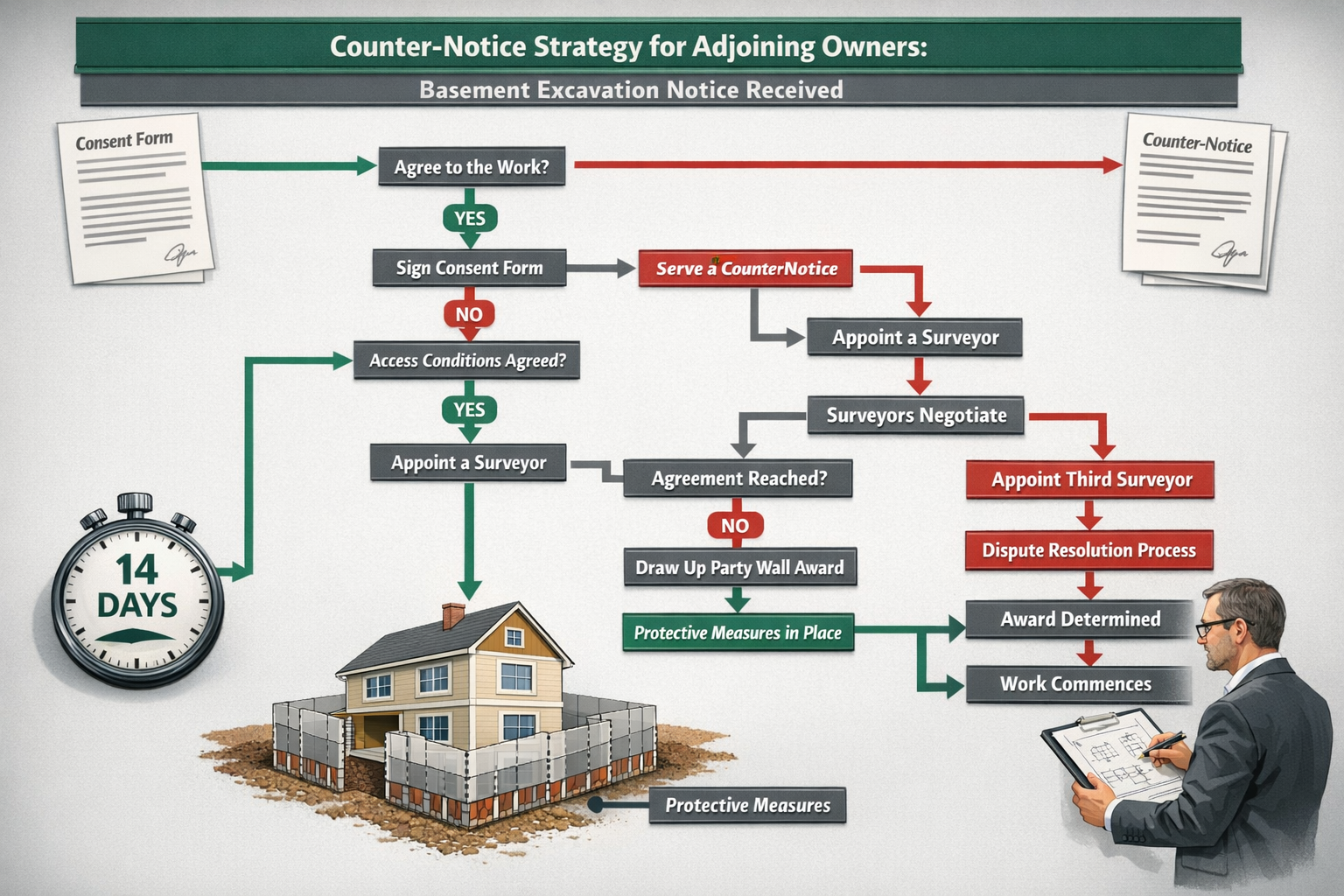
When adjoining owners receive party wall notices for basement conversions, they have exactly 14 days to respond [2]. This critical window determines whether the process proceeds smoothly or enters dispute resolution. Understanding counter-notice strategies is essential for protecting property interests.
The 14-Day Response Window
Upon receiving a party wall notice, adjoining owners have three options:
Option 1: Consent to the Works
Written consent allows the work to proceed as described. However, this does not waive rights to claim for damage that occurs during construction [2]. Adjoining owners should:
- Request detailed drawings and specifications
- Photograph existing conditions thoroughly
- Obtain written confirmation of insurance coverage
- Consider a pre-works condition survey
Option 2: Consent with Modifications
Adjoining owners can consent while requesting specific protective measures, such as:
- Additional underpinning beneath their foundations
- Vibration monitoring during excavation
- Specific working hours to minimize disruption
- Enhanced waterproofing measures
Option 3: Issue a Counter-Notice (Dissent)
If the adjoining owner has concerns about the proposed works, issuing a counter-notice triggers the surveyor appointment process [2]. This is the most common response for significant basement excavations.
Appointing Party Wall Surveyors
When a counter-notice is served, the Party Wall Act requires surveyor appointment to resolve differences [2]. Adjoining owners can:
Appoint Their Own Surveyor: This provides independent representation and ensures their interests are protected. The building owner typically pays both surveyors' fees for party wall matters [2].
Agree to a Single "Agreed Surveyor": Both parties use one surveyor, reducing costs but requiring trust in the surveyor's impartiality.
"The surveyor's role is to produce a Party Wall Award that specifies how the work will proceed, what protective measures are required, and how any damage will be addressed." [2]
For complex basement conversions, appointing separate surveyors is generally advisable. Adjoining owners should seek party wall surveyor quotes from experienced professionals familiar with deep excavation projects.
Template Counter-Notice for Basement Excavation Works
A properly drafted counter-notice should include:
COUNTER-NOTICE UNDER THE PARTY WALL ETC. ACT 1996
Date: [Insert date within 14 days of receiving notice]
To: [Building Owner's name and address]
From: [Adjoining Owner's name and address]
Re: Party Wall Notice dated [date] for basement conversion works at [address]
I/We acknowledge receipt of your [Section 2/Section 6] notice dated [date] regarding proposed basement conversion works.
I/We hereby dissent from the notice and require a dispute to be resolved in accordance with Section 10 of the Party Wall etc. Act 1996.
I/We appoint [Surveyor name and contact details] as my/our surveyor to act in this matter.
Alternatively: I/We request that you provide the name and contact details of your appointed surveyor so that arrangements can be made for surveyor appointment.
Specific Concerns:
- Potential foundation damage from excavation within [X] meters
- Structural impact of underpinning works
- Vibration and settlement risks
- Water table disturbance affecting drainage
I/We require a comprehensive Party Wall Award addressing protective measures and condition monitoring.
Signed: ___________________
Date: ___________________
Protective Measures for Deep Excavations
Party Wall Awards for basement conversions should specify detailed protective measures, including:
Structural Protection:
- Underpinning specifications and methodology
- Temporary support systems during excavation
- Load distribution measures
- Foundation monitoring protocols
Monitoring Requirements:
- Pre-works condition survey (photographic and structural)
- Crack monitoring with datum points
- Vibration monitoring during excavation
- Settlement monitoring at regular intervals
- Post-works inspection and documentation
Insurance and Liability:
- Confirmation of adequate insurance coverage
- Clear liability framework for damage claims
- Dispute resolution procedures
- Access rights for inspection
Working Restrictions:
- Permitted working hours
- Noise and dust control measures
- Site access and egress arrangements
- Emergency contact procedures
For adjoining owners concerned about neighbour disputes, these protective measures provide essential safeguards. The Party Wall Award becomes a legally binding document that both parties must follow.
Common Pitfalls to Avoid
❌ Missing the 14-Day Deadline: Failure to respond within 14 days is deemed consent, potentially waiving the right to surveyor appointment [2].
❌ Informal Responses: Counter-notices must be in writing. Verbal objections or casual emails may not constitute valid dissent.
❌ Inadequate Documentation: Without thorough pre-works condition records, proving damage causation becomes extremely difficult.
❌ Delaying Surveyor Appointment: Once a counter-notice is served, prompt surveyor appointment keeps the process moving and prevents extended delays.
❌ Ignoring Section 6 Notices: Even if Section 2 notices are agreed, Section 6 excavation notices require separate consideration and response.
For properties with complex boundary disputes or existing structural concerns, early engagement with experienced surveyors is crucial. The party wall agreement process provides a structured framework for protecting all parties' interests.
Coordinating Party Wall Procedures with Planning and Building Control
Basement conversions require coordination across multiple regulatory frameworks. While party wall notices address neighboring property interests, planning permission and building regulations govern the construction itself.
Planning Permission Requirements
Most basement conversions in England require planning permission, particularly when:
- Extending beyond the existing building footprint
- Excavating in conservation areas
- Creating new lightwells or external access points
- Altering the external appearance of the property
Understanding planning permission guidelines helps property owners sequence their applications appropriately. The recommended order is:
- Obtain planning permission (if required)
- Develop detailed construction drawings
- Serve party wall notices (1-2 months before work)
- Submit building regulations application
- Appoint contractors and commence work
Building Regulations and Structural Calculations
All basement conversions must comply with Building Regulations, covering:
- Structural stability (foundations, underpinning, load-bearing walls)
- Fire safety (escape routes, fire-resistant construction)
- Drainage and waterproofing (tanking, pumping systems)
- Ventilation and moisture control
The structural calculations required for Building Regulations often inform the party wall notice documentation, particularly for Section 6 excavation notices. Coordinating with building surveyor services ensures technical consistency across all submissions.
Timeline Coordination for 2026 Projects
With the Renters' Rights Act 2026 adding tenant notification requirements for rental properties, the complete timeline for basement conversions now spans:
| Phase | Duration | Key Actions |
|---|---|---|
| Initial Planning | 1-2 months | Feasibility study, initial designs, tenant consultation (if applicable) |
| Planning Application | 2-3 months | Submit and obtain planning permission |
| Detailed Design | 1-2 months | Structural calculations, party wall drawings, Building Regs preparation |
| Party Wall Notices | 1-2 months | Serve notices, await responses, appoint surveyors if needed |
| Party Wall Award | 1-2 months | Surveyor negotiations, Award preparation and agreement |
| Building Regulations | 1 month | Submit and obtain approval |
| Construction | 3-6 months | Excavation, underpinning, construction, finishing |
Total Timeline: 10-18 months from initial concept to completion
For landlords with tenanted properties, the 2026 framework requires integrating tenant welfare considerations throughout this timeline, particularly during the construction phase.
Cost Implications and Financial Planning
Understanding the financial aspects of party wall procedures for basement conversions helps property owners budget appropriately and avoid unexpected expenses.
Party Wall Surveyor Fees
When disputes arise and surveyors are appointed, the building owner typically pays all reasonable surveyor fees [2]. Costs vary based on project complexity:
- Straightforward basement conversion: £1,500-£3,000 total
- Complex excavation with multiple neighbors: £3,000-£6,000 total
- Disputed Awards requiring extensive negotiation: £6,000-£10,000+
For detailed cost breakdowns, consult resources on party wall costs specific to your region and project scope.
Insurance Considerations
Building owners undertaking basement conversions should ensure:
✓ Adequate public liability insurance (minimum £5-10 million)
✓ Professional indemnity insurance for designers and surveyors
✓ Contract works insurance covering construction risks
✓ Notification to existing property insurers about major works
Adjoining owners should verify their own insurance covers structural damage claims and consider whether additional coverage is warranted during neighboring construction.
Damage Claims and Compensation
If damage occurs during basement conversion works, the Party Wall Award framework provides the mechanism for resolution. Typical damage scenarios include:
- Cracking in walls, ceilings, or external render
- Settlement causing doors or windows to stick
- Drainage disruption affecting waste or surface water systems
- Damp penetration from disturbed waterproofing
The pre-works condition survey (Schedule of Condition) becomes the baseline for assessing damage causation and appropriate compensation. Property owners should work with professional surveyor services to document conditions thoroughly before work begins.
Regional Considerations and Local Authority Variations
While the Party Wall etc. Act 1996 applies uniformly across England and Wales, local factors influence basement conversion feasibility and party wall procedures.
London and High-Density Urban Areas
London experiences particularly high demand for basement conversions due to property values and space constraints. The 2026 construction boom continues to drive party wall survey demand [3], with implications for:
- Surveyor availability: High demand can extend surveyor appointment timelines
- Local authority scrutiny: Councils in areas like Kensington & Chelsea have additional basement development restrictions
- Cumulative impact: Multiple concurrent basement projects in terraced streets create complex party wall scenarios
Property owners in London should engage London-based surveyor consultancy services familiar with local conditions and council requirements.
Geological and Soil Conditions
Local geology significantly affects basement conversion feasibility and party wall risk:
- Clay soils (common in London and Southeast): Higher settlement risk, requiring careful underpinning design
- Sandy or gravelly soils: Excavation stability challenges, potential water table issues
- Areas prone to subsidence: Enhanced monitoring and protective measures essential
Understanding subsidence risks helps adjoining owners assess whether additional protective measures should be requested in Party Wall Awards.
Conservation Areas and Listed Buildings
Properties in conservation areas or with listed building status face additional constraints:
- Planning permission requirements are more stringent
- Party wall works may require listed building consent
- Protective measures must respect historic fabric
- Specialist surveyors with heritage experience are advisable
Best Practices for Smooth Party Wall Procedures in 2026
Successfully navigating party wall procedures for basement conversions requires proactive planning and professional guidance.
For Building Owners (Property Owners Undertaking Conversions)
1. Start Early: Begin party wall consultations 4-6 months before intended construction start dates to accommodate notice periods and potential disputes.
2. Communicate Proactively: Informal discussions with neighbors before formal notices can identify concerns early and facilitate smoother processes.
3. Provide Comprehensive Information: Detailed drawings, specifications, and methodologies in party wall notices reduce uncertainty and objections.
4. Budget for Surveyor Fees: Assume disputes will arise and budget accordingly—it's better to have funds available than face delays.
5. Choose Experienced Professionals: Work with surveyors, structural engineers, and contractors experienced in basement conversions and party wall procedures.
6. Maintain Detailed Records: Document all communications, notices, responses, and site conditions throughout the process.
7. For Landlords: Integrate tenant consultation under the 2026 framework with party wall procedures, ensuring compliance with both regulatory regimes.
For Adjoining Owners (Neighbors Receiving Notices)
1. Respond Within 14 Days: Never miss the statutory response deadline—set reminders and seek advice promptly.
2. Appoint Your Own Surveyor: For significant basement excavations, independent representation protects your interests more effectively than agreed surveyors.
3. Commission Pre-Works Surveys: Professional condition surveys provide essential baseline documentation for any future damage claims.
4. Request Comprehensive Awards: Ensure Party Wall Awards specify detailed protective measures, monitoring protocols, and damage resolution procedures.
5. Understand Your Rights: The building owner pays reasonable surveyor fees for party wall matters—don't let cost concerns prevent proper representation [2].
6. Maintain Open Communication: While protecting your interests, maintaining constructive relationships with neighbors facilitates smoother processes.
7. Monitor Works Actively: Regular site visits and monitoring ensure compliance with Party Wall Awards and early identification of issues.
For Property Professionals and Surveyors
1. Stay Current with 2026 Regulations: The Renters' Rights Act implementation requires updated knowledge of landlord-tenant dynamics affecting party wall procedures [5].
2. Develop Template Libraries: Standardized notice templates, counter-notice formats, and Award provisions improve efficiency while ensuring compliance.
3. Build Local Networks: Relationships with other surveyors, structural engineers, and local authority officers facilitate smoother dispute resolution.
4. Invest in Continuing Education: Regular training on party wall legislation updates, construction methodologies, and dispute resolution techniques maintains professional competence.
5. Leverage Technology: Digital condition survey tools, monitoring systems, and document management platforms enhance service quality and efficiency.
For those seeking expert guidance, resources on how to find the best local surveyor and the benefits of RICS surveyors provide valuable starting points.
Conclusion
Navigating Party Wall Notices for Basement Conversions Under Renters' Rights Act: 2026 Timing and Counter-Notice Strategies requires understanding the intersection of party wall legislation, construction methodologies, and the evolving rental sector framework. With the Renters' Rights Act implementation beginning May 1, 2026 [5], property owners and adjoining owners must adapt their approaches to basement conversion projects.
The three notice types—Line of Junction, Party Structure, and Section 6 excavation notices—each serve distinct purposes with specific timing requirements ranging from one to two months [1]. The 14-day counter-notice window provides adjoining owners critical protection, triggering surveyor appointment and comprehensive Party Wall Awards that specify protective measures for deep excavations [2].
For landlords undertaking basement conversions in 2026, the transition to periodic tenancies as the default arrangement [5] requires coordinating party wall procedures with enhanced tenant welfare obligations. Strategic planning, comprehensive documentation, and professional surveyor engagement are essential for successful projects.
Actionable Next Steps
If you're planning a basement conversion:
- Consult with experienced party wall surveyors 4-6 months before intended work
- Develop detailed construction drawings and specifications
- Serve appropriate party wall notices with comprehensive information
- If applicable, coordinate tenant notifications under the 2026 framework
- Budget for potential surveyor fees and dispute resolution costs
If you've received a party wall notice for neighboring basement works:
- Seek professional advice within 7 days of receiving the notice
- Commission a pre-works condition survey of your property
- Consider appointing your own party wall surveyor to protect your interests
- Request detailed protective measures and monitoring protocols in the Award
- Document all communications and site conditions throughout the process
For professional guidance:
Contact experienced party wall agreement surveyors who understand both the technical requirements of basement excavations and the 2026 regulatory landscape. Professional support ensures compliance, protects property interests, and facilitates smoother construction processes for all parties involved.
The complexity of party wall procedures for basement conversions in 2026 demands proactive planning, comprehensive documentation, and expert guidance. By understanding the statutory framework, timing requirements, and counter-notice strategies, property owners and adjoining owners can navigate these processes effectively while protecting their respective interests.
References
[1] Three Types Of Party Wall Notices – https://stokemont.com/advice/three-types-of-party-wall-notices/
[2] Party Wall Agreement – https://hoa.org.uk/advice/guides-for-homeowners/i-am-improving/party-wall-agreement/
[3] Party Wall Surveys Amid 2026 Construction Boom Handling Disputes In High Demand Uk Housing Markets – https://nottinghillsurveyors.com/blog/party-wall-surveys-amid-2026-construction-boom-handling-disputes-in-high-demand-uk-housing-markets
[4] Landlords 2026 – https://theindependentlandlord.com/landlords-2026/
[5] Renters Rights Act Implementation Roadmap Now Published – https://www.hoganlovells.com/en/publications/renters-rights-act-implementation-roadmap-now-published
[6] The Renters Rights Act Information Sheet 2026 – https://www.gov.uk/government/publications/the-renters-rights-act-information-sheet-2026