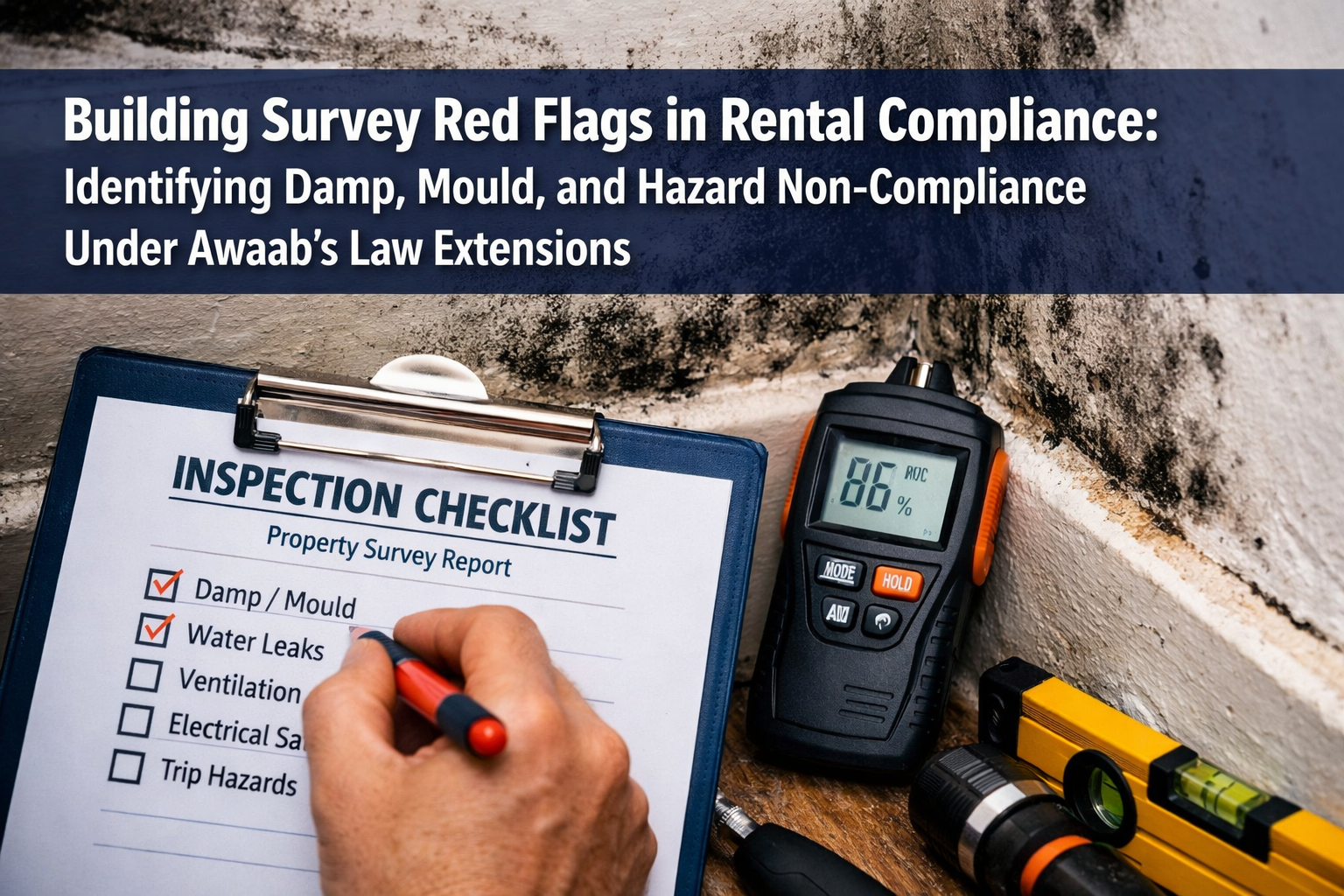
With just weeks remaining until 1 May 2026, landlords managing approximately 9% of private rental properties affected by damp and mould face a compliance deadline that could trigger penalties reaching £30,000 per serious breach.[1] The extension of Awaab's Law to the private rented sector through the Renters' Rights Act represents the most significant shift in rental property hazard management in decades, demanding immediate attention to Building Survey Red Flags in Rental Compliance: Identifying Damp, Mould, and Hazard Non-Compliance Under Awaab's Law Extensions.
Since October 2025, social housing providers have operated under strict investigation and remediation timelines—24 hours for emergency hazards, 10 working days for serious concerns—establishing precedents that private landlords must now follow.[2] This article provides a systematic approach to identifying, documenting, and assessing hazards that trigger landlord obligations under the expanded framework.
Key Takeaways
- Emergency damp and mould hazards require landlord investigation within 24 hours of notification, with repair work commencing immediately under Awaab's Law timelines effective 1 May 2026 for private rentals[1]
- Building surveys must document hazard severity using standardized assessment criteria to determine whether 10-day investigation or 24-hour emergency response protocols apply
- Landlords face financial penalties up to £30,000 plus tenant rent repayment orders covering up to 12 months' rent for non-compliance with investigation and remediation timelines[1]
- Documentation standards must meet expert witness requirements including timestamped photographs, moisture readings, thermal imaging, and clear hazard classification
- Awaab's Law will progressively expand to additional hazards in 2026 and nearly all housing hazards by 2027, making comprehensive survey protocols essential for ongoing compliance[2]
Understanding Awaab's Law Extensions and Compliance Obligations
Awaab's Law emerged from the tragic death of two-year-old Awaab Ishak, who died from prolonged exposure to mould in his family's social housing flat. The legislation initially targeted social housing providers, but the private rented sector extension takes effect on 1 May 2026—creating urgent compliance requirements for an estimated 4.6 million private rental properties across England.[1]
Timeline of Implementation Phases
The phased rollout establishes clear compliance milestones:
| Implementation Date | Sector Affected | Compliance Requirements |
|---|---|---|
| 27 October 2025 | Social housing landlords | Fixed investigation and repair timelines for damp and mould |
| 1 May 2026 | Private rented sector | Same damp and mould investigation and repair obligations |
| 2026 (Q3-Q4) | All rental sectors | Extension to additional specified hazards |
| 2027 | All rental sectors | Coverage of nearly all housing hazards (excluding overcrowding) |
This progressive expansion means that building surveyor services must evolve beyond traditional damp assessment to comprehensive hazard identification across multiple categories.
Core Landlord Obligations Under the New Framework
Under Awaab's Law extensions, landlords cannot deflect responsibility by attributing damp and mould to tenant "lifestyle" factors.[6] The legislation establishes absolute landlord responsibility for property conditions, regardless of perceived tenant behavior.
Emergency Response Requirements (24 Hours):
- Begin investigation within 24 hours of becoming aware of urgent damp/mould hazards
- Commence repair work immediately or within 24 hours
- Provide alternative accommodation if hazard makes property uninhabitable[2]
Non-Emergency Investigation Timeline (10 Working Days):
- Investigate potential significant damp and mould hazards within 10 working days
- Provide written findings within 3 working days of investigation completion
- Document root cause analysis and proposed remediation approach[2]
Repair Commencement Deadlines:
- Emergency hazards: Within 24 hours
- Serious hazards: Within 14 days of cause identification
- Preventive works: Within 5 working days[2]
For landlords seeking to understand these obligations before purchasing rental properties, reviewing expert building evaluation reports becomes essential due diligence.
Building Survey Red Flags: Identifying Damp, Mould, and Hazard Non-Compliance
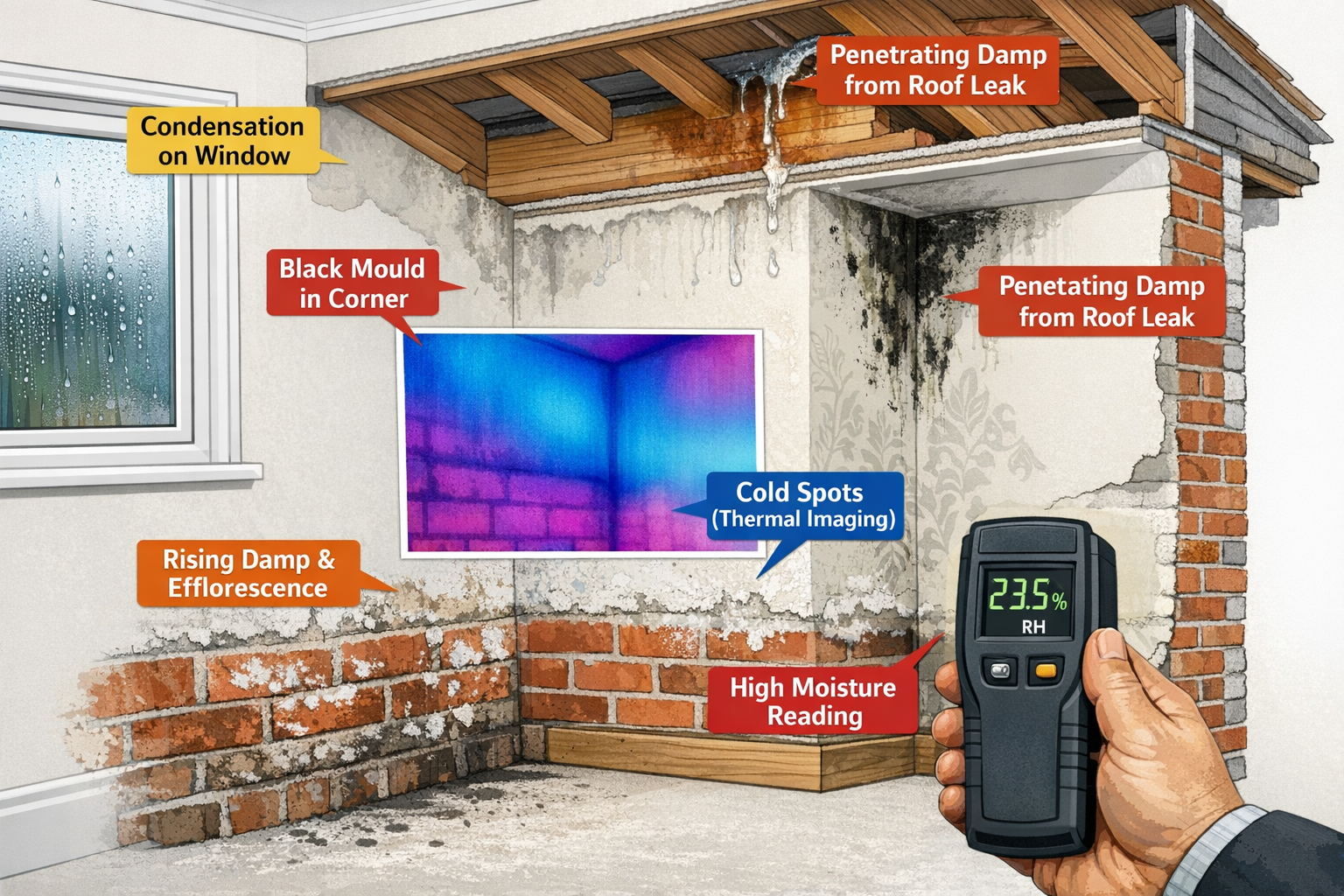
Effective compliance under Building Survey Red Flags in Rental Compliance: Identifying Damp, Mould, and Hazard Non-Compliance Under Awaab's Law Extensions requires systematic hazard identification using standardized assessment protocols. Professional surveyors must distinguish between hazard types, severity levels, and urgency classifications.
Primary Damp Categories and Red Flag Indicators
1. Rising Damp 🔴
Rising damp occurs when ground moisture travels upward through porous building materials via capillary action. Red flag indicators include:
- Tide marks on walls typically extending 1-1.5 meters above floor level
- Efflorescence (white salt deposits) on internal wall surfaces
- Deteriorating plaster that crumbles when touched
- Peeling wallpaper or paint at skirting board level
- Musty odor concentrated in lower wall areas
- Moisture meter readings consistently above 20% relative humidity in lower wall sections
Rising damp frequently affects properties built before 1875 lacking damp-proof courses, or where existing DPC has failed. Comprehensive damp survey London assessments should include chemical analysis to distinguish rising damp from other moisture sources.
2. Penetrating Damp 🟠
Penetrating damp results from water entering through external building fabric defects. Critical red flags include:
- Localized damp patches on walls, often appearing after rainfall
- Staining patterns that worsen during wet weather
- External wall cracks allowing water ingress
- Defective pointing in brickwork or masonry
- Blocked or damaged guttering causing overflow
- Failed roof tiles or flashing near chimney stacks
- Window frame deterioration allowing water penetration
Thermal imaging reveals temperature differentials indicating moisture pathways, making it essential for property damp assessment documentation.
3. Condensation and Mould Growth 🔴
Condensation-related mould represents the most common hazard triggering Awaab's Law obligations. Red flags include:
- Black mould colonies on walls, ceilings, or window frames
- Condensation on windows, especially in bedrooms and bathrooms
- Mould growth patterns in room corners and behind furniture
- Persistent musty smell indicating hidden mould colonies
- Water droplets on cold surfaces during winter months
- Poor ventilation with inadequate air circulation
- Inadequate heating creating cold surfaces prone to condensation
Properties with single-glazed windows, insufficient insulation, or blocked ventilation face elevated condensation risk. The English Housing Survey indicates that 9% of private rental properties show damp and mould evidence, suggesting widespread condensation management failures.[1]
Severity Assessment Framework for Compliance Classification
Awaab's Law compliance hinges on accurate hazard severity classification determining response timelines. Surveyors should apply the Housing Health and Safety Rating System (HHSRS) alongside Awaab-specific criteria:
Emergency Hazards (24-Hour Response Required):
- Extensive mould growth covering more than 1 square meter
- Mould in sleeping areas affecting vulnerable occupants (children, elderly, immunocompromised)
- Active water ingress causing immediate structural damage
- Hazards creating imminent health risk requiring urgent medical attention
- Conditions making property immediately uninhabitable
Serious Hazards (10-Day Investigation + 14-Day Repair):
- Moderate mould growth (0.5-1 square meter) in habitable rooms
- Rising damp affecting significant wall areas
- Penetrating damp from structural defects
- Ventilation failures causing persistent condensation
- Hazards with potential for rapid deterioration
Moderate Hazards (Standard Remediation Timelines):
- Minor damp patches with no mould growth
- Isolated condensation issues responsive to tenant behavior changes
- Preventive maintenance requirements
- Early-stage deterioration requiring monitoring
Professional dampness assessments pricing typically reflects the complexity of severity classification, with comprehensive HHSRS assessments commanding premium fees due to legal implications.
Additional Hazard Categories for 2026-2027 Extension
While damp and mould dominate current Awaab's Law requirements, the 2026 expansion to additional hazards and 2027 near-universal coverage demand broader survey scope:[2]
- Structural defects (subsidence, settlement, structural movement)
- Fire safety deficiencies (inadequate escape routes, missing fire doors)
- Electrical hazards (outdated wiring, missing RCD protection)
- Gas safety issues (faulty boilers, inadequate ventilation)
- Pest infestations (rats, mice, insects affecting health)
- Overcrowding (excluded from Awaab's Law but covered under separate regulations)
- Falls hazards (unsafe stairs, balconies, windows)
- Thermal comfort (inadequate heating, excessive cold)
Surveyors conducting building inspection work should begin documenting these hazard categories now to establish baseline property conditions before expanded obligations take effect.
Documentation Standards for Building Survey Red Flags in Rental Compliance
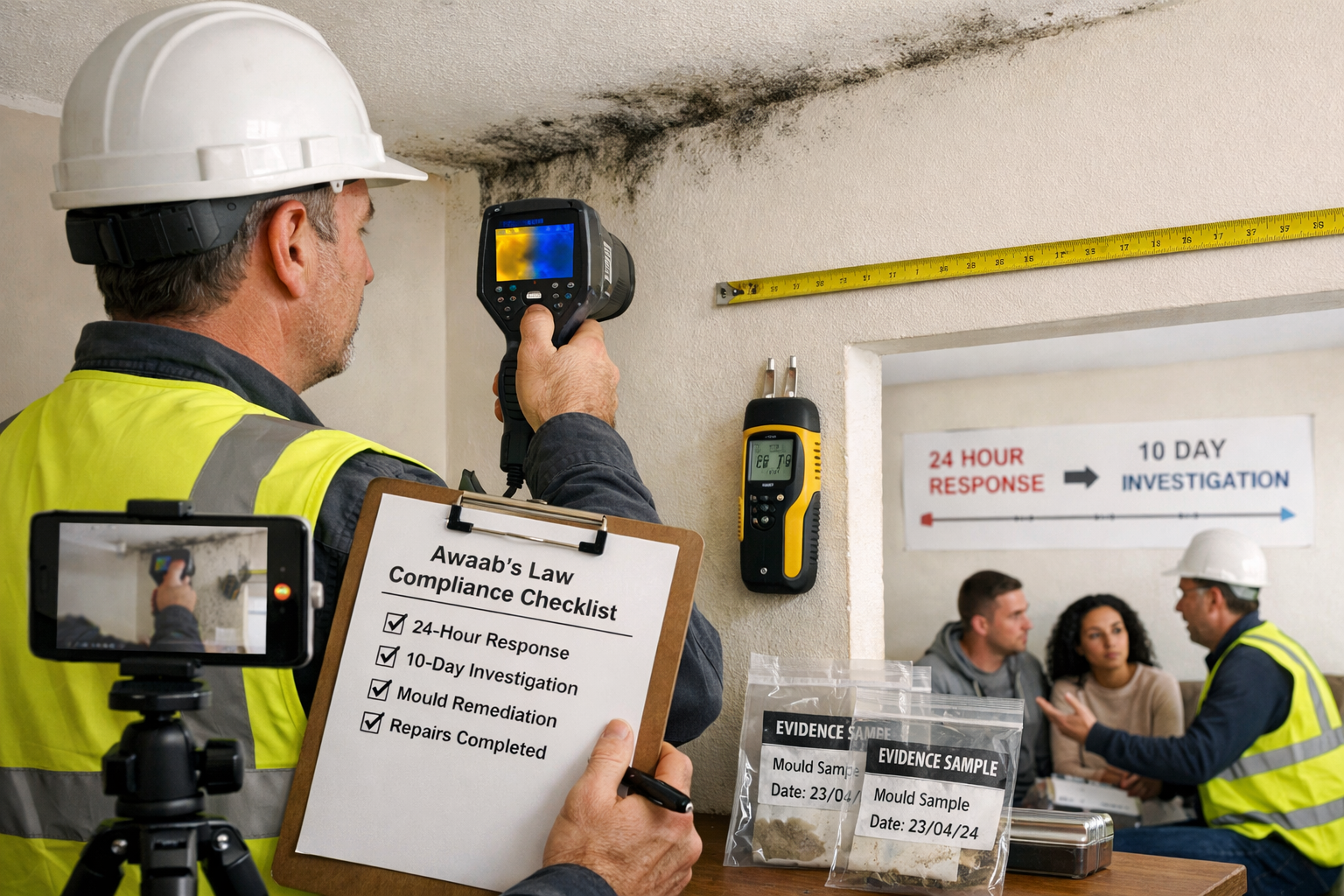
Effective compliance under Building Survey Red Flags in Rental Compliance: Identifying Damp, Mould, and Hazard Non-Compliance Under Awaab's Law Extensions requires documentation meeting expert witness standards. As enforcement actions and tenant rent repayment claims increase, survey reports must withstand legal scrutiny.
Essential Documentation Components
1. Photographic Evidence Standards 📸
High-quality photographic documentation forms the foundation of defensible survey reports:
- Timestamped images showing date and time of inspection
- Wide-angle context shots showing room layout and hazard location
- Close-up detail images capturing mould growth patterns, damp staining, and deterioration
- Scale reference using measuring tape or standard objects
- Multiple angles of each identified hazard
- Before-and-after comparison for reinspection documentation
- External elevation photographs showing potential ingress points
Professional surveyors should capture minimum 5-8 photographs per identified hazard, with systematic labeling linking images to written report sections.
2. Moisture Measurement Protocols 💧
Quantitative moisture data provides objective evidence supporting hazard classification:
- Moisture meter readings recorded at multiple wall heights (floor level, 1 meter, 1.5 meters)
- Relative humidity measurements in affected rooms
- Temperature readings identifying cold spots prone to condensation
- Calibration certificates for all measurement equipment
- Measurement methodology clearly documented (invasive vs. non-invasive)
- Comparative readings from unaffected areas establishing baseline
Moisture readings above 20% relative humidity in building materials typically indicate active damp requiring investigation. Readings above 30% suggest serious hazards requiring emergency response protocols.[3]
3. Thermal Imaging Analysis 🌡️
Thermal imaging cameras reveal hidden moisture patterns and insulation defects:
- Temperature differential mapping showing cold bridging
- Moisture pathway visualization indicating penetrating damp routes
- Insulation deficiency identification affecting condensation risk
- Color-coded thermal maps with temperature scales
- Comparative analysis between affected and unaffected areas
Thermal imaging provides compelling visual evidence for moisture damage report documentation, particularly when explaining complex damp mechanisms to non-technical audiences.
Survey Report Structure for Awaab's Law Compliance
Professional survey reports addressing Building Survey Red Flags in Rental Compliance: Identifying Damp, Mould, and Hazard Non-Compliance Under Awaab's Law Extensions should follow this standardized structure:
Executive Summary Section:
- Property address and inspection date
- Summary of identified hazards with severity classifications
- Landlord compliance status (compliant/non-compliant)
- Urgent action requirements with specific timelines
- Estimated remediation costs
Detailed Findings Section:
- Room-by-room hazard documentation
- Hazard type identification (rising damp, penetrating damp, condensation, mould)
- Severity assessment with HHSRS scoring
- Root cause analysis
- Photographic evidence with reference numbers
- Quantitative measurements (moisture, temperature, humidity)
Compliance Assessment Section:
- Awaab's Law timeline requirements for each hazard
- Landlord notification date (establishing compliance clock)
- Required investigation deadline
- Required repair commencement deadline
- Alternative accommodation requirements (if applicable)
Remediation Recommendations Section:
- Specific repair specifications for each hazard
- Preventive measures to avoid recurrence
- Ventilation improvements required
- Heating system upgrades needed
- Insulation enhancements recommended
- Estimated costs and timelines
Appendices:
- Full photographic evidence catalog
- Moisture measurement data tables
- Thermal imaging reports
- Equipment calibration certificates
- Relevant regulatory guidance references
For landlords considering property purchases, commissioning comprehensive surveys before completion allows renegotiation after poor building survey results when significant compliance issues emerge.
Expert Witness Documentation Standards
Survey reports may serve as expert witness evidence in enforcement proceedings or tenant legal claims. Documentation should meet these elevated standards:
✅ Objectivity and impartiality – Avoid advocacy for either party
✅ Methodology transparency – Clearly explain assessment approach
✅ Professional qualifications – Include surveyor credentials and experience
✅ Standards compliance – Reference RICS guidance and industry standards
✅ Peer review readiness – Ensure findings withstand professional scrutiny
✅ Clear conclusions – Provide unambiguous hazard classifications
✅ Limitation statements – Acknowledge scope restrictions or access limitations
Professional indemnity insurance typically requires adherence to RICS standards, making chartered surveyors the preferred choice for compliance-critical assessments.
Practical Building Survey Checklist for Rental Property Compliance
Systematic hazard identification requires structured inspection protocols. This practical checklist enables thorough assessment of Building Survey Red Flags in Rental Compliance: Identifying Damp, Mould, and Hazard Non-Compliance Under Awaab's Law Extensions:
Pre-Inspection Preparation Checklist
- Review property history and previous survey reports
- Obtain tenant consent for intrusive investigation (if required)
- Calibrate moisture meters and thermal imaging equipment
- Prepare documentation templates and checklists
- Review current weather conditions (recent rainfall affecting damp assessment)
- Confirm access to all rooms, cupboards, and roof spaces
- Prepare evidence collection equipment (camera, measuring tools, sample bags)
Room-by-Room Inspection Protocol
Living Areas and Bedrooms:
- Check all external walls for damp staining or discoloration
- Inspect behind furniture and in corners for hidden mould growth
- Test moisture levels at multiple wall heights
- Examine window frames for condensation or mould
- Assess heating adequacy and radiator functionality
- Check ventilation provision (windows, vents, trickle vents)
- Document any musty odors indicating hidden mould
- Photograph all identified hazards with scale reference
Kitchens and Bathrooms:
- Inspect extractor fan operation and effectiveness
- Check for mould growth around windows, tiles, and sealants
- Test moisture levels in walls adjacent to plumbing
- Examine under-sink areas for leaks or water damage
- Assess ventilation adequacy for moisture-generating activities
- Check for condensation on cold surfaces
- Document any penetrating damp from external walls
- Verify adequate heating provision
Basements and Cellars:
- Inspect for rising damp indicators (tide marks, efflorescence)
- Check for water pooling or standing water
- Assess ventilation and air circulation
- Test moisture levels in walls and floors
- Look for mould growth in corners and on stored items
- Examine external walls for penetrating damp
- Document any flooding history or water ingress evidence
Roof Spaces and Attics:
- Inspect roof covering condition from interior
- Check for water staining on timbers indicating leaks
- Assess insulation adequacy and condition
- Look for condensation on roof timbers
- Examine ventilation provision
- Check for mould growth on timbers or stored items
- Document any daylight visible through roof covering
External Inspection:
- Examine guttering and downpipes for blockages or damage
- Check external wall condition and pointing
- Assess roof covering condition (tiles, flashing, chimneys)
- Look for cracks allowing water penetration
- Check ground levels relative to damp-proof course
- Assess drainage adequacy around property perimeter
- Document any vegetation growth against walls
Hazard Severity Classification Decision Tree
When assessing identified hazards, apply this decision framework:
Step 1: Identify Hazard Type
→ Damp (rising/penetrating/condensation)
→ Mould growth
→ Structural defect
→ Other hazard category
Step 2: Assess Extent
→ Minor (< 0.5 square meters affected)
→ Moderate (0.5-1 square meter affected)
→ Extensive (> 1 square meter affected)
Step 3: Evaluate Location
→ Non-habitable areas (storage, utility)
→ Habitable rooms (living, dining)
→ Sleeping areas (bedrooms)
→ Areas used by vulnerable occupants
Step 4: Determine Health Risk
→ Low risk (cosmetic impact only)
→ Moderate risk (potential health effects)
→ High risk (immediate health threat)
Step 5: Classify Urgency
→ Emergency (24-hour response)
→ Serious (10-day investigation)
→ Moderate (standard remediation)
This systematic approach ensures consistent hazard classification across multiple properties and surveyors.
Financial Implications and Enforcement Mechanisms
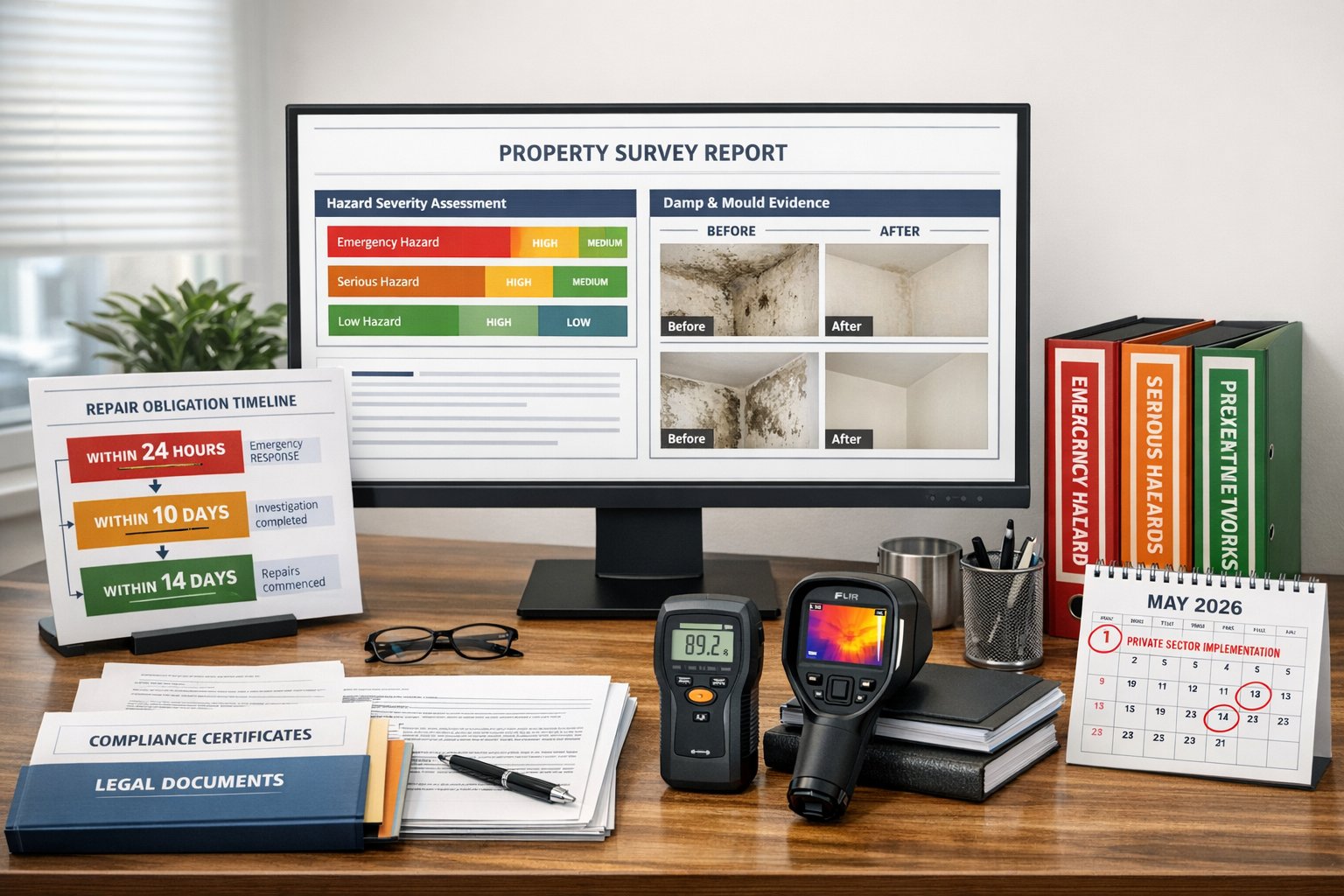
Understanding the financial consequences of non-compliance motivates proactive hazard identification and remediation. The enforcement framework combines regulatory penalties with tenant-initiated claims, creating substantial financial exposure for non-compliant landlords.
Regulatory Penalties and Enforcement Powers
Local authorities possess extensive enforcement powers under Awaab's Law extensions:
Financial Penalties:
- Up to £30,000 for serious breaches of investigation and repair timelines[1]
- Unlimited fines for continued non-compliance after enforcement notices
- Civil penalty notices issued without criminal prosecution
- Penalty amounts determined by breach severity and landlord culpability
Enforcement Orders:
- Improvement notices requiring specific remediation works within set timelines
- Prohibition orders preventing property occupation until hazards addressed
- Emergency prohibition orders for immediate serious hazards
- Demolition orders for properties beyond economic repair
Criminal Prosecution:
- Criminal offenses for failure to comply with enforcement notices
- Prosecution costs recoverable from landlords
- Criminal records affecting future licensing and property management
Tenant Rent Repayment Orders
Beyond regulatory enforcement, tenants can pursue rent repayment orders (RROs) recovering up to 12 months' rent when landlords fail to address damp and mould hazards.[1] RROs create direct financial consequences independent of local authority action.
RRO Eligibility Criteria:
- Landlord failed to comply with Awaab's Law timelines
- Tenant suffered from hazard presence
- Landlord received proper notification of hazard
- Remediation not completed within required timeframes
Recoverable Amounts:
- Maximum 12 months' rent for serious compliance failures
- Proportional reductions based on breach severity
- Legal costs potentially recoverable by successful tenants
- Interest on delayed payments
The combination of regulatory penalties and tenant RROs creates potential financial exposure exceeding £50,000 for serious compliance failures on individual properties.
Cost-Benefit Analysis of Proactive Compliance
Proactive hazard identification and remediation delivers substantial financial benefits compared to reactive enforcement responses:
| Approach | Typical Costs | Risk Exposure | Outcome |
|---|---|---|---|
| Proactive Survey & Remediation | £500-2,000 survey + £2,000-8,000 remediation | Minimal | Full compliance, tenant satisfaction |
| Reactive Response (Post-Complaint) | £5,000-15,000 emergency remediation + alternative accommodation | £30,000 penalty + 12 months rent RRO | Legal costs, reputation damage |
| Non-Compliance | £0 upfront | £30,000+ penalties + unlimited RRO + prohibition orders | Property unusable, criminal record |
The financial case for proactive damp proofing services and comprehensive survey work becomes compelling when enforcement risks materialize.
Insurance Implications and Coverage Gaps
Standard landlord insurance policies typically exclude coverage for:
- Fines and penalties imposed by regulatory authorities
- Rent repayment orders to tenants
- Gradual deterioration and maintenance failures
- Pre-existing damp and mould conditions
Specialized compliance insurance products have emerged offering:
- Legal defense costs for enforcement proceedings
- Rent repayment order coverage (subject to sub-limits)
- Emergency remediation costs for newly discovered hazards
- Alternative accommodation costs during repairs
However, insurance underwriters require evidence of proactive compliance management, including regular professional surveys and documented maintenance programs. Properties lacking recent damp and timber report cost assessments may face coverage exclusions or premium loadings.
Preparing for Future Hazard Expansions and Decent Homes Standard
The Awaab's Law framework represents the foundation of progressively expanding rental property compliance obligations. Forward-thinking landlords and surveyors must prepare for additional hazards in 2026 and near-universal hazard coverage in 2027.[2]
Anticipated Hazard Categories for 2026-2027 Expansion
While government guidance remains under development, likely expansion categories include:
Structural Hazards:
- Subsidence and settlement (see guide to subsidence for assessment protocols)
- Structural movement and cracking
- Foundation failures
- Roof structure deterioration
Fire Safety Hazards:
- Inadequate fire detection systems
- Missing or defective fire doors
- Unsafe escape routes
- Combustible cladding
Electrical and Gas Hazards:
- Outdated electrical installations
- Missing RCD protection
- Gas appliance defects
- Inadequate ventilation for combustion appliances
Falls and Collision Hazards:
- Unsafe stairs and balconies
- Defective windows and guards
- Slippery surfaces
- Low headroom areas
Comprehensive full structural inspection protocols should begin incorporating these hazard categories to establish baseline property conditions.
Decent Homes Standard Extension to Private Sector
The Decent Homes Standard extension to private rentals (anticipated 2027-2028) will impose additional property condition requirements:[1]
Thermal Comfort Requirements:
- Adequate thermal insulation meeting current building regulations
- Efficient heating systems capable of maintaining comfortable temperatures
- Double-glazed windows or equivalent thermal performance
- Proper ventilation preventing condensation
Property Condition Standards:
- Good condition windows and doors
- Sound roof structure and covering
- Adequate kitchen and bathroom facilities
- Proper drainage and waste systems
Energy Efficiency Requirements:
- Minimum Energy Performance Certificate (EPC) ratings
- Cost-effective energy efficiency improvements
- Renewable energy consideration for major refurbishments
The convergence of Awaab's Law hazard management and Decent Homes Standard property conditions creates comprehensive compliance frameworks requiring systematic survey assessment.
Developing Comprehensive Compliance Management Systems
Professional landlords should implement structured compliance management systems incorporating:
Regular Inspection Schedules:
- Annual professional surveys for high-risk properties
- Biennial surveys for standard properties
- Post-tenancy condition assessments
- Seasonal inspections (pre-winter condensation risk assessment)
Tenant Communication Protocols:
- Clear hazard reporting procedures
- Acknowledgment and response timelines
- Progress updates during remediation
- Completion confirmation and documentation
Documentation Management:
- Centralized hazard register
- Timestamped notification records
- Investigation and remediation logs
- Photographic evidence archives
- Contractor certificates and warranties
Contractor Relationships:
- Pre-approved specialist contractors for emergency response
- Service level agreements ensuring timeline compliance
- Quality assurance protocols
- Insurance and qualification verification
Landlords managing multiple properties should consider property management software incorporating Awaab's Law timeline tracking and automated compliance alerts.
Conclusion: Implementing Effective Building Survey Red Flags Protocols
The extension of Awaab's Law to the private rented sector on 1 May 2026 represents a fundamental shift in rental property compliance obligations. With approximately 9% of private rental properties affected by damp and mould, and enforcement mechanisms including £30,000 penalties plus 12-month rent repayment orders, the financial and legal risks of non-compliance have never been higher.[1]
Building Survey Red Flags in Rental Compliance: Identifying Damp, Mould, and Hazard Non-Compliance Under Awaab's Law Extensions requires systematic hazard identification using standardized assessment protocols, comprehensive documentation meeting expert witness standards, and proactive remediation programs ensuring timeline compliance.
Actionable Next Steps for Landlords and Property Managers
Immediate Actions (Before 1 May 2026):
-
Commission comprehensive building surveys for all rental properties, focusing on damp, mould, and condensation risk assessment through qualified building surveyor services
-
Establish baseline property conditions with timestamped photographic evidence and moisture measurements, creating defensible documentation of pre-compliance status
-
Implement tenant notification systems ensuring hazard reports reach landlords within hours, not days, enabling timeline compliance
-
Develop emergency response protocols with pre-approved contractors capable of 24-hour mobilization for urgent hazards
-
Review and update insurance coverage to address compliance risks and ensure adequate protection for enforcement scenarios
Medium-Term Actions (2026-2027):
-
Conduct remediation programs addressing identified hazards before enforcement actions materialize, prioritizing properties with vulnerable tenants
-
Implement preventive maintenance schedules targeting condensation risk through improved heating, ventilation, and insulation
-
Prepare for hazard expansion by incorporating additional hazard categories into survey protocols as government guidance emerges
-
Develop tenant education programs explaining condensation prevention and hazard reporting procedures
-
Monitor regulatory developments regarding Decent Homes Standard extension and additional Awaab's Law hazard categories
Long-Term Strategic Actions:
-
Upgrade properties to exceed minimum standards, creating competitive advantage in increasingly regulated rental markets
-
Implement comprehensive property management systems with integrated compliance tracking and automated timeline monitoring
-
Build professional relationships with specialist surveyors, contractors, and legal advisors supporting compliance management
-
Consider portfolio rationalization, disposing of properties requiring extensive compliance investment
-
Invest in energy efficiency and ventilation improvements addressing root causes of condensation and mould growth
The convergence of Awaab's Law extensions, Decent Homes Standard implementation, and progressive hazard expansion creates a compliance landscape requiring professional expertise and systematic management. Landlords who view compliance as strategic investment rather than regulatory burden will achieve superior tenant outcomes, reduced enforcement risk, and enhanced property values.
For comprehensive assessment of rental property compliance status, professional building surveys conducted by chartered surveyors provide the foundation for effective hazard management under the new regulatory framework. The cost of proactive compliance assessment represents a fraction of potential enforcement penalties and tenant claims, making professional survey investment an essential component of responsible property management in 2026 and beyond.
References
[1] Preventing Damp And Mould In 2026 Under Awaab S Law – https://www.augustapp.com/blog/preventing-damp-and-mould-in-2026-under-awaab-s-law
[2] Awaabs Law Damp Mould Timelines – https://www.platinumchemicals.co.uk/blogs/news/awaabs-law-damp-mould-timelines
[3] 530b9bb8 4f20 462d 823b 10925a937e45 – https://helpmefix.io/blog/530b9bb8-4f20-462d-823b-10925a937e45
[4] Awaabs Law Private Rented Sector Extension – https://awaabs-law.com/awaabs-law-private-rented-sector-extension
[5] Awaabs Law Duco Solutions – https://www.duco.eu/uk-ie/blog/awaabs-law-duco-solutions
[6] Awaabs Law Comes Into Force What Does It Mean For Construction – https://www.trowers.com/insights/2025/november/awaabs-law-comes-into-force-what-does-it-mean-for-construction
[7] Social Housing Landlords Cannot Blame Tenants For Damp And Mould And Should Offer Alternative Accommodation – https://www.property118.com/social-housing-landlords-cannot-blame-tenants-for-damp-and-mould-and-should-offer-alternative-accommodation/