
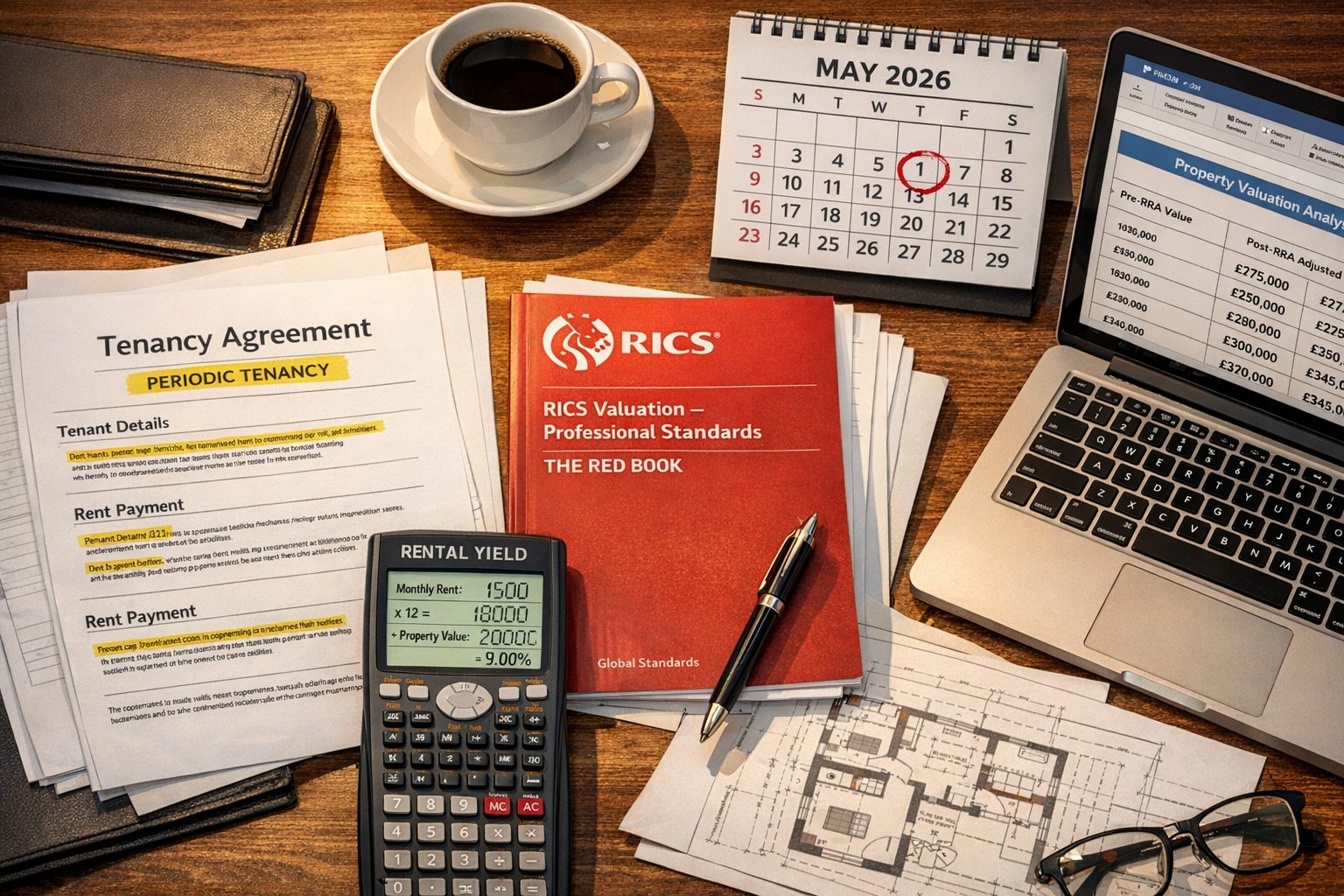
The Private Rented Sector (PRS) faces its most significant regulatory disruption in decades: on May 1, 2026, every assured shorthold tenancy in England will simultaneously convert to a periodic tenancy, eliminating fixed-term agreements and fundamentally altering the risk-return profile that underpins property valuations. For surveyors conducting Renters' Rights Act 2026 and Valuation Impact: Assessing Periodic Tenancies, Rent Controls, and Landlord Compliance for PRS Valuations, this legislative shift demands immediate recalibration of valuation methodologies, yield calculations, and risk assessments across the entire residential investment market.
The Renters' Rights Act 2025 (RRA), which comes into full force on this single implementation date, transforms the landlord-tenant relationship by removing Section 21 "no-fault" evictions, mandating Section 13 rent increase procedures, and granting tenants unprecedented flexibility to exit tenancies with just two months' notice [1]. These changes don't merely adjust the regulatory framework—they fundamentally alter the investment characteristics that determine property values in the PRS.
Key Takeaways
- All ASTs convert to periodic tenancies on May 1, 2026, eliminating fixed-term agreements and increasing tenant mobility, which directly impacts income certainty and property valuations
- Section 21 abolition forces landlords to use Section 8 grounds only, reducing possession certainty and requiring valuation adjustments for increased void risk
- Mandatory Section 13 rent review processes create procedural constraints that may depress rental growth assumptions in valuation models
- Compliance requirements and tenant rights expansions increase operational costs and legal risks, necessitating downward adjustments to net operating income projections
- Surveyors must adopt new valuation adjustment frameworks that quantify regulatory risk, tenant turnover probability, and compliance costs when conducting Red Book valuations
Understanding the Renters' Rights Act 2026 Core Provisions
The End of Fixed-Term Tenancies
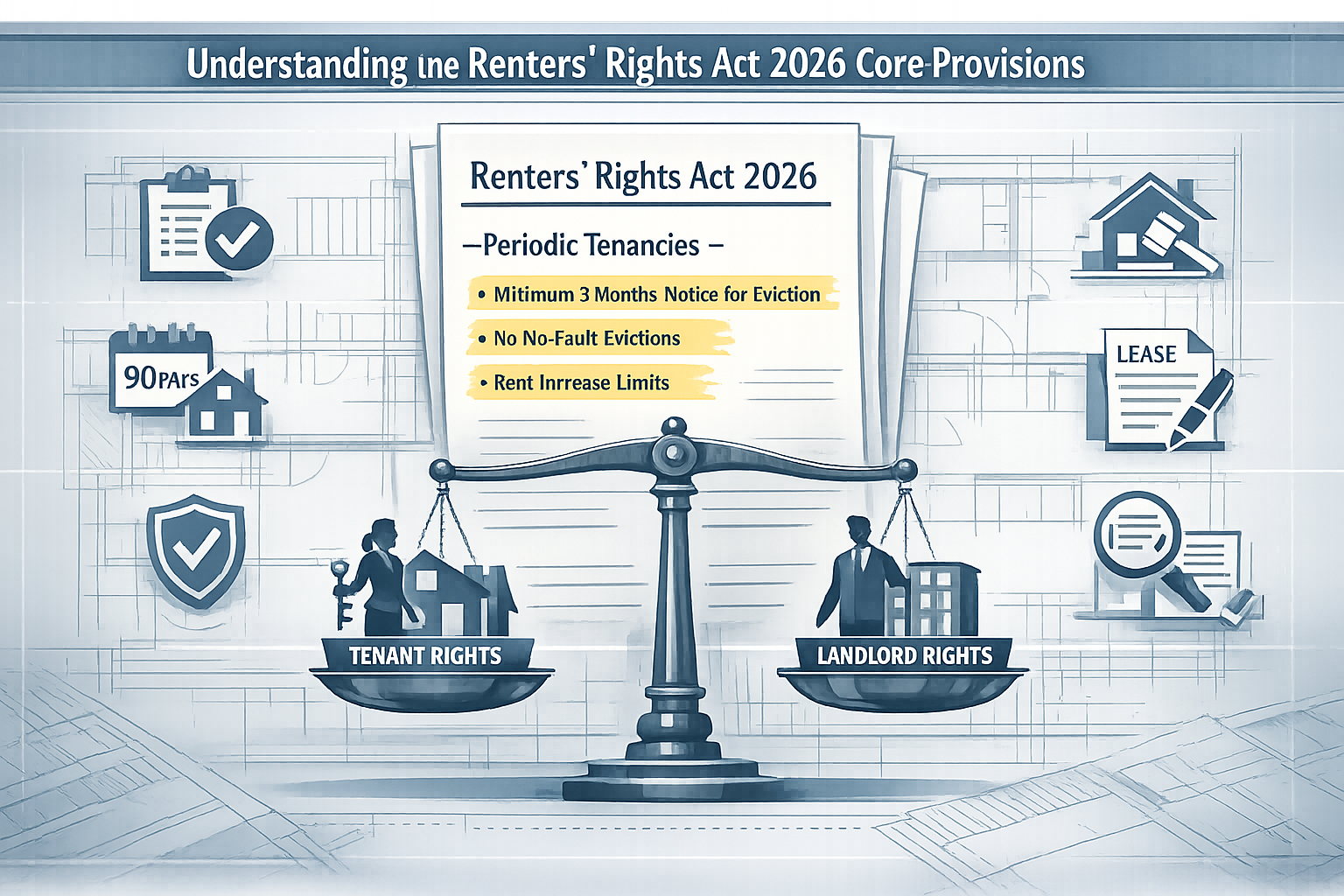
The most fundamental change under the RRA is the complete elimination of fixed-term assured shorthold tenancies. From May 1, 2026, all existing ASTs—regardless of when they were created—will automatically convert to assured periodic tenancies (APTs) [1]. This isn't a gradual transition; it's a simultaneous transformation affecting millions of tenancy agreements across England.
For property valuations, this change removes a critical element of income security. Fixed-term tenancies provided landlords with:
✅ Guaranteed rental income for the term duration
✅ Predictable vacancy scheduling aligned with lease expiry
✅ Rent review certainty at predetermined intervals
✅ Reduced tenant turnover costs during the fixed period
Under the new periodic tenancy regime, these certainties evaporate. Tenants can now serve two months' notice at any time, to expire at the end of a rental period [1]. This flexibility fundamentally increases tenant mobility and creates perpetual vacancy risk that must be reflected in valuation calculations.
Section 21 Abolition and Possession Challenges
The removal of Section 21 "no-fault" evictions represents perhaps the most contentious element of the RRA. Landlords must now rely exclusively on Section 8 grounds for possession, which require demonstrating specific circumstances such as:
- Rent arrears (mandatory and discretionary grounds)
- Anti-social behavior
- Property damage
- Landlord intention to sell or occupy
- Breach of tenancy terms
Each ground carries different evidential requirements and court processes. The shift from no-fault to fault-based evictions introduces litigation risk, extended possession timelines, and increased legal costs—all of which impact property valuations. When conducting building surveys and valuations, surveyors must now factor in the reduced liquidity and control that characterizes post-RRA PRS investments.
Section 13 Rent Increase Mandates
Under the RRA, landlords can only increase rent using the Section 13 statutory process [1]. This eliminates contractual rent review clauses and subjects all rent increases to:
- Minimum notice periods (typically one month before the increase takes effect)
- Tenant challenge rights to the First-tier Tribunal
- Market rent determinations by the Tribunal if challenged
- Annual frequency limitations on rent increases
This procedural framework introduces friction and uncertainty into rental growth projections. Surveyors must adjust rental growth assumptions to account for:
- Potential tenant challenges delaying increases
- Tribunal determinations that may set rents below landlord expectations
- Administrative costs associated with the Section 13 process
- Increased tenant turnover if rent increases trigger notice periods
Renters' Rights Act 2026 and Valuation Impact: Quantifying the Regulatory Effect
Yield Compression and Capital Value Adjustments
The regulatory changes introduced by the RRA create multiple downward pressures on PRS property values. Surveyors conducting Renters' Rights Act 2026 and Valuation Impact: Assessing Periodic Tenancies, Rent Controls, and Landlord Compliance for PRS Valuations must quantify these effects through systematic adjustments to both income and yield assumptions.
Income adjustments should reflect:
| Risk Factor | Typical Adjustment Range | Rationale |
|---|---|---|
| Increased void periods | 1-3% of gross rental income | Higher tenant mobility under periodic tenancies |
| Rent increase friction | 0.5-1.5% annual rental growth reduction | Section 13 procedural constraints and challenge risk |
| Compliance costs | £200-£500 per unit annually | Enhanced tenant rights, pet provisions, advertising rules |
| Legal and possession costs | 0.5-1% of gross rental income | Section 8 litigation replacing Section 21 |
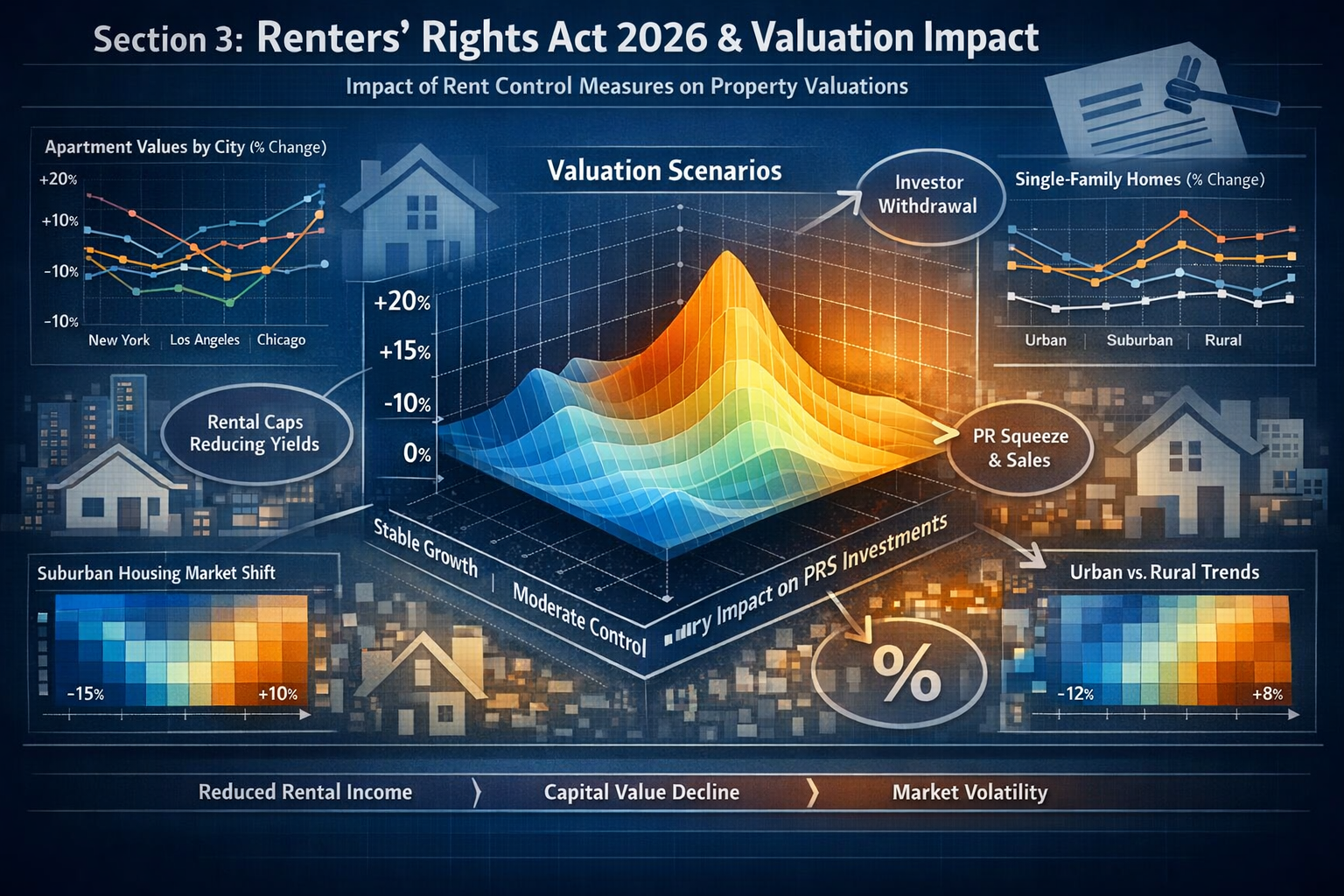
Yield adjustments typically range from 25 to 75 basis points depending on property type, location, and tenant profile. Higher-turnover properties (student accommodation, short-term professional lets) face greater yield expansion than stable family housing with long-term tenants.
For example, a property previously valued at £400,000 with a 5.0% net yield might now require adjustment to 5.5% net yield, reducing capital value to approximately £364,000—a 9% reduction solely attributable to regulatory risk repricing.
Periodic Tenancy Risk Premium
The conversion to periodic tenancies introduces a liquidity and control discount that must be reflected in valuations. Unlike fixed-term tenancies that provide predictable income streams, periodic tenancies create perpetual uncertainty about tenant retention.
Surveyors should consider:
Tenant profile analysis 📊
- Professional couples and families: Lower turnover risk (adjustment 0-25 bps)
- Young professionals and sharers: Moderate risk (adjustment 25-50 bps)
- Student and short-term tenants: High risk (adjustment 50-75 bps)
Property characteristics
- High-demand locations with strong rental markets justify smaller adjustments
- Properties in marginal areas with longer void periods require larger discounts
- Purpose-built rental developments with professional management may command premium valuations
The periodic tenancy risk premium should be additive to baseline investment yields, not a replacement for fundamental property risk assessment. When preparing homebuyers reports or building surveys, surveyors must clearly articulate how regulatory changes affect both current use value and investment value.
Landlord Compliance Costs and NOI Impact
The RRA introduces multiple compliance requirements that directly reduce net operating income:
🏠 Pet accommodation provisions: Tenants have an implied right to keep pets unless landlords demonstrate reasonable objections [1]. This increases wear-and-tear costs, insurance premiums, and potential damage liabilities.
📢 Advertising regulations: New rules govern property advertising, requiring additional compliance procedures and potential third-party verification costs [1].
🚫 Discrimination prohibitions: Anti-discrimination rules protect tenant access but create legal risk for landlords who must document legitimate reasons for tenant selection decisions [1].
🔄 Enhanced maintenance obligations: Periodic tenancies increase the frequency of tenant turnover, multiplying inspection, cleaning, and refurbishment costs.
Collectively, these compliance costs can reduce NOI by 2-4%, depending on property type and management efficiency. Professional landlords with economies of scale may absorb these costs more effectively than individual buy-to-let investors, creating valuation differentials based on likely purchaser profile.
Practical Valuation Adjustment Techniques for PRS Properties
Comparative Method Adjustments
When using the comparative method for Renters' Rights Act 2026 and Valuation Impact: Assessing Periodic Tenancies, Rent Controls, and Landlord Compliance for PRS Valuations, surveyors must distinguish between pre-RRA and post-RRA transactions.
Step 1: Identify comparable transaction dates
Transactions completed before May 1, 2026, reflect pre-RRA market conditions and require adjustment. Post-implementation comparables already incorporate regulatory changes.
Step 2: Apply temporal adjustment factors
For pre-RRA comparables, apply a regulatory adjustment factor of 5-12% depending on property characteristics:
- 5-7% adjustment: High-demand areas, family housing, stable tenant demographics
- 7-10% adjustment: Moderate markets, mixed tenant profiles, average turnover
- 10-12% adjustment: High-turnover properties, marginal locations, student/short-term lets
Step 3: Verify adjustment through yield analysis
Cross-reference comparative adjustments against investment method calculations to ensure consistency. The regulatory discount should produce similar value conclusions across multiple methodologies.
Investment Method Refinements
The investment method requires the most sophisticated adjustments for post-RRA valuations. Surveyors should:
Recalibrate rental growth assumptions 📈
Reduce long-term rental growth projections by 0.5-1.0% annually to reflect Section 13 friction and tenant challenge risks. In markets with historically aggressive rent increases, larger adjustments may be warranted.
Increase void allowances
Raise void assumptions from typical 4-6 weeks annually to 6-10 weeks to account for increased tenant mobility under periodic tenancies.
Adjust management fees
Increase management cost assumptions by 0.5-1.0% of gross rental income to reflect enhanced compliance requirements, documentation obligations, and legal risk management.
Apply regulatory risk yield premium
Add 25-75 basis points to comparable investment yields to reflect reduced landlord control, possession uncertainty, and compliance complexity.
Discount for lack of fixed-term premium
Properties previously commanding premium valuations due to long fixed-term tenancies in place should be revalued at periodic tenancy rates, eliminating any fixed-term premium.
Residual Method Considerations for Development Valuations
For development sites with PRS end-use, the RRA impacts residual land valuations through reduced Gross Development Value (GDV) assumptions. Developers and their surveyors must:
✔️ Reduce projected sale prices for completed PRS units by 5-12% to reflect investor appetite for post-RRA regulatory environment
✔️ Increase contingency allowances for regulatory compliance during construction and initial letting phases
✔️ Adjust developer's profit margins to reflect increased holding risk if initial letting proves slower than anticipated
✔️ Consider alternative use classes where planning flexibility exists, as other sectors may offer superior risk-adjusted returns
The residual method's sensitivity to GDV assumptions means that even modest RRA-related adjustments can significantly impact land values and development viability. When assessing development sites, surveyors should conduct sensitivity analysis showing value ranges under different regulatory impact scenarios.
Landlord Compliance Requirements and Valuation Implications
The Dual Compliance Challenge: RRA and Making Tax Digital
Landlords face a compressed compliance timeline in 2026. Making Tax Digital for Landlords rolls out from April 6, 2026 [1], just 25 days before the RRA implementation on May 1. This dual regulatory burden creates:
- System implementation costs for digital record-keeping and quarterly reporting
- Professional fees for accountants and tax advisors
- Time costs for landlords managing compliance personally
- Penalty risks during the transition period as systems bed in
Surveyors should incorporate these transitional costs into short-term cash flow projections, typically adding £500-£1,500 per property for 2026 compliance setup, with ongoing annual costs of £200-£400 for digital tax compliance.
Possession Ground Compliance and Legal Risk
The shift to Section 8-only possession grounds creates asymmetric legal risk for landlords. While tenants retain the right to exit with two months' notice, landlords face:
⚖️ Extended possession timelines: Court backlogs and procedural requirements can extend possession processes to 6-12 months
⚖️ Evidential burdens: Demonstrating grounds requires documentation, witness statements, and potentially expert evidence
⚖️ Cost exposure: Legal fees for contested possession cases typically range from £2,000-£10,000
⚖️ Reputational risk: Possession proceedings may impact landlord licensing and registration status
These factors create a possession risk premium that should be reflected in valuations through either increased yield requirements or explicit deductions from capital value. Properties with existing problematic tenancies or histories of possession proceedings warrant particular scrutiny and adjustment.
Enhanced Tenant Rights and Property Condition Standards
The RRA's enhanced tenant protections indirectly raise property condition expectations. While not explicitly creating new minimum standards, the combination of:
- Reduced landlord possession rights
- Increased tenant security
- Pet accommodation provisions
- Anti-discrimination protections
Creates market pressure for landlords to maintain properties to higher standards to attract and retain quality tenants. Surveyors should assess whether subject properties meet these de facto elevated standards and adjust valuations accordingly.
Properties requiring significant upgrading to meet market expectations should be valued using a cost-to-cure adjustment, deducting estimated improvement costs from comparable values. This approach aligns with building inspection best practices and ensures valuations reflect true market positioning.
Regional Variations and Market-Specific Adjustments
High-Demand vs. Marginal Markets
The RRA's valuation impact varies significantly by location. High-demand markets with structural housing shortages (London, South East, university cities) demonstrate greater resilience to regulatory changes because:
- Strong tenant demand reduces void risk despite increased mobility
- Rental growth pressure persists even with Section 13 constraints
- Landlords can maintain selectivity in tenant placement
- Capital value support from alternative use demand (owner-occupation)
Conversely, marginal markets with weak fundamentals face compounded challenges:
- Pre-existing void risk exacerbated by periodic tenancy flexibility
- Limited rental growth potential further constrained by Section 13 procedures
- Reduced investor demand as risk-return profiles deteriorate
- Potential market exit by marginal landlords, increasing supply
Surveyors must calibrate RRA adjustments to local market dynamics, potentially applying minimal adjustments in prime London locations while making substantial reductions in declining post-industrial areas.
Property Type Considerations
Different PRS property types experience varying RRA impacts:
Houses in Multiple Occupation (HMOs) 🏘️
Higher regulatory burden due to multiple tenancies, increased turnover risk, and complex compliance requirements. Yield adjustments typically 50-75 basis points.
Purpose-Built Student Accommodation (PBSA)
Moderate impact as sector already operates on periodic/academic year basis. Primary concern is Section 13 rent increase friction. Yield adjustments 25-40 basis points.
Family Houses
Lower impact due to stable tenant demographics and longer average tenancy durations. Yield adjustments 25-40 basis points.
Flats and Apartments
Moderate impact varying by location and tenant profile. Yield adjustments 40-60 basis points.
Luxury/Premium Properties
Lower impact as affluent tenants typically demonstrate greater stability. However, Section 13 constraints on premium rent growth may be significant. Yield adjustments 25-50 basis points.
Future-Proofing Valuations: Anticipating Further Regulatory Change
The Trajectory of PRS Regulation
The RRA represents a significant regulatory tightening, but surveyors should anticipate further changes. Political momentum toward enhanced tenant protections suggests potential future developments:
- Rent control mechanisms beyond Section 13 procedures
- Minimum energy efficiency standards (EPC C by 2028 already proposed)
- Licensing expansion to all PRS properties, not just HMOs
- Deposit alternatives and rent guarantee schemes
- Tenant right to buy provisions for long-term tenancies
When conducting valuations with extended time horizons (investment analysis, development appraisals), surveyors should incorporate regulatory risk scenarios that model potential future changes. This approach provides clients with realistic risk-adjusted value ranges rather than point estimates that may quickly become obsolete.
Building Regulatory Resilience into Valuation Advice
Professional surveyors can add value by providing forward-looking regulatory analysis alongside traditional valuation outputs. This includes:
📋 Compliance audits identifying current and anticipated regulatory gaps
📋 Improvement prioritization recommending investments that enhance both value and regulatory compliance
📋 Portfolio optimization advising on property disposals where regulatory risk outweighs return potential
📋 Alternative use analysis evaluating conversion to owner-occupation, commercial use, or alternative residential models
This comprehensive approach positions surveyors as strategic advisors rather than mere valuation technicians, particularly valuable for institutional investors and professional landlords managing substantial PRS portfolios.
Conclusion
The Renters' Rights Act 2026 fundamentally reshapes the Private Rented Sector's investment landscape, requiring surveyors to adopt sophisticated new approaches to Renters' Rights Act 2026 and Valuation Impact: Assessing Periodic Tenancies, Rent Controls, and Landlord Compliance for PRS Valuations. The simultaneous conversion of all tenancies to periodic arrangements, elimination of Section 21 evictions, and mandatory Section 13 rent procedures create multiple downward pressures on property values that must be systematically quantified and reflected in valuation outputs.
Immediate action steps for surveyors:
- Review and update valuation templates to incorporate RRA-specific adjustment factors for income, yields, and compliance costs
- Develop market-specific adjustment matrices reflecting regional variations in regulatory impact
- Enhance client communication to explain regulatory changes and their valuation implications clearly
- Build expertise in Section 8 possession grounds and Section 13 rent review procedures to provide informed advice
- Monitor early post-implementation market data to refine adjustment factors as actual impacts become evident
- Consider additional professional development in regulatory compliance to offer comprehensive advisory services
For property investors, landlords, and developers, obtaining professional valuations from qualified surveyors who understand these regulatory complexities is now essential. The RRA creates a clear dividing line between pre- and post-implementation market conditions, making historical valuation approaches increasingly obsolete.
Whether you're acquiring PRS properties, refinancing existing portfolios, or developing new rental housing, ensure your surveyor explicitly addresses RRA impacts in their valuation methodology. Get a professional valuation quote from surveyors who understand the full implications of the Renters' Rights Act 2026 for property values.
The PRS market will adapt to these new regulatory realities, but the transition period creates both risks and opportunities. Surveyors who master the technical challenges of post-RRA valuations will provide essential guidance to clients navigating this transformed landscape, ensuring investment decisions rest on accurate, regulation-adjusted property values that reflect the true risk-return profile of modern PRS investments.
References
[1] Landlords 2026 – https://theindependentlandlord.com/landlords-2026/