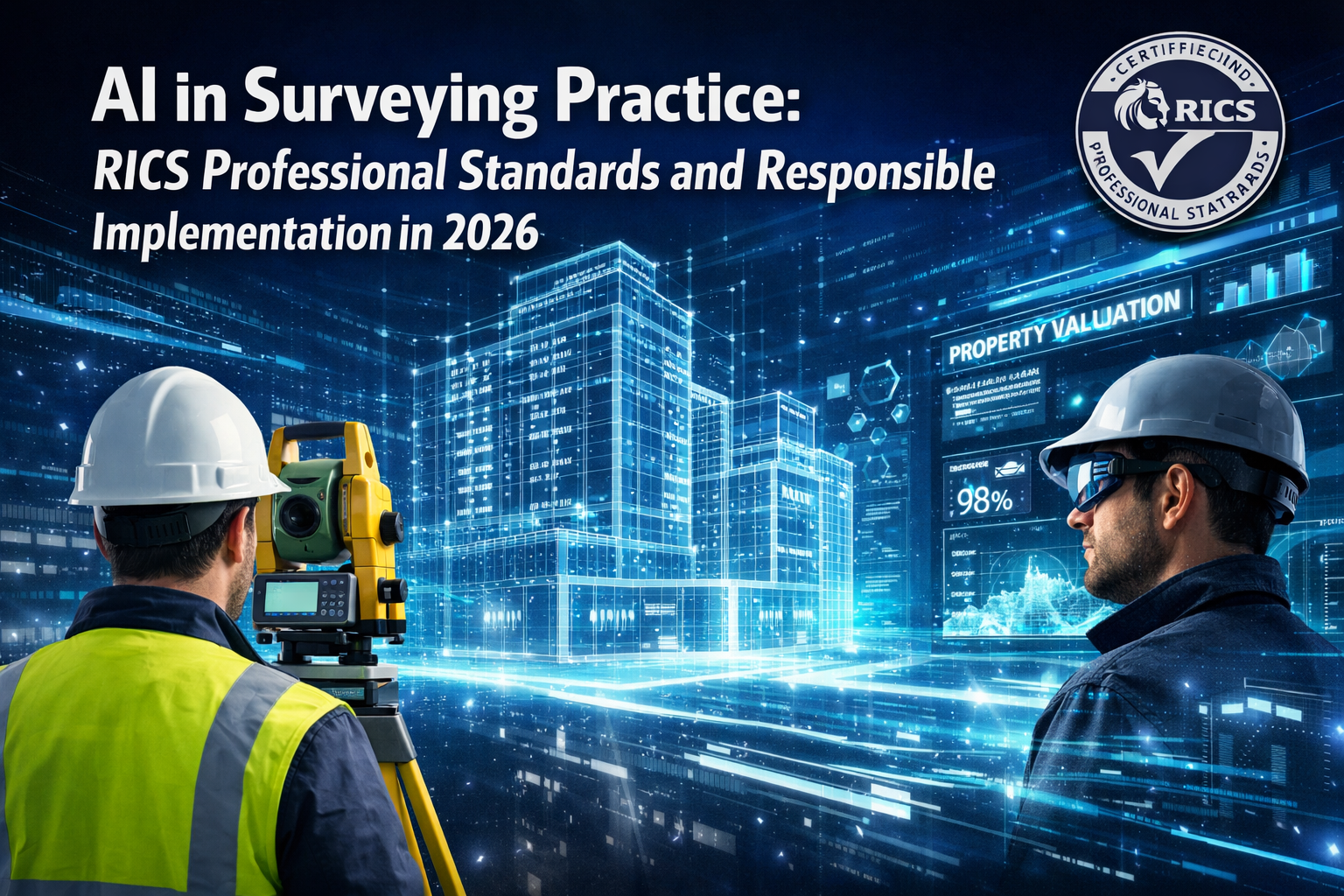
As of March 9, 2026, every RICS-regulated surveyor and firm worldwide operates under mandatory compliance with the first comprehensive global standard governing artificial intelligence use in professional practice. This regulatory watershed moment transforms how surveyors integrate AI tools—from property defect identification systems to automated valuation models—while maintaining the professional judgment and ethical accountability that define trusted surveying services.
The new AI in Surveying Practice: RICS Professional Standards and Responsible Implementation in 2026 framework establishes clear boundaries between technological enhancement and professional responsibility. For surveyors leveraging advanced tools like GeoConnect for early property insights or AI-powered thermal imaging analysis, understanding these requirements isn't optional—it's a fundamental aspect of lawful practice.
Key Takeaways
- 🔒 Mandatory compliance for all RICS members and regulated firms worldwide since March 9, 2026, with written risk registers required for AI systems materially impacting service delivery
- 📋 Pre-engagement disclosure to clients is compulsory—surveyors must inform clients in writing when, how, and why AI will be used before commencing work
- ⚖️ Human accountability remains absolute—professional surveyors cannot delegate responsibility to AI systems and must document reliability assessments for all AI-generated outputs
- 🎯 Material impact assessment determines applicability—only AI outputs capable of influencing service delivery fall under the standard's requirements
- 📊 Written policies and governance frameworks must be established before deploying AI tools, covering both internally developed and third-party systems
Understanding the RICS AI Standard: Scope and Applicability
What Constitutes Material Impact in AI-Assisted Surveying?
The cornerstone of AI in Surveying Practice: RICS Professional Standards and Responsible Implementation in 2026 lies in determining material impact. Not every AI application requires full compliance documentation—the standard specifically targets AI outputs that can influence service delivery outcomes.[1]
Material impact examples include:
✅ AI-generated document summarization for RICS building surveys
✅ Automated building fault identification and classification
✅ AI-assisted opinion composition in valuation reports
✅ Predictive maintenance recommendations based on property data
✅ Automated risk assessment for structural integrity
Non-material applications typically include:
❌ Basic scheduling and calendar management
❌ Simple data entry automation
❌ Email filtering and organization
❌ Standard word processing assistance
RICS members must determine materiality in writing and maintain this assessment as part of their compliance documentation.[1] This written determination forms the foundation of the governance framework and protects both practitioners and clients.
Global Compliance Requirements and Jurisdictional Considerations
The standard applies universally to RICS members and regulated firms, regardless of geographic location.[1] However, a critical provision addresses potential conflicts between the RICS standard and local legislation.
When local laws conflict with RICS requirements, local legislation takes precedence. Firms must:
- Document the specific conflict in writing
- Report the conflict to RICS formally
- Maintain records of how local law was prioritized
- Continue compliance with all non-conflicting standard elements[3]
This protocol ensures regulatory compliance tracking while respecting sovereign legal frameworks. For surveyors operating across multiple jurisdictions—common in international property markets—this requires careful legal review and documentation systems.
The Five Pillars of AI in Surveying Practice: RICS Professional Standards and Responsible Implementation in 2026
Pillar 1: Mandatory AI Risk Registers
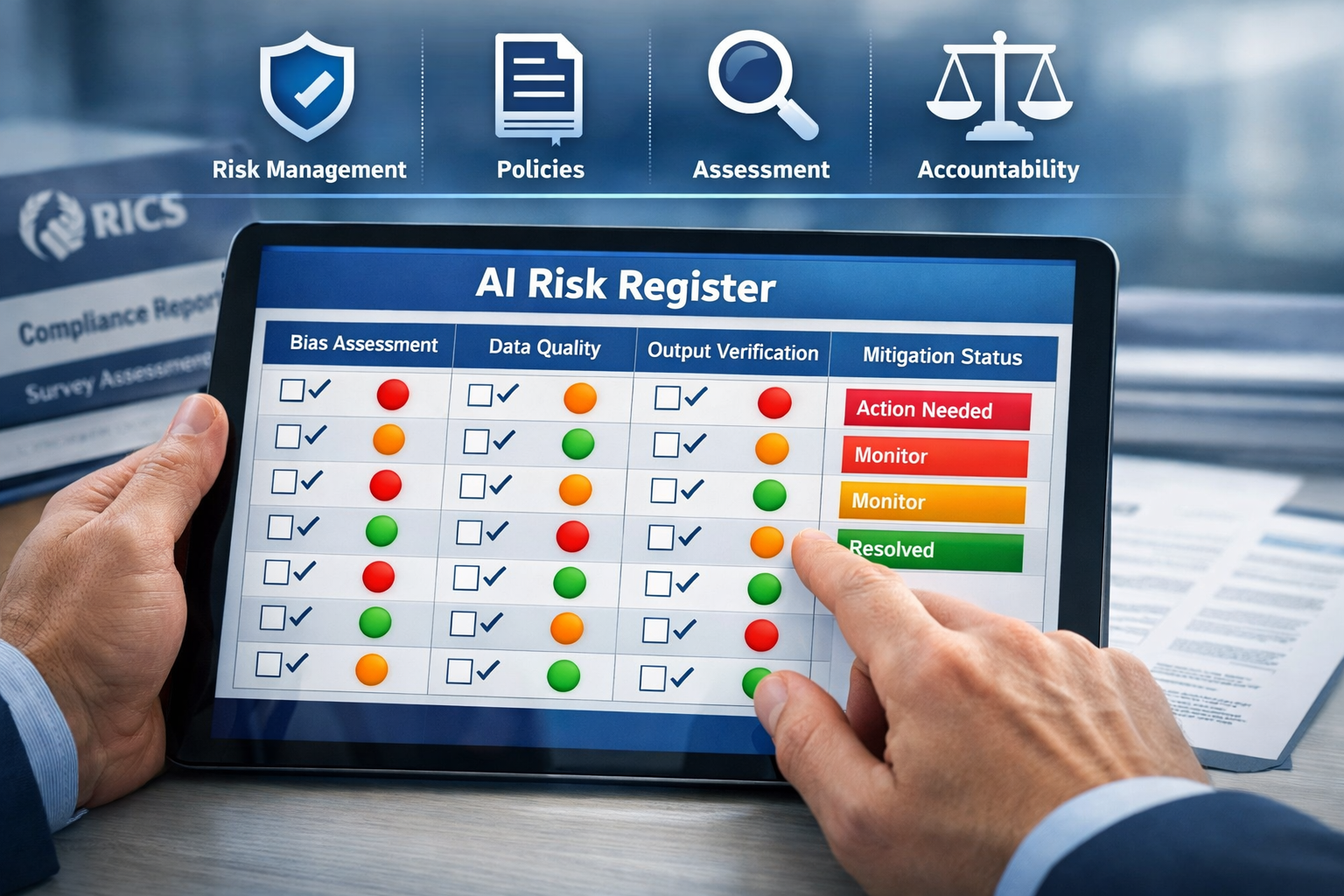
Every RICS-regulated firm using AI systems with material impact must maintain a written AI risk register.[3] This isn't a one-time exercise but an evolving document that captures:
Core Risk Categories:
| Risk Type | Description | Documentation Required |
|---|---|---|
| Inherent Bias | Systematic errors in training data or algorithms | Source data analysis, bias testing results |
| Erroneous Outputs | Incorrect conclusions or recommendations | Error rate tracking, validation protocols |
| Data Quality Issues | Incomplete, outdated, or inaccurate input data | Data provenance records, quality metrics |
| Security Vulnerabilities | Data breaches, unauthorized access risks | Security assessments, encryption protocols |
The risk register must include regular updates documenting risk mitigation efforts and their effectiveness.[3] For firms conducting homebuyers reports or building surveys, this means tracking how AI tools perform across different property types and conditions.
Pillar 2: Written Responsible Use Policies
Before deploying any AI system—whether internally developed or third-party—firms must establish written responsible use policies informed by their risk register.[3] These policies serve as operational guardrails for AI integration.
Essential policy components include:
- 📌 Clear definitions of acceptable AI applications
- 📌 Prohibited uses and red-line scenarios
- 📌 Output verification requirements before client delivery
- 📌 Training requirements for staff using AI tools
- 📌 Escalation procedures when AI produces uncertain results
- 📌 Data handling and privacy protection protocols
For surveyors using tools like GeoConnect for early property insights, policies should specify how AI-generated risk indicators are validated through traditional inspection methods. The policy framework ensures AI enhances rather than replaces professional expertise.
Pillar 3: Professional Judgment and Output Verification
Perhaps the most critical element of AI in Surveying Practice: RICS Professional Standards and Responsible Implementation in 2026 is the absolute requirement for professional judgment.[2] Surveyors must assess and document the reliability of AI outputs in writing before relying on them in service delivery.[3]
This encompasses:
🔍 Professional Scepticism – Applying knowledge, skills, and experience to critically evaluate AI recommendations
🔍 Independent Verification – Cross-checking AI outputs against traditional assessment methods
🔍 Written Reliability Assessments – Documenting why AI outputs are considered trustworthy for specific applications
🔍 Contextual Evaluation – Understanding AI limitations within specific property contexts
When conducting a specific defect survey, for example, AI might flag potential damp issues through image analysis. The surveyor must still physically inspect, test moisture levels, and apply professional judgment before confirming the diagnosis.
Human accountability remains non-delegable—surveyors are fully responsible for all outputs, even those generated through AI-assisted workflows.[4] This principle protects clients and maintains the profession's integrity.
Pillar 4: Client Disclosure and Transparency
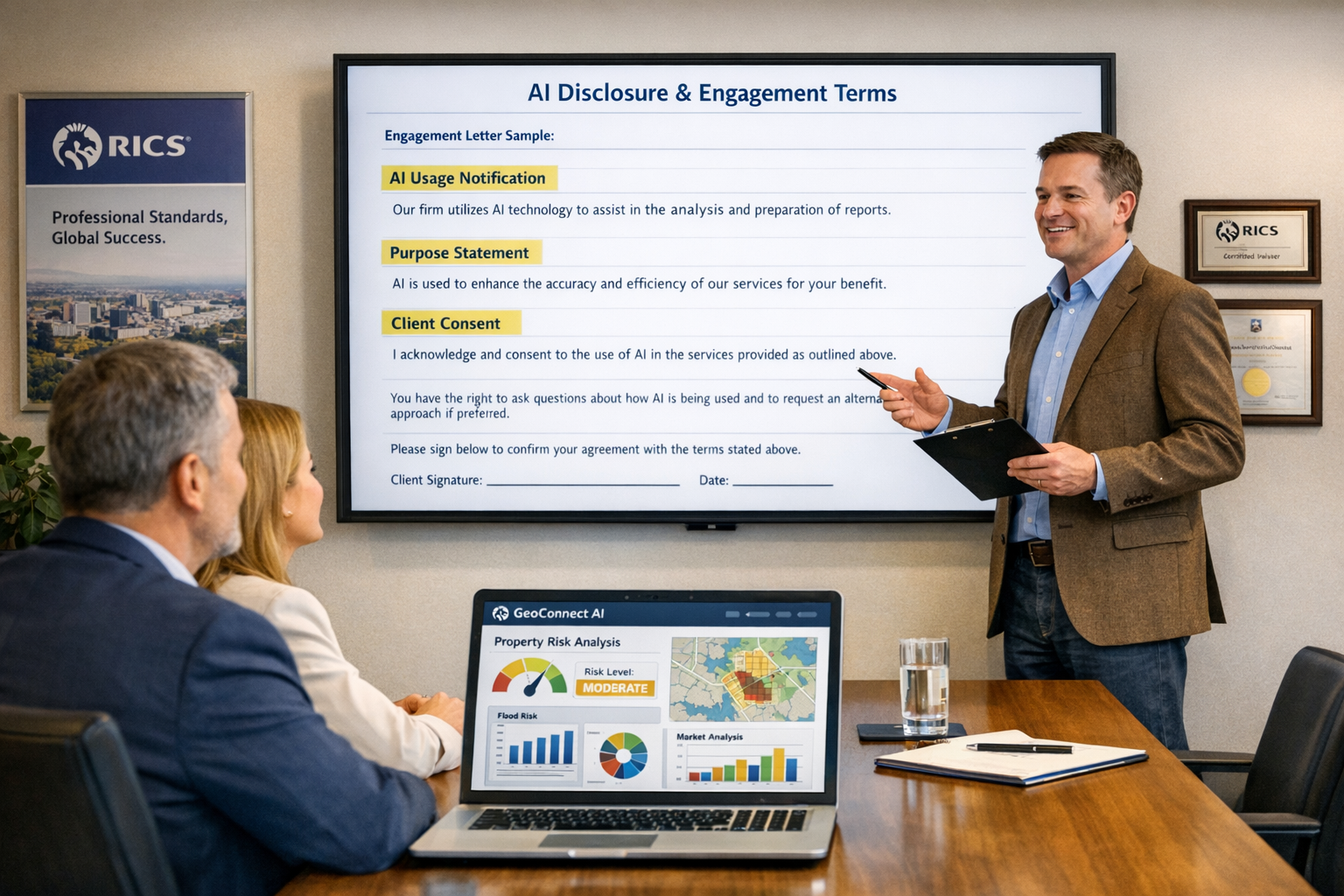
Transparency forms the ethical foundation of responsible AI implementation. RICS members and regulated firms must inform clients in writing and in advance when and for what purpose AI will be used in their surveying services.[3]
Disclosure requirements include:
✍️ Specific AI applications planned for the engagement
✍️ Purpose and expected benefits of AI use
✍️ Limitations and potential risks of AI tools
✍️ Human oversight and verification procedures
✍️ Client rights to request non-AI alternatives
These disclosures must appear in terms of engagement and service agreements before work commences.[3] For firms offering Level 2 vs Level 3 surveys, this means clearly stating which survey elements involve AI assistance and how professional judgment validates AI outputs.
Transparency builds trust and allows clients to make informed decisions about their property assessments. It also protects surveyors from liability claims related to undisclosed AI use.
Pillar 5: Governance, Procurement, and Due Diligence
The standard requires robust governance frameworks covering AI procurement and due diligence processes.[3] Firms must assess whether AI is the most appropriate tool by considering available alternatives and documenting this rationale.
Procurement considerations:
- 🛡️ Vendor security and data protection standards
- 🛡️ Algorithm transparency and explainability
- 🛡️ Training data quality and bias testing
- 🛡️ Ongoing support and system updates
- 🛡️ Compliance with data protection regulations (GDPR, etc.)
- 🛡️ Professional indemnity insurance implications
For surveyors evaluating AI-powered property analysis platforms, due diligence should examine how the system was trained, what data sources inform its recommendations, and how it performs across different property types and geographic regions.
Documentation of this assessment process demonstrates professional diligence and supports defensible decision-making if questions arise about tool selection.
Practical Implementation: AI Tools in Modern Surveying Practice
GeoConnect and Early Property Insights
Tools like GeoConnect exemplify how AI can enhance surveying practice while requiring careful professional oversight. These platforms aggregate property data, environmental risks, planning history, and neighborhood analytics to provide early insights before physical inspections.
Responsible GeoConnect implementation under RICS standards:
- Risk Register Entry – Document potential data accuracy issues, update frequency limitations, and geographic coverage gaps
- Policy Framework – Establish when GeoConnect insights inform preliminary assessments versus final recommendations
- Professional Verification – Cross-reference AI-generated risk indicators with on-site inspection findings
- Client Disclosure – Inform clients that preliminary property analysis uses AI-powered data aggregation
- Output Documentation – Record how GeoConnect insights were validated or contradicted by physical assessment
When conducting building surveys, GeoConnect might flag historical flooding risks or subsidence patterns in the area. The surveyor must verify these indicators through site-specific investigation, soil analysis, and structural assessment rather than accepting AI outputs uncritically.
AI-Powered Defect Identification Systems
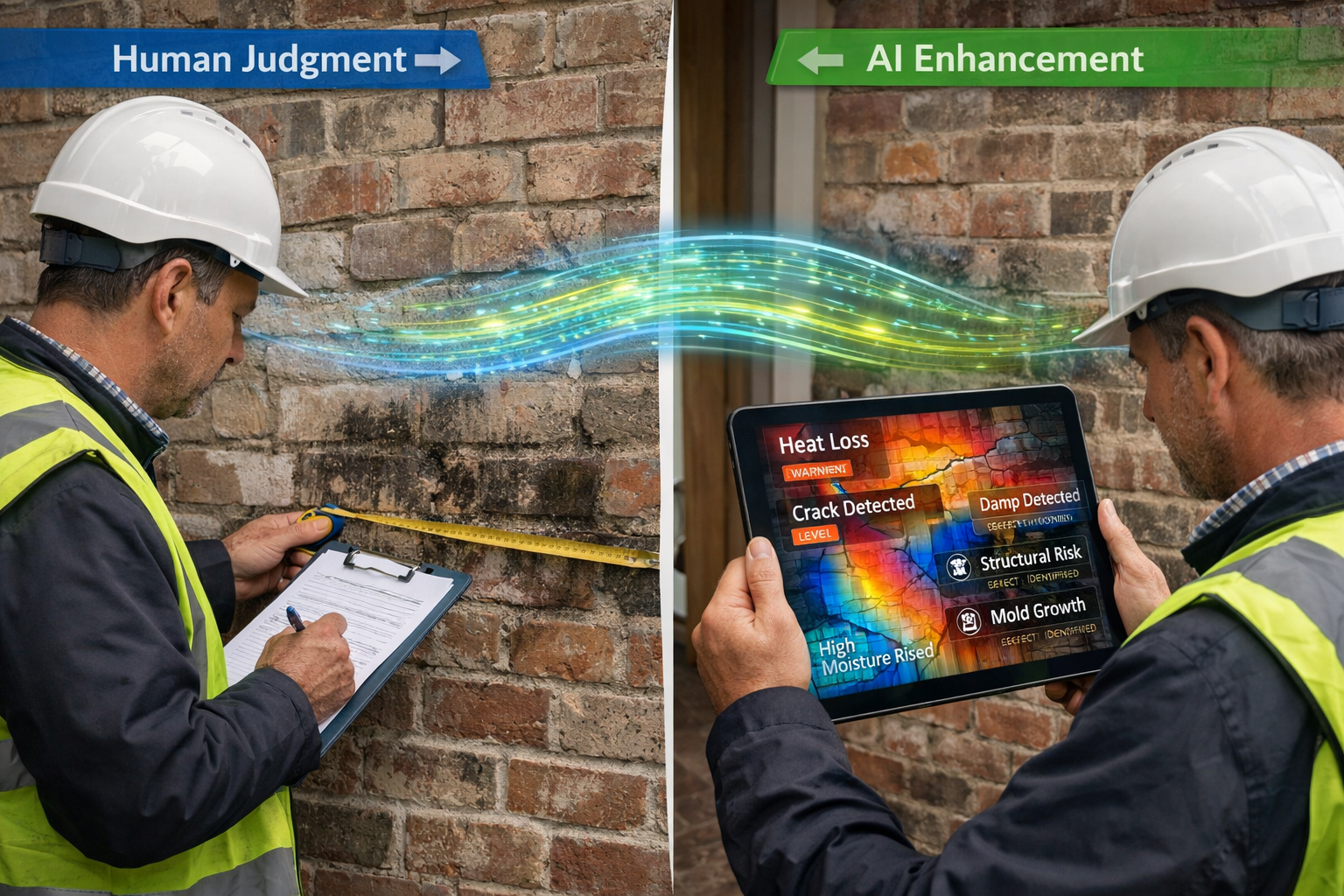
Thermal imaging cameras with AI-enhanced defect recognition can identify potential damp, insulation gaps, or structural anomalies. These systems analyze temperature patterns and flag areas requiring closer inspection.
Professional judgment application:
- ✔️ AI flags thermal anomaly suggesting possible damp penetration
- ✔️ Surveyor physically inspects the area, tests moisture levels with calibrated meters
- ✔️ Surveyor examines surrounding context (ventilation, drainage, building materials)
- ✔️ Professional determination considers AI input alongside traditional assessment
- ✔️ Final report documents both AI indication and professional verification
For clients seeking damp surveys in London, this approach combines technological efficiency with professional expertise, delivering comprehensive assessments that meet RICS standards.
Automated Valuation Models (AVMs) and Professional Oversight
AVMs use AI to estimate property values based on comparable sales, market trends, and property characteristics. While efficient for preliminary valuations, RICS standards require professional oversight before client reliance.
Compliance framework for AVM use:
📊 Document AVM algorithm methodology and data sources
📊 Establish accuracy thresholds for different property types
📊 Require professional review of all AVM outputs before client delivery
📊 Disclose AVM use in valuation reports and engagement letters
📊 Maintain records of AVM accuracy versus final professional valuations
When clients need formal Red Book valuations, AVMs might inform initial estimates, but professional surveyors must conduct comprehensive assessments incorporating market knowledge, property condition, and contextual factors that algorithms cannot fully capture.
Balancing Innovation with Accountability in 2026
The AI in Surveying Practice: RICS Professional Standards and Responsible Implementation in 2026 framework represents a deliberate balance between embracing technological advancement and preserving professional accountability.[4] RICS designed these standards to enable innovation while maintaining surveyors' core role as providers of trusted, independent, and ethical advice.
Benefits of Structured AI Integration
For Surveyors:
- 🚀 Enhanced efficiency in data gathering and preliminary analysis
- 🚀 Improved pattern recognition across large property portfolios
- 🚀 Reduced time on routine tasks, allowing focus on complex professional judgment
- 🚀 Competitive advantage through technology adoption with risk mitigation
For Clients:
- 🏆 Faster preliminary assessments and property insights
- 🏆 More comprehensive data integration in survey reports
- 🏆 Transparent understanding of how technology supports professional services
- 🏆 Maintained professional accountability and quality assurance
When clients are negotiating purchase prices after surveys, AI-enhanced defect identification can provide more detailed documentation to support negotiations while professional judgment ensures accurate severity assessment.
Common Implementation Challenges
Challenge 1: Resource Requirements for Small Firms
Developing comprehensive risk registers and policies requires time and expertise. Smaller surveying practices may find initial compliance demanding.
Solution: RICS provides guidance documents and templates. Firms can also collaborate through professional networks to share best practices and policy frameworks (while maintaining competitive differentiation).
Challenge 2: Rapidly Evolving AI Technology
AI tools advance quickly, potentially outpacing governance frameworks and risk assessments.
Solution: Build regular review cycles into policies (quarterly or semi-annually) to reassess AI tool performance, update risk registers, and adjust procedures as technology evolves.
Challenge 3: Client Understanding and Expectations
Clients may misunderstand AI capabilities, either over-trusting automated outputs or rejecting technology-enhanced services entirely.
Solution: Clear, jargon-free disclosure documentation explaining how AI enhances rather than replaces professional judgment. Emphasize human oversight and accountability in all client communications.
Training and Professional Development for AI Competency
Effective implementation of AI in Surveying Practice: RICS Professional Standards and Responsible Implementation in 2026 requires ongoing professional development. Surveyors need competency in:
Technical Understanding:
- How AI systems process data and generate recommendations
- Limitations of machine learning models in property assessment
- Data quality requirements for reliable AI outputs
- Bias recognition and mitigation strategies
Professional Application:
- Integrating AI outputs into traditional assessment workflows
- Documenting professional judgment in AI-assisted engagements
- Communicating AI use and limitations to clients effectively
- Maintaining professional scepticism toward automated recommendations
Governance and Compliance:
- Risk register development and maintenance
- Policy framework creation and implementation
- Client disclosure best practices
- Record-keeping requirements for regulatory compliance
RICS and other professional bodies offer continuing professional development (CPD) courses specifically addressing responsible AI implementation. Surveyors should prioritize these training opportunities to ensure competent, compliant practice.
Future Outlook: AI Evolution and Regulatory Adaptation
The 2026 standard represents the first comprehensive global regulatory framework for AI in surveying,[6] establishing baseline practice management aimed at minimizing harm and upskilling the profession. As AI technology continues advancing, regulatory frameworks will likely evolve.
Anticipated developments:
🔮 Enhanced AI Explainability – Next-generation AI systems may provide clearer reasoning for recommendations, facilitating professional verification
🔮 Industry-Specific Training Data – AI models trained specifically on surveying contexts may improve accuracy and reduce bias
🔮 Integrated Compliance Tools – Software solutions that embed RICS compliance documentation within AI workflows
🔮 International Regulatory Harmonization – Other professional bodies may adopt similar standards, creating global consistency
Surveyors who establish robust governance frameworks now position themselves advantageously for future regulatory developments. The principles of transparency, professional judgment, and client protection will remain central regardless of technological advancement.
Conclusion: Embracing Responsible AI Innovation in Surveying Practice
The mandatory AI in Surveying Practice: RICS Professional Standards and Responsible Implementation in 2026 framework transforms how surveyors integrate artificial intelligence into professional services. By requiring written risk registers, responsible use policies, professional judgment documentation, client disclosure, and governance frameworks, RICS ensures technology enhances rather than compromises the quality and integrity of surveying practice.
For surveyors leveraging tools like GeoConnect, AI-powered defect identification systems, or automated valuation models, compliance isn't merely regulatory box-ticking—it's a framework for delivering superior client service through responsible innovation. The standard protects clients, maintains professional accountability, and positions the surveying profession to confidently embrace technological advancement.
Actionable Next Steps for RICS Members and Firms
✅ Immediate Actions (If Not Already Completed):
- Conduct comprehensive audit of all AI tools currently in use
- Assess materiality of AI outputs on service delivery
- Develop written AI risk register documenting identified risks
- Create responsible use policies covering all AI applications
- Update client engagement letters and terms to include AI disclosure
- Train all staff on RICS AI standard requirements and firm policies
✅ Ongoing Compliance:
- Schedule quarterly risk register reviews and updates
- Document professional judgment assessments for all AI-assisted work
- Maintain detailed records of AI output verification procedures
- Monitor AI tool performance and accuracy over time
- Participate in CPD courses on AI competency and responsible implementation
- Review and update policies as AI technology and regulatory guidance evolve
✅ Strategic Development:
- Evaluate new AI tools through rigorous procurement due diligence
- Build competitive advantage through transparent, responsible AI integration
- Develop client communication materials explaining AI use benefits and safeguards
- Engage with industry peers to share best practices and implementation insights
- Monitor regulatory developments and prepare for future standard updates
The future of surveying practice lies in the intelligent integration of artificial intelligence with irreplaceable professional expertise. By following the RICS framework, surveyors can confidently leverage technology to deliver enhanced services while maintaining the trust, accountability, and ethical standards that define the profession.
Whether conducting building surveys, choosing the right property assessment, or providing specialized services, RICS surveyors in 2026 operate at the intersection of traditional expertise and technological innovation—guided by clear professional standards that protect clients and advance the profession.
References
[1] Ai Responsible Use Standard – https://ww3.rics.org/uk/en/journals/construction-journal/ai-responsible-use-standard.html
[2] Navigating The New Rics Ai Standard What It Means For Surveyors – https://www.artefact.com/blog/navigating-the-new-rics-ai-standard-what-it-means-for-surveyors/
[3] Responsible Use Of Artificial Intelligence In Surveying Practice September 2025 – https://www.rics.org/content/dam/ricsglobal/documents/standards/Responsible-use-of-artificial-intelligence-in-surveying-practice_September-2025.pdf
[4] Rics Releases First Global Standard For Responsible Use Of Ai In Surveying – https://www.gim-international.com/content/news/rics-releases-first-global-standard-for-responsible-use-of-ai-in-surveying
[6] Rics Professional Standard On Responsible Ai Use In Building Surveys Ethical Protocols For 2026 Practice – https://nottinghillsurveyors.com/blog/rics-professional-standard-on-responsible-ai-use-in-building-surveys-ethical-protocols-for-2026-practice