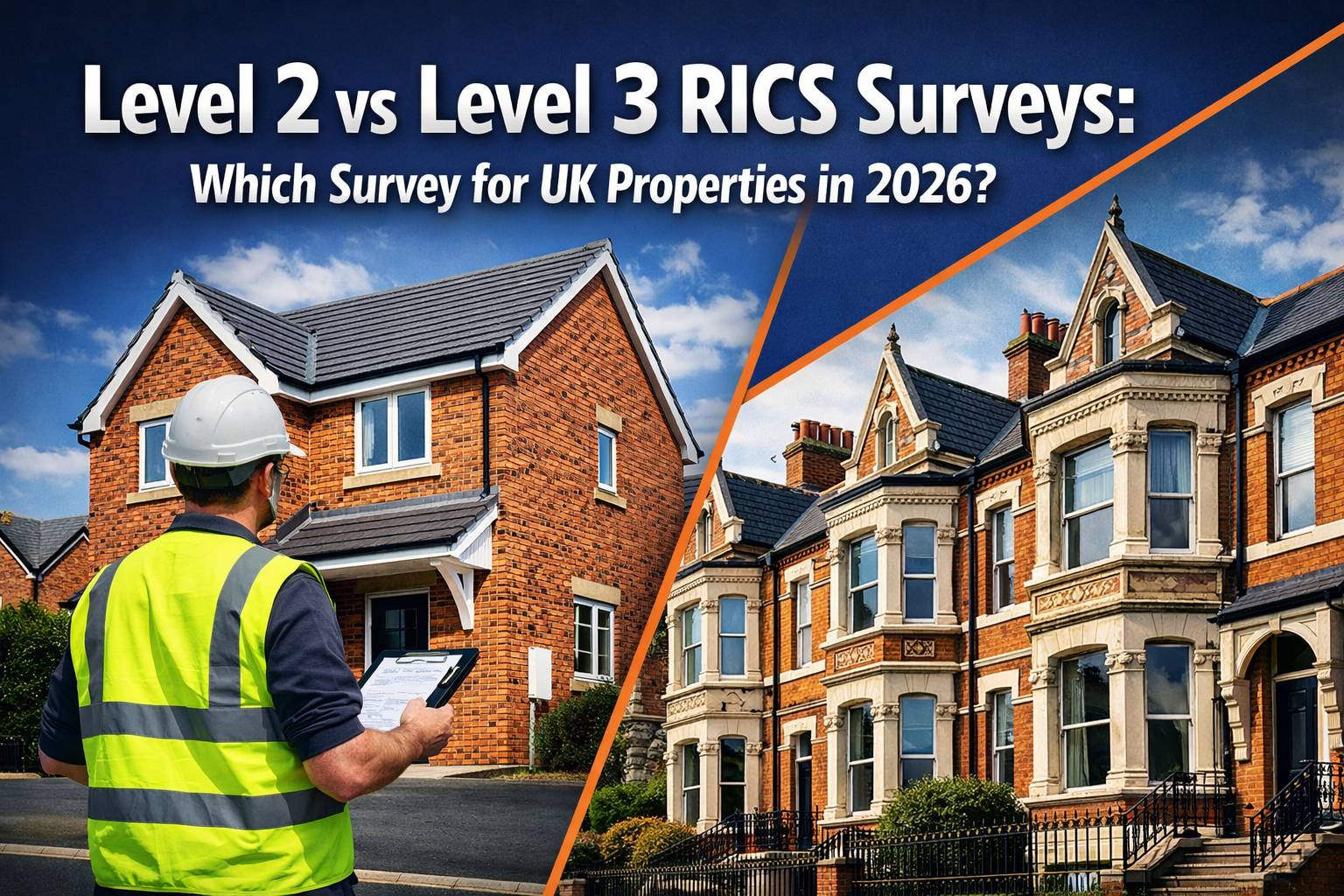
Nearly 40% of UK property buyers discover significant defects after purchase that could have been identified during a proper survey—a costly mistake that often runs into tens of thousands of pounds. The choice between a Level 2 and Level 3 RICS survey represents one of the most critical decisions in the property buying process, yet many buyers struggle to understand which option provides the best value for their specific circumstances.
Understanding Level 2 vs Level 3 RICS Surveys: Choosing the Right Option for UK Flats and Houses in 2026 requires careful consideration of property age, construction type, visible condition, and your renovation plans. This comprehensive guide breaks down the essential differences, costs, and benefits to help you make an informed decision that protects your investment.
Key Takeaways
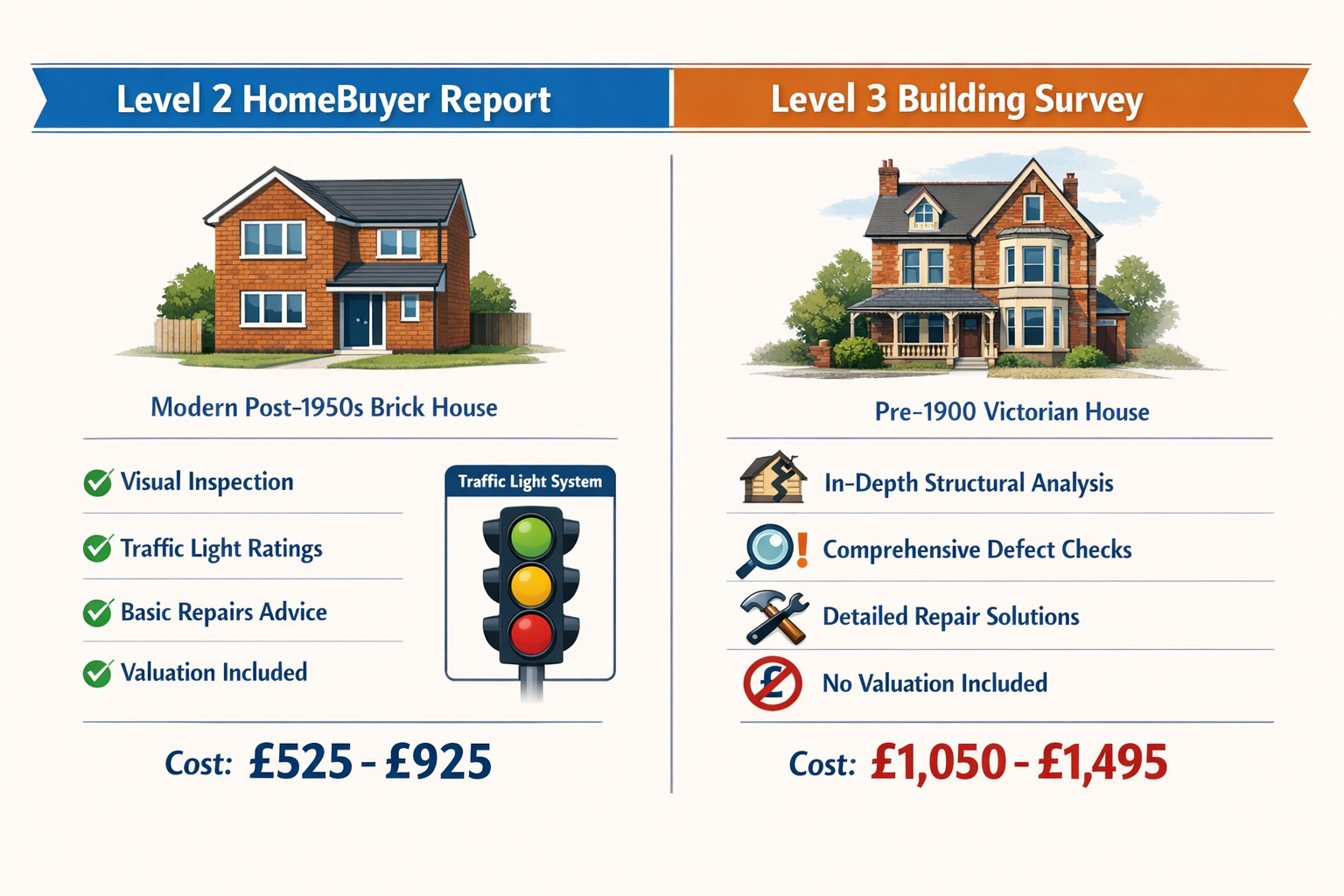
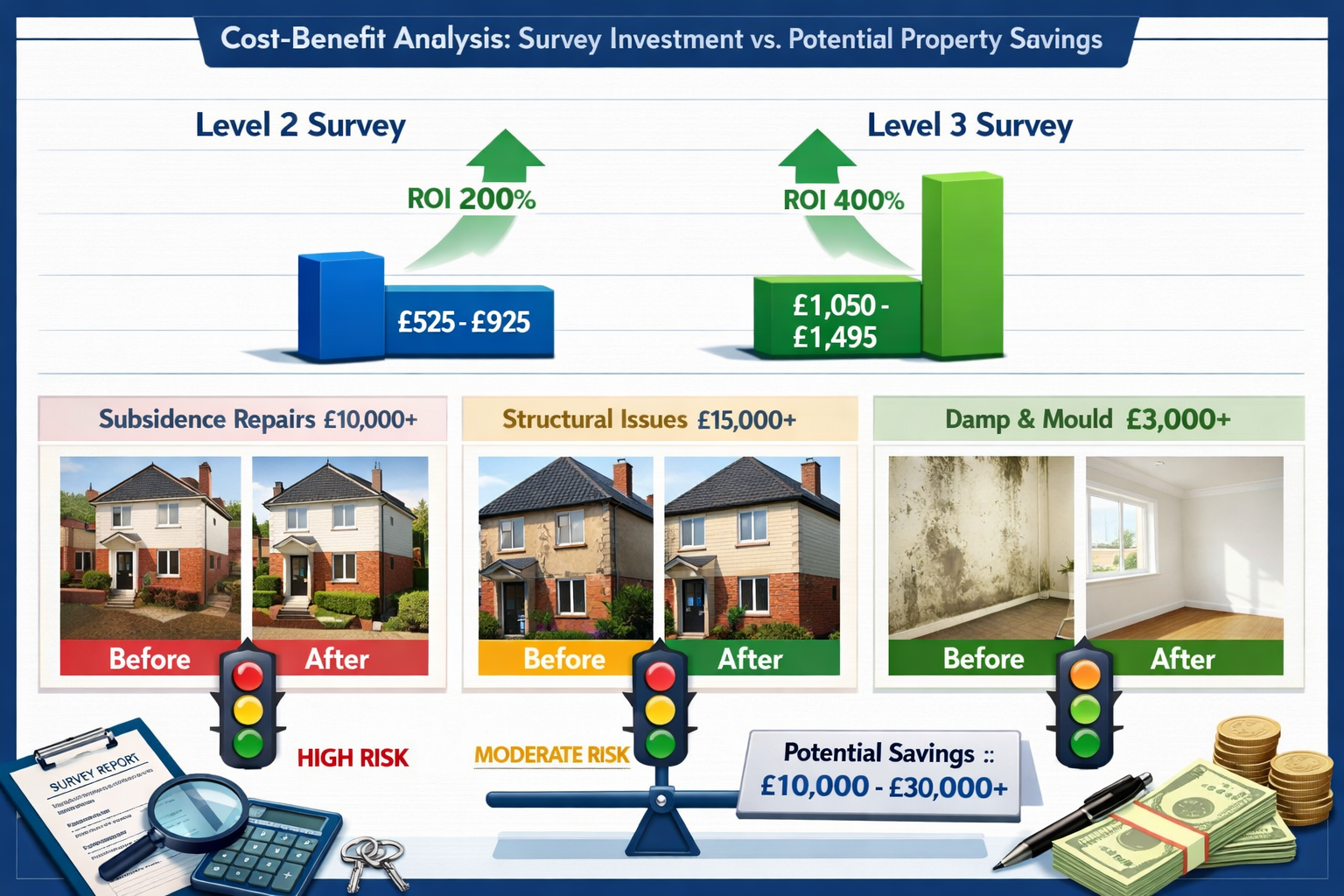
- Level 2 surveys cost £525-925 and suit modern properties built after 1950 in reasonable condition, while Level 3 surveys range from £1,050-1,495 and are essential for pre-1900 properties, listed buildings, or homes with structural concerns
- Level 2 provides traffic-light ratings for property elements, whereas Level 3 delivers detailed cause-and-effect analysis explaining why defects occur and their long-term implications
- Property age is the primary decision factor: post-1950s standard construction typically needs Level 2, while pre-1900 properties with traditional materials require Level 3's comprehensive approach
- Both surveys are non-invasive visual inspections that include roof space and drainage examination, but Level 3 offers significantly more detailed reporting and investigation recommendations
- Valuation add-ons are available for Level 2 surveys, providing market value and insurance reinstatement figures alongside the condition report
Understanding RICS Survey Levels: The Foundation of Property Assessment
The Royal Institution of Chartered Surveyors (RICS) standardized UK property surveys into three distinct levels in 2020, replacing the previous naming conventions with a clearer numerical system. This framework helps buyers match survey depth to property complexity and risk profile.
What Makes Level 2 the UK's Most Popular Survey Choice
Level 2 surveys, also known as RICS HomeBuyer Reports, represent the most requested survey option in the UK property market [1]. These surveys are specifically designed for conventional properties in reasonable condition, typically built after the 1950s using standard brick and tile construction methods.
The Level 2 survey provides:
✅ Visual inspection of all accessible areas inside and outside the property
✅ Roof space examination using head and shoulders access
✅ Drainage chamber inspection where safely accessible
✅ Traffic-light rating system (green, amber, red) for condition assessment
✅ Maintenance advice and future budgeting guidance
✅ Optional valuation including market value and insurance reinstatement costs [2]
This survey level strikes a balance between cost and comprehensiveness, making it ideal for properties that don't present obvious structural concerns. The traffic-light system provides immediate clarity: green indicates satisfactory condition, amber signals items needing attention, and red highlights urgent issues requiring immediate action [2].
For buyers considering a RICS HomeBuyer Survey, understanding what preparation is needed can enhance the survey's effectiveness. Learn more about what to do before an RICS home survey to ensure optimal results.
Level 3: The Most Comprehensive RICS Survey Available
Level 3 surveys, formerly called Building Surveys or Full Structural Surveys, represent the most detailed and thorough property inspection available through RICS-qualified surveyors [2]. These surveys go beyond identifying problems—they analyze root causes, predict future implications, and provide detailed remediation strategies.
Level 3 surveys are specifically recommended for:
🏛️ Older properties, particularly those built before 1900
🏗️ Properties with complex construction using traditional materials like timber frames, flint, or bungaroosh
📋 Listed buildings requiring specialist conservation knowledge
🔧 Extended or significantly altered properties with multiple construction phases
⚠️ Properties showing visible defects such as cracking, damp, or structural movement
🛠️ Homes requiring major renovation where comprehensive structural information is essential [1][2]
The key differentiator is analytical depth. While Level 2 identifies that cracks exist and rates their severity, Level 3 investigates why those cracks occurred—whether from subsidence, settlement, thermal movement, or structural inadequacy—and explains the likely progression if left untreated [1].
Level 2 vs Level 3 RICS Surveys: Choosing the Right Option for UK Flats and Houses in 2026—Key Decision Factors
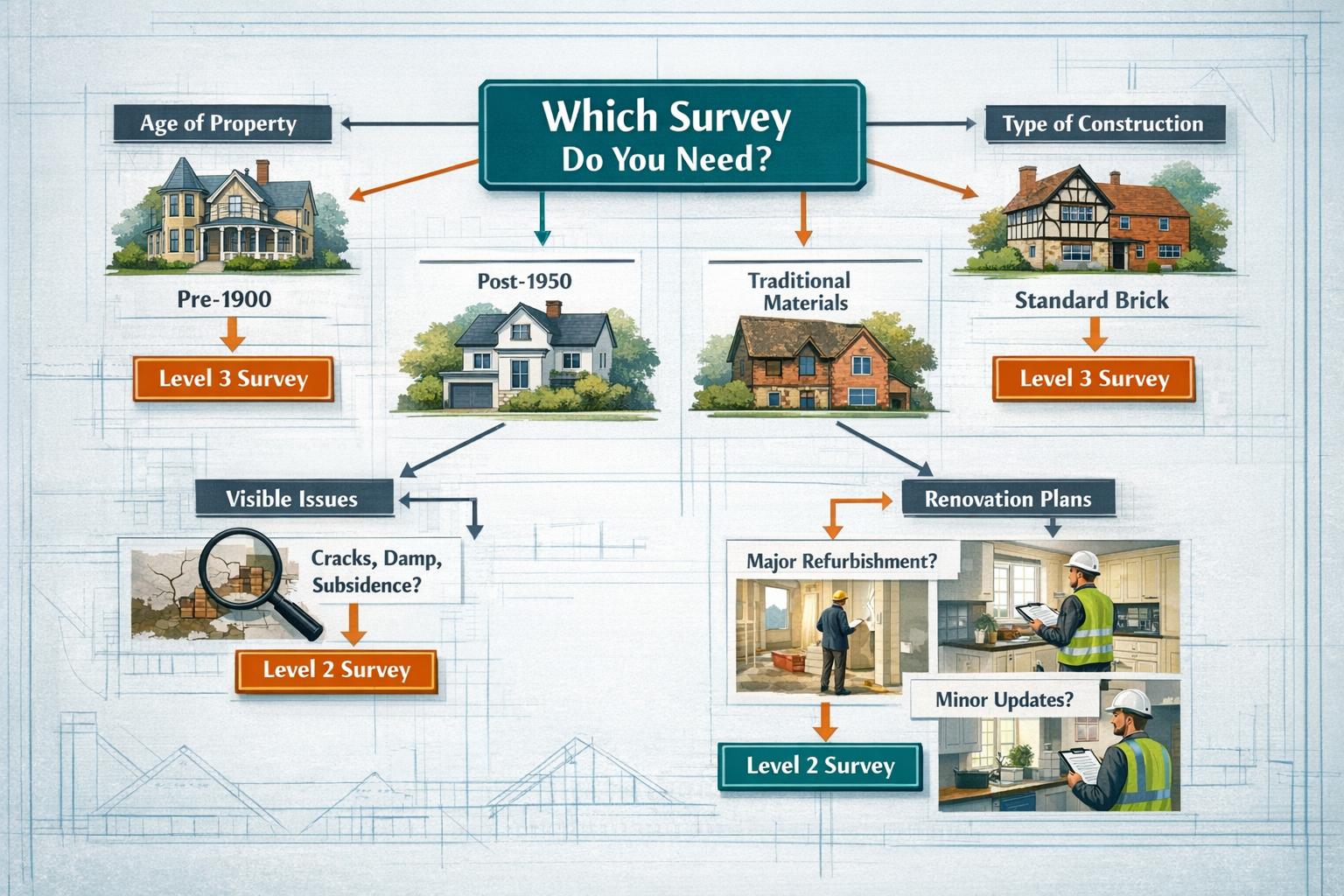
Selecting between these survey levels requires honest assessment of several critical property characteristics. Making the wrong choice can leave significant issues undiscovered or result in paying for unnecessary detail.
Property Age and Construction Methods
Property age remains the single most important factor in survey selection. The construction techniques, materials, and building regulations applicable when a property was built fundamentally determine the appropriate survey level.
Choose Level 2 for:
- Properties built from the mid-20th century onwards
- Standard brick and tile construction
- Homes showing no obvious structural movement
- Properties built to modern building regulations
- Conventional construction methods without unusual features [1]
Choose Level 3 for:
- Properties built before 1900
- Traditional construction using lime mortar, timber frames, or unusual materials
- Buildings constructed with flint, cob, or bungaroush (common in coastal areas like Brighton)
- Properties with thatched roofs or other specialist features
- Any building where construction methods are unclear or mixed [1]
The 1900 threshold isn't arbitrary—it reflects a fundamental shift in UK construction practices. Pre-1900 properties typically used lime-based mortars that allow buildings to "breathe" and move slightly with seasonal changes. Modern cement-based construction is more rigid and requires different assessment approaches [3].
Visible Condition and Known Defects
The property's apparent condition during viewing provides crucial guidance for survey selection. Even relatively modern properties may require Level 3 surveys if they show concerning signs.
Red flags that suggest upgrading to Level 3 include:
🚩 Visible cracking in walls, particularly diagonal cracks or stepped cracking in brickwork
🚩 Damp patches or staining on walls and ceilings
🚩 Uneven floors or doors that stick or won't close properly
🚩 External wall bulging or leaning
🚩 Previous underpinning or structural repair evidence
🚩 Significant extensions or alterations visible from outside [1]
These symptoms may indicate underlying structural issues that require the detailed investigation a Level 3 survey provides. The additional cost becomes insignificant compared to discovering £15,000+ of subsidence repairs after purchase.
Understanding what happens when surveys reveal problems is crucial—our guide on what to do after a bad building survey report provides actionable next steps.
Renovation Plans and Future Intentions
Your plans for the property significantly influence which survey level provides better value. Buyers planning major renovations should strongly consider Level 3 surveys, regardless of property age [2].
A Level 3 survey provides essential information for renovation planning:
- Structural load-bearing capacity for removing walls or adding extensions
- Foundation condition relevant to basement conversions or underpinning
- Roof structure integrity for loft conversions
- Detailed material condition affecting restoration approaches
- Hidden defects that might complicate renovation work
This comprehensive information enables accurate renovation budgeting and prevents costly surprises mid-project. The survey cost represents a fraction of typical renovation expenses but provides critical intelligence for planning.
For those considering specific defect investigations beyond standard surveys, specialized assessments can complement either survey level.
Cost-Benefit Analysis: Level 2 vs Level 3 RICS Surveys for UK Properties in 2026
Understanding the financial implications of each survey level requires looking beyond the initial fee to consider the value of information gained and potential savings from identifying issues early.
Level 2 Survey Costs and Value Proposition
As of 2026, Level 2 surveys typically cost between £525 and £925 for standard residential properties [4]. This price variation reflects several factors:
- Property size: Larger homes require more inspection time
- Location: London and Southeast England command premium rates
- Valuation inclusion: Survey-only versus survey-plus-valuation options
- Surveyor qualifications: RICS-registered professionals versus unqualified inspectors
- Report detail: Standard versus enhanced reporting formats
The survey-plus-valuation option adds approximately £100-150 to the base cost but provides significant additional value:
💷 Market valuation confirming the purchase price is reasonable
💷 Insurance reinstatement cost preventing under-insurance
💷 Negotiation leverage if valuation comes in below asking price [2]
For buyers of standard post-1950s properties in good condition, Level 2 surveys offer excellent value. The traffic-light system provides clear prioritization of issues, and the maintenance advice helps budget for future expenses.
Reviewing an example homebuyers report helps buyers understand what information to expect and how to interpret findings.
Level 3 Survey Costs and Return on Investment
Level 3 surveys range from £1,050 to £1,495 for typical residential properties in 2026, with complex or large properties potentially exceeding £2,000 [4]. This premium reflects the significantly greater time investment and analytical expertise required.
Consider the return on investment through potential savings:
| Defect Type | Typical Repair Cost | Survey Investment | ROI |
|---|---|---|---|
| Subsidence | £10,000-£50,000 | £1,200 | 733%-4,067% |
| Structural movement | £5,000-£25,000 | £1,200 | 317%-1,983% |
| Major damp issues | £3,000-£15,000 | £1,200 | 150%-1,150% |
| Roof structure failure | £8,000-£20,000 | £1,200 | 567%-1,567% |
These figures demonstrate that discovering just one major defect justifies the Level 3 investment many times over. Additionally, survey findings provide powerful negotiation leverage—buyers frequently renegotiate purchase prices downward by £5,000-£20,000 based on survey results [5].
For guidance on using survey results in negotiations, see our article on whether you can renegotiate after a poor building survey result.
Hidden Costs of Choosing the Wrong Survey Level
Selecting an insufficient survey level creates false economy. The £400-600 saved by choosing Level 2 over Level 3 for a problematic property becomes insignificant when:
- Major defects remain undiscovered until after completion
- Mortgage lenders withdraw offers upon discovering structural issues
- Insurance becomes unavailable or prohibitively expensive due to undisclosed problems
- Resale value drops when future buyers discover issues you missed
- Legal disputes arise over undisclosed defects (though survey limitations are clearly stated)
Conversely, over-surveying (Level 3 for a straightforward modern property) wastes money without providing proportionate additional value. The key is matching survey depth to genuine property risk.
What Each Survey Level Actually Includes: A Detailed Comparison
Understanding exactly what surveyors examine and report at each level helps set realistic expectations and ensures you're paying for appropriate detail.
Level 2 Survey Scope and Reporting Format
Level 2 surveys are visual, non-invasive inspections that assess all accessible areas without causing damage to the property [1]. Surveyors examine:
External elements:
- Walls, windows, and doors
- Roof coverings (from ground level and binoculars)
- Rainwater goods (gutters and downpipes)
- External decoration condition
- Drainage chambers (where safely accessible)
- Boundaries and outbuildings
Internal elements:
- All rooms, including roof space (head and shoulders access)
- Walls, ceilings, and floors
- Internal joinery and fittings
- Damp evidence
- Services (visual inspection only—no testing)
The report uses a traffic-light rating system that provides immediate clarity:
🟢 Condition Rating 1 (Green): No repair currently needed; property element performing as intended
🟡 Condition Rating 2 (Amber): Defects requiring future repair or replacement; budget for maintenance
🔴 Condition Rating 3 (Red): Defects requiring urgent repair or replacement; serious deterioration or safety risk [2]
This format enables quick assessment of overall property condition and helps prioritize repair budgets. The report also includes advice on ongoing maintenance requirements and recommendations for specialist investigations where necessary.
Level 3 Survey Scope and Analytical Depth
Level 3 surveys conduct the same visual, non-invasive inspection as Level 2 but with significantly greater analytical depth and detailed reporting [1]. The key differences include:
Enhanced investigation:
- More extensive roof space inspection where safely accessible
- Detailed examination of construction methods and materials
- Analysis of structural adequacy and load-bearing elements
- Investigation of defect causes, not just symptoms
- Assessment of repair urgency and likely progression
Comprehensive reporting:
- Cause-and-effect analysis: Why problems exist and their root causes
- Consequence explanation: What happens if issues aren't addressed
- Repair methodology: Specific approaches for remediation
- Cost guidance: Approximate repair expense ranges
- Monitoring recommendations: When to observe issues over time before acting
For example, where a Level 2 report might state "Diagonal cracking observed in rear elevation—Condition Rating 3—recommend structural engineer assessment," a Level 3 report would explain:
"Diagonal cracking in rear elevation brickwork originates at DPC level and extends to eaves, following mortar joints in a classic subsidence pattern. Likely caused by clay soil shrinkage due to nearby mature oak tree (6m from property, within root zone). Cracking appears active based on fresh mortar displacement. Recommend monitoring for 12 months through crack monitoring stations, followed by structural engineer assessment if movement continues. If subsidence confirmed, expect underpinning costs of £12,000-18,000 for affected wall section. Tree management may be required."
This level of detail enables informed decision-making about whether to proceed with purchase, renegotiate price, or walk away.
For properties showing specific concerns like moisture issues, a specialized damp survey may complement either survey level.
Special Considerations for UK Flats and Apartments
Flat purchases introduce unique complications that affect survey selection and scope. Understanding these nuances ensures appropriate protection for leasehold properties.
Leasehold Survey Limitations
Surveyors can only inspect areas you own or have legal access to—a significant limitation for flats. This typically excludes:
- Common parts (hallways, stairs, entrance areas)
- Roof structure and coverings
- External walls and building envelope
- Foundations and substructure
- Other flats and their potential defects
For flats, surveyors rely heavily on:
- Visible evidence within your unit (damp patches suggesting roof leaks, for example)
- Lease documentation regarding maintenance responsibilities
- Service charge accounts indicating major works history
- Managing agent information about building condition
This limitation means even Level 3 surveys cannot provide complete building assessment for flats. However, they still offer significant value by thoroughly examining your specific unit and identifying red flags about building management.
When Flats Require Level 3 Surveys
Despite access limitations, certain flat scenarios justify Level 3 surveys:
🏢 Converted period properties: Victorian or Georgian houses converted to flats often have complex structural issues
🏗️ Purpose-built flats with visible defects: Cracking, damp, or deterioration within your unit
💰 High-value purchases: Where the additional survey cost is proportionally small
📋 Buildings with poor maintenance history: Service charge accounts showing deferred maintenance
🏚️ Properties requiring renovation: Where detailed condition information guides planning
For standard purpose-built flats in good condition, Level 2 surveys typically suffice, particularly when combined with thorough lease and service charge review.
Making Your Decision: Practical Steps for Choosing Between Level 2 and Level 3
Armed with comprehensive understanding, follow this systematic approach to select the appropriate survey level for your specific circumstances.
The Property Assessment Checklist
Work through these questions to guide your decision:
1. When was the property built?
- Pre-1900: Strong Level 3 indicator
- 1900-1950: Consider property condition and construction type
- Post-1950: Level 2 likely sufficient unless other factors apply
2. What construction methods were used?
- Standard brick/block with tile roof: Level 2 appropriate
- Traditional materials (timber frame, lime mortar, unusual materials): Level 3 recommended
- Mixed construction or multiple extension phases: Level 3 advised
3. What visible condition issues exist?
- No obvious defects, well-maintained: Level 2 suitable
- Minor maintenance issues only: Level 2 adequate
- Cracking, damp, structural concerns: Upgrade to Level 3
4. What are your plans for the property?
- Live in as-is with routine maintenance: Level 2 sufficient
- Minor cosmetic updates: Level 2 adequate
- Major renovation, extension, or conversion: Level 3 essential
5. What's your risk tolerance?
- Comfortable with some uncertainty: Level 2 acceptable
- Risk-averse, want maximum information: Level 3 provides peace of mind
6. What's the property value relative to survey cost?
- Survey represents <0.5% of property value: Consider Level 3
- Survey represents >1% of property value: Level 2 may offer better value
Getting Multiple Survey Quotes
Don't automatically accept the first quote. Compare at least three RICS-qualified surveyors considering:
✓ RICS membership verification: Ensure AssocRICS or MRICS qualification
✓ Local experience: Surveyors familiar with local construction types and issues
✓ Report samples: Request example reports to assess detail and clarity
✓ Turnaround time: Typical 5-7 working days, but confirm for your timeline
✓ Professional indemnity insurance: Verify adequate coverage
✓ Additional services: Valuation options, follow-up consultations, specialist investigations
The cheapest quote isn't always the best value—experienced surveyors who spot issues others miss more than justify premium fees.
For buyers in specific areas, working with local specialists who understand regional property characteristics provides significant advantages. Consider exploring condition survey reports for comprehensive property assessment options.
Understanding Survey Limitations
Both Level 2 and Level 3 surveys have explicit limitations that buyers must understand:
⚠️ Non-invasive inspection only: No lifting floorboards, removing fixtures, or damaging property
⚠️ Visual assessment: Cannot see behind walls, under floors, or inside concealed spaces
⚠️ No specialist testing: Electrical, gas, drainage, or environmental testing requires separate specialists
⚠️ Weather-dependent: Some elements may be obscured by snow, heavy vegetation, or stored items
⚠️ Access-dependent: Surveyors cannot inspect areas they cannot safely reach
These limitations are clearly stated in survey terms and conditions. Surveys identify visible defects and recommend further investigation where necessary—they don't guarantee the property is defect-free.
For issues requiring specialist attention, such as ongoing structural movement, monitoring surveys can track changes over time.
Conclusion: Making an Informed Survey Decision for Your 2026 Property Purchase
Choosing between Level 2 vs Level 3 RICS Surveys: Choosing the Right Option for UK Flats and Houses in 2026 ultimately depends on matching survey depth to property complexity, visible condition, and your renovation intentions. Level 2 surveys provide excellent value for standard post-1950s properties in reasonable condition, offering clear traffic-light ratings and maintenance guidance for £525-925. Level 3 surveys justify their £1,050-1,495 cost for pre-1900 properties, buildings with visible defects, or homes requiring major renovation through comprehensive cause-and-effect analysis and detailed remediation strategies.
The financial protection a properly-selected survey provides far exceeds its cost. Discovering a single major defect—subsidence, structural inadequacy, or significant damp—can save tens of thousands of pounds through informed negotiation or avoiding problematic purchases entirely. Conversely, selecting insufficient survey depth creates false economy when serious issues emerge post-purchase.
Your Next Steps
- Assess your property using the decision checklist above, honestly evaluating age, construction, condition, and your plans
- Request quotes from at least three RICS-qualified surveyors, comparing experience, report samples, and turnaround times
- Review example reports to understand what information each survey level provides—see our homebuyers report example for detailed insights
- Schedule your survey as soon as your offer is accepted to maintain purchase timeline momentum
- Prepare for the survey by reviewing our guidance on what to do before an RICS home survey
- Review results thoroughly with your surveyor, asking questions about any unclear findings or recommendations
- Act on survey findings by obtaining specialist reports where recommended, renegotiating price if appropriate, or reconsidering the purchase if issues are too severe
The property purchase represents one of life's largest financial commitments. Investing in appropriate survey depth provides the information foundation for confident decision-making, protecting your investment and ensuring your new home doesn't harbor expensive surprises. Whether Level 2 or Level 3 proves right for your circumstances, commissioning a professional RICS survey from a qualified surveyor remains one of the most valuable steps in the property buying process.
For personalized advice on which survey level suits your specific property and circumstances, consult with RICS-qualified surveyors who can assess your unique situation and recommend the most appropriate approach for your 2026 property purchase.
References
[1] Level 2 Vs Level 3 Which Home Survey Is Right For You – https://www.tatesurveyingservices.co.uk/advice/level-2-vs-level-3-which-home-survey-is-right-for-you/
[2] House Surveys Uk The Costs Types And Benefits Of An Rics Home Survey – https://www.rics.org/consumer-guides/house-surveys-uk-the-costs-types-and-benefits-of-an-rics-home-survey
[3] Level 2 V Level 3 Survey – https://nottinghillsurveyors.com/blog/level-2-v-level-3-survey
[4] Survey Pricing – https://surveymatch.co.uk/survey-pricing/
[5] Home Survey Level 2 Vs Level 3 Which Is Right For Your Next Move – https://awh.co.uk/2026/03/09/home-survey-level-2-vs-level-3-which-is-right-for-your-next-move/