Residential building disputes cost UK homeowners over £1.2 billion annually, with expert witness testimony proving decisive in 78% of cases that reach court. Yet many qualified surveyors find themselves unprepared when called to provide expert evidence, lacking systematic protocols for evidence gathering, report structuring, and courtroom testimony. Understanding Expert Witness Protocols for Residential Building Disputes: RICS Standards and Court Preparation has become essential for surveyors navigating the increasingly complex landscape of property litigation in 2026.
The role of an expert witness extends far beyond conducting a standard building survey. When residential disputes escalate to legal proceedings—whether involving structural defects, boundary disagreements, or construction quality issues—surveyors must transform their technical expertise into compelling, defensible evidence that withstands rigorous cross-examination.
Key Takeaways
- RICS professional standards mandate specific protocols for expert witnesses including independence, objectivity, and comprehensive evidence documentation [1]
- Evidence gathering requires systematic site inspection, photographic documentation, technical measurements, and contemporaneous note-taking to create defensible records
- Report structure must follow Civil Procedure Rules Part 35 requirements, including clear methodology, reasoned opinions, and acknowledgment of duty to the court
- Court preparation involves understanding cross-examination techniques, maintaining professional composure, and communicating technical concepts to non-specialist audiences
- Continuing professional development under the revised 2026 RICS framework ensures expert witnesses maintain current knowledge of standards and legal requirements [4]
Understanding the Expert Witness Role in Residential Building Disputes
The Legal Framework and RICS Standards
Expert witnesses in residential building disputes operate within a clearly defined legal framework that prioritizes duty to the court over any allegiance to the instructing party. The Royal Institution of Chartered Surveyors (RICS) provides comprehensive guidance through its dispute resolution standards, which cover appointments as arbitrators, independent experts, mediators, and adjudicators [1].
The fundamental principle governing expert witness work is independence. Unlike an advocate who represents one party's interests, an expert witness must provide objective, impartial opinion based solely on professional expertise and factual evidence. This distinction becomes particularly important in residential disputes where emotions run high and parties may pressure experts to support predetermined positions.
RICS building surveying standards establish the technical foundation for expert witness work [2]. These standards encompass:
- Professional competence requirements for surveyors undertaking expert witness appointments
- Inspection protocols for residential properties involved in disputes
- Reporting standards that ensure clarity, accuracy, and defensibility
- Ethical obligations including conflicts of interest disclosure and independence maintenance
Common Types of Residential Building Disputes
Expert witnesses encounter several recurring dispute categories in residential property cases:
Structural Defects and Building Quality 🏗️
These disputes typically arise when purchasers discover defects after completion, or when construction work fails to meet acceptable standards. Common issues include:
- Foundation settlement and subsidence problems
- Damp penetration and water ingress
- Structural cracking indicating movement
- Defective workmanship in renovations or extensions
Boundary and Party Wall Disputes 📏
Disagreements over property boundaries and party wall matters frequently require expert determination. These cases involve:
- Boundary line identification and encroachment claims
- Party wall damage from adjacent construction
- Rights of light and access disputes
- Shared structure maintenance responsibilities
Pre-Purchase Survey Negligence 📋
When homebuyers claim their surveyor failed to identify significant defects during a pre-purchase survey, expert witnesses must evaluate whether the original survey met professional standards.
New Build Defects 🏘️
Disputes involving new build properties require experts to assess whether construction meets building regulations, NHBC standards, and contractual specifications.
Qualifications and Competency Requirements
Not every chartered surveyor possesses the specific competencies required for expert witness work. RICS expects expert witnesses to demonstrate:
- Relevant technical expertise in the specific dispute area
- Current knowledge of building standards, regulations, and case law
- Report writing skills meeting legal requirements
- Court experience or formal training in expert witness procedures
- Professional indemnity insurance with appropriate coverage levels
The revised CPD framework effective from January 2026 includes enhanced quality review mechanisms that impact expert witness practice [4]. Surveyors acting as experts must maintain documented evidence of continuing professional development in both technical building surveying and legal/procedural aspects of expert witness work.
Evidence Gathering Protocols for Expert Witness Protocols for Residential Building Disputes: RICS Standards and Court Preparation
Systematic Site Inspection Methodology
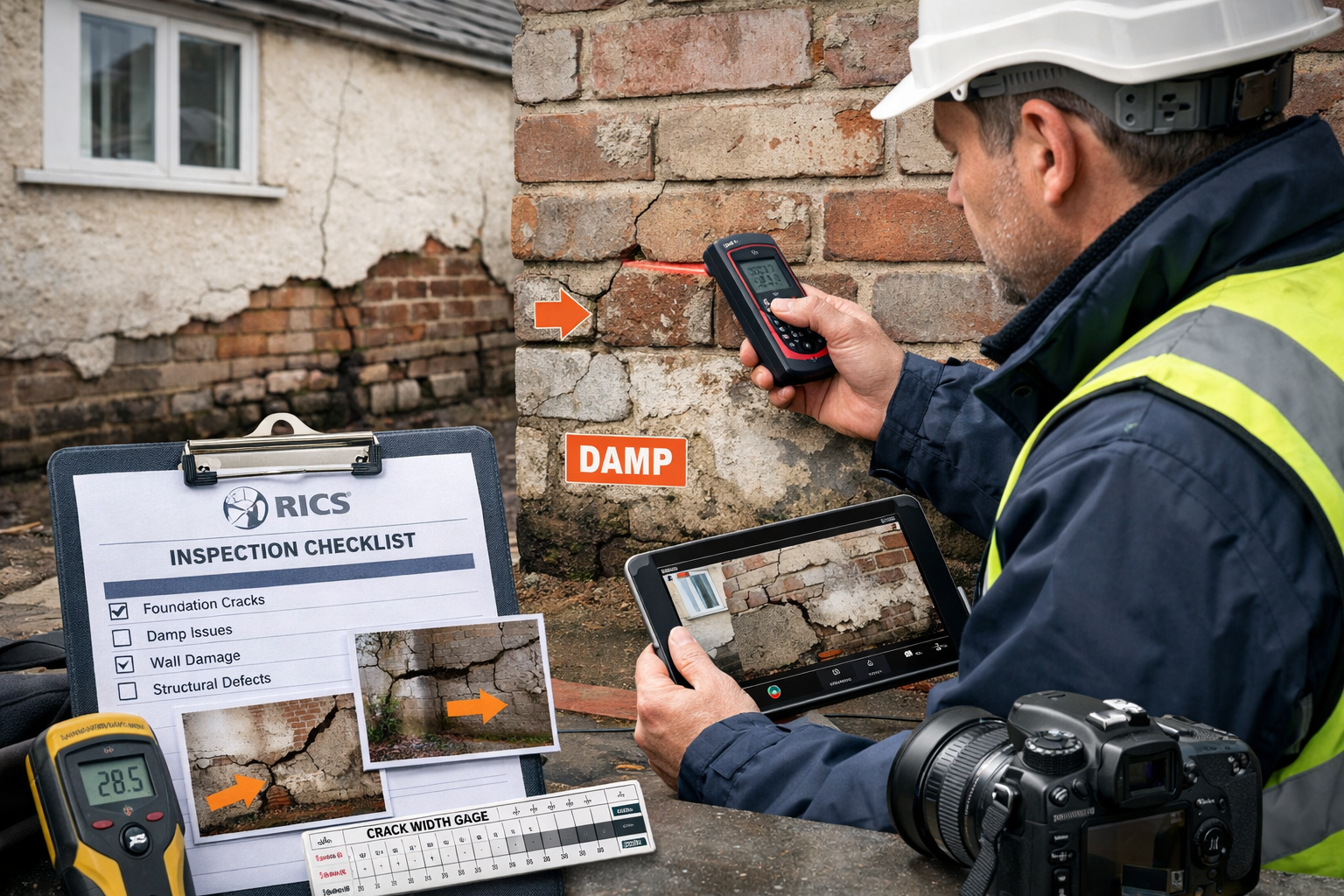
Effective evidence gathering begins with a methodical site inspection that creates a defensible record of property conditions. Unlike a standard RICS survey, expert witness inspections require enhanced documentation protocols:
Pre-Inspection Preparation ✅
- Review all available documentation including original surveys, building control records, planning permissions, and party correspondence
- Identify specific allegations and counterclaims requiring investigation
- Prepare inspection checklist addressing each disputed issue
- Ensure appropriate equipment availability (moisture meters, crack monitoring devices, laser measuring tools, professional photography equipment)
Site Inspection Protocol
The inspection itself must follow a systematic approach:
| Inspection Stage | Key Activities | Documentation Required |
|---|---|---|
| External Survey | Photograph all elevations, measure boundary positions, assess structural condition | Annotated photographs, measurements, contemporaneous notes |
| Internal Survey | Examine disputed defects, take technical readings, assess repair requirements | Room-by-room notes, technical readings, photographic evidence |
| Defect Analysis | Measure crack widths, assess damp levels, evaluate structural movement | Calibrated instrument readings, comparative measurements |
| Context Assessment | Consider property age, construction type, maintenance history | Historical research notes, comparative analysis |
Photographic Evidence Standards 📸
Photographic documentation forms crucial evidence in residential disputes. Expert witnesses should:
- Use professional-quality cameras with date/time stamps enabled
- Include scale references (measuring tapes, coins) in defect photographs
- Capture wide-angle context shots and close-up detail images
- Photograph from multiple angles to show spatial relationships
- Document surrounding areas that may influence defect causation
- Maintain organized digital filing systems with clear image descriptions
Technical Measurements and Testing
Objective technical data strengthens expert opinions and withstands cross-examination scrutiny. Essential measurement protocols include:
Moisture Content Analysis
Using calibrated moisture meters, experts should take multiple readings across affected areas, recording:
- Specific measurement locations (with photographs)
- Numerical readings and meter settings
- Ambient conditions during testing
- Comparison with normal/expected readings for the building type
Structural Movement Assessment
When evaluating cracks or structural movement:
- Measure crack widths at multiple points using crack width gauges
- Document crack patterns and orientations
- Assess whether movement is historic or ongoing
- Consider installing monitoring devices if progressive movement is suspected
Dimensional Verification
Boundary disputes and construction quality cases require precise measurements:
- Use professional surveying equipment (laser distance meters, theodolites)
- Cross-check critical dimensions with multiple measurement methods
- Reference measurements to fixed datums
- Document measurement methodology for replication
Contemporaneous Note-Taking
Contemporaneous notes—records made at the time of inspection—carry significant evidential weight in court proceedings. Expert witnesses should:
- Use bound notebooks with numbered pages (preventing page removal allegations)
- Record date, time, weather conditions, and persons present
- Note observations immediately during inspection
- Avoid retrospective additions (if necessary, clearly mark and date any later additions)
- Retain original notes even after formal report preparation
These handwritten records often prove crucial during cross-examination, demonstrating the expert's systematic approach and providing contemporaneous evidence of site conditions.
Document Collection and Review
Comprehensive evidence gathering extends beyond site inspection to include:
Building Records Research 📚
- Original planning applications and building control approvals
- Previous survey reports and property valuations
- Maintenance records and repair invoices
- Correspondence between parties regarding defects
- Warranties, guarantees, and insurance documentation
Expert Review of Third-Party Reports
When disputes involve competing expert opinions, thorough review of opposing expert reports identifies:
- Methodological differences or deficiencies
- Factual errors or misinterpretations
- Alternative explanations for observed conditions
- Areas of agreement that narrow dispute scope
Report Structure and Presentation for Expert Witness Protocols for Residential Building Disputes: RICS Standards and Court Preparation
Civil Procedure Rules Part 35 Requirements
Expert witness reports in UK residential building disputes must comply with Civil Procedure Rules (CPR) Part 35, which establishes mandatory content and format requirements. Non-compliance can result in report rejection or cost penalties.
Essential Report Components 📄
- Statement of Compliance
Every expert report must include a declaration that the expert:
- Understands their duty to the court overrides any obligation to instructing parties
- Has complied with that duty
- Is aware of CPR Part 35 requirements and accompanying Practice Direction
- Expert's Qualifications and Experience
The report should detail:
- Professional qualifications (MRICS, FRICS status)
- Relevant experience in the specific dispute area
- Previous expert witness appointments (if applicable)
- Any limitations on expertise relevant to the case
- Instructions Received
Transparency requires stating:
- Who instructed the expert
- Questions or issues the expert was asked to address
- Documents and information provided
- Any limitations on investigation scope
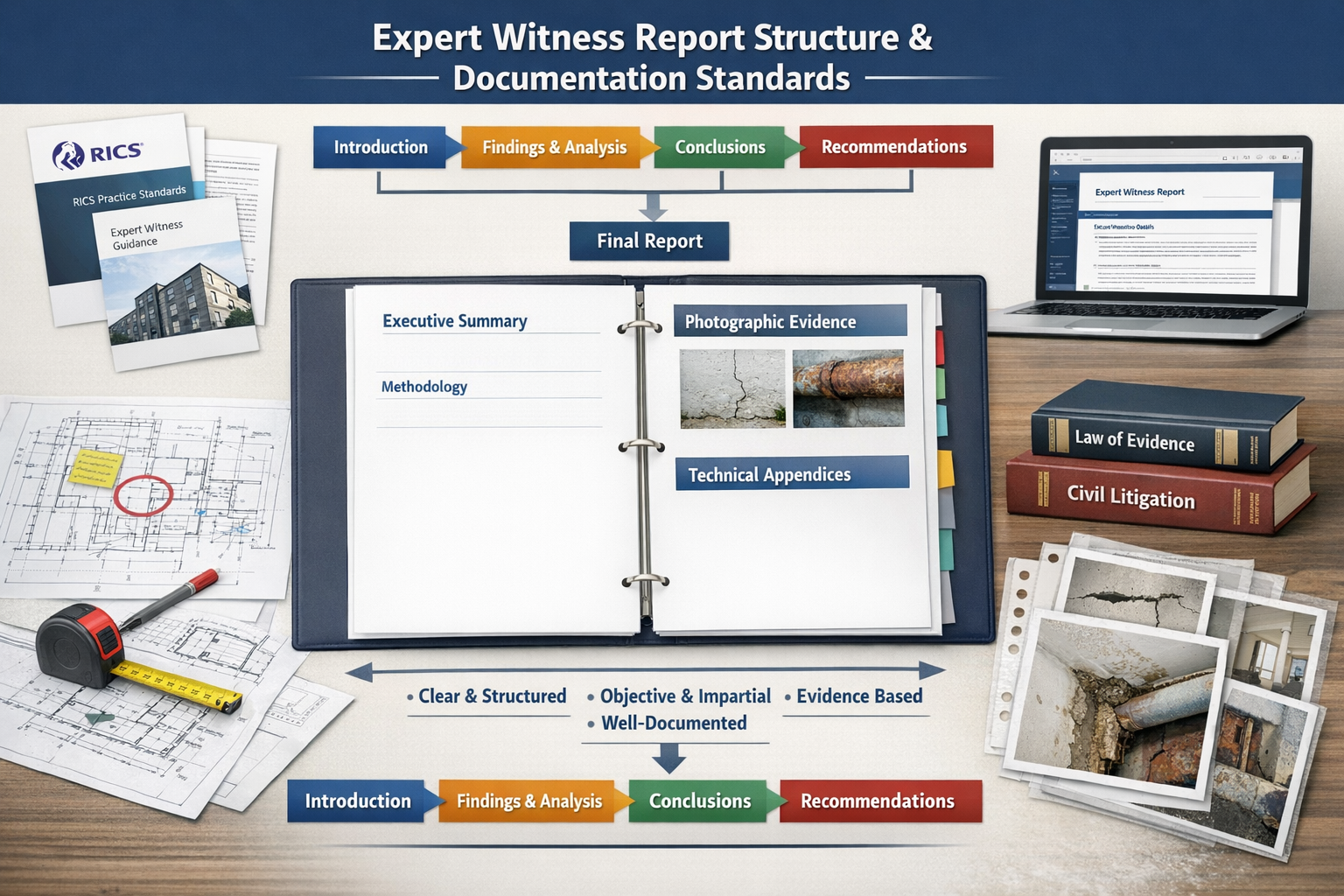
RICS-Compliant Report Structure
Building surveying standards and dispute resolution guidance inform the optimal structure for expert witness reports in residential cases [1][2]:
Executive Summary
A concise overview (1-2 pages) presenting:
- Property identification and dispute nature
- Key findings and conclusions
- Summary of expert opinion on disputed issues
Property Description and Context
- Location, age, construction type
- Relevant planning and building control history
- Previous alterations or repairs
- Surrounding environment factors
Methodology Section
Detailed explanation of:
- Inspection dates and duration
- Persons present during inspection
- Equipment and testing methods used
- Documents reviewed
- Standards and guidance referenced
- Any limitations on investigation
Findings and Analysis
The substantive section presenting:
- Factual observations from site inspection
- Technical measurements and test results
- Photographic evidence (with clear captions and references)
- Analysis of defect causation
- Assessment of repair requirements and costs
Opinion and Conclusions
- Clear statement of expert opinion on each disputed issue
- Reasoning supporting conclusions
- Acknowledgment of alternative explanations where appropriate
- Identification of matters outside expert's expertise
Statement of Truth
The mandatory declaration:
"I confirm that I have made clear which facts and matters referred to in this report are within my own knowledge and which are not. Those that are within my own knowledge I confirm to be true. The opinions I have expressed represent my true and complete professional opinions on the matters to which they refer."
Visual Evidence Presentation
Effective expert reports integrate visual evidence seamlessly:
Photographic Plates 📷
- Number all photographs sequentially
- Provide detailed captions explaining what each image shows
- Reference photographs in report text
- Include location plans showing photograph viewpoints
- Annotate images to highlight specific defects or features
Technical Drawings and Plans
- Include measured floor plans showing defect locations
- Provide elevation drawings for external defects
- Use consistent symbols and annotation conventions
- Include scale bars and north points
- Consider color-coding to distinguish different issues
Comparison Tables
When addressing multiple defects or comparing conditions:
| Defect Location | Nature of Defect | Severity | Probable Cause | Repair Estimate |
|---|---|---|---|---|
| Front elevation | Vertical cracking | Moderate | Settlement | £3,500-£4,200 |
| Rear extension | Damp penetration | Significant | Failed DPC | £2,800-£3,500 |
| Party wall | Structural damage | Severe | Adjacent excavation | £8,000-£12,000 |
Common Pitfalls to Avoid
Advocacy Rather Than Independence ⚠️
The most serious error involves allowing the instructing party's desired outcome to influence expert opinion. Maintain objectivity by:
- Forming opinions based solely on evidence
- Acknowledging weaknesses in your position
- Identifying matters that support opposing arguments
- Never allowing clients to draft or significantly alter technical conclusions
Inadequate Reasoning
Courts reject conclusory opinions lacking supporting analysis. Always:
- Explain the reasoning process leading to conclusions
- Reference specific evidence supporting opinions
- Address alternative explanations
- Cite relevant standards, regulations, or technical literature
Exceeding Expertise Boundaries
Expert witnesses should only opine on matters within their professional competence. When disputes involve multiple disciplines:
- Clearly identify limitations on expertise
- Recommend additional specialist input where appropriate
- Distinguish factual observations from expert interpretation
- Avoid speculative opinions on matters outside surveying expertise
Court Preparation and Cross-Examination Strategies for Expert Witness Protocols for Residential Building Disputes: RICS Standards and Court Preparation
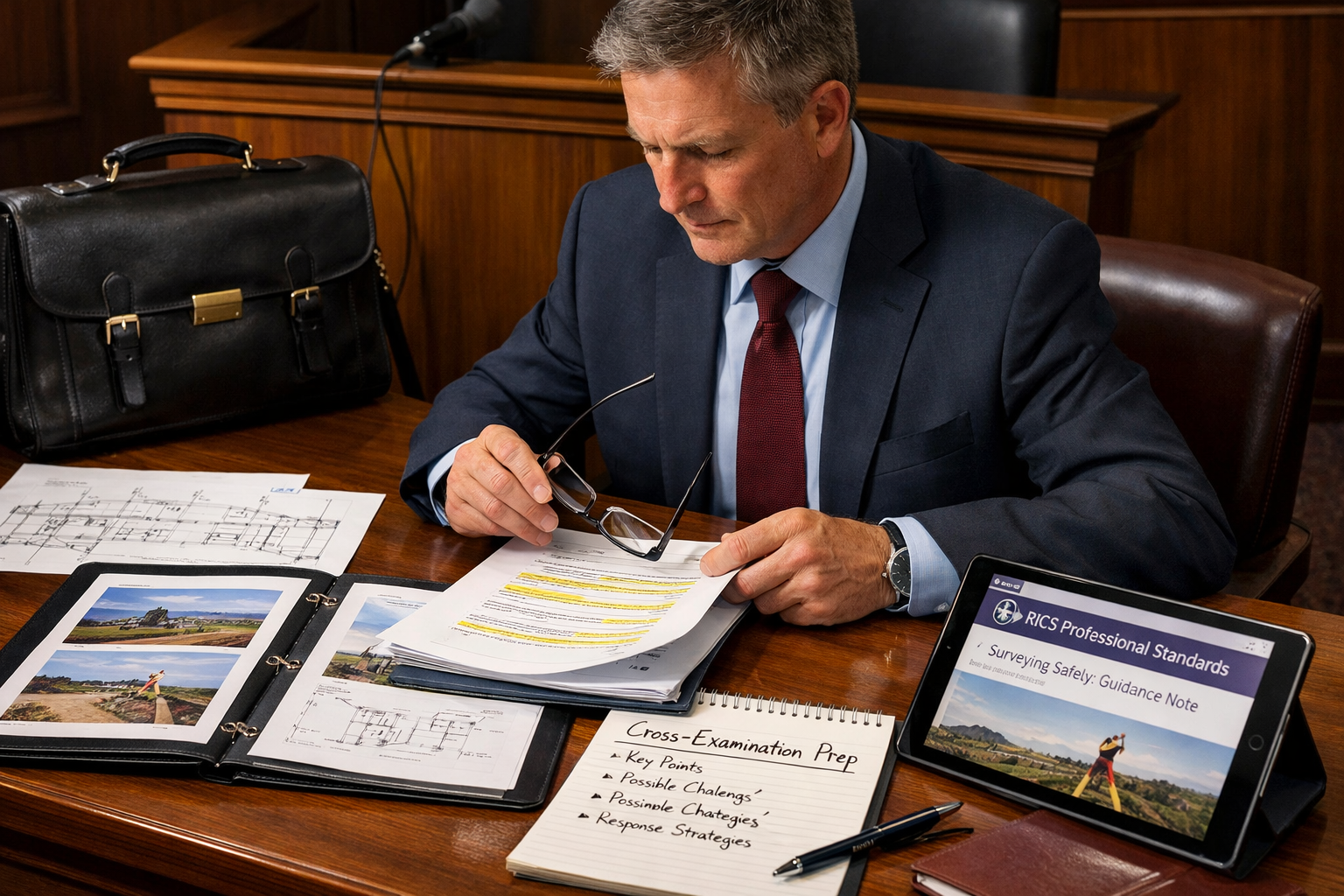
Pre-Trial Preparation Essentials
Effective courtroom testimony begins long before entering the witness box. Comprehensive preparation distinguishes credible expert witnesses from those who struggle under cross-examination pressure.
Case File Mastery 📚
Expert witnesses must achieve complete familiarity with:
- Their own report (including all appendices and exhibits)
- Opposing expert's report and identified areas of disagreement
- Key documents referenced in reports
- Timeline of events relevant to the dispute
- Previous correspondence and instructions
Consider creating a case summary document highlighting:
- Core disputed issues
- Your key opinions on each issue
- Supporting evidence for each opinion
- Anticipated challenges from opposing counsel
- Potential weaknesses requiring explanation
Conference with Legal Team
Pre-trial conferences with instructing solicitors and barristers serve multiple purposes:
- Clarifying legal issues and burden of proof
- Understanding courtroom procedures and protocols
- Reviewing anticipated questions and cross-examination themes
- Discussing presentation of technical concepts to non-specialist judges
- Agreeing on demonstrative aids (photographs, drawings, models)
Understanding Cross-Examination Techniques
Opposing counsel employs various tactics to undermine expert credibility or challenge opinions. Awareness of common techniques enables effective responses:
Challenging Qualifications and Experience 🎯
Counsel may suggest the expert lacks specific experience relevant to the dispute. Counter by:
- Clearly stating relevant qualifications without exaggeration
- Explaining how general expertise applies to specific issues
- Acknowledging limitations while maintaining confidence in opinions within competence area
Highlighting Inconsistencies
Cross-examination often focuses on perceived contradictions between:
- Report statements and courtroom testimony
- Current opinions and previous reports in other cases
- Expert's position and published standards or guidance
Minimize vulnerability by:
- Reviewing reports thoroughly before testimony
- Ensuring consistency between written and oral evidence
- Explaining any evolution in opinion based on new information
- Never attempting to hide or minimize genuine inconsistencies
The "Learned Treatise" Approach
Counsel may reference technical publications, standards, or case law suggesting alternative interpretations. Respond by:
- Acknowledging authoritative sources while explaining contextual differences
- Distinguishing general principles from specific case circumstances
- Maintaining that professional judgment considers multiple factors beyond single references
Hypothetical Scenarios
Questions posing altered facts ("If X were different, would your opinion change?") test opinion robustness. Handle by:
- Carefully considering hypothetical modifications
- Explaining which changes would or wouldn't affect conclusions
- Avoiding speculation on scenarios lacking evidentiary foundation
Effective Testimony Techniques
Communication Principles 💬
Expert witnesses must translate technical concepts for non-specialist audiences:
- Use plain language: Avoid unnecessary jargon; define technical terms when first used
- Provide context: Explain why specific technical matters are significant
- Use analogies: Relate complex concepts to everyday experiences
- Maintain pace: Speak slowly enough for note-taking; pause between points
- Address the judge: Direct answers to the decision-maker, not the questioning lawyer
Maintaining Professional Demeanor
Courtroom credibility depends heavily on professional presentation:
✅ Do:
- Dress formally in business attire
- Maintain calm, measured responses even under aggressive questioning
- Pause before answering to consider questions fully
- Admit when you don't know something rather than speculating
- Acknowledge valid points made by opposing counsel
- Request clarification if questions are unclear
❌ Don't:
- Become defensive or argumentative
- Rush answers or interrupt questions
- Volunteer information beyond what's asked
- Use sarcasm or display irritation
- Attempt humor (rarely successful in formal proceedings)
- Show bias toward the instructing party
Handling Difficult Questions
"Isn't it possible that…" Questions
These invite speculation about alternative scenarios. Respond by:
- Acknowledging theoretical possibilities while emphasizing probability
- Returning to evidence-based conclusions
- Distinguishing between "possible" and "probable" or "likely"
"Yes or No" Demands
When complex issues require nuanced answers, counsel may demand simple responses. Handle by:
- Providing yes/no answer if genuinely appropriate
- Politely explaining when questions require qualified answers
- Requesting permission to explain: "I can answer yes or no, but may I explain why?"
Questions About Fees
Inquiries about compensation aim to suggest bias. Address by:
- Stating fees honestly and without embarrassment
- Explaining that payment is for time and expertise, not opinions
- Noting that fees remain the same regardless of testimony content
Joint Expert Meetings and Statements
Courts increasingly direct opposing experts to meet and produce joint statements identifying:
- Areas of agreement
- Remaining areas of disagreement
- Reasons for disagreement
Effective Joint Statement Preparation 🤝
- Approach collaboratively: View opposing expert as fellow professional, not adversary
- Focus on technical issues: Set aside legal arguments or party positions
- Seek genuine agreement: Narrow disputes where evidence supports consensus
- Clearly articulate disagreements: Explain reasoning differences without attacking opposing expert
- Maintain independence: Don't compromise genuine professional opinions for artificial agreement
These joint statements significantly streamline trials by focusing court time on genuinely disputed technical issues.
Continuing Professional Development and Quality Assurance
The revised RICS CPD framework effective from January 2026 introduces enhanced quality review mechanisms affecting expert witness practice [4]. Surveyors undertaking expert witness work must demonstrate ongoing competency through:
Structured Learning Activities
- Formal training in expert witness procedures and courtroom skills
- Updates on relevant case law and procedural changes
- Technical CPD in specialist areas (structural engineering, building pathology, boundary law)
- Ethics training addressing independence and conflicts of interest
Reflective Practice
- Case reviews analyzing testimony effectiveness
- Peer discussion of challenging expert witness scenarios
- Self-assessment against RICS competency frameworks
Quality Assurance Measures
- Regular review of report templates against current CPR requirements
- Maintaining up-to-date knowledge of RICS standards revisions [3]
- Professional indemnity insurance review ensuring adequate coverage
- Feedback solicitation from instructing solicitors on report quality
Practical Checklists for Expert Witness Success
Pre-Appointment Checklist ✅
Before accepting expert witness instructions:
- Confirm competence in specific dispute area
- Check for conflicts of interest
- Verify professional indemnity insurance adequacy
- Agree scope of work and fee arrangements in writing
- Establish realistic timescales for report delivery
- Clarify court availability if trial testimony required
Evidence Gathering Checklist 📋
During site inspections:
- Photograph all elevations and disputed areas
- Take technical measurements with calibrated equipment
- Record contemporaneous notes in bound notebook
- Collect relevant documents and correspondence
- Identify areas requiring specialist testing
- Document weather and site conditions
- Note persons present and their roles
Report Quality Checklist 📝
Before submitting expert reports:
- Verify CPR Part 35 compliance
- Include all mandatory declarations
- Check consistency throughout report
- Ensure all photographs are referenced and captioned
- Confirm all technical terms are defined
- Review for objectivity and independence
- Proofread for errors and ambiguities
- Verify all appendices are attached and referenced
Court Preparation Checklist ⚖️
Before testimony:
- Re-read entire case file including all reports
- Prepare case summary highlighting key opinions
- Review opposing expert's report and disagreement areas
- Meet with legal team to discuss strategy
- Prepare demonstrative aids if appropriate
- Confirm court attendance details and timing
- Arrange professional attire and necessary documents
Conclusion
Mastering Expert Witness Protocols for Residential Building Disputes: RICS Standards and Court Preparation requires surveyors to develop capabilities extending far beyond technical building knowledge. Success demands systematic evidence gathering, rigorous report preparation, and confident courtroom testimony—all while maintaining the independence and objectivity that define the expert witness role.
The enhanced quality frameworks introduced by RICS in 2026 reflect the profession's commitment to maintaining high standards in dispute resolution contexts [3][4]. Surveyors who invest in developing expert witness competencies position themselves to provide valuable services in the growing residential property dispute market while upholding the professional standards that underpin public confidence in chartered surveyors.
Actionable Next Steps
For surveyors seeking to develop or enhance expert witness capabilities:
- Undertake formal expert witness training covering legal procedures, report writing, and testimony skills
- Review current RICS standards on dispute resolution and building surveying to ensure practice alignment [1][2]
- Develop systematic protocols for evidence gathering, documentation, and report preparation
- Seek mentorship from experienced expert witnesses to gain practical insights
- Consider starting with smaller disputes to build experience before accepting complex, high-value cases
- Maintain detailed CPD records demonstrating ongoing competency in both technical and procedural aspects
For property owners involved in residential building disputes, engaging a surveyor with proper expert witness credentials and understanding of RICS protocols ensures your technical case receives professional presentation. When selecting an expert witness, verify their qualifications, relevant experience, and familiarity with current court procedures.
The intersection of technical building expertise and legal process creates unique challenges, but surveyors who master Expert Witness Protocols for Residential Building Disputes: RICS Standards and Court Preparation provide essential services that facilitate fair resolution of property disputes while maintaining the professional standards that define chartered surveying practice.
References
[1] Dispute Resolution Standards – https://www.rics.org/profession-standards/rics-standards-and-guidance/sector-standards/dispute-resolution-standards
[2] Building Surveying Standards – https://www.rics.org/profession-standards/rics-standards-and-guidance/sector-standards/building-surveying-standards
[3] Building Survey Standards Evolution How Rics Quality Strengthening Initiatives Impact Surveyor Practice In 2026 – https://nottinghillsurveyors.com/blog/building-survey-standards-evolution-how-rics-quality-strengthening-initiatives-impact-surveyor-practice-in-2026
[4] Revised Cpd Framework Effective 2026 New App – https://www.rics.org/news-insights/revised-cpd-framework-effective-2026-new-app
[5] Rics Standards And Guidance – https://www.rics.org/profession-standards/rics-standards-and-guidance
SEO Meta Title: Expert Witness Protocols: RICS Standards & Court Prep