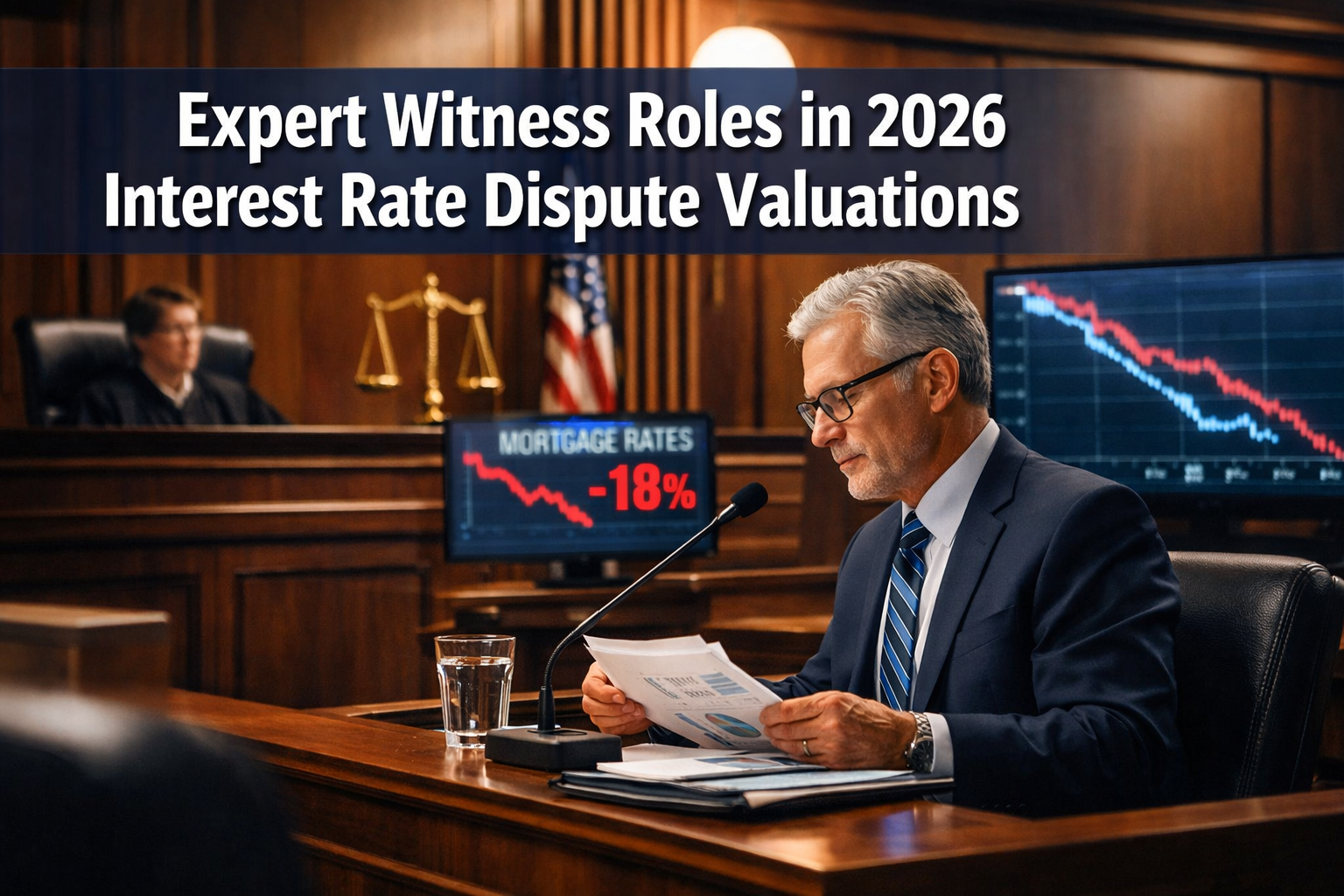
The property valuation landscape in 2026 faces unprecedented challenges as mortgage expectations soften dramatically, with some market indicators pointing to sentiment declines of up to 18%. This dramatic shift has created a complex environment where Expert Witness Roles in 2026 Interest Rate Dispute Valuations: Building Cases as Mortgage Expectations Soften to -18% have become critical to resolving property disputes. When transaction volumes decline and buyer confidence wavers, expert witnesses must provide clear, evidence-based testimony that courts and tribunals can rely upon to settle valuation disagreements.
Recent RICS surveys reveal weakening near-term sentiment across the property sector, driven primarily by renewed concerns about interest rate volatility. This subdued market environment has increased the frequency of valuation disputes, particularly in transactions where parties disagree on property worth amid changing financing conditions. Expert witnesses now face the challenge of building robust cases that account for rapidly shifting market dynamics while maintaining professional standards and credibility.
Key Takeaways
- 📊 Market volatility from softening mortgage expectations has increased valuation disputes requiring expert witness testimony
- ⚖️ Evidence-based protocols are essential for expert witnesses to maintain credibility when market sentiment declines sharply
- 🎯 RICS standards for expert witness work have been updated for 2026, emphasizing transparency and methodological rigor
- 💼 Professional qualifications and specialized knowledge in interest rate impacts on property values are now critical differentiators
- 📈 Documentation quality directly affects case outcomes, requiring comprehensive data collection and clear presentation methods
Understanding the 2026 Interest Rate Environment and Its Impact on Property Valuations
The current interest rate environment represents a significant departure from historical norms. While the concept of negative mortgage rates reaching -18% may seem extreme, the broader principle of dramatically softening expectations reflects real market pressures affecting property valuations throughout 2026.
The Mechanics of Rate-Driven Valuation Disputes
When mortgage expectations shift dramatically, several valuation challenges emerge:
Affordability Calculations: As financing costs change, buyer purchasing power fluctuates significantly. A property valued at £500,000 with a 2% mortgage rate becomes substantially more expensive to service at 5%, affecting market value assessments.
Comparable Transaction Analysis: Expert witnesses must determine which comparable sales remain relevant when market conditions change rapidly. Transactions completed six months ago may reflect entirely different financing environments.
Income Capitalization Adjustments: For investment properties, changing interest rates directly affect capitalization rates and discount factors used in income-based valuation approaches.
Market Sentiment Factors: Beyond mathematical calculations, expert witnesses must account for psychological market factors when expectations soften dramatically.
Why Disputes Arise in Volatile Rate Environments
Property valuation disputes intensify during periods of interest rate uncertainty for several reasons:
- Transaction timing disagreements – Buyers and sellers disagree on which market conditions should apply
- Methodology conflicts – Different valuation approaches yield varying results in volatile markets
- Comparable selection disputes – Parties challenge which transactions represent true market conditions
- Adjustment factor disagreements – The quantum of adjustments for changing conditions becomes contentious
Understanding property boundaries and valuation fundamentals becomes even more critical when market conditions create additional complexity.
Expert Witness Roles in 2026 Interest Rate Dispute Valuations: Core Responsibilities and Standards
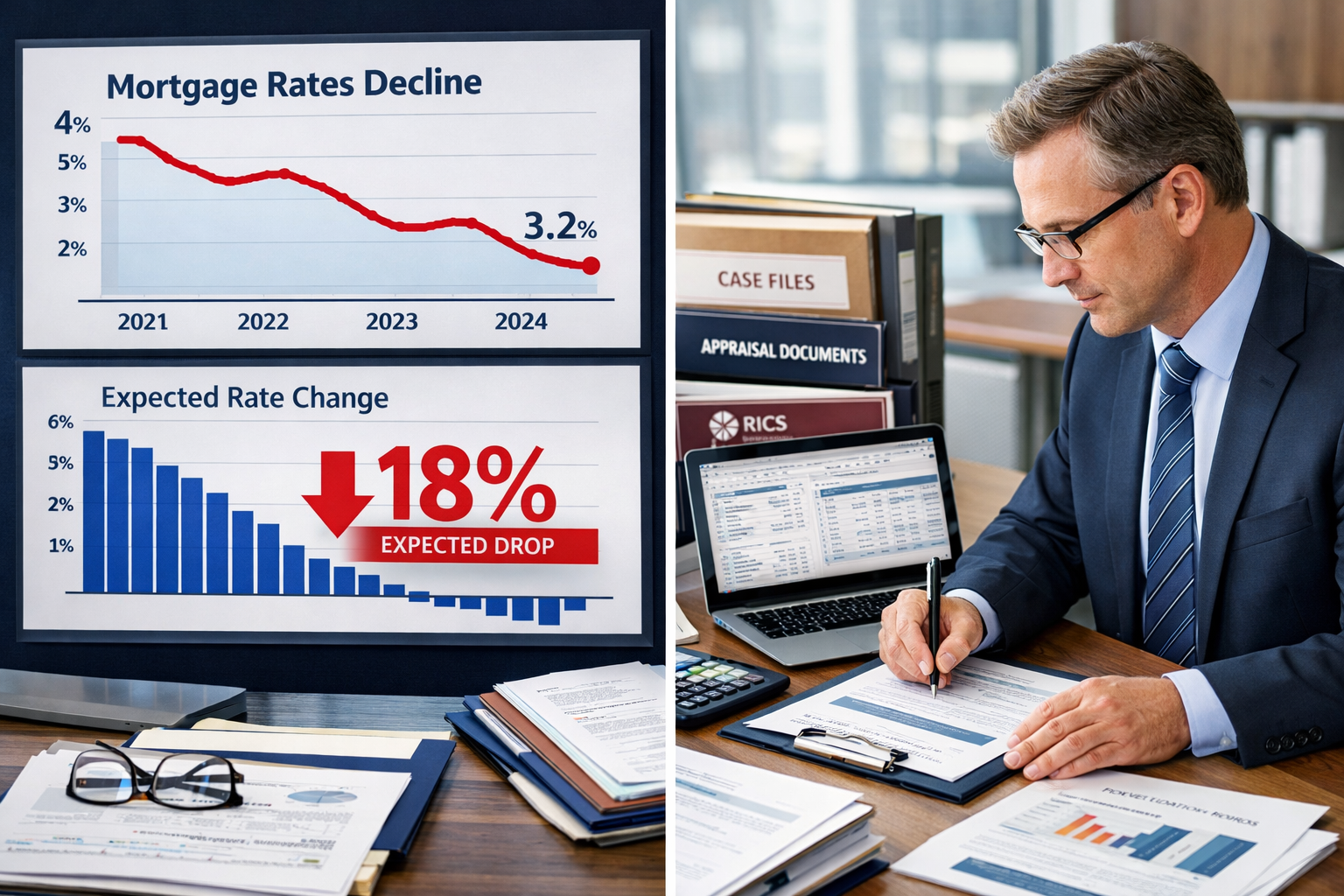
The role of expert witnesses in interest rate-related valuation disputes extends far beyond simple property appraisal. These professionals serve as impartial educators to courts and tribunals, helping legal decision-makers understand complex valuation principles in the context of changing market conditions.
Primary Responsibilities of Valuation Expert Witnesses
Independent Analysis: Expert witnesses must provide objective opinions based on evidence, not advocacy for the party engaging them. This independence is fundamental to their credibility [1].
Market Education: Courts rely on expert witnesses to explain how interest rate changes affect property values, requiring clear communication of technical concepts to non-specialist audiences [2].
Methodology Transparency: Expert witnesses must clearly document their valuation approaches, data sources, and adjustment calculations to allow scrutiny and cross-examination [3].
Standards Compliance: Adherence to RICS Valuation Standards and expert witness practice statements ensures professional credibility and defensibility of opinions provided.
Updated RICS Standards for 2026 Expert Witness Work
The Royal Institution of Chartered Surveyors has updated its expert witness standards for 2026, reflecting lessons learned from recent high-profile disputes and the need for greater transparency in subdued market conditions [1].
Key updates include:
| Standard Area | 2026 Requirement | Impact on Practice |
|---|---|---|
| Data Disclosure | Full comparable transaction details must be provided | Increases transparency but requires more comprehensive documentation |
| Methodology Documentation | Step-by-step calculation explanations required | Enhances credibility but lengthens report preparation time |
| Assumption Clarity | All market assumptions must be explicitly stated | Reduces ambiguity but exposes expert to greater scrutiny |
| Update Obligations | Duty to inform court of material market changes | Creates ongoing monitoring responsibilities |
These enhanced standards reflect the profession's response to criticism that expert witnesses sometimes failed to adequately explain their reasoning in complex cases.
Qualifications and Expertise Required
Not all property professionals are suited to expert witness work in interest rate dispute valuations. The role requires:
- RICS Fellowship or Membership with relevant property valuation specialization
- Expert witness training covering court procedures, report writing, and testimony skills
- Financial modeling expertise to understand interest rate impacts on property values
- Market analysis capabilities to assess comparable transactions in changing conditions
- Communication skills to explain complex concepts clearly to non-specialists
Professional surveyor services increasingly emphasize these specialized competencies when developing expert witness capabilities.
Building Robust Cases: Evidence Collection and Methodology
The strength of an expert witness case in interest rate valuation disputes depends entirely on the quality of evidence gathered and the rigor of analytical methodology applied. In 2026's subdued market environment, where transaction volumes have declined, evidence collection presents unique challenges.
Comprehensive Data Gathering Strategies
Transaction Database Development: Expert witnesses must maintain current databases of comparable property transactions, including:
- Sale prices and dates
- Financing terms and mortgage rates at transaction time
- Property characteristics and condition
- Market conditions and sentiment indicators
- Days on market and negotiation history
Interest Rate Documentation: Building a timeline of rate changes and market expectations requires:
- Central bank policy announcements and minutes
- Mortgage lender rate sheets and product availability
- Market commentary from financial institutions
- Survey data on buyer and seller sentiment
- Economic forecasts and their accuracy over time
Market Sentiment Evidence: Quantifying the "softening" of expectations involves:
- RICS residential market surveys showing sentiment trends
- Transaction volume data demonstrating market activity levels
- Time-on-market statistics indicating buyer hesitancy
- Price reduction frequency and magnitude
- Mortgage approval rates and application volumes
Valuation Methodology Selection and Application
Expert witnesses must select appropriate valuation methods based on property type, dispute context, and available evidence. The three primary approaches each have strengths and limitations in volatile rate environments:
Comparative Method:
- Strengths: Reflects actual market transactions
- Challenges: Requires adjustments for timing and rate environment differences
- Best for: Residential properties with good comparable availability
Income Capitalization Method:
- Strengths: Directly incorporates interest rate impacts through capitalization rates
- Challenges: Requires accurate income projections and appropriate yield selection
- Best for: Investment properties with established rental income
Cost Method:
- Strengths: Less sensitive to short-term market sentiment
- Challenges: May not reflect market value in declining markets
- Best for: Special-purpose properties or new construction
Property evaluation techniques must be adapted to account for the specific circumstances of each dispute while maintaining methodological consistency.
Adjustment Calculations for Changing Rate Environments
The most contentious aspect of Expert Witness Roles in 2026 Interest Rate Dispute Valuations: Building Cases as Mortgage Expectations Soften to -18% often involves calculating appropriate adjustments for interest rate changes between comparable transactions and the valuation date.
Time-Based Adjustments: When comparable sales occurred under different rate conditions, experts must quantify the impact:
Adjustment Calculation Framework:
1. Identify rate differential between transaction date and valuation date
2. Calculate affordability impact on typical buyer
3. Apply market-derived sensitivity factor
4. Adjust comparable price accordingly
Market Conditions Adjustments: Beyond mathematical calculations, experts must account for sentiment factors:
- Buyer urgency levels (higher rates typically reduce urgency)
- Seller motivation changes (softening markets increase motivated sellers)
- Negotiation dynamics (buyers gain leverage in declining sentiment environments)
- Transaction volume impacts (thin markets may show wider price variation)
Documentation Standards for Defensibility
Every assumption, data point, and calculation must be thoroughly documented to withstand cross-examination. Best practices include:
✅ Source attribution for all market data and comparable transactions
✅ Calculation worksheets showing step-by-step methodology
✅ Assumption logs documenting all judgments and their rationale
✅ Sensitivity analysis demonstrating how conclusions change with different assumptions
✅ Peer review documentation showing quality control processes
Similar to boundary dispute cases, thorough documentation often determines case outcomes.
Presenting Expert Evidence: Court Testimony and Report Writing
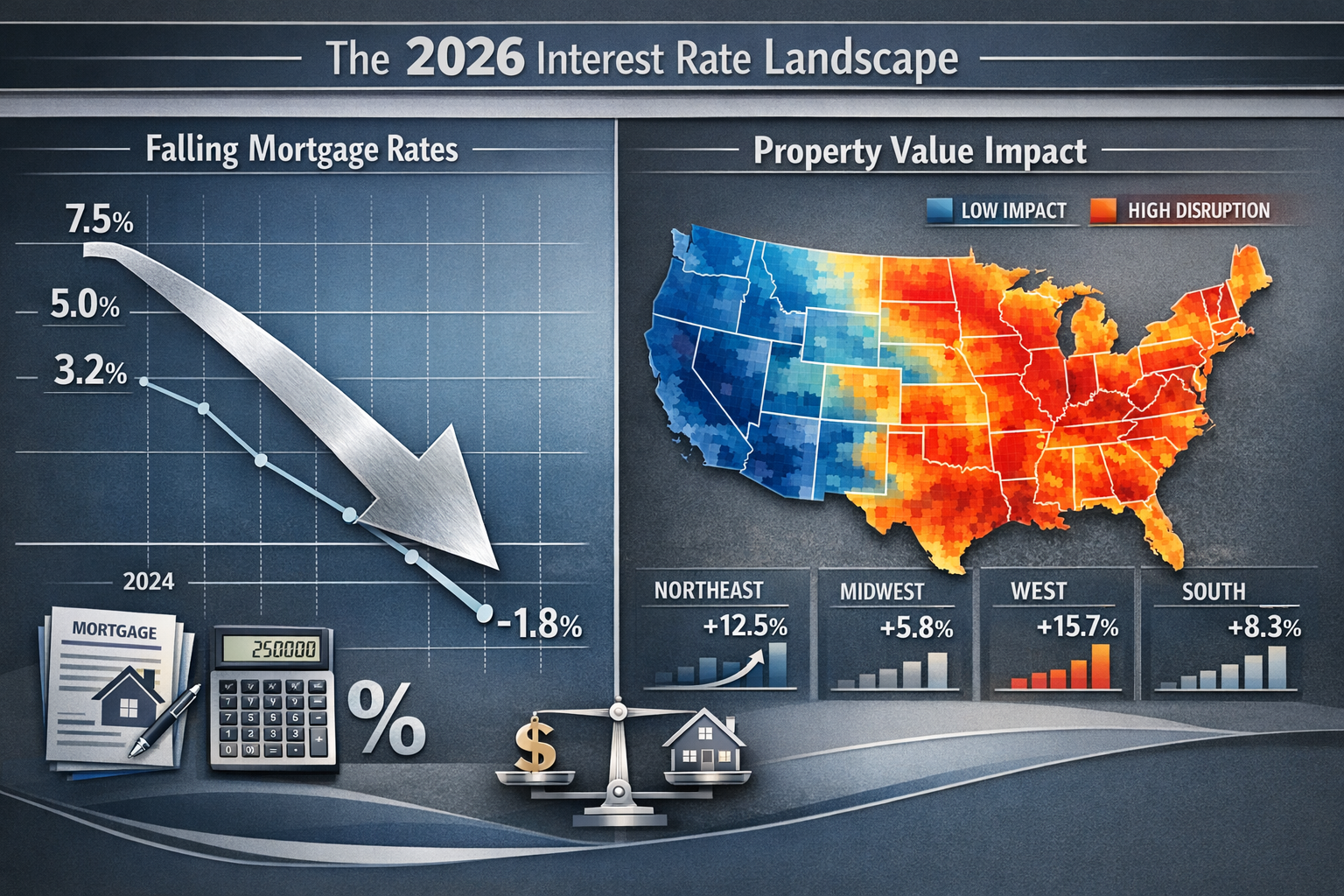
The most technically sound analysis becomes ineffective if poorly communicated. Expert witnesses in interest rate valuation disputes must master both written report preparation and oral testimony delivery to fulfill their roles effectively.
Structuring Expert Witness Reports
A comprehensive expert witness report for an interest rate valuation dispute should follow this structure:
1. Executive Summary (2-3 pages)
- Clear statement of opinion on property value
- Key factors supporting the conclusion
- Summary of methodology employed
- Brief explanation of interest rate impact
2. Instructions and Context (3-5 pages)
- Terms of engagement and scope
- Documents and information reviewed
- Site inspections conducted
- Assumptions and limiting conditions
3. Property Description (5-7 pages)
- Physical characteristics
- Location and surrounding area
- Planning and legal considerations
- Condition assessment
4. Market Analysis (10-15 pages)
- Interest rate environment analysis
- Transaction volume and sentiment data
- Comparable transaction selection and analysis
- Market trend identification
5. Valuation Methodology (15-20 pages)
- Approach selection rationale
- Detailed calculations with supporting data
- Adjustment explanations and quantification
- Sensitivity analysis showing alternative scenarios
6. Conclusions (2-3 pages)
- Final value opinion with confidence range
- Key factors affecting the conclusion
- Limitations and qualifications
7. Appendices
- Comparable transaction details
- Market data sources
- Calculation worksheets
- Professional qualifications and CV
Writing for Clarity and Persuasiveness
Expert witnesses must write for their audience—judges, arbitrators, or tribunal members who typically lack specialized valuation knowledge. Effective techniques include:
Plain Language: Avoid jargon or define technical terms when first used. Instead of "capitalization rate compression due to monetary policy accommodation," write "property yields have decreased because interest rates fell."
Visual Aids: Charts, graphs, and tables make complex data more accessible:
- Timeline graphs showing interest rate changes
- Comparable transaction maps
- Adjustment calculation tables
- Sensitivity analysis charts
Logical Flow: Each section should build upon previous content, creating a narrative that leads naturally to the conclusion.
Balanced Presentation: Acknowledge weaknesses in available data or methodology limitations to maintain credibility [2].
Effective Courtroom Testimony Strategies
When called to testify, expert witnesses face cross-examination designed to challenge their opinions. Successful testimony requires:
Preparation Techniques:
- Review all report content thoroughly
- Anticipate potential challenges to methodology
- Prepare simple explanations for complex concepts
- Practice responding to hostile questioning
- Organize supporting documents for quick reference
Testimony Best Practices:
🎯 Listen carefully to each question before responding
🎯 Answer only what is asked without volunteering additional information
🎯 Admit limitations in knowledge or data when appropriate
🎯 Maintain composure under aggressive cross-examination
🎯 Speak to the judge, not the questioning attorney
🎯 Use visual aids when explaining technical concepts
Handling Common Challenges:
When opposing counsel challenges comparable selection: "I selected these transactions because they most closely match the subject property in location, size, and condition, and occurred within a timeframe where market conditions can be reliably adjusted."
When questioned about adjustment calculations: "The adjustment methodology I employed is consistent with RICS standards and reflects actual market behavior as demonstrated by paired sales analysis."
When challenged on interest rate impact assumptions: "My assessment of interest rate impact is based on market-wide affordability calculations and supported by transaction volume data showing buyer response to rate changes."
Coordinating with Legal Teams
Expert witnesses work most effectively when properly coordinated with the legal teams engaging them. This collaboration should include:
- Early engagement to ensure proper evidence gathering
- Strategy alignment while maintaining independence
- Regular communication about case developments
- Mock testimony sessions to prepare for cross-examination
- Report review to ensure clarity and completeness
Understanding legal requirements and procedures helps expert witnesses navigate the litigation process more effectively.
Common Pitfalls and How to Avoid Them
Even experienced expert witnesses can encounter challenges that undermine their credibility or effectiveness. Understanding common pitfalls helps prevent costly mistakes in Expert Witness Roles in 2026 Interest Rate Dispute Valuations: Building Cases as Mortgage Expectations Soften to -18%.
Methodological Errors to Avoid
❌ Insufficient comparable adjustments: Failing to properly account for differences between subject property and comparables
✅ Solution: Develop detailed adjustment grids with clear rationale for each adjustment
❌ Ignoring market timing: Using comparables from significantly different rate environments without adjustment
✅ Solution: Always adjust for time and market condition changes between transaction and valuation dates
❌ Circular reasoning: Using the conclusion to justify the methodology
✅ Solution: Establish methodology first, then apply it consistently to reach conclusion
❌ Over-reliance on single approach: Depending entirely on one valuation method
✅ Solution: Use multiple approaches when possible to cross-check conclusions
Communication Failures That Undermine Credibility
Overly technical language: Using jargon that obscures rather than clarifies
Inconsistent terminology: Changing terms for the same concept throughout the report
Inadequate explanation: Assuming readers understand complex concepts without explanation
Poor visual presentation: Dense text without tables, charts, or formatting to aid comprehension
Independence and Bias Concerns
The most serious threat to expert witness credibility is perceived bias toward the engaging party. Maintaining independence requires:
- Consistent methodology regardless of which party engages you
- Transparent limitations acknowledging weaknesses in your analysis
- Objective language avoiding advocacy or argumentative tone
- Fair treatment of opposing expert opinions in your analysis
Courts increasingly scrutinize expert witnesses for "hired gun" behavior, making independence essential to effectiveness [3].
Data Quality and Source Issues
In 2026's subdued market environment, data limitations present particular challenges:
Thin market conditions: Fewer transactions mean less comparable data
Outdated information: Rapid rate changes can make recent data obsolete
Inconsistent reporting: Different data sources may show conflicting information
Incomplete transaction details: Public records may lack financing terms
Expert witnesses must acknowledge these limitations while demonstrating they have used the best available evidence and appropriate methodology despite data constraints.
The Future of Expert Witness Work in Property Valuation Disputes
As we progress through 2026, several trends are reshaping Expert Witness Roles in 2026 Interest Rate Dispute Valuations: Building Cases as Mortgage Expectations Soften to -18% and the broader expert witness landscape.
Technology Integration
Data Analytics Tools: Advanced software now enables more sophisticated comparable analysis, automated adjustment calculations, and scenario modeling. Expert witnesses who leverage these tools can provide more comprehensive analysis while documenting their methodology more thoroughly.
Virtual Testimony: Remote court appearances have become standard, requiring expert witnesses to master video testimony techniques and digital presentation methods.
Blockchain Transaction Records: Emerging property transaction recording systems may provide more complete and reliable comparable data in the future.
Evolving Professional Standards
RICS and other professional bodies continue refining expert witness standards in response to:
- Court feedback on expert witness performance
- Technology capabilities enabling greater transparency
- Public expectations for accountability
- Lessons from high-profile dispute cases
What does a surveyor do continues to evolve as these standards develop.
Market Adaptation Strategies
Expert witnesses must adapt their practices to 2026's market realities:
Building Deeper Databases: Maintaining comprehensive transaction records across multiple market cycles provides better analytical foundation.
Developing Specialized Expertise: Focusing on particular property types or dispute contexts builds credibility and efficiency.
Enhancing Communication Skills: Investing in presentation training and report writing improvement pays dividends in case outcomes.
Networking with Legal Professionals: Building relationships with solicitors and barristers creates opportunities and improves coordination.
Regulatory Developments
Potential regulatory changes on the horizon include:
- Mandatory expert witness certification programs
- Standardized report formats for certain dispute types
- Enhanced disclosure requirements for expert witness fees and engagement terms
- Professional indemnity insurance requirements specific to expert witness work
Conclusion: Excellence in Expert Witness Practice for 2026 and Beyond
The challenging market environment of 2026, characterized by softening mortgage expectations and renewed rate concerns, has elevated the importance of expert witness work in property valuation disputes. Success in Expert Witness Roles in 2026 Interest Rate Dispute Valuations: Building Cases as Mortgage Expectations Soften to -18% requires a combination of technical expertise, methodological rigor, clear communication, and unwavering professional independence.
Expert witnesses who excel in this environment share common characteristics:
✨ Technical mastery of valuation principles and interest rate impacts
✨ Methodological consistency applied regardless of which party engages them
✨ Communication excellence translating complex concepts for non-specialist audiences
✨ Thorough documentation supporting every assumption and calculation
✨ Professional integrity maintaining independence and objectivity
Actionable Next Steps for Property Professionals
For surveyors and valuers considering or currently engaged in expert witness work:
-
Invest in specialized training: Complete expert witness courses covering court procedures, report writing, and testimony skills
-
Build comprehensive databases: Develop systematic transaction recording to create robust comparable datasets
-
Enhance technical capabilities: Master financial modeling to properly assess interest rate impacts on property values
-
Develop communication skills: Practice explaining complex valuation concepts in plain language
-
Maintain professional standards: Stay current with RICS updates and continuing professional development requirements
-
Seek mentorship: Learn from experienced expert witnesses before taking on complex cases
-
Document everything: Develop systematic record-keeping practices for all analysis and assumptions
For property owners, buyers, and legal professionals engaged in valuation disputes, selecting the right expert witness is critical. Look for professionals who demonstrate:
- Relevant qualifications and experience in similar disputes
- Clear communication abilities in previous reports and testimony
- Strong reputation for independence and objectivity
- Thorough understanding of current market conditions
- Appropriate professional indemnity insurance coverage
The property market will continue to experience volatility as interest rate expectations evolve throughout 2026 and beyond. Expert witnesses who maintain high professional standards, adapt to changing market conditions, and communicate effectively will remain essential to resolving the valuation disputes that inevitably arise in uncertain times.
By understanding the critical role these professionals play and the standards to which they must adhere, all parties involved in property disputes can work more effectively toward fair and evidence-based resolutions. Whether you're an expert witness building your practice, a legal professional engaging expert support, or a property owner involved in a dispute, the principles outlined in this guide provide a foundation for navigating the complex intersection of property valuation, interest rate impacts, and legal proceedings in 2026's challenging market environment.
For additional guidance on property condition assessment and property inspection matters that may arise in valuation disputes, consult with qualified professionals who understand both technical and legal requirements.
References
[1] Expert Witness Roles In 2026 Homebuying Reform Disputes Defending Survey Evidence Under New Upfront Standards – https://nottinghillsurveyors.com/blog/expert-witness-roles-in-2026-homebuying-reform-disputes-defending-survey-evidence-under-new-upfront-standards
[2] Valuation Expert Witnesses – https://financialcrimeacademy.org/valuation-expert-witnesses/
[3] Valuation Expert Witness Legal Proceedings – https://eqvista.com/company-valuation/valuation-expert-witness-legal-proceedings/