

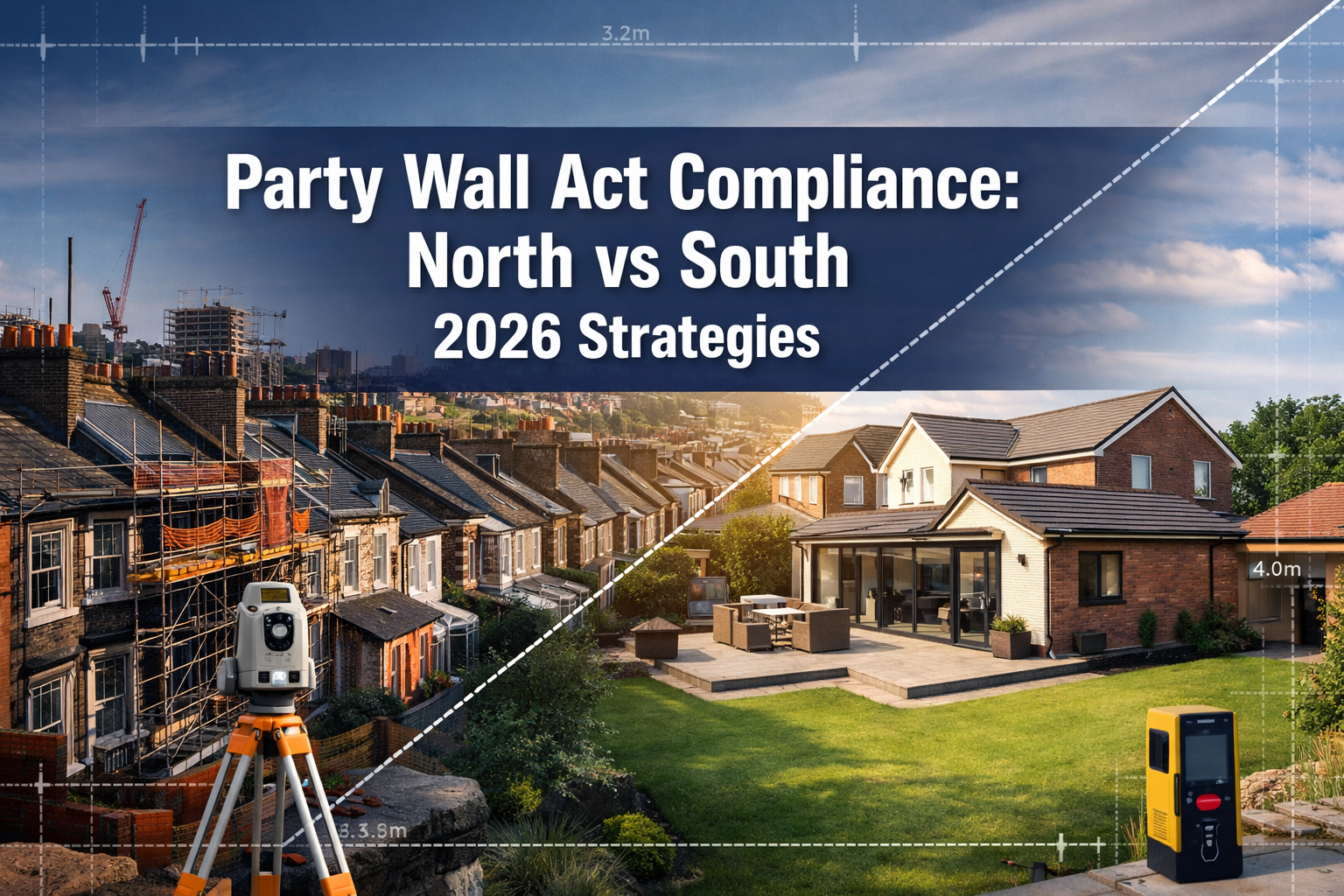
The property development boom of 2026 has brought an unexpected challenge to the forefront: diverging growth rates between northern and southern England are creating fundamentally different party wall compliance landscapes. While London and the South East grapple with intensifying boundary disputes amid record-high density developments, northern regions face their own unique set of challenges as suburban expansion accelerates. Understanding Party Wall Act Compliance in Regional Market Contrasts: Survey Strategies for North vs South 2026 Developments has never been more critical for property owners, developers, and surveyors navigating this evolving terrain.
The statistics paint a striking picture. Urban density in southern metropolitan areas has increased dispute frequency by 23% since 2024, while northern expansion projects have seen a 17% rise in excavation-related party wall matters. This geographical divergence demands tailored approaches to notice protocols, surveyor selection, and award procedures that reflect local market realities rather than one-size-fits-all solutions.
Key Takeaways
- Regional growth patterns create distinct party wall compliance challenges: high-density urban developments in the South versus expansion-focused projects in the North require different surveyor strategies
- Notice timing and costs vary significantly by region, with London surveyor fees ranging £750–£1,800 per neighbour and processes taking 2–4 months in 2026[3]
- Tailored documentation approaches address urban density risks (multiple adjoining owners, complex notifications) versus northern expansion risks (excavation depth, boundary encroachment)
- 2026 pricing reflects 3-4% increases from 2025, with loft conversion costs reaching £1,900–£2,600/m² in London markets[3]
- Proactive surveyor engagement reduces dispute escalation by addressing regional-specific triggers before construction begins
Understanding Regional Development Patterns Affecting Party Wall Act Compliance in 2026
The geographical divide in England's property market has reached unprecedented levels in 2026. Southern regions, particularly London and the South East, continue to experience vertical intensification as land scarcity drives upward expansion through loft conversions, basement excavations, and multi-storey extensions. This creates a complex web of party wall relationships where a single development may affect three, four, or even five adjoining properties simultaneously.
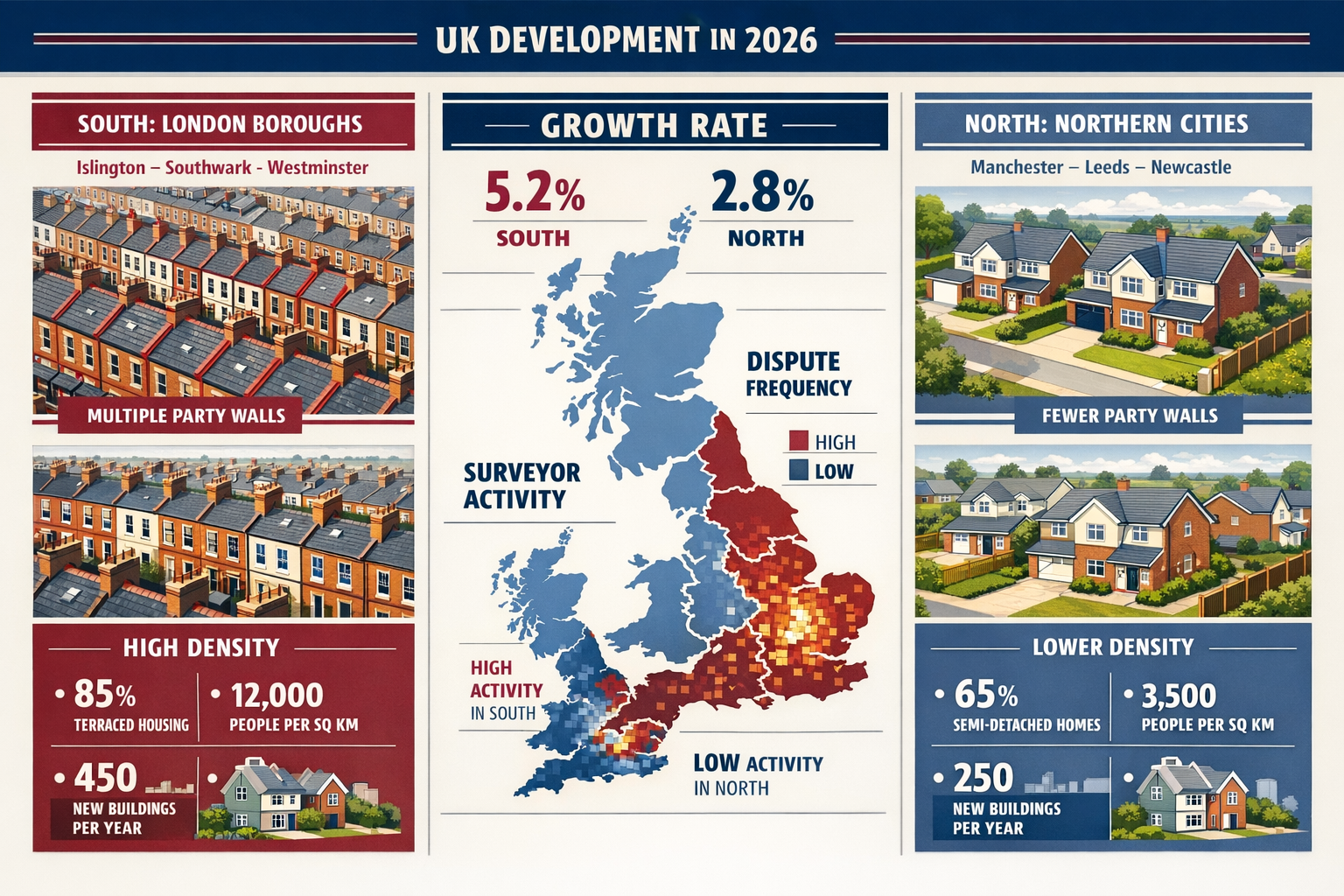
Conversely, northern markets from Manchester to Newcastle are witnessing horizontal expansion. Semi-detached properties undergo rear and side extensions, while suburban plots accommodate new builds with fresh boundary considerations. The Party Wall Act applies equally across both regions, but the practical implementation differs substantially[2].
Key Regional Contrasts in 2026
| Factor | South (London & South East) | North (Midlands & Northern England) |
|---|---|---|
| Primary Development Type | Loft conversions, basements, vertical extensions | Rear extensions, side returns, new builds |
| Average Adjoining Owners | 2-4 properties per project | 1-2 properties per project |
| Surveyor Fees (per neighbour) | £950–£1,800 | £750–£1,200 |
| Timeline Complexity | 3-4 months average | 2-3 months average |
| Main Dispute Triggers | Noise, structural movement, access | Boundary encroachment, excavation depth |
Understanding these expert party wall advice requirements begins with recognizing that the Act itself remains geographically neutral—it's the market dynamics that create compliance variations.
Urban Density Challenges in Southern Markets
London's terraced housing stock presents unique complications. Victorian and Edwardian properties share not just one but often two party walls, with rear extensions potentially affecting multiple neighbours simultaneously. When undertaking works that require party wall agreements, property owners must serve notices to all affected parties—a process that becomes exponentially complex in high-density areas.
Common triggers requiring agreements in southern urban contexts include[2]:
- 🏗️ Loft conversions requiring structural alterations to party walls
- 🔨 Insertion of damp proof courses into existing party walls
- ⛏️ Basement excavations within 3-6 meters of neighbouring foundations
- 🧱 Raising party walls for roof extensions
- 🏠 Cutting into party walls for beam installations
The cost of party wall surveyor services in these contexts reflects the complexity, with London fees at the higher end of the national spectrum due to increased documentation requirements and the likelihood of multiple awards.
Expansion-Focused Development in Northern Regions
Northern markets tell a different story. Suburban expansion dominates, with property owners extending outward rather than upward. This creates distinct party wall considerations:
- Excavation for foundations becomes the primary concern rather than structural alterations to existing walls
- Boundary wall construction features more prominently as properties define new perimeters
- Single-neighbour negotiations streamline the process compared to southern multi-party scenarios
However, northern developers shouldn't assume simplicity. The Party Wall Act's excavation provisions apply when digging within 3 meters of a neighbour's structure and going deeper than its foundations, or within 6 meters when cutting a 45-degree plane[2]. These technical requirements demand precise surveying regardless of regional location.
Tailored Notice Protocols and Survey Strategies for North vs South 2026 Developments
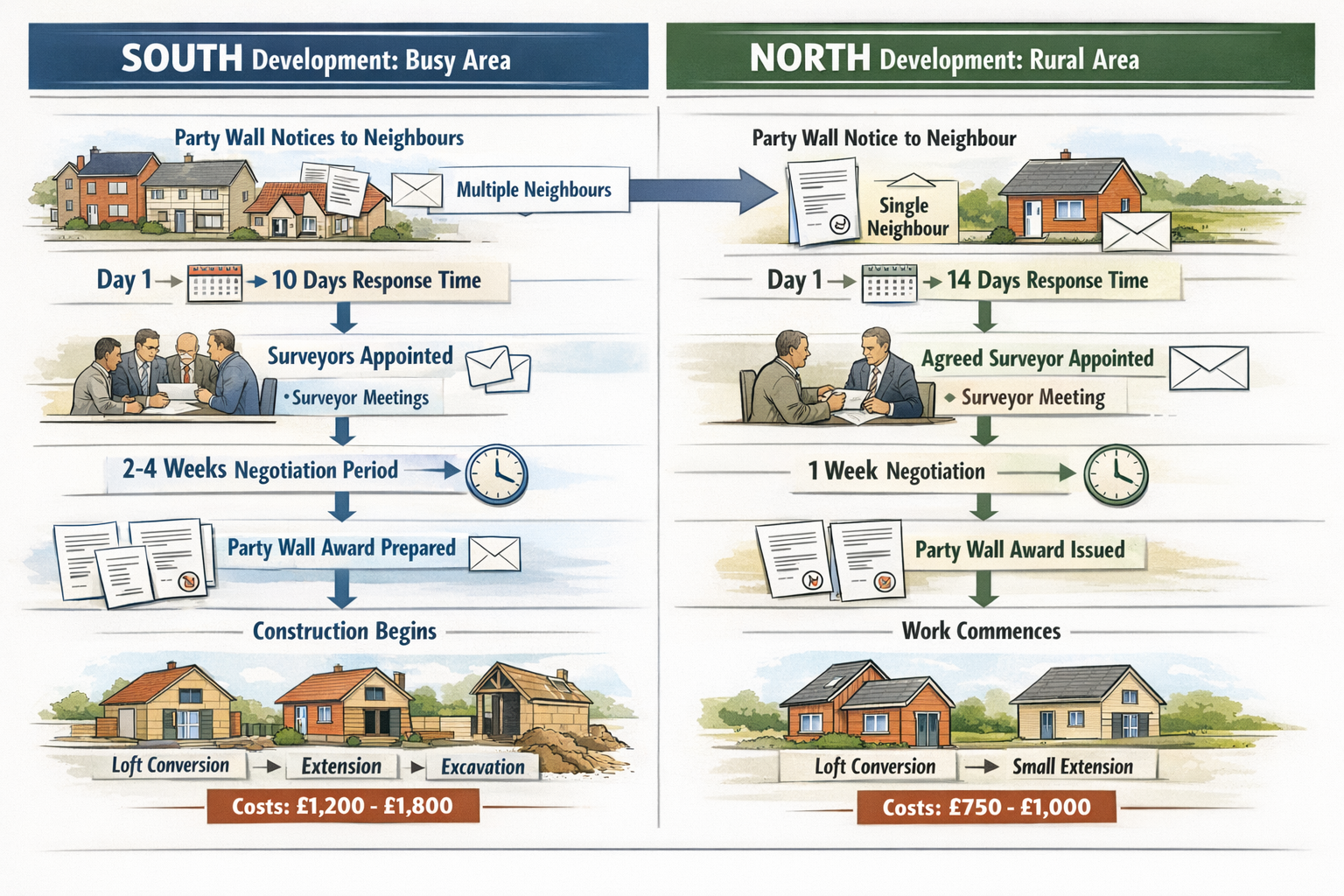
Party Wall Act Compliance in Regional Market Contrasts: Survey Strategies for North vs South 2026 Developments requires fundamentally different approaches to notice serving and surveyor engagement. The Act mandates 2 months' notice for most building works and 1 month for excavation or new boundary walls[2], but regional market realities demand strategic timing adjustments.
Southern Strategy: Managing Multiple Stakeholders
In dense urban environments, particularly across Islington, Southwark, and Westminster, the notice protocol must account for:
1. Comprehensive Neighbour Identification
- Survey all potential affected properties before serving notices
- Consider properties at angles or behind the immediate adjoining owner
- Account for commercial tenants in mixed-use developments (the Act applies to commercial and industrial properties)[1]
2. Staggered Notice Serving
- Serve all notices simultaneously to avoid delays when one neighbour dissents
- Prepare for the possibility that different neighbours may appoint different surveyors
- Budget for multiple surveyor fees if neighbours don't agree to share an "agreed surveyor"
3. Enhanced Documentation
- Provide detailed technical drawings showing all affected boundaries
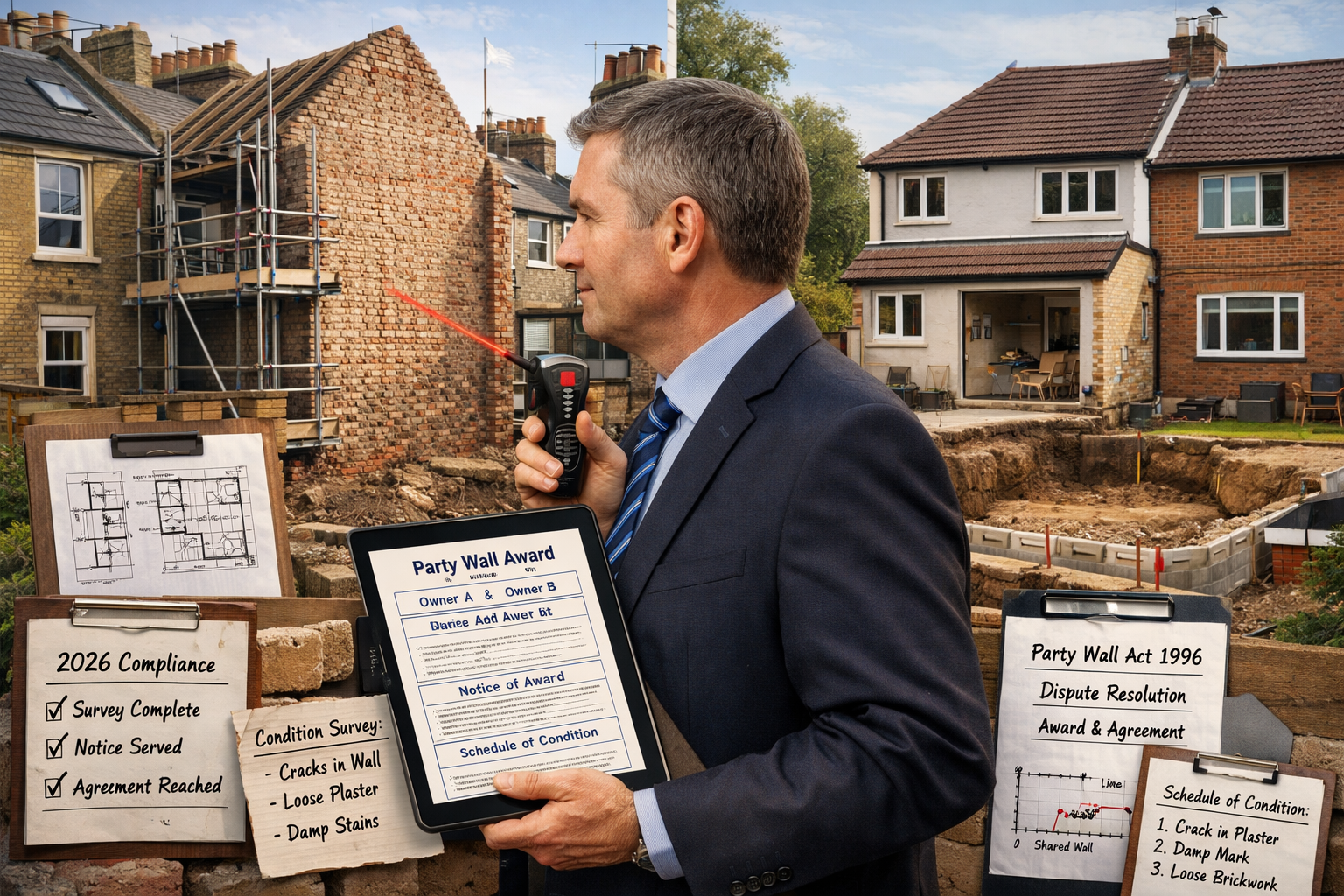
- Include comprehensive schedules of condition to protect against spurious damage claims
- Prepare for more extensive photographic records given the age and condition of urban housing stock
Expert Insight: "In 2026 London developments, we're seeing an average of 2.7 affected neighbours per loft conversion project. The key is treating each relationship as a separate compliance pathway while maintaining consistent technical standards across all awards." — Senior Party Wall Surveyor
Northern Strategy: Depth and Boundary Precision
Northern expansion projects demand different strategic emphases:
1. Excavation-Focused Assessments
- Prioritize accurate measurement of neighbouring foundation depths
- Commission trial pit investigations before serving notices when excavation depth is uncertain
- Address the 3-meter and 6-meter rules explicitly in notice documentation
2. Boundary Clarity
- Resolve any boundary disputes before commencing party wall procedures
- Consider commissioning a boundary survey when property lines are unclear
- Address building walls on property lines with precision to avoid future complications
3. Single-Neighbour Relationship Management
- Invest time in pre-notice discussions to build consensus
- Offer the agreed surveyor approach to reduce costs for both parties
- Provide clear explanations of the process to neighbours unfamiliar with party wall procedures
The party wall notice itself must be technically accurate regardless of region, but the supporting communication strategy should reflect local market familiarity with the process.
Surveyor Selection Strategies by Region
Choosing the right surveyor represents a critical decision point where regional expertise matters significantly. When finding a surveyor for 2026 developments, consider:
For Southern Urban Projects:
✅ Experience with multi-party awards
✅ Familiarity with Victorian/Edwardian construction methods
✅ Track record in high-density neighbourhoods
✅ Ability to manage complex access arrangements
✅ Strong dispute resolution credentials
For Northern Expansion Projects:
✅ Excavation and foundation expertise
✅ Experience with modern construction methods
✅ Understanding of suburban boundary considerations
✅ Practical approach to single-neighbour negotiations
✅ Cost-effective service delivery
The party wall surveyor quotes you receive should reflect these regional competencies. Don't simply select based on price—the cheapest surveyor may lack the specific experience your regional context demands.
Award Documentation: Regional Adaptations
The party wall award itself must comply with statutory requirements, but effective surveyors adapt their approach:
Southern Urban Awards Typically Include:
- More extensive schedules of condition given older building stock
- Detailed access protocols for constrained urban sites
- Specific provisions for protecting neighbouring properties during works
- Clear dispute resolution mechanisms given higher conflict probability
- Comprehensive insurance requirements
Northern Expansion Awards Typically Emphasize:
- Precise excavation depth specifications and monitoring protocols
- Boundary line confirmation and permanent markers
- Foundation design approval processes
- Drainage and water management provisions
- Reinstatement standards for garden areas
Understanding these regional nuances helps property owners set realistic expectations for both party wall costs and timeline requirements.
Practical Implementation: Case Studies and Best Practices for 2026 Compliance
Real-world application of Party Wall Act Compliance in Regional Market Contrasts: Survey Strategies for North vs South 2026 Developments reveals instructive patterns that property owners and developers can learn from.
Southern Case Study: Multi-Party Loft Conversion in London
A 2026 loft conversion project in Wandsworth illustrates urban complexity. The terraced property shared walls with two neighbours and required excavation for underpinning that affected a fourth property behind.
Challenges Encountered:
- One neighbour appointed their own surveyor (requiring a "two surveyor" approach)
- Another neighbour initially dissented, delaying the process by three weeks
- Access arrangements required coordination across multiple properties
- Pre-existing minor cracks in a neighbouring property necessitated extensive photographic evidence
Successful Strategy:
- Served all notices simultaneously on day one
- Commissioned comprehensive schedules of condition before any dissent
- Appointed an experienced surveyor familiar with property law and dispute resolution
- Budgeted £4,200 total for surveyor fees (three neighbours at varying fee levels)
- Built four months into the project timeline for party wall procedures
Outcome: Awards issued after 14 weeks, construction proceeded without disputes, and final costs came in 8% under budget due to avoided delays.
Northern Case Study: Suburban Extension in Greater Manchester
A rear extension project affecting a single semi-detached neighbour demonstrates northern market dynamics.
Challenges Encountered:
- Excavation required going 1.2 meters deeper than neighbouring foundations
- Neighbour was unfamiliar with party wall procedures and initially resistant
- Boundary line had never been formally surveyed
- Existing fence didn't align with legal boundary
Successful Strategy:
- Invested in pre-notice neighbour consultation explaining the statutory process
- Proposed an agreed surveyor approach to minimize costs for both parties
- Commissioned a boundary survey before serving excavation notice
- Provided detailed foundation design drawings with the notice
- Budgeted £950 for surveyor fees and £380 for boundary survey
Outcome: Neighbour agreed to the works after understanding the legal framework, agreed surveyor issued award in 7 weeks, and construction commenced on schedule with positive neighbour relations maintained.
Best Practices for 2026 Regional Compliance
Based on current market conditions and the experiences of property surveyors across England, these best practices emerge:
🔍 Pre-Notice Phase (All Regions)
- Commission desktop research on neighbouring properties
- Review Land Registry documents for ownership clarity
- Conduct informal neighbour consultations where appropriate
- Obtain detailed architectural drawings before serving notices
- Budget realistically for surveyor fees based on regional norms
📋 Notice Serving Phase
- Southern urban: Serve all notices simultaneously, prepare for multiple surveyors
- Northern expansion: Invest time in neighbour education, propose agreed surveyor approach
- Both regions: Ensure notices are technically accurate and include all required information
⚖️ Award Negotiation Phase
- Engage proactively with appointed surveyors
- Respond promptly to information requests
- Consider reasonable neighbour concerns even when not legally required
- Document all communications for potential dispute resolution
🏗️ Construction Phase
- Adhere strictly to award conditions
- Maintain communication with neighbours throughout works
- Document compliance photographically
- Address any concerns immediately before they escalate
💰 Cost Management Strategies
The financial implications of regional compliance variations are significant. Based on 2026 market data[3]:
| Cost Component | Southern Urban | Northern Expansion |
|---|---|---|
| Surveyor Fees (per neighbour) | £950–£1,800 | £750–£1,200 |
| Average Total Surveyor Costs | £2,400–£5,400 (multiple neighbours) | £750–£1,800 (typically single neighbour) |
| Timeline Impact on Holding Costs | 3-4 months (higher finance costs) | 2-3 months (lower holding costs) |
| Dispute Resolution (if needed) | £2,500–£8,000 | £1,500–£4,000 |
These figures demonstrate why regional strategy matters—a southern London project might allocate £5,000 for party wall compliance, while a northern extension budgets £1,200 for the same statutory process.
Avoiding Common Regional Pitfalls
Southern Urban Mistakes:
❌ Underestimating the number of affected neighbours
❌ Serving notices sequentially rather than simultaneously
❌ Selecting surveyors without urban density experience
❌ Failing to budget adequately for multiple surveyor appointments
❌ Neglecting comprehensive schedules of condition
Northern Expansion Mistakes:
❌ Assuming simplicity because there's only one neighbour
❌ Neglecting accurate excavation depth measurements
❌ Proceeding without boundary clarity
❌ Failing to explain the statutory process to unfamiliar neighbours
❌ Selecting surveyors without excavation expertise
Emerging 2026 Trends Affecting Regional Compliance
Several developments are reshaping party wall compliance across both regions:
🤖 Digital Documentation: More surveyors are using digital tools for schedules of condition, reducing costs and improving accuracy across all regions.
📱 Neighbour Communication Platforms: Apps facilitating party wall communication are gaining traction, particularly in southern urban areas with multiple stakeholders.
🏢 Commercial Integration: The rise of mixed-use developments means party wall procedures increasingly involve commercial tenants, particularly in urban regeneration areas[1].
⚡ Accelerated Timelines: Competitive surveyor markets in both regions are reducing average award timelines by 10-15% compared to 2024.
💼 Professional Standards: Enhanced RICS guidance for 2026 emphasizes regional competency, encouraging surveyors to develop specialized expertise.
For property owners navigating these complexities, engaging residential property advice specialists early in the planning process prevents costly mistakes and timeline delays.
Conclusion: Strategic Regional Approaches to Party Wall Compliance in 2026
Party Wall Act Compliance in Regional Market Contrasts: Survey Strategies for North vs South 2026 Developments demands recognition that one-size-fits-all approaches fail in England's divergent property markets. Southern urban density creates multi-party complexity requiring sophisticated stakeholder management, comprehensive documentation, and higher budgets. Northern expansion projects demand precision in excavation specifications, boundary clarity, and effective single-neighbour relationship building.
The fundamental legal framework remains consistent—the Party Wall Act applies equally across England and Wales—but successful compliance requires tailored strategies reflecting regional market realities. Property owners and developers who recognize these distinctions, budget appropriately, and engage regional expertise position themselves for smoother projects with fewer disputes and delays.
Actionable Next Steps
For Southern Urban Developers:
- Budget £2,500–£5,500 for party wall compliance on typical projects
- Add 3-4 months to project timelines for party wall procedures
- Commission schedules of condition before serving any notices
- Engage surveyors with proven urban multi-party experience
- Serve all notices simultaneously to avoid cascading delays
For Northern Expansion Projects:
- Budget £1,000–£2,000 for party wall compliance including boundary surveys
- Add 2-3 months to project timelines for procedures
- Invest in pre-notice neighbour consultations to build consensus
- Verify excavation depths through trial pits if uncertain
- Propose agreed surveyor approaches to minimize costs
For All Property Owners:
- Engage expert party wall advice during initial project planning
- Understand that party wall compliance is a statutory requirement, not an optional process
- Recognize that upfront investment in proper procedures prevents expensive disputes
- Maintain positive neighbour relations throughout the process
- Document everything comprehensively to protect against future claims
The 2026 property development landscape presents both challenges and opportunities. Diverging regional growth patterns have created distinct compliance environments, but property owners who adapt their strategies accordingly will navigate party wall requirements efficiently, maintain positive neighbour relationships, and complete projects on time and within budget.
Whether undertaking a loft conversion in London, a rear extension in Hounslow, or a new build in northern suburbs, understanding regional party wall dynamics transforms compliance from an obstacle into a manageable project component. The key lies in recognizing that geography matters—not in the law itself, but in how market conditions shape its practical application.
References
[1] Party Wall Agreements In Data Centre Developments 2026 Compliance Amid Ai Driven Uk Demand – https://nottinghillsurveyors.com/blog/party-wall-agreements-in-data-centre-developments-2026-compliance-amid-ai-driven-uk-demand
[2] Party Wall Agreement – https://hoa.org.uk/advice/guides-for-homeowners/i-am-improving/party-wall-agreement/
[3] Party Wall Agreement London 2026 – https://www.mayfairstudio.co.uk/blog/party-wall-agreement-london-2026