
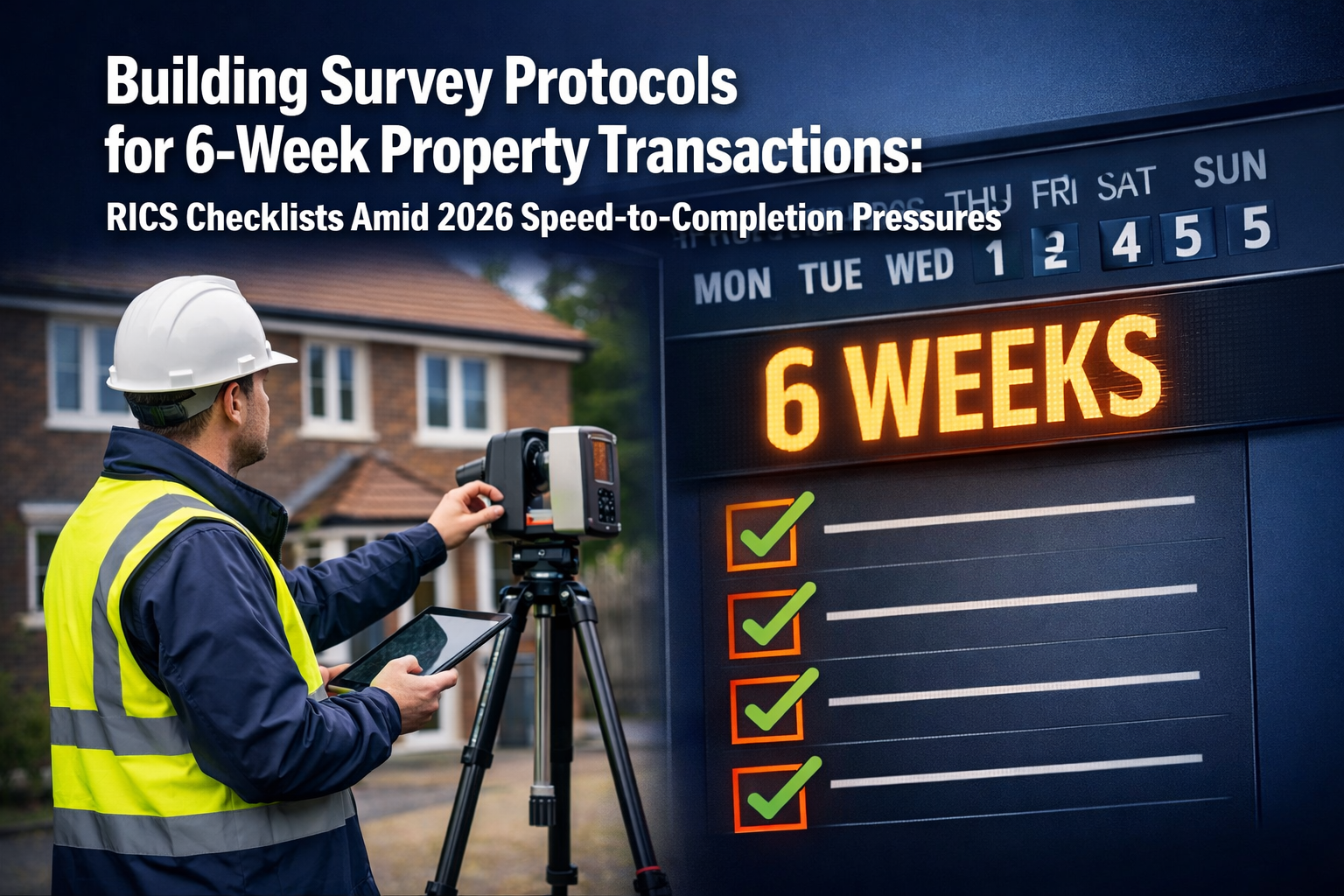
The UK property market faces an unprecedented challenge in 2026: average transaction times hover around 17.6 weeks, yet consumer demand increasingly pushes for completions in just 6.78 weeks. This dramatic gap creates intense pressure on building surveyors who must maintain rigorous RICS standards while accelerating their processes. Building Survey Protocols for 6-Week Property Transactions: RICS Checklists Amid 2026 Speed-to-Completion Pressures represents the critical evolution in how property professionals balance thoroughness with efficiency in an increasingly fast-paced market.
For surveyors, solicitors, and property buyers alike, understanding how to adapt Level 3 building survey protocols for accelerated due diligence without compromising accuracy has become essential. The traditional methodologies that served the industry well for decades now require strategic refinement to meet modern expectations while preserving the professional standards that protect all parties in property transactions.
Key Takeaways
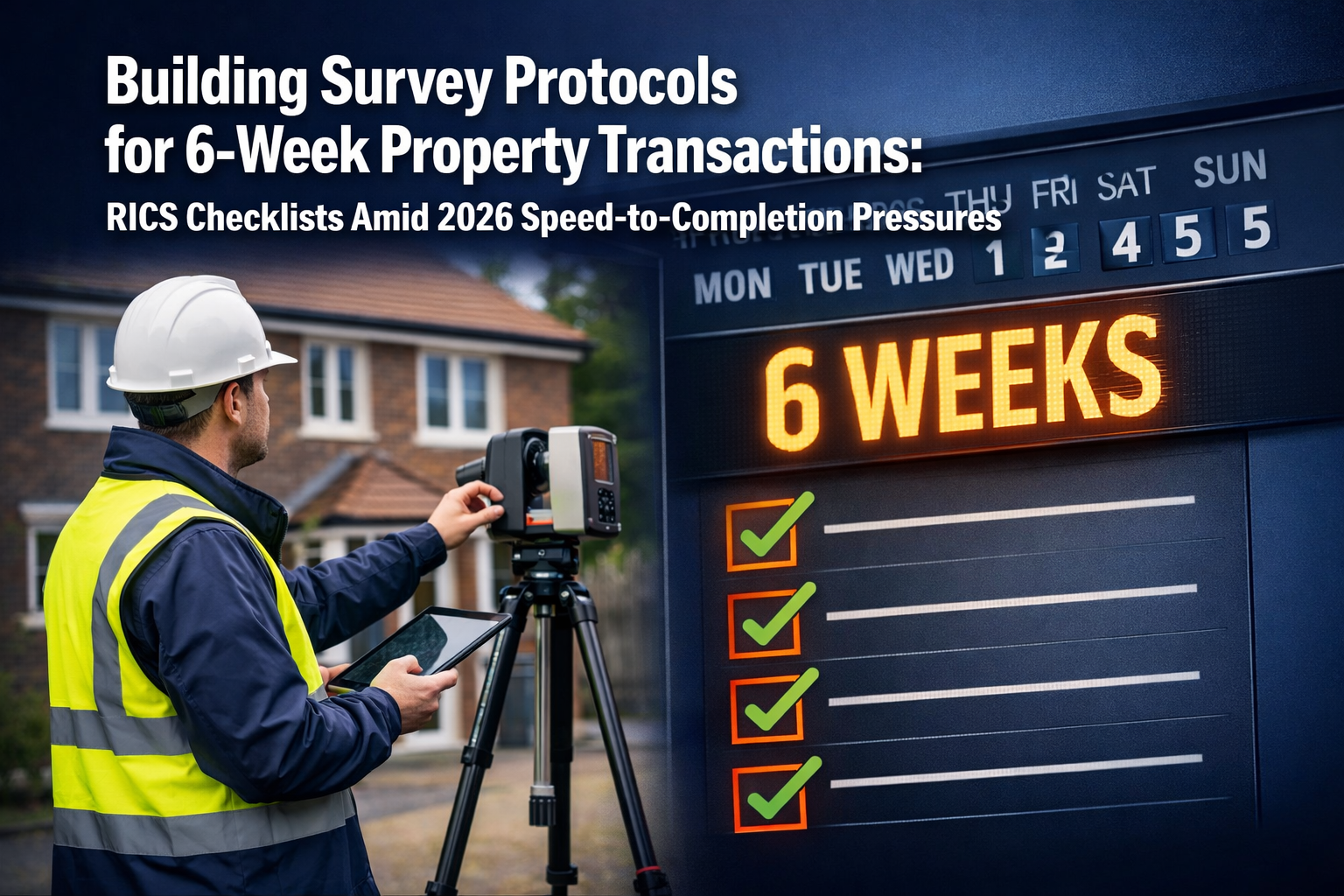
- Speed vs. Quality Balance: Surveyors must compress traditional 2-3 week survey timelines into 5-7 days while maintaining RICS quality standards through enhanced pre-inspection preparation and technology integration
- Enhanced RICS Checklists: Updated protocols incorporate digital tools, prioritized inspection sequences, and streamlined reporting templates specifically designed for accelerated transactions
- Risk Management: Fast-track surveys require more rigorous pre-screening, clear scope definitions, and enhanced communication protocols to prevent quality compromise
- Technology Enablement: Thermal imaging, drone surveys, and digital reporting platforms have become essential tools rather than optional enhancements for meeting 6-week completion targets
- Professional Standards: RICS 2026 quality strengthening initiatives provide the framework for maintaining professional integrity even under compressed timelines
Understanding the 6-Week Transaction Challenge
The property market transformation in 2026 has created a fundamental tension between consumer expectations and practical realities. While buyers increasingly demand rapid completions—driven by competitive markets and financial pressures—the comprehensive due diligence required for major property purchases cannot be rushed without significant risk.
The Current Transaction Timeline Gap
Traditional property transactions in the UK follow a well-established pattern that typically spans 17-18 weeks from offer acceptance to completion. This timeline includes:
- Mortgage application and approval: 3-4 weeks
- Property survey and valuation: 2-3 weeks
- Legal searches and conveyancing: 8-10 weeks
- Exchange and completion preparation: 2-3 weeks
However, consumer research consistently shows that buyers would prefer transactions to complete in approximately 6-7 weeks. This preference stems from multiple factors including rental overlap costs, uncertainty stress, and competitive market conditions where faster buyers secure desirable properties.
Why Building Surveys Face Particular Pressure
Among all transaction components, building surveys face unique challenges in acceleration because they involve:
🔍 Physical site inspection that cannot be rushed without missing critical defects
📋 Comprehensive documentation across multiple building systems and components
🏗️ Technical analysis requiring professional judgment and experience
📊 Detailed reporting that must be clear, accurate, and legally defensible
The RICS building survey standards establish baseline requirements that ensure thorough property assessment [5]. These standards exist to protect buyers from purchasing properties with hidden defects that could cost thousands in unexpected repairs.
The Cost of Getting It Wrong
When surveys are rushed without proper protocols, the consequences can be severe:
- Missed structural defects leading to post-purchase disputes
- Inadequate documentation creating liability issues for surveyors
- Buyer dissatisfaction and potential professional negligence claims
- Market reputation damage for surveying practices
Understanding what to do before an RICS home survey helps buyers prepare for efficient inspections, but the primary responsibility for protocol adaptation rests with surveying professionals.
Building Survey Protocols for 6-Week Property Transactions: Adapting RICS Standards
The evolution of building survey protocols for accelerated transactions requires systematic adaptation of traditional methodologies while preserving the core quality standards that define professional practice. The RICS quality strengthening initiatives introduced in 2026 provide the framework for this adaptation [1].
Enhanced Pre-Inspection Preparation
The key to successful fast-track surveys lies in front-loading preparation work before the physical site visit. This approach compresses overall timelines without reducing on-site inspection quality.
Digital Property Intelligence Gathering
Modern surveyors now routinely conduct comprehensive desktop research before site visits:
- Historical records review: Previous surveys, planning applications, building control records
- Aerial and satellite imagery: Roof condition, site layout, potential access issues
- Local authority databases: Conservation areas, listed building status, flood risk zones
- Utility and service records: Known infrastructure issues, major works history
This pre-inspection intelligence allows surveyors to develop targeted inspection plans that maximize on-site efficiency.
Client Pre-Survey Questionnaire
Structured questionnaires sent to sellers and estate agents gather critical information:
| Information Category | Key Questions | Time Saved |
|---|---|---|
| Property History | Age, previous renovations, known issues | 30-45 min |
| Access Arrangements | Keys, alarm codes, vacant possession | 15-20 min |
| Recent Works | Guarantees, certificates, contractor details | 20-30 min |
| Utilities | Service locations, meter access, shutoff valves | 15-20 min |
Streamlined On-Site Inspection Protocols
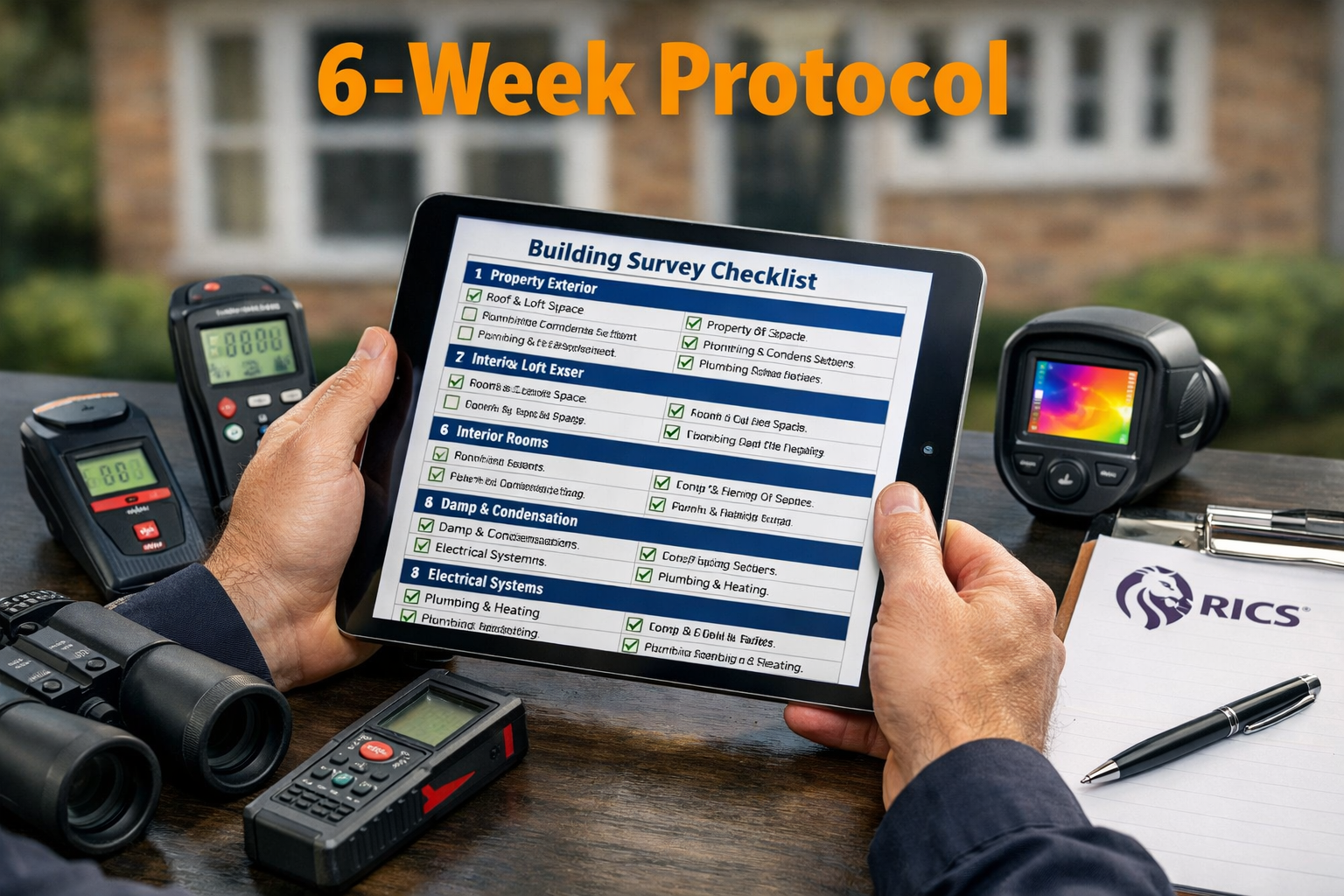
The physical inspection represents the most time-sensitive component of accelerated surveys. RICS-compliant protocols for 6-week transactions incorporate several efficiency enhancements:
Technology-Enhanced Data Collection
Modern surveying equipment dramatically reduces inspection time while improving accuracy:
Thermal Imaging Cameras 🌡️
- Rapid identification of insulation defects, moisture penetration, and heat loss
- Reduces physical investigation time by 40-50%
- Provides visual documentation for reports
Laser Distance Measurers
- Instant room measurements and area calculations
- Eliminates manual tape measure errors
- Integrates directly with reporting software
Digital Voice Recording
- Real-time observation capture during inspection
- Reduces note-taking interruptions
- Enables transcription for report compilation
Drone Surveys
- Roof and chimney inspection without scaffolding
- Reduces high-level access time by 60-70%
- Provides comprehensive visual records
These technologies are outlined in the RICS equipment checklist as recommended tools for modern practice [3].
Prioritized Inspection Sequences
Fast-track protocols follow a risk-prioritized inspection sequence that ensures critical elements receive thorough attention:
Priority 1: Structural and Safety-Critical Elements (40% of inspection time)
- Foundation and substructure condition
- Load-bearing walls and structural frames
- Roof structure and coverings
- Damp and timber defects requiring specialized surveys
Priority 2: Building Envelope and Services (35% of inspection time)
- External walls and weatherproofing
- Windows and doors
- Heating, electrical, and plumbing systems
- Drainage and external works
Priority 3: Internal Finishes and Minor Elements (25% of inspection time)
- Internal decorations and fixtures
- Built-in furniture and appliances
- Minor defects and maintenance items
This prioritization ensures that if time constraints arise, the most significant issues receive complete attention.
Accelerated Reporting and Delivery
Report compilation traditionally consumes 5-7 working days after inspection. Fast-track protocols compress this to 2-3 working days through several innovations:
Template-Based Reporting Systems
Modern surveying software includes RICS-compliant templates with:
- Pre-populated standard text for common conditions and defects
- Automated formatting ensuring consistent professional presentation
- Integrated photo management linking images to relevant report sections
- Digital signature and authentication enabling immediate delivery
Structured Reporting Hierarchy
Reports follow a standardized structure that facilitates rapid compilation:
- Executive Summary (prepared first): Key findings, major defects, cost implications
- Condition Ratings (completed on-site): Traffic light system for building elements
- Detailed Observations (dictated during inspection): Room-by-room findings
- Technical Analysis (post-inspection): Professional assessment and recommendations
- Appendices (automated): Photos, diagrams, reference materials
This structure allows clients to receive preliminary findings within 24 hours while the comprehensive report follows within 2-3 days.
RICS Checklists for Speed-to-Completion Pressures in 2026
The Royal Institution of Chartered Surveyors has responded to market pressures by developing enhanced guidance specifically addressing accelerated transaction timelines. These updated protocols balance speed with the quality strengthening initiatives that define professional standards in 2026 [1].
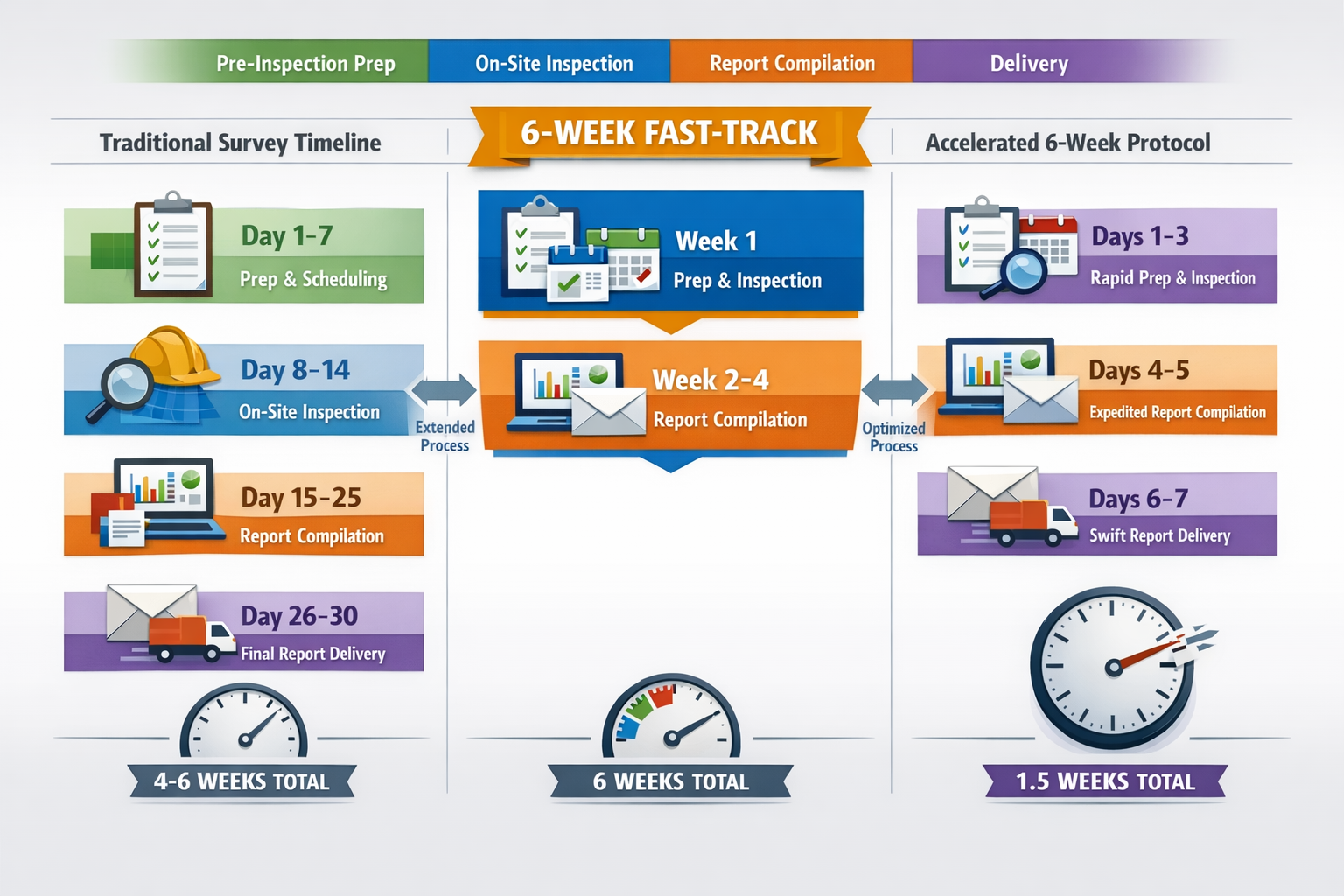
The Updated RICS Fast-Track Survey Framework
RICS guidance for 6-week transactions establishes clear parameters for accelerated surveys while maintaining professional standards:
Scope Definition and Client Communication
Mandatory Pre-Engagement Procedures:
✅ Written acknowledgment from clients that accelerated timelines may limit certain inspection elements
✅ Clear scope definition specifying exactly what will and won't be inspected within compressed timeframes
✅ Risk disclosure explaining potential limitations of fast-track approaches
✅ Alternative options presenting standard timeline surveys for comparison
This enhanced communication protects both clients and surveyors by establishing realistic expectations from the outset.
Quality Assurance Checkpoints
Fast-track surveys incorporate mandatory quality gates at key stages:
Pre-Inspection Gate
- Desktop research completion verification
- Equipment calibration and functionality checks
- Access arrangements confirmation
- Weather and site condition assessment
On-Site Gate
- Minimum time allocation verification (no survey under 3 hours for typical residential)
- Priority element inspection completion
- Photographic evidence standards met
- Preliminary findings documented
Post-Inspection Gate
- Report peer review (for properties over £500,000 or with significant defects)
- Technical accuracy verification
- RICS standard compliance check
- Client communication confirmation
Property-Specific Protocol Adaptations
Different property types require tailored approaches within the 6-week framework:
Modern Properties (Built Post-2000)
Inspection Focus: Building regulations compliance, new-build defects, warranty coverage
Time Allocation: 3-4 hours on-site (reduced from standard 5-6 hours)
Technology Priority: Thermal imaging for insulation defects, moisture meters for new-build dampness
Report Emphasis: Snag lists, developer warranty status, building control certification
For detailed guidance on modern property surveys, see our analysis of building survey protocols for new-build properties in 2026 [4].
Period Properties (Pre-1900)
Inspection Focus: Structural movement, traditional construction materials, historical alterations
Time Allocation: 5-7 hours on-site (cannot be significantly reduced)
Technology Priority: Drone surveys for high-level elements, moisture analysis for rising damp
Report Emphasis: Conservation considerations, traditional repair specifications, specialist recommendations
Converted Properties (Flats, Maisonettes)
Inspection Focus: Conversion quality, shared elements, lease obligations
Time Allocation: 3-5 hours on-site depending on size and complexity
Technology Priority: Acoustic testing for sound insulation, thermal imaging for party walls
Report Emphasis: Lease review, service charge implications, shared repair responsibilities
Regional Implementation Considerations
Survey protocols must also adapt to regional variations in property types and market conditions. Professional surveyors operating across London and surrounding areas implement location-specific protocols:
Inner London Considerations
- Higher property values requiring enhanced due diligence
- Complex leasehold arrangements and shared ownership structures
- Conservation area and listed building complications
- Areas served include Kensington, Chelsea, and Marylebone
Outer London and Suburbs
- Larger properties with more extensive grounds
- Greater variety in construction types and ages
- More accessible inspection conditions
- Coverage areas include Wimbledon, Kingston, Uxbridge, and Harrow
East London Development Areas
- New-build and conversion properties predominate
- Modern construction requiring different inspection approaches
- Rapid market changes affecting valuation context
- Locations include Stratford, Woolwich, and Lewisham
Managing Client Expectations Through the Process
"The most successful fast-track surveys are those where clients understand both the capabilities and limitations of accelerated protocols from the very beginning." — RICS Professional Standards
Transparent Communication Framework:
📞 Initial Consultation (Day 0)
- Explain 6-week transaction requirements
- Assess property suitability for fast-track approach
- Discuss potential limitations and alternative options
📅 Pre-Inspection Briefing (Day 1-2)
- Confirm access arrangements and timing
- Outline inspection scope and methodology
- Set expectations for preliminary and final reporting
🔍 Post-Inspection Update (Day 3-4)
- Provide verbal summary of key findings
- Highlight any significant concerns requiring immediate attention
- Confirm final report delivery timeline
📊 Report Delivery and Review (Day 5-7)
- Deliver comprehensive written report
- Offer consultation to discuss findings and implications
- Provide guidance on next steps after receiving survey results
This structured communication approach ensures clients remain informed throughout the accelerated process while managing expectations about what fast-track surveys can realistically achieve.
Maintaining Professional Standards Under Time Pressure
The fundamental challenge of Building Survey Protocols for 6-Week Property Transactions: RICS Checklists Amid 2026 Speed-to-Completion Pressures lies in preserving professional integrity while meeting market demands. RICS quality strengthening initiatives provide the ethical and practical framework for this balance [1].
Non-Negotiable Professional Standards
Certain elements of building surveys cannot be compromised regardless of timeline pressures:
Structural Safety Assessment
Minimum Requirements:
- Visual inspection of all accessible structural elements
- Investigation of visible cracks, movement, or distortion
- Assessment of foundation and substructure condition where accessible
- Evaluation of roof structure integrity
Time Allocation: This element must receive adequate attention even if other areas are streamlined. Structural issues represent the highest financial and safety risks for buyers.
Damp and Moisture Analysis
Minimum Requirements:
- Moisture meter testing of suspect areas
- Visual assessment of all walls, floors, and ceilings
- Identification of potential water ingress routes
- Evaluation of ventilation and condensation risks
Technology Support: Modern moisture meters and thermal imaging cameras enable faster yet more accurate damp detection than traditional methods.
Professional Liability Protection
Surveyors operating under accelerated timelines must maintain robust professional practices:
✓ Professional Indemnity Insurance adequate for property values and risk profiles
✓ Detailed file documentation recording inspection scope, limitations, and decision-making
✓ Clear written communications establishing scope and managing expectations
✓ Continuing Professional Development in fast-track methodologies and technologies
When to Decline Fast-Track Engagements
Professional judgment requires recognizing when accelerated surveys are inappropriate:
Property Characteristics Unsuitable for Fast-Track:
- Large estates or properties over 400 square meters
- Severely dilapidated properties requiring extensive investigation
- Properties with known complex structural issues
- Listed buildings requiring specialist conservation assessment
- Properties with significant access limitations
Client Circumstances Requiring Standard Timelines:
- First-time buyers unfamiliar with property purchase processes
- Properties at the upper end of buyer budgets where thorough due diligence is critical
- Situations where clients express anxiety about rushed processes
- Transactions involving vulnerable parties requiring additional protection
Declining inappropriate fast-track engagements protects both professional standards and client interests, even when it means losing business in the short term.
Technology Integration and Training
Meeting 2026 speed-to-completion pressures requires surveyors to embrace technological advancement while maintaining core professional competencies:
Essential Technology Skills:
- Thermal imaging interpretation and reporting
- Drone operation and aerial photography analysis
- Digital reporting platform proficiency
- Mobile data capture and cloud synchronization
- Video recording and annotation for complex defects
Ongoing Training Requirements:
- RICS-accredited fast-track methodology courses
- Equipment manufacturer certification programs
- Software platform training and updates
- Peer learning and case study review sessions
The chartered surveyor professional development framework ensures practitioners maintain currency with evolving best practices.
Quality Metrics and Performance Monitoring
Professional practices implementing fast-track protocols should establish quality monitoring systems to ensure standards remain high:
| Quality Metric | Target Standard | Monitoring Frequency |
|---|---|---|
| Report Delivery Time | Within 3 working days | Every survey |
| Client Satisfaction | 4.5+ out of 5.0 rating | Monthly aggregate |
| Defect Detection Rate | Comparable to standard surveys | Quarterly review |
| Professional Complaints | <1% of surveys | Continuous monitoring |
| Peer Review Outcomes | 95%+ compliance rating | Sample-based quarterly |
These metrics provide objective evidence that accelerated protocols maintain professional standards rather than compromising quality for speed.
Conclusion
Building Survey Protocols for 6-Week Property Transactions: RICS Checklists Amid 2026 Speed-to-Completion Pressures represents a fundamental evolution in how property professionals balance thoroughness with efficiency. The gap between traditional 17.6-week transaction timelines and consumer demand for 6-7 week completions creates unprecedented pressure on surveyors to adapt their methodologies while preserving the professional standards that protect all parties.
The key to successful fast-track surveys lies in strategic protocol adaptation rather than simple corner-cutting. Enhanced pre-inspection preparation, technology-enabled data collection, prioritized inspection sequences, and streamlined reporting processes enable surveyors to compress timelines without compromising the quality of their professional assessments.
RICS quality strengthening initiatives provide the framework for maintaining professional integrity under time pressure, establishing clear parameters for scope definition, client communication, and quality assurance checkpoints. However, success ultimately depends on individual practitioners exercising professional judgment about when fast-track approaches are appropriate and when standard timelines remain necessary.
Actionable Next Steps
For Property Buyers:
- Discuss timeline expectations with your surveyor during initial consultation
- Understand the scope and limitations of fast-track survey protocols
- Prepare property access and information in advance to facilitate efficient inspections
- Consider whether your specific property and circumstances are suitable for accelerated surveys
- Review available resources on common myths about property surveys to make informed decisions
For Surveying Professionals:
- Invest in technology platforms that enable efficient data collection and reporting
- Develop standardized fast-track protocols tailored to different property types
- Establish clear client communication frameworks managing expectations from initial contact
- Implement quality monitoring systems tracking performance metrics
- Pursue continuing professional development in accelerated survey methodologies
- Maintain professional judgment about engagement suitability rather than accepting all fast-track requests
For Industry Stakeholders:
- Recognize that sustainable transaction acceleration requires coordination across all parties, not just surveyors
- Support development of technology standards and interoperability enabling efficient information sharing
- Advocate for realistic timeline expectations that balance speed with due diligence requirements
- Promote professional standards that protect consumers while enabling market efficiency
The property market of 2026 demands speed, but not at the expense of accuracy and professional integrity. By embracing enhanced protocols, leveraging modern technology, and maintaining unwavering commitment to RICS standards, surveyors can meet the challenge of 6-week transactions while continuing to protect buyers from the costly consequences of inadequate property assessment.
References
[1] Building Survey Standards Evolution How Rics Quality Strengthening Initiatives Impact Surveyor Practice In 2026 – https://nottinghillsurveyors.com/blog/building-survey-standards-evolution-how-rics-quality-strengthening-initiatives-impact-surveyor-practice-in-2026
[2] House Survey Checklist – https://www.comparemymove.com/guides/surveying/house-survey-checklist
[3] Equipment Checklist – https://www.rics.org/profession-standards/rics-standards-and-guidance/sector-standards/building-surveying-standards/home-surveys/equipment-checklist
[4] Building Survey Protocols For New Build Properties In 2026 Spotting Defects Amid 2 5 Price Growth Forecasts – https://nottinghillsurveyors.com/blog/building-survey-protocols-for-new-build-properties-in-2026-spotting-defects-amid-2-5-price-growth-forecasts
[5] Home Surveys – https://www.rics.org/profession-standards/rics-standards-and-guidance/sector-standards/building-surveying-standards/home-surveys