

The prime London property market is experiencing a seismic shift in 2026. New budget measures targeting homes valued above £2 million are fundamentally changing how properties are assessed, sold, and valued. For surveyors working in this elite segment, the Valuation Adjustments for 2026 Budget Tax Hits on Prime London Properties: Surveyor Strategies Post-£2M Fee Reforms represent both a challenge and an opportunity to demonstrate professional expertise in navigating complex fiscal landscapes.
As the 2026 revaluation takes effect on 1 April 2026, property professionals must recalibrate their valuation methodologies to account for substantial changes in the rating system. This marks one of the most significant shifts in recent years, with the Autumn Budget forecasting a 10.2 percent increase in Business Rates revenue for Government in 2026/27 [1]. For prime London properties, these changes extend beyond commercial rates to influence residential valuations, buyer sentiment, and market dynamics.
Key Takeaways
- 🏛️ The 2026 revaluation introduces complex multiplier frameworks affecting properties above £2M, with more than 1,500 additional properties now falling within high-value brackets
- 📊 Transitional relief caps limit annual increases to 30% for large properties in year one, but cumulative effects over three years remain substantial
- 🔍 Surveyors must integrate tax impact analysis into standard valuation reports, accounting for Crossrail supplements and London-specific levies
- 💷 Foreign buyer return and stable southern markets are creating opportunities despite tax headwinds, requiring nuanced market positioning
- ✅ Professional valuation adjustments now require detailed documentation of tax liabilities, relief eligibility, and comparative market analysis
Understanding the 2026 Budget Tax Framework for Prime Properties
The 2026 revaluation represents a fundamental restructuring of how high-value properties are assessed and taxed in London. The Valuation Office Agency (VOA) has reassessed rateable values based on rental values between the 2023 and 2026 Rating Lists, reflecting sharp increases across many sectors [1].
The New Multiplier Structure
From April 2026, a more complex multiplier framework applies to all properties. While headline multipliers appear lower due to overall rateable value (RV) uplifts, the structure is wider and more segmented, with rates determined by both property use and RV size [1].
Key threshold changes include:
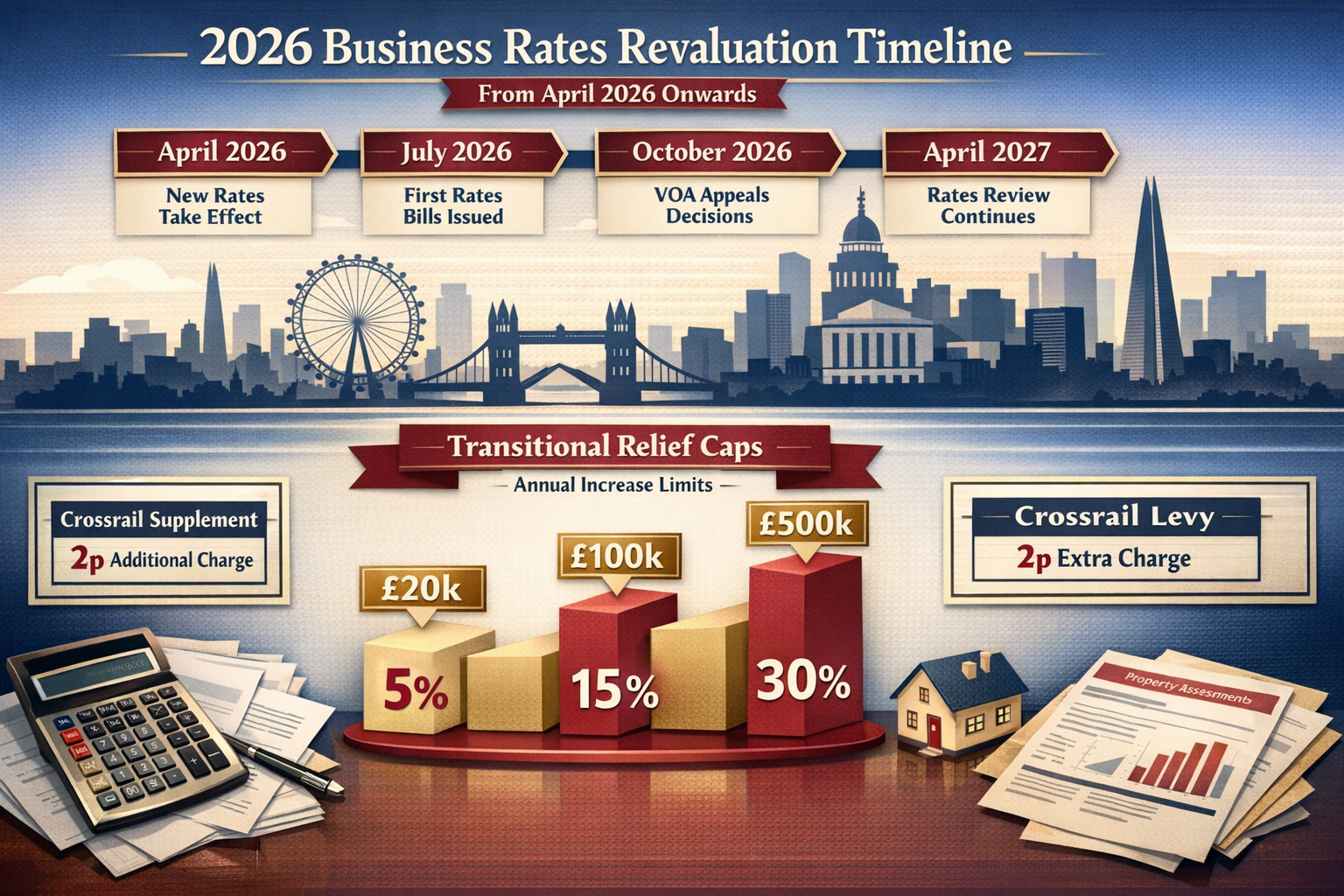
| Property Size | RV Threshold | Transitional Cap 2026/27 | Transitional Cap 2027/28 |
|---|---|---|---|
| Small | Up to £20,000 (£28,000 London) | 5% | 10% |
| Medium | £20,000 to £100,000 | 15% | 25% |
| Large | Above £100,000 | 30% | 25% |
For prime residential properties that generate rental income or have commercial elements, these thresholds create significant planning considerations. Properties valued above £2 million often contain mixed-use elements, home offices, or investment components that trigger business rates assessments.
London-Specific Pressures and Supplements
London properties face additional cost pressures beyond standard business rates. The continuing Crossrail/City of London supplements of 2p apply to properties with RVs over £75,000 [1]. This seemingly modest addition compounds over time, particularly for properties in central London postcodes like SW1, W1, and SW3.
The withdrawal of Covid-era retail, hospitality, and leisure (RHL) relief has left a significant gap. The previous 40 percent relief provided £1.8 billion of support, which is not fully replaced by new multipliers [1]. While approximately 750,000 RHL properties gain access to permanently lower multipliers, the net effect for high-value mixed-use properties remains negative.
Valuation Adjustments for 2026 Budget Tax Hits: Surveyor Methodologies
Professional surveyors must now integrate comprehensive tax impact analysis into every prime property valuation. The Valuation Adjustments for 2026 Budget Tax Hits on Prime London Properties: Surveyor Strategies Post-£2M Fee Reforms require a multi-layered approach that considers both immediate and long-term fiscal implications.
Core Adjustment Principles
When conducting property valuation work on properties above £2 million, surveyors should apply the following adjustment framework:
1. Baseline Market Value Assessment 📋
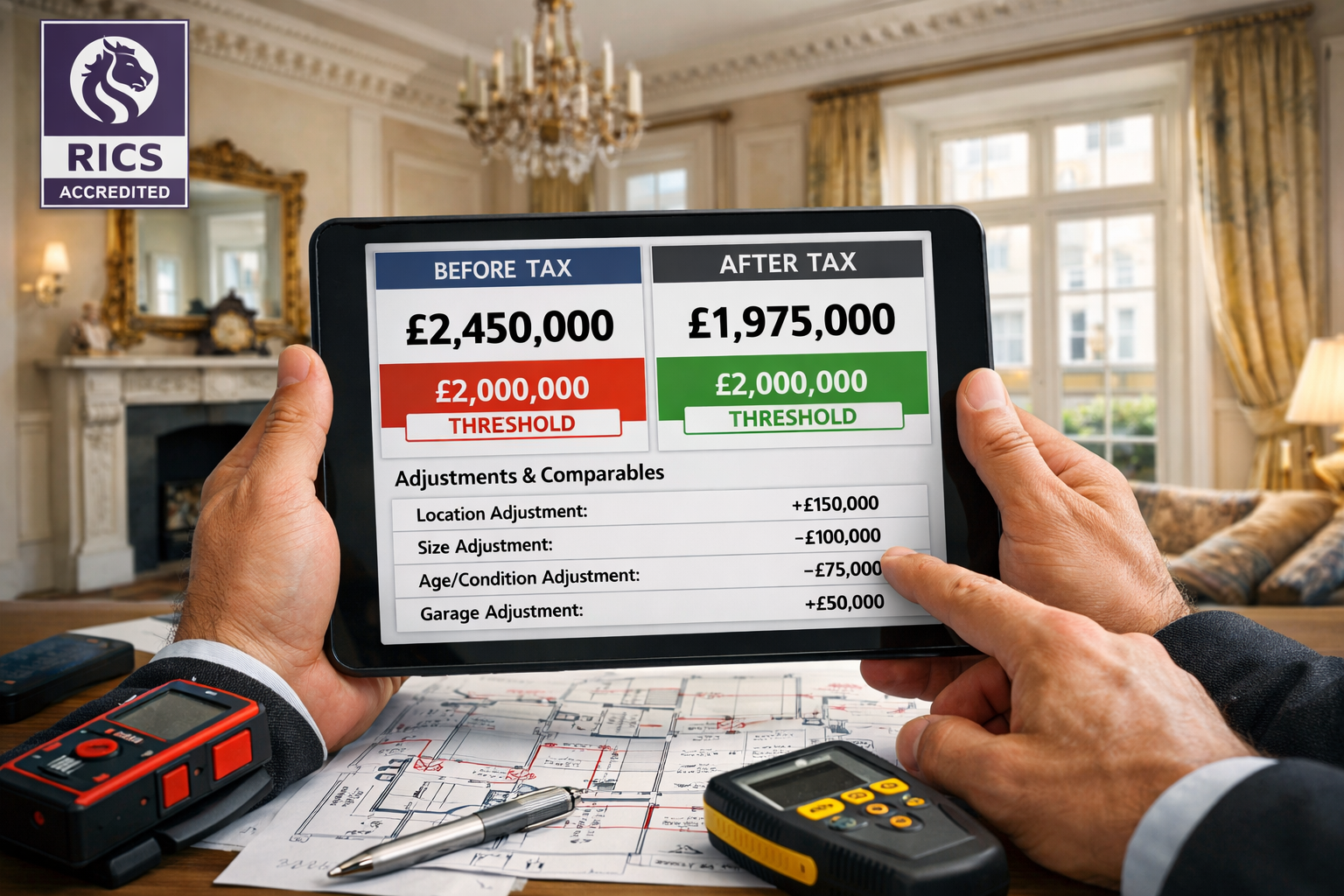
- Establish pre-tax market value using comparable sales data
- Account for location premiums in prime postcodes
- Consider property condition through detailed building surveys
- Document all period features and value-adding elements
2. Tax Liability Calculation 💰
- Identify all applicable business rates components
- Calculate Crossrail supplements for eligible properties
- Project transitional relief phasing over three-year period
- Estimate cumulative tax burden through 2028/29
3. Market Sentiment Adjustment 📉
- Factor in buyer resistance to high-tax properties
- Assess competitive positioning against sub-£2M alternatives
- Evaluate foreign buyer appetite and currency advantages
- Consider rental yield implications for investment properties
4. Negotiation Buffer Integration 🤝
- Build in adjustment range for negotiation strategies
- Document justification for downward adjustments
- Prepare comparative analysis with similar properties
- Establish defendable valuation floor
Practical Surveyor Checklist for High-Value Properties
✅ Pre-Inspection Phase:
- Review VOA assessment records and rateable value history
- Obtain previous valuation reports and tax assessments
- Research comparable sales within 6-month window
- Identify any pending planning applications or modifications
✅ During Inspection:
- Document all commercial or mixed-use elements
- Photograph features that justify premium valuations
- Assess property condition with tax implications in mind
- Measure and verify floor areas against VOA records
✅ Post-Inspection Analysis:
- Calculate adjusted market value with tax burden factored
- Prepare sensitivity analysis showing value at different tax scenarios
- Document all assumptions and data sources
- Provide clear recommendations for clients
✅ Reporting Requirements:
- Include dedicated section on tax implications
- Present before-tax and after-tax valuations
- Explain transitional relief eligibility and duration
- Offer strategic recommendations for timing and pricing
For properties requiring comprehensive assessment, a Level 3 survey provides the detailed analysis necessary to support valuation adjustments in the current tax environment.
Strategic Responses to Prime London Market Conditions in 2026
Despite tax headwinds, the prime London property market shows resilience. Expert forecasts indicate stable southern markets with selective opportunities for well-positioned properties [2]. The return of foreign buyers, particularly from regions experiencing currency advantages, provides a counterbalance to domestic buyer hesitation.
Market Segmentation Strategies
Surveyors must recognize that the £2 million threshold creates distinct market segments with different dynamics:
Properties £1.5M – £2M (Just Below Threshold) 🏠
- Increased demand from buyers avoiding higher tax bracket
- Premium pricing power for properties just under threshold
- Strategic renovation considerations to maintain sub-£2M valuation
- Enhanced marketability compared to slightly larger properties
Properties £2M – £3M (Lower Prime) 🏘️
- Maximum tax impact relative to property value
- Requires strongest justification for premium pricing
- Benefits from foreign buyer interest and rental yield focus
- Opportunity for negotiation leverage on behalf of buyers
Properties £3M+ (Upper Prime) 🏛️
- Tax burden proportionally smaller relative to total value
- Buyer pool less price-sensitive to tax changes
- Location and prestige factors dominate purchase decisions
- International buyer focus with long-term investment horizon
Positioning Properties in a Tax-Conscious Market
Effective surveyor strategies for the post-reform environment include:
Emphasize Tax-Efficient Features ⭐
- Highlight energy efficiency improvements that may qualify for relief
- Document sustainable features and green certifications
- Identify potential for home office deductions or mixed-use benefits
- Present long-term value retention despite short-term tax impacts
Provide Comparative Tax Analysis 📊
- Show tax burden relative to comparable properties
- Demonstrate favorable positioning within tax bracket
- Calculate total cost of ownership including all levies
- Present scenarios for different holding periods
Leverage Professional Networks 🤝
- Collaborate with tax advisors on complex assessments
- Coordinate with party wall surveyors for renovation planning
- Partner with specialists for damp surveys and condition reports
- Build relationships with international buyer representatives
Time Market Entry Strategically ⏰
- Advise clients on optimal listing timing relative to tax year
- Consider transitional relief phases when recommending sale timing
- Monitor foreign exchange rates for international buyer targeting
- Align with seasonal market patterns in prime London segments
Documentation and Risk Management
The complexity of Valuation Adjustments for 2026 Budget Tax Hits on Prime London Properties: Surveyor Strategies Post-£2M Fee Reforms demands meticulous documentation. Professional indemnity considerations require surveyors to:
- Maintain detailed calculation worksheets showing all adjustment factors
- Preserve evidence of comparable sales and market data used
- Document client communications regarding tax implications and assumptions
- Update valuations regularly as transitional relief phases progress
- Provide clear disclaimers about tax law changes and VOA reassessments
For first-time buyers entering the prime market, understanding these complexities is essential. Resources like booking a building survey help navigate the process with professional guidance.

Sector-Specific Impacts and Specialized Property Considerations
While residential properties above £2 million face significant challenges, certain property types experience disproportionate impacts from the 2026 reforms. Surveyors specializing in these sectors must develop targeted adjustment methodologies.
Mixed-Use and Commercial-Residential Properties
Properties combining residential and commercial elements face the most complex valuation challenges. Industrial and logistics sectors, large specialist properties, healthcare and higher education estates, and major leisure sites are likely to face material rises even after transitional protection [1].
Key considerations include:
- Apportionment challenges between residential and commercial components
- Multiple rate calculations for different property sections
- Planning use class implications for valuation adjustments
- Rental yield analysis across both residential and commercial tenancies
Period Properties and Heritage Assets
Prime London's stock of period properties presents unique valuation considerations under the new tax regime:
- Conservation area restrictions limiting modification options
- Listed building status affecting improvement potential and costs
- Maintenance obligations requiring specialized building condition assessments
- Heritage premiums versus tax burden calculations
Investment Portfolio Properties
For properties held as investments, the 2026 reforms fundamentally alter return calculations:
Yield Impact Analysis:
- Gross rental yield adjustments for increased tax burden
- Net operating income recalculations with new levy structures
- Capital appreciation forecasts in tax-conscious market
- Exit strategy timing relative to transitional relief phases
Portfolio Optimization:
- Rebalancing toward sub-£2M properties for tax efficiency
- Geographic diversification beyond high-supplement zones
- Property type mix adjustments favoring lower-RV categories
- Disposal timing strategies to maximize transitional relief benefits
Future-Proofing Valuation Practices for Ongoing Reforms
The 2026 reforms represent not an isolated event but the beginning of more frequent revaluation cycles. Government policy aims to move toward more regular assessments, potentially every three years, requiring surveyors to develop adaptive methodologies.
Technology Integration for Dynamic Valuations
Modern surveying practices increasingly rely on technology to manage complex tax scenarios:
Valuation Software Enhancements 💻
- Automated tax calculation modules integrated with VOA data
- Real-time market comparison algorithms
- Scenario modeling for different tax relief phases
- Client-facing dashboards showing total cost of ownership
Data Management Systems 📱
- Centralized databases of comparable sales with tax adjustments
- Historical tracking of rateable value changes
- Automated alert systems for VOA reassessments
- Secure client portals for ongoing valuation updates
Professional Development and Specialization
Surveyors working in the prime London market must invest in ongoing education:
- Tax law updates and implications for property valuation
- RICS guidance on valuation adjustments for fiscal changes
- Market intelligence from prime property specialists
- International buyer trends and cross-border considerations
Understanding what surveyors do in this evolving landscape helps clients appreciate the value of professional expertise.
Client Education and Advisory Services
Beyond technical valuation work, surveyors serve as trusted advisors helping clients navigate complex decisions:
Pre-Purchase Advisory 🏡
- Total cost of ownership projections including all taxes
- Comparative analysis of properties in different tax brackets
- Timing recommendations for optimal purchase conditions
- Negotiation strategy development based on tax implications
Portfolio Management 📈
- Regular revaluation services tracking tax impact changes
- Strategic disposal and acquisition recommendations
- Tax-efficient improvement planning and timing
- Long-term value preservation strategies
Dispute Resolution Support ⚖️
- VOA challenge preparation and documentation
- Expert witness services for valuation disputes
- Rateable value appeal support with evidence compilation
- Negotiation with tax authorities on assessment challenges
Common Misconceptions About 2026 Tax Reforms
Several myths circulate regarding the impact of 2026 reforms on prime London properties. Addressing these common myths about property surveys and valuations helps clients make informed decisions:
Myth 1: "All properties above £2M face the same tax increase" ❌
Reality: Tax impact varies significantly based on rateable value, location, property type, and mixed-use elements. Each property requires individual assessment.
Myth 2: "Transitional relief eliminates the tax burden" ❌
Reality: Transitional relief only caps annual increases, not total liability. The full tax impact materializes over three years, and relief expires completely after 2028/29.
Myth 3: "Prime London properties will crash in value" ❌
Reality: While tax pressures create headwinds, fundamental demand factors—limited supply, foreign buyer interest, location prestige—continue supporting values in prime areas.
Myth 4: "Surveyors can't accurately value properties during tax transitions" ❌
Reality: Professional surveyors use sophisticated methodologies incorporating tax impacts, market sentiment, and comparable analysis to provide reliable valuations even in transitional periods.
Conclusion: Navigating the New Valuation Landscape
The Valuation Adjustments for 2026 Budget Tax Hits on Prime London Properties: Surveyor Strategies Post-£2M Fee Reforms represent a fundamental shift in how prime London properties are assessed, valued, and positioned in the market. While the 10.2 percent increase in Business Rates revenue [1] and complex multiplier structures create challenges, professional surveyors equipped with comprehensive adjustment methodologies can provide clients with accurate valuations and strategic guidance.
Success in this new environment requires:
✅ Comprehensive tax impact analysis integrated into every valuation
✅ Detailed documentation supporting all adjustment decisions
✅ Market intelligence tracking buyer sentiment and pricing trends
✅ Technology adoption enabling dynamic valuation updates
✅ Professional collaboration with tax advisors and specialists
✅ Client education demystifying complex fiscal implications
Actionable Next Steps for Property Owners and Buyers
For Sellers:
- Commission a comprehensive property valuation incorporating 2026 tax impacts
- Review VOA assessment records and consider challenge if rateable value appears excessive
- Time market entry strategically considering transitional relief phases
- Prepare comprehensive documentation highlighting tax-efficient features
- Engage professional surveyors early in the sales process
For Buyers:
- Request detailed tax impact analysis for all properties above £2M
- Compare total cost of ownership across different price brackets
- Leverage tax burden in negotiation strategies with sellers
- Consider properties just below £2M threshold for tax efficiency
- Consult with surveyors before making offers on high-value properties
For Investors:
- Reassess portfolio holdings for tax efficiency optimization
- Calculate revised yield projections incorporating new tax structures
- Develop exit strategies aligned with transitional relief timelines
- Diversify across property types and value brackets
- Engage ongoing valuation services tracking tax impact evolution
The prime London property market remains resilient despite fiscal headwinds. With expert surveyor guidance, property owners and buyers can navigate the 2026 reforms successfully, making informed decisions that protect value and capitalize on opportunities in this transformed landscape. The key lies in recognizing that professional valuation expertise has never been more essential to successful property transactions in London's prime markets.
References
[1] Are You Ready For The 2026 Revaluation – https://bcconsultancy.co.uk/are-you-ready-for-the-2026-revaluation/
[2] Autumn Budget 2026 Impact London Property Market – https://www.chestertons.co.uk/articles/autumn-budget-2026-impact-london-property-market
[4] 2026 Revaluation – https://www.cityoflondon.gov.uk/services/business-rates/2026-revaluation