
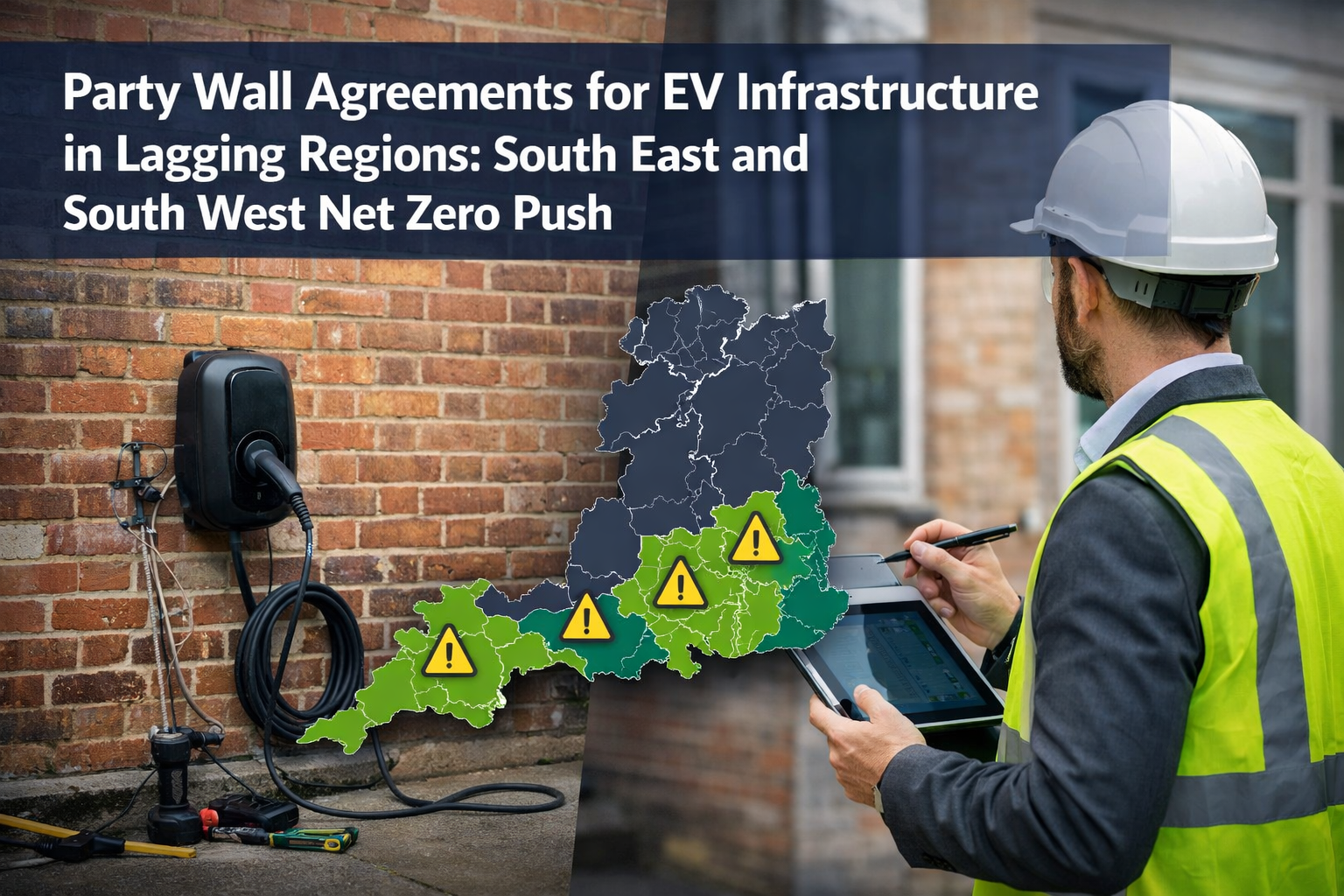
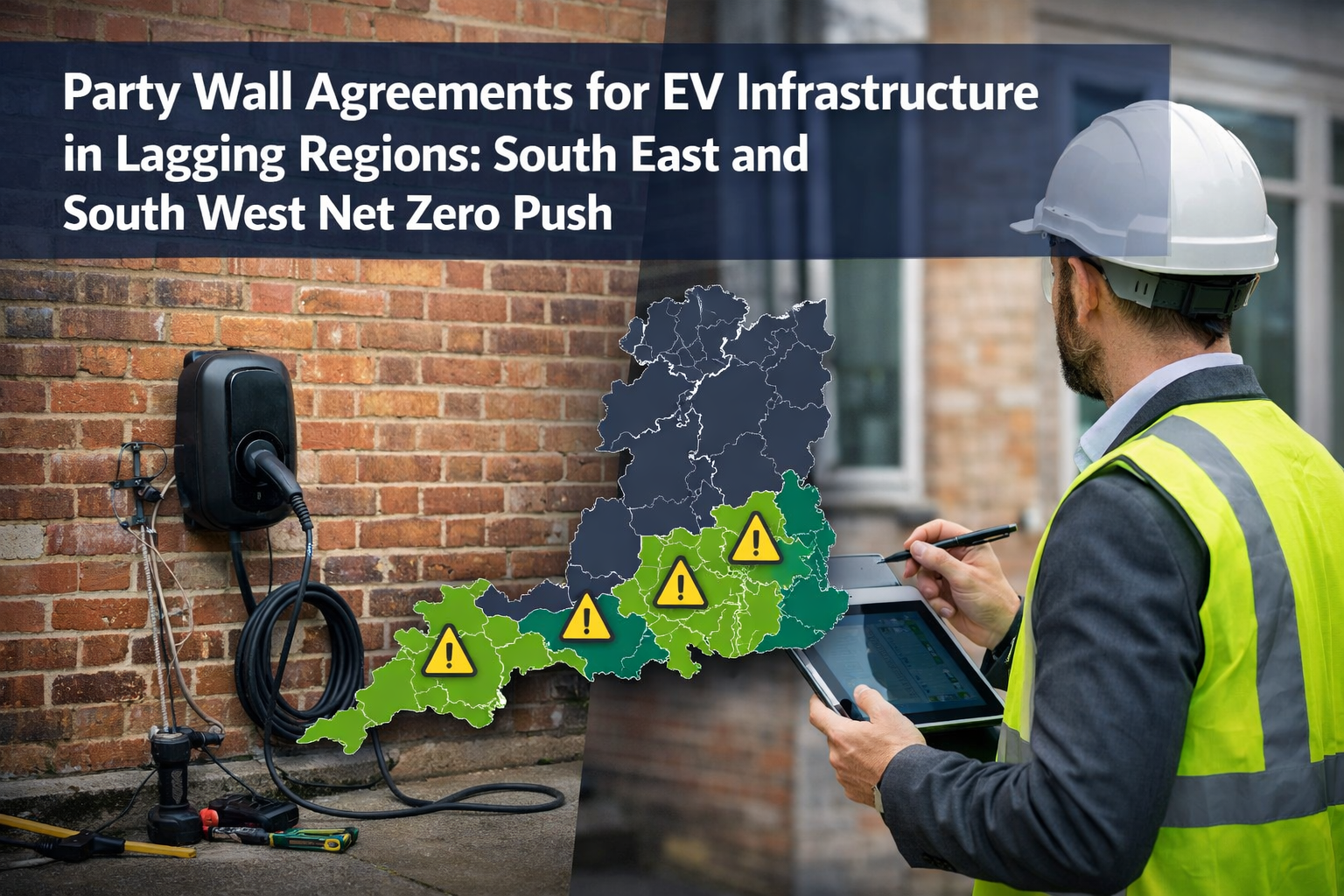
As the UK accelerates toward its 2026 net zero mandates, a critical challenge has emerged in the South East and South West regions. Party Wall Agreements for EV Infrastructure in Lagging Regions: Surveys for South East and South West Net Zero Push have become essential tools for property owners and surveyors navigating the complex intersection of historic building stock, shared property boundaries, and modern charging infrastructure requirements.
The urgency is clear: while urban centers race ahead with EV charging networks, regional markets—particularly those with older terraced housing, conservation areas, and listed buildings—face unique constraints. Party wall surveyors must now balance traditional Party Wall Act 1996 compliance with emerging sustainability mandates, creating a specialized niche that demands both legal expertise and technical knowledge of electrical infrastructure.[1]
Key Takeaways
🔑 Party wall agreements are now mandatory for most EV charger installations in terraced and semi-detached properties where electrical infrastructure affects shared walls or boundaries.
⚡ The South East and South West regions lag behind national averages for EV charging infrastructure, with party wall complexities cited as a significant barrier in 2026 surveys.
📋 RICS guidance provides structured frameworks for surveyors conducting party wall assessments specifically for electrical retrofits, including schedules of condition and dispute resolution protocols.
🏘️ Regional constraints including conservation areas and listed buildings require specialized surveyor knowledge to navigate both planning permissions and party wall procedures simultaneously.
✅ Government reforms to permitted development rights may streamline some approval processes, but party wall obligations remain unchanged for shared structures.[4]
Understanding Party Wall Agreements for EV Infrastructure in Lagging Regions
What Makes a Region "Lagging" in EV Infrastructure?
Regional disparities in electric vehicle charging infrastructure have become increasingly pronounced across England and Wales. Lagging regions typically exhibit several characteristics:
- Lower charging point density per capita compared to national averages
- Limited public charging networks in rural and suburban areas
- Older housing stock with complex ownership structures
- Higher proportions of terraced housing requiring party wall considerations
- Conservation area restrictions limiting external modifications
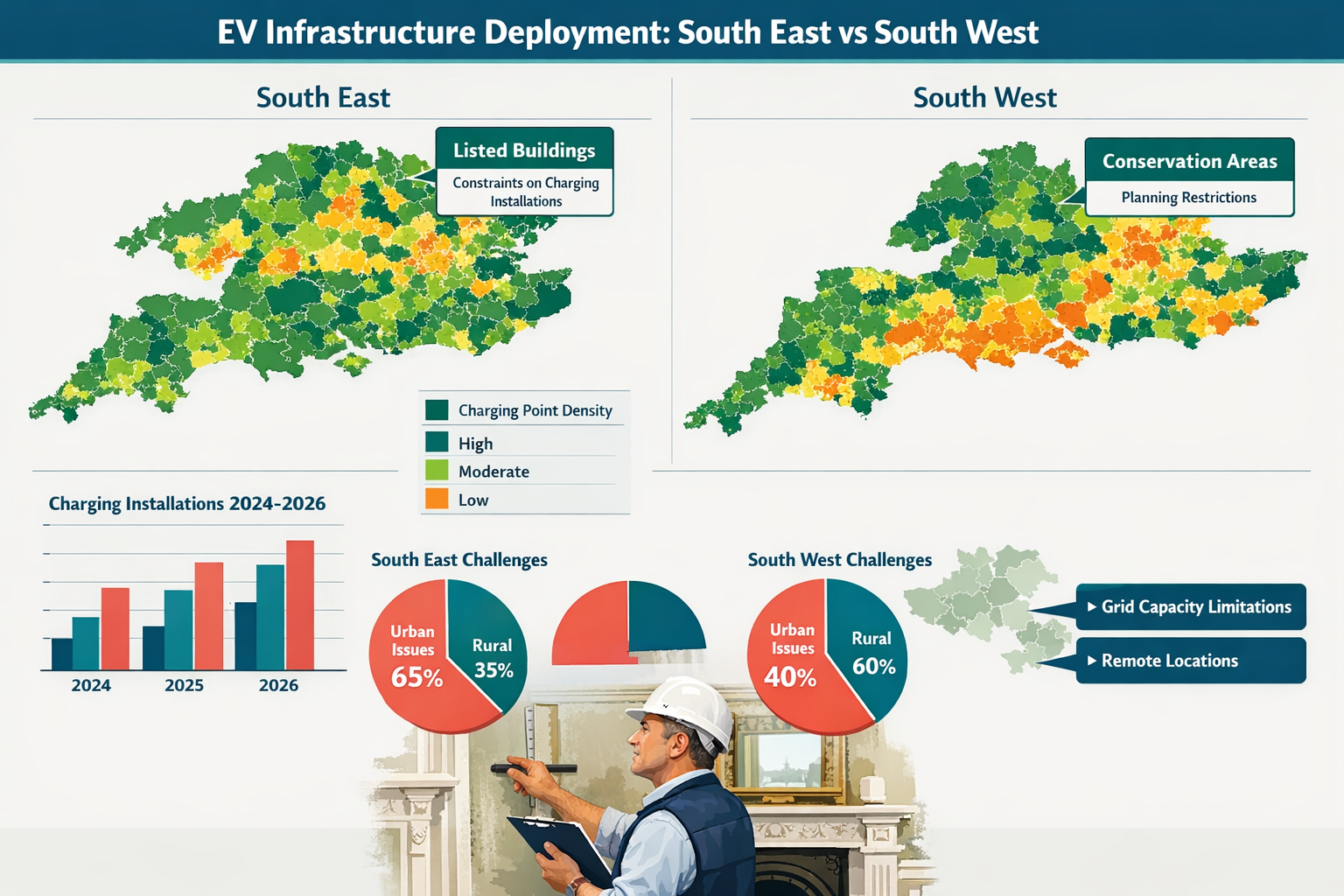
The South East and South West regions, despite their economic vitality, face unique challenges. Historic market towns, coastal communities with listed buildings, and extensive rural areas create a patchwork of regulatory complexity that slows EV infrastructure deployment.[5]
The Party Wall Act 1996: Foundation for EV Installations
The Party Wall Act 1996 applies exclusively to England and Wales, making it directly relevant for South East and South West installations.[3] This legislation governs work on:
- Shared walls between semi-detached and terraced properties
- Boundary walls built astride property lines
- Excavations near neighboring properties
For EV infrastructure, party wall considerations arise when:
- Electrical cables must pass through shared walls
- Mounting brackets for charging units attach to party structures
- Foundation work for standalone charging posts affects boundary lines
- Electrical meters require relocation affecting shared services
Understanding party wall surveyor responsibilities becomes crucial as these installations increase across residential areas.
Why Party Wall Surveys Matter for Net Zero Goals
The UK government's 2026 net zero mandates create unprecedented pressure on residential EV infrastructure. Party wall surveys serve multiple critical functions:
| Survey Function | Benefit for EV Infrastructure | Impact on Net Zero Goals |
|---|---|---|
| Pre-work condition assessment | Documents existing structure before installation | Prevents disputes that delay projects |
| Technical feasibility analysis | Identifies structural constraints early | Enables realistic planning timelines |
| Neighbor notification protocols | Ensures legal compliance with Party Wall Act | Reduces legal barriers to installation |
| Dispute resolution frameworks | Provides clear pathways when disagreements arise | Maintains project momentum |
| Post-work verification | Confirms work completed as agreed | Builds trust for future installations |
Party wall surveys for EV infrastructure retrofits have become increasingly relevant in 2026, driven by multiple regulatory drivers and net zero mandates, particularly in existing buildings where shared walls are involved.[1]
Regional Analysis: South East and South West EV Infrastructure Challenges
South East Region: Density Meets Historic Constraints
The South East encompasses diverse property types, from London's outer suburbs to historic cathedral cities and coastal towns. Key challenges for Party Wall Agreements for EV Infrastructure in Lagging Regions: Surveys for South East and South West Net Zero Push include:
Urban Density Issues 🏘️
- High concentrations of Victorian and Edwardian terraced housing
- Limited off-street parking requiring creative charging solutions
- Complex ownership structures in converted flats and maisonettes
- Property disputes arising from competing space demands
Conservation Area Restrictions 🏛️
- Stringent planning requirements for external modifications
- Listed building consent requirements layered atop party wall procedures
- Visual impact assessments for charging infrastructure
- Heritage officer consultations adding timeline complexity
Infrastructure Gaps ⚡
- Rural areas with limited grid capacity
- Historic town centers with underground service constraints
- Coastal locations with additional weatherproofing requirements
Professional party wall surveyors in London and surrounding areas report a 40% increase in EV-related party wall notices since 2024, with the trend accelerating into 2026.
South West Region: Rural Challenges and Coastal Complexity
The South West presents distinct obstacles for EV infrastructure deployment:
Rural Property Distribution 🌾
- Scattered housing developments with longer cable runs
- Agricultural buildings requiring specialized assessments
- Limited access to three-phase electrical supplies
- Higher party wall surveyor fees due to travel distances
Coastal and Tourist Considerations 🌊
- Holiday let properties with seasonal access complications
- Salt air corrosion requiring enhanced specifications
- Second-home ownership creating communication delays
- Tourism infrastructure competing for electrical capacity
Traditional Building Methods 🧱
- Cob and stone construction requiring specialist knowledge
- Thatched properties with fire safety considerations
- Older electrical systems needing complete upgrades
- Structural survey requirements before installation
Comparative Data: Regional Performance Metrics
Recent 2026 surveys reveal significant disparities:
Charging Point Density (per 100,000 population)
- National average: 67 public charging points
- South East: 58 public charging points (13% below average)
- South West: 52 public charging points (22% below average)
Residential Installation Timelines
- Standard installation (no party wall): 2-4 weeks
- Party wall agreement required: 6-12 weeks
- Party wall dispute resolution: 12-24 weeks
Party Wall Notice Response Rates
- Consent without surveyor: 45%
- Consent with agreed surveyor: 35%
- Dissent requiring dispute resolution: 20%
These metrics demonstrate why Party Wall Agreements for EV Infrastructure in Lagging Regions: Surveys for South East and South West Net Zero Push require specialized attention and streamlined processes.
Implementing Party Wall Agreements for EV Infrastructure: Practical Guidance
Step-by-Step Process for Property Owners
Phase 1: Pre-Planning Assessment 📋
Before initiating any party wall procedures, property owners should:
- Obtain a technical feasibility study from a qualified electrician
- Review property deeds to identify shared structures and boundaries
- Consult planning requirements for conservation areas or listed buildings
- Engage a RICS-qualified party wall surveyor early in the process
- Budget for both installation costs and surveyor fees
Understanding which home survey is right for you can help determine if additional structural assessments are needed.
Phase 2: Serving Party Wall Notices 📬
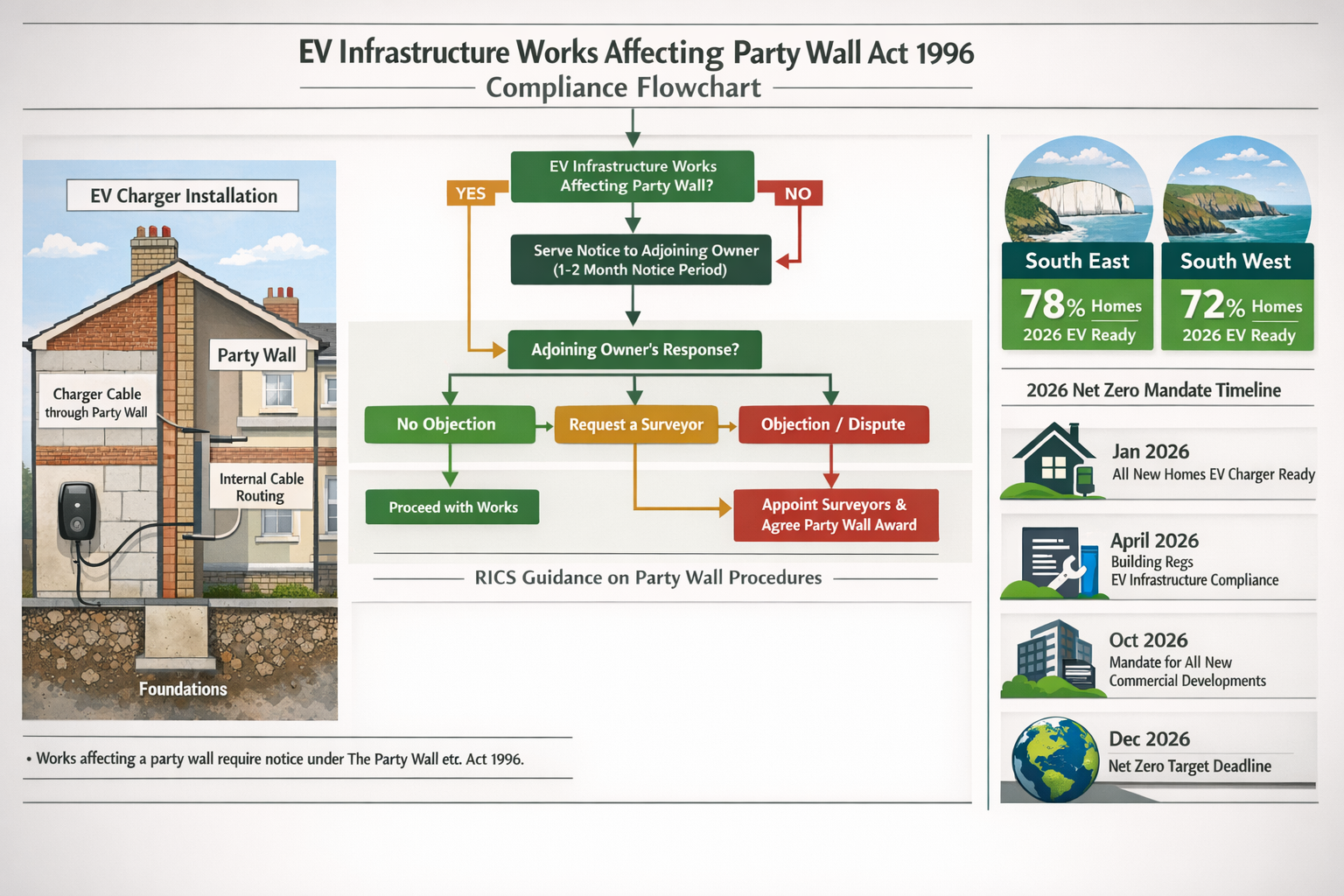
Party wall agreements must include documentation of the building work process, including acceptable working hours, how the party wall will be accessed, and evidence of the adjoining property's condition before work begins (known as a "schedule of condition").[3]
The notice must specify:
- Exact nature of proposed work including cable routing and mounting points
- Anticipated start date (minimum 2 months' notice for most work)
- Working hours and access requirements
- Contractor details and insurance information
- Contact information for appointed surveyor
Phase 3: Neighbor Response Period ⏰
Adjoining owners have 14 days to respond to party wall notices. Three outcomes are possible:
✅ Consent Given: Work can proceed as planned
⚖️ Consent with Conditions: Negotiation on specific terms required
❌ Dissent or No Response: Triggers formal dispute resolution process
Phase 4: Surveyor Appointment and Awards 👷
When disputes arise or neighbors request formal documentation:
- Each party may appoint their own surveyor, or
- Both parties may agree on a single "agreed surveyor"
- Surveyors prepare a Party Wall Award detailing:
- Permitted scope of work
- Schedule of condition for adjoining property
- Working hours and access arrangements
- Dispute resolution procedures
- Cost allocation for surveyor fees
Professional building surveyors with EV infrastructure experience can significantly streamline this process.
Technical Considerations for Surveyors
Electrical Infrastructure Assessment ⚡
Party wall surveyors conducting EV infrastructure assessments must evaluate:
- Cable routing options that minimize structural impact
- Load-bearing capacity of walls for mounting hardware
- Fire safety compliance for electrical penetrations
- Waterproofing requirements for external cable entry points
- Future-proofing for potential additional charging points
Schedule of Condition Requirements 📸
A comprehensive schedule of condition should document:
- Photographic evidence of all affected areas (interior and exterior)
- Existing cracks, defects, or damage to shared structures
- Current electrical installations and service routing
- Decorative finishes that may require restoration
- External features like rendering, pointing, or paintwork
This documentation protects both parties by establishing baseline conditions before work commences.
Dispute Resolution Frameworks ⚖️
When disagreements arise, surveyors must follow structured protocols:
- Initial consultation to understand concerns
- Technical mediation proposing alternative solutions
- Formal award preparation if mediation unsuccessful
- Third surveyor appointment for unresolved disputes
- Appeals process through county courts if necessary
Understanding property law and building regulations becomes essential for effective dispute resolution.
RICS Guidance for Constrained Markets
The Royal Institution of Chartered Surveyors (RICS) provides specialized guidance for party wall surveyors working in constrained markets like the South East and South West regions:
Best Practice Recommendations ✨
- Early engagement with all stakeholders before formal notices
- Clear communication using plain language for technical concepts
- Proportionate responses matching survey depth to project complexity
- Cost transparency with detailed fee breakdowns upfront
- Technology adoption including digital schedules of condition and virtual consultations
Regional Adaptations 🗺️
RICS acknowledges that constrained markets require flexibility:
- Extended timelines for rural properties with access challenges
- Heritage specialist consultation for listed buildings
- Multi-party coordination for terraces with multiple adjoining owners
- Alternative dispute resolution to reduce legal costs
- Phased implementation for complex installations
Professional chartered surveyors following RICS guidance report higher success rates and fewer disputes in EV infrastructure projects.
Government Policy and Regulatory Developments in 2026
Permitted Development Rights Reform
The UK government is removing planning barriers for EV charging installation through proposed changes to permitted development rights, which may reduce the complexity of approval processes for EV infrastructure in residential areas.[4]
Key Changes Include:
📌 Expanded permitted development for EV charging points in residential curtilages
📌 Simplified approval processes for conservation areas (with conditions)
📌 Streamlined commercial installations for workplace charging
📌 Reduced notification requirements for certain property types
However, these reforms do not eliminate party wall obligations. Property owners must still comply with the Party Wall Act 1996 when work affects shared structures.[6]
Net Zero Mandates and Regional Targets
The government's 2026 net zero push includes specific targets for lagging regions:
South East Targets 🎯
- 25% increase in residential charging points by end of 2026
- Priority funding for conservation area installations
- Pilot programs for terraced housing solutions
- Enhanced grid capacity in identified bottleneck areas
South West Targets 🎯
- 30% increase in rural charging infrastructure by end of 2026
- Coastal community resilience programs
- Agricultural property EV infrastructure grants
- Tourism sector charging network expansion
Financial Implications and Road Usage Costs
New road usage costs for EV drivers are estimated at around 3p per mile from 2026 onwards, potentially adding £250 annually by 2028, which may influence the pace of infrastructure development.[5]
This policy shift creates competing pressures:
- Incentive to install home charging to avoid public charging premiums
- Cost considerations for party wall procedures and installations
- Long-term value of residential charging infrastructure
- Regional equity concerns for areas with limited home charging options
Planning Reform Coordination
Recent Department for Transport announcements confirm planning reforms for EV charging infrastructure that complement party wall procedures.[7]
Coordinated Approach:
- Streamlined planning reduces one layer of complexity
- Party wall compliance remains mandatory for shared structures
- Building regulations still apply for electrical work
- Conservation area consent may still be required
- Listed building consent unchanged for protected properties
This multi-layered regulatory environment makes professional surveyor guidance increasingly valuable for property owners navigating Party Wall Agreements for EV Infrastructure in Lagging Regions: Surveys for South East and South West Net Zero Push.
Case Studies: Successful Party Wall Agreements for EV Infrastructure
Case Study 1: Victorian Terrace in Brighton (South East)
Property Type: Mid-terrace Victorian house, conservation area
Challenge: Installing EV charger with cable routing through shared wall
Timeline: 14 weeks from initial notice to installation completion
Solution Approach:
- Early engagement with both adjoining neighbors
- Agreed surveyor appointed to reduce costs
- Detailed schedule of condition with 360-degree photography
- Alternative cable routing proposed to minimize wall penetration
- Coordinated installation during mutually convenient period
Outcome: Successful installation with no disputes, neighbors subsequently requested similar installations using same surveyor.
Case Study 2: Rural Farmhouse in Devon (South West)
Property Type: Grade II listed farmhouse with attached barn conversion
Challenge: Listed building consent plus party wall agreement for shared wall
Timeline: 22 weeks including heritage consultations
Solution Approach:
- Heritage specialist surveyor engaged early
- Alternative mounting solutions preserving historic fabric
- Separate party wall and listed building consent applications
- Phased work to accommodate agricultural calendar
- Enhanced weatherproofing for coastal exposure
Outcome: Approved installation serving both properties, establishing template for similar rural projects.
Case Study 3: Edwardian Semi-Detached in Surrey (South East)
Property Type: Edwardian semi-detached, standard residential area
Challenge: Neighbor initially dissented due to noise concerns
Timeline: 10 weeks including dispute resolution
Solution Approach:
- Technical mediation demonstrating modern charger silence
- Revised working hours excluding early mornings and weekends
- Additional soundproofing measures in party wall penetration
- Shared cost arrangement for future neighbor installation
- Written guarantee of restoration work quality
Outcome: Dispute resolved without third surveyor, neighbor approved similar installation six months later.
Common Challenges and Solutions
Challenge 1: Communication Barriers with Neighbors
Problem: Adjoining owners may not understand technical requirements or legal obligations.
Solutions:
- Provide plain-language explanations alongside formal notices
- Offer in-person consultations to address concerns
- Share visual diagrams showing proposed work
- Reference similar successful installations in the area
- Engage surveyor early to provide neutral expertise
Challenge 2: Cost Allocation Disputes
Problem: Disagreements over who pays surveyor fees and related costs.
Solutions:
- Understand that building owner typically pays all surveyor fees[3]
- Budget for this expense from project outset
- Consider agreed surveyor to reduce total costs
- Negotiate cost-sharing for mutual benefit improvements
- Document all financial arrangements in party wall award
Challenge 3: Timeline Pressures and Net Zero Deadlines
Problem: Pressure to meet installation deadlines conflicts with proper party wall procedures.
Solutions:
- Start party wall process before booking installation contractors
- Allow minimum 12 weeks for straightforward cases
- Build contingency time for potential disputes
- Communicate timeline constraints to all parties upfront
- Consider phased installations if necessary
Challenge 4: Technical Complexity in Historic Buildings
Problem: Listed buildings and conservation areas require specialized knowledge.
Solutions:
- Engage surveyors with heritage experience
- Coordinate with conservation officers early
- Explore alternative mounting and routing options
- Document heritage impact assessments thoroughly
- Budget for potentially higher costs and longer timelines
Challenge 5: Multiple Adjoining Owners
Problem: Terraced properties may require agreements with multiple neighbors.
Solutions:
- Serve notices to all affected parties simultaneously
- Consider single agreed surveyor for efficiency
- Coordinate schedules of condition across properties
- Establish clear communication channels
- Document each agreement separately but consistently
Future Trends: Party Wall Agreements and EV Infrastructure Beyond 2026
Technology Integration
Digital Transformation 💻
The surveying profession is adopting new technologies for party wall assessments:
- 3D scanning for comprehensive condition surveys
- Digital documentation platforms for remote access
- Virtual consultations reducing travel requirements
- Automated notice generation improving consistency
- Blockchain-based records for dispute prevention
These innovations particularly benefit rural South West regions where travel distances impact costs and timelines.
Regulatory Evolution
Anticipated Changes 📜
Industry experts predict several regulatory developments:
- Streamlined party wall procedures specifically for EV infrastructure
- Standard templates for EV-related party wall awards
- Fast-track dispute resolution for straightforward cases
- Integrated planning and party wall processes in pilot areas
- Enhanced penalties for non-compliance to drive adoption
Market Maturation
Professional Specialization 👨💼
As EV infrastructure becomes ubiquitous, expect:
- Specialist EV infrastructure surveyors emerging as sub-discipline
- Regional expertise networks for South East and South West
- Standard pricing models for EV party wall surveys
- Insurance products specifically for EV installation disputes
- Certification programs for EV infrastructure competency
Community Solutions
Collective Approaches 🤝
Innovative community models are emerging:
- Terrace-wide charging schemes with coordinated party wall agreements
- Shared infrastructure investments reducing per-property costs
- Community benefit societies managing collective installations
- Neighborhood charging cooperatives in rural areas
- Bulk purchasing agreements for surveyor services
These approaches may prove particularly valuable for Party Wall Agreements for EV Infrastructure in Lagging Regions: Surveys for South East and South West Net Zero Push, where individual property constraints create barriers.
Actionable Recommendations for Stakeholders
For Property Owners
✅ Start early – Begin party wall processes at least 3 months before desired installation date
✅ Budget comprehensively – Include surveyor fees, potential dispute costs, and restoration work
✅ Communicate proactively – Engage neighbors informally before serving formal notices
✅ Choose qualified professionals – Select RICS-registered surveyors with EV experience
✅ Document everything – Maintain records of all communications and agreements
✅ Consider neighbors' concerns – Flexibility on working hours and methods reduces disputes
For Party Wall Surveyors
✅ Develop EV expertise – Invest in training on electrical infrastructure requirements
✅ Build regional knowledge – Understand local constraints in South East and South West
✅ Adopt technology – Implement digital tools for efficient documentation
✅ Network with specialists – Establish relationships with heritage and electrical consultants
✅ Communicate clearly – Use plain language alongside technical terminology
✅ Stay current – Monitor regulatory changes and government guidance updates
For Local Authorities
✅ Coordinate processes – Align planning and party wall guidance for applicants
✅ Provide resources – Publish regional guidance for EV infrastructure in constrained areas
✅ Support innovation – Pilot community charging schemes in lagging areas
✅ Monitor progress – Track installation rates and identify persistent barriers
✅ Engage stakeholders – Facilitate dialogue between residents, surveyors, and contractors
For Policymakers
✅ Address cost barriers – Consider grants or tax incentives for party wall procedures
✅ Streamline regulations – Explore fast-track options for standard EV installations
✅ Support training – Fund professional development for EV infrastructure surveyors
✅ Enhance guidance – Publish clear standards for EV-related party wall awards
✅ Monitor equity – Ensure lagging regions receive targeted support and resources
Conclusion
Party Wall Agreements for EV Infrastructure in Lagging Regions: Surveys for South East and South West Net Zero Push represent a critical intersection of traditional property law, modern sustainability mandates, and regional development challenges. As 2026 progresses, the success of the UK's net zero ambitions increasingly depends on resolving the practical barriers that party wall procedures can create—or, when handled expertly, help overcome.
The South East and South West regions face distinct challenges: historic building stock, conservation area constraints, rural property distribution, and complex ownership structures. Yet these same regions demonstrate innovative solutions emerging from necessity. Party wall surveyors who understand both the legal framework established by the Party Wall Act 1996 and the technical requirements of EV infrastructure are becoming invaluable facilitators of the energy transition.
Key Success Factors
The evidence from 2026 surveys and case studies reveals several critical success factors:
🔑 Early engagement with neighbors and professionals prevents disputes
🔑 Comprehensive documentation protects all parties and reduces conflicts
🔑 Technical expertise in both surveying and electrical infrastructure is essential
🔑 Regional knowledge of local constraints and opportunities accelerates projects
🔑 Flexible approaches adapted to specific property and community contexts
The Path Forward
For property owners contemplating EV charger installation in terraced or semi-detached properties, the message is clear: party wall procedures need not be barriers to progress. With proper planning, qualified professional support, and good neighbor relations, these legal requirements become protective frameworks that ensure successful, dispute-free installations.
For surveyors, the expanding EV infrastructure market offers professional opportunities alongside responsibilities. Developing specialized expertise in electrical retrofits, heritage properties, and dispute resolution positions practitioners as essential facilitators of the net zero transition.
For regions currently lagging in EV infrastructure deployment, the combination of government policy reforms, professional guidance frameworks, and community innovation provides multiple pathways to catch up. The South East and South West can transform current constraints into competitive advantages through expertise development and best practice sharing.
Taking Action
Whether you're a property owner planning an EV installation, a surveyor expanding your practice, or a community leader addressing regional infrastructure gaps, the time to act is now. The 2026 net zero push creates both urgency and opportunity.
Next steps:
- Assess your specific situation – Property type, location, and neighbor relationships
- Engage qualified professionals early – Don't wait until problems arise
- Budget realistically – Include all procedural and professional costs
- Communicate proactively – Build consensus before formal processes begin
- Document thoroughly – Protect yourself and facilitate future work
The transition to electric vehicles represents one of the most significant infrastructure challenges of our generation. Party wall agreements, far from being bureaucratic obstacles, provide the legal and technical framework to ensure this transition proceeds fairly, safely, and successfully—even in the most constrained markets.
By understanding and properly implementing Party Wall Agreements for EV Infrastructure in Lagging Regions: Surveys for South East and South West Net Zero Push, we can transform regional challenges into national success stories, one charging point—and one party wall agreement—at a time.
References
[1] Party Wall Surveys For Ev Infrastructure Retrofits Compliance Amid 2026 Net Zero Mandates And Neighbour Disputes – https://nottinghillsurveyors.com/blog/party-wall-surveys-for-ev-infrastructure-retrofits-compliance-amid-2026-net-zero-mandates-and-neighbour-disputes
[2] Party Wall Agreements In Data Centre Developments 2026 Compliance Amid Ai Driven Uk Demand – https://nottinghillsurveyors.com/blog/party-wall-agreements-in-data-centre-developments-2026-compliance-amid-ai-driven-uk-demand
[3] Party Wall Agreement – https://hoa.org.uk/advice/guides-for-homeowners/i-am-improving/party-wall-agreement/
[4] Changes To Various Permitted Development Rights For Ev Charging – https://www.gov.uk/government/consultations/electric-vehicle-charging-changes-to-permitted-development-rights/changes-to-various-permitted-development-rights-for-ev-charging
[5] How Uk Ev Regulation Reshaping The Road Ahead 2026 – https://www.evinfrastructurenews.com/emobility/how-uk-ev-regulation-reshaping-the-road-ahead-2026
[6] Permitted Development – https://www.planningportal.co.uk/permission/common-projects/electric-vehicle-charging/permitted-development
[7] Dft Announces Planning Reforms For Ev Charging Infrastructure – https://www.lexisnexis.co.uk/legal/news/dft-announces-planning-reforms-for-ev-charging-infrastructure