

{"cover":"Professional landscape format (1536×1024) editorial hero image featuring bold text overlay 'Level 3 Building Surveys: RICS January 2026 Market Insights' in extra large 72pt white sans-serif font with dark shadow and semi-transparent navy overlay box, positioned in upper third center. Background shows detailed close-up of RICS chartered surveyor in hard hat examining structural elements of traditional British property with clipboard and moisture meter, visible brick walls and timber beams. Foreground includes subtle overlay of upward-trending market graph lines and +43% price optimism statistic. Color palette: deep navy blue, white, gold RICS accents, natural brick tones. Magazine cover quality, high contrast, professional editorial style with depth of field effect.","content":["Landscape format (1536×1024) detailed infographic illustration showing side-by-side comparison of three-tier RICS home survey levels with Level 3 Building Survey prominently featured. Visual shows cross-section cutaway of Victorian terraced house with surveyor figures at different inspection depths: Level 1 surface inspection, Level 2 moderate inspection, Level 3 comprehensive deep inspection with magnifying glass examining roof timbers, lifted floorboards, opened inspection chambers, and thermal imaging of walls. Includes checkmark icons, depth measurement arrows, and color-coded zones (green for basic, amber for intermediate, red for comprehensive). Text overlays show 'Most Detailed RICS Inspection' and 'January 2026 Market Context'. Clean architectural drawing style with blueprint aesthetic, professional color scheme of navy, white, and RICS gold accents.","Landscape format (1536×1024) professional data visualization showing dual-axis chart combining RICS UK Residential Market Survey January 2026 statistics. Left axis displays net balance percentages for house prices improving from -19% (October 2025) to -10% (January 2026) as ascending bar graph in navy blue. Right axis shows regional heat map of UK with color-coded areas: Scotland and Northern Ireland in green (strongest growth), London and South East in red (lagging), with percentage indicators. Center overlay features surveyor silhouette with inspection equipment. Bottom banner shows key metrics: '+43% long-term optimism', '-15% buyer enquiries', '+35% sales outlook'. Modern financial dashboard aesthetic with clean typography, grid lines, and professional color palette of navy, green, red, and gold accents.","Landscape format (1536×1024) detailed photorealistic scene showing RICS Level 3 Building Survey in action during January 2026 market conditions. Wide-angle view of surveyor in professional attire and hard hat conducting comprehensive inspection in loft space of period property, using thermal imaging camera to scan roof timbers while lifting corner of insulation material. Visible elements include opened inspection hatch, ladder, moisture meter on wooden beam, clipboard with detailed checklist, and natural daylight streaming through roof tiles. Foreground shows opened drain inspection chamber with visible pipework. Background includes property market stabilization chart on tablet device showing -10% net balance figure. Warm natural lighting, high detail, professional documentary photography style with annotations pointing to key inspection areas and equipment."]"}
The UK property market stands at a critical juncture in early 2026. After months of declining confidence and falling prices, house prices have finally stabilised at the national level with a net balance of -10% over the past three months—a significant improvement from the low of -19% recorded in October 2025.[1] This stabilisation, revealed in the Level 3 Building Surveys for Stabilising National Prices: RICS Insights from January 2026 Market Survey, signals a turning point for buyers, sellers, and property professionals navigating uncertain economic conditions.
For prospective homebuyers entering this recovering market, comprehensive property assessment has never been more critical. Level 3 Building Surveys—the most detailed inspection available from RICS-qualified professionals—provide the thorough analysis needed to make informed decisions when prices are stabilising but regional disparities persist. This article examines how the January 2026 RICS market data intersects with Level 3 survey protocols to protect buyers in a cautiously optimistic market.
Key Takeaways
- 🏘️ National house prices stabilised at -10% net balance in January 2026, improving from -19% in October 2025, marking the strongest recovery signal in six months
- 📊 Long-term price optimism reached 43%—the highest level since February 2025—with surveyors anticipating continued recovery over the next twelve months
- 🔍 Level 3 Building Surveys provide comprehensive protection through detailed inspections including roof space entry, drain chamber examination, and window operability testing
- 🗺️ Regional disparities remain significant despite national stabilisation, with Scotland and Northern Ireland showing growth while London and the South East continue to lag
- 💼 Survey demand tracks transaction activity, making Level 3 inspections increasingly valuable as agreed sales reach their least negative reading since June 2025
Understanding Level 3 Building Surveys for Stabilising National Prices: RICS Insights from January 2026 Market Survey
What Is a Level 3 Building Survey?
A Level 3 Building Survey (formerly called a Full Building Survey or Structural Survey) represents the most comprehensive property inspection available to UK homebuyers. Unlike the more basic Level 1 (Condition Report) or Level 2 (HomeBuyer Report), Level 3 surveys deliver an exhaustive assessment of a property's condition, construction, and potential defects.[5]
The RICS Level 3 inspection includes:[7]
✅ Comprehensive grounds assessment with surveyors following the trail of suspected problems to a greater extent than lower-level surveys
✅ Mandatory roof space entry with visual inspection of roof structure and thermal insulation assessment
✅ Window operability testing where all windows are attempted to be opened (with permission and where safe)
✅ Inspection chamber examination with covers lifted to observe drain and septic tank operation
✅ Detailed defect identification with specific advice on repairs, maintenance options, and ongoing care
This thorough approach makes Level 3 surveys particularly valuable for older properties, buildings of unusual construction, properties requiring significant renovation, or homes where buyers plan substantial alterations. When considering which home survey is right for you, understanding these distinctions becomes essential.
The January 2026 Market Context
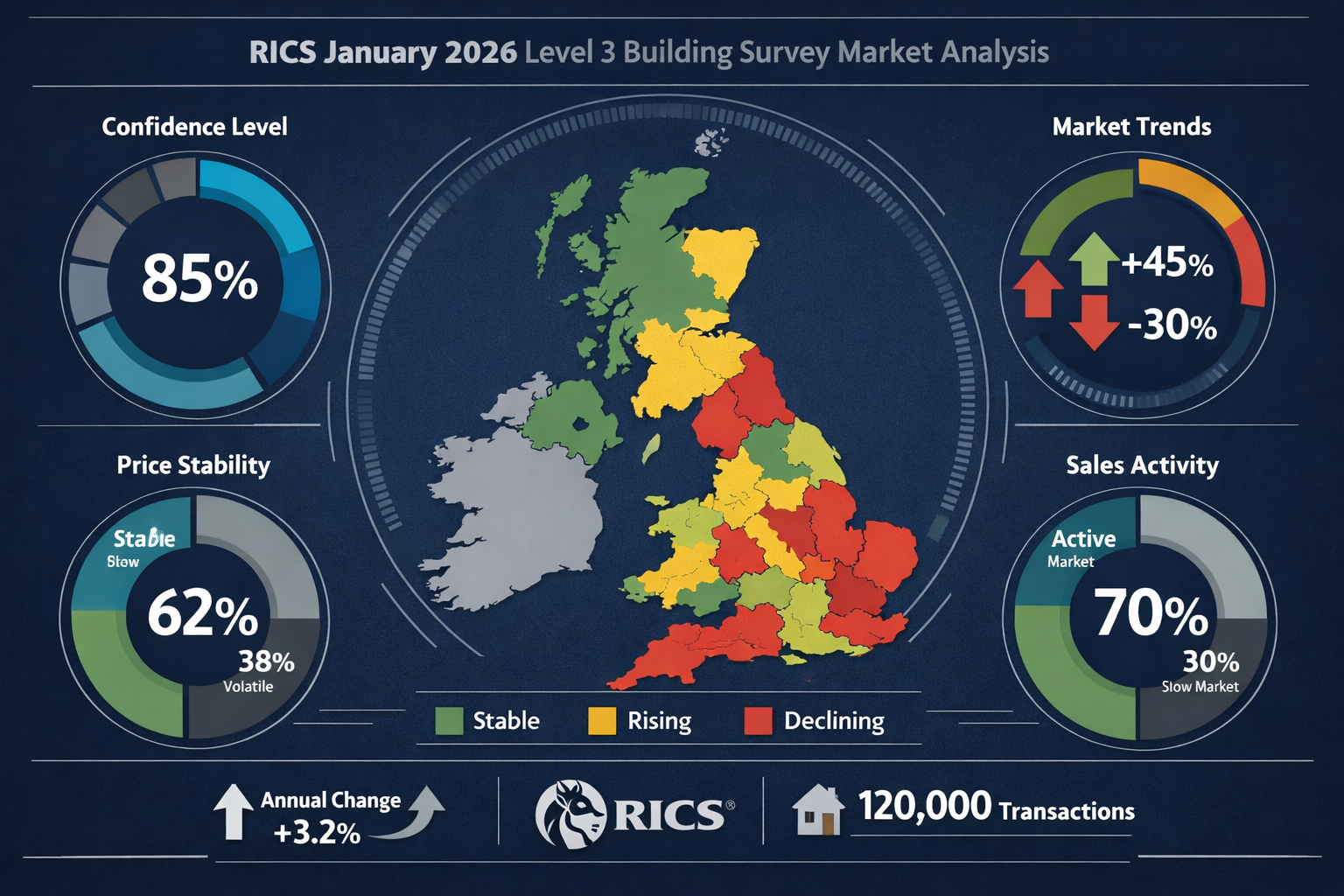
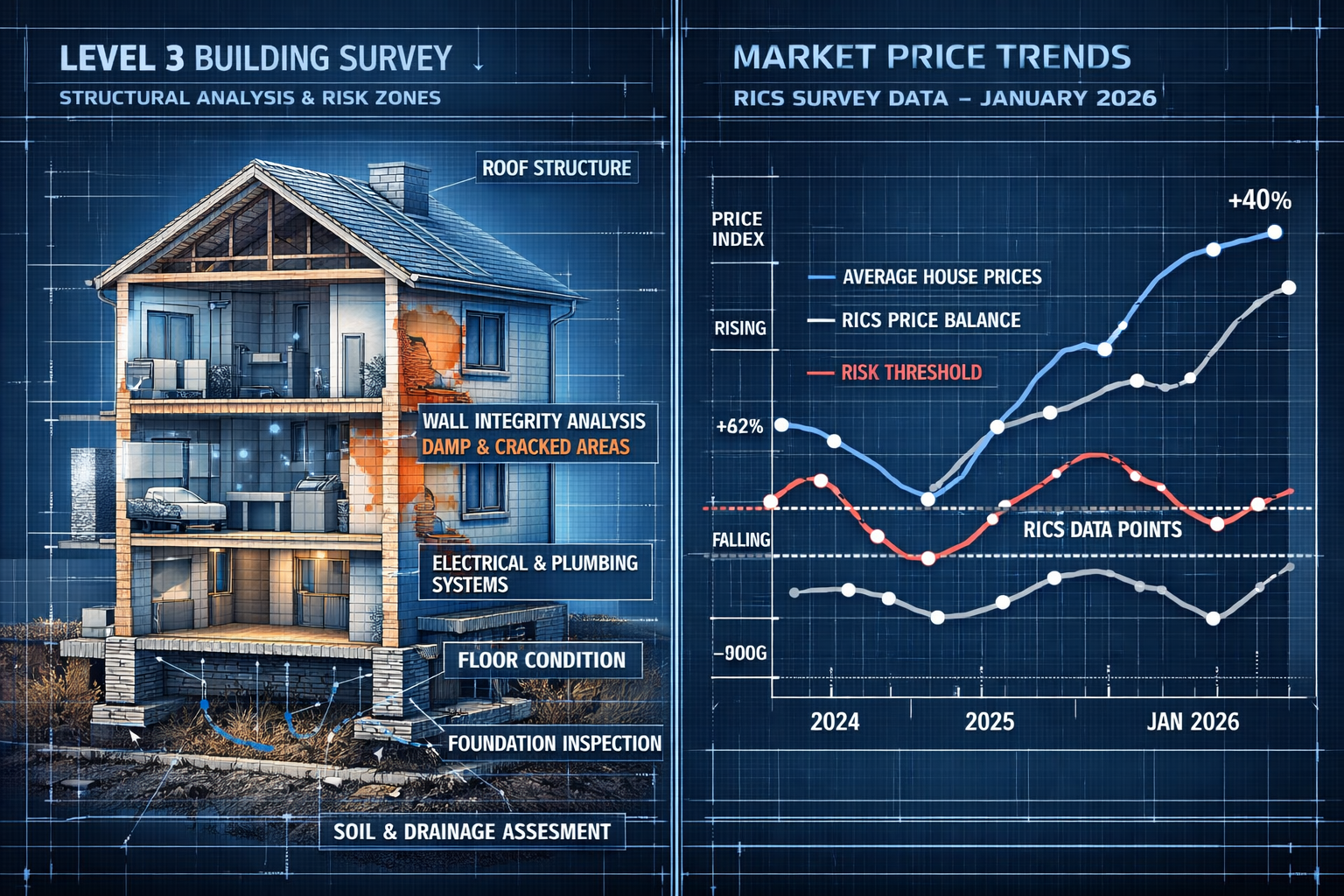
The RICS UK Residential Market Survey for January 2026 reveals a market in transition. After sustained downward pressure throughout late 2025, several key indicators suggest stabilisation:[1]
| Market Indicator | January 2026 | December 2025 | October 2025 | Trend |
|---|---|---|---|---|
| House Price Balance | -10% | -12% | -19% | ⬆️ Improving |
| New Buyer Enquiries | -15% | -21% | -29% | ⬆️ Improving |
| Agreed Sales | -9% | -13% | -17% | ⬆️ Improving |
| 12-Month Sales Outlook | +35% | +28% | +18% | ⬆️ Strengthening |
| Long-Term Price Optimism | +43% | +38% | +31% | ⬆️ Growing |
This data demonstrates that while the market remains cautious, the trajectory has shifted decisively positive. New buyer enquiries improved significantly, with the net balance rising to -15% in January from -21% in December.[1] More importantly, agreed sales reached their least negative reading since June 2025 at a net balance of -9%, indicating strengthening transaction activity.[1]
For buyers considering property purchases during this stabilisation period, comprehensive due diligence through Level 3 building surveys provides critical protection against overpaying in a market where prices may still adjust regionally.
How Level 3 Building Surveys Protect Buyers in a Stabilising Market
Identifying Hidden Defects Before Price Recovery
The January 2026 RICS data shows long-term price optimism at its strongest since February 2025, with 43% of surveyed members anticipating higher prices over the next twelve months.[1] This growing confidence suggests that buyers entering the market now may benefit from purchasing before further price increases—but only if they avoid properties with costly hidden defects.
Level 3 surveys excel at uncovering issues that could derail a purchase or require substantial post-purchase investment:
Structural Issues:
- Foundation movement and subsidence indicators
- Roof timber decay or inadequate support structures
- Wall tie failure in cavity wall construction
- Lintel deterioration above openings
Moisture and Damp Problems:
- Rising damp in solid wall construction
- Penetrating damp from defective rainwater goods
- Condensation issues from inadequate ventilation
- Timber decay from prolonged moisture exposure
Building Services Defects:
- Outdated electrical installations requiring rewiring
- Inefficient or dangerous heating systems
- Drainage problems identified through inspection chamber examination
- Water supply issues affecting pressure or quality
By identifying these defects before purchase, buyers can either negotiate price reductions, request repairs as a condition of sale, or make informed decisions to walk away. This becomes particularly valuable in a stabilising market where using an RICS survey to negotiate property prices can mean the difference between a sound investment and a financial burden.
Regional Disparities Demand Local Expertise
Despite national stabilisation, the January 2026 RICS survey reveals significant regional disparities. The strongest price growth appears in Scotland and Northern Ireland, while London, the South East, South West, and East Anglia continue to lag due to ongoing affordability challenges.[1]
This regional variation makes local surveyor expertise invaluable. A qualified surveyor familiar with regional construction methods, common defects in local housing stock, and area-specific issues (such as subsidence from garden trees or Japanese knotweed) can provide insights that generic surveys miss.
"Survey market demand has mirrored broader housing market trends, with RICS Level 2 and Level 3 survey volumes closely tracking transactional activity fluctuations throughout 2026."[6]
This correlation between survey demand and market activity suggests that as transaction volumes increase with market stabilisation, securing experienced surveyors may become more challenging. Booking early ensures access to qualified professionals who understand both national trends and local market dynamics.
Comprehensive Inspection Protocols for 2026
The RICS standards for Level 3 surveys mandate specific inspection protocols that distinguish them from lower-level assessments:[7]
Roof Space Inspection:
- Surveyors must enter the roof space where safe and accessible
- Visual inspection of roof structure, including rafters, purlins, and trusses
- Thermal insulation corners lifted to identify thickness and underlying ceiling type
- Assessment of ventilation adequacy and signs of condensation
Window and Door Assessment:
- All windows attempted to be opened where possible (with permission)
- Operation tested for ease of use and security
- Frame condition assessed for rot, distortion, or inadequate sealing
- Glazing condition evaluated for failed sealed units or damage
Drainage Examination:
- Inspection chamber covers lifted where safe and without causing damage
- Visual assessment of drain flow and condition
- Identification of septic tank location and operation
- Recommendations for further specialist drainage surveys if concerns identified
Grounds and External Areas:
- Comprehensive assessment of boundary walls, fences, and gates
- Inspection of paving, drives, and pathways for settlement or defects
- Evaluation of garden structures, outbuildings, and sheds
- Assessment of drainage patterns and potential water ingress routes
These detailed protocols ensure that buyers receive a complete picture of property condition—essential information when making purchase decisions in a market showing early recovery signs but persistent caution.
Strategic Timing: Level 3 Building Surveys for Stabilising National Prices in 2026
Market Confidence and Transaction Activity
The January 2026 RICS survey reveals a twelve-month sales outlook sentiment that surged to +35%—the strongest reading since December 2024.[1] This confidence among property professionals reflects several factors:
📈 Improving buyer enquiries suggesting pent-up demand beginning to release
📈 Stabilising prices reducing fear of further declines
📈 Strengthening agreed sales indicating transactions converting more successfully
📈 Regional growth pockets providing opportunities in specific markets
For buyers, this environment creates a strategic opportunity. Purchasing during stabilisation—before widespread price increases—can deliver value, but only with proper due diligence. Saving money with building surveys becomes possible when survey findings enable negotiation or prevent costly mistakes.
First-Time Buyers and Level 3 Surveys
First-time buyers entering the market in 2026 face unique challenges. The RICS data shows that while national prices have stabilised, affordability constraints persist, particularly in southern England.[1] For these buyers, every pound matters, making comprehensive property assessment critical.
Level 3 surveys benefit first-time buyers by:
🏠 Preventing buyer's remorse through complete disclosure of property condition
🏠 Enabling informed budgeting with detailed repair cost estimates
🏠 Supporting mortgage applications by identifying issues lenders might flag
🏠 Providing maintenance roadmaps for properties requiring ongoing attention
First-time buyers booking building surveys gain confidence that their investment—often representing years of savings—will deliver long-term value rather than unexpected financial stress.
What to Do After Receiving Your Survey Report
Receiving a comprehensive Level 3 survey report can be overwhelming, particularly if it identifies significant defects. However, understanding how to respond strategically maximises the value of your investment in professional inspection.
If the Report Identifies Major Issues:
- Review findings with your surveyor to understand severity and urgency
- Obtain specialist quotes for repair costs from qualified contractors
- Renegotiate the purchase price based on documented defect costs
- Request seller repairs as a condition of proceeding with purchase
- Consider walking away if defects exceed your budget or risk tolerance
Understanding what to do after a bad building survey report empowers buyers to make decisions that protect their financial interests.
If the Report Shows Minor Issues:
- Use findings to negotiate modest price reductions
- Plan maintenance schedules for identified ongoing care needs
- Budget for future repairs based on surveyor recommendations
- Proceed with confidence knowing the property's true condition
Preparing for Your Level 3 Survey
Maximising the value of your Level 3 survey begins before the surveyor arrives. Proper preparation ensures the inspection proceeds smoothly and comprehensively.
Before the Survey:
✓ Ensure access to all areas including loft spaces, basements, and outbuildings
✓ Locate and provide access to inspection chambers and drainage points
✓ Clear stored items that might obstruct inspection areas
✓ Inform current occupants about the inspection scope and timing
✓ Provide any available property documentation (previous surveys, planning permissions, building control certificates)
Understanding what to do before an RICS home survey helps ensure the inspection captures all relevant information.
During the Survey:
While buyers typically don't attend the inspection, being available for surveyor questions can be helpful. If you do attend:
- Allow the surveyor to work independently without interference
- Ask questions only after the inspection concludes
- Take notes on any particular concerns the surveyor mentions
- Avoid making assumptions about findings until the written report arrives

Comparing Survey Options in the 2026 Market
Level 2 vs Level 3: Choosing the Right Option
The January 2026 market conditions create specific scenarios where Level 3 surveys deliver superior value compared to Level 2 HomeBuyer Reports. Understanding these distinctions helps buyers make appropriate choices.
Choose Level 3 When:
🔹 Purchasing properties built before 1900
🔹 Buying homes of unusual construction (timber frame, thatched roof, cob walls)
🔹 Planning significant alterations or renovations
🔹 Concerned about specific defects or previous poor maintenance
🔹 Purchasing properties that have been empty for extended periods
🔹 Buying in areas with known ground movement or subsidence issues
Level 2 May Suffice When:
🔸 Purchasing relatively modern properties (post-1980) in good condition
🔸 Buying conventional construction homes in standard condition
🔸 Working with tight budgets where comprehensive inspection isn't affordable
🔸 Purchasing properties where visual inspection suggests minimal concerns
For detailed comparison, review our guide on home survey levels 2 vs Level 3 to understand which option suits your circumstances.
Cost Considerations in a Stabilising Market
Level 3 surveys represent a significant investment, typically costing £800-£1,500+ depending on property size, location, and complexity. However, in a market showing early recovery signs, this cost must be weighed against potential savings and risk mitigation.
Value Proposition:
| Survey Cost | Potential Savings/Protection | Net Benefit |
|---|---|---|
| £1,200 | £15,000 price negotiation from identified structural issues | +£13,800 |
| £1,200 | £8,000 avoided through walking away from problem property | +£6,800 |
| £1,200 | £25,000 future repair costs identified before purchase | +£23,800 |
The RICS data showing 43% of professionals expecting price increases over twelve months[1] suggests that buyers who secure properties at current stabilised prices—while avoiding defective homes—position themselves advantageously for future market appreciation.
Understanding damp survey costs and other specialist inspection pricing helps buyers budget comprehensively for due diligence.
Regional Insights: Applying Level 3 Survey Findings Across UK Markets
London and the South East: Affordability Challenges Persist
Despite national stabilisation, the January 2026 RICS survey confirms that London and the South East continue to lag due to ongoing affordability challenges.[1] For buyers in these regions, Level 3 surveys provide particular value by:
- Identifying defects that justify price reductions in already expensive markets
- Uncovering issues that might otherwise remain hidden in competitive bidding situations
- Providing detailed condition assessments for period properties common in these areas
- Supporting negotiations in markets where sellers may be more motivated due to slower sales
Scotland and Northern Ireland: Growth Market Opportunities
With the strongest price growth appearing in Scotland and Northern Ireland[1], buyers in these regions face different considerations. Level 3 surveys help by:
- Ensuring buyers don't overpay in rising markets by identifying hidden defects
- Providing comprehensive assessments of regional construction types and materials
- Identifying maintenance needs that could offset price appreciation
- Supporting confident decision-making in competitive growth markets
Regional Construction Variations
UK housing stock varies significantly by region, with construction methods, materials, and common defects differing across the country:
Northern England:
- Stone construction common in rural areas
- Solid wall properties requiring specific damp assessment
- Mining subsidence concerns in former industrial regions
Southern England:
- Period properties with complex construction histories
- Chalk and clay subsoils affecting foundation performance
- Higher prevalence of listed buildings requiring specialist knowledge
Scotland:
- Traditional stone and lime construction
- Specific moisture management challenges
- Different building regulations and standards
Wales:
- Slate roof construction requiring specialist assessment
- Rural properties with septic drainage systems
- Stone construction with unique maintenance needs
Level 3 surveyors with regional expertise understand these variations and tailor inspections accordingly.
Professional Standards and Qualifications in 2026
RICS Accreditation and Professional Standards
The Royal Institution of Chartered Surveyors (RICS) sets rigorous standards for property professionals conducting Level 3 Building Surveys. In 2026, these standards ensure:
✅ Qualified professionals with appropriate training and experience
✅ Standardised inspection protocols ensuring consistency across surveys
✅ Professional indemnity insurance protecting clients against negligent advice
✅ Continuing professional development requirements maintaining current knowledge
✅ Ethical standards governing professional conduct and client relationships
When selecting a surveyor, verify their RICS membership and ask about their specific experience with properties similar to the one you're purchasing. Understanding what a surveyor does helps buyers appreciate the professional expertise involved.
Survey Report Quality and Clarity
The January 2026 market environment demands clear, actionable survey reports that buyers can use for decision-making. Quality Level 3 reports should include:
📋 Executive summary highlighting critical findings
📋 Detailed condition assessment for each building element
📋 Photographic evidence documenting identified defects
📋 Repair recommendations with priority ratings
📋 Cost estimates for significant repair work
📋 Maintenance advice for ongoing property care
Reports should avoid jargon, explain technical terms clearly, and provide sufficient detail for buyers to make informed decisions. If your report lacks clarity, don't hesitate to contact your surveyor for explanation—professional standards require them to ensure client understanding.
Addressing Common Concerns and Myths
Myth: "New-Build Properties Don't Need Level 3 Surveys"
One persistent misconception suggests that new-build properties don't require comprehensive surveys because they're covered by warranties and built to current standards. However, evidence contradicts this assumption.
Recent analysis of new-build properties in 2026 reveals that comprehensive building survey protocols remain essential for spotting defects even in newly constructed homes.[3] Common new-build issues include:
- Snagging defects affecting finishes and functionality
- Building regulation compliance concerns
- Inadequate site drainage causing future problems
- Poor workmanship hidden behind finished surfaces
While new-build warranties provide some protection, they don't replace the value of independent professional assessment before purchase completion.
Myth: "Survey Reports Always Kill Property Deals"
Another common concern suggests that comprehensive surveys inevitably identify issues that derail purchases. This misconception misunderstands the survey's purpose.
Level 3 surveys provide information for decision-making, not automatic deal-breakers. Many identified issues are:
- Minor maintenance needs requiring modest ongoing attention
- Defects easily remedied with reasonable repair costs
- Issues already reflected in the asking price
- Concerns manageable through negotiation or seller repairs
Understanding common myths about property surveys helps buyers approach the process with realistic expectations.
Myth: "All Surveyors Provide the Same Service"
Surveyor quality, experience, and approach vary significantly. Factors affecting survey value include:
- Local knowledge of regional construction methods and common defects
- Property type experience with period homes, unusual construction, or specific building types
- Report quality varying from basic compliance to comprehensive, actionable advice
- Communication approach affecting client understanding and confidence
Selecting surveyors based solely on price risks receiving inadequate service. Instead, prioritise qualifications, experience, and professional reputation.
Complementary Property Services
Specialist Surveys and Assessments
Level 3 Building Surveys provide comprehensive general assessment, but specific concerns may require additional specialist investigation:
Damp and Timber Surveys:
When Level 3 surveys identify moisture concerns, specialist damp surveys provide detailed analysis of:
- Moisture source identification
- Timber decay extent and treatment requirements
- Remediation recommendations and costs
Structural Engineering Assessment:
Significant structural concerns may require chartered structural engineer involvement for:
- Foundation movement analysis
- Load-bearing capacity evaluation
- Structural alteration feasibility
- Detailed repair specifications
Drainage Surveys:
When inspection chamber examination reveals concerns, specialist drainage surveys using CCTV equipment can assess:
- Underground drainage condition
- Blockage locations and causes
- Root intrusion or pipe collapse
- Repair or replacement requirements
RICS Property Valuations
In addition to condition assessment, buyers may require formal property valuations for mortgage purposes or investment analysis. RICS property valuations provide:
- Market value assessment for lending purposes
- Investment value analysis for portfolio decisions
- Reinstatement cost calculation for insurance
- Red Book compliant valuations for legal proceedings
The January 2026 market conditions—with prices stabilising but regional variations persisting—make accurate valuation particularly important for ensuring purchase prices reflect true market value.
Conclusion: Making Informed Decisions in the 2026 Property Market
The Level 3 Building Surveys for Stabilising National Prices: RICS Insights from January 2026 Market Survey reveals a property market at a critical inflection point. With house prices stabilising at -10% net balance[1], long-term optimism reaching 43%[1], and transaction activity strengthening across most indicators, buyers face a strategic opportunity to enter the market before anticipated price increases.
However, this opportunity comes with responsibility. The same market conditions that create potential value also demand rigorous due diligence. Level 3 Building Surveys provide the comprehensive assessment necessary to:
✅ Identify hidden defects before they become costly surprises
✅ Negotiate fair prices based on documented property condition
✅ Make informed decisions about whether to proceed, renegotiate, or walk away
✅ Plan future maintenance with detailed understanding of property needs
✅ Protect financial investment in what remains most people's largest purchase
The regional disparities highlighted in the January 2026 RICS data—with Scotland and Northern Ireland showing growth while London and the South East lag—underscore the importance of local expertise and property-specific assessment. No two properties are identical, and standardised approaches cannot capture the nuances that affect value and condition.
Next Steps for Prospective Buyers
If you're considering property purchase in 2026:
- Research the local market using RICS data and regional insights to understand pricing trends
- Budget for comprehensive surveys recognising that Level 3 inspections represent valuable investment protection
- Select qualified surveyors with RICS accreditation and relevant property type experience
- Prepare properties for inspection ensuring surveyors can access all areas comprehensively
- Review reports thoroughly and seek clarification on any unclear findings
- Use findings strategically for negotiation, decision-making, and future planning
The stabilising market conditions revealed in the January 2026 RICS survey create opportunities for buyers who approach purchases with eyes wide open. Level 3 Building Surveys provide the vision necessary to see clearly—protecting investments, enabling negotiations, and supporting confident decision-making in a market showing early recovery signs but persistent caution.
As transaction activity strengthens and surveyor demand increases alongside market recovery, securing quality professional advice early in your property search ensures you benefit from comprehensive assessment when it matters most. The difference between a sound property investment and a costly mistake often lies in the thoroughness of pre-purchase inspection—making Level 3 surveys an invaluable tool for navigating the 2026 property market successfully.
References
[1] Uk Resi Survey Jan 2026 Report Shows Early Signs Market Recovery Despite Caution – https://www.rics.org/news-insights/uk-resi-survey-jan-2026-report-shows-early-signs-market-recovery-despite-caution
[2] Uk Residential Market Survey January 2026 – https://www.rics.org/content/dam/ricsglobal/documents/market-surveys/uk-residential-market-survey/UK-Residential-Market-Survey_January-2026.pdf
[3] Building Survey Protocols For New Build Properties In 2026 Spotting Defects Amid 2 5 Price Growth Forecasts – https://nottinghillsurveyors.com/blog/building-survey-protocols-for-new-build-properties-in-2026-spotting-defects-amid-2-5-price-growth-forecasts
[5] Level 3 Survey – https://surveymatch.co.uk/level-3-survey/
[6] How The Residential Survey Market Is Performing In 2026 Observations From The Digital Reporting Frontline – https://scafol-io.com/how-the-residential-survey-market-is-performing-in-2026-observations-from-the-digital-reporting-frontline/
[7] Scope Of Inspection Home Survey Level Three – https://www.rics.org/profession-standards/rics-standards-and-guidance/sector-standards/building-surveying-standards/home-surveys/scope-of-inspection-home-survey-level-three