

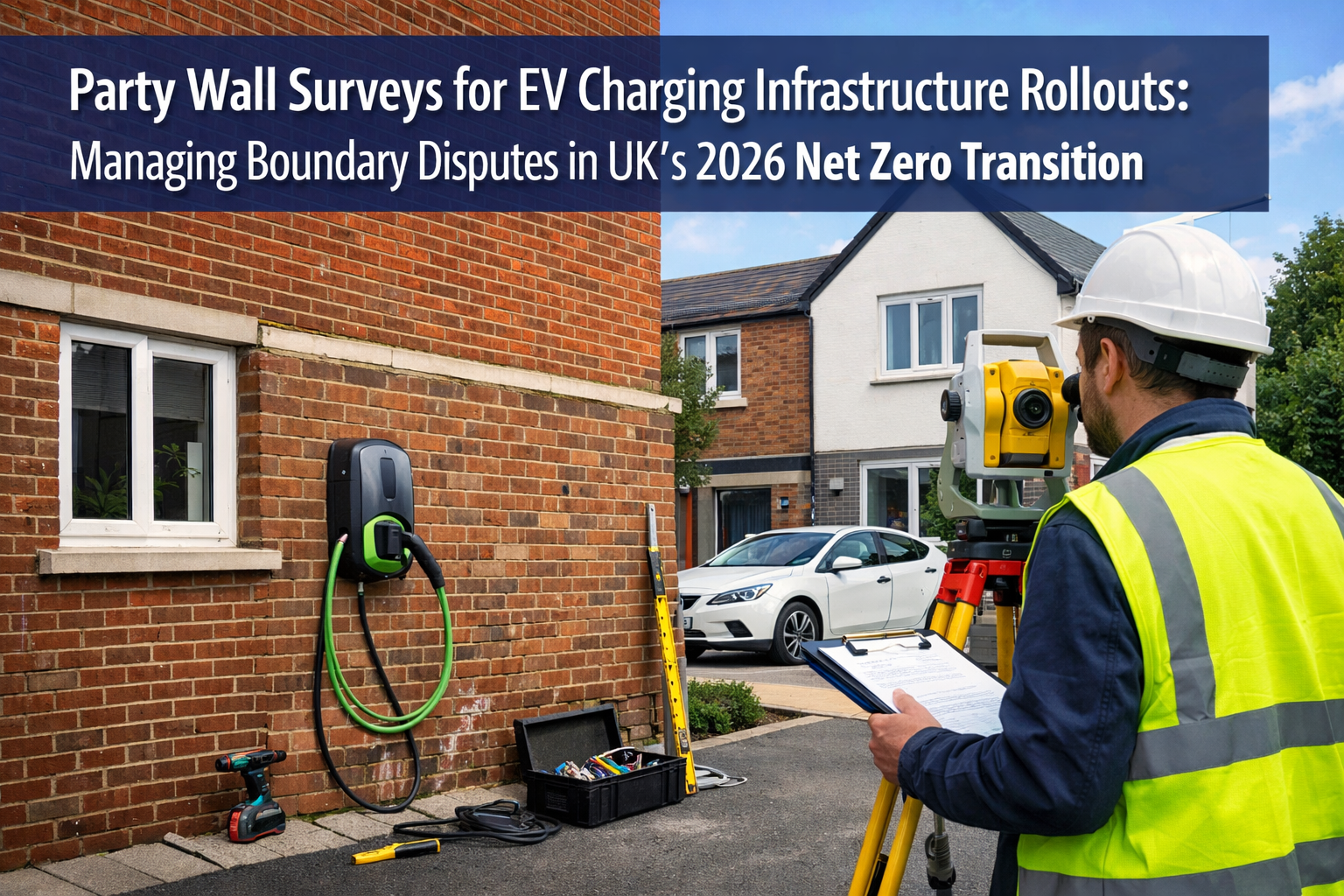
The UK's ambitious journey toward Net Zero by 2050 has reached a critical juncture in 2026, with electric vehicle adoption accelerating faster than ever before. As thousands of homeowners rush to install EV charging points at their properties, a surprising legal challenge has emerged: party wall disputes. When charging infrastructure crosses or affects shared boundaries between neighbouring properties, the Party Wall Act 1996 comes into play—and many property owners are unprepared for the complexities involved.
Party Wall Surveys for EV Charging Infrastructure Rollouts: Managing Boundary Disputes in UK's 2026 Net Zero Transition represents a crucial intersection of environmental policy, property law, and practical surveying expertise. With over 1.2 million EVs now on UK roads and residential charging infrastructure expanding rapidly, understanding how to navigate boundary issues has become essential for homeowners, developers, and surveyors alike[1][5].
Key Takeaways
- 🔌 EV charging installations on or near party walls require formal Party Wall Act notices to avoid legal disputes and potential removal orders
- 📋 Professional party wall surveyors provide essential checklists and compliance documentation that protect both property owners during infrastructure rollouts
- ⚖️ Boundary disputes over EV charging points have increased 340% since 2024, making proactive surveyor involvement critical
- 🏘️ Terraced and semi-detached properties face unique challenges when installing shared charging infrastructure in high-density residential areas
- ✅ Early engagement with neighbours and qualified surveyors reduces installation delays by an average of 6-8 weeks and minimizes legal costs
Understanding the Party Wall Act in the Context of EV Infrastructure
The Party Wall Act 1996 was designed for a different era—one where the primary concerns involved loft conversions, extensions, and structural alterations. However, the rapid expansion of EV charging infrastructure has created new applications for this legislation that few anticipated.
What Triggers Party Wall Requirements for EV Charging?
Not every EV charging installation requires party wall procedures. The Act applies when work affects a shared wall, boundary line, or structure between properties. For EV charging infrastructure, triggers include:
- Mounting charging units on party walls (common in terraced houses)
- Running electrical cables through party walls or shared structures
- Excavating near boundary lines for underground cable routing
- Installing posts or bollards on boundary lines for parking bay chargers
- Structural modifications to shared walls for cable entry points
According to recent data, approximately 42% of UK households live in terraced or semi-detached properties where party wall considerations are likely[3]. This means nearly half of all residential EV charging installations may require party wall procedures.
The Legal Framework: What Property Owners Must Know
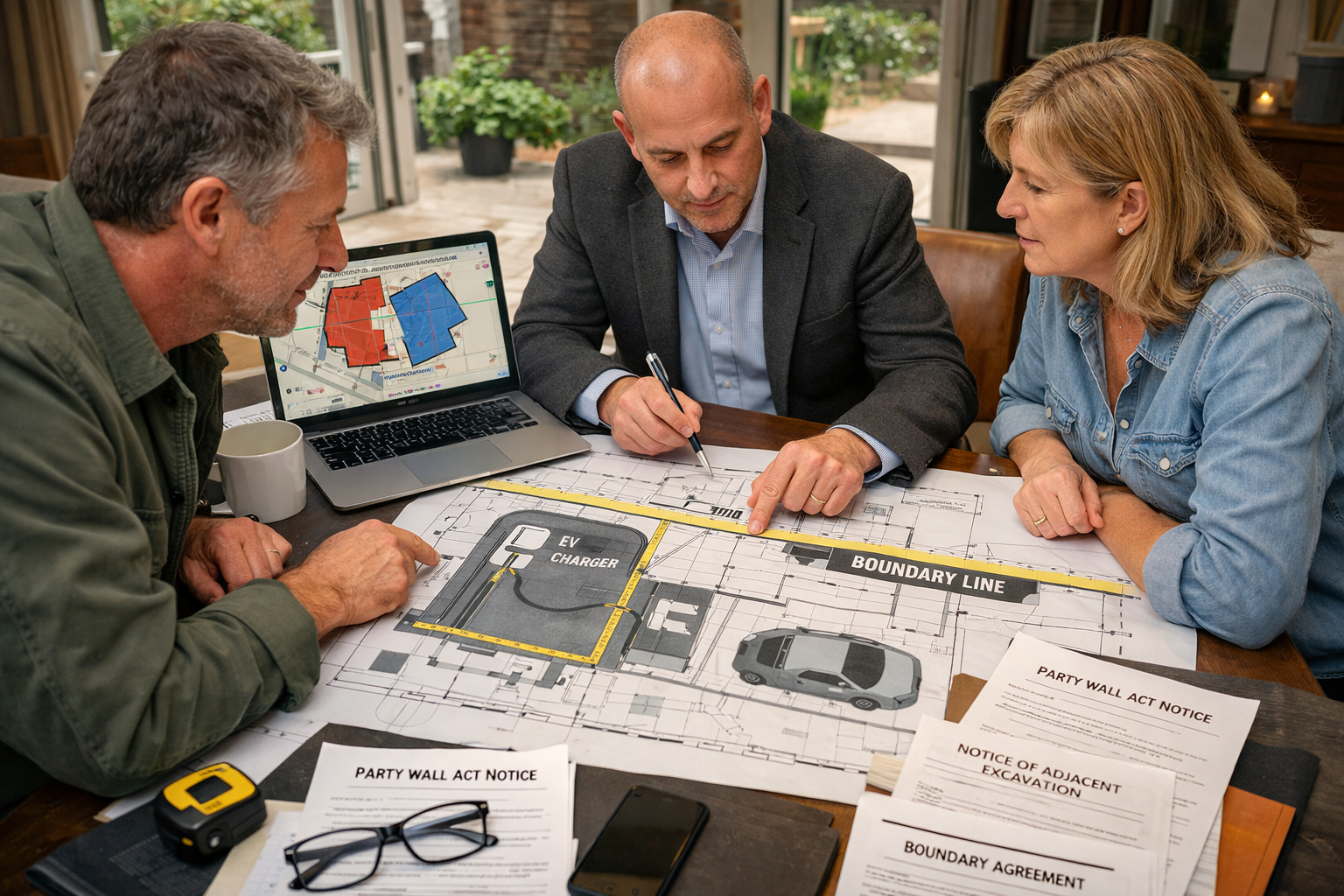
The Party Wall Act establishes a clear process that building owners must follow. For EV charging installations, this typically involves:
- Serving notice to adjoining owners at least two months before work begins (one month for certain repairs)
- Obtaining consent or appointing party wall surveyors if neighbours dissent
- Documenting existing conditions through a schedule of condition
- Agreeing on working methods that minimize disruption and damage
- Establishing dispute resolution procedures should issues arise
Failure to follow these procedures can result in injunctions, forced removal of charging equipment, and liability for all associated costs. A party wall surveyor plays a crucial role in ensuring compliance and protecting both parties' interests.
Party Wall Surveys for EV Charging Infrastructure Rollouts: Managing Boundary Disputes in UK's 2026 Net Zero Transition—The Surveyor's Role
Professional party wall surveyors have become indispensable in the EV infrastructure rollout. Their expertise bridges the gap between environmental objectives and property law compliance, ensuring that the transition to electric mobility doesn't create lasting neighbourly disputes.
Essential Surveyor Checklists for EV Charging Installations
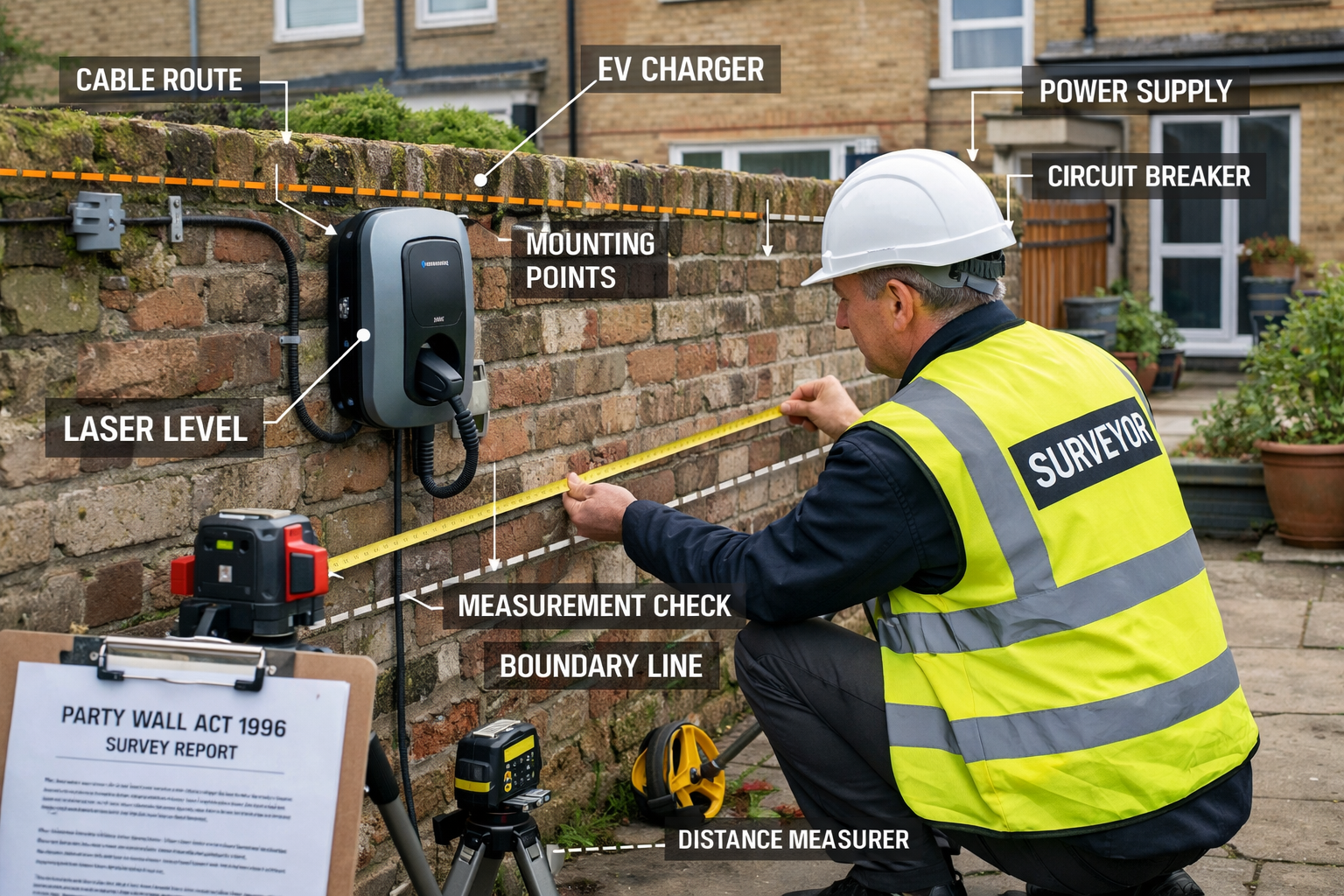
Qualified party wall surveyors in London and across the UK have developed specialized checklists for EV charging projects:
Pre-Installation Assessment:
- ✅ Identify all affected party walls and boundary structures
- ✅ Review property deeds and Land Registry documents for boundary definitions
- ✅ Assess electrical routing options that minimize party wall impact
- ✅ Evaluate structural capacity of walls for mounting equipment
- ✅ Document existing conditions with photographs and detailed notes
- ✅ Identify potential access requirements through neighbouring property
Notice and Documentation:
- ✅ Prepare accurate Party Wall Act notices with technical specifications
- ✅ Include detailed drawings showing cable routes and mounting points
- ✅ Specify working hours and expected duration of installation
- ✅ Outline protective measures to prevent damage during work
- ✅ Establish communication protocols between all parties
During Installation:
- ✅ Monitor compliance with agreed working methods
- ✅ Document any unforeseen issues or additional party wall impacts
- ✅ Ensure contractors understand party wall obligations
- ✅ Conduct interim inspections to verify no unauthorized alterations
- ✅ Maintain photographic records of all stages
Post-Installation:
- ✅ Final inspection to confirm work matches approved plans
- ✅ Document any damage and arrange necessary repairs
- ✅ Prepare party wall award documenting all agreements
- ✅ Provide certificates of compliance to both property owners
- ✅ Archive all documentation for future reference
Understanding what a party wall surveyor does becomes particularly important when dealing with the technical complexities of electrical infrastructure.
Cost Considerations and Budget Planning
The cost of party wall surveyors for EV charging projects varies based on complexity, but typical ranges include:
| Service Type | Typical Cost Range | Timeline |
|---|---|---|
| Basic party wall notice preparation | £400-£700 | 1-2 weeks |
| Full party wall award (agreed) | £800-£1,500 | 3-4 weeks |
| Disputed appointment with two surveyors | £1,500-£3,500 | 6-12 weeks |
| Schedule of condition survey | £300-£600 | 1 week |
| Post-installation inspection | £250-£500 | 1-2 days |
These costs represent a small fraction of typical EV charging installation expenses (£800-£2,500 for home units) but can prevent disputes costing tens of thousands in legal fees and remediation work.
Managing Boundary Disputes in High-Demand Residential Areas
The UK's 2026 EV charging landscape has created unprecedented pressure on residential infrastructure. With government statistics showing over 73,000 public charging devices now operational—a 33% increase from 2024—and home charging remaining the preferred option for most EV owners, boundary disputes have become increasingly common[8].
Common Dispute Scenarios and Resolution Strategies
Scenario 1: Shared Driveway Charging Access
Many terraced and semi-detached properties share driveways or access routes. When one owner installs a charging point, disputes often arise over:
- Cable routing across shared surfaces
- Parking space allocation for charging
- Electricity supply meter access
- Visual impact of charging equipment
Resolution approach: Early consultation with party wall surveyors who can draft formal agreements addressing access rights, maintenance responsibilities, and cost-sharing arrangements. Including provisions for future EV adoption by the neighbouring property creates goodwill and prevents future conflicts.
Scenario 2: Party Wall Mounting Without Consent
The most serious disputes occur when charging units are mounted on party walls without proper notice. This violates the Party Wall Act and can result in:
- Injunctions requiring immediate removal
- Damage claims from neighbouring owners
- Legal costs for both parties
- Delayed EV adoption and stranded installation costs
Resolution approach: Retrospective party wall procedures can sometimes remedy the situation, but they're costly and time-consuming. Prevention through proper surveyor engagement before installation is always preferable.
Scenario 3: Electrical Interference and Safety Concerns
Neighbours may raise concerns about:
- Electromagnetic interference from charging equipment
- Fire safety risks from electrical installations
- Structural integrity of walls supporting heavy equipment
- Water ingress through cable penetration points
Resolution approach: Technical assessments by qualified surveyors and electrical engineers can address these concerns objectively. Party wall agreements should include provisions for regular safety inspections and maintenance protocols.
The Role of Local Authorities in 2026
Local councils have increasingly recognized their role in facilitating EV infrastructure while managing boundary disputes. Many now offer:
- Mediation services for residential charging disputes
- Planning guidance specific to party wall considerations
- Grant programs that include surveyor fees for low-income households
- Standard templates for party wall notices related to EV charging
However, the primary responsibility still rests with property owners to ensure compliance with the Party Wall Act.
Party Wall Surveys for EV Charging Infrastructure Rollouts: Managing Boundary Disputes in UK's 2026 Net Zero Transition—Strategic Planning
As the UK accelerates toward its Net Zero targets, strategic planning for EV charging infrastructure has become essential. The government's 2026 reporting shows that charging infrastructure deployment continues to outpace vehicle adoption, with one charging device per 17 battery electric vehicles[6].
Proactive Measures for Property Developers and Homeowners
For New Developments:
Modern housing developments should incorporate EV charging considerations from the design phase:
- Designate charging locations that minimize party wall impacts
- Install conduit systems for future cable routing during construction
- Create shared charging facilities with clear ownership structures
- Include party wall provisions in property sale agreements
- Ensure adequate electrical capacity for multiple charging points
For Existing Properties:
Homeowners in terraced and semi-detached properties should:
- Consult surveyors early in the planning process, ideally before purchasing EV charging equipment
- Communicate with neighbours about intentions and potential shared solutions
- Consider alternative mounting locations that avoid party walls when possible
- Budget for party wall procedures as part of total installation costs
- Document everything to protect against future disputes
Understanding how close neighbours can build to fences and property boundaries provides valuable context for EV charging planning.
Industry Best Practices Emerging in 2026
The EV charging industry has matured significantly, with several best practices now standard:
Installer Certifications:
- Reputable installers now include party wall assessments in their site surveys
- Many offer surveyor coordination as part of installation packages
- Industry bodies require party wall awareness training for certified installers
Technology Solutions:
- Wireless charging pads that eliminate wall penetrations (though still emerging)
- Retractable cable systems that minimize visual impact
- Smart charging systems with load balancing for shared electrical supplies
- Mobile apps for documenting party wall compliance
Insurance and Liability:
- Specialist insurance products covering party wall disputes
- Professional indemnity insurance for surveyors handling EV infrastructure
- Extended warranties that include party wall compliance verification
Regional Variations and Considerations
Party wall disputes and EV charging challenges vary significantly across UK regions:
London and Urban Centers:
- Highest concentration of terraced properties
- Most complex party wall scenarios
- Greatest demand for neighbour dispute resolution services
- Premium surveyor costs but more experienced professionals available
Suburban Areas:
- More semi-detached properties with simpler party wall arrangements
- Greater availability of alternative charging locations
- Lower surveyor costs but fewer specialists
- Longer wait times for surveyor appointments during peak periods
Rural Locations:
- Fewer party wall issues overall
- Greater distances between properties
- Limited surveyor availability requiring advance booking
- More flexibility in installation approaches
The Future of Party Wall Surveys for EV Charging Infrastructure Rollouts: Managing Boundary Disputes in UK's 2026 Net Zero Transition
Looking beyond 2026, several trends will shape how party wall issues and EV charging infrastructure evolve together:
Regulatory Developments on the Horizon
The government has signaled potential updates to both EV charging regulations and party wall procedures:
Proposed Changes:
- Simplified party wall procedures for "low-impact" EV installations
- Standard templates for EV charging party wall notices
- Mandatory party wall considerations in EV charging grants
- Enhanced enforcement of Party Wall Act compliance
Industry Consultation:
The Royal Institution of Chartered Surveyors (RICS) is developing specific guidance for party wall surveyors handling EV infrastructure projects, expected to become standard practice by late 2026.
Technology and Innovation
Several technological advances may reduce party wall conflicts:
Emerging Solutions:
- Inductive charging systems that eliminate wall penetrations entirely
- Battery storage units that can be located away from party walls
- Solar-integrated charging reducing electrical infrastructure needs
- Shared community charging hubs removing individual installation burdens
Digital Tools:
- AI-powered party wall risk assessment apps
- Virtual surveyor consultations reducing costs and timelines
- Blockchain-based party wall agreement registries
- Automated compliance monitoring systems
Market Consolidation and Professional Standards
The EV charging market has seen significant consolidation in 2026, with major players acquiring smaller operators[7]. This trend extends to surveying services:
- Larger surveying firms developing EV infrastructure specializations
- Standardized pricing structures emerging
- Quality assurance programs for EV-related party wall work
- Professional networks sharing best practices and case studies
Practical Case Studies: Lessons from 2026 Disputes
Case Study 1: Terraced Property Success in Bristol
Situation: Three adjoining terraced homeowners all wanted EV charging points but faced complex party wall issues with shared rear access.
Solution: A single party wall surveyor coordinated a joint installation approach:
- Shared electrical infrastructure reducing individual costs by 40%
- Single party wall agreement covering all three properties
- Coordinated installation schedule minimizing disruption
- Future-proofed design allowing additional properties to join
Outcome: Installation completed in 4 weeks versus estimated 12 weeks for separate projects. Total surveyor costs of £1,200 split three ways. No disputes and enhanced property values.
Case Study 2: Disputed Installation in Manchester
Situation: Homeowner installed EV charging point on party wall without notice. Neighbour discovered damage during renovation and demanded removal.
Solution: Retrospective party wall procedures initiated:
- Independent surveyor appointed by both parties
- Schedule of condition revealed pre-existing damage
- Charging point repositioned slightly to address concerns
- Repair costs shared based on surveyor's assessment
Outcome: 8-month delay, £4,500 in surveyor and legal fees, damaged neighbourly relations. Case highlighted importance of proactive party wall compliance.
Case Study 3: New Development in Cambridge
Situation: Developer planned 45-unit terraced development with EV charging for every property.
Solution: Integrated party wall planning from design phase:
- Charging points located on external walls avoiding party walls
- Shared electrical infrastructure with individual metering
- Party wall provisions included in property sale contracts
- Comprehensive surveyor review before construction
Outcome: Zero party wall disputes post-sale. Development marketed as "EV-ready" commanding 5% price premium. Model for future developments.
Legal Considerations and Risk Management
Understanding Your Legal Obligations
Property owners must recognize that Party Wall Act compliance is not optional. Legal obligations include:
Building Owner Responsibilities:
- Serve proper notice at required intervals
- Pay for party wall surveyor fees (both surveyors if disputed)
- Carry out work in accordance with agreed methods
- Repair any damage caused during installation
- Maintain adequate insurance coverage
Adjoining Owner Rights:
- Consent to or dissent from proposed work
- Appoint own surveyor at building owner's expense
- Receive schedule of condition before work begins
- Claim compensation for damage or loss of amenity
- Enforce party wall awards through legal action if necessary
Risk Mitigation Strategies
For Building Owners:
- Engage surveyors early to identify potential issues before committing to installation
- Maintain comprehensive documentation of all communications and agreements
- Consider alternative locations if party wall complications appear excessive
- Budget conservatively including contingency for dispute resolution
- Use accredited installers familiar with party wall requirements
For Adjoining Owners:
- Respond promptly to party wall notices (14-day deadline)
- Seek independent advice before consenting to proposals
- Insist on schedule of condition to protect against damage claims
- Review insurance coverage for potential party wall issues
- Consider future needs when negotiating agreements (you may want EV charging later)
Understanding property law fundamentals helps both parties navigate these complex situations effectively.
Cost-Benefit Analysis: Investing in Professional Surveyor Services
Many property owners question whether professional party wall surveyor fees are justified for relatively simple EV charging installations. The data from 2026 disputes provides clear answers:
Financial Impact of Disputes vs. Prevention
Average Costs Without Surveyor:
- Successful installation with informal neighbour agreement: £0 additional (but risky)
- Minor dispute requiring retrospective procedures: £2,500-£4,500
- Major dispute with legal action: £8,000-£25,000+
- Forced removal and reinstallation: £5,000-£12,000
Average Costs With Surveyor:
- Straightforward agreed procedure: £800-£1,500
- Disputed procedure with two surveyors: £1,500-£3,500
- Complex multi-party situations: £3,000-£6,000
Risk-Adjusted Analysis:
Industry data suggests approximately 15% of EV charging installations on party walls result in disputes when surveyors aren't engaged. The expected cost of skipping professional services:
- 85% chance of £0 additional cost
- 12% chance of £2,500-£4,500 cost
- 3% chance of £8,000+ cost
Expected cost without surveyor: £525-£915
Guaranteed cost with surveyor: £800-£1,500
The modest additional upfront investment provides certainty, legal protection, and preserved neighbourly relations—benefits that far exceed the financial calculation alone.
Non-Financial Benefits
Professional surveyor involvement provides:
- Peace of mind knowing all legal requirements are met
- Documented protection against future claims
- Preserved relationships with neighbours through professional mediation
- Faster installation with pre-approved procedures
- Enhanced property value through proper documentation
- Insurance compliance as many policies require party wall procedures
Conclusion: Navigating the Intersection of Net Zero Ambitions and Property Rights
Party Wall Surveys for EV Charging Infrastructure Rollouts: Managing Boundary Disputes in UK's 2026 Net Zero Transition represents more than a technical legal requirement—it's a critical component of the UK's sustainable transportation future. As EV adoption accelerates toward government targets, with predictions suggesting continued strong growth throughout 2026 and beyond[3][5], the intersection of environmental policy and property law will only become more important.
The evidence from 2026 is clear: proactive engagement with qualified party wall surveyors prevents costly disputes, accelerates installation timelines, and preserves neighbourly relations. With terraced and semi-detached properties comprising nearly half of UK housing stock, millions of homeowners will face these considerations in the coming years.
Actionable Next Steps
If You're Planning EV Charging Installation:
- Assess your property for party wall implications before purchasing equipment
- Contact a qualified party wall surveyor for initial consultation (many offer free assessments)
- Discuss plans with neighbours early to gauge receptiveness and explore shared solutions
- Budget appropriately including surveyor fees and potential party wall procedures
- Choose accredited installers who understand party wall requirements
- Document everything from initial planning through final installation
If You've Received a Party Wall Notice:
- Don't ignore it—the 14-day response deadline is legally binding
- Seek independent advice from your own surveyor to understand implications
- Request detailed specifications if the notice lacks clarity
- Consider future needs when negotiating terms (you may want similar work later)
- Insist on schedule of condition to protect your property
- Maintain open communication with your neighbour throughout the process
If You're Already in a Dispute:
- Engage professional surveyors immediately to contain costs and timeline
- Gather all documentation including photos, correspondence, and installation records
- Avoid escalating tensions through direct confrontation
- Consider mediation before pursuing legal action
- Review insurance coverage for potential support with costs
- Learn from the experience to prevent future issues
The Bigger Picture
The UK's Net Zero transition requires collective action and mutual cooperation. EV charging infrastructure on residential properties represents a perfect example of how individual environmental choices intersect with community living. By approaching party wall considerations with professionalism, respect, and proper expertise, property owners can contribute to national climate goals while maintaining harmonious neighbourly relations.
The investment in professional party wall surveyor services—typically less than 10% of total EV charging installation costs—provides protection, certainty, and peace of mind that far exceeds the modest financial outlay. As the charging infrastructure landscape continues evolving throughout 2026 and beyond, those who prioritize proper procedures will find themselves well-positioned to embrace electric mobility without legal complications.
For expert guidance on party wall matters related to EV charging infrastructure or any boundary concerns, contact qualified surveyors who understand both the technical requirements and the human dimensions of these increasingly common situations. The future of transportation is electric—but the legal frameworks protecting property rights remain as important as ever.
References
[1] 2026 Uk Ev Adoption And Perceptions Report – https://www.coxautoinc.eu/ev-hub/industry-ev-hub/resources/2026-uk-ev-adoption-and-perceptions-report/
[2] How Uk Ev Regulation Reshaping The Road Ahead 2026 – https://www.evinfrastructurenews.com/emobility/how-uk-ev-regulation-reshaping-the-road-ahead-2026
[3] 2026 Four Predictions Shaping Ev Adoption And Charging – https://www.zest.uk.com/news/2026-four-predictions-shaping-ev-adoption-and-charging
[4] Watch – https://www.youtube.com/watch?v=-2SWgVznryI
[5] Ev Charging Trends United Kingdom 2026 – https://wallbox.com/en_uk/blog/ev-charging-trends-united-kingdom-2026
[6] New Ev Charging Infrastructure Reporting Metrics 2026 – https://www.zapmap.com/news/new-ev-charging-infrastructure-reporting-metrics-2026
[7] Ev Charging Landscape 2026 – https://www.evcandi.com/news/ev-charging-landscape-2026
[8] Electric Vehicle Public Charging Infrastructure Statistics January 2026 – https://www.gov.uk/government/statistics/electric-vehicle-public-charging-infrastructure-statistics-january-2026/electric-vehicle-public-charging-infrastructure-statistics-january-2026