

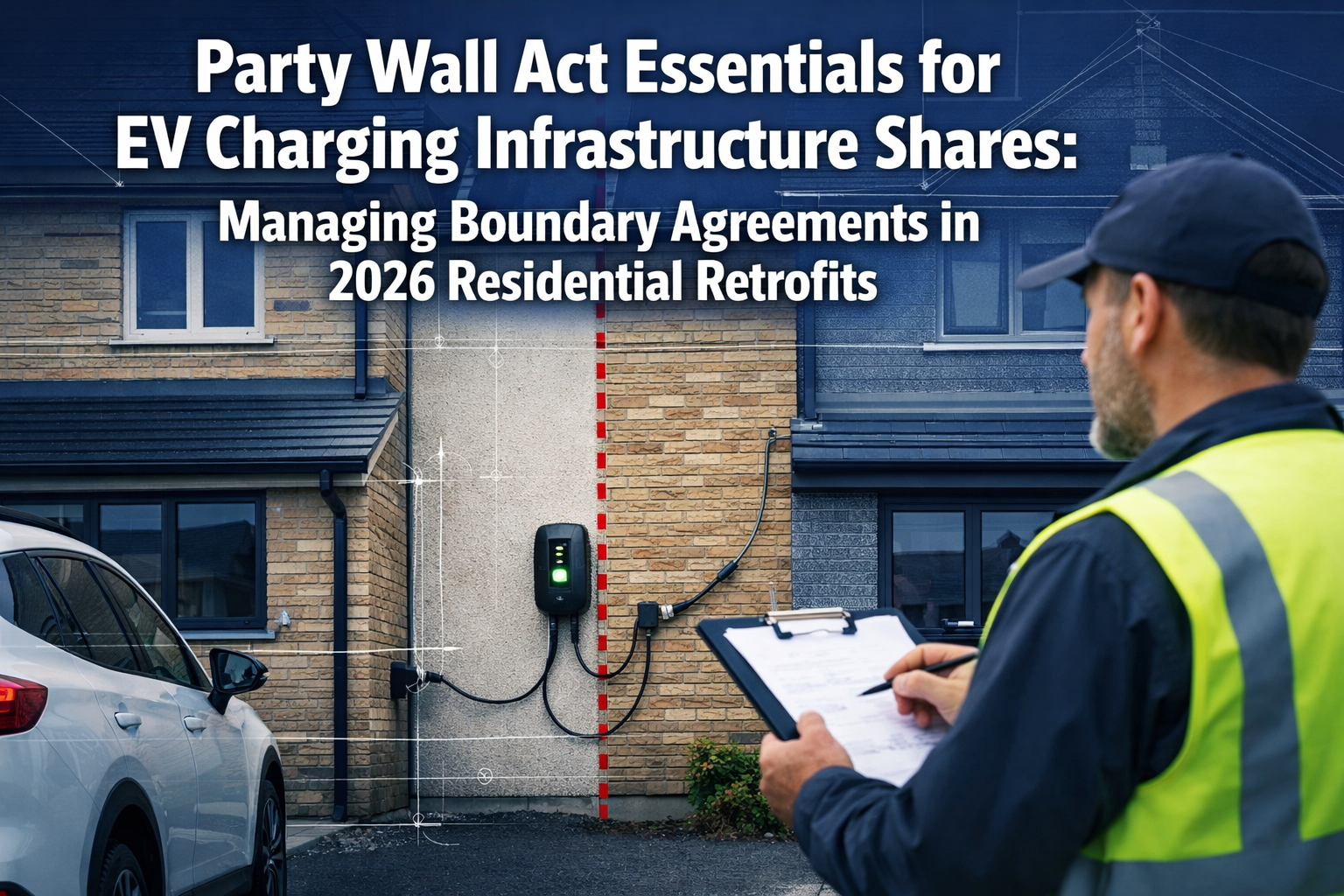
The surge in electric vehicle ownership across the UK has created an unexpected challenge for homeowners: what happens when your EV charger needs to cross a property boundary? As residential streets transform into charging hubs, understanding Party Wall Act Essentials for EV Charging Infrastructure Shares: Managing Boundary Agreements in 2026 Residential Retrofits has become critical for property owners navigating shared charging solutions. With planning permission exemptions now in place for driveway chargers[1], the focus has shifted from regulatory approval to neighbor relations and boundary law compliance.
The intersection of modern EV infrastructure and century-old property law creates unique challenges. As of 2026, homeowners installing shared charging points must navigate the Party Wall Act 1996 framework while meeting new smart charger standards that came into force in 2022[4]. This comprehensive guide explores the essential procedures, legal requirements, and practical strategies for managing boundary agreements when retrofitting residential properties with EV charging infrastructure.
Key Takeaways
- Planning exemptions don't eliminate Party Wall obligations: While most domestic EV chargers no longer require planning permission in England[1][2], work affecting party walls still demands proper notices and agreements
- Shared charging infrastructure requires formal agreements: Cable routes, mounting points, and electrical connections crossing boundaries must comply with Party Wall Act procedures
- Schedule of condition documentation protects all parties: Pre-installation surveys establish baseline property conditions and prevent future disputes
- Smart charger compliance adds complexity: New technical standards for off-peak scheduling and cybersecurity[4] must be integrated into party wall awards
- Professional surveyor involvement minimizes risk: Expert guidance through notices, awards, and dispute resolution ensures legal compliance and neighbor cooperation
Understanding the Party Wall Act Framework for EV Charging Installations
The Party Wall etc. Act 1996 provides the legal framework for construction work affecting shared walls, boundaries, and adjacent properties. When retrofitting EV charging infrastructure in 2026, this legislation becomes relevant in several specific scenarios that homeowners must recognize before commencing work.
When Does EV Charging Work Trigger Party Wall Requirements?
EV charging installations typically engage the Party Wall Act under three main circumstances:
1. Mounting Chargers on Party Walls 🔌
When a charging unit attaches directly to a wall shared with a neighbor, Section 2 of the Act applies. This includes drilling fixings, running conduit, or installing cable management systems that penetrate or load the party structure.
2. Running Cables Along or Through Boundaries ⚡
Cable routes that cross property lines—whether underground beneath shared driveways or overhead along boundary walls—constitute work affecting the boundary and require proper notification under Section 1.
3. Excavation Near Neighboring Foundations 🏗️
Trenching for underground cable runs within three meters of an adjoining owner's structure, or within six meters if the excavation goes deeper than the neighbor's foundations, triggers Section 6 requirements.
"The rise of shared EV charging infrastructure has created a new category of party wall work that wasn't contemplated when the 1996 Act was drafted. Homeowners must adapt traditional procedures to modern electrical installations." — Party Wall Surveyor Guidance, 2026
Key Sections of the Act Relevant to EV Infrastructure
| Act Section | Application to EV Charging | Notice Period Required |
|---|---|---|
| Section 1 | New walls on boundary lines; cable routes along property lines | 1 month |
| Section 2 | Work to existing party walls; mounting charging units | 2 months |
| Section 6 | Excavation for underground cables near foundations | 1 month |
Understanding which section applies determines the notification timeline and procedural requirements. Many residential EV installations involve multiple sections simultaneously—for example, mounting a charger on a party wall (Section 2) while running cables underground near foundations (Section 6).
The Relationship Between Planning Permission and Party Wall Procedures
A common misconception among homeowners in 2026 is that the planning permission exemptions for EV chargers[1][2] eliminate the need for party wall procedures. This is categorically incorrect. The two regulatory frameworks operate independently:
- Planning permission addresses whether the development complies with local planning policies and land use regulations
- Party Wall Act procedures protect the structural and legal rights of adjoining property owners
Since June 2025, most single domestic EV chargers on private driveways no longer require planning permission in England[1]. However, this exemption provides no relief from party wall obligations. Homeowners must still serve proper notices and obtain consent or awards when work affects shared structures or boundaries.
The expert party wall advice available from qualified surveyors helps navigate this dual regulatory landscape, ensuring compliance with both planning and party wall requirements where applicable.
Party Wall Act Essentials for EV Charging Infrastructure Shares: The Notice and Consent Process
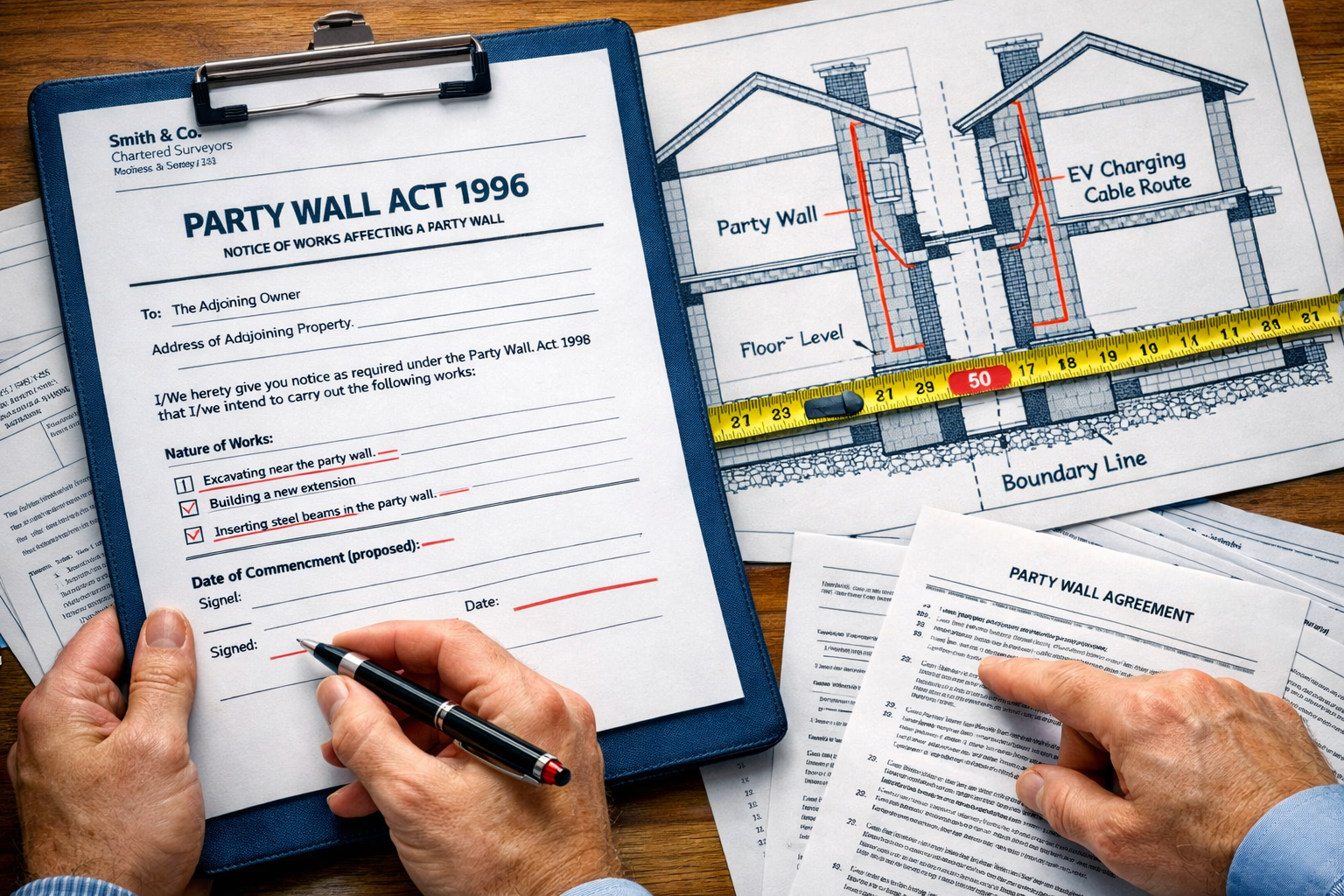
Proper notification forms the cornerstone of lawful party wall work. The Party Wall Act Essentials for EV Charging Infrastructure Shares: Managing Boundary Agreements in 2026 Residential Retrofits process begins with serving correct notices to all affected adjoining owners.
Preparing and Serving Party Wall Notices for EV Installations
The notice must contain specific information tailored to the EV charging work:
Essential Notice Contents 📋
- Detailed description of the proposed work (charger model, mounting method, cable routes)
- Precise location of work relative to the party wall or boundary
- Proposed start date (respecting minimum notice periods)
- Statement of the building owner's rights under the Act
- Clear indication of the adjoining owner's right to consent or dissent
For EV charging installations, additional technical specifications should be included:
- Electrical load specifications: Charger power rating (typically 7kW for domestic installations)
- Smart charger compliance: Confirmation that the unit meets 2022 regulations for off-peak scheduling and cybersecurity[4]
- Cable routing diagrams: Showing exact paths through or along party structures
- Mounting details: Fixing methods, penetration depths, and load distribution
Response Scenarios and Timelines
Once served, the adjoining owner has 14 days to respond in one of three ways:
Scenario 1: Consent ✅
The adjoining owner provides written consent to the proposed work. This is the simplest outcome, allowing work to proceed without a formal award. However, even with consent, prudent building owners should still commission a schedule of condition to document pre-work property status.
Scenario 2: Dissent or Non-Response ⚠️
If the adjoining owner dissents or fails to respond within 14 days, a "dispute" is deemed to exist under the Act. This is not necessarily adversarial—it simply triggers the formal surveyor appointment process.
Scenario 3: Counter-Proposals 🔄
The adjoining owner may consent subject to modifications (different mounting locations, alternative cable routes, specific working hours). These counter-proposals must be evaluated for technical feasibility and cost implications.
Appointing Surveyors Under the Act
When a dispute arises (including deemed disputes from non-response), the Act provides three surveyor appointment options:
- Agreed Surveyor: Both parties jointly appoint a single surveyor who acts impartially
- Two Surveyors: Each party appoints their own surveyor, who then select a third surveyor to resolve any disagreements
- Three Surveyors: Each party appoints a surveyor, and those two immediately appoint a third surveyor
For straightforward EV charging installations, the agreed surveyor route typically proves most cost-effective and efficient. Understanding what a party wall surveyor does helps homeowners make informed decisions about surveyor selection and appointment.
The appointed surveyor(s) then prepare a Party Wall Award—a legally binding document that:
- Authorizes the specific work described
- Sets conditions for execution (working hours, access requirements, noise limitations)
- Allocates costs between parties
- Establishes dispute resolution procedures
- Incorporates the schedule of condition
Cost Allocation in EV Charging Party Wall Matters
Under the Act, the building owner (the person carrying out the work) typically bears all reasonable costs, including:
- Their own surveyor's fees
- The adjoining owner's surveyor's fees (in a two-surveyor scenario)
- The third surveyor's fees (if appointed)
- Schedule of condition preparation costs
For 2026 residential EV charging installations, total surveyor costs typically range from £800-£2,500 depending on complexity, property value, and whether disputes arise. Obtaining party wall surveyor quotes from multiple qualified professionals helps budget accurately for these essential expenses.
Schedules of Condition: Protecting All Parties During EV Retrofits
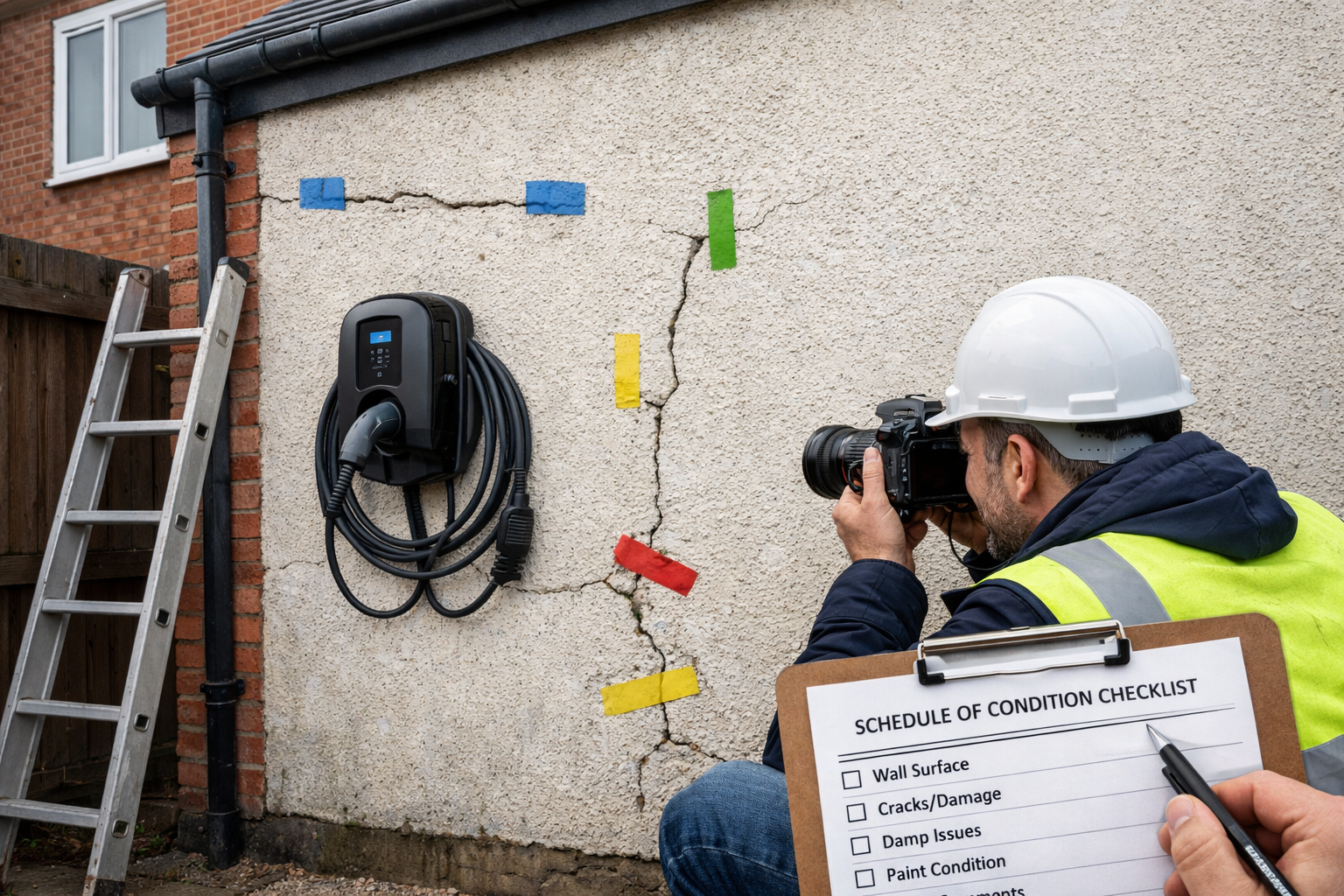
The schedule of condition represents one of the most valuable protective measures in party wall procedures, yet it's frequently overlooked or inadequately executed. For EV charging installations affecting boundaries, a comprehensive schedule provides crucial evidence of pre-work property conditions.
What a Schedule of Condition Documents
A schedule of condition is a detailed photographic and written record of the adjoining owner's property before work commences. For EV charging retrofits, this documentation should capture:
Structural Elements 🏠
- Condition of party walls (cracks, settlement, existing damage)
- Foundation areas near planned excavation routes
- Boundary walls and fences along cable paths
- Drainage systems that might be affected by trenching
Interior Spaces 🛋️
- Rooms adjacent to the party wall where the charger mounts
- Ceilings, walls, and decorative finishes
- Existing cracks in plasterwork
- Door and window alignment
External Features 🌳
- Paving, driveways, and hardstanding along cable routes
- Garden features near excavation areas
- Existing utility connections
- Boundary markers and fencing
Photographic Evidence 📸
Modern schedules of condition should include:
- High-resolution timestamped photographs
- Multiple angles of each documented area
- Close-ups of existing defects
- Wide shots showing overall context
- Video walkthroughs for comprehensive coverage
When to Commission the Schedule
Timing is critical for schedule of condition effectiveness. The survey should occur:
- After party wall notices are served
- Before any work commences on site
- Ideally within 1-2 weeks of the planned start date to minimize intervening changes
For EV charging installations, scheduling the condition survey to coincide with any building surveys or property inspection work can provide cost efficiencies while ensuring comprehensive documentation.
Using Schedules to Prevent and Resolve Disputes
The schedule of condition serves multiple protective functions:
Prevention 🛡️
- Establishes baseline conditions that all parties acknowledge
- Reduces neighbor anxiety by demonstrating professional approach
- Identifies pre-existing issues that won't be attributed to the new work
- Provides clear reference point if concerns arise during construction
Resolution ⚖️
- Offers objective evidence in damage claims
- Distinguishes new damage from pre-existing conditions
- Supports insurance claims if necessary
- Facilitates fair compensation determinations
"In 15 years of party wall surveying, I've never seen a case where a thorough schedule of condition didn't save at least one party from unfair claims. For EV installations with multiple cable penetrations, this documentation is absolutely essential." — Chartered Building Surveyor, London, 2026
Integrating Smart Charger Requirements into Documentation
The 2022 regulations requiring smart functionality in all new EV chargers[4] add technical complexity to party wall documentation. Schedules of condition for 2026 installations should specifically note:
- Electrical system baseline: Existing electrical installations on party walls
- Data connectivity infrastructure: Wi-Fi signal strength, broadband connections
- Cybersecurity considerations: Network security measures in place
- Off-peak scheduling capabilities: Verification that the proposed charger meets regulatory requirements
These technical elements should be incorporated into the Party Wall Award alongside traditional structural considerations, creating a comprehensive framework for the installation.
Managing Shared EV Charging Infrastructure Across Property Boundaries
As EV adoption accelerates, many homeowners are exploring shared charging arrangements with neighbors to reduce costs and maximize infrastructure efficiency. These collaborative approaches introduce additional complexity to party wall procedures and boundary agreements.
Models for Shared Charging Infrastructure
Several sharing models have emerged in 2026 residential settings:
Model 1: Jointly Owned Charging Point 🤝
- Both neighbors contribute to installation costs
- Shared ownership of equipment
- Joint maintenance responsibilities
- Requires formal co-ownership agreement alongside party wall award
Model 2: Primary Owner with Access Rights 🔑
- One neighbor owns and maintains the charger
- Adjacent neighbor pays for access rights and usage
- License agreement grants specific charging privileges
- Party wall award addresses structural aspects; separate license covers usage
Model 3: Third-Party Managed System 🏢
- External provider installs and maintains equipment
- Both neighbors contract with provider
- Provider handles billing and maintenance
- Party wall procedures address installation; provider agreements cover operation
Each model requires careful integration of party wall procedures with contractual arrangements governing ownership, access, costs, and responsibilities.
Drafting Boundary Agreements for Long-Term Charging Access
When EV charging infrastructure crosses boundaries, a comprehensive boundary agreement should address:
Physical Infrastructure Rights ⚡
- Exact location of cables, conduits, and equipment
- Right to access for maintenance and repairs
- Replacement and upgrade provisions
- Removal obligations if charging ceases
Cost Allocation 💷
- Initial installation cost sharing
- Ongoing electricity cost apportionment
- Maintenance and repair responsibilities
- Upgrade cost sharing for future improvements
Usage Terms 📅
- Charging schedules and priority access
- Guest vehicle provisions
- Capacity limitations if both parties charge simultaneously
- Fair usage policies
Dispute Resolution 🤝
- Mediation procedures for disagreements
- Surveyor involvement in technical disputes
- Cost allocation for dispute resolution
- Exit provisions if the arrangement becomes unworkable
These boundary agreements should be drafted by solicitors experienced in property boundaries and legal agreements, then registered as land charges to bind future property owners.
Addressing New Build and Retrofit Mandates
The 2026 regulatory landscape includes specific requirements for EV charging in new developments and major renovations. All new covered car parks must have charging points installed, and residential buildings undergoing major renovation with over 10 parking spaces require cable routes for EV charging[3].
For residential retrofits, these mandates create opportunities and obligations:
Opportunities 📈
- Increased property value from EV-ready infrastructure
- Future-proofing against emerging regulations
- Enhanced marketability to EV-owning buyers
- Potential for shared infrastructure reducing individual costs
Obligations 📋
- Compliance with smart charger standards[4]
- Integration with building control requirements
- Coordination with construction projects and wall construction codes
- Proper party wall procedures regardless of planning exemptions
Understanding how these mandates interact with party wall requirements helps homeowners plan compliant, cost-effective installations that protect all parties' interests.
Common Challenges and Practical Solutions in 2026 EV Charging Party Wall Matters
Despite clear legal frameworks, EV charging installations frequently encounter practical challenges that require creative problem-solving within party wall procedures.
Challenge 1: Neighbor Opposition to EV Infrastructure
The Issue: Some adjoining owners object to EV charging installations due to aesthetic concerns, perceived property devaluation, or general resistance to change.
The Solution:
- Provide detailed information about planning exemptions[1][2] demonstrating regulatory acceptance
- Share data on property value impacts (generally neutral or positive)
- Offer aesthetic solutions (concealed cable routes, discreet mounting)
- Emphasize the temporary nature of any disruption
- Consider involving an agreed surveyor early to provide neutral expert perspective
The Party Wall Act does not give adjoining owners the right to prevent work entirely—only to ensure it's executed safely with proper safeguards. Understanding this distinction helps manage expectations and move past emotional objections to practical solutions.
Challenge 2: Cable Routing Through Complex Boundary Configurations
The Issue: Modern residential properties often feature complex boundaries with shared driveways, communal gardens, or multiple adjoining owners, complicating cable routing decisions.
The Solution:
- Commission professional surveys identifying all affected parties
- Explore alternative routing options minimizing boundary crossings
- Consider wireless charging technology for particularly complex situations
- Use property boundary specialists to clarify ownership and rights
- Obtain comprehensive title searches identifying all parties with interests
For properties with land boundary disagreements or property boundary disputes, resolving these underlying issues before commencing EV installation prevents compounding problems.
Challenge 3: Coordinating Smart Charger Compliance with Party Wall Requirements
The Issue: The 2022 smart charger regulations[4] require off-peak scheduling, randomized delays, and cybersecurity controls—technical requirements that may affect party wall arrangements.
The Solution:
- Include smart charger specifications in party wall notices
- Address data connectivity requirements in awards
- Consider shared Wi-Fi access or dedicated connectivity solutions
- Document cybersecurity measures protecting both properties
- Specify upgrade paths for evolving smart charging standards
The Party Wall Award should explicitly reference smart charger compliance, ensuring that future upgrades to meet evolving standards don't require entirely new party wall procedures.
Challenge 4: Managing Costs When Multiple Properties Benefit
The Issue: When shared charging infrastructure benefits multiple properties, determining fair cost allocation becomes complex, especially when properties have different numbers of vehicles or charging needs.
The Solution:
- Use metered electricity consumption for ongoing cost allocation
- Apportion installation costs based on anticipated usage
- Consider capacity-based allocation (e.g., 60/40 split for a household with two EVs vs. one)
- Build in periodic review mechanisms to adjust allocations
- Document allocation methodology clearly in boundary agreements
Professional quantity surveyors can provide cost allocation frameworks that parties perceive as fair, reducing potential disputes.
Challenge 5: Future-Proofing for Evolving EV Technology
The Issue: EV charging technology evolves rapidly. Infrastructure installed in 2026 may become obsolete within 5-10 years, requiring upgrades that affect party walls again.
The Solution:
- Install oversized conduits allowing cable upgrades without new excavation
- Include upgrade provisions in initial Party Wall Awards
- Draft boundary agreements with technology refresh clauses
- Consider modular mounting systems facilitating charger replacement
- Document infrastructure specifications comprehensively for future reference
Forward-thinking party wall awards can include provisions for "like-for-like" replacement or technology upgrades within specified parameters, avoiding repeated full party wall procedures for routine improvements.
The Role of Professional Surveyors in EV Charging Party Wall Matters
Professional surveyor involvement transforms potentially contentious EV charging installations into smoothly executed projects that protect all parties' interests. Understanding the surveyor's role helps homeowners maximize the value of this professional service.
Surveyor Selection Criteria for EV Infrastructure Projects
Not all party wall surveyors possess equal expertise in modern EV charging installations. When selecting a professional, prioritize:
Technical Knowledge 🔧
- Understanding of electrical systems and EV charging technology
- Familiarity with smart charger regulations[4]
- Experience with cable routing and mounting systems
- Knowledge of current building regulations for electrical work
Party Wall Expertise 📚
- Membership in relevant professional bodies (RICS, FPWS)
- Demonstrated experience with Section 1, 2, and 6 work
- Track record of successful award preparation
- Understanding of dispute resolution procedures
Local Knowledge 🗺️
- Familiarity with local building control requirements
- Understanding of regional property characteristics
- Relationships with local contractors and specialists
- Knowledge of area-specific boundary issues
The London party wall agreement specialists at established firms bring this comprehensive expertise to residential EV charging projects.
The Surveyor's Duties in EV Charging Installations
Party wall surveyors owe duties to both the building owner and adjoining owner, maintaining impartiality while protecting both parties' legitimate interests:
Pre-Work Phase 📋
- Review and validate party wall notices
- Advise on notice timing and content
- Facilitate communication between parties
- Commission schedules of condition
- Identify potential issues before work commences
Award Preparation 📝
- Draft comprehensive Party Wall Awards
- Specify work methods and safeguards
- Set reasonable working conditions
- Allocate costs fairly
- Incorporate technical specifications for smart chargers
During Construction 🏗️
- Monitor compliance with award terms
- Conduct site inspections
- Address emerging issues promptly
- Mediate disputes between parties
- Verify work quality and safety
Post-Completion ✅
- Conduct final inspections
- Compare final conditions to schedule
- Resolve any damage claims
- Issue completion certificates
- Archive documentation for future reference
This comprehensive involvement ensures that EV charging installations proceed smoothly while protecting property rights and maintaining neighbor relations.
Cost-Benefit Analysis of Professional Surveyor Involvement
Homeowners sometimes question whether professional surveyor fees justify the expense for relatively straightforward EV charger installations. The cost-benefit analysis strongly favors professional involvement:
Costs 💷
- Surveyor fees: £800-£2,500 for typical residential EV installations
- Schedule of condition: £300-£800
- Additional inspections if issues arise: £200-£500 per visit
Benefits ✨
- Risk mitigation: Protection against damage claims potentially worth £10,000+
- Legal compliance: Avoiding penalties for non-compliance with the Act
- Dispute prevention: Professional mediation preventing costly legal proceedings
- Time savings: Efficient process management reducing project delays
- Documentation: Comprehensive records protecting future property transactions
- Neighbor relations: Professional approach maintaining community harmony
For most homeowners, the relatively modest surveyor fees represent excellent value insurance against significant financial and legal risks.
Integrating Party Wall Procedures with Broader EV Charging Planning
Party Wall Act Essentials for EV Charging Infrastructure Shares: Managing Boundary Agreements in 2026 Residential Retrofits represents just one component of comprehensive EV charging planning. Successful installations integrate party wall procedures with broader regulatory, technical, and financial considerations.
Coordinating with Building Control and Electrical Certification
EV charging installations require multiple regulatory approvals working in concert:
Building Control Approval 🏛️
- Required for electrical work exceeding minor repairs
- Inspects installation safety and compliance
- Issues completion certificates
- Coordinates with party wall procedures where structural work occurs
Electrical Certification ⚡
- Part P compliance for electrical installations
- Qualified electrician certification
- Testing and inspection documentation
- Integration with smart charger compliance[4]
Party Wall Procedures 🏠
- Addresses boundary and structural issues
- Protects adjoining owners' interests
- Establishes working conditions
- Documents pre-work conditions
These regulatory streams should be coordinated through a project plan that sequences approvals efficiently and ensures no regulatory requirements are overlooked.
Accessing Grant Funding and Financial Incentives
The UK government continues to offer support for EV charging infrastructure in 2026, though schemes have evolved from previous years. Changes to electric vehicle chargepoint grant schemes from April 2026[6] affect funding availability for residential installations.
Current Grant Landscape 💰
- Reduced support for standard residential installations
- Enhanced funding for shared infrastructure serving multiple properties
- Specific grants for properties without off-street parking
- Local authority schemes supplementing national programs
When planning shared charging infrastructure across boundaries, investigating available grants can significantly reduce costs for all parties. Grant applications should be coordinated with party wall procedures to ensure timing alignment.
Long-Term Maintenance and Upgrade Planning
Party wall awards and boundary agreements should address long-term infrastructure management:
Maintenance Responsibilities 🔧
- Regular inspection schedules
- Routine maintenance tasks and cost allocation
- Emergency repair procedures
- Record-keeping requirements
Technology Upgrades 📱
- Provisions for smart charger software updates
- Hardware replacement procedures
- Capacity upgrades as EV technology evolves
- Integration with home energy management systems
Infrastructure Lifecycle ⏳
- Expected equipment lifespan (typically 10-15 years)
- Replacement planning and cost allocation
- Decommissioning procedures if charging needs change
- Obligations to restore party structures if equipment is removed
Addressing these long-term considerations in initial party wall awards and boundary agreements prevents future disputes and ensures sustainable shared infrastructure.
Conclusion: Navigating Party Wall Act Requirements for Successful EV Charging Retrofits
The convergence of accelerating EV adoption and established property law creates both challenges and opportunities for homeowners in 2026. Understanding Party Wall Act Essentials for EV Charging Infrastructure Shares: Managing Boundary Agreements in 2026 Residential Retrofits enables property owners to install necessary charging infrastructure while protecting their interests and maintaining positive neighbor relations.
Key Success Factors
Successful EV charging installations affecting party walls and boundaries share several common elements:
✅ Early Planning: Identifying party wall requirements before purchasing equipment or scheduling contractors
✅ Professional Guidance: Engaging qualified party wall surveyors and solicitors experienced in boundary matters
✅ Comprehensive Documentation: Preparing thorough schedules of condition and detailed party wall awards
✅ Neighbor Communication: Maintaining open, respectful dialogue with adjoining owners throughout the process
✅ Regulatory Compliance: Ensuring installations meet planning exemptions[1][2], smart charger standards[4], and building control requirements
✅ Future-Proofing: Designing infrastructure and agreements that accommodate evolving technology and changing needs
Actionable Next Steps
For homeowners planning EV charging installations affecting party walls or boundaries in 2026:
Immediate Actions (Within 1 Week)
- Obtain accurate property boundary plans from Land Registry
- Identify all adjoining owners who may be affected
- Research party wall surveyor quotes from qualified professionals
- Review charger options ensuring smart charger compliance[4]
Short-Term Actions (Within 1 Month)
- Commission initial surveyor consultation to assess party wall requirements
- Prepare and serve party wall notices with appropriate lead times
- Obtain electrical contractor quotes from certified installers
- Investigate available grant funding[6] for shared infrastructure
Medium-Term Actions (1-3 Months)
- Complete party wall procedures including awards and schedules of condition
- Finalize boundary agreements if sharing infrastructure with neighbors
- Obtain building control approval and schedule inspections
- Coordinate installation timing with all parties
Long-Term Actions (Ongoing)
- Maintain comprehensive records of all party wall documentation
- Schedule regular maintenance per award requirements
- Monitor evolving regulations and technology standards
- Review and update boundary agreements as circumstances change
The Broader Context
As the UK advances toward its EV transition goals[5][9], residential charging infrastructure will become increasingly essential. The temporary inconvenience of party wall procedures represents a small investment in long-term sustainable transportation infrastructure that benefits individual homeowners, local communities, and national environmental objectives.
Homeowners who approach these installations with thorough planning, professional guidance, and respect for neighbors' rights position themselves for successful outcomes that enhance property value, reduce transportation costs, and contribute to broader environmental goals. The Party Wall Act Essentials for EV Charging Infrastructure Shares: Managing Boundary Agreements in 2026 Residential Retrofits framework provides the legal and procedural foundation for these positive outcomes.
By integrating party wall procedures with comprehensive EV charging planning, homeowners create infrastructure that serves their immediate needs while remaining flexible enough to accommodate future technological advances and changing circumstances. This forward-thinking approach transforms what might seem like regulatory burden into valuable protection for all parties involved in shared boundary infrastructure.
References
[1] What Do The Uk Reforms Mena For Ev Charging Construction – https://constructiondigital.com/news/what-do-the-uk-reforms-mena-for-ev-charging-construction
[2] New Driveway Rules Ev Charger Planning Permission England 2026 – https://westminsterpimliconews.co.uk/new-driveway-rules-ev-charger-planning-permission-england-2026/
[3] Ev Charging Legislation New Build Uk – https://podenergy.com/guides/ev-charging-legislation-new-build-uk
[4] Uk Ev Charging Standards 2026 – https://www.versinetic.com/news-blog/uk-ev-charging-standards-2026/
[5] How Uk Ev Regulation Reshaping The Road Ahead 2026 – https://www.evinfrastructurenews.com/emobility/how-uk-ev-regulation-reshaping-the-road-ahead-2026
[6] Changes To Electric Vehicle Chargepoint Grant Schemes From 1 April 2026 – https://www.gov.uk/guidance/changes-to-electric-vehicle-chargepoint-grant-schemes-from-1-april-2026
[7] Electric Vehicle Charging Changes To Permitted Development Rights – https://www.gov.uk/government/consultations/electric-vehicle-charging-changes-to-permitted-development-rights
[8] Drivers Urge Government To Act On Charging Divide – https://www.evaengland.org.uk/2026/01/22/drivers-urge-government-to-act-on-charging-divide/
[9] Advancing The Uks Ev Transition In 2026 – https://www.fleetpoint.org/fleet-management-2/electric-fleet/advancing-the-uks-ev-transition-in-2026/
[10] What Do The Uk Reforms Mena For Ev Charging Construction – https://constructiondigital.com/news/what-do-the-uk-reforms-mena-for-ev-charging-construction