


Northern England's housing market is experiencing a remarkable transformation in 2026. As property prices climb and buyers migrate northward from expensive southern markets, construction activity is surging across Manchester, Leeds, Liverpool, and Newcastle. This boom brings a critical challenge: managing party wall matters between neighbouring properties as renovation and development projects multiply. Understanding Party Wall Surveys in Northern England's Housing Recovery: Dispute Avoidance Strategies as Development Activity Accelerates has become essential for homeowners, developers, and construction professionals navigating this dynamic landscape.
The region's terraced housing stock—a defining architectural feature—means that almost every significant home improvement project triggers party wall considerations. With development activity accelerating, the potential for disputes has never been higher, making proactive surveying and compliance strategies crucial for protecting investments and maintaining neighbourhood harmony.
Key Takeaways
- 🏗️ Northern England's housing recovery is driving unprecedented renovation activity, with party wall considerations affecting most terraced and semi-detached properties
- 💷 Party wall surveyor costs in 2026 range from £900-£2,700 for standard projects, with the building owner typically responsible for all fees
- 📋 Early neighbour engagement and proper notification procedures can prevent costly disputes and project delays
- ⚖️ RICS compliance and professional surveyor involvement ensure legal protection and fair resolution processes
- 🤝 Dispute avoidance strategies including schedules of condition and agreed awards save time, money, and relationships
Understanding Party Wall Surveys in Northern England's Housing Recovery Context
The Northern Housing Renaissance
Northern England's property market has shifted dramatically. Cities like Manchester have seen property values increase by double digits, while Leeds, Sheffield, and Liverpool attract investors and homebuyers priced out of London and the Southeast. This migration has triggered a renovation boom as new owners modernize Victorian and Edwardian properties to contemporary standards.
The region's characteristic terraced housing presents unique challenges. These properties share structural walls with neighbours on one or both sides, meaning that extensions, loft conversions, and basement excavations almost always engage the Party Wall Act 1996. Understanding when you need a party wall agreement becomes critical as development activity accelerates.
What Triggers Party Wall Requirements
Three main scenarios require party wall procedures:
- Work directly to a party wall – Cutting into, underpinning, or raising a shared wall
- Building on the boundary line – New walls or structures at the property line
- Excavation near neighbouring foundations – Digging within 3-6 meters of adjacent structures
In Northern England's dense urban environments, these situations arise frequently during:
- Loft conversions requiring steel beam insertion through party walls
- Rear extensions built along boundary lines
- Basement conversions involving excavation near neighbouring foundations
- Structural repairs to shared walls in older properties
The Role of Professional Surveyors
Professional party wall surveyors serve as impartial experts who balance the rights of building owners to improve their properties with the protection of adjoining owners from damage or inconvenience. What does a party wall surveyor do encompasses several critical functions:
- Preparing and serving notices in compliance with statutory requirements
- Negotiating agreed awards between parties when possible
- Preparing schedules of condition documenting pre-work property status
- Resolving disputes through the Party Wall Award process
- Monitoring works to ensure compliance with agreed terms
Cost Considerations for Party Wall Surveys in Northern England's Housing Recovery
2026 Surveyor Fee Structure
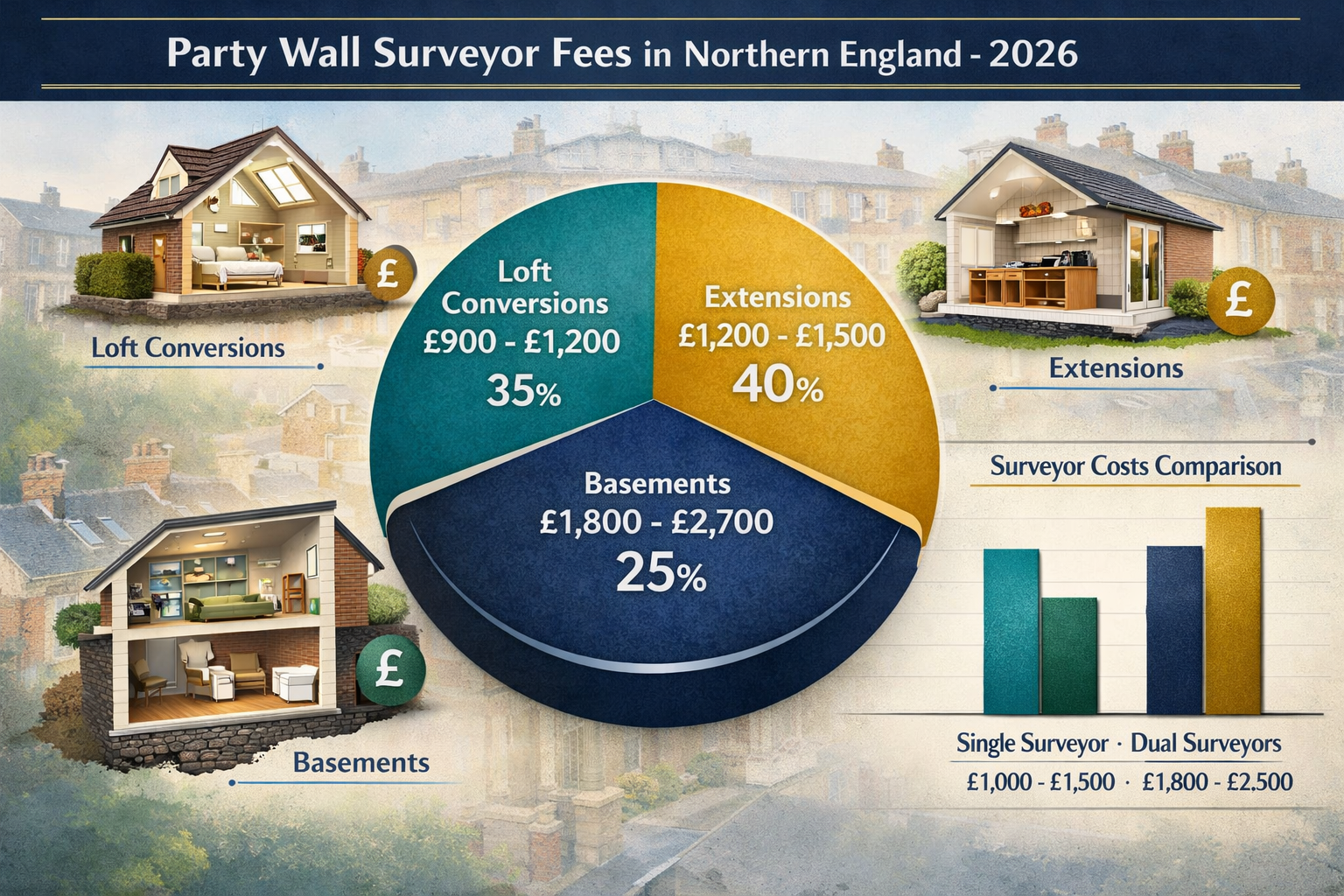
Understanding the financial implications helps homeowners budget appropriately. According to industry data, party wall surveyor costs in 2026 vary based on project complexity[1]:
| Project Type | Cost Range (Single Surveyor) | Cost Range (Two Surveyors) |
|---|---|---|
| Loft Conversion | £900 – £1,200 | £1,800 – £2,400 |
| Extension | £1,200 – £1,500 | £2,400 – £3,000 |
| Basement Conversion | £1,800 – £2,700 | £3,600 – £5,400 |
These figures represent standard residential projects in Northern England. Complex commercial developments or projects involving multiple adjoining properties may incur higher fees.
Who Pays the Costs?
The building owner (the person carrying out the work) typically bears all party wall surveyor costs, including fees for both their own surveyor and any surveyor appointed by the adjoining owner[1]. This responsibility includes:
- Initial notice preparation and service
- Schedule of condition surveys
- Party Wall Award preparation
- Dispute resolution procedures
- Post-completion inspections
The exception occurs when a party wall is in disrepair and responsibility is shared between both property owners[1].
Cost-Saving Strategies
Smart approaches can minimize expenses while maintaining compliance:
1. Early Neighbour Engagement – If neighbours agree on proposed works upfront, you may avoid needing a formal Party Wall Award, significantly reducing costs[1].
2. Agreed Awards – When both parties consent to the same surveyor acting for both sides (as an "Agreed Surveyor"), fees are substantially lower than appointing separate professionals.
3. Comprehensive Schedules of Condition – While adding upfront costs, detailed pre-work documentation prevents expensive disputes about damage claims later[1].
4. Clear Communication – Transparent discussions about work scope, timing, and protective measures reduce the likelihood of objections and formal dispute procedures.

Dispute Avoidance Strategies as Development Activity Accelerates
Proactive Notification Procedures
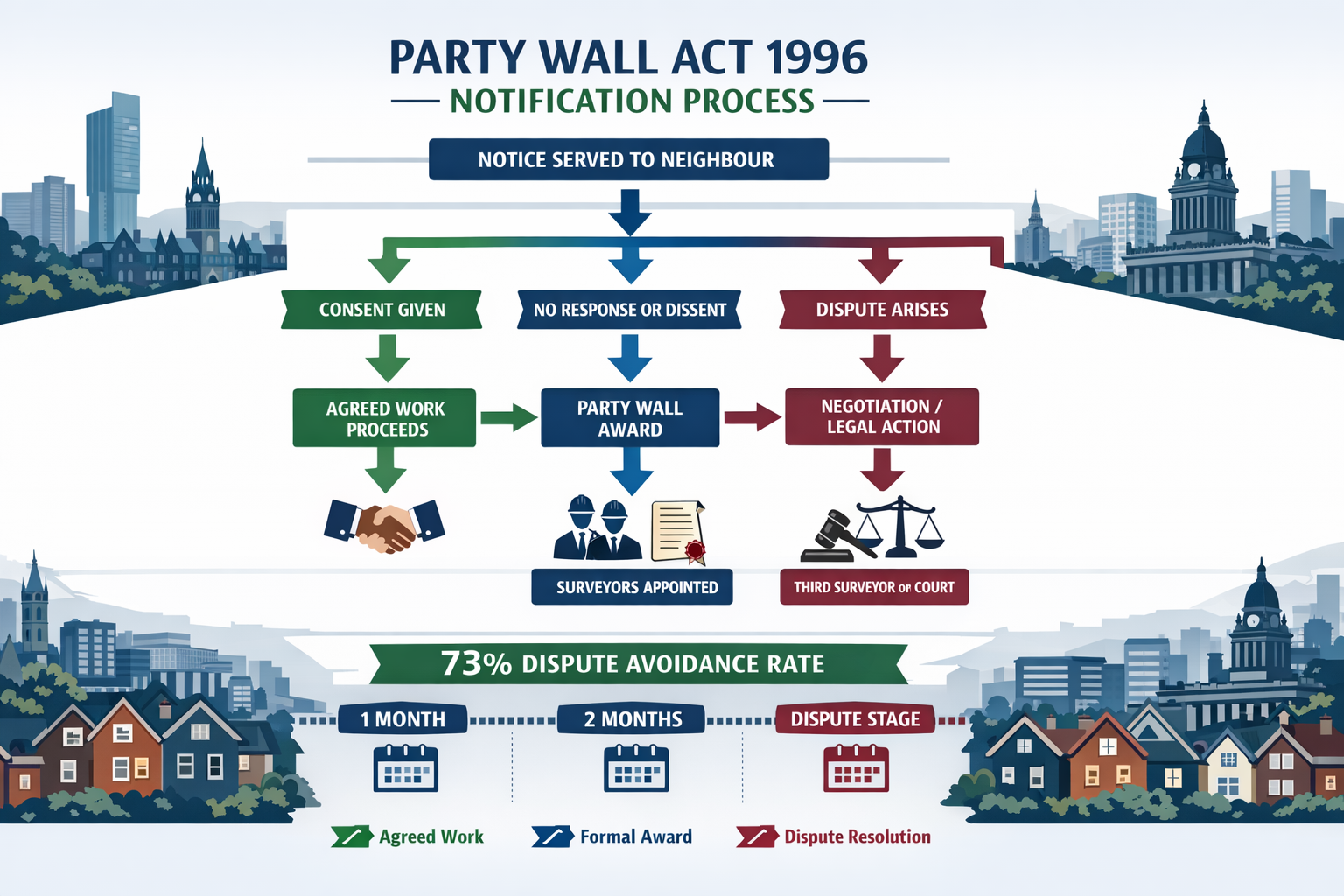
The Party Wall Act requires specific notice periods depending on work type:
- Two months' notice for work directly to party walls
- One month's notice for excavations near neighbouring foundations
Serving notices early and correctly demonstrates professionalism and gives neighbours adequate time to consider implications. Many disputes arise from rushed or improperly served notices that catch neighbours off-guard.
The Schedule of Condition: Your Protection Policy
A schedule of condition documents the existing state of neighbouring properties before work begins. This photographic and written record can be agreed between parties or prepared by a surveyor[1]. It serves as crucial evidence if damage claims arise later.
Comprehensive schedules include:
- Detailed photographs of all rooms, focusing on walls, ceilings, and floors
- Written descriptions of existing cracks, settlement, or defects
- Measurements of significant features
- External documentation of boundaries, drainage, and shared structures
In Northern England's older housing stock, where properties may already show signs of age-related movement, schedules of condition provide essential baseline documentation.
Building Trust Through Transparency
Dispute avoidance relies heavily on relationship management:
✅ Explain the benefits – Help neighbours understand that party wall procedures protect their interests too
✅ Share plans and specifications – Transparency about work scope reduces anxiety and suspicion
✅ Discuss timing and access – Coordinate schedules to minimize disruption to neighbours' lives
✅ Offer regular updates – Keep communication channels open throughout the project
✅ Address concerns promptly – Respond quickly to questions or worries before they escalate
RICS Compliance and Professional Standards
Engaging RICS-qualified surveyors ensures adherence to professional standards and ethical guidelines. RICS (Royal Institution of Chartered Surveyors) members must:
- Maintain professional indemnity insurance
- Follow strict codes of conduct
- Provide impartial advice regardless of who appoints them
- Declare any conflicts of interest
- Keep current with legislative changes
This professional framework protects all parties and increases confidence in the process. When seeking expert party wall surveyor services, verifying RICS membership should be a priority.
Common Dispute Triggers and How to Avoid Them
Top causes of party wall disputes in Northern England's recovering market:
1. Inadequate Notice – Rushed or informal notifications that don't meet statutory requirements
- Solution: Use professional surveyors to prepare and serve formal notices with proper documentation
2. Lack of Communication – Neighbours feeling excluded or disrespected
- Solution: Personal conversations before formal notices, explaining plans and addressing concerns
3. Damage Concerns – Fear that work will harm neighbouring property
- Solution: Comprehensive schedules of condition and clear protective measures in the Award
4. Noise and Disruption – Anxiety about construction impact on daily life
- Solution: Realistic timelines, agreed working hours, and regular progress updates
5. Boundary Confusion – Uncertainty about property lines and wall ownership
- Solution: Professional boundary surveys and clear documentation before work begins
Understanding the average cost of boundary disputes highlights the value of prevention over litigation.
Regional Considerations for Party Wall Surveys in Northern England's Housing Recovery
Architectural Characteristics
Northern England's housing stock presents specific challenges:
Victorian and Edwardian Terraces – Solid brick party walls often lack cavity construction, meaning work requires cutting into structural elements. These properties frequently show age-related movement that must be documented before new work begins.
Back-to-Back Housing – Particularly in Leeds and Bradford, these properties share walls on three sides, multiplying party wall considerations.
Industrial Conversions – Warehouse and mill conversions increasingly popular in Manchester and Liverpool often involve complex shared structures requiring specialist surveyor knowledge.
1960s-70s Semi-Detached Properties – Cavity wall construction in these properties presents different considerations for work like loft conversions.
Local Authority Variations
While the Party Wall Act applies uniformly across England, local planning authorities in Northern England may have specific requirements for:
- Conservation areas – Additional approvals may be needed alongside party wall procedures
- Listed buildings – Heritage considerations affect permissible work methods
- Article 4 directions – Some areas restrict permitted development rights, requiring planning permission in addition to party wall compliance
Coordinating party wall procedures with planning and building control approvals ensures comprehensive compliance.
Market-Specific Pressures
Northern England's housing recovery creates particular pressures:
Tight Timelines – Competitive markets encourage rapid project progression, but rushing party wall procedures invites disputes and delays.
Investment Properties – Landlords and developers focused on returns may underestimate the importance of proper party wall management, creating friction with owner-occupier neighbours.
First-Time Renovators – Many buyers new to property ownership don't understand party wall requirements, leading to accidental non-compliance.
Mixed Tenure – Streets combining owner-occupiers, landlords, and housing association properties require careful stakeholder management.
Best Practices for Homeowners and Developers
For Individual Homeowners
Before Starting Your Project:
- Engage a surveyor early – Consult professionals during planning stages, not after construction is scheduled to begin
- Budget comprehensively – Include party wall costs (£900-£2,700+) in project budgets[1]
- Talk to neighbours first – Informal discussions before formal notices build goodwill
- Understand your timeline – Factor in 1-2 month notice periods plus response time
- Choose reputable contractors – Experienced builders familiar with party wall requirements reduce complications
During the Process:
- Respond promptly to surveyor requests for information
- Facilitate access for schedule of condition surveys
- Keep neighbours informed of progress
- Address any concerns raised immediately
- Document all communications
For Developers and Construction Companies
Systematic Approach:
📋 Develop standard procedures – Create checklists ensuring party wall compliance on every project
📋 Train site managers – Ensure on-site teams understand party wall requirements and neighbour relations
📋 Budget realistically – Include party wall costs in feasibility assessments and project budgets
📋 Engage specialists – Use experienced party wall surveyors rather than general consultants
📋 Maintain detailed records – Document all notices, responses, and communications
Risk Management:
- Commission schedules of condition even when not strictly required
- Consider protective insurance for party wall matters
- Build contingency time into project schedules for party wall procedures
- Establish clear escalation procedures for handling neighbour concerns
For Adjoining Owners
Protecting Your Interests:
When you receive a party wall notice, you have 14 days to respond. Your options include:
Consent – Agreeing to the work as proposed (you can still appoint a surveyor to protect your interests)
Dissent – Disagreeing with aspects of the proposal, triggering the Award process
No Response – Silence after 14 days is treated as dissent, automatically initiating dispute procedures
Key Actions:
✓ Read notices carefully – Understand exactly what work is proposed and how it might affect your property
✓ Seek professional advice – Consider appointing your own surveyor (at the building owner's expense)
✓ Request a schedule of condition – Ensure your property's pre-work state is documented
✓ Raise concerns promptly – Don't wait until work begins to voice objections
✓ Be reasonable – The Act gives building owners rights to improve their property; focus on protecting against damage rather than blocking legitimate work
The Future of Party Wall Surveys in Northern England's Housing Recovery
Emerging Trends
Digital Documentation – Increasing use of 3D scanning and photogrammetry for schedules of condition provides more comprehensive records than traditional photography.
Remote Surveying – Video consultations and virtual inspections supplement physical surveys, improving efficiency while maintaining thoroughness.
Integrated Project Management – Party wall procedures increasingly integrated with planning, building control, and project management systems for seamless compliance.
Sustainability Considerations – Retrofitting for energy efficiency often involves party wall work, as insulation, ventilation, and renewable energy installations affect shared structures.
Legislative Awareness
Staying current with case law and regulatory interpretations ensures compliance. Recent developments affecting party wall practice include:
- Clarifications on notice requirements for specific work types
- Case law regarding reasonable working hours and access
- Guidance on handling non-responsive adjoining owners
- Standards for digital notice service
Professional surveyors maintain awareness of these developments, protecting clients from inadvertent non-compliance.
Building a Collaborative Culture
As Northern England's housing recovery continues, fostering a culture of collaboration rather than confrontation benefits everyone:
- Homeowners achieve their improvement goals without unnecessary conflict
- Neighbours receive proper protection and consideration
- Surveyors facilitate fair outcomes efficiently
- Communities maintain harmony despite intensive development activity
- Property values benefit from well-executed improvements
The most successful projects treat party wall procedures not as bureaucratic obstacles but as frameworks for respectful cooperation between neighbours pursuing legitimate interests.
Practical Resources and Next Steps
Finding Qualified Professionals
When selecting a party wall surveyor, consider:
- RICS membership and professional qualifications
- Local experience in Northern England's housing stock
- Clear fee structures and transparent costs
- Communication style and responsiveness
- Professional indemnity insurance coverage
Many homeowners benefit from consulting surveyors who also provide building survey services, ensuring comprehensive property knowledge.
Documentation Checklist
Essential documents for party wall matters:
- ✅ Property deeds and title plans
- ✅ Architect's drawings and specifications
- ✅ Structural engineer's calculations (if applicable)
- ✅ Building control approvals
- ✅ Planning permissions (where required)
- ✅ Contractor details and insurance certificates
- ✅ Neighbour contact information
- ✅ Photographic evidence of existing conditions
Timeline Planning
Typical party wall procedure timeline:
| Stage | Duration | Notes |
|---|---|---|
| Initial surveyor consultation | 1-2 weeks | Assess requirements, prepare notices |
| Notice service | Immediate | Formal delivery to neighbours |
| Response period | 14 days | Neighbours consider and respond |
| Surveyor appointment (if dissent) | 1-2 weeks | Appointing surveyors, initial meetings |
| Schedule of condition | 1-2 weeks | Documenting existing property state |
| Award preparation | 2-4 weeks | Negotiating terms, preparing formal Award |
| Award service | Immediate | Formal delivery to all parties |
| Total minimum timeline | 6-10 weeks | Before construction can commence |
Building these timelines into project schedules prevents frustrating delays.
Conclusion
Party Wall Surveys in Northern England's Housing Recovery: Dispute Avoidance Strategies as Development Activity Accelerates represents a critical intersection of legal compliance, professional practice, and community relations. As the region's property market continues its upward trajectory in 2026, understanding and implementing proper party wall procedures becomes increasingly important for homeowners, developers, and construction professionals.
The key to success lies in proactive engagement rather than reactive compliance. By involving qualified surveyors early, communicating transparently with neighbours, and following established procedures, building owners can achieve their improvement goals while maintaining positive relationships and legal protection.
Investment in proper party wall management pays dividends through:
- 🛡️ Legal protection against future damage claims
- 💰 Cost control through dispute avoidance
- ⏱️ Time savings by preventing project delays
- 🤝 Preserved relationships with neighbours
- 📈 Property value protection through professional documentation
Your Next Steps
If you're planning building work:
- Consult a qualified party wall surveyor at the earliest planning stage
- Review your project scope against party wall trigger criteria
- Budget appropriately for surveyor fees (£900-£2,700+ depending on complexity)[1]
- Engage neighbours early through informal discussions
- Allow adequate time for proper procedures before construction begins
If you've received a party wall notice:
- Read it carefully and note the 14-day response deadline
- Consider appointing your own surveyor to protect your interests
- Request a schedule of condition if not already offered
- Communicate concerns promptly and professionally
- Seek professional advice rather than relying solely on internet research
Northern England's housing recovery presents tremendous opportunities for property improvement and value creation. By embracing professional party wall survey practices and prioritizing dispute avoidance strategies, the region can achieve this growth while maintaining the community harmony that makes these neighbourhoods desirable places to live.
The accelerating development activity demands nothing less than professional excellence, clear communication, and mutual respect—principles that serve as the foundation for successful party wall management in 2026 and beyond.
References
[1] Party Wall Surveyor Cost – https://hoa.org.uk/advice/guides-for-homeowners/i-am-improving/party-wall-surveyor-cost/