


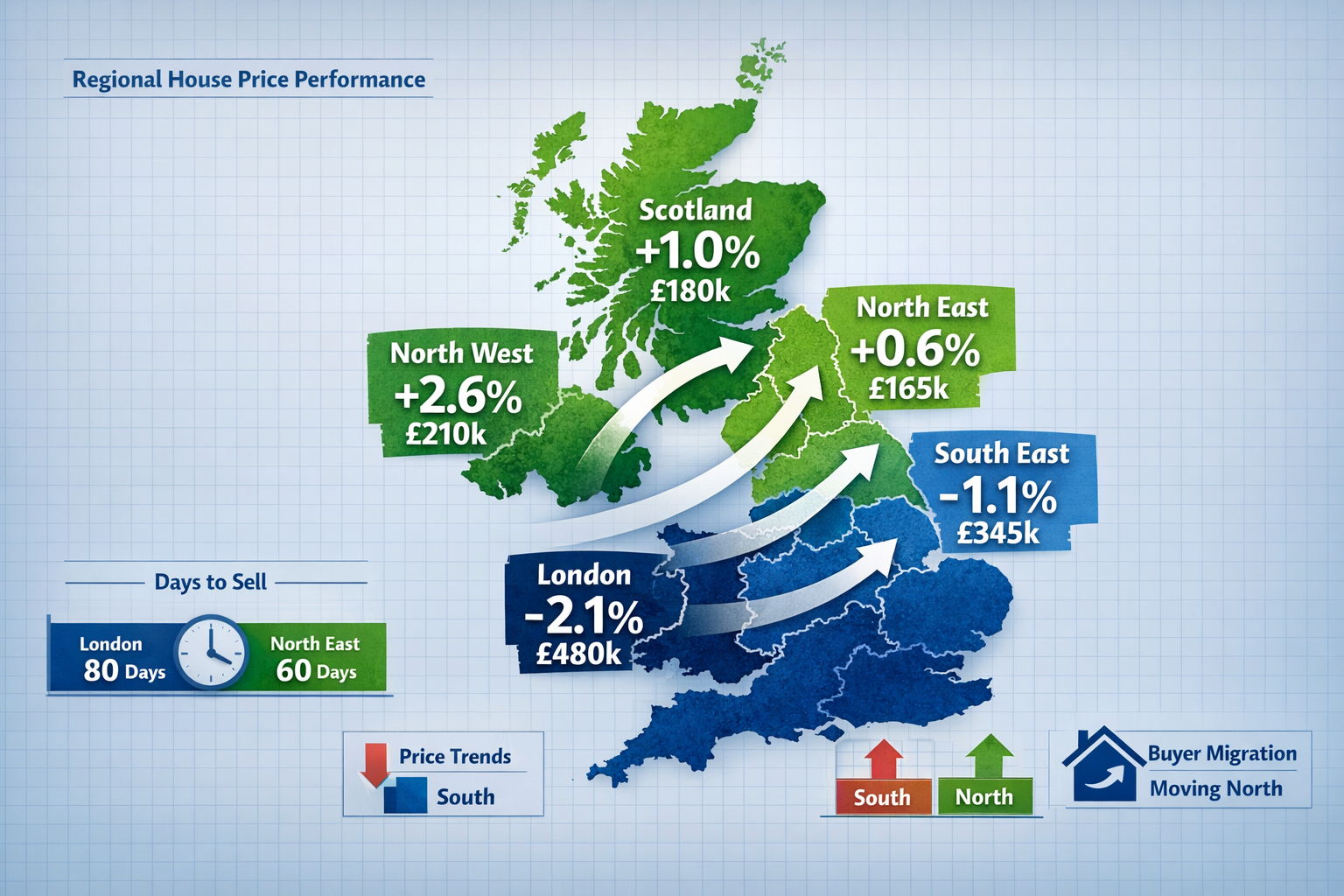
The UK property landscape is experiencing a dramatic geographical shift in 2026, with first-time buyers increasingly looking beyond the traditional London and South East markets. As London house prices fell 2.1% year-on-year to £680,987 and the South East declined 1.1% to £476,637, Northern regions are demonstrating remarkable resilience and growth [1]. This migration pattern presents unique opportunities for building surveyors who understand the distinct challenges and opportunities that come with Building Surveys for First-Time Buyers Migrating North: Capturing Opportunities as London and South East Affordability Pressures Mount.
The numbers tell a compelling story: while London properties now take 80 days to find a buyer, the North East achieves sales in just 60 days, and Scotland's market moves even faster at 39 days [1]. For first-time buyers priced out of southern markets—where average entry prices hover around £226,955 nationally—the North offers not just affordability but genuine investment potential. However, this demographic shift requires surveyors to adapt their approach, understanding both the unique construction characteristics of Northern housing stock and the specific concerns of buyers unfamiliar with regional property markets.
Key Takeaways
- 🏘️ Regional price divergence: London and South East prices declined in 2026 while Northern regions (North West +2.6%, North East +0.6%) showed positive growth, creating migration opportunities
- 📊 Market speed advantage: Northern properties sell 20-33% faster than London (60 days vs 80 days), indicating stronger buyer demand and market confidence
- 🔍 Survey adaptation needed: First-time buyers migrating North require tailored building surveys addressing unfamiliar construction types, climate-related defects, and regional property characteristics
- 💰 Affordability gap: North West average prices (£270,656) represent 60% savings compared to London (£680,987), making homeownership accessible for southern first-time buyers
- 📈 Emerging buyer confidence: First-time buyers are "benefitting from more approachable lending options" and stepping into the market with greater certainty in 2026 [3]
Understanding the Regional Property Market Shift in 2026
The Southern Affordability Crisis Deepens
The London and South East property markets have entered a decisive correction phase in 2026. London's 2.1% annual price decline represents more than just a statistical blip—it signals a fundamental affordability crisis that has pushed the average property to £680,987, placing homeownership beyond reach for most first-time buyers [1]. The South East's 1.1% decline to £476,637 marks it as the worst-performing major region nationally, creating unprecedented challenges for those seeking to enter the property ladder in traditional southern strongholds.
Prime Central London exemplifies this shift, currently representing "the best buyers' market we have seen in ten years," with stock levels up 8.3% and average discounts from asking price reaching 10.3% [2]. Yet even with these discounts, entry-level properties remain prohibitively expensive for typical first-time buyers, who face average entry prices of £226,955 nationally—a figure that barely scratches the surface in London markets.
The market velocity tells an equally important story. London properties now require 80 days to find a buyer, indicating reduced demand and increased buyer caution [1]. This extended timeline creates uncertainty and additional holding costs for sellers while signaling to potential buyers that southern markets may face further corrections.
Northern Regions Demonstrate Growth and Resilience
In stark contrast, Northern property markets are experiencing genuine growth and buyer confidence. The North West achieved 2.6% year-on-year price growth to £270,656, while maintaining a healthy market velocity of 66 days to sale [1]. The North East, despite more modest 0.6% growth to £194,832, boasts the fastest selling time nationally at just 60 days—demonstrating strong local demand and market efficiency.
Scotland's performance is particularly noteworthy, achieving 1.0% growth to £199,528 with an exceptional 39-day selling timeline [1]. This rapid market movement indicates robust buyer confidence and suggests that properties are competitively priced relative to local demand.
For first-time buyers, these figures translate into tangible advantages:
- Affordability: North West properties cost 60% less than London equivalents
- Market certainty: Faster sales indicate stable, confident markets
- Growth potential: Positive price trends suggest sound investment fundamentals
- Negotiating position: Balanced markets favor prepared buyers with proper surveys
The First-Time Buyer Migration Pattern
The demographic shift is unmistakable. First-time buyers are increasingly "waiting for longer, saving up, and moving straight into family houses when they are in their thirties" with budgets of £1.5m to £2m in prime southern markets [2]. However, these same buyers recognize that identical budgets in Northern regions can secure substantially larger properties with better growth prospects.
This migration is facilitated by several 2026 market conditions:
- Increased supply: London listings rose 16% year-on-year, while the South East saw 9% increases, giving buyers unprecedented choice [4]
- Remote work flexibility: Continued hybrid working arrangements reduce location dependence
- Improved lending: First-time buyers are "benefitting from more approachable lending options" [3]
- Transport connectivity: Enhanced rail links make Northern cities increasingly accessible
For building surveyors, this migration creates opportunities to serve a new client demographic: southern buyers unfamiliar with Northern construction types, climate considerations, and regional property characteristics. Understanding how to deliver comprehensive building surveys tailored to this audience becomes essential.
Building Surveys for First-Time Buyers Migrating North: Key Considerations

Regional Construction Characteristics and Common Defects
Northern housing stock differs significantly from southern properties in construction methods, materials, and age profiles. First-time buyers migrating from London and the South East often lack familiarity with these regional characteristics, making thorough building surveys essential.
Victorian and Edwardian Terraced Housing
Northern cities feature extensive Victorian and Edwardian terraced housing stock—the backbone of affordable first-time buyer markets. These properties present specific survey considerations:
- Solid wall construction: Unlike modern cavity walls, solid brick walls (typically 9-inch or 13.5-inch) are more susceptible to penetrating damp and require different treatment approaches
- Suspended timber floors: Ground floors often feature suspended timber construction vulnerable to rot, particularly where ventilation has been compromised
- Slate roofing: Traditional Welsh slate roofs may be nearing end-of-life (100-150 years) and require careful inspection for nail fatigue and slipped slates
- Original sash windows: Single-glazed timber sash windows are common and may require complete replacement or specialist repair
- Shared party walls: Terraced properties involve party wall considerations that southern buyers may not fully understand
When conducting first-time buyer building surveys, surveyors should provide detailed explanations of these construction types, expected maintenance requirements, and typical repair costs.
Climate-Related Defects
The Northern climate presents distinct challenges compared to the South East:
- Higher rainfall: Manchester receives approximately 1,300mm annual rainfall versus London's 600mm, increasing damp risks
- Wind-driven rain: Western-facing elevations experience severe weather exposure requiring robust pointing and render
- Freeze-thaw cycles: More frequent freezing temperatures accelerate masonry deterioration and roof damage
- Reduced drying potential: Lower temperatures and humidity extend drying times for damp-affected structures
Surveyors should specifically investigate moisture-related defects including rising damp, penetrating damp, and condensation issues. Providing guidance on damp survey considerations helps first-time buyers understand remediation costs and prioritize repairs.
Tailoring Survey Reports for Migrating Buyers
First-time buyers relocating from London and the South East require enhanced contextual information in survey reports. Standard technical descriptions may not adequately serve clients unfamiliar with Northern property characteristics.
Essential Report Enhancements
Comparative context: Include regional benchmarking to help buyers understand whether identified defects are typical for the property age and type. For example: "The solid wall construction and absence of cavity wall insulation is standard for properties of this age in Manchester and does not represent a defect, though it does impact energy efficiency."
Cost transparency: Provide detailed repair cost estimates using regional pricing. Northern labor and material costs typically run 15-25% lower than London equivalents. Clearly stating "estimated repair cost: £3,500 (based on regional pricing)" prevents buyer shock and enables accurate budgeting.
Prioritization matrix: Use traffic-light rating systems (red/amber/green) to help first-time buyers distinguish between:
- 🔴 Critical defects requiring immediate attention or price renegotiation
- 🟡 Moderate issues that should be addressed within 1-3 years
- 🟢 Minor observations representing routine maintenance
Energy efficiency guidance: Northern properties often feature lower EPC ratings due to solid wall construction and single glazing. Explain improvement options and potential costs, helping buyers understand long-term running costs versus southern properties.
Local market intelligence: Include brief commentary on the local market conditions, typical property values, and neighborhood characteristics. First-time buyers relocating to unfamiliar areas benefit enormously from this contextual information.
Addressing First-Time Buyer Concerns and Questions
Migrating first-time buyers typically have specific anxieties that surveyors should proactively address:
"Is this property good value compared to what I'd get in London?"
Provide comparative value analysis within the survey report. For example: "This three-bedroom terraced property at £185,000 in Leeds represents approximately 27% of the cost of an equivalent property in Zone 3 London, while offering 15% more living space and a private garden."
"What will ongoing maintenance actually cost?"
Include annual maintenance cost estimates based on property age, condition, and type. Break down expected costs for:
- Routine maintenance (gutters, external decoration, etc.)
- Anticipated major works within 5-10 years
- Energy costs based on EPC rating and regional utility prices
This transparency helps buyers budget accurately and avoid post-purchase financial stress.
"Are there issues I wouldn't encounter in southern properties?"
Explicitly highlight regional-specific considerations:
- Coal mining legacy issues (subsidence, mine shaft proximity)
- Radon gas in certain Northern regions
- Different building control standards in historical periods
- Local stone types and their specific maintenance requirements
"Should I negotiate the price based on survey findings?"
Provide clear guidance on whether identified defects warrant price renegotiation. Our guide on renegotiating after poor survey results offers frameworks for these conversations. Surveyors should indicate which defects represent genuine price reduction justifications versus routine maintenance expectations.
Capturing Opportunities: Strategic Approaches for Building Surveyors

Developing Regional Expertise and Market Positioning
Building surveyors can capitalize on the migration trend by developing specialized expertise serving first-time buyers relocating from southern markets. This requires both technical knowledge and market positioning.
Building Regional Construction Knowledge
Invest in understanding regional construction typologies:
- Local building materials: Pennine stone, Yorkshire stone, red brick varieties, and their specific maintenance requirements
- Historical building practices: Regional variations in construction methods, particularly pre-1919 properties
- Local defect patterns: Area-specific issues such as mining subsidence zones, flood risk areas, and soil conditions
- Regional contractors: Develop relationships with reliable local tradespeople to provide accurate repair cost estimates
Consider obtaining additional qualifications in specialized areas relevant to Northern housing stock, such as timber frame construction, stone masonry, or heritage property assessment.
Marketing to Migrating Buyers
Position services specifically for the London-to-North migration demographic:
- Educational content: Create guides explaining Northern property characteristics for southern buyers
- Comparative pricing: Clearly communicate survey costs (typically 20-30% lower than London equivalents)
- Remote coordination: Offer flexible scheduling and virtual consultations for buyers still based in the South
- Package services: Bundle building surveys with local area reports and contractor recommendations
Develop partnerships with relocation specialists, Northern estate agents, and employer relocation programs to access this growing market segment.
Choosing the Right Survey Level for Different Property Types
First-time buyers often struggle to determine which survey type they need. Providing clear guidance based on property characteristics helps buyers make informed decisions.
When to Recommend a Full Building Survey
A comprehensive RICS Building Survey (Level 3) is appropriate for:
- Pre-1900 properties: Victorian and earlier terraced houses with solid wall construction
- Properties with known defects: Any property where the estate agent or seller has disclosed issues
- Unusual construction: Non-standard materials or methods unfamiliar to the buyer
- Significant alterations: Properties with extensions, conversions, or structural modifications
- Investment properties: Where buyers plan substantial renovation or conversion
For first-time buyers unfamiliar with Northern property types, a full building survey provides the comprehensive information needed for confident decision-making, even if the property appears superficially sound.
When a HomeBuyer Report Suffices
A RICS HomeBuyer Report (Level 2) may be adequate for:
- Post-1950 properties: Modern construction with cavity walls and standard specifications
- Well-maintained properties: Evidence of regular upkeep and recent improvements
- Standard construction: Typical terraced or semi-detached houses without unusual features
- Budget constraints: Where buyers have limited survey budgets but still need professional assessment
However, surveyors should clearly explain the limitations of HomeBuyer Reports, particularly regarding non-visible defects and areas not readily accessible.
Leveraging Technology and Remote Services
The geographical distance between migrating buyers and their target properties creates opportunities for technology-enhanced survey services.
Digital Survey Delivery
Implement enhanced digital reporting:
- Video walkthroughs: Supplement written reports with narrated video tours highlighting key findings
- Interactive floor plans: Digital plans with clickable defect markers linked to photographs and descriptions
- Virtual consultations: Post-survey video calls to discuss findings and answer questions
- Cloud-based delivery: Instant report access via secure portals rather than postal delivery
These enhancements particularly benefit buyers unable to attend surveys in person due to distance or work commitments.
Drone and Thermal Imaging
Invest in advanced survey technology:
- Drone roof surveys: Comprehensive roof inspection without scaffolding, particularly valuable for terraced properties with difficult access
- Thermal imaging: Identify heat loss, moisture ingress, and insulation defects not visible to naked eye inspection
- Moisture meters: Quantitative damp measurement providing objective data for buyers and sellers
These technologies not only improve survey quality but also differentiate services in an increasingly competitive market. Understanding common survey myths helps educate buyers about the value of comprehensive, technology-enhanced surveys.
Building Networks and Referral Partnerships
Success in serving migrating first-time buyers requires strategic partnerships across the property ecosystem.
Key Partnership Opportunities
Southern estate agents: Develop relationships with London and South East agents whose clients are relocating North. Offer co-marketing arrangements and referral fees where appropriate.
Mortgage brokers: Partner with brokers specializing in first-time buyer mortgages to become their recommended surveyor for Northern purchases.
Relocation services: Corporate relocation companies managing employee moves from southern headquarters to Northern offices represent a consistent client source.
Northern estate agents: Position yourself as the specialist surveyor for southern buyers, offering agents a solution for clients unfamiliar with regional property characteristics.
Employer relocation programs: Many organizations relocating operations from London to Northern cities (Manchester, Leeds, Newcastle) provide relocation support including survey cost assistance.
Referral Incentive Structures
Develop compliant referral programs that:
- Provide value to referring parties without compromising survey independence
- Comply with RICS ethical guidelines regarding referral fees
- Create mutual benefit through improved client outcomes
- Build long-term partnership relationships rather than transactional arrangements
Regional Market Opportunities and Growth Areas
Identifying High-Potential Northern Markets
Not all Northern markets offer equal opportunities for first-time buyers or building surveyors. Understanding regional market dynamics helps target services effectively.
Manchester and Greater Manchester
Manchester represents the largest opportunity for migrating first-time buyers:
- Average prices: £270,656 (North West regional average) [1]
- Strong employment growth in technology, media, and professional services
- Excellent transport connectivity including direct London rail links
- Diverse housing stock from Victorian terraces to modern apartments
- Established first-time buyer market with competitive mortgage products
Survey opportunities: High volume of Victorian terraced properties requiring comprehensive surveys, plus increasing new-build apartment developments needing snagging surveys.
Leeds and West Yorkshire
Leeds offers compelling value with strong economic fundamentals:
- Slightly lower average prices than Manchester
- Major legal, financial, and healthcare employment hub
- Extensive Victorian and Edwardian terraced housing stock
- Growing technology sector attracting young professionals
- Good educational infrastructure supporting family buyers
Survey opportunities: Significant demand for pre-purchase surveys on terraced properties, plus heritage property expertise for stone-built properties in surrounding areas.
Liverpool and Merseyside
Liverpool provides exceptional affordability with improving market conditions:
- Substantially lower entry prices than Manchester or Leeds
- Cultural renaissance attracting creative industries and young professionals
- Significant regeneration projects improving infrastructure
- Strong rental market supporting buy-to-let investors
- Georgian and Victorian architectural heritage
Survey opportunities: Value-conscious first-time buyers requiring cost-effective surveys, plus investment property surveys for buy-to-let purchasers.
Newcastle and North East
Newcastle and the wider North East offer the fastest market velocity nationally:
- Average 60-day selling times indicating strong demand [1]
- Lowest average prices (£194,832) providing maximum affordability [1]
- Growing technology and renewable energy sectors
- Excellent quality of life metrics
- Strong local buyer demand supplemented by southern migration
Survey opportunities: Fast-moving market requires responsive survey services with quick turnaround times to avoid buyers losing properties to competing offers.
Emerging Opportunities in 2026 and Beyond
Several market trends suggest expanding opportunities for building surveyors serving migrating first-time buyers:
Increased Housing Supply
The 2026 market began with "the highest level of homes for sale in over eight years, with average agents marketing 32 properties" [4]. This increased supply, particularly the 16% year-on-year increase in London listings and 9% increase in the South East [4], suggests more southern homeowners are considering relocation, potentially moving North themselves or selling to fund Northern purchases.
For surveyors, this translates into sustained demand for survey services as inventory levels remain elevated and buyer choice expands.
Improving Lending Conditions
First-time buyers are "benefitting from more approachable lending options" in 2026 [3], with lenders increasingly comfortable with Northern property markets. This improved lending environment facilitates southern buyer migration by:
- Reducing deposit requirements for well-surveyed properties
- Offering competitive rates on Northern properties previously considered higher risk
- Providing flexible income assessment for remote workers relocating North
- Supporting larger loan-to-value ratios for properties with positive survey reports
Hybrid Working Permanence
The permanent establishment of hybrid working in many sectors removes the primary barrier to Northern relocation—daily London commuting requirements. This structural change suggests the migration trend will continue beyond short-term market cycles.
Surveyors should position for sustained demand rather than treating this as a temporary opportunity, investing in permanent regional presence and expertise rather than short-term market capture.
Practical Implementation: Building a Northern First-Time Buyer Survey Practice
Service Design and Pricing Strategy
Developing a successful practice serving migrating first-time buyers requires thoughtful service design balancing comprehensive quality with affordability.
Tiered Service Offerings
Create clear service tiers that address different buyer needs and budgets:
Essential Survey Package (£400-550):
- RICS HomeBuyer Report (Level 2) for standard post-1950 properties
- Digital report delivery within 48 hours
- Email support for follow-up questions
- Suitable for well-maintained, conventional construction properties
Comprehensive Survey Package (£650-850):
- Full RICS Building Survey (Level 3) for pre-1950 or non-standard properties
- Detailed photographic documentation
- Video walkthrough of key findings
- 30-minute post-survey consultation call
- Repair cost estimates for identified defects
- Suitable for Victorian/Edwardian terraced properties and properties with known issues
Premium Survey Package (£950-1,200):
- Full RICS Building Survey with enhanced reporting
- Drone roof inspection and thermal imaging
- Detailed energy efficiency assessment with improvement recommendations
- 60-minute consultation call
- Local contractor recommendations
- 12-month follow-up support
- Suitable for complex properties, significant purchases, or buyers requiring maximum support
Pricing should reflect regional market conditions while maintaining professional standards. Northern survey fees typically run 20-30% below London equivalents, making them attractive to budget-conscious first-time buyers while remaining commercially viable.
Marketing and Client Communication
Effective marketing to migrating first-time buyers requires educational content and clear value communication.
Content Marketing Strategy
Develop educational resources addressing common buyer concerns:
- Regional property guides: "Understanding Victorian Terraced Houses in Manchester" or "What London Buyers Should Know About Leeds Properties"
- Cost comparison calculators: Interactive tools showing total cost of ownership comparisons between London and Northern properties
- Video content: Virtual tours of typical Northern property types with commentary on common features and defects
- Case studies: Anonymized examples of survey findings and how they informed buyer decisions
This content positions surveyors as trusted advisors rather than transactional service providers, building relationships before formal engagement.
Clear Communication Protocols
Establish communication standards that address the unique needs of remote buyers:
- Rapid response times: Commit to 4-hour email response during business hours
- Flexible scheduling: Offer weekend and evening survey appointments to accommodate buyer travel
- Pre-survey briefings: 15-minute calls before surveys to understand buyer concerns and priorities
- Plain language reporting: Avoid excessive technical jargon; explain findings in accessible terms
- Post-survey availability: Guaranteed availability for follow-up questions within 48 hours of report delivery
These protocols demonstrate buyer-centric service that differentiates practices in competitive markets.
Quality Assurance and Professional Standards
Maintaining rigorous quality standards protects both buyers and surveyors while building reputation and referrals.
Comprehensive Inspection Protocols
Develop standardized inspection checklists specific to Northern property types:
- Victorian terraced house inspection protocol (40+ inspection points)
- Edwardian semi-detached property protocol
- Inter-war property protocol
- Post-war property protocol
- Modern property protocol
Each protocol should address construction-specific considerations and common regional defects, ensuring consistent, comprehensive inspections regardless of individual surveyor.
Continuing Professional Development
Invest in ongoing education to maintain expertise:
- RICS continuing professional development requirements
- Specialist training in regional construction types
- Technology training (drone operation, thermal imaging interpretation)
- Market knowledge updates on regional property trends
- Legal updates on building regulations and survey liability
This commitment to professional development ensures services remain current and competitive as markets evolve.
Professional Indemnity Insurance
Ensure adequate insurance coverage for survey work, particularly when serving first-time buyers who may be more likely to pursue claims if unexpected defects emerge post-purchase. Consider coverage levels of £1-2 million minimum, with higher limits for high-value properties or complex surveys.
Conclusion
The Building Surveys for First-Time Buyers Migrating North: Capturing Opportunities as London and South East Affordability Pressures Mount represents a significant and sustained market opportunity for building surveyors in 2026 and beyond. With London prices declining 2.1% to £680,987 and the South East falling 1.1% to £476,637, while Northern regions demonstrate positive growth (North West +2.6%, North East +0.6%), the geographical rebalancing of UK property markets is unmistakable [1].
For first-time buyers, this shift offers genuine affordability and investment potential. Northern properties cost 60% less than London equivalents while selling 25% faster, indicating healthy market fundamentals and buyer confidence. The emergence of "more approachable lending options" [3] and permanent hybrid working arrangements remove traditional barriers to relocation, suggesting this migration pattern will persist beyond short-term market cycles.
For building surveyors, success requires adaptation and specialization. Understanding regional construction characteristics—Victorian terraced housing, solid wall construction, climate-related defects—enables delivery of comprehensive, valuable surveys. Tailoring reports to address the specific concerns of migrating buyers unfamiliar with Northern properties creates differentiation and client satisfaction. Investing in technology, developing regional expertise, and building strategic partnerships positions practices for sustained growth in this expanding market segment.
Actionable Next Steps
For building surveyors looking to capture this opportunity:
- Develop regional expertise: Invest time understanding Northern construction types, local defect patterns, and regional pricing for repairs and improvements
- Enhance service offerings: Create tiered survey packages specifically designed for first-time buyers, with clear pricing and comprehensive reporting
- Build strategic partnerships: Establish relationships with London estate agents, mortgage brokers, and relocation services to access migrating buyer flows
- Invest in technology: Implement drone surveys, thermal imaging, and digital reporting to serve remote buyers effectively
- Create educational content: Develop guides, videos, and resources that position you as the expert for southern buyers purchasing Northern properties
- Maintain professional standards: Ensure comprehensive insurance, rigorous inspection protocols, and ongoing professional development to deliver consistent quality
For first-time buyers considering Northern migration:
- Commission comprehensive surveys: Don't compromise on survey quality when purchasing unfamiliar property types in unfamiliar regions
- Choose experienced surveyors: Select professionals with specific expertise in regional construction characteristics and Northern property markets
- Ask questions: Use survey consultations to understand regional property characteristics, expected maintenance costs, and local market conditions
- Factor in total costs: Consider not just purchase price but ongoing maintenance, energy costs, and potential improvement expenses
- Review survey findings carefully: Use detailed building survey reports to inform purchase decisions and price negotiations
The geographical rebalancing of UK property markets creates opportunities for prepared participants—buyers seeking affordability and surveyors ready to serve this emerging demographic with specialized expertise and buyer-focused services. As affordability pressures continue mounting in London and the South East, the Northern migration will likely accelerate, making 2026 the ideal time to establish expertise and market position in this growing segment.
References
[1] March 2026 – https://www.rightmove.co.uk/news/house-price-index/march-2026/
[2] March 2026 – https://www.black-brick.com/insights/market-update/march-2026/
[3] The 2026 London Sales Market Monthly Trends And Insights From Foxtons – https://www.foxtons.co.uk/discover/2026/01/the-2026-london-sales-market-monthly-trends-and-insights-from-foxtons
[4] Post Spring 2026 Uk Property Market Report Steady Momentum 1773065752 – https://www.guildproperty.co.uk/news/post-spring-2026-uk-property-market-report-steady-momentum-1773065752