


The property market in 2026 presents a unique challenge for surveyors and valuers. With house prices stabilising at a -10% net balance but showing consistent improvement, the traditional valuation methodologies that worked during periods of strong momentum require significant adaptation. Valuation surveys in stabilising markets demand a more nuanced approach—one that accounts for weak price momentum, regional divergence, and the transitional nature of current market conditions.
When price appreciation slows to match inflation rates of approximately 2-3% annually, surveyors must shift from appreciation-driven frameworks to income-focused and comparative methodologies that reflect the new reality. The techniques for assessing properties when price momentum remains subdued require greater emphasis on property-specific characteristics, local market dynamics, and careful analysis of comparable sales data in an environment where inventory has increased 20% year-over-year.
Key Takeaways
- Stabilising markets require adjusted valuation frameworks that prioritize property-specific risk factors over broad market momentum assumptions
- Increased inventory and transaction activity in 2026 provide better comparable sales data, enabling more accurate price discovery mechanisms
- Regional divergence demands localized analysis as different property types and geographic areas experience varying levels of stabilization
- Income-approach methodologies gain importance when appreciation potential is limited, making rental yields and debt service coverage critical valuation components
- Supply discipline across property sectors creates more reliable valuation benchmarks, particularly for commercial and residential assessments
Understanding Market Stabilisation and Its Impact on Property Valuation
The Characteristics of Stabilising Markets 📊
A stabilising market differs fundamentally from both rapidly appreciating and declining markets. In 2026, property markets exhibit several key characteristics that define this transitional phase:
Price momentum indicators show consistent but modest movement, with residential properties experiencing 2-3% annual growth that roughly matches consumer price inflation. This represents a significant departure from the double-digit appreciation rates seen in previous boom cycles. For surveyors, this means traditional comparable sales analysis requires more careful temporal adjustments.
Bid-ask spreads have narrowed considerably as transaction activity strengthened through late 2025. This improved price discovery mechanism creates clearer valuation benchmarks across most asset classes. The gap between seller expectations and buyer offers—which widened dramatically during market uncertainty—has contracted, providing more reliable transaction data for comparative analysis.
Inventory levels have increased approximately 20% year-over-year in residential markets, reducing the data scarcity issues that plagued valuers during tight market conditions. More comparable sales mean better statistical reliability in valuation models, though surveyors must carefully assess the quality and relevance of each comparable property.
Market-Specific Valuation Challenges
Different property sectors face unique valuation challenges in stabilising conditions:
| Property Type | Stabilisation Characteristic | Primary Valuation Challenge |
|---|---|---|
| Residential | Modest 2-3% annual growth | Distinguishing property-specific value from market trends |
| Industrial | Transitioning toward supply-demand balance | Adjusting cap rates from peak compression levels |
| Multifamily | Moving from outsized shifts to equilibrium | Recalibrating market rent assumptions |
| Office | Sharp divergence between quality tiers | Developing granular analytical frameworks |
| Retail | Stable occupancy with limited new supply | Establishing reliable comparable sales data |
The office market divergence presents particular challenges. High-quality office properties in prime locations maintain value and attract investment, while challenged assets face significant headwinds. This bifurcation means surveyors cannot rely on broad market cap rates but must develop property-specific risk assessments that account for location quality, tenant mix, lease terms, and physical condition.
Understanding these market dynamics is essential when choosing the right property assessment approach for valuation purposes.
Core Valuation Techniques for Properties in Stabilising Markets

The Comparative Method: Enhanced Approaches for Limited Momentum Markets
The comparative method remains the foundation of property valuation, but stabilising markets require refinements to traditional approaches. With price momentum subdued, the selection and adjustment of comparable properties becomes more critical than ever.
Selecting Appropriate Comparables
In markets with weak momentum, surveyors must apply stricter criteria for comparable selection:
- Temporal proximity: Limit comparables to transactions within the past 3-6 months rather than 12 months, as even modest market shifts can render older sales less relevant
- Physical similarity: Prioritize properties with closely matched characteristics (size, age, condition, layout) over location-only comparisons
- Transaction circumstances: Exclude distressed sales, related-party transactions, and properties sold with unusual terms that don't reflect market conditions
- Market segment alignment: Ensure comparables target the same buyer demographic and price tier
Supply discipline across property types has helped stabilize valuations and restore confidence in comparable sales methodologies. With moderating construction pipelines, the risk of supply-driven value erosion has diminished, making historical comparables more reliable predictors of current value.
Making Accurate Adjustments
When price momentum remains subdued, adjustment factors require careful calibration:
✅ Condition adjustments become more significant when appreciation isn't masking deferred maintenance issues
✅ Location premiums must reflect actual buyer preferences rather than historical assumptions
✅ Feature valuations should be based on market extraction rather than cost-based estimates
✅ Time adjustments may be minimal or zero in truly flat markets, avoiding artificial inflation
The increased availability of transaction data in 2026 enables more sophisticated statistical analysis of adjustment factors. Surveyors can employ paired sales analysis and regression techniques to quantify the value impact of specific property characteristics with greater precision.
For properties requiring negotiation after survey findings, accurate comparable analysis provides essential leverage in price discussions.
The Income Approach: Critical for Subdued Appreciation Environments
When appreciation potential is limited, the income approach gains prominence in valuation methodology. This technique proves particularly valuable for investment properties, multifamily residential, and commercial assets.
Rental Yield Analysis
In stabilising markets, rental yields provide a more reliable value indicator than speculative appreciation assumptions:
Gross rental yield = (Annual rental income ÷ Property value) × 100
Net rental yield = (Annual rental income – Operating expenses) ÷ Property value × 100
For residential properties in 2026, typical net yields range from 3-5% in established markets, with higher yields in emerging areas or properties requiring management intensity. Surveyors must verify rental income assumptions against actual market rents rather than landlord projections.
Capitalization Rate Application
Cap rates have stabilized with asset-quality differentiation becoming the primary driver of rate variation rather than broad sector swings. This enables more precise valuation methodologies that account for property-specific risk factors.
The formula: Property Value = Net Operating Income ÷ Capitalization Rate
In stabilising markets, cap rate selection requires careful consideration of:
- Property quality tier (Class A, B, or C)
- Location desirability and economic fundamentals
- Tenant quality and lease term security
- Physical condition and deferred maintenance
- Management efficiency and operating expense ratios
The preference for moderate-risk strategies among investors—with two-thirds favoring value-add and core-plus approaches—suggests cap rates should reflect careful selective property assessment rather than broad market positioning.
Debt Service Coverage Ratio (DSCR)
Greater availability of construction and development financing in 2026 improves funding certainty, enabling more reliable income-approach valuations. The DSCR calculation helps determine supportable property values:
DSCR = Net Operating Income ÷ Annual Debt Service
Lenders typically require DSCR of 1.20-1.30 for stabilized properties. In markets with subdued momentum, conservative DSCR assumptions protect against income volatility and refinancing risk.
The Cost Approach: Establishing Value Floors
The cost approach provides particular value in stabilising markets by establishing a floor value based on replacement cost. This methodology proves especially useful for:
- Newer properties where depreciation is minimal
- Unique properties with limited comparable sales
- Properties in transitional neighborhoods
- Insurance valuation purposes
The calculation involves:
Property Value = Land Value + (Replacement Cost – Depreciation)
In 2026's stabilising environment, land values have largely plateaued, making historical land sales more reliable for extraction analysis. Construction costs have moderated from pandemic-era peaks but remain elevated, requiring current cost data from reliable sources.
Physical depreciation assessment becomes more critical when momentum is subdued, as buyers scrutinize condition more carefully. Surveyors should conduct thorough property condition assessments to accurately quantify deferred maintenance and functional obsolescence.
Regional Divergence and Localized Valuation Strategies
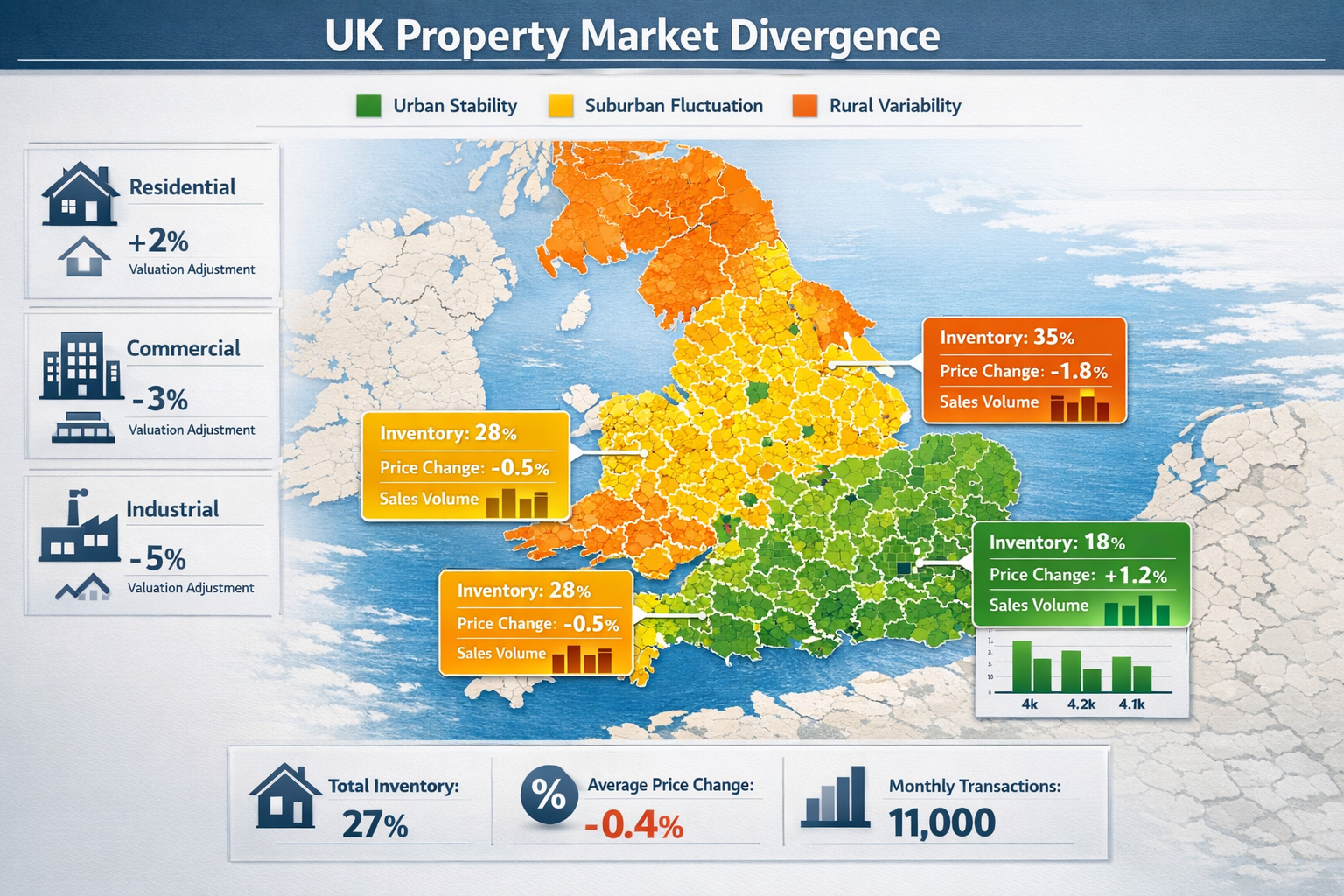
Identifying Regional Market Characteristics
Valuation surveys in stabilising markets must account for significant regional divergence in property performance. While national indicators show overall stabilization, local markets exhibit varying momentum levels that require tailored analytical approaches.
Urban vs. Suburban vs. Rural Dynamics
Different geographic contexts present distinct valuation considerations:
Urban centers in major cities show greater stability due to:
- Diversified economic bases reducing single-industry risk
- Higher transaction volumes providing better comparable data
- More sophisticated buyer pools with access to financing
- Established rental markets supporting income approach valuations
Suburban markets face mixed conditions:
- Some areas benefit from continued remote work trends
- Others experience normalization after pandemic-driven surges
- School quality and family amenities drive value differentiation
- Comparable selection requires careful attention to micro-location factors
Rural and peripheral areas present unique challenges:
- Lower transaction volumes limit comparable sales data
- Property uniqueness reduces comparability
- Economic dependency on specific industries creates volatility
- Longer marketing periods affect liquidity assumptions
Property Type Considerations in Different Regions
The industrial and multifamily sectors are transitioning from periods of outsized supply and demand shifts toward equilibrium, requiring adjusted capitalization rates and market rent assumptions. However, this transition occurs at different paces across regions:
🏭 Industrial properties in logistics hubs maintain strong valuations due to e-commerce demand, while secondary markets face cap rate expansion
🏘️ Multifamily assets in high-growth metros experience continued rent growth, while oversupplied markets require conservative income projections
🏢 Office properties show the starkest regional divergence, with gateway cities maintaining premium valuations for quality assets while secondary markets struggle
Understanding these regional patterns is essential when negotiating purchase prices based on survey findings, as local market conditions significantly impact negotiation leverage.
Micro-Market Analysis Techniques
Effective valuation in stabilising markets requires drilling down to micro-market analysis:
Neighborhood lifecycle assessment identifies whether areas are emerging, mature, or declining, affecting appreciation potential and risk profiles. Surveyors should analyze:
- Recent development activity and planning permissions
- Demographic trends and household formation rates
- Retail and amenity development patterns
- School performance and quality metrics
- Crime statistics and safety perceptions
- Transportation infrastructure improvements
Competitive supply analysis examines pipeline projects that could affect future valuations. Even in stabilising markets, localized oversupply can depress values in specific submarkets.
Economic base analysis evaluates employment diversity, wage growth, and industry health in the local area. Markets dependent on single employers or industries carry higher risk profiles that should be reflected in valuation assumptions.
Practical Implementation: Conducting Effective Valuation Surveys
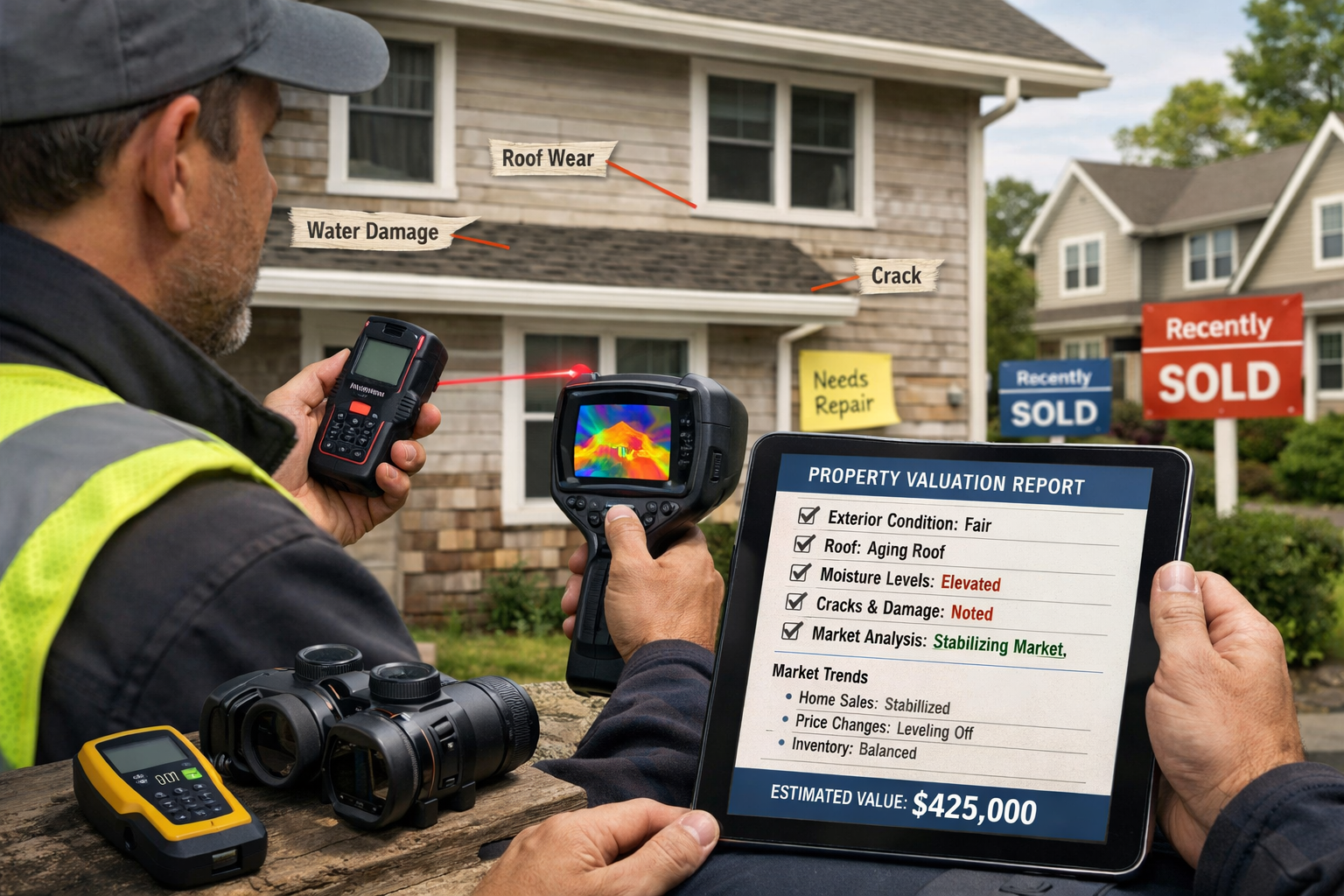
Pre-Survey Preparation and Data Collection
Successful valuation surveys in stabilising markets require thorough preparation before site visits. The techniques for assessing properties when price momentum remains subdued begin with comprehensive data gathering:
Essential Data Sources
📋 Transaction databases: Access to recent sales data through Land Registry, Multiple Listing Services, or commercial databases
📋 Rental market data: Current asking rents and actual lease transactions in the subject property's market segment
📋 Economic indicators: Local employment data, population trends, and development activity
📋 Property-specific information: Planning history, building permits, previous surveys, and title documents
The 95% of investors maintaining or increasing acquisition activity in 2026 signals renewed confidence in valuation accuracy, but this confidence depends on thorough due diligence and data verification.
On-Site Assessment Techniques
Physical inspection remains irreplaceable in property valuation, particularly when markets lack strong momentum to mask deficiencies:
Structural assessment should identify:
- Foundation integrity and settlement indicators
- Roof condition and remaining useful life
- Building envelope performance and weatherproofing
- Mechanical systems age and functionality
- Evidence of deferred maintenance
Functional obsolescence evaluation examines whether the property meets current market expectations:
- Layout efficiency and flow
- Room sizes and ceiling heights
- Kitchen and bathroom quality
- Energy efficiency and sustainability features
- Technology infrastructure and connectivity
For properties with specific concerns, specialized assessments may be necessary. A comprehensive damp survey can identify moisture issues that significantly impact value, while monitoring surveys track structural movement over time.
Synthesizing Multiple Valuation Approaches
Best practice in stabilising markets involves triangulation across multiple valuation methods:
- Start with the comparative approach as the primary methodology, carefully selecting and adjusting comparable sales
- Apply the income approach for investment properties, verifying rental assumptions and cap rate selections
- Use the cost approach as a reasonableness check, particularly for newer properties or unique assets
- Reconcile the results by weighting each approach based on data quality and applicability to the subject property
When the three approaches yield significantly different values, investigate the causes:
- Are comparable sales truly comparable, or do adjustments mask fundamental differences?
- Do income projections reflect actual market rents or optimistic assumptions?
- Does the cost approach properly account for all forms of depreciation?
Adjusting for Market Uncertainty
Even in stabilising markets, uncertainty remains. Professional valuers should:
✓ Provide value ranges rather than single-point estimates when data quality or market conditions warrant
✓ Clearly state assumptions underlying the valuation, allowing readers to assess sensitivity to changing conditions
✓ Include market commentary explaining local conditions and trends affecting the subject property
✓ Recommend re-valuation triggers such as significant market events or property condition changes
Understanding what to do after receiving survey results helps clients act appropriately on valuation findings, whether proceeding with purchase, renegotiating terms, or walking away from unsuitable properties.
Advanced Considerations for Professional Surveyors
Leveraging Technology in Valuation Surveys
Modern valuation practice in 2026 incorporates technological tools that enhance accuracy and efficiency:
Automated Valuation Models (AVMs) provide useful starting points but require professional judgment in stabilising markets where algorithmic assumptions may lag market reality. Use AVMs for:
- Initial value estimates and reasonableness checks
- Identifying potential comparable properties
- Tracking market trends over time
- Supporting high-volume portfolio valuations
Geographic Information Systems (GIS) enable sophisticated spatial analysis:
- Mapping comparable sales with visual proximity assessment
- Analyzing neighborhood characteristics and amenity access
- Identifying environmental risks and opportunities
- Visualizing market trends and price gradients
Building Information Modeling (BIM) and digital measurement tools improve accuracy in cost approach valuations by providing precise quantity takeoffs and condition documentation.
Regulatory and Professional Standards
Professional valuers must adhere to established standards and guidelines:
The RICS Valuation – Global Standards (Red Book) provides the framework for professional valuation practice. In stabilising markets, particular attention should be paid to:
- Basis of value selection: Market value, investment value, or other appropriate basis
- Assumptions and special assumptions: Clearly documented and justified
- Valuation uncertainty: Appropriately communicated when market conditions warrant
- Conflicts of interest: Identified and managed according to professional standards
Clients benefit from working with qualified professionals who understand why choosing RICS surveyors ensures adherence to rigorous professional standards.
Communicating Valuation Results Effectively
The final valuation report must communicate findings clearly to diverse audiences:
Executive summary should provide:
- Property identification and description
- Valuation figure and basis of value
- Key assumptions and limiting conditions
- Brief methodology explanation
- Market context summary
Detailed analysis includes:
- Comprehensive property description
- Market analysis and trends
- Methodology explanation for each approach
- Comparable sales analysis with adjustments
- Income and expense analysis (if applicable)
- Reconciliation of value indications
- Supporting documentation and photographs
Market commentary in 2026 should address:
- Local market stabilization indicators
- Regional divergence factors
- Supply and demand dynamics
- Transaction activity levels
- Investor sentiment and capital availability
Effective communication ensures clients understand not just the valuation conclusion but the reasoning and market context supporting it.
Conclusion
Valuation surveys in stabilising markets require surveyors to adapt traditional methodologies to account for subdued price momentum, regional divergence, and transitional market conditions. The techniques for assessing properties when price momentum remains subdued emphasize property-specific characteristics, careful comparable selection, income-focused analysis, and localized market understanding.
As 2026 progresses with minimal home price growth expected at 2-3% annually, surveyors must shift from appreciation-driven frameworks to methodologies that prioritize rental yields, debt service coverage, and careful risk assessment. The increased inventory levels and improved price discovery mechanisms create opportunities for more accurate valuations, but only when professionals apply rigorous analytical techniques and maintain awareness of regional market variations.
Actionable Next Steps
For property professionals conducting valuations in stabilising markets:
- Update your comparable sales database regularly, focusing on recent transactions within 3-6 months
- Verify rental income assumptions against actual market data rather than historical trends or landlord projections
- Develop property-specific risk assessments that account for condition, location, and tenant quality rather than relying on broad market cap rates
- Conduct thorough physical inspections as deferred maintenance issues become more significant in low-momentum markets
- Communicate uncertainty appropriately through value ranges and clearly stated assumptions when market conditions warrant
- Stay informed about regional divergence by monitoring local economic indicators, development activity, and transaction volumes
Whether you're valuing residential properties for purchase decisions, commercial assets for investment analysis, or conducting portfolio valuations for institutional clients, the stabilising market environment of 2026 demands careful, methodical approaches that balance multiple valuation techniques with local market knowledge.
For property buyers and investors, working with qualified surveyors who understand these nuanced techniques ensures accurate valuations that support informed decision-making. Consider exploring different survey levels to determine the appropriate assessment depth for your specific property and circumstances.
The stabilising property market presents both challenges and opportunities. By applying the techniques outlined in this guide, surveyors can deliver accurate, defensible valuations that serve clients well in this transitional environment, supporting confident property transactions and sound investment decisions across all market segments.