


The property market landscape across the United Kingdom has shifted dramatically in 2026, with Northern England emerging as the clear frontrunner in price growth and transaction activity. As southern regions face downward pressure, the Building Survey Demand Surge in Northern England: Capitalizing on 2026 Market Momentum represents a transformative opportunity for building surveyors ready to expand their capacity and service offerings. This regional boom brings both exciting prospects and operational challenges that require strategic planning and quality management.

Key Takeaways
- 🏘️ Northern England leads UK property growth with consistent price increases throughout Q1 2026, while southern regions experience downward pressure
- 📈 3-5% price appreciation expected across Northern England during 2026, driving increased demand for comprehensive building surveys
- 🔍 Survey instruction volumes surging as buyer confidence returns, with a net balance of +35% anticipating sales increases over the coming year
- ⚖️ Quality standards must be maintained despite capacity pressures—strategic workflow management is essential for sustainable growth
- 💼 Long-term market optimism strengthening with the strongest sales expectations since December 2024, creating sustained opportunities for surveying professionals
Understanding the Building Survey Demand Surge in Northern England: Capitalizing on 2026 Market Momentum
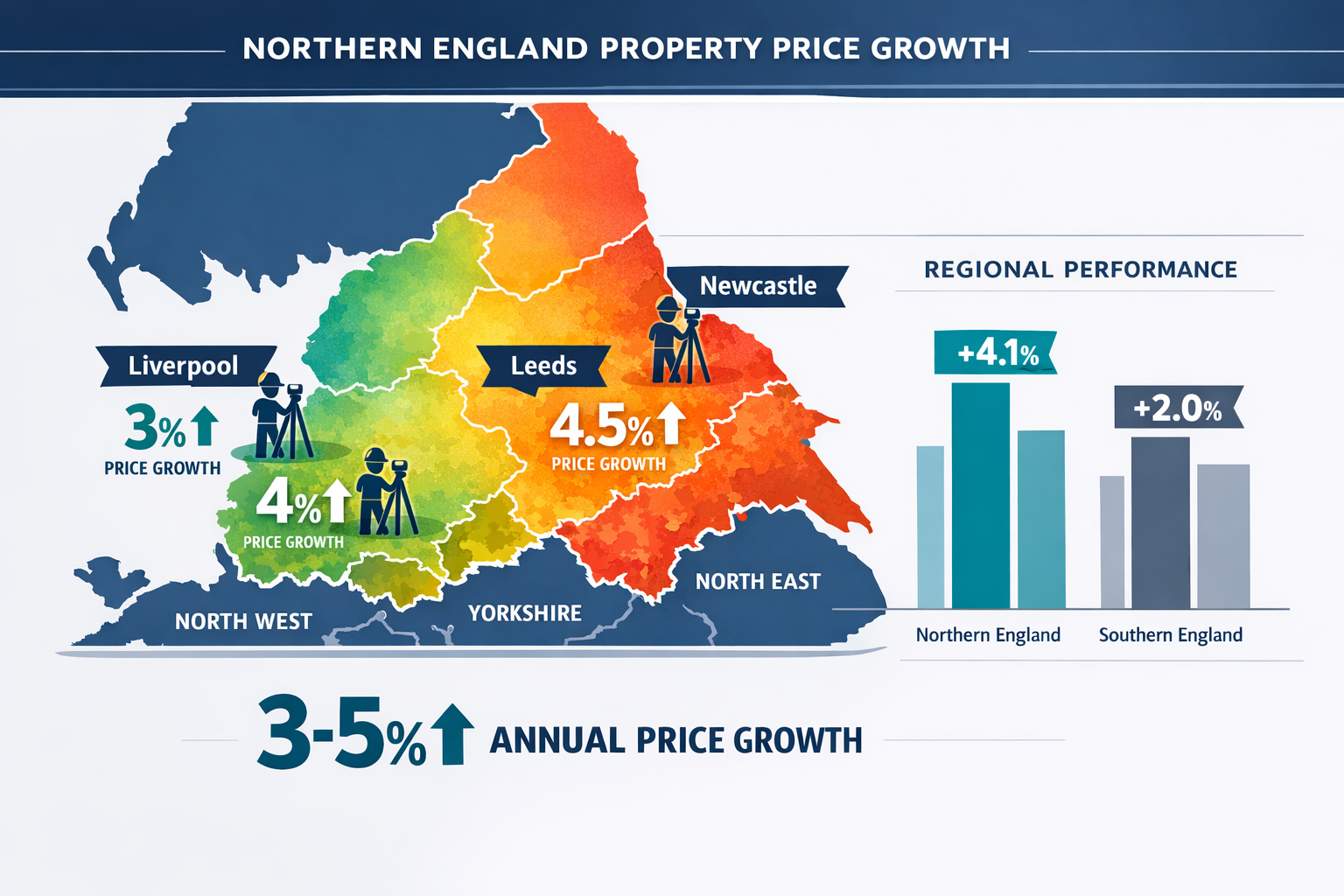
The Northern Powerhouse: Regional Performance Analysis
Northern England has emerged as a standout performer in Q1 2026, with market respondents consistently reporting prices moving higher across the region [1]. This marks a notable divergence from southern regions experiencing downward pressure, creating what industry experts are calling a "north-south divide" in property market performance.
The data reveals compelling regional variations:
| Region | Price Trend (Q1 2026) | 12-Month Outlook |
|---|---|---|
| North West England | Upward trajectory | Positive growth expected |
| North of England | Upward trajectory | Moderate appreciation |
| Yorkshire | Rising prices | 3-5% appreciation likely |
| London | Below average | Cautious outlook |
| South East | Below average | Subdued expectations |
| South West | Below average | Limited growth |
According to the latest RICS Residential Market Survey, Northern Ireland and Scotland continue to see house prices move higher, while the North West and North of England report prices on an upward trajectory as of January 2026 [3]. This consistent performance creates sustained demand for building surveys as buyers seek professional assessments before committing to purchases in these appreciating markets.
Price Appreciation Projections and Survey Implications
Building surveyors should anticipate 3-5% price appreciation in Northern England during 2026, representing a moderation from earlier growth patterns but still indicating healthy market conditions [2]. This projected growth has several important implications for surveying professionals:
Increased Due Diligence Requirements: As property values rise, buyers become more cautious about making informed decisions. The financial stakes of purchasing a property that may appreciate 3-5% annually make comprehensive building surveys increasingly valuable.
Valuation Accuracy Pressures: Surveyors must adjust their comparative market analysis techniques to account for rapidly changing local market conditions. Properties used as comparables may have sold in significantly different market conditions just months earlier.
Buyer Confidence Drivers: Professional surveys provide the reassurance buyers need when entering a rising market, helping them distinguish between properties likely to participate in appreciation versus those with hidden defects that could undermine value growth.
Market Activity Indicators: Sales and Enquiries
The market sentiment indicators reveal growing conviction among industry professionals. A net balance of +35% of survey participants anticipate an increase in sales activity over the coming year, marking the strongest reading since December 2024 [3]. This indicates growing conviction for recovery and suggests sustained instruction volumes for building surveyors.
However, short-term indicators show more nuanced patterns:
- New buyer enquiries stood at -15% in January 2026, reflecting improved sentiment from -21% in the prior month [3]
- Three-month sales expectations recorded a net balance of +4% in January 2026, down from +22% in December [3]
- New property instructions showed minimal movement with a +1% net balance, broadly stable compared to December's -1% [3]
These figures suggest a tentative turning point in market activity rather than an explosive boom, which actually benefits surveyors by allowing for manageable capacity expansion rather than overwhelming demand surges.
"Growing conviction among respondents indicates recovery in sales volumes is expected to gather momentum over the year ahead, even as expectations remain relatively cautious in the immediate term." [3]
Managing Capacity During the Building Survey Demand Surge in Northern England
Workflow Optimization Strategies
As instruction volumes increase across Northern England, building surveyors face the critical challenge of expanding capacity while maintaining quality standards. This balance requires strategic workflow management and operational efficiency improvements.
Appointment Scheduling Systems: Implementing robust scheduling software allows surveyors to maximize site visit efficiency by:
- Clustering appointments geographically to minimize travel time
- Allocating appropriate time slots based on property type and survey complexity
- Building buffer periods for unexpected complications or extended inspections
- Tracking capacity utilization across team members
Template and Documentation Efficiency: While each property requires individualized assessment, standardizing certain aspects of the survey process can improve throughput:
- Developing comprehensive checklists for different property types (Victorian terraces, post-war semi-detached, modern builds)
- Creating report templates with pre-populated sections for common building elements
- Utilizing mobile survey apps that allow on-site data capture and photo annotation
- Implementing quality control protocols that catch errors before final report delivery
For surveyors looking to expand their service offerings, understanding the differences between homebuyers surveys and full structural surveys helps match client needs with appropriate service levels.
Team Expansion and Training Considerations
Meeting increased demand may require expanding surveying teams, but this must be done strategically to maintain professional standards:
Recruitment Priorities:
- ✅ RICS-qualified surveyors with relevant regional experience
- ✅ Professionals familiar with Northern England property types
- ✅ Candidates with strong technical writing and client communication skills
- ✅ Team members who understand local building regulations and construction methods
Training Programs: New team members require comprehensive onboarding that covers:
- Regional building characteristics: Northern England features distinctive property types including Victorian terraced houses, mill conversions, and stone-built cottages requiring specialized knowledge
- Quality standards protocols: Ensuring consistency across all surveyors regardless of experience level
- Report writing standards: Maintaining clear, accessible communication that serves clients effectively
- Client interaction skills: Building confidence and trust during site visits and follow-up consultations
Technology Integration for Scalability
Modern surveying practices increasingly rely on technology solutions that enhance both capacity and quality:
Digital Survey Tools:
- Thermal imaging cameras for efficient damp and insulation assessment
- Laser measuring devices for accurate dimensional data
- Drone technology for roof and chimney inspections without access equipment
- Moisture meters and electrical testing equipment for comprehensive diagnostics
Report Generation Software: Cloud-based platforms enable:
- Real-time collaboration among team members
- Consistent formatting and branding across all deliverables
- Photo integration and annotation directly from mobile devices
- Version control and quality assurance workflows
Client Communication Platforms: Managing increased instruction volumes requires efficient client interaction systems including:
- Automated booking confirmations and appointment reminders
- Digital report delivery with secure client portals
- Follow-up survey distribution to gather feedback
- CRM systems to track client relationships and referral sources
Quality Standards and Professional Excellence During Market Growth

Maintaining Inspection Thoroughness
The Building Survey Demand Surge in Northern England: Capitalizing on 2026 Market Momentum creates pressure to process more instructions quickly, but compromising inspection quality represents a false economy that damages professional reputation and exposes surveyors to liability.
Time Allocation Discipline: Each property type requires appropriate inspection duration:
- Small terraced houses: Minimum 2-3 hours on-site
- Semi-detached properties: 3-4 hours for thorough assessment
- Detached houses: 4-6 hours depending on size and complexity
- Period properties: Additional time for detailed fabric inspection
Rushing inspections to accommodate more appointments inevitably leads to missed defects, inadequate photography, and incomplete assessments that fail to serve clients properly.
Systematic Inspection Methodology: Following a consistent approach ensures nothing gets overlooked:
- External envelope inspection (roof, walls, windows, doors)
- Internal room-by-room assessment (ceilings, walls, floors, fixtures)
- Services evaluation (heating, plumbing, electrical, drainage)
- Structural elements (foundations, load-bearing walls, timber frames)
- Specialist areas (damp, timber defects, building movement)
For properties requiring additional specialized assessments, understanding when to recommend stock condition surveys or other supplementary investigations demonstrates professional thoroughness.
Report Quality and Client Communication
Clear, actionable reporting remains the cornerstone of professional surveying practice, regardless of market pressures:
Essential Report Elements:
- 📋 Executive summary highlighting critical findings
- 📋 Detailed condition assessment for all building elements
- 📋 Photographic evidence with clear annotations
- 📋 Prioritized recommendations (urgent, short-term, long-term)
- 📋 Cost guidance for identified repairs
- 📋 Plain language explanations accessible to non-technical readers
Communication Best Practices: Busy market conditions make client communication even more important:
- Providing realistic timelines for report delivery
- Offering follow-up calls to discuss findings and answer questions
- Being available for contractor consultations during negotiation phases
- Maintaining professional boundaries while being responsive
The ability to find the best local surveyor often depends on reputation for quality and responsiveness—attributes that must be protected during growth phases.
Risk Management and Professional Indemnity
Increased instruction volumes naturally increase exposure to professional liability claims, making robust risk management essential:
Documentation Standards: Comprehensive records protect against future disputes:
- Detailed site notes and observations
- Timestamped photographs with location data
- Records of areas not inspected (with reasons)
- Client communication logs and instruction confirmations
Professional Indemnity Insurance: Review coverage levels to ensure they align with:
- Increased instruction volumes and annual fee income
- Property values in Northern England markets
- Team expansion and multiple surveyors operating under firm name
- Emerging risks from new property types or survey methodologies
Limitation of Liability Clauses: Clear terms of engagement that specify:
- Scope of inspection and reporting
- Areas excluded from assessment
- Reliance on client-provided information
- Time limitations on report validity
Regional Construction Activity and Supply Dynamics
New Build Development Impact
The construction sector provides important context for understanding the Building Survey Demand Surge in Northern England: Capitalizing on 2026 Market Momentum. In the year to 30 September 2025, building starts increased in all English regions except London, with the East Midlands and Yorkshire and the Humber posting the largest gains at 43% and 33% respectively [4].
This construction activity influences surveying demand in several ways:
New Build Surveys: While new properties come with NHBC warranties, many buyers still commission independent surveys, particularly for:
- Pre-completion snagging inspections
- Verification of specification compliance
- Independent assessment before warranty expiration
- Conversion and renovation projects
Market Supply Dynamics: An estimated 158,700 net additional homes were delivered in England between 1 April 2025 and 11 January 2026 [4], providing supply context for regional market dynamics. This supply increase helps moderate price growth while maintaining healthy transaction volumes.
Renovation and Conversion Work: The surge in building activity extends beyond new construction to include:
- Victorian terrace renovations and modernization
- Mill and warehouse conversions to residential use
- Period property restoration projects
- Extension and improvement works
These projects often require specialized surveys including building works assessments and ongoing monitoring services.
Property Type Considerations in Northern Markets
Northern England features distinctive property types that require specialized surveying knowledge:
Victorian and Edwardian Terraces: Common across Northern cities, these properties present characteristic challenges:
- Solid wall construction requiring damp expertise
- Original slate roofs nearing end of serviceable life
- Single-glazed sash windows and period joinery
- Shared party walls requiring party wall considerations
- Coal fire damage and chimney condition issues
Stone-Built Properties: Particularly prevalent in Yorkshire and rural areas:
- Lime mortar pointing requiring specialist knowledge
- Stone deterioration and weathering assessment
- Thermal performance challenges
- Traditional construction methods differing from modern standards
Post-War Housing Stock: Significant volumes of 1950s-1970s construction:
- Concrete construction systems requiring specific expertise
- Cavity wall insulation retrofit assessments
- Original electrical and plumbing systems nearing replacement
- Asbestos presence requiring careful identification
Strategic Positioning for Long-Term Market Opportunities
Building Client Relationships During Growth Phases
The current market momentum provides exceptional opportunities to build lasting client relationships that extend beyond individual survey instructions:
Referral Network Development: Satisfied clients during a busy market become valuable referral sources:
- Estate agents recognizing quality survey work
- Solicitors appreciating clear, timely reporting
- Mortgage brokers requiring reliable surveying partners
- Previous clients returning for additional properties or investment purchases
Value-Added Services: Expanding service offerings to meet broader client needs:
- Pre-purchase consultations helping buyers understand survey types
- Post-survey contractor liaison and tender review
- Ongoing property maintenance advice and periodic inspections
- Investment property portfolio assessments
Geographic Expansion: The Northern England market boom may justify expanding service coverage to capture additional opportunities across the region while maintaining quality standards.
Marketing and Business Development
Capitalizing on market momentum requires strategic marketing that positions surveying firms for sustained growth:
Digital Presence Optimization:
- Website content highlighting Northern England expertise and regional knowledge
- Case studies demonstrating successful survey outcomes
- Educational content helping buyers understand survey value
- Local SEO optimization for key Northern cities and towns
Professional Networking: Active participation in property industry networks:
- RICS regional events and professional development programs
- Estate agent relationship building and introduction meetings
- Solicitor firm connections and conveyancing partnerships
- Property investor forums and landlord associations
Thought Leadership: Establishing expertise through:
- Market commentary on Northern England property trends
- Technical articles on regional building characteristics
- Client education resources and buying guides
- Media engagement on local property market developments
Sustainable Growth Planning
While the 2026 market presents immediate opportunities, sustainable business development requires long-term planning:
Capacity Planning Horizons: Consider market cycles when expanding:
- Current surge may moderate as supply increases
- Economic conditions could shift buyer sentiment
- Interest rate movements affect mortgage availability
- Regional development policies influence long-term demand
Financial Management: Growth phases require careful financial stewardship:
- Reinvesting profits in technology and training
- Building cash reserves for quieter periods
- Managing receivables and payment terms
- Balancing expansion costs against revenue growth
Quality System Development: Formalizing processes that maintain standards:
- ISO 9001 quality management systems
- Regular peer review and technical audits
- Continuing professional development programs
- Client satisfaction measurement and feedback integration
Conclusion
The Building Survey Demand Surge in Northern England: Capitalizing on 2026 Market Momentum represents a transformative opportunity for building surveyors prepared to expand capacity strategically while maintaining uncompromising quality standards. With Northern England leading UK property market performance through Q1 2026 and 3-5% price appreciation expected throughout the year, surveying professionals face sustained instruction volumes driven by returning buyer confidence and strengthening sales expectations.
Success in this environment requires balancing growth ambitions with professional excellence. Surveyors must implement efficient workflow systems, consider strategic team expansion, and leverage technology solutions that enhance both capacity and quality. However, the fundamental principles of thorough inspection, clear reporting, and client-focused service remain paramount—compromising these standards for short-term volume gains damages long-term reputation and professional standing.
The regional construction boom, distinctive Northern property types, and evolving market dynamics create opportunities extending well beyond immediate survey instructions. Building lasting client relationships, developing referral networks, and establishing thought leadership position firms for sustained success as the Northern England market continues its upward trajectory.
Actionable Next Steps
For building surveyors ready to capitalize on Northern England's market momentum:
- Assess current capacity utilization and identify bottlenecks limiting instruction throughput
- Implement workflow optimization systems including scheduling software and digital survey tools
- Review quality standards protocols to ensure consistency across all team members and instructions
- Evaluate team expansion needs and begin recruitment or training programs for qualified professionals
- Strengthen regional expertise in Northern England property types and local market conditions
- Develop strategic partnerships with estate agents, solicitors, and mortgage brokers across target areas
- Monitor market indicators including RICS surveys and regional price data to anticipate demand shifts
- Invest in professional development focusing on emerging building technologies and survey methodologies
The Building Survey Demand Surge in Northern England: Capitalizing on 2026 Market Momentum offers exceptional prospects for surveyors combining professional excellence with strategic business development. Those who rise to meet this opportunity while maintaining unwavering quality standards will build sustainable practices positioned for long-term success regardless of future market cycles.
References

[1] Rics Residential Market Survey Q1 2026 Building Survey Implications For Northern England Price Surges 2 – https://nottinghillsurveyors.com/blog/rics-residential-market-survey-q1-2026-building-survey-implications-for-northern-england-price-surges-2
[2] Northern England Valuation Surge 2026 Rics Insights On Price Growth And Surveyor Adjustment Techniques – https://nottinghillsurveyors.com/blog/northern-england-valuation-surge-2026-rics-insights-on-price-growth-and-surveyor-adjustment-techniques
[3] Uk Residential Market Survey January 2026 – https://www.rics.org/content/dam/ricsglobal/documents/market-surveys/uk-residential-market-survey/UK-Residential-Market-Survey_January-2026.pdf
[4] Housing Supply Indicators Of New Supply England July To September 2025 – https://www.gov.uk/government/statistics/housing-supply-indicators-of-new-supply-england-july-to-september-2025/housing-supply-indicators-of-new-supply-england-july-to-september-2025