
Agreed sales in prime London fell 22% below their five-year average in the first nine months of 2026, the weakest opening three quarters in at least six years. That single statistic, buried in LonRes data analysed by PrimeResi on 14 October 2026, tells Wimbledon sellers almost everything they need to know before the Autumn Budget lands on 28 October. The London property sales slump October 2026 Wimbledon homeowners are watching is not a rumour or an estate agent's scare tactic. It is a measurable, market-wide slowdown, and it is already changing how buyers behave on roads around the Village, the Common, Southfields and Raynes Park.
This article explains what the data shows, why it matters specifically for Wimbledon, and the concrete steps sellers should take now, before the Budget adds another layer of uncertainty.
Key Takeaways
- Prime London agreed sales are 22% below the five-year average and 36% below 2021 levels, the slowest nine-month start in six years.
- Average mortgage rates have climbed above 5%, with two-year fixes near 5.97% and five-year fixes near 5.99% in mid-October 2026.
- One in four newly listed homes had already been on the market before, and six in ten of those were relisted at a lower price.
- Only 42% of London listings are finding a buyer, against almost two-thirds nationally, and homes are taking 78 days on average to sell.
- A pre-sale RICS valuation and survey is now the single best way for Wimbledon sellers to price correctly first time and avoid a damaging relisting.
The Numbers Behind the London Property Sales Slump October 2026 Wimbledon Sellers Face
The scale of the slowdown is unusual because it is confirmed by several independent sources, not one agency's spin. LonRes figures for July 2026, reported by The National on 14 October, showed average prime London sale prices 7.9% lower than a year earlier, with new listings down 30.3%. Zoopla's data for the four weeks to 20 September 2026 showed sales agreed falling 9% year on year, with every single UK region reporting a decline, London included.
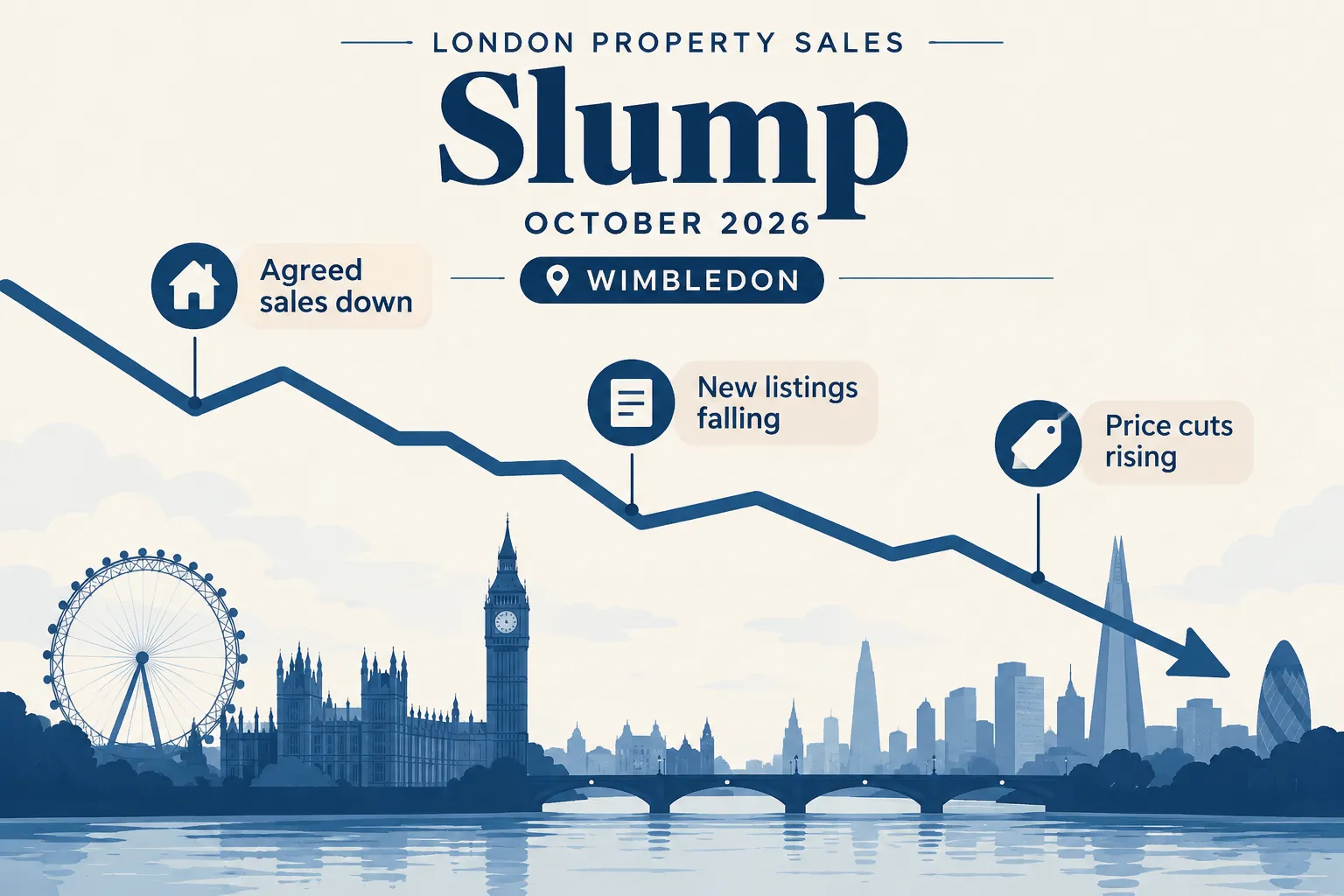
Rightmove's September index adds important local colour. London asking prices rose 1.8% month on month on seasonal relisting, but were still down 2.6% year on year. More tellingly, only 42% of London listings found a buyer, compared with nearly two-thirds across the UK, and the average time to find a buyer in the capital stretched to 78 days. Homes for sale sat at a 12-year high for the time of year, meaning buyers have far more choice, and far less urgency, than in recent autumns.
The Office for National Statistics put London's average price at £569,000 in July 2026, down 3.3% year on year. Nationwide's Q3 2026 release showed London at £529,720, up a marginal 0.4% annually, while Outer Metropolitan areas (which include much of south-west London's commuter belt) slipped 0.2%. National annual price growth halved to just 0.8% in September, the weakest pace since December 2025.
Why Mortgage Rates and the Budget Are Freezing Buyers
Richard Donnell of Zoopla summed up the mood plainly: "The Middle East conflict has pushed up energy prices and mortgage rates, tempering the autumn rebound in housing activity," adding that "buyers are simply more cautious and selective about what they view and offer." That caution has a clear financial driver. Average mortgage rates started 2026 near 4% and have since climbed above 5%, adding roughly £150 a month, or £1,800 a year, to the cost of a typical mortgage.
By mid-October, according to PropertyWire via Tembo, the average two-year fix stood at 5.97% and the average five-year fix at 5.99%, both having briefly crossed 6% earlier in the month. The Bank of England base rate has held at 3.75% since December 2025, with the next decision due 5 November, just a week after the Budget. HSBC and NatWest began trimming selected fixed rates from 15 October, a small but welcome signal, though borrowing remains far more expensive than buyers budgeted for a year ago.
Layered on top of this is Budget uncertainty itself. Speculation ahead of 28 October has made many buyers reluctant to commit to a purchase until tax and property policy details are confirmed. Zoopla now expects UK price growth to slow to about 0.5% by year end, with transactions falling to 1.1 million for 2026, down from 1.2 million in 2025.
What This Means for Wimbledon Sellers
Wimbledon has historically been more resilient than much of inner London, thanks to strong schools, green space on the Common, and good rail links from stations serving the Village, Southfields and Raynes Park. But resilience does not mean immunity. The same forces depressing sales across prime and outer London, higher mortgage costs, cautious buyers, and Budget-related hesitation, are visible in the number of viewings, the pace of offers, and the gap between asking and achieved prices on family houses in these areas.
"Buyers are simply more cautious and selective about what they view and offer.", Richard Donnell, Zoopla
Sellers who priced ambitiously in spring 2026, expecting a normal autumn bounce, are now finding fewer serious offers. The national pattern of relisting is the clearest warning sign for anyone preparing to list a Wimbledon property this autumn.
Price Cuts Are Rising: Avoid the Relisting Trap
Zoopla's research found that one in four homes newly listed had actually been on the market before, most commonly flats and larger family homes, which describes a meaningful slice of Wimbledon's stock. Of those relisted properties, six in ten came back at a lower price than their original listing.
This matters enormously for sequencing a sale. A property that sits unsold for months, gets withdrawn, and reappears at a reduced price signals weakness to buyers before they even book a viewing. Portals show price history. Agents' buyer databases remember. The second listing almost always performs worse than a correctly priced first listing would have.
| Mistake | Consequence | Better approach |
|---|---|---|
| Overpricing to "test the market" | Long time on market, stale listing | Price against realistic comparable evidence from day one |
| Relisting after a failed sale | Buyers see price history, offer lower | Get an independent valuation before relaunching |
| Ignoring survey issues | Deals collapse post-offer, delays pile up | Commission a survey pre-marketing to fix issues early |
Pre-Sale RICS Valuation and Survey: Your Best Defence Before the Budget
The single most effective response to this slowdown is to remove guesswork before a property ever appears on a portal. A RICS chartered surveyor can provide an independent, evidence-based valuation that reflects current conditions, not last spring's optimism.
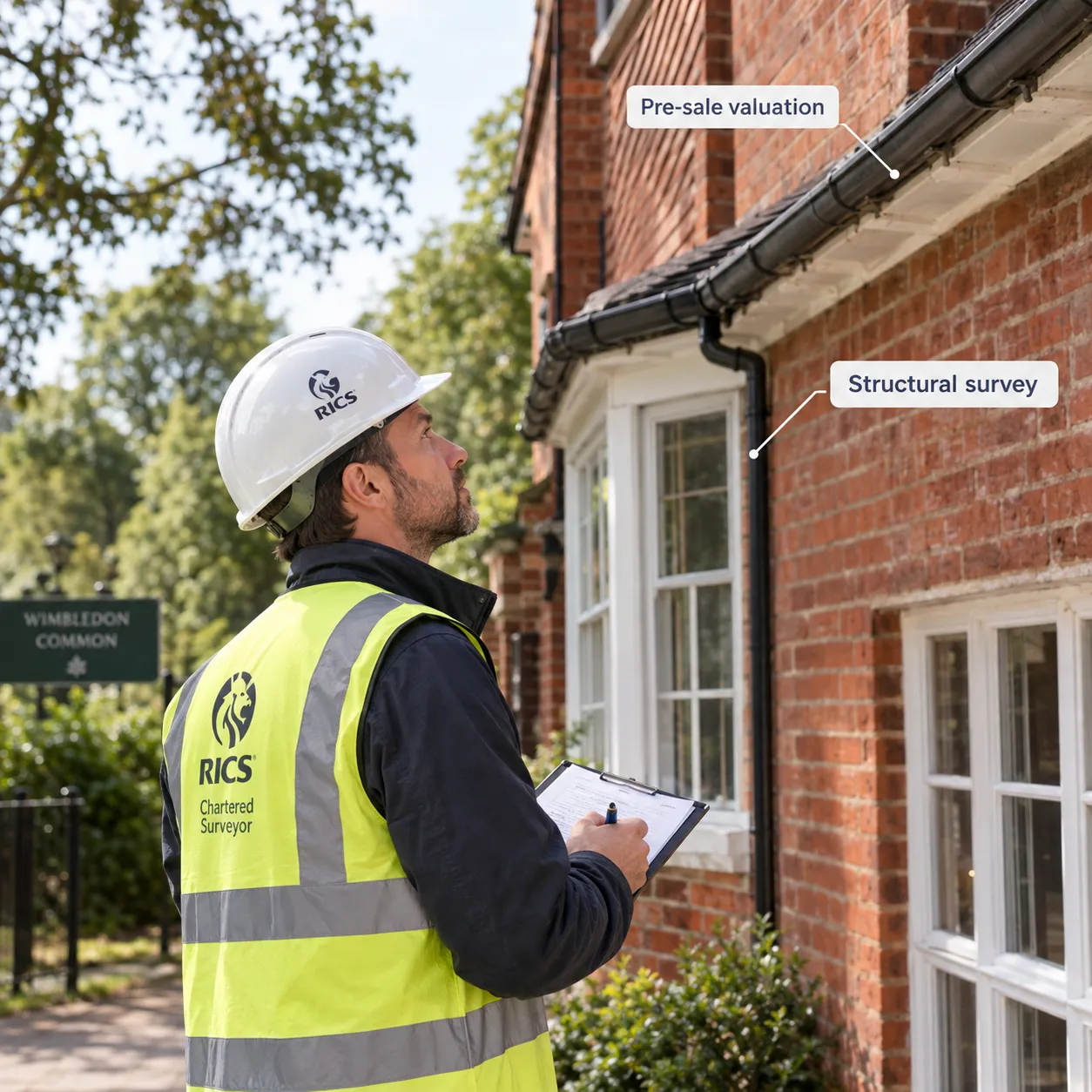
A pre-sale survey, usually a Home Survey Level 2 or Level 3 depending on the property's age and construction, flags structural issues, damp, roof condition or subsidence risk before a buyer's own surveyor finds them mid-transaction. In a market where only 42% of London listings are selling, and time on market averages 78 days, any delay caused by late-discovered defects can be fatal to a sale. Fixing or disclosing issues upfront, with costed quotes, keeps negotiations factual rather than emotional.
For Wimbledon's period houses around the Village and Common, and the mix of conversions and new-build flats near Southfields and Raynes Park, this step is particularly valuable because build quality and maintenance vary street by street.
What Buyers Can Negotiate Right Now
With stock at a 12-year high for the season and mortgage costs elevated, buyers have genuine leverage. Sellers should expect and plan for:
- Requests for price reductions reflecting the 2.6% annual fall in London asking prices
- Longer completion timelines while buyers secure mortgage offers at current higher rates
- Conditional offers pending survey results, especially on older Wimbledon stock
- Chain-free or cash buyers demanding a discount for certainty and speed
Sellers who anticipate these requests, rather than resisting them, close deals faster.
Frequently Asked Questions
Is the London property sales slump of October 2026 affecting Wimbledon specifically?
Yes, indirectly. Wimbledon is not immune to the wider forces, higher mortgage rates, fewer buyers, and Budget uncertainty, even though its fundamentals remain stronger than many London areas.
Should Wimbledon sellers wait until after the Budget to list?
Not necessarily. A well-priced, survey-ready property can still attract serious buyers now. Waiting risks listing into a more crowded post-Budget market with even more competition.
How much have mortgage rates risen in 2026?
Average rates climbed from around 4% in January to above 5% by autumn, with two-year and five-year fixes briefly exceeding 6% in October before easing slightly.
Why is a pre-sale RICS survey worth the cost?
It identifies issues before buyers do, prevents late-stage price renegotiation, and supports a realistic, defensible asking price from the outset.
Will prices in Wimbledon fall like the London average?
Outer London and commuter-belt areas have shown smaller declines than prime central London, but growth is clearly slowing, so realistic pricing matters more than ever.
Conclusion
The London property sales slump October 2026 Wimbledon sellers are navigating is real, well-documented, and unlikely to reverse quickly before the Budget. Agreed sales are at a six-year low, price cuts are becoming common, and buyers hold more negotiating power than at any point in recent years. The sellers who succeed this autumn will be those who price realistically from day one, commission an independent RICS valuation and survey before listing, and prepare for buyer requests on price, timing and conditions. Acting now, ahead of the 28 October Budget and the 5 November rate decision, gives Wimbledon sellers the best chance of a smooth, successful sale rather than a costly relisting later.