


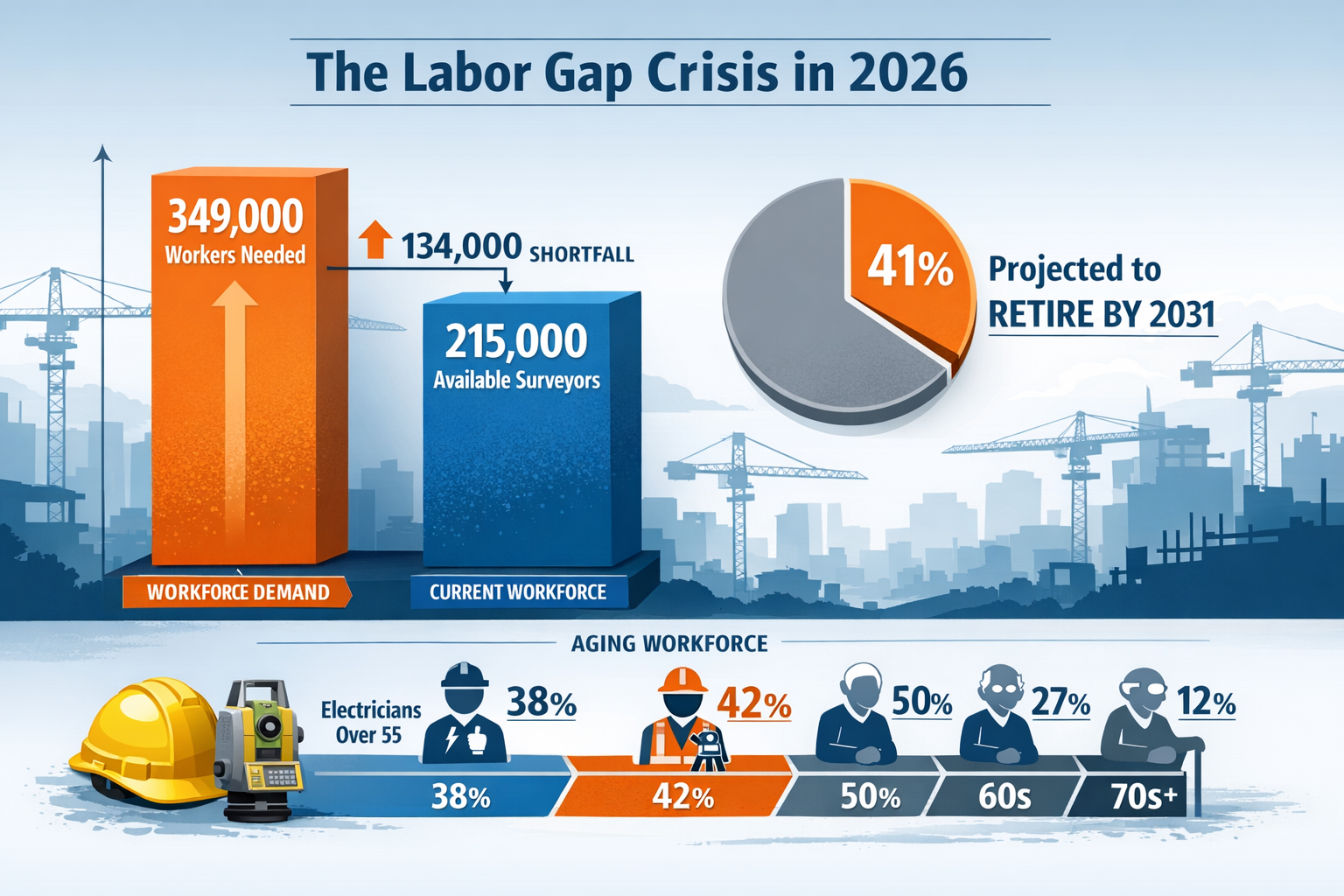
The construction and surveying industries face an unprecedented challenge in 2026: a critical shortage of skilled professionals threatening to derail projects across the nation. As the U.S. construction industry requires 349,000 net new workers in 2026[1][4], surveying firms find themselves at a crossroads. The question is no longer whether technology will transform the profession, but how quickly firms can adopt digital solutions to survive the labor crisis. Workforce Shortages in Surveying: Digital Tools Bridging the Labor Gap in 2026 Projects represents both a challenge and an opportunity—one that forward-thinking firms are addressing through artificial intelligence, automation, and interoperable technology platforms.
The surveying profession, which forms the critical foundation for construction projects, property transactions, and infrastructure development, faces a perfect storm of challenges. An aging workforce, insufficient new talent entering the field, and exponentially growing project demands have created a gap that traditional hiring alone cannot fill. Yet amid this crisis, innovative digital tools are emerging as powerful force multipliers, enabling surveying firms to accomplish more with fewer personnel while maintaining—and even improving—accuracy and efficiency.
Key Takeaways
- 🏗️ The construction industry needs 349,000 new workers in 2026, with surveying facing similar critical shortages as approximately 41% of the current workforce approaches retirement by 2031[1][2]
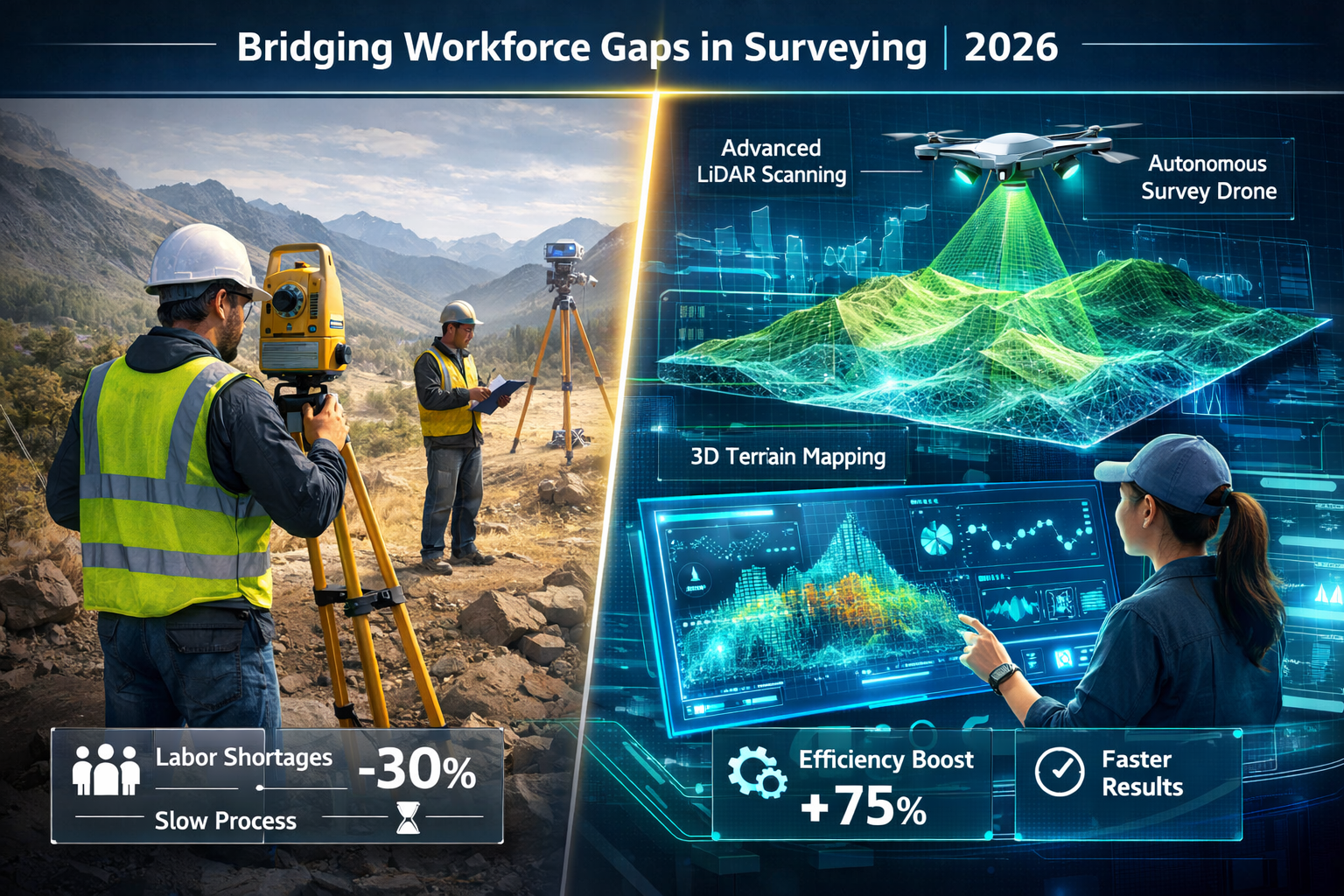
- 🤖 AI-powered surveying tools and automation technologies are enabling firms to process data 10-15 times faster than traditional methods, effectively multiplying workforce capacity
- 📱 Digital surveying platforms with cloud integration allow real-time collaboration, reducing project timelines by 30-40% and enabling smaller teams to handle larger project portfolios
- 🚁 Drone technology and LiDAR systems have democratized complex surveying tasks, allowing technicians to complete work that previously required senior-level expertise
- 💡 Firms adopting comprehensive digital transformation strategies are successfully managing 50-70% more projects without proportional increases in staffing levels
Understanding the Surveying Workforce Crisis in 2026
The Scale of the Labor Shortage
The workforce shortage affecting surveying in 2026 cannot be understated. While the broader construction industry faces a requirement for 349,000 net new workers—a figure expected to rise to 456,000 workers in 2027 as construction spending growth resumes[1][4]—surveying occupies a particularly vulnerable position within this ecosystem. The specialized nature of surveying work, combined with certification requirements and technical expertise demands, makes these positions exceptionally difficult to fill.
Approximately 41% of the current construction workforce is projected to retire by 2031[2], and surveying professionals skew even older than the general construction demographic. About one-fifth of U.S. electricians are older than 55[1], and similar age distributions exist among chartered surveyors, land surveyors, and quantity surveyors. This creates a ticking time bomb for the industry—experienced professionals are leaving faster than new talent can be recruited and trained.
The impact extends beyond simple headcount. When conducting structural surveys or topographic surveys, the loss of experienced professionals means the departure of institutional knowledge, client relationships, and nuanced expertise that takes years to develop. Traditional apprenticeship models, which once sustained the profession, have struggled to attract younger workers who often perceive surveying as outdated or physically demanding compared to technology-focused careers.
Root Causes Behind the Shortage
Several interconnected factors have created the current crisis:
Demographic Shifts: The baby boomer generation, which comprises a significant portion of senior surveyors, is reaching retirement age en masse. Unlike previous generational transitions, the replacement cohorts (Gen X and Millennials) are smaller and have been drawn to different career paths.
Educational Pipeline Challenges: University programs in surveying and geomatics have seen declining enrollment over the past decade. The perception of surveying as a traditional, field-based profession has made it less attractive to digitally-native younger generations, despite the reality that modern surveying increasingly involves sophisticated technology.
Competitive Labor Market: The construction workforce crisis extends across all trades and specialties[8]. Surveying firms compete not only with each other but with technology companies, engineering firms, and other industries offering remote work options and perceived career advancement opportunities.
Certification Barriers: Becoming a chartered surveyor or licensed land surveyor requires years of education, practical experience, and examination. These lengthy qualification periods deter potential entrants who can access other careers more quickly.
Project Demand Growth: Despite workforce constraints, demand for surveying services continues to grow. Infrastructure investment, property development, and construction projects all require comprehensive surveying work, creating a widening gap between available professionals and project needs.
The Cost of Inaction
Firms that fail to address workforce shortages face severe consequences. Project delays have become the leading impact of construction workforce shortages[8], with surveying bottlenecks often creating cascading delays throughout entire project timelines. When a homebuyers survey or commercial property assessment cannot be scheduled promptly due to surveyor availability, property transactions stall, construction cannot commence, and economic activity slows.
The financial implications extend beyond lost revenue. Firms struggling with capacity constraints often overwork existing staff, leading to burnout, quality issues, and further attrition. Client relationships suffer when deliverables are delayed or rushed. Competitive positioning erodes as more agile competitors capture market share.
How Digital Tools Are Transforming Surveying Capacity
AI and Machine Learning Applications
Artificial intelligence represents perhaps the most transformative force in addressing Workforce Shortages in Surveying: Digital Tools Bridging the Labor Gap in 2026 Projects. Modern AI-powered surveying platforms have fundamentally changed what a single surveyor can accomplish in a day.
Automated Data Processing: Traditional surveying generated massive datasets that required hours or days of manual processing. AI algorithms now process point cloud data, identify features, classify objects, and generate deliverables with minimal human intervention. What once required a team of technicians working for days can now be accomplished in hours with a single operator overseeing AI-driven workflows.
Intelligent Quality Control: Machine learning systems can identify anomalies, inconsistencies, and potential errors in survey data far faster than manual review. These systems learn from historical data to recognize patterns that indicate measurement errors, equipment malfunctions, or environmental interference, flagging issues for human review rather than requiring comprehensive manual checking.
Predictive Analytics: AI tools analyze historical project data to predict resource requirements, identify potential challenges, and optimize survey planning. This enables more efficient deployment of limited personnel resources, ensuring the right expertise is available at the right time.
Automated Report Generation: Natural language processing and template-based AI systems can generate preliminary survey reports, condition survey reports, and documentation that previously required significant professional time. While human review and refinement remain essential, the initial drafting process has been dramatically accelerated.
Drone Technology and Remote Sensing
Unmanned aerial vehicles (UAVs) equipped with advanced sensors have democratized complex surveying tasks, enabling less experienced technicians to capture data that previously required senior-level expertise.
Rapid Site Coverage: Drones can survey large sites in a fraction of the time required for traditional ground-based methods. A single operator can capture comprehensive topographic data for dozens of acres in hours rather than the days or weeks required for conventional approaches.
LiDAR Integration: Light Detection and Ranging (LiDAR) systems mounted on drones generate highly accurate three-dimensional point clouds. This technology has made precision surveying accessible to firms that previously couldn't justify the cost of terrestrial laser scanning equipment or the specialized personnel to operate it.
Safety Improvements: Drones access hazardous or difficult terrain without exposing personnel to risk. This not only improves safety outcomes but also reduces the physical demands of surveying work, potentially attracting a broader talent pool.
Multi-Sensor Platforms: Modern survey drones integrate multiple sensors—RGB cameras, thermal imaging, multispectral sensors, and LiDAR—capturing diverse data types simultaneously. This multi-modal approach provides comprehensive site information from a single flight, maximizing efficiency.
Cloud-Based Collaboration Platforms
Interoperability and real-time collaboration have emerged as critical capabilities for addressing workforce constraints. Cloud-based surveying platforms enable distributed teams to work together seamlessly, regardless of geographic location.
Real-Time Data Sharing: Field crews upload survey data directly to cloud platforms, where office-based teams can immediately begin processing and analysis. This eliminates traditional bottlenecks where data sat on local devices waiting for physical transfer.
Collaborative Workflows: Multiple team members can work on different aspects of a project simultaneously. While one surveyor processes topographic data, another can work on boundary analysis, and a third can begin report preparation—all accessing the same centralized dataset.
Remote Expertise Access: Senior professionals can provide guidance, quality review, and technical oversight remotely. A junior surveyor in the field can consult with an expert hundreds of miles away, viewing the same data in real-time and receiving immediate feedback.
Client Integration: Modern platforms allow clients to access project progress, review preliminary findings, and provide feedback without requiring in-person meetings. This transparency improves client satisfaction while reducing time-consuming coordination activities.
Automated Survey Equipment
Robotic total stations, GNSS receivers with automated tracking, and self-leveling instruments have reduced the skill requirements for data collection while improving accuracy and speed.
Robotic Total Stations: These instruments automatically track prisms, measure angles and distances, and record data with minimal operator intervention. A single surveyor can accomplish tasks that traditionally required a two-person crew, effectively doubling workforce capacity.
Autonomous Monitoring Systems: Automated monitoring equipment can be deployed on construction sites to continuously track movement, settlement, or deformation. These systems operate 24/7 without human supervision, providing data that would be impossible to capture with traditional periodic manual surveys.
Integrated Positioning Systems: Modern GNSS receivers integrate multiple satellite constellations (GPS, GLONASS, Galileo, BeiDou) and correction services to achieve centimeter-level accuracy with simplified workflows. This technology has reduced the expertise required for precise positioning, enabling broader deployment of surveying capabilities.
Implementing Digital Solutions to Bridge Workforce Gaps
Strategic Technology Adoption Framework
Successfully leveraging Workforce Shortages in Surveying: Digital Tools Bridging the Labor Gap in 2026 Projects requires strategic planning rather than ad-hoc technology purchases. Leading firms follow structured adoption frameworks:
Needs Assessment: Begin by analyzing current workflow bottlenecks, capacity constraints, and project types. Identify which tasks consume disproportionate time, where errors most frequently occur, and which capabilities would enable the firm to accept additional work.
Phased Implementation: Avoid overwhelming staff with simultaneous changes across all operations. Implement technologies in phases, allowing time for training, workflow adaptation, and troubleshooting before adding additional systems.
Integration Planning: Ensure new technologies integrate with existing systems and workflows. Isolated tools that don't share data create new inefficiencies rather than solving existing ones. Prioritize platforms with open APIs and industry-standard data formats.
Training Investment: Technology only delivers value when personnel can use it effectively. Allocate significant resources to comprehensive training programs, ongoing support, and skill development. Consider that training costs often equal or exceed initial technology acquisition costs.
Performance Metrics: Establish clear metrics to evaluate technology ROI. Track productivity improvements, error reduction, project capacity increases, and client satisfaction changes. Use data to refine implementation strategies and justify continued investment.
Building Digital-First Workflows
Transforming traditional surveying practices into digital-first operations requires reimagining fundamental workflows:
Field-to-Finish Automation: Design workflows where field data flows automatically through processing, quality control, analysis, and deliverable generation with minimal manual intervention. Each handoff point represents an opportunity for automation.
Template Standardization: Develop standardized templates for common project types—homebuyers reports, boundary surveys, topographic mapping—that can be automatically populated with project-specific data. This consistency improves efficiency while maintaining quality.
Quality Assurance Protocols: Implement automated quality checks at each workflow stage. Systems should flag data gaps, measurement inconsistencies, or specification non-conformance before human review, focusing professional attention where it adds most value.
Client Deliverable Automation: Automate the generation of standard deliverables—PDF reports, CAD drawings, GIS datasets—in client-specified formats. This eliminates time-consuming manual formatting and reduces errors from manual data transfer.
Upskilling Existing Workforce
Digital transformation succeeds when existing staff embrace new tools rather than resist them. Effective upskilling strategies include:
Role Evolution: Help traditional surveyors understand how technology enhances rather than replaces their expertise. Position digital tools as amplifying professional judgment rather than automating it away.
Mentorship Programs: Pair tech-savvy junior staff with experienced professionals. This bidirectional knowledge transfer ensures technological capabilities combine with professional expertise.
Certification and Credentials: Support staff pursuing certifications in emerging technologies—drone operation, LiDAR processing, BIM coordination. These credentials demonstrate professional development while building organizational capabilities.
Continuous Learning Culture: Establish regular technology training sessions, lunch-and-learn programs, and knowledge-sharing forums. Technology evolves rapidly; one-time training becomes obsolete quickly.
Attracting New Talent Through Technology
Modern technology makes surveying more attractive to younger, digitally-native workers:
Rebranding the Profession: Emphasize surveying as a high-tech field involving drones, AI, 3D modeling, and advanced software rather than traditional perceptions of manual fieldwork.
Flexible Work Arrangements: Cloud-based workflows enable remote work options for data processing, analysis, and report generation roles. This flexibility appeals to workers prioritizing work-life balance.
Career Path Clarity: Demonstrate clear advancement opportunities from technician roles operating automated equipment to senior positions leveraging technology for complex problem-solving.
Technology Showcase: Feature cutting-edge equipment and software in recruitment materials. Highlight projects using the latest tools to attract candidates excited by technological innovation.
Case Studies: Firms Successfully Navigating the Labor Gap

Mid-Size Firm Doubles Capacity Without Hiring
A regional surveying firm with 15 professionals faced a common challenge: growing project demand but inability to recruit additional qualified surveyors. Rather than turning away work, the firm invested in comprehensive digital transformation:
Technology Deployment: The firm implemented drone surveying capabilities, cloud-based project management, AI-powered data processing, and automated reporting systems over an 18-month period.
Results Achieved:
- Project capacity increased by 67% without adding surveyors
- Average project completion time decreased by 35%
- Data accuracy improved with 90% reduction in field rework
- Client satisfaction scores increased by 28%
- Junior staff productivity matched previous senior staff levels
Key Success Factors: Phased implementation allowed gradual workflow adaptation. Significant training investment ensured staff competency. Leadership commitment maintained momentum through initial challenges.
Specialized Firm Expands Service Offerings
A firm specializing in building condition assessments wanted to expand into topographic and boundary surveying but lacked personnel with those specializations.
Technology Strategy: Rather than hiring specialists, the firm invested in automated survey equipment, comprehensive training for existing staff, and partnerships with technology providers offering technical support.
Outcomes:
- Successfully entered two new service lines
- Existing staff cross-trained across multiple specialties
- Revenue diversification reduced business risk
- Technology differentiation won competitive bids
Lessons Learned: Technology can accelerate skill development, but professional judgment remains essential. The firm maintained quality by combining automated data collection with expert review and client consultation.
Solo Practitioner Competes with Large Firms
An individual chartered surveyor leveraged technology to compete for projects typically requiring multi-person teams:
Tool Selection: Focused on affordable, high-impact technologies—consumer-grade drone with survey-quality camera, subscription-based processing software, cloud collaboration platform, and automated reporting tools.
Competitive Advantages:
- Lower overhead enabled competitive pricing
- Technology efficiency matched larger firm turnaround times
- Personalized service differentiated from corporate competitors
- Specialized expertise combined with technological capability
Sustainability: The practitioner built a sustainable practice handling project volumes previously impossible for solo operations, demonstrating that technology democratizes capabilities once exclusive to large firms.
Overcoming Implementation Challenges
Financial Investment Concerns
Technology adoption requires capital investment that can strain firm finances, particularly for smaller practices:
Cost-Benefit Analysis: Calculate technology ROI by quantifying time savings, error reduction, and capacity increases. A drone system costing £15,000 that enables one surveyor to accomplish work previously requiring three delivers payback within months.
Phased Investment: Prioritize highest-impact, lowest-cost technologies first. Cloud collaboration platforms and automated reporting tools often deliver significant value with minimal investment before proceeding to expensive hardware.
Financing Options: Consider equipment leasing, subscription-based software models, and technology grants. Many vendors offer flexible payment terms recognizing cash flow constraints.
Competitive Necessity: Frame technology investment not as discretionary spending but as essential for competitive survival. Firms lacking digital capabilities increasingly lose bids to technologically advanced competitors.
Staff Resistance and Change Management
Experienced professionals sometimes resist technological change, fearing skill obsolescence or workflow disruption:
Transparent Communication: Clearly explain why change is necessary, how it benefits both the firm and individual staff, and what support will be provided during transition.
Involvement in Selection: Include staff in technology evaluation and selection processes. People support what they help create and resist what's imposed upon them.
Quick Wins: Demonstrate early successes with technology solving genuine pain points. When staff experience tangible benefits—less time on tedious tasks, fewer errors, easier client communication—resistance diminishes.
Patience and Support: Recognize that proficiency takes time. Provide ongoing support, celebrate progress, and maintain realistic expectations during learning curves.
Data Security and Professional Liability
Digital workflows create new risks around data security, privacy, and professional liability:
Cybersecurity Protocols: Implement robust security measures—encrypted data transmission, secure cloud storage, access controls, and regular backups. Survey data often contains sensitive property information requiring protection.
Professional Standards Compliance: Ensure digital workflows maintain compliance with professional standards and regulations. Automated processes must still meet accuracy requirements, documentation standards, and ethical obligations.
Quality Assurance: Technology can introduce new error modes. Establish verification protocols ensuring automated outputs meet professional standards before client delivery.
Insurance Coverage: Review professional liability insurance ensuring coverage extends to technology-assisted work. Some policies may require notification of significant workflow changes.
Integration with Traditional Methods
Complete digital transformation rarely happens overnight. Firms typically operate hybrid workflows combining traditional and digital methods:
Interoperability: Ensure digital systems can exchange data with traditional formats. CAD files, PDF reports, and paper documents will coexist with point clouds and digital twins for years.
Selective Application: Apply digital tools where they deliver greatest value while maintaining traditional approaches for specialized situations. Not every project justifies drone deployment or AI processing.
Knowledge Preservation: Document traditional expertise even as digital methods expand. Institutional knowledge about local conditions, historical precedents, and professional judgment remains valuable regardless of technology.
The Future of Surveying: Technology and Human Expertise
Emerging Technologies on the Horizon
The digital tools addressing Workforce Shortages in Surveying: Digital Tools Bridging the Labor Gap in 2026 Projects continue evolving rapidly:
Artificial General Intelligence: Next-generation AI systems will handle increasingly complex analytical tasks, potentially automating preliminary interpretations that currently require professional judgment.
Autonomous Survey Robots: Ground-based autonomous vehicles equipped with survey sensors will conduct routine monitoring and data collection without human operators, further multiplying workforce capacity.
Augmented Reality Interfaces: AR systems will overlay survey data onto real-world views, enabling intuitive visualization and field verification that accelerates decision-making.
Blockchain for Property Records: Distributed ledger technology may transform how survey data integrates with property records, creating immutable documentation and streamlining transaction processes.
Quantum Positioning Systems: Emerging positioning technologies promise accuracy improvements and reduced dependence on satellite systems, enabling surveying in challenging environments.
The Irreplaceable Human Element
Despite technological advancement, human expertise remains central to professional surveying:
Professional Judgment: Technology processes data, but professionals interpret results, assess implications, and provide advice. Understanding whether wall cracks indicate structural issues or normal settlement requires expertise that AI cannot replicate.
Client Relationships: Surveying is fundamentally a professional service. Clients value trusted advisors who understand their objectives, communicate clearly, and provide contextual guidance beyond raw data.
Ethical Responsibility: Professional surveyors bear ethical and legal responsibilities for their work. Technology assists decision-making but cannot assume accountability.
Complex Problem-Solving: Unusual situations, conflicting data, and unique challenges require creative problem-solving that combines technical knowledge, experience, and professional judgment.
Regulatory Navigation: Understanding and applying complex regulations, standards, and legal requirements demands professional expertise that technology supports rather than replaces.
Hybrid Models for Sustainable Practice
The future of surveying lies not in choosing between technology and human expertise but in optimizing their combination:
Technology Handles Routine Tasks: Automated systems manage data collection, processing, quality control, and standard deliverable generation—freeing professionals for higher-value activities.
Professionals Focus on Judgment: Surveyors concentrate on interpretation, client consultation, complex problem-solving, and professional certification of results.
Continuous Skill Development: Professionals continuously update skills, combining traditional expertise with technological proficiency to remain relevant and valuable.
Scalable Service Delivery: Technology enables firms to scale services efficiently, handling more projects without proportional staff increases while maintaining quality and professional standards.
Practical Steps for Firms Facing Workforce Constraints
Immediate Actions (0-3 Months)
Firms can begin addressing workforce shortages immediately with these steps:
✅ Conduct Workflow Audit: Document current processes identifying time-consuming tasks, bottlenecks, and repetitive activities amenable to automation.
✅ Assess Technology Gaps: Inventory existing technology, identify underutilized capabilities, and determine highest-priority additions.
✅ Research Available Solutions: Investigate digital tools specifically addressing identified bottlenecks. Attend webinars, request demonstrations, and consult peer firms about their experiences.
✅ Pilot Small-Scale Implementation: Test one technology on a limited basis—perhaps automated reporting for a specific project type—to gain experience before broader deployment.
✅ Engage Staff in Planning: Discuss workforce challenges openly with staff, solicit input on technology solutions, and build buy-in for upcoming changes.
Short-Term Initiatives (3-12 Months)
Building on immediate actions, implement these medium-term strategies:
📊 Develop Technology Roadmap: Create a phased implementation plan prioritizing technologies by impact, cost, and implementation complexity.
📊 Invest in Core Platforms: Deploy foundational technologies—cloud collaboration systems, modern survey processing software, and automated reporting tools—that enable multiple workflow improvements.
📊 Comprehensive Training Programs: Develop structured training ensuring all staff achieve proficiency with new tools. Include initial training, ongoing support, and advanced skill development.
📊 Revise Standard Procedures: Update firm procedures and quality standards reflecting digital workflows. Document new processes ensuring consistency.
📊 Measure and Refine: Track productivity metrics, project timelines, and quality indicators to quantify technology impact and identify refinement opportunities.
Long-Term Strategic Planning (1-3 Years)
Sustaining competitive advantage requires ongoing strategic evolution:
🎯 Continuous Technology Refresh: Establish regular technology evaluation cycles. Digital tools evolve rapidly; what's cutting-edge today becomes standard tomorrow and obsolete within years.
🎯 Talent Development Pipeline: Build relationships with universities, offer internships, and create apprenticeship programs attracting new talent excited by technological innovation.
🎯 Service Innovation: Leverage technology to develop new service offerings—real-time construction monitoring, digital twin creation, predictive maintenance analysis—differentiating from competitors.
🎯 Industry Leadership: Share experiences, contribute to professional associations, and help shape industry standards for digital surveying practices.
🎯 Business Model Evolution: Consider how technology enables new business models—subscription-based monitoring services, data-as-a-service offerings, or technology-enabled partnerships.
Conclusion: Embracing Digital Transformation for Sustainable Success
The workforce crisis facing surveying in 2026 is real, significant, and unlikely to resolve through traditional recruitment alone. With 349,000 workers needed across construction[1][4] and 41% of the current workforce approaching retirement[2], the industry faces a fundamental choice: transform through technology or face declining capacity and relevance.
Workforce Shortages in Surveying: Digital Tools Bridging the Labor Gap in 2026 Projects is not merely a challenge to overcome but an opportunity to reimagine professional practice. Firms embracing AI, automation, drone technology, and cloud collaboration are not just surviving the labor shortage—they're thriving, handling more projects with better quality and greater efficiency than ever before.
The path forward requires courage to change established practices, investment in technology and training, and commitment to continuous evolution. But the rewards are substantial: sustainable competitive advantage, improved profitability, enhanced client service, and professional practices positioned for long-term success.
Technology will not replace professional surveyors. Instead, it amplifies their capabilities, extends their reach, and elevates their practice. The surveyor of 2026 and beyond combines traditional expertise with digital proficiency, leveraging automation for routine tasks while focusing professional judgment on complex challenges requiring human insight.
Your Next Steps
For surveying firms ready to address workforce constraints through digital transformation:
- Assess your current state: Honestly evaluate your firm's technological capabilities, workforce constraints, and competitive position
- Identify quick wins: Select one or two high-impact technologies you can implement within 90 days
- Build your roadmap: Develop a comprehensive 3-year technology adoption plan with clear milestones and success metrics
- Invest in your people: Allocate resources for training, support, and skill development ensuring your team can leverage new tools effectively
- Start today: The firms that will thrive in 2027 and beyond are those that begin transformation now
The surveying profession has weathered many transformations throughout its history—from chains and theodolites to total stations and GPS. The current digital revolution represents another evolution, one that offers unprecedented opportunities for firms willing to embrace change.
When considering your next homebuyers survey or major project, remember that the most successful firms are those combining professional expertise with technological capability. The labor gap is real, but with the right digital tools, it's a gap that can be bridged.
References
[1] Construction Industry Must Add 349000 Workers In 2026 – https://distributionstrategy.com/construction-industry-must-add-349000-workers-in-2026/
[2] Half A Million Short The Construction Workforce Crisis Reshaping Project Delivery – https://cicconstruction.com/blog/half-a-million-short-the-construction-workforce-crisis-reshaping-project-delivery/
[3] Prediction Of Workforce Shortage In 2026 Key Trends And Solutions – https://www.usiq.org/prediction-of-workforce-shortage-in-2026-key-trends-and-solutions/
[4] constructiondive – https://www.constructiondive.com/news/labor-demand-gap-shrinks-abc-construction-staff/810681/
[5] 2026 Labor Market Predictions – https://www.ziprecruiter-research.org/commentary/2026-labor-market-predictions
[6] 2026 Forecast – https://workplaceintelligence.com/wp-content/uploads/2025/10/2026-Forecast.pdf
[7] Empsit – https://www.bls.gov/news.release/pdf/empsit.pdf
[8] New Survey Finds Construction Workforce Shortages Are Leading Cause Project Delays Immigration – https://www.agc.org/new-survey-finds-construction-workforce-shortages-are-leading-cause-project-delays-immigration