
The property surveying profession stands at a technological crossroads in 2026. Imagine a surveyor reviewing hundreds of lease documents in minutes rather than days, or predicting flood risks with unprecedented accuracy by analyzing decades of environmental data in seconds. This isn't science fiction—it's the reality of AI and Machine Learning in Property Surveying: Predicting Risks and Automating Workflows in 2026. As the industry accelerates its digital transformation, surveying firms face mounting pressure to deliver faster, more accurate results while maintaining the professional judgment that defines their expertise.[7]
The integration of artificial intelligence and machine learning into property surveying represents more than just technological advancement—it's a fundamental shift in how surveyors process massive datasets, detect risks, and streamline analysis. From predicting natural disasters like floods and landslides to automating routine administrative tasks, these technologies are reshaping every aspect of the profession. However, this transformation comes with critical challenges that must be understood and addressed.
Key Takeaways
- AI processes massive datasets to detect patterns and predict risks like floods and landslides that would be impossible for humans to identify manually, transforming risk assessment capabilities in property surveying
- Automation reduces administrative burden by up to 60%, freeing surveyors to focus on high-value interpretation and client advisory work rather than data compilation
- Human judgment remains irreplaceable for risk assessment, interpretation, and tailored advice—AI assists but cannot replace professional expertise and experience
- Four critical challenge areas persist in 2026: reporting limitations, over-reliance on automation, gaps in human interpretation, and accuracy concerns that require careful management
- Practical adoption requires strategic planning including phased implementation, staff training, and maintaining the balance between technological efficiency and professional standards
Understanding AI and Machine Learning in Modern Property Surveying
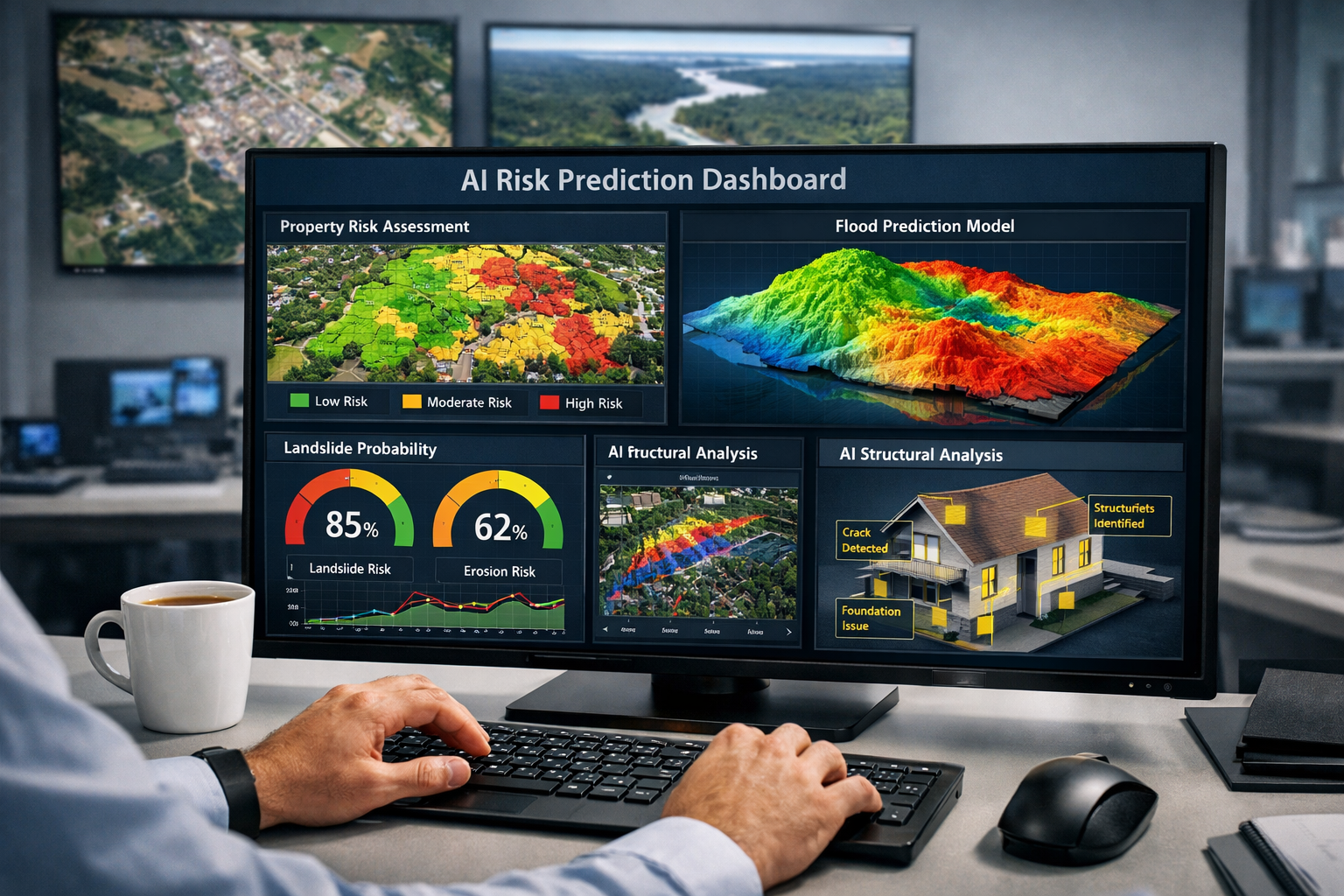
What Makes AI Different in 2026?
The surveying profession entered 2026 amid accelerating digital transformation, driven by industry pressure to deliver faster and more accurate results.[7] Unlike earlier technological advances that simply digitized existing processes, AI and Machine Learning in Property Surveying: Predicting Risks and Automating Workflows in 2026 fundamentally changes how surveyors approach their work.
Machine learning algorithms are now trained to analyze real-world data and identify features and patterns that would be difficult—or impossible—for humans to detect manually.[5] This capability extends far beyond simple data processing. Modern AI systems can:
- 🔍 Analyze historical property data spanning decades to identify emerging risk patterns
- 📊 Process high-resolution drone imagery alongside GPS data and robotic total station datasets
- 🌍 Integrate environmental data from multiple sources to predict natural disaster risks
- ⚡ Automate initial document review and data compilation tasks
- 🎯 Flag compliance issues by cross-referencing local zoning regulations automatically
The Technology Stack Powering Modern Surveying
Specialized CAD, GIS, and mapping software now processes massive amounts of data in the cloud, integrating high-resolution drone images, GPS data, and robotic total station datasets accessible from anywhere.[3] This cloud-based infrastructure enables surveyors to:
| Technology Component | Function | Benefit |
|---|---|---|
| Cloud Computing | Stores and processes large datasets remotely | Access data anywhere, collaborate in real-time |
| Machine Learning Algorithms | Identifies patterns in historical data | Predicts risks with greater accuracy |
| GIS Integration | Maps spatial relationships and environmental factors | Visualizes risk zones and property characteristics |
| Drone Technology | Captures high-resolution aerial imagery | Safer, faster site assessment |
| Robotic Total Stations | Automated precise measurements | Increased accuracy, reduced human error |
When choosing a surveying technology provider, understanding this technology stack helps firms make informed decisions about which capabilities they need most.
How AI Predicts Property Risks: From Floods to Structural Failures
Processing Massive Environmental Datasets
One of the most transformative applications of AI and Machine Learning in Property Surveying: Predicting Risks and Automating Workflows in 2026 is in risk prediction. Machine learning algorithms excel at processing vast amounts of environmental, historical, and structural data to identify risks that traditional methods might miss.
Flood risk prediction serves as an excellent example. AI systems can analyze:
- Historical rainfall patterns over 50+ years
- Topographical data and drainage systems
- Climate change projections and weather trends
- Previous flood events and their severity
- Soil composition and water absorption rates
- Urban development changes affecting water flow
By processing these interconnected datasets simultaneously, AI can generate probability-based flood risk assessments far more sophisticated than traditional methods. The system doesn't just tell you if a property is in a flood zone—it predicts the likelihood of flooding under various scenarios, the potential severity, and how risk levels may change over time.
Landslide and Ground Movement Detection
Similarly, landslide prediction benefits enormously from AI's pattern recognition capabilities. Machine learning algorithms trained on geological data can identify subtle indicators of ground instability:
- Micro-movements detected through satellite imagery over time
- Soil composition analysis combined with rainfall data
- Historical landslide events in similar geological conditions
- Vegetation changes that may indicate ground shifts
- Underground water flow patterns
This predictive capability transforms how surveyors approach property condition assessments, particularly for properties in areas with complex geology or changing environmental conditions.
Structural Defect Pattern Recognition
Beyond environmental risks, AI excels at identifying structural defect patterns that might indicate future problems. When analyzing building surveys, machine learning systems can:
- Compare current structural conditions against thousands of similar properties
- Identify defect progression patterns based on building age and materials
- Predict which minor issues are likely to develop into major problems
- Estimate timelines for necessary repairs based on deterioration rates
- Flag unusual patterns that warrant immediate professional attention
"While technology can assist with initial processing and data organization, the interpretation of findings, assessment of risk, and provision of tailored advice fundamentally require human judgment and years of professional experience."[2]
This quote highlights a crucial point: AI enhances but doesn't replace professional expertise. The technology identifies patterns and probabilities, but qualified surveyors must interpret these findings within the broader context of each unique property.
Real-World Risk Assessment Integration
When conducting a building survey, modern surveyors increasingly rely on AI-assisted risk assessment tools. However, the most effective approach combines technological capabilities with human expertise:
AI Contributions:
- Initial data processing and pattern identification
- Risk probability calculations based on historical data
- Automated flagging of potential issues requiring investigation
- Comparison against similar properties and conditions
Human Surveyor Contributions:
- On-site inspection and physical assessment
- Contextual interpretation of AI findings
- Professional judgment on risk severity and urgency
- Tailored recommendations based on client needs
- Verification of AI-generated insights
This partnership between technology and expertise represents the future of property surveying—not replacement of professionals, but enhancement of their capabilities.
Automating Surveying Workflows: Efficiency Gains and Practical Applications
Administrative Task Automation
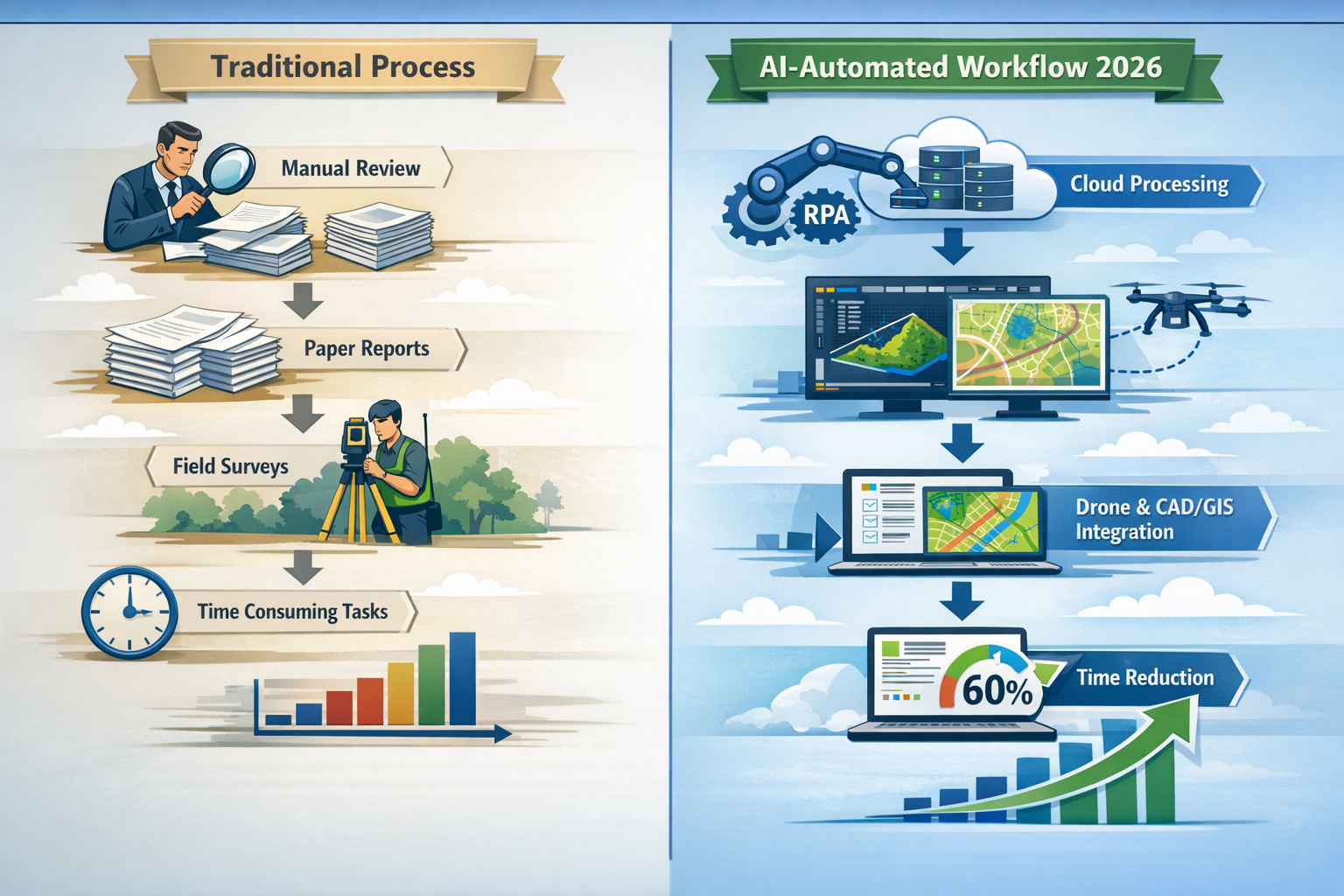
One of the most immediate benefits of AI and Machine Learning in Property Surveying: Predicting Risks and Automating Workflows in 2026 is the dramatic reduction in time spent on administrative tasks. AI reduces time spent on initial document review and data compilation, freeing surveyors for higher-value interpretation work.[2]
Key administrative tasks now automated:
- 📄 Initial document review – AI scans and categorizes property documents, extracting relevant information
- 📋 Data compilation – Automated gathering of property records, planning applications, and historical surveys
- 📝 Report formatting – AI assists with structuring reports according to professional standards
- 🗂️ Information organization – Intelligent filing and retrieval systems for property data
- 📊 Data entry – Automated population of standardized forms and databases
These efficiency gains are substantial. While specific metrics vary by firm size and implementation approach, many surveying practices report 40-60% reduction in time spent on administrative tasks, allowing surveyors to focus on what they do best: professional analysis and client advisory services.
Document Analysis and Lease Reviews
The application of AI to lease document analysis reveals both the promise and limitations of current technology. When tested on lease reviews and license documents, AI-generated summaries appeared concise and well-organized at first glance, but closer examination revealed important provisions were overlooked or inadequately summarized, requiring qualified surveyors for thorough review and proper interpretation.[2]
This finding is critical for firms considering AI adoption. The technology excels at:
✅ Initial document screening – Quickly identifying document types and key sections
✅ Standard clause identification – Recognizing common lease provisions
✅ Data extraction – Pulling specific information like dates, parties, and financial terms
✅ Preliminary summaries – Creating initial overviews for surveyor review
However, AI currently struggles with:
❌ Nuanced interpretation – Understanding complex or unusual provisions
❌ Context-dependent clauses – Recognizing how different provisions interact
❌ Legal implications – Assessing the practical impact of specific terms
❌ Client-specific concerns – Identifying issues relevant to particular client circumstances
For those wondering which home survey is right for you, understanding these AI capabilities helps set realistic expectations about what technology can and cannot provide.
Workflow Optimization in Practice
Related industry benefits in site planning and design demonstrate AI's broader impact—collapsing design timelines from weeks to hours and enabling professionals to increase output from 100 projects annually to 400+ projects using AI-assisted tools.[1]
While these figures come from adjacent real estate disciplines, they illustrate the transformative potential of well-implemented AI systems. For surveying firms, similar workflow optimizations might include:
Before AI Implementation:
- Manual review of property documents: 4-6 hours
- Data compilation from multiple sources: 3-5 hours
- Initial risk assessment research: 2-4 hours
- Report drafting and formatting: 3-4 hours
- Total time per survey: 12-19 hours
After AI Implementation:
- AI-assisted document review: 1-2 hours (surveyor verification)
- Automated data compilation: 30 minutes (surveyor oversight)
- AI-generated risk assessment: 1 hour (surveyor interpretation)
- AI-assisted report generation: 1-2 hours (surveyor refinement)
- Total time per survey: 4-6 hours
This 60-70% time reduction on routine tasks allows surveyors to handle more complex cases, provide deeper analysis, or serve more clients without compromising quality.
Cloud-Based Collaboration and Data Access
The shift to cloud-based surveying platforms represents another crucial workflow automation. Specialized CAD, GIS, and mapping software now processes massive amounts of data in the cloud, integrating high-resolution drone images, GPS data, and robotic total station datasets accessible from anywhere.[3]
This accessibility transforms how surveying teams collaborate:
- Remote site assessment – Review drone footage and data without traveling to site
- Real-time collaboration – Multiple team members access and update survey data simultaneously
- Client transparency – Share progress and findings with clients instantly
- Cross-location coordination – Teams in different locations work on the same project seamlessly
- Historical data integration – Instantly access previous surveys and property records
For firms serving multiple locations, such as those offering property surveying services across London, cloud-based systems eliminate geographical barriers and improve service consistency.
Regulatory Compliance Automation
AI tools can integrate local zoning data and automatically flag potential compliance issues, enabling proactive adherence to regulations from the design phase.[1] For property surveyors, this capability extends to:
- Planning permission requirements – Automated checking against local authority rules
- Building regulation compliance – Flagging potential violations before detailed inspection
- Conservation area restrictions – Identifying special requirements for listed buildings
- Party wall considerations – Highlighting situations requiring party wall agreements
- Environmental regulations – Checking against contaminated land registers and environmental constraints
This proactive compliance checking reduces the risk of missing critical regulatory requirements and helps clients understand potential constraints early in the property acquisition process.
Critical Challenges and Limitations of AI in Property Surveying
Four Key Challenge Areas
Between 2023 and January 2026, the RICS Building Consultancy team tracked four key areas where AI affects surveying: reporting limitations, over-reliance on automation, gaps in human interpretation, and accuracy concerns—with all remaining relevant today.[2]
Understanding these challenges is essential for firms implementing AI and Machine Learning in Property Surveying: Predicting Risks and Automating Workflows in 2026. Let's examine each area in detail:
1. Reporting Limitations 📋
The Challenge: AI-generated reports often lack the nuance, context, and professional judgment that clients expect from qualified surveyors. While AI can produce well-formatted, concise summaries, these reports may:
- Miss subtle but significant issues requiring professional interpretation
- Fail to prioritize findings based on client-specific circumstances
- Overlook the relationship between different defects or conditions
- Provide generic recommendations rather than tailored advice
The Solution: Use AI for report structure and initial drafting, but require thorough surveyor review and enhancement before client delivery. The surveyor adds professional judgment, contextual interpretation, and client-specific recommendations.
2. Over-Reliance on Automation ⚠️
The Challenge: As AI systems become more sophisticated, there's a risk that surveyors—particularly less experienced ones—may rely too heavily on automated outputs without applying critical thinking.
This over-reliance can lead to:
- Acceptance of AI findings without verification
- Reduced on-site investigation thoroughness
- Missed opportunities to identify issues AI wasn't trained to recognize
- Erosion of fundamental surveying skills
The Solution: Implement clear protocols requiring human verification of AI outputs, maintain strong training programs in traditional surveying fundamentals, and treat AI as an assistant rather than a replacement for professional judgment.
3. Gaps in Human Interpretation 🧠
The Challenge: Human judgment remains essential for risk assessment. While technology can assist with initial processing and data organization, the interpretation of findings, assessment of risk, and provision of tailored advice fundamentally require human judgment and years of professional experience.[2]
AI cannot currently:
- Understand the emotional and financial context of client situations
- Apply professional ethics and judgment to complex scenarios
- Recognize when standard approaches don't fit unusual circumstances
- Provide the reassurance and explanation clients need
The Solution: Clearly define which tasks are appropriate for AI automation and which require human expertise. Invest in continuing professional development to ensure surveyors maintain and enhance their interpretive skills.
4. Accuracy Concerns 🎯
The Challenge: AI systems are only as good as the data they're trained on. Accuracy concerns arise from:
- Incomplete or biased training datasets
- Rapidly changing building materials and construction methods
- Regional variations in construction practices
- Unique property characteristics not represented in training data
When tested on lease reviews, AI-generated summaries appeared accurate at first glance, but closer examination revealed important provisions were overlooked or inadequately summarized.[2]
The Solution: Implement rigorous quality control processes, maintain human oversight of all AI outputs, continuously update AI training data with new information, and never rely solely on AI for critical assessments.
Balancing Efficiency with Professional Standards
The tension between efficiency gains and professional standards represents perhaps the most significant challenge facing the surveying profession in 2026. While AI can dramatically reduce time spent on routine tasks, surveyors must ensure this efficiency doesn't come at the cost of quality or thoroughness.
Best practices for maintaining this balance:
- 📌 Establish clear quality benchmarks – Define minimum standards for all surveys regardless of AI involvement
- 📌 Implement multi-stage review processes – Require human verification at critical decision points
- 📌 Maintain professional indemnity insurance – Ensure coverage accounts for AI-assisted work
- 📌 Document AI usage – Keep clear records of which tasks were AI-assisted and which were human-led
- 📌 Client communication – Be transparent about AI usage while emphasizing human expertise
For those considering a homebuyers report or structural survey, understanding how AI is used—and its limitations—helps set appropriate expectations.
Data Privacy and Security Considerations
As surveying firms process increasing amounts of data through cloud-based AI systems, data privacy and security become paramount concerns:
Key considerations:
- 🔒 Client confidentiality – Ensuring property data isn't exposed through AI processing
- 🔒 GDPR compliance – Meeting data protection requirements for personal information
- 🔒 Cybersecurity – Protecting against data breaches and unauthorized access
- 🔒 Data retention – Managing how long AI systems store sensitive information
- 🔒 Third-party processors – Understanding who has access to client data
Firms must implement robust data governance policies that address these concerns while still leveraging AI capabilities.
Practical Adoption Guide for Surveying Firms
Assessing Your Firm's Readiness
Before implementing AI and Machine Learning in Property Surveying: Predicting Risks and Automating Workflows in 2026, firms should conduct a thorough readiness assessment:
Technical Infrastructure:
- Current software and hardware capabilities
- Internet connectivity and bandwidth
- Cloud storage and computing resources
- Data backup and security systems
Staff Capabilities:
- Current technical skill levels
- Willingness to adopt new technologies
- Training needs and learning capacity
- Age and experience distribution of team
Financial Resources:
- Budget for software licenses and subscriptions
- Hardware upgrade requirements
- Training and implementation costs
- Ongoing maintenance and support expenses
Business Objectives:
- Target efficiency improvements
- Service quality goals
- Client satisfaction metrics
- Competitive positioning aims
Phased Implementation Strategy
Rather than attempting wholesale transformation overnight, successful firms adopt a phased approach to AI implementation:
Phase 1: Foundation (Months 1-3)
- Select one or two administrative tasks for initial automation
- Implement basic document management and organization systems
- Train staff on new tools with hands-on support
- Establish baseline metrics for comparison
Phase 2: Expansion (Months 4-6)
- Add AI-assisted data compilation and initial analysis
- Integrate cloud-based collaboration tools
- Develop quality control protocols for AI outputs
- Measure efficiency gains and adjust processes
Phase 3: Advanced Integration (Months 7-12)
- Implement machine learning for risk prediction
- Automate report generation with human oversight
- Integrate multiple data sources and platforms
- Refine workflows based on experience
Phase 4: Optimization (Months 12+)
- Continuously improve AI training data
- Expand to additional surveying services
- Develop proprietary AI capabilities
- Share best practices across organization
Staff Training and Change Management
Successful AI adoption depends heavily on effective staff training and change management. Development firms using AI-powered planning have reported saving over $200,000 in labor hours and $90,000 per year on feasibility studies through rapid vetting of viable projects and quick elimination of unviable deals.[1]
To achieve similar results, firms should:
Training Approaches:
- 👥 Hands-on workshops – Practical sessions with real project data
- 👥 Mentorship programs – Pair tech-savvy staff with those needing support
- 👥 External courses – Professional development in AI and data science
- 👥 Vendor training – Leverage software provider expertise
- 👥 Ongoing support – Establish internal help desk or champion system
Change Management Strategies:
- 💡 Communicate the "why" – Explain benefits for staff, clients, and firm
- 💡 Address concerns openly – Discuss job security and role evolution
- 💡 Celebrate early wins – Highlight successful implementations
- 💡 Involve staff in decisions – Seek input on tool selection and processes
- 💡 Provide adequate time – Don't rush implementation or expect instant mastery
Selecting the Right AI Tools and Partners
The AI technology landscape for property surveying includes numerous options. When selecting tools and partners, consider:
Software Selection Criteria:
| Factor | Questions to Ask |
|---|---|
| Functionality | Does it address your specific needs? Does it integrate with existing systems? |
| Accuracy | What validation has been performed? Can you test with your own data? |
| Usability | Is the interface intuitive? What training is required? |
| Support | What implementation assistance is provided? What ongoing support is available? |
| Cost | What's the total cost of ownership? Are there hidden fees? |
| Scalability | Can it grow with your firm? What are upgrade paths? |
| Security | How is data protected? Is it GDPR compliant? |
| Reputation | What do other surveying firms say? Are there case studies? |
Partnership Considerations:
When working with AI technology providers:
- ✅ Industry experience – Prefer vendors with property surveying expertise
- ✅ Customization options – Ensure tools can adapt to your specific workflows
- ✅ Long-term viability – Choose established providers likely to remain in business
- ✅ Integration support – Verify compatibility with your existing technology stack
- ✅ Data ownership – Clarify who owns data processed through their systems
Building an AI-Enhanced Service Offering
As firms develop AI capabilities, they can create enhanced service offerings that differentiate them from competitors:
Premium Services:
- Predictive risk reports – AI-enhanced analysis of future risks and maintenance needs
- Rapid turnaround surveys – Faster delivery through workflow automation
- Comprehensive data packages – Rich datasets with historical analysis and trends
- Interactive digital reports – 3D visualization and dynamic risk mapping
- Ongoing monitoring services – Subscription-based property condition tracking
Modern AI platforms provide simultaneous 2D and 3D visualization, improving stakeholder understanding and accelerating project approvals.[1] Surveyors can leverage these capabilities to offer more engaging, understandable reports that clients value highly.
For firms offering specialized services like property valuation or lease extension valuation, AI-enhanced analysis can provide more robust, data-driven valuations that stand up to scrutiny.
Measuring ROI and Success Metrics
To justify AI investment and guide ongoing optimization, firms should track clear success metrics:
Efficiency Metrics:
- Time per survey (before and after AI implementation)
- Administrative time as percentage of total time
- Number of surveys completed per surveyor per month
- Report turnaround time from instruction to delivery
Quality Metrics:
- Client satisfaction scores
- Accuracy of risk predictions (validated over time)
- Number of issues missed or misidentified
- Professional indemnity insurance claims
Financial Metrics:
- Revenue per surveyor
- Profit margin per survey type
- Client acquisition cost
- Client retention rate
- Return on AI technology investment
Competitive Metrics:
- Market share in target segments
- Win rate against competitors
- Premium pricing capability
- Brand reputation indicators
AI enables validation of feasibility assessments and pro formas against actual generated layouts before detailed design begins, replacing educated guesses with real data in investment decisions.[1] Similarly, surveying firms can use data analytics to validate their own business decisions and continuously improve their AI implementation.
The Future of AI in Property Surveying Beyond 2026
Emerging Technologies on the Horizon
While AI and Machine Learning in Property Surveying: Predicting Risks and Automating Workflows in 2026 already represents significant advancement, several emerging technologies promise further transformation:
Advanced Sensor Integration:
- IoT sensors for continuous property monitoring
- Thermal imaging combined with AI defect detection
- Moisture sensors with predictive maintenance algorithms
- Structural stress monitoring with real-time alerts
Enhanced Visualization:
- Augmented reality (AR) for on-site defect visualization
- Virtual reality (VR) for remote property inspections
- Digital twins of properties for scenario modeling
- Holographic reporting for client presentations
Predictive Maintenance:
- AI systems that predict specific component failure timelines
- Automated maintenance scheduling recommendations
- Cost-benefit analysis of repair timing options
- Integration with property management systems
Natural Language Processing:
- Voice-activated survey data entry
- Automated client query responses
- Natural language report generation
- Conversational AI for client consultations
Regulatory and Professional Standards Evolution
As AI becomes more prevalent, regulatory frameworks and professional standards will continue evolving:
Expected Developments:
- RICS guidance on appropriate AI use in surveying
- Mandatory disclosure of AI involvement in surveys
- Professional indemnity insurance adjustments for AI-assisted work
- Standardized AI validation and testing requirements
- Ethical guidelines for AI decision-making in surveying
Firms that stay ahead of these regulatory changes—and perhaps help shape them through professional body participation—will be better positioned for long-term success.
Skills Surveyors Will Need
The surveyor of the future will need a hybrid skill set combining traditional expertise with technological literacy:
Essential Skills for 2026 and Beyond:
- 🎓 Traditional surveying fundamentals – Core knowledge remains critical
- 🎓 Data literacy – Understanding statistics, probability, and data quality
- 🎓 Technology proficiency – Comfort with AI tools and digital platforms
- 🎓 Critical thinking – Ability to question and verify AI outputs
- 🎓 Communication skills – Explaining complex AI findings to clients
- 🎓 Ethical judgment – Navigating AI limitations and professional responsibilities
- 🎓 Continuous learning – Staying current with rapid technological change
Educational institutions and professional development programs are already adapting curricula to address these evolving requirements.
Maintaining the Human Element
Despite technological advancement, the human element of property surveying remains irreplaceable. The most successful firms in 2026 and beyond will be those that use AI to enhance—not replace—human expertise.
Preserving Professional Value:
- Client relationships built on trust and communication
- Professional judgment in complex or unusual situations
- Ethical decision-making and client advocacy
- Contextual understanding of local markets and conditions
- Empathy and emotional intelligence in client interactions
When clients search for property surveyors in areas like Wandsworth or Hammersmith, they're not just seeking data—they're seeking professional guidance, reassurance, and expertise. AI enhances the surveyor's ability to provide these services but cannot replace them.
Conclusion: Embracing AI While Maintaining Professional Excellence
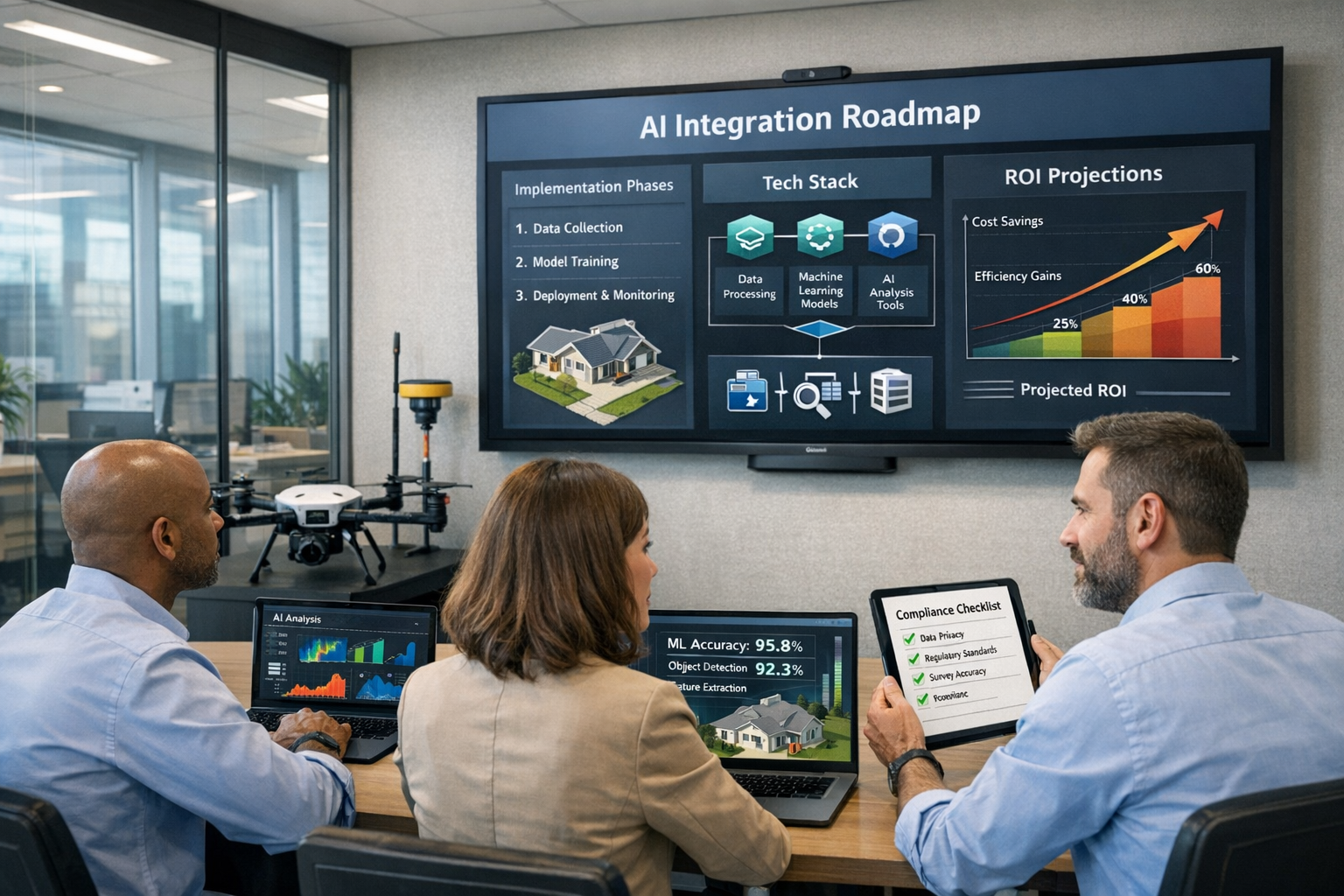
AI and Machine Learning in Property Surveying: Predicting Risks and Automating Workflows in 2026 represents a transformative opportunity for the surveying profession. The technology's ability to process massive datasets, predict risks like floods and landslides, and automate routine workflows offers substantial benefits in efficiency, accuracy, and service quality.
However, successful adoption requires careful navigation of significant challenges—reporting limitations, over-reliance on automation, gaps in human interpretation, and accuracy concerns. The firms that thrive will be those that strategically implement AI while maintaining the professional judgment, ethical standards, and human expertise that define quality surveying.
Actionable Next Steps for Surveying Firms
For firms ready to begin their AI journey:
-
Conduct a comprehensive readiness assessment – Evaluate your technical infrastructure, staff capabilities, financial resources, and business objectives
-
Start small with a pilot project – Choose one or two administrative tasks for initial automation rather than attempting wholesale transformation
-
Invest in staff training and change management – Ensure your team understands both the capabilities and limitations of AI tools
-
Establish clear quality control protocols – Define how AI outputs will be verified and what level of human oversight is required
-
Select technology partners carefully – Prioritize vendors with property surveying expertise and strong support capabilities
-
Measure and optimize continuously – Track efficiency, quality, and financial metrics to guide ongoing improvement
-
Stay informed about regulatory developments – Engage with professional bodies and stay current on evolving standards
For individual surveyors:
-
Develop data literacy skills – Take courses in statistics, data analysis, and AI fundamentals
-
Experiment with available AI tools – Gain hands-on experience with document analysis, data visualization, and automation platforms
-
Maintain traditional expertise – Continue developing core surveying skills that remain essential
-
Network with tech-forward peers – Learn from others who have successfully implemented AI in their practice
-
Communicate value to clients – Explain how AI enhances your service quality and efficiency
The future of property surveying lies not in choosing between human expertise and artificial intelligence, but in strategically combining both to deliver superior client outcomes. As you consider downloading an example of a homebuyers report or exploring why RICS surveyors matter, remember that the best surveys will always combine cutting-edge technology with irreplaceable professional judgment.
The firms and professionals who embrace this balanced approach—leveraging AI's strengths while maintaining human expertise—will define the future of property surveying and deliver the greatest value to their clients in 2026 and beyond.
References
[1] Site Planning – https://www.growthfactor.ai/blog-posts/site-planning
[2] How Ai Is Changing Building Surveying Opportunities And Limitations – https://www.eddisons.com/insights/how-ai-is-changing-building-surveying-opportunities-and-limitations
[3] How Technology Is Revolutionizing Land Surveys – https://www.firstchoicesurveying.com/blog/how-technology-is-revolutionizing-land-surveys
[5] Watch – https://www.youtube.com/watch?v=mDFbLrhWNdI
[7] Doubling Down On Digital – https://amerisurv.com/2026/02/01/doubling-down-on-digital/