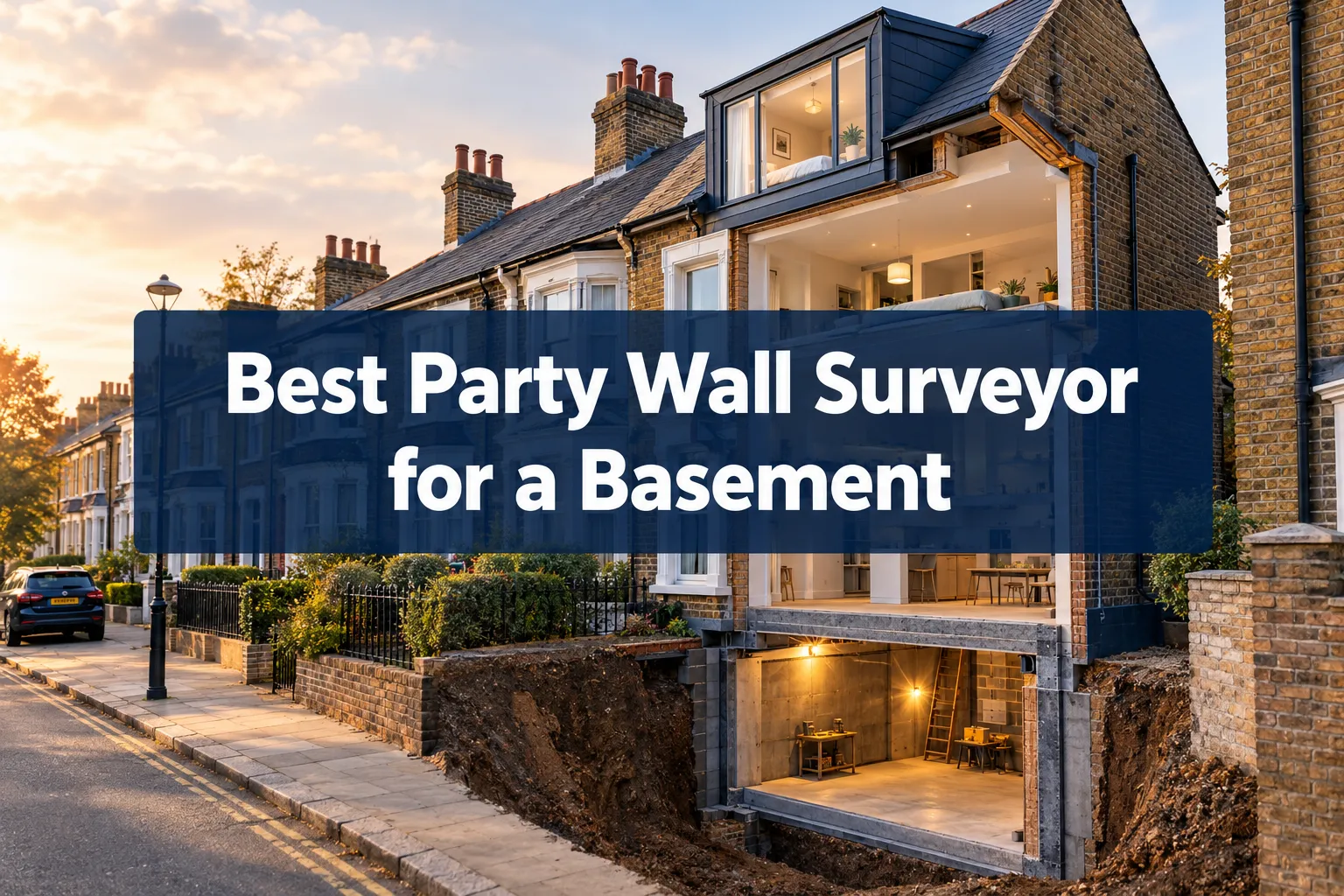
Fewer than one in five homeowners who instruct a party wall surveyor ask to see proof of professional indemnity insurance before signing the engagement letter, yet without it, any claim for damage caused during a basement dig or loft conversion can fall entirely on the building owner. Choosing the best party wall surveyor for a basement or loft conversion is not simply a matter of finding the cheapest quote; it requires structured due diligence across qualifications, specialist experience, fee transparency, documentation practice and communication standards.
This checklist sets out exactly what to examine before you appoint anyone.
Key Takeaways
- Only appoint a surveyor who holds MRICS or FRICS status and, ideally, membership of the Faculty of Party Wall Surveyors (FPWS) or the Pyramus & Thisbe Society.
- Basements trigger Section 6 excavation rules; loft conversions trigger Section 2 structural works, your surveyor must understand which sections apply and how to sequence notices correctly.
- There is no statutory fee scale; written quotations are the only reliable protection against unexpected charges.
- A detailed Schedule of Condition, produced before works start, is the single most important document for protecting both neighbours.
- An agreed surveyor acting for both parties can reduce cost and delay, provided both owners genuinely consent.
Why Basement and Loft Projects Carry Higher Party Wall Risk
Most party wall matters involve straightforward rear extensions. Basements and loft conversions are different. Both involve structural intervention at or close to shared walls, and both carry a higher probability of damage to adjoining properties if the work is poorly managed.
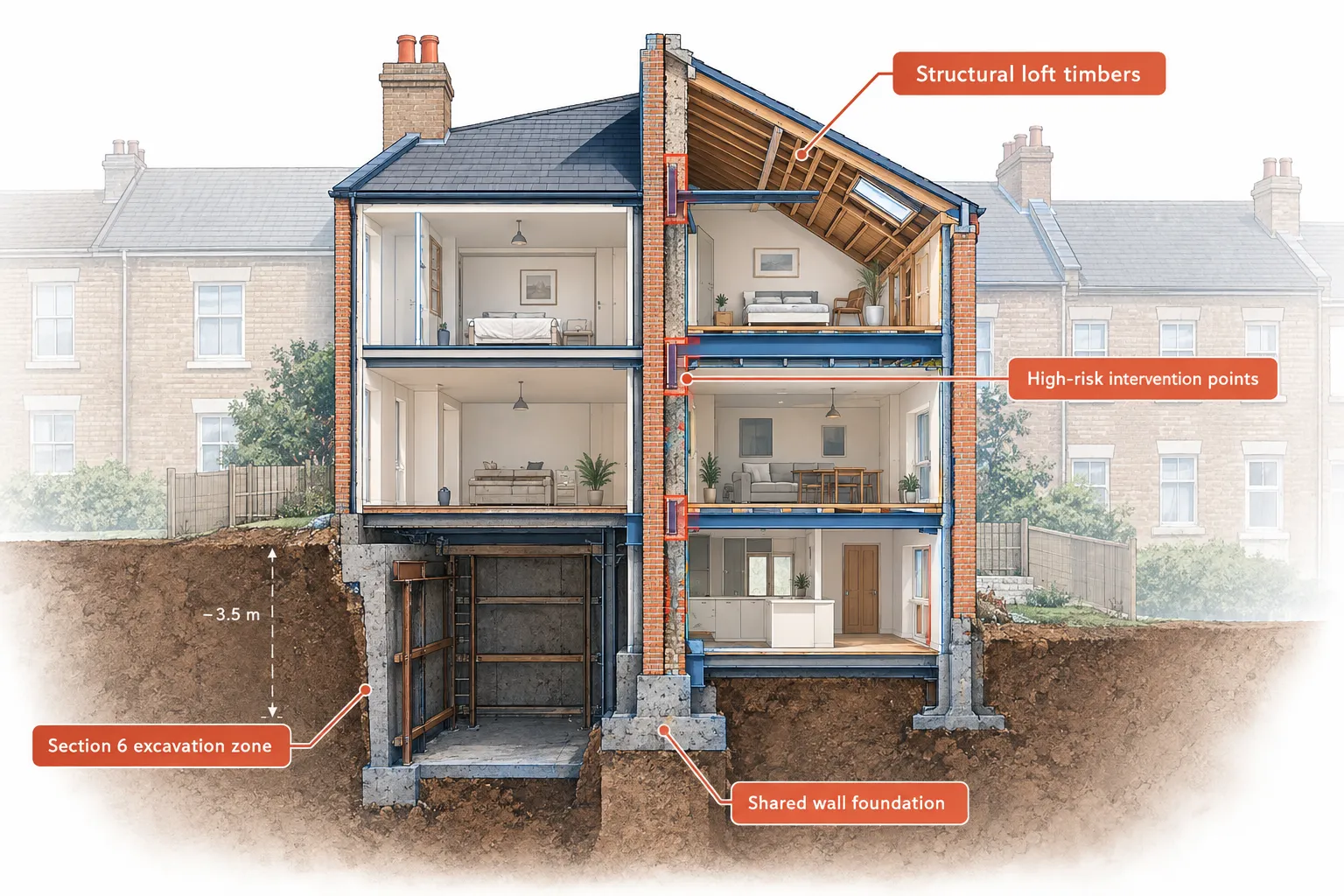
A basement excavation can undermine the foundations of a neighbouring property. Under Section 6 of the Party Wall etc. Act 1996, a building owner must serve notice on any adjoining owner whose property lies within three metres of the proposed excavation if the new foundations will be deeper than the neighbour's existing ones. Where the excavation is deeper still, a six-metre rule may also apply. Getting this wrong, serving the wrong notice, serving it late, or failing to serve it at all, can expose a building owner to injunctions and civil claims [8].
Loft conversions present a different set of risks. Cutting into a party wall to insert steel beams, raising the party wall, removing a shared chimney breast or making structural alterations close to the party structure all require notice under Section 2. A surveyor who has handled only standard extensions may not recognise every trigger point in a loft scheme [3].
For a full explanation of which works require a party wall agreement, see when do you need a party wall agreement.
The Due-Diligence Checklist: Qualifications and Professional Standing
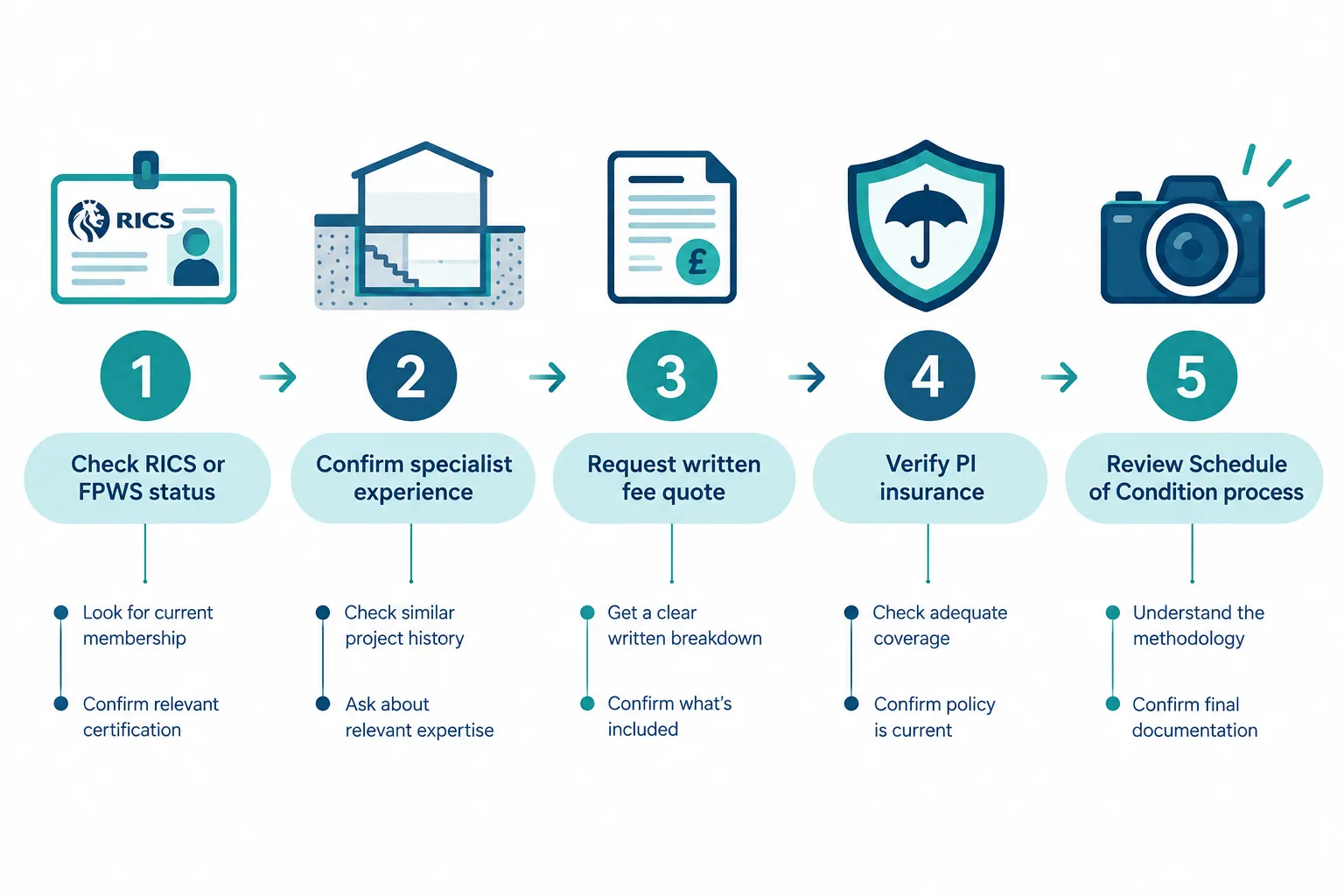
The starting point for finding the best party wall surveyor for a basement or loft conversion is verifying formal qualifications and professional body membership. This is non-negotiable.
RICS chartered status (MRICS or FRICS)
RICS' updated consumer guidance recommends appointing only chartered surveyors for Party Wall Act matters [1]. Chartered status means the individual has passed structured assessments, holds continuing professional development obligations and is subject to RICS disciplinary procedures. You can verify RICS membership at no cost on the RICS website.
Specialist party wall body membership
Chartered status alone does not guarantee party wall expertise. The Faculty of Party Wall Surveyors (FPWS) and the Pyramus & Thisbe Society both require members to demonstrate specialist knowledge of party wall legislation and practice [4]. A surveyor who holds membership of one of these bodies alongside RICS status gives you a stronger baseline assurance of specialist competence.
Impartiality obligations
A party wall surveyor does not act as a traditional client-facing professional. Once appointed under the Act, the surveyor owes duties to both owners, not just the one who instructed them. RICS professional standards make this explicit: surveyors appointed under the Act must act impartially in determining disputes, for the benefit of both owners [2][6]. Ask any prospective surveyor directly how they manage this obligation. A vague answer is a warning sign.
For background on how the Party Wall Act 1996 applies to you, including the distinction between building owner and adjoining owner rights, the linked guide covers the core framework.
Checklist: Qualifications
| Question to ask | What a good answer looks like |
|---|---|
| Are you MRICS or FRICS? | Confirmed, verifiable on RICS website |
| Are you a member of FPWS or Pyramus & Thisbe? | Yes, with membership number |
| Do you specialise primarily in party wall work? | Yes, not a general practice add-on |
| Can you confirm you will act impartially? | Clear explanation of the dual-duty obligation |
Assessing Specific Experience With Basements and Loft Conversions
General party wall experience is not the same as experience with high-risk basement excavations or complex loft structural works. Ask directly, and ask for specifics [4].
For basement projects, ask:
- How many Section 6 excavation notices have you served in the past two years?
- Have you dealt with projects where both the three-metre and six-metre rules applied?
- How do you approach the risk assessment and specification of protective measures in the Award?
- Have you managed access disputes during basement digs?
For loft conversion projects, ask:
- Have you handled loft schemes involving steel beam insertions into party walls?
- How do you coordinate with structural engineers to ensure all notifiable works are captured?
- Have you dealt with raised party walls or chimney breast removals?
A surveyor who can answer these questions with concrete examples, project types, locations, complications encountered, is demonstrably more capable than one who gives a generalised affirmative [4][3].
Schedule of Condition: the non-negotiable document
Before any work begins, a competent surveyor must inspect the adjoining property and produce a detailed Schedule of Condition. This means written descriptions of the existing state of walls, ceilings, floors and any visible structural elements, supported by high-resolution photographs [3]. The Schedule is then incorporated into the Party Wall Award so that any damage alleged after works can be measured against pre-existing conditions. For basement excavations, where ground movement can cause cracking at some distance from the site, this document is the primary evidential protection for both owners.
If a surveyor is vague about the Schedule of Condition process, or suggests it is optional, do not appoint them.
For context on what structural defects can look like and how they are documented, the guide on cracks in walls and when to worry explains the surveyor's perspective on crack assessment.
Fees, Insurance and Process Knowledge
Understanding 2026 Fee Ranges
There is no statutory fee scale for party wall surveyors. Under Section 10(13) of the Party Wall etc. Act 1996, surveyors determine their own costs, and government guidance confirms there are no set charges [10]. This means the market varies considerably.
Typical agreed surveyor fees in London as of 2026 are approximately:
| Project type | Typical agreed surveyor fee (excl. VAT) |
|---|---|
| Loft conversion | £1,100, £1,300 |
| Rear or side extension | £1,300, £1,500 |
| Basement excavation | £1,800, £2,500+ |
Where two surveyors are appointed (one for each owner), each charges separately, and the building owner typically bears both fees. Basement projects at the higher end of complexity can exceed these ranges [10].
Obtain at least two written quotations. Ensure the quotation specifies what is included: notice preparation, Schedule of Condition, Award drafting, any site visits and correspondence. Verbal fee estimates carry no contractual weight. For more detail on the cost landscape, see London party wall surveyor costs.
Professional Indemnity Insurance
Ask every prospective surveyor to confirm they hold professional indemnity (PI) insurance and to state the level of cover. If a surveyor cannot confirm adequate PI cover clearly, treat this as a firm reason not to appoint them [4]. RICS ethics guidance confirms that party wall practitioners must comply with general service regulations, which include maintaining appropriate insurance and clear terms of engagement [9].
Notice Timings and Correct Sections
A competent surveyor will advise you on which sections of the Act apply to your project and how to sequence notices correctly. The key timings are:
- Two months' notice before starting works to a party structure (Section 2) or excavation (Section 6).
- One month's notice before works on the line of junction (Section 1).
- Work cannot begin until either written neighbour consent is received or a Party Wall Award is in place [8].
For basement projects, the surveyor must also advise on whether both the three-metre and six-metre excavation distances apply, and specify the protective measures and access arrangements in the Award [10].
For a detailed explanation of the agreed surveyor route, where one surveyor acts for both parties, see the guide on agreed surveyor party wall appointments. This approach can reduce both cost and delay where neighbours are cooperative.

Communication and Dispute Resolution
Ask prospective surveyors:
- What is your typical response time to emails and calls?
- How do you manage communication between building owner and adjoining owner?
- What is your process if a dispute arises mid-project?
- Are you willing to act as an agreed surveyor if both parties consent?
Slow communication during a live basement excavation can cause real problems. A surveyor who sets out their communication standards clearly at the outset is demonstrating professional discipline [4].
If you have already received a party wall notice and need to understand your position as an adjoining owner, the guide on what to do when you receive a party wall notice sets out the options and timescales.
The Complete Due-Diligence Question Set
Use this question set when interviewing any party wall surveyor for a basement or loft conversion project.
Qualifications and standing
- Are you MRICS or FRICS? Can I verify this?
- Are you a member of FPWS or the Pyramus & Thisbe Society?
- Do you specialise in party wall work, or is it part of a broader general practice?
Project-specific experience
- Have you handled basement excavation projects involving Section 6 notices?
- Have you dealt with loft conversions requiring steel beam insertions or raised party walls?
- Can you describe a recent project similar to mine and how you managed it?
Fees and insurance
- Will you provide a written fee quotation specifying all inclusions?
- Do you hold professional indemnity insurance, and at what level of cover?
- Who bears the cost if two surveyors are appointed?
Process and documentation
- How do you approach the Schedule of Condition for a basement or loft project?
- Which sections of the Act apply to my project, and how will you sequence the notices?
- What is your typical timeline from instruction to Award?
Communication and dispute resolution
- What is your standard response time?
- Are you willing to act as an agreed surveyor if both owners consent?
- How do you handle disputes that arise during the works?
FAQ
Do I need a party wall surveyor for a loft conversion?
Not in every case. If your loft conversion involves no structural work to a shared wall, for example, a simple roof light installation on a detached property, the Act may not be triggered. However, most loft conversions on semi-detached or terraced properties involve work that does engage the Act, and a surveyor should assess this before you proceed [3][8].
Can the same surveyor act for both me and my neighbour?
Yes, provided both parties give written consent. This is the agreed surveyor route and can reduce cost and delay significantly. The agreed surveyor must still act impartially [2][6].
Who pays the party wall surveyor's fees?
In most cases the building owner (the person carrying out the works) pays. Where two surveyors are appointed, the building owner typically bears both fees. The surveyors determine the costs under Section 10(13) of the Act [10].
What happens if my neighbour refuses to engage?
If an adjoining owner fails to respond to a party wall notice within 14 days, a dispute is deemed to have arisen and the surveyor appointment process is triggered automatically. Work cannot lawfully begin until an Award is in place [8].
Is a Party Wall Award legally binding?
Yes. A Party Wall Award is a legally binding document. Either party can appeal it to the County Court within 14 days of service, but the Award stands unless successfully challenged [1][8].
How long does the party wall process take for a basement?
Allow a minimum of two to three months from serving notice to having an Award in place for a straightforward basement project. Complex schemes with multiple adjoining owners or disputed matters can take longer.
Conclusion
Selecting the best party wall surveyor for a basement or loft conversion requires more than a quick search and the first available quote. The structured checklist above, covering RICS and specialist body membership, project-specific experience, impartiality obligations, Schedule of Condition practice, written fee agreements, PI insurance and communication standards, gives you a reliable framework for comparing candidates.
Start by verifying RICS chartered status on the RICS website. Then confirm specialist party wall body membership. Ask the project-specific questions about Section 6 excavation experience or loft structural works, depending on your project type. Request written fee quotations from at least two surveyors. Confirm PI insurance in writing before you sign any engagement letter.
A well-chosen surveyor will serve the correct notices, produce a robust Schedule of Condition, draft a clear and enforceable Award, and manage neighbour relations professionally throughout. That combination is what protects both you and your neighbour, and keeps your project on programme.
References
[1] Party Walls – rics.org
[2] Party Wall Legislation And Procedure – rics.org
[3] Party Wall Surveyor – surveymerchant.com
[4] Tips For Choosing The Best Party Wall Surveyor – fpws.uk
[5] Party Walls – ricsfirms.com
[6] Party Wall Surveyors Impartiality – ww3.rics.org
[8] Rics Consumer Guide Party Walls – mayfordssurveying.co.uk
[9] Ethics And Party Wall Practice – ww3.rics.org
[10] Party Wall Notices And Agreements Costs And Process – beamsrenovation.com