

Level 2 v Level 3 Survey: The Complete Property Buyer’s Guide for 2026
When purchasing a property, choosing between a Level 2 v Level 3 survey can mean the difference between a sound investment and a costly mistake. This decision impacts not only your immediate purchase but potentially saves thousands in unexpected repairs and provides crucial negotiating power. Understanding which RICS home survey suits your property can protect your financial future and ensure you’re making an informed decision in today’s competitive property market.
Key Takeaways
- Level 2 surveys (RICS HomeBuyer Reports) suit conventional properties built post-1900 in reasonable condition, costing £400-£600 on average
- Level 3 surveys (Building Surveys) provide comprehensive structural analysis for older, altered, or unusual properties, typically costing £600-£1,200
- Survey choice significantly impacts your ability to negotiate property prices and identify hidden defects
- Property age, condition, and construction type are the primary factors determining which survey level you need
- Investment in the right survey type can save £10,000-£50,000+ in unforeseen repair costs
Understanding RICS Survey Standards and Classifications
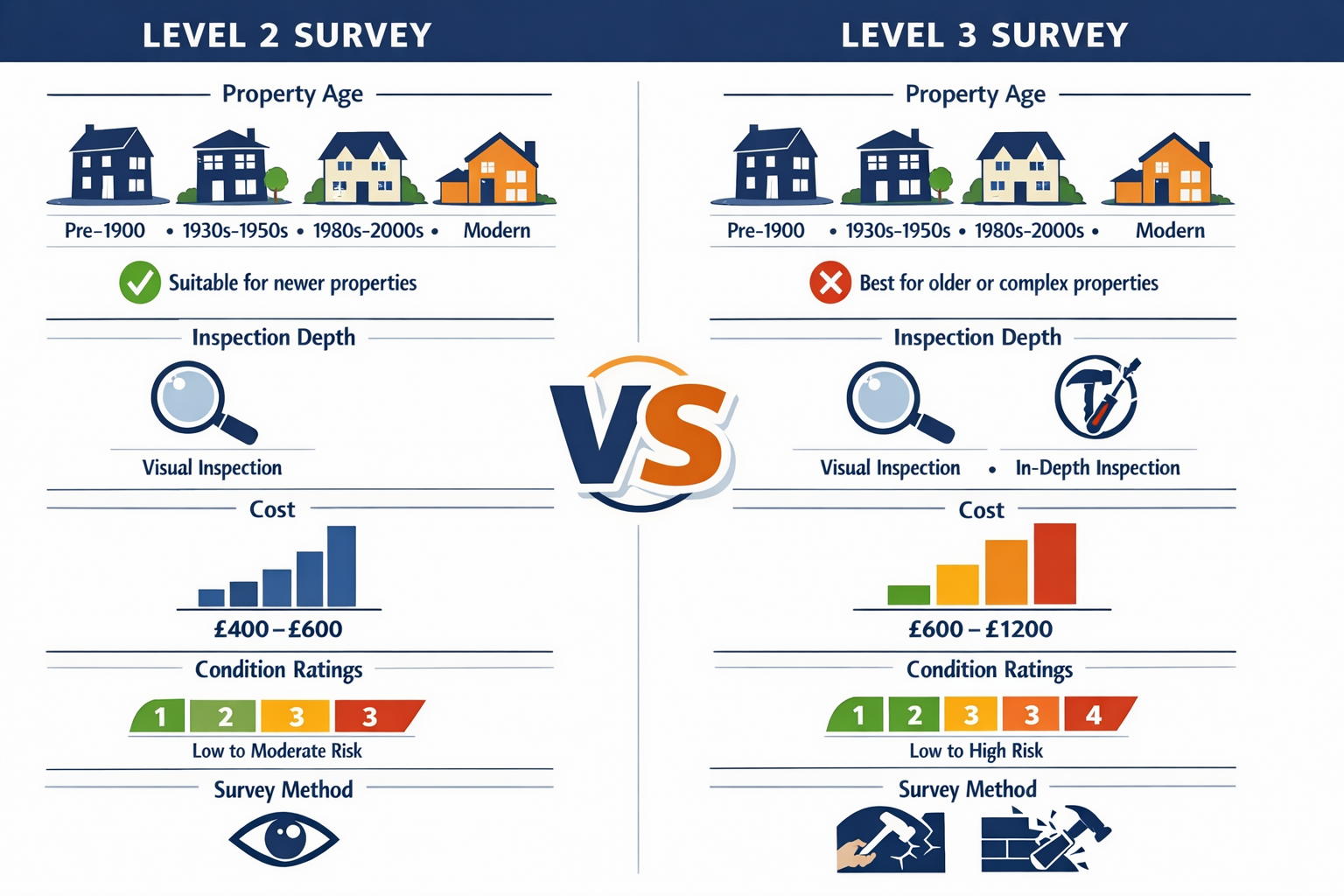
The Royal Institution of Chartered Surveyors (RICS) establishes the gold standard for property inspection in the UK. In 2026, RICS maintains three distinct survey levels, each designed for specific property types and buyer needs. These standardized surveys ensure consistency, professionalism, and comprehensive property assessment across the industry.
RICS Survey Levels Overview:
| Survey Type | Alternative Name | Ideal For | Average Cost |
|---|---|---|---|
| Level 1 | Condition Report | New-build/modern properties | £250-£400 |
| Level 2 | HomeBuyer Report | Standard properties in good condition | £400-£600 |
| Level 3 | Building Survey | Older/unusual/poor condition properties | £600-£1,200 |
The Level 2 v Level 3 survey decision represents the most common dilemma for property buyers, as these two options cover the vast majority of residential purchases. Understanding the nuances between these survey types ensures you receive appropriate property assessment without overpaying for unnecessary detail or risking inadequate inspection depth.
What Is a Level 2 Survey? (RICS HomeBuyer Report)
A Level 2 survey, officially known as the RICS HomeBuyer Report, provides a comprehensive overview of a property’s condition using a traffic light rating system. This intermediate survey option balances thoroughness with cost-effectiveness, making it the most popular choice among UK property buyers in 2026.
Level 2 Survey Inspection Methodology
The Level 2 property inspection focuses on visible and accessible elements of the building. Chartered surveyors conducting this assessment examine:
✅ Structural elements – walls, roofs, foundations (externally visible portions)
✅ Damp and moisture issues – using moisture meters and visual inspection
✅ Woodwork and joinery – windows, doors, staircases, visible timber
✅ Insulation and energy efficiency – loft insulation, glazing standards
✅ Drainage and guttering – external drainage systems, downpipes
✅ Services overview – basic assessment of heating, plumbing, electrics
The surveyor will not move furniture, lift carpets, or conduct invasive testing. This non-intrusive approach keeps costs manageable while still identifying significant property defects that could affect your purchase decision.
Traffic Light Rating System Explained
Level 2 surveys utilize an intuitive three-tier condition rating:
🟢 Condition 1 (Green) – No repair currently needed, normal maintenance required
🟡 Condition 2 (Amber) – Defects requiring future repair or replacement
🔴 Condition 3 (Red) – Urgent defects requiring immediate attention or investigation
This visual system allows buyers to quickly identify problem areas and prioritize concerns. Properties with multiple Condition 3 ratings often provide strong grounds for renegotiating the purchase price.
When to Choose a Level 2 Survey
A Level 2 survey proves ideal for:
- Conventional properties built after 1900 using standard construction methods
- Properties in reasonable condition without obvious structural concerns
- Standard construction types – brick, block, timber frame
- Unaltered properties maintaining original layout and structure
- Properties under 100 years old in good maintenance condition
According to chartered surveyors, approximately 65% of property purchases in London and the Southeast utilize Level 2 surveys, reflecting their suitability for the majority of residential transactions.
Level 2 Survey Costs in 2026
Property survey costs vary based on property value, location, and surveyor expertise:
Typical Level 2 Survey Pricing:
- Properties under £250,000: £400-£500
- Properties £250,000-£500,000: £500-£650
- Properties £500,000-£1,000,000: £650-£850
- Properties over £1,000,000: £850-£1,200
Regional variations exist, with London and Southeast England commanding premium rates due to higher property values and living costs. Many buyers find that understanding common myths about property surveys helps them appreciate the value these inspections provide.
What Is a Level 3 Survey? (Building Survey)
The Level 3 survey, traditionally called a Building Survey or Full Structural Survey, represents the most comprehensive property inspection available. This detailed assessment provides in-depth analysis of a property’s construction, condition, and potential defects, making it essential for older, unusual, or problematic buildings.
Level 3 Survey Inspection Depth
Unlike the Level 2 survey’s visual assessment, the Level 3 building survey involves:
🔍 Comprehensive structural analysis – detailed examination of all accessible areas
🔍 Invasive testing where necessary – opening up concealed spaces with permission
🔍 Detailed defect diagnosis – identifying causes, not just symptoms
🔍 Extensive photography – comprehensive visual documentation
🔍 Detailed written report – typically 30-50+ pages of analysis
🔍 Repair cost estimates – guidance on remediation expenses
🔍 Maintenance advice – long-term property care recommendations
Chartered surveyors conducting Level 3 surveys spend significantly more time on-site (typically 4-8 hours versus 2-4 hours for Level 2), examining roof spaces, under-floor areas, and conducting thorough structural evaluation.
Level 3 Survey Report Contents
A comprehensive Building Survey report includes:
1. Executive Summary – key findings and urgent concerns
2. Property Description – construction type, age, materials, alterations
3. Detailed Room-by-Room Analysis – condition assessment of every space
4. Structural Assessment – foundations, walls, roof structure, floors
5. Services Evaluation – heating, plumbing, electrical, drainage
6. Grounds and Boundaries – external spaces, outbuildings, boundary disputes
7. Defects Analysis – detailed explanation of problems discovered
8. Recommendations – prioritized repair schedule and cost guidance
This comprehensive documentation proves invaluable for renovation planning, budget forecasting, and understanding long-term property investment implications.
When to Choose a Level 3 Survey
A Level 3 survey becomes essential for:
- Pre-1900 properties – Victorian, Georgian, Edwardian buildings
- Listed buildings – properties with heritage protection
- Significantly altered properties – major extensions or conversions
- Unusual construction – timber frame, thatched roofs, non-standard materials
- Properties in poor condition – visible structural concerns or neglect
- Properties requiring renovation – planning major refurbishment projects
- Commercial to residential conversions – barn conversions, warehouse apartments
When buying property in areas like Wimbledon, where many period properties exist, Level 3 surveys frequently prove necessary to properly assess structural integrity and identify issues like subsidence or Japanese knotweed.
Level 3 Survey Costs in 2026
Building Survey costs reflect the extensive time and expertise required:
Typical Level 3 Survey Pricing:
- Properties under £250,000: £600-£800
- Properties £250,000-£500,000: £750-£1,000
- Properties £500,000-£1,000,000: £1,000-£1,500
- Properties over £1,000,000: £1,500-£3,000+
Additional specialist surveys may be recommended following a Level 3 survey, including damp surveys, timber reports, or structural engineering assessments, which incur separate fees.
Level 2 v Level 3 Survey: Direct Comparison
Understanding the practical differences between Level 2 v Level 3 surveys helps buyers make informed decisions aligned with their property type and risk tolerance.
Inspection Scope Comparison
| Aspect | Level 2 Survey | Level 3 Survey |
|---|---|---|
| Inspection Type | Visual, non-invasive | Comprehensive, may include invasive testing |
| Time On-Site | 2-4 hours | 4-8 hours |
| Report Length | 15-25 pages | 30-50+ pages |
| Roof Inspection | Ground/ladder level only | Full roof space examination |
| Floor Inspection | Visible surfaces only | Under-floor areas where accessible |
| Defect Detail | Condition ratings | Detailed diagnosis and causation |
| Repair Costs | General guidance | Specific estimates |
| Suitability Assessment | Not included | Detailed fitness-for-purpose analysis |
Property Age Decision Matrix
Property Built 1980-Present:
- ✅ Level 2 sufficient for standard construction
- ⚠️ Level 3 if significant alterations or concerns exist
Property Built 1900-1980:
- ✅ Level 2 for well-maintained properties
- ⚠️ Level 3 for properties showing wear or unusual features
Property Built Pre-1900:
- ❌ Level 2 generally inadequate
- ✅ Level 3 strongly recommended
Listed or Heritage Properties:
- ❌ Level 2 inappropriate
- ✅ Level 3 essential
Cost-Benefit Analysis
While Level 3 surveys cost 50-100% more than Level 2 surveys, the investment proves worthwhile when considering potential savings:
Level 2 Survey Investment:
- Average cost: £550
- Identifies: Major visible defects
- Potential savings: £5,000-£15,000 in price negotiations
- Best for: Standard properties in good condition
Level 3 Survey Investment:
- Average cost: £1,000
- Identifies: Comprehensive structural issues, hidden defects
- Potential savings: £15,000-£50,000+ in avoided repairs/negotiations
- Best for: Older, unusual, or concerning properties
Real-world data from 2026 shows that buyers who commissioned appropriate surveys saved an average of 3.2% on purchase prices through informed negotiations, while those who under-surveyed faced average unexpected repair costs of £12,400 within the first two years of ownership.
Making Your Level 2 v Level 3 Survey Decision
Selecting the appropriate survey level requires careful consideration of multiple factors beyond just property age.
Decision Framework: 5 Critical Questions
1. What is the property’s age and construction type?
Properties built pre-1900 or using non-standard construction almost always require Level 3 surveys. Modern properties (post-1980) in good condition typically suit Level 2 assessments.
2. What is the property’s apparent condition?
Visible signs of neglect, structural movement, damp, or poor maintenance indicate Level 3 survey necessity. Well-maintained properties with no obvious concerns suit Level 2 surveys.
3. Has the property been significantly altered?
Major extensions, loft conversions, structural changes, or layout modifications necessitate Level 3 surveys to assess alteration quality and building regulation compliance.
4. What are your renovation plans?
If planning significant refurbishment, a Level 3 survey provides essential information for project planning and cost estimation. For properties requiring no work, Level 2 surveys suffice.
5. What is your risk tolerance?
Risk-averse buyers or those purchasing at maximum budget should favor Level 3 surveys for comprehensive peace of mind. Buyers with financial buffers may accept Level 2 survey limitations.
Expert Surveyor Recommendations
Professional chartered surveyors consistently recommend:
“When in doubt, upgrade to a Level 3 survey. The additional cost is minimal compared to the potential financial exposure from undiscovered defects. We regularly see buyers who economized on surveys facing five-figure repair bills within months of purchase.”
First-time buyers particularly benefit from comprehensive surveys, as they often lack experience identifying property defects and understanding maintenance requirements.
Regional Considerations in 2026
Property survey requirements vary by region:
London and Southeast England:
- Higher proportion of period properties requires Level 3 surveys
- Property values justify comprehensive assessment
- Complex building histories common in urban areas
Northern England and Scotland:
- Different construction methods (stone, sandstone) require specialist knowledge
- Climate-related issues (exposure, moisture) demand thorough assessment
- Lower property values make survey cost-benefit analysis crucial
Coastal Regions:
- Salt exposure and weather damage necessitate detailed inspection
- Flood risk assessment increasingly important
- Building deterioration often accelerated
Property Condition Assessment and Survey Findings
Understanding what surveys reveal helps buyers interpret reports and make informed decisions.
Common Level 2 Survey Findings
Typical issues identified in HomeBuyer Reports include:
Condition 2 (Amber) Findings:
- Aging boiler requiring replacement within 5 years (£2,000-£3,500)
- Roof covering nearing end of serviceable life (£8,000-£15,000)
- Dated electrical installation requiring upgrade (£3,000-£6,000)
- Deteriorating window frames needing replacement (£5,000-£12,000)
- Poor loft insulation affecting energy efficiency (£500-£1,500)
Condition 3 (Red) Findings:
- Active damp penetration requiring immediate investigation (£1,500-£8,000+)
- Structural movement requiring monitoring or repair (£5,000-£25,000+)
- Defective drainage causing property damage (£2,000-£10,000)
- Unsafe electrical installation requiring urgent attention (£3,000-£8,000)
- Roof leaks causing internal damage (£3,000-£12,000)
Common Level 3 Survey Findings
Building Surveys typically uncover more extensive issues:
Structural Concerns:
- Foundation movement or settlement (£10,000-£50,000+)
- Timber decay in structural elements (£5,000-£30,000)
- Roof structure deterioration (£15,000-£40,000)
- Wall tie failure in cavity walls (£3,000-£15,000)
Hidden Defects:
- Concealed damp affecting internal structures (£8,000-£25,000)
- Inadequate structural alterations (£10,000-£40,000 to rectify)
- Asbestos-containing materials requiring removal (£2,000-£15,000)
- Defective drainage systems (£5,000-£20,000)
Building Regulation Non-Compliance:
- Unauthorized alterations requiring retrospective approval
- Substandard electrical or plumbing installations
- Inadequate fire safety measures in conversions
- Structural modifications requiring engineering assessment
Financial Implications and Price Negotiations
Survey findings directly impact property transactions and buyer finances.
Using Survey Results for Negotiations
Professional property buyers leverage survey findings to:
1. Request Price Reductions
Average price reductions following surveys range from 2-8% depending on defect severity. Properties with multiple Condition 3 ratings frequently achieve 5%+ reductions.
2. Require Seller Remediation
Buyers may request sellers address urgent defects before completion, particularly for safety-critical issues like electrical faults or structural concerns.
3. Renegotiate Terms
Extended completion dates allowing repair work or retention of funds pending remediation provide alternative negotiation strategies.
4. Withdraw from Purchase
Severe structural issues or unexpectedly high repair costs justify withdrawal, protecting buyers from poor investments.
Long-Term Financial Planning
Survey findings inform long-term property ownership costs:
Immediate Costs (Years 1-2):
- Urgent repairs identified in survey
- Safety-critical remediation
- Building regulation compliance work
Medium-Term Costs (Years 3-10):
- Planned replacements (boiler, windows, roof)
- Preventative maintenance
- Energy efficiency improvements
Long-Term Costs (Years 10+):
- Major structural maintenance
- Complete system replacements
- Periodic redecoration and refurbishment
Buyers who factor survey findings into financial planning avoid the shock of unexpected expenses and can budget appropriately for property ownership.
Technology and Innovation in Property Surveys 2026
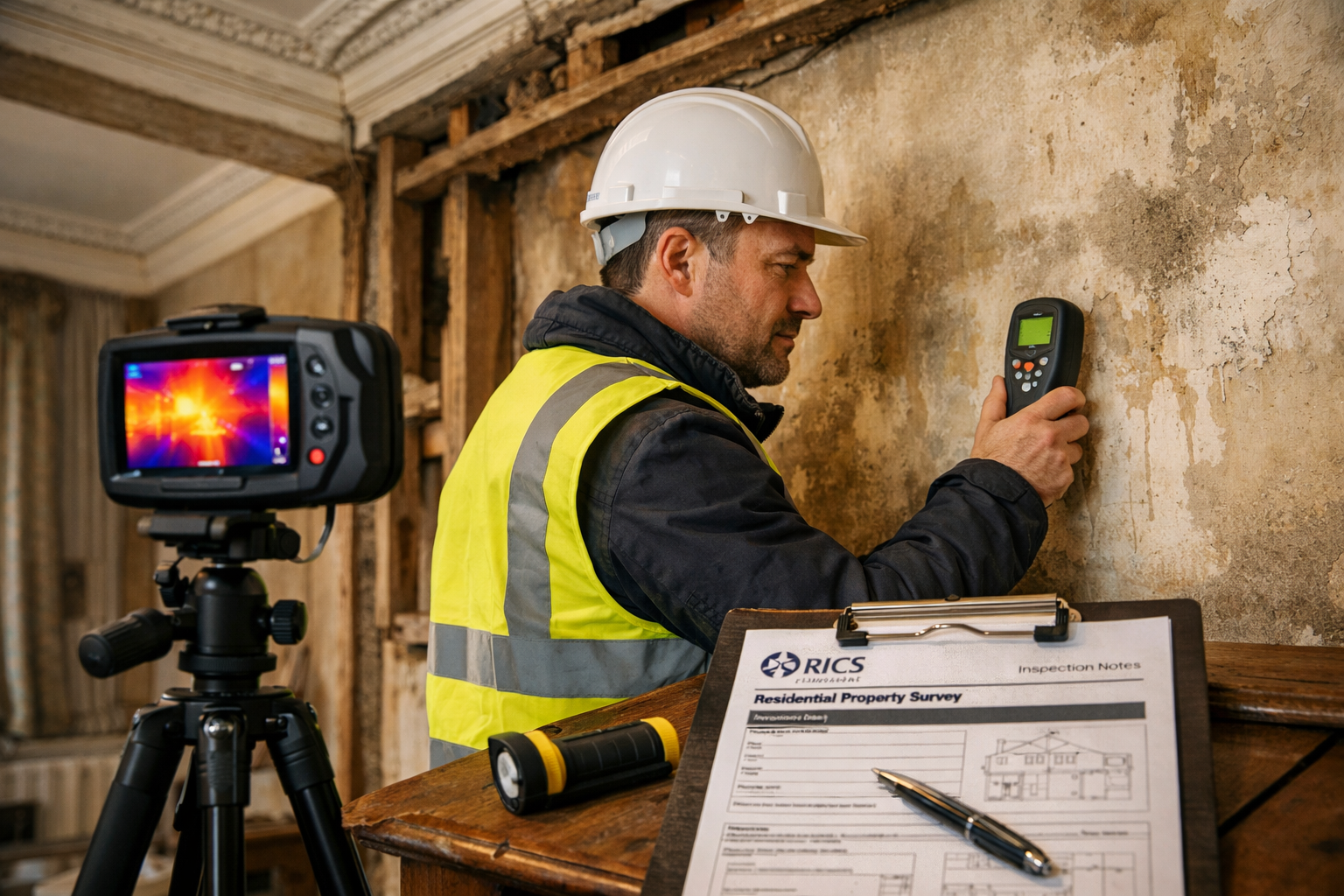
Modern property surveys increasingly incorporate advanced technology:
Thermal Imaging Surveys
Infrared cameras detect:
- Heat loss and insulation deficiencies
- Hidden moisture and damp penetration
- Underfloor heating defects
- Electrical hotspots indicating faults
Drone Roof Inspections
Unmanned aerial vehicles enable:
- Safe inspection of difficult-to-access roofs
- Detailed photographic evidence of roof condition
- Chimney stack examination without scaffolding
- Comprehensive external elevation documentation
Moisture Mapping Technology
Advanced moisture meters provide:
- Precise moisture content readings
- Depth of moisture penetration
- Moisture source identification
- Historical moisture pattern analysis
Digital Reporting Platforms
Modern survey reports feature:
- Interactive digital formats with hyperlinked sections
- Embedded photographs and videos
- Clickable floor plans highlighting defect locations
- Priority matrices for repair scheduling
These technological advances enhance survey accuracy and provide buyers with clearer, more comprehensive property information than ever before.
Specialist Surveys and Additional Investigations
Both Level 2 and Level 3 surveys may recommend specialist investigations:
When Additional Surveys Are Needed
Damp and Timber Surveys:
Required when moisture issues or timber decay detected. Damp survey reports provide detailed analysis and remediation specifications.
Structural Engineering Reports:
Necessary for significant structural movement, subsidence, or major alterations requiring technical assessment.
Electrical Installation Condition Reports (EICR):
Recommended for properties with aging electrical systems or when last inspection date unknown.
Drainage Surveys (CCTV):
Required when drainage defects suspected or for older properties with original drainage systems.
Asbestos Surveys:
Essential for pre-2000 properties, particularly those requiring renovation work.
Environmental Surveys:
Assess contamination risks, flood vulnerability, or ground stability concerns.
Budgeting for Comprehensive Assessment
Buyers should budget for potential additional surveys:
| Survey Type | Typical Cost | When Required |
|---|---|---|
| Damp & Timber | £300-£600 | Moisture issues detected |
| Structural Engineer | £500-£1,500 | Structural movement/concerns |
| EICR | £200-£400 | Electrical safety assessment |
| Drainage CCTV | £250-£500 | Drainage defects suspected |
| Asbestos Survey | £300-£600 | Pre-2000 properties |
Choosing the Right Surveyor
Surveyor selection significantly impacts survey quality and value.
Essential Surveyor Qualifications
Look for:
✅ RICS Membership – AssocRICS, MRICS, or FRICS designation
✅ Relevant Experience – local market knowledge and property type expertise
✅ Professional Indemnity Insurance – minimum £1,000,000 coverage
✅ Positive Reviews – verified client testimonials and recommendations
✅ Clear Communication – accessible for questions and clarifications
Questions to Ask Potential Surveyors
Before commissioning a survey, ask:
- How many years of experience do you have with this property type?
- Will you personally conduct the inspection or delegate to an assistant?
- What is your typical turnaround time for report delivery?
- Are you available for post-survey queries and clarification?
- Do you provide a sample report for review?
- What is included in your fee, and are there any additional charges?
- Do you have experience with [specific concerns like subsidence or period properties]?
Local Expertise Matters
Choosing a local surveyor provides advantages:
- Familiarity with regional construction methods
- Knowledge of area-specific issues (ground conditions, flooding, etc.)
- Understanding of local property market dynamics
- Established relationships with specialist contractors
- Accessibility for site visits and follow-up questions
Common Survey Mistakes to Avoid
Understanding frequent errors helps buyers maximize survey value.
Mistake #1: Choosing Survey Type Based on Cost Alone
The cheapest survey option often proves most expensive long-term. Selecting inadequate survey levels leads to undiscovered defects and financial exposure far exceeding survey cost savings.
Mistake #2: Not Reading the Full Report
Many buyers only skim survey summaries, missing crucial detail in comprehensive sections. Thorough report review ensures complete understanding of property condition.
Mistake #3: Ignoring Amber (Condition 2) Ratings
While not urgent, Condition 2 defects require future attention and cost money. Buyers must factor these into long-term budgets and purchase negotiations.
Mistake #4: Failing to Follow Up on Recommendations
Surveys often recommend specialist investigations. Ignoring these recommendations creates knowledge gaps and potential future problems.
Mistake #5: Not Using Survey Findings in Negotiations
Survey results provide powerful negotiating leverage. Failing to renegotiate based on findings means overpaying for defective properties.
Conclusion: Making the Right Level 2 v Level 3 Survey Choice
The Level 2 v Level 3 survey decision fundamentally impacts your property purchase success, financial security, and long-term ownership satisfaction. While Level 2 surveys suit conventional properties in good condition, Level 3 surveys provide essential protection for older, unusual, or concerning buildings.
Key Decision Principles:
🏠 Property age matters – Pre-1900 properties almost always require Level 3 surveys
💰 Survey costs are investments – Comprehensive surveys save multiples of their cost through defect identification and negotiation leverage
🔍 When uncertain, upgrade – The incremental cost of Level 3 surveys provides disproportionate value and peace of mind
📊 Use findings strategically – Survey results enable informed negotiations and long-term financial planning
👨💼 Surveyor expertise counts – RICS-qualified, experienced professionals deliver superior value
Your Next Steps
- Assess your property using the decision framework in this guide
- Get quotes from qualified surveyors with relevant experience
- Review sample reports to understand what each survey level provides
- Commission the appropriate survey before exchange of contracts
- Read the complete report thoroughly and seek clarification on unclear points
- Use findings strategically in purchase negotiations
- Plan financially for identified repairs and maintenance requirements
The right survey choice protects your largest financial investment, provides negotiating power, and ensures you understand exactly what you’re buying. Whether you select a Level 2 or Level 3 survey, professional property assessment remains the most valuable investment in your home-buying journey.
For expert guidance on your specific property, contact experienced chartered surveyors who can recommend the optimal survey level and provide comprehensive property assessment tailored to your needs.
References
[1] Royal Institution of Chartered Surveyors (RICS). (2026). “RICS Home Survey Standards.” Professional Standards Documentation.
[2] UK Property Survey Association. (2026). “Annual Survey Cost Analysis Report.” Industry Statistics Publication.
[3] HomeOwners Alliance. (2026). “Property Survey Impact Study: Price Negotiations and Defect Discovery.” Research Report.
[4] Building Research Establishment (BRE). (2025). “Common Property Defects in UK Housing Stock.” Technical Analysis.
[5] Chartered Institute of Building (CIOB). (2026). “Building Pathology and Survey Methodology.” Professional Guidance.