

Party Wall Agreed Surveyor: The Complete Guide to Shared Appointments in 2025
When construction work affects a shared wall between properties, the last thing anyone wants is costly disputes, delayed projects, or damaged neighborly relationships. Yet thousands of property owners across the UK face exactly this scenario every year. Enter the party wall agreed surveyor—a cost-effective, collaborative solution that can transform potentially contentious building work into a smooth, professionally managed process.
A party wall agreed surveyor is a single, impartial professional jointly appointed by both property owners to oversee party wall matters, rather than each owner hiring separate surveyors. This approach not only reduces costs significantly but also streamlines communication and expedites the entire party wall process. Understanding how this appointment works, when it’s appropriate, and how to implement it correctly can save property owners thousands of pounds while ensuring full legal compliance under the Party Wall etc. Act 1996.
Key Takeaways
- 🤝 A party wall agreed surveyor is a single professional jointly appointed by both neighbors to handle all party wall matters impartially, reducing costs by up to 60% compared to appointing separate surveyors
- 📋 Both property owners must consent in writing to the agreed surveyor appointment, and either party retains the right to appoint their own surveyor at any time
- 💰 Typical fees for an agreed surveyor range from £700-£1,200 for straightforward cases, compared to £2,000-£3,500 when three separate surveyors are involved
- ⚖️ The agreed surveyor must remain completely impartial and owes equal duties to both property owners, acting in accordance with RICS professional standards
- 📝 The appointment is most suitable for amicable neighbor relationships where both parties trust the process and no significant disputes exist
What Is a Party Wall Agreed Surveyor?
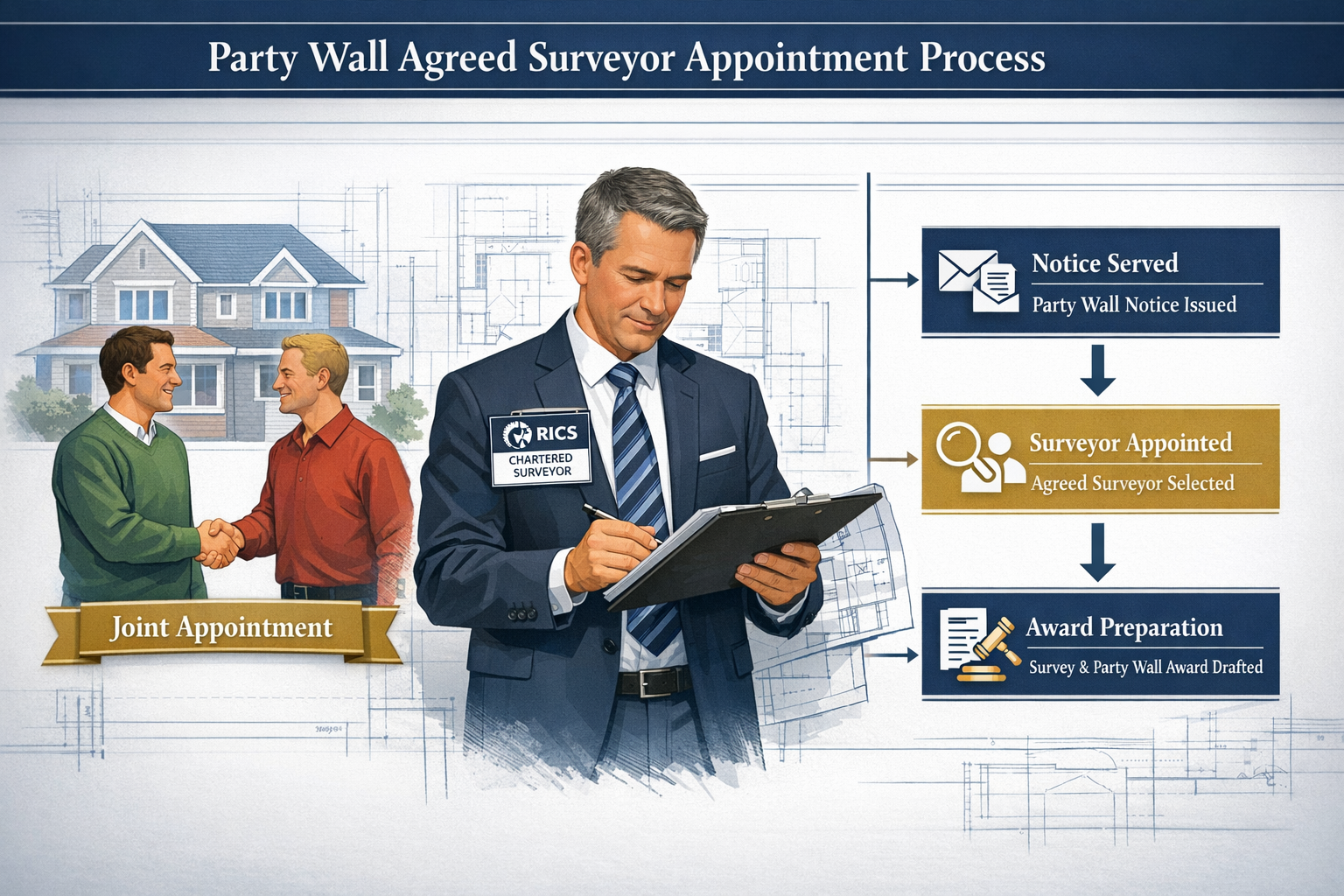
A party wall agreed surveyor represents a collaborative approach to managing construction work that affects shared walls, boundaries, or excavations near neighboring properties. Under the Party Wall etc. Act 1996, when a building owner serves notice on their neighbor regarding planned works, the adjoining owner has three options: consent to the works, dissent and appoint their own surveyor, or agree to jointly appoint a single surveyor with the building owner.
This jointly appointed professional is known as the agreed surveyor. Unlike the traditional “three surveyor” scenario where each owner appoints their own surveyor and those two then select a third surveyor, the agreed surveyor acts alone, serving both parties with complete impartiality.
The Legal Framework
The Party Wall etc. Act 1996 specifically provides for agreed surveyor appointments in Section 10. This legislation recognizes that not all party wall matters require adversarial processes, and that cooperative neighbors can benefit from a more streamlined approach.
Key legal principles include:
- The agreed surveyor must be a qualified professional, typically a chartered building surveyor with party wall expertise
- Both parties must provide written consent to the appointment
- The agreed surveyor owes equal duties to both the building owner and adjoining owner
- Either party can withdraw consent and appoint their own surveyor at any stage
- The agreed surveyor’s decisions in the party wall award are legally binding on both parties
How It Differs from the Three Surveyor Approach
Understanding the distinction between these approaches is crucial for making informed decisions about your party wall matters.
| Aspect | Agreed Surveyor | Three Surveyor Approach |
|---|---|---|
| Number of Professionals | One surveyor serving both parties | Three surveyors (one per owner plus third surveyor) |
| Cost | £700-£1,200 typically | £2,000-£3,500+ typically |
| Timeline | Faster—single point of decision | Slower—requires coordination between three professionals |
| Suitable For | Amicable relationships, straightforward works | Complex disputes, contentious relationships |
| Impartiality | Must remain neutral to both parties | Each owner’s surveyor advocates for their client |
| Communication | Direct with both parties | Through respective surveyors |
When Should You Consider a Party Wall Agreed Surveyor?
Determining whether an agreed surveyor appointment suits your circumstances requires honest assessment of several factors. This decision can significantly impact both the cost and the smoothness of your building project.
Ideal Scenarios for Agreed Surveyor Appointments
Friendly Neighbor Relationships 🏘️
When you maintain a positive relationship with your neighbor and both parties approach the party wall process cooperatively, an agreed surveyor often represents the best choice. This scenario frequently occurs when:
- You’ve discussed the proposed works openly with your neighbor
- Both parties understand the party wall process
- There’s mutual trust and no history of property disputes
- The neighbor is supportive or neutral about your building project
Straightforward Building Works
Certain types of construction work lend themselves particularly well to agreed surveyor appointments:
- Loft conversions affecting party walls
- Single-story rear extensions
- Replacement of timber floor beams bearing on party walls
- Minor structural alterations to party walls
- Standard basement excavations within typical proximity to boundaries
For more complex projects involving structural concerns, additional considerations may apply.
Cost-Conscious Projects
Property owners working within tight budgets often benefit substantially from agreed surveyor appointments. The cost savings—potentially £1,000-£2,000 or more—can be redirected toward the actual building works.
When an Agreed Surveyor May Not Be Appropriate
Pre-Existing Disputes ⚠️
If you and your neighbor already have ongoing disagreements about boundary issues, property maintenance, or previous building work, the three surveyor approach typically provides better protection for both parties.
Complex or Contentious Works
Large-scale projects such as:
- Multi-story extensions significantly affecting light, privacy, or structural integrity
- Deep basement excavations requiring underpinning
- Works to properties with existing structural issues
- Projects where the adjoining owner has expressed serious concerns
Unequal Knowledge or Resources
When one party has significantly more understanding of construction or legal matters, or when there’s an imbalance in resources, separate representation ensures both parties receive appropriate advocacy.
Commercial or High-Value Properties
For commercial properties or high-value residential buildings where potential damages could be substantial, the additional protection of separate surveyors often justifies the higher cost.
The Party Wall Agreed Surveyor Appointment Process
Successfully appointing an agreed surveyor requires following proper procedures to ensure legal compliance and protect both parties’ interests.
Step 1: Serving the Party Wall Notice
The building owner must first serve appropriate notice under the Party Wall etc. Act 1996. This typically involves:
- Identifying which notices are required based on the type of work (Party Structure Notice, Line of Junction Notice, or Notice of Adjacent Excavation)
- Preparing compliant notices with all required information about the proposed works
- Serving notices correctly on all affected adjoining owners, typically at least two months before work commences (one month for Line of Junction notices)
The notice should clearly explain the adjoining owner’s rights, including the option to consent, dissent, or agree to a joint surveyor appointment.
Step 2: Discussing the Agreed Surveyor Option
Once the notice is served, the building owner should communicate with the adjoining owner about the agreed surveyor approach:
- Explain the benefits: Lower costs, faster process, single point of contact
- Address concerns: Reassure about impartiality and professional obligations
- Discuss surveyor selection: Consider whether either party has preferences for specific professionals
- Clarify costs: Explain that the building owner typically pays all surveyor fees
This conversation works best when conducted respectfully and with full transparency about the proposed works.
Step 3: Selecting the Agreed Surveyor
Choosing the right professional is crucial. Both parties should seek a surveyor who:
✅ Holds appropriate qualifications: Chartered membership of RICS (Royal Institution of Chartered Surveyors) is the gold standard
✅ Has specific party wall expertise: General building surveyors may lack the specialized knowledge required
✅ Demonstrates local knowledge: Familiarity with local building practices and typical construction methods in your area
✅ Shows clear impartiality: No prior relationship with either party that could compromise neutrality
✅ Communicates clearly: Ability to explain technical matters in accessible language
✅ Provides transparent fee structures: Clear quotations with no hidden costs
Professional surveyors with established reputations in party wall matters typically provide the most reliable service.
Step 4: Formalizing the Appointment
Both parties must provide written consent to the agreed surveyor appointment. This documentation should include:
- Full names and addresses of both building owner and adjoining owner
- Property addresses affected by the party wall works
- Clear statement of consent to the joint appointment
- Name and contact details of the agreed surveyor
- Acknowledgment that either party may withdraw consent and appoint their own surveyor
- Date and signatures from both parties
The agreed surveyor will typically provide a template consent form to ensure all necessary elements are included.
Step 5: The Surveyor’s Assessment and Award
Once appointed, the party wall agreed surveyor will:
- Inspect both properties to document pre-construction conditions
- Review the proposed works in detail, examining plans and specifications
- Assess potential impacts on the adjoining property
- Recommend protective measures if necessary
- Prepare the Party Wall Award, a legally binding document that:
- Describes the works in detail
- Sets out the rights and responsibilities of both parties
- Specifies protective measures and working methods
- Establishes procedures for resolving disputes during construction
- Addresses cost allocation for the surveyor’s fees
The award must be served on both parties, who then have 14 days to appeal to the Third Surveyor (who would be appointed specifically for the appeal) if they disagree with any aspect.
Understanding Party Wall Agreed Surveyor Costs and Fees
One of the most compelling reasons to consider an agreed surveyor is the significant cost savings compared to the three surveyor approach. However, understanding the fee structure helps both parties budget appropriately.
Typical Fee Ranges in 2025
Agreed Surveyor Fees:
- Simple party wall matters: £700-£1,000
- Standard loft conversions or extensions: £900-£1,200
- More complex works or multiple notices: £1,200-£1,800
Three Surveyor Scenario Fees:
- Building owner’s surveyor: £800-£1,500
- Adjoining owner’s surveyor: £800-£1,500
- Third surveyor (selection and standby): £400-£500
- Total: £2,000-£3,500+
The cost savings of 40-60% make the agreed surveyor approach financially attractive for many property owners. For context on party wall costs, you can review detailed information about party wall surveyor pricing in London.
What Influences Surveyor Fees?
Several factors affect the final cost:
Property Location 📍
Surveyors in London and the South East typically charge 20-40% more than those in other UK regions, reflecting higher operating costs and property values.
Complexity of Works
- Basic works affecting a single party wall: Lower fees
- Multiple party walls or boundary works: Moderate fees
- Extensive excavations or structural alterations: Higher fees
Number of Site Visits Required
- Initial inspection: Included in base fee
- Progress inspections during construction: Additional charges (£150-£300 per visit)
- Final inspection upon completion: Often included
Documentation and Award Preparation
More complex projects requiring detailed specifications, schedules of condition with extensive photography, or multiple revisions to the award will incur higher fees.
Urgency
Rush appointments or expedited awards may attract premium charges of 20-30% above standard fees.
Who Pays the Agreed Surveyor’s Fees?
Under the Party Wall etc. Act 1996, the building owner is responsible for all reasonable surveyor fees, including those of an agreed surveyor. This principle applies regardless of which party suggested the agreed surveyor approach.
The party wall award will formally document this cost allocation. In rare circumstances where the adjoining owner requests additional services beyond the standard party wall process, they may be asked to contribute to those specific costs.
Getting Value for Money
To ensure reasonable fees:
- Obtain quotations from multiple qualified surveyors before making a selection
- Request itemized fee breakdowns showing what services are included
- Clarify what triggers additional charges (e.g., extra site visits, extended projects)
- Check if VAT is included in quoted fees (VAT applies to surveyor services)
- Ask about payment schedules—many surveyors request payment in stages
Rights and Responsibilities Under an Agreed Surveyor Appointment
Both property owners retain important rights even after appointing an agreed surveyor, and understanding these protections is essential.
Rights of the Building Owner
Right to Proceed with Lawful Works 🔨
Once the party wall award is in place, the building owner has the legal right to proceed with the works as described, provided they:
- Follow the specifications and protective measures outlined in the award
- Provide reasonable notice before commencing work
- Allow agreed inspections by the surveyor
- Minimize unnecessary inconvenience to the adjoining owner
Right to Reasonable Surveyor Service
The building owner can expect:
- Professional, timely service in accordance with RICS standards
- Clear communication about the process and timeline
- Transparent fee structures without unexpected charges
- Impartial treatment despite paying the fees
Right to Challenge the Award
If the building owner believes the award contains unreasonable conditions or restrictions, they have 14 days to appeal to a Third Surveyor appointed specifically for the appeal process.
Rights of the Adjoining Owner
Right to Appoint Own Surveyor ⚖️
The adjoining owner retains the absolute right to withdraw consent for the agreed surveyor and appoint their own surveyor at any time, even after the agreed surveyor has been working on the matter. This provides crucial protection if:
- Concerns arise about the agreed surveyor’s impartiality
- The relationship with the building owner deteriorates
- The adjoining owner feels their interests aren’t being adequately protected
- Unexpected complications emerge during the works
Right to Protective Measures
The adjoining owner is entitled to:
- Comprehensive photographic schedules of condition documenting their property before works commence
- Reasonable protective measures to prevent damage
- Access for the surveyor to inspect their property
- Compensation for any damage caused by the works
Right to Information
The agreed surveyor must keep the adjoining owner fully informed about:
- The nature and extent of proposed works
- Expected timeline and working hours
- Potential impacts on their property
- Protective measures being implemented
Responsibilities of Both Parties
Providing Access
Both owners must provide reasonable access to their properties for:
- Initial condition surveys
- Progress inspections during construction
- Final completion inspections
Cooperating with the Process
Both parties should:
- Respond promptly to surveyor communications
- Provide requested information or documentation
- Allow necessary works to proceed as per the award
- Raise concerns constructively through the surveyor
Respecting the Award
Once served, the party wall award is legally binding on both parties. Failure to comply can result in injunctions or legal action.
The Agreed Surveyor’s Professional Obligations
Understanding what the party wall agreed surveyor must do helps both parties know what to expect and ensures accountability.
Duty of Impartiality
The agreed surveyor’s paramount obligation is complete impartiality. Unlike the three surveyor scenario where each owner’s surveyor advocates for their client, the agreed surveyor must:
- Give equal weight to both parties’ concerns
- Make decisions based solely on professional judgment and the Act’s requirements
- Avoid any appearance of favoritism
- Disclose any potential conflicts of interest immediately
- Refuse appointment if genuine impartiality cannot be maintained
This impartiality is protected by RICS professional standards and the surveyor’s professional indemnity insurance requirements.
Professional Standards and Conduct
Agreed surveyors must:
✓ Hold appropriate qualifications: Typically RICS chartered membership with party wall specialization
✓ Maintain professional indemnity insurance: Typically £1-2 million minimum coverage
✓ Follow RICS guidance: Including the RICS Party Wall Guidance Note and professional conduct standards
✓ Act within statutory timescales: The Act specifies various time limits that must be observed
✓ Provide clear, accurate documentation: Awards must be comprehensive and unambiguous
✓ Maintain confidentiality: Except where disclosure is required by law or the party wall process
Specific Duties During the Process
Pre-Construction Phase:
- Thoroughly inspect both properties
- Prepare detailed schedules of condition with photographs
- Review plans and specifications for the proposed works
- Assess potential risks and impacts
- Recommend appropriate protective measures
- Prepare a comprehensive party wall award
During Construction:
- Monitor compliance with the award’s terms
- Conduct inspections at appropriate intervals
- Address any concerns raised by either party
- Resolve disputes about the works’ execution
- Recommend additional protective measures if needed
Post-Construction:
- Conduct final inspections
- Assess whether any damage has occurred
- Oversee remedial works if required
- Ensure the building owner fulfills all obligations under the award
For properties requiring additional specialist assessments, surveyors may recommend complementary services such as damp surveys if moisture-related concerns arise during inspections.
Common Challenges and How to Address Them

Even with an agreed surveyor appointment, challenges can arise. Knowing how to address them prevents minor issues from becoming major disputes.
Challenge 1: Communication Breakdown Between Neighbors
The Problem:
Despite initially agreeing to a joint appointment, neighbors may stop communicating effectively, particularly if unexpected issues arise during construction.
The Solution:
- The agreed surveyor should establish clear communication protocols from the outset
- Regular updates to both parties, even when there’s nothing significant to report
- Addressing concerns immediately rather than allowing them to fester
- Encouraging direct communication between neighbors where appropriate, with the surveyor facilitating
- Documenting all significant communications in writing
Challenge 2: Scope Creep in Building Works
The Problem:
The building owner decides to expand or modify the works beyond what was described in the original party wall notice and award.
The Solution:
- Any material changes require a new or amended party wall notice
- The agreed surveyor must advise the building owner to serve appropriate additional notices
- The award may need to be revised to address the changed scope
- Both parties must consent to any amendments
- If the adjoining owner objects to the changes, the matter may require separate surveyor appointments
Challenge 3: Perceived Bias
The Problem:
The adjoining owner becomes concerned that the agreed surveyor is favoring the building owner, particularly because the building owner is paying the fees.
The Solution:
- The agreed surveyor should proactively demonstrate impartiality through:
- Equal communication with both parties
- Transparent decision-making with clear reasoning
- Strict adherence to professional standards
- Willingness to impose conditions on the building owner where appropriate
- If concerns persist, the adjoining owner can exercise their right to appoint their own surveyor
- The agreed surveyor should never take offense at this decision—it’s a legitimate right
Challenge 4: Damage Disputes
The Problem:
Damage occurs to the adjoining property, but there’s disagreement about whether it was caused by the party wall works or pre-existed.
The Solution:
This highlights the critical importance of comprehensive schedules of condition:
- Detailed photographic records before works commence
- Written descriptions of pre-existing defects
- Video documentation for particularly vulnerable properties
- Regular monitoring inspections during construction
- Expert assessment if the cause of damage is unclear
- The agreed surveyor’s professional judgment, based on evidence, resolves most disputes
For properties where structural issues like subsidence are a concern, particularly thorough pre-construction documentation becomes essential.
Challenge 5: Contractor Non-Compliance
The Problem:
The building owner’s contractors fail to follow the protective measures or working methods specified in the party wall award.
The Solution:
- The agreed surveyor has authority to halt works that don’t comply with the award
- The building owner remains legally responsible for their contractors’ compliance
- The surveyor should issue written warnings and set deadlines for compliance
- Persistent non-compliance may require legal intervention
- The building owner bears the cost of any damage resulting from non-compliance
Alternatives to the Party Wall Agreed Surveyor
While the agreed surveyor approach offers significant advantages, understanding alternatives helps property owners make informed decisions.
The Three Surveyor Approach
As discussed earlier, this involves each party appointing their own surveyor, with those two surveyors selecting a third surveyor who remains on standby to resolve any disagreements.
Advantages:
- Each party has dedicated representation and advocacy
- Appropriate for contentious relationships or complex disputes
- Provides additional checks and balances
- The adjoining owner feels more protected
Disadvantages:
- Significantly higher costs (typically double or more)
- Slower process requiring coordination between multiple professionals
- Potential for disagreements between surveyors
- More formal and potentially adversarial
Consent Without Surveyors
In some cases, the adjoining owner may simply consent to the proposed works without any surveyor involvement.
When This Works:
- Very minor works with negligible impact
- Extremely trusting neighbor relationships
- The adjoining owner fully understands the works and their rights
- Both parties are comfortable proceeding informally
Risks:
- No formal record of pre-construction condition
- No professional oversight of the works
- Difficulty proving causation if damage occurs
- Potential for disputes without clear resolution mechanism
Important Note: Even with consent, it’s generally advisable to have at least a basic schedule of condition prepared by a professional to protect both parties.
Building Owner Appointing a Surveyor Alone
If the adjoining owner doesn’t respond to the party wall notice within 14 days, the building owner can appoint a surveyor on their behalf.
How It Works:
- The building owner serves notice of the appointment on the adjoining owner
- The appointed surveyor must act impartially despite being appointed by the building owner
- The adjoining owner can still appoint their own surveyor later if they wish
Considerations:
- This isn’t the same as an agreed surveyor—consent from both parties is lacking
- The appointed surveyor must be particularly careful about demonstrating impartiality
- Costs are similar to an agreed surveyor appointment
- The adjoining owner may feel their rights are being overridden, potentially damaging relationships
Finding and Selecting the Right Party Wall Agreed Surveyor
Choosing the right professional can make the difference between a smooth process and a problematic one.
Essential Qualifications and Credentials
RICS Chartered Membership 🎓
Look for surveyors who are Members (MRICS) or Fellows (FRICS) of the Royal Institution of Chartered Surveyors. This ensures:
- Rigorous professional training and examination
- Ongoing continuing professional development requirements
- Adherence to professional and ethical standards
- Professional indemnity insurance
- Accountability through RICS complaints procedures
Party Wall Specialization
Not all building surveyors specialize in party wall matters. Seek professionals who:
- Regularly handle party wall cases
- Demonstrate up-to-date knowledge of the Party Wall etc. Act 1996
- Belong to specialist organizations like the Faculty of Party Wall Surveyors
- Have handled cases similar to your specific situation
Local Experience
Surveyors familiar with your area understand:
- Local building practices and typical construction methods
- Common property types and their vulnerabilities
- Local authority requirements that may intersect with party wall matters
- Regional fee expectations and reasonable costs
Questions to Ask Potential Surveyors
Before appointing an agreed surveyor, both parties should be comfortable with the selection. Consider asking:
- “How many party wall cases do you handle annually?”
- Look for surveyors who handle at least 20-30 cases per year
- “What’s your experience with this type of work?”
- Ensure they’ve handled similar projects (loft conversions, extensions, excavations, etc.)
- “Can you provide references from recent clients?”
- Both building owners and adjoining owners if possible
- “What’s your typical timeline for completing the award?”
- Reasonable expectations: 3-6 weeks from appointment to award service
- “How do you ensure impartiality when acting as an agreed surveyor?”
- Listen for specific practices and procedures, not just general assurances
- “What are your fees, and what do they include?”
- Request itemized quotations with clear scope of services
- “How will you communicate with both parties throughout the process?”
- Look for commitment to regular, balanced communication
- “What happens if complications arise during construction?”
- Understand their approach to monitoring and dispute resolution
Red Flags to Avoid
Be cautious of surveyors who:
❌ Lack specific party wall experience or qualifications
❌ Cannot provide clear, written fee quotations
❌ Show reluctance to communicate with both parties equally
❌ Have conflicts of interest (e.g., prior relationship with one party)
❌ Make guarantees about outcomes (“I’ll make sure your neighbor can’t object”)
❌ Pressure you to make quick decisions without adequate information
❌ Don’t carry adequate professional indemnity insurance
❌ Have complaints or disciplinary actions through RICS
Where to Find Qualified Surveyors
RICS Find a Surveyor Service
The official RICS directory allows you to search for chartered surveyors by location and specialism.
Faculty of Party Wall Surveyors
This specialist organization maintains a directory of experienced party wall surveyors.
Local Recommendations
Ask your architect, builder, or solicitor for recommendations. Personal referrals from professionals who regularly work with party wall surveyors can be valuable.
Online Research
Professional surveying firms often provide detailed information about their party wall services, qualifications, and experience.
Practical Tips for a Smooth Agreed Surveyor Process
Success with an agreed surveyor appointment often comes down to preparation, communication, and realistic expectations.
For Building Owners
Start Early ⏰
Don’t wait until the last minute to serve party wall notices. The process typically takes 6-10 weeks from notice service to award, and construction cannot legally commence until the award is in place (or the consent period has expired).
Be Transparent with Your Neighbor
- Discuss your plans informally before serving formal notices
- Share architectural drawings and explain the scope of work
- Address concerns proactively
- Emphasize your commitment to minimizing disruption
Choose a Reputable Contractor
The best party wall award means little if contractors don’t follow it. Select builders who:
- Understand party wall requirements
- Have experience with similar projects
- Demonstrate professionalism and care
- Are willing to coordinate with the party wall surveyor
Budget for the Full Process
Include party wall costs in your project budget:
- Surveyor fees: £700-£1,200 for agreed surveyor
- Potential additional inspection fees during construction
- Contingency for remedial works if minor damage occurs
Maintain Good Communication
- Keep your neighbor informed about progress
- Provide advance notice of particularly disruptive work phases
- Address complaints promptly and respectfully
- Remember that maintaining the relationship matters beyond this single project
For Adjoining Owners
Understand Your Rights 📋
You’re not obligated to accept an agreed surveyor appointment. If you’re uncomfortable with the approach, you have every right to appoint your own surveyor.
Don’t Delay Responses
If you don’t respond to a party wall notice within 14 days, the building owner can appoint a surveyor on your behalf. Engage with the process promptly to maintain control.
Ask Questions
Don’t agree to an agreed surveyor appointment unless you:
- Understand the proposed works and their potential impact
- Feel comfortable with the surveyor being suggested
- Trust that your interests will be protected
- Have had all your concerns addressed
Document Everything
- Keep copies of all notices, correspondence, and the party wall award
- Take your own photographs of your property before works commence
- Note any concerns or observations during construction
- Maintain a log of disruptions or issues
Be Reasonable but Firm
- Don’t object to reasonable, lawful works out of spite
- Do insist on proper protective measures and professional oversight
- Don’t accept vague assurances—require formal documentation
- Do exercise your rights if you feel they’re not being respected
For Both Parties
Focus on the Long-Term Relationship 🤝
You’ll remain neighbors long after the construction is complete. Approaching the party wall process with mutual respect and goodwill pays dividends for years to come.
Trust the Professional Process
The Party Wall etc. Act 1996 has been refined over decades to balance the rights of both parties fairly. When followed properly with qualified professionals, it works well.
Keep Perspective on Costs
While party wall surveyor fees may seem significant, they’re typically a small percentage of the overall building project cost (usually 1-3%). The protection and professional oversight they provide is worth the investment.
Document the Agreement
Ensure all aspects of the agreed surveyor appointment are in writing, including:
- Both parties’ written consent
- The surveyor’s fee quotation and payment terms
- Expected timeline
- Scope of services
The Future of Party Wall Agreed Surveyors in 2025 and Beyond
The party wall industry continues to evolve, with several trends shaping how agreed surveyors operate in 2025.
Technology Integration
Digital Schedules of Condition
Modern surveyors increasingly use:
- High-resolution photography and 360-degree imaging
- Drone surveys for roof and upper-level documentation
- Digital annotation and reporting tools
- Cloud-based sharing for immediate access by both parties
Virtual Inspections
While not replacing physical site visits, video calls and remote inspections can supplement the process for:
- Initial consultations
- Progress updates
- Minor queries during construction
Electronic Awards and Communication
Email service of awards, digital signatures, and online document management streamline the process and reduce delays.
Increased Professionalization
The party wall sector continues to mature, with:
- More rigorous training and qualification requirements
- Stronger professional standards and accountability
- Greater public awareness of party wall rights and processes
- More sophisticated dispute resolution mechanisms
Focus on Sustainability
Party wall surveyors increasingly consider:
- Environmental impact of proposed works
- Sustainable building methods and materials
- Energy efficiency improvements
- Long-term building performance
Greater Emphasis on ADR (Alternative Dispute Resolution)
Rather than resorting to formal appeals and legal proceedings, there’s growing use of:
- Mediation for party wall disputes
- Early neutral evaluation
- Structured negotiation processes
These approaches align well with the collaborative spirit of agreed surveyor appointments.
Conclusion: Making the Right Choice for Your Party Wall Matters
The party wall agreed surveyor approach represents a practical, cost-effective solution for managing building works that affect shared walls and boundaries. When neighbors maintain amicable relationships and the works are relatively straightforward, this collaborative approach delivers significant benefits: reduced costs, faster timelines, streamlined communication, and professional oversight that protects both parties.
However, the agreed surveyor route isn’t universally appropriate. Complex projects, contentious relationships, or situations where one party feels vulnerable may warrant the additional protection of separate surveyor representation. The beauty of the Party Wall etc. Act 1996 is that it provides flexibility to choose the approach that best fits your specific circumstances.
Your Next Steps
If you’re a building owner planning works:
- Determine whether party wall notices are required for your project
- Discuss your plans with your neighbor informally before serving formal notices
- Serve proper party wall notices with adequate advance time
- Propose the agreed surveyor option if your relationship with your neighbor is cooperative
- Research and select qualified surveyors together with your neighbor
- Budget appropriately for surveyor fees and the party wall process
- Maintain open communication throughout the construction period
If you’re an adjoining owner who has received a party wall notice:
- Review the notice carefully and understand the proposed works
- Seek clarification about anything you don’t understand
- Consider your options: consent, dissent and appoint your own surveyor, or agree to a joint appointment
- Don’t ignore the notice—respond within 14 days to maintain control
- If considering an agreed surveyor, ensure you’re comfortable with both the approach and the specific professional
- Document your property’s condition even before the surveyor’s formal schedule
- Exercise your rights if concerns arise at any stage
For both parties:
The party wall process exists to protect everyone’s interests while allowing necessary and reasonable building works to proceed. Approaching it with good faith, professional guidance, and mutual respect typically leads to successful outcomes that preserve both your property and your neighborly relationship.
Whether you choose an agreed surveyor or the three surveyor approach, ensure you work with qualified, experienced professionals who understand the technical, legal, and interpersonal aspects of party wall matters. The investment in proper professional oversight pays dividends in peace of mind, legal protection, and smooth project execution.
If you’re facing party wall matters and need expert guidance, contact experienced chartered surveyors who can assess your specific situation and recommend the most appropriate approach. With the right professional support and a collaborative mindset, your building project can proceed smoothly while maintaining positive relationships with your neighbors.