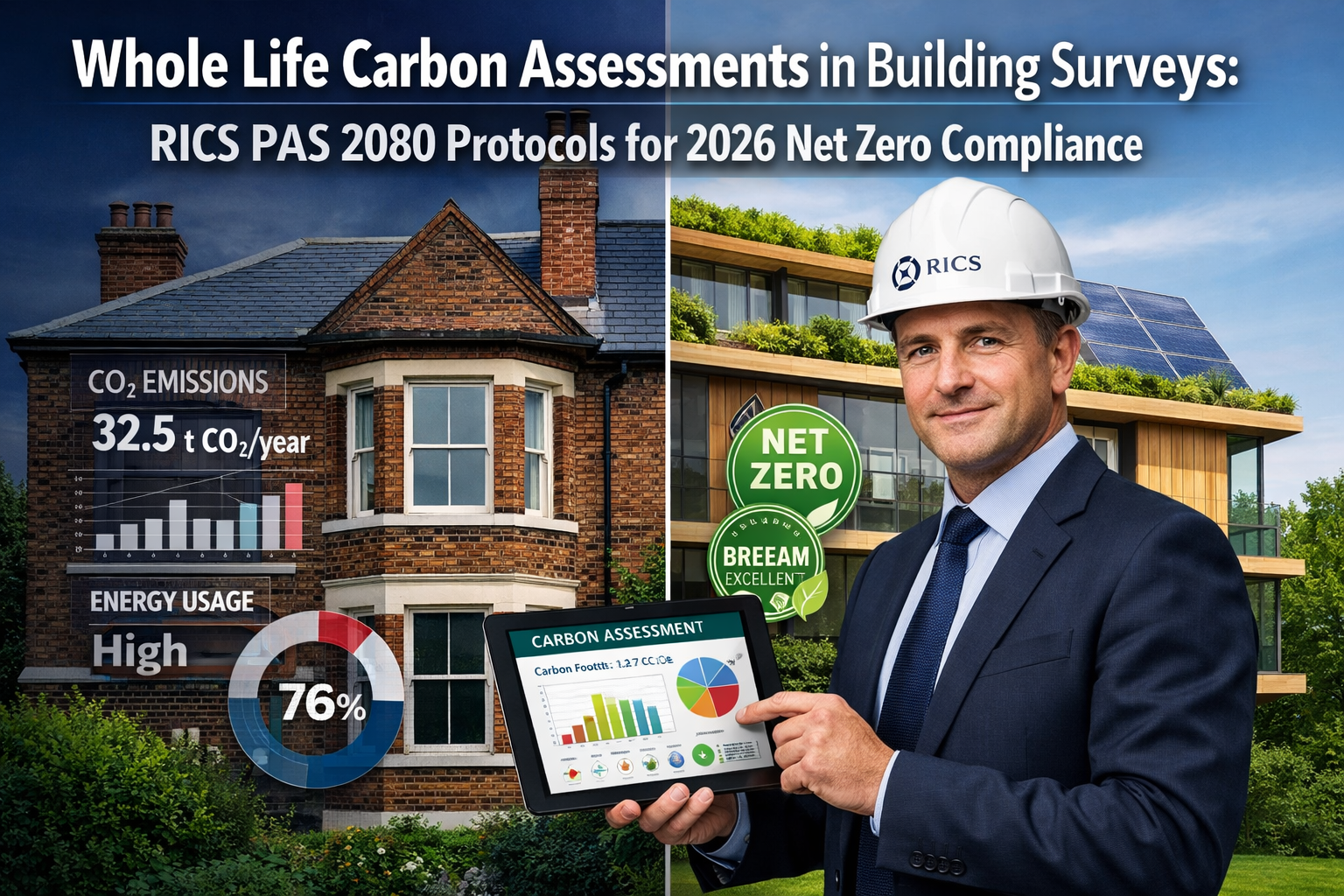
Buildings account for nearly 40% of global carbon emissions, yet most property valuations still ignore the carbon cost embedded in walls, foundations, and roofing systems. As the UK construction industry races toward mandatory whole life carbon reporting in 2026–27, chartered surveyors face a pivotal challenge: integrating Whole Life Carbon Assessments in Building Surveys: RICS PAS 2080 Protocols for 2026 Net Zero Compliance into everyday practice. Since July 1, 2024, RICS members must follow the updated 2nd edition Whole Life Carbon Assessment (WLCA) standard for all new assessments[6], marking a fundamental shift in how building surveys evaluate property value and sustainability performance.
This transformation extends far beyond regulatory box-ticking. Property professionals who master Whole Life Carbon Assessments in Building Surveys: RICS PAS 2080 Protocols for 2026 Net Zero Compliance will unlock competitive advantages in ESG-driven markets, deliver actionable retrofit strategies, and protect client investments against emerging carbon penalties. With embodied carbon limits expected from 2028 onwards[1], the time to act is now.
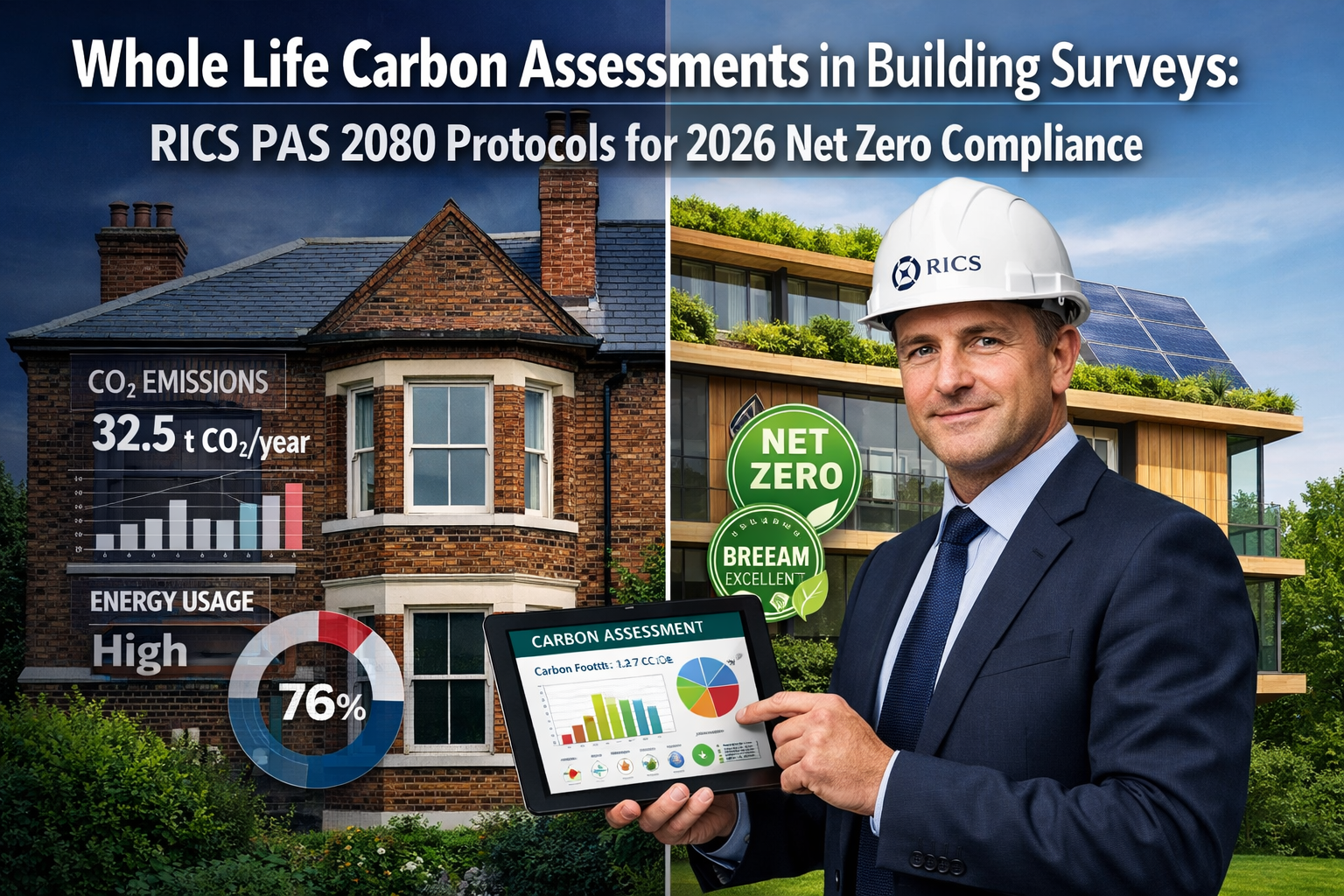
Key Takeaways
✅ Mandatory compliance: RICS 2nd edition WLCA standards became compulsory for all new assessments from July 1, 2024, with Part Z Building Regulations introducing mandatory reporting around 2026–27[6][1]
✅ Integration opportunity: Level 3 building surveys now offer the perfect vehicle for embedding whole life carbon assessments, retrofit valuations, and ESG risk analysis into property transactions
✅ Practical frameworks: PAS 2080:2023 provides the management structure while RICS WLCA delivers the calculation methodology—together forming a complete compliance pathway[2][8]
✅ Financial impact: Properties with documented carbon performance and retrofit potential command premium valuations as investors increasingly prioritize sustainability credentials[7]
✅ 2028 deadline: Embodied carbon limits will take effect from 2028, making early adoption of carbon assessment protocols essential for maintaining property marketability[1]
Understanding Whole Life Carbon Assessment Frameworks
What Is Whole Life Carbon?
Whole life carbon (WLC) encompasses all greenhouse gas emissions associated with a building throughout its entire lifecycle—from raw material extraction and manufacturing (embodied carbon) through construction, operation, maintenance, and eventual demolition or reuse[5]. This comprehensive view contrasts sharply with traditional energy performance assessments that focus exclusively on operational carbon.
The RICS WLCA professional standard, updated in 2024, provides the recognized methodology for calculating these emissions across distinct lifecycle stages[8]:
| Lifecycle Stage | Carbon Components | Assessment Priority |
|---|---|---|
| A1-A3: Product | Raw material extraction, transport, manufacturing | 🔴 High |
| A4-A5: Construction | Transport to site, construction activities | 🟡 Medium |
| B1-B5: Use | Maintenance, repair, replacement, refurbishment | 🟡 Medium |
| B6-B7: Operational | Energy and water consumption during occupancy | 🔴 High |
| C1-C4: End of Life | Deconstruction, transport, waste processing | 🟢 Low |
| D: Beyond Life | Reuse, recycling, energy recovery benefits | 🟢 Low |
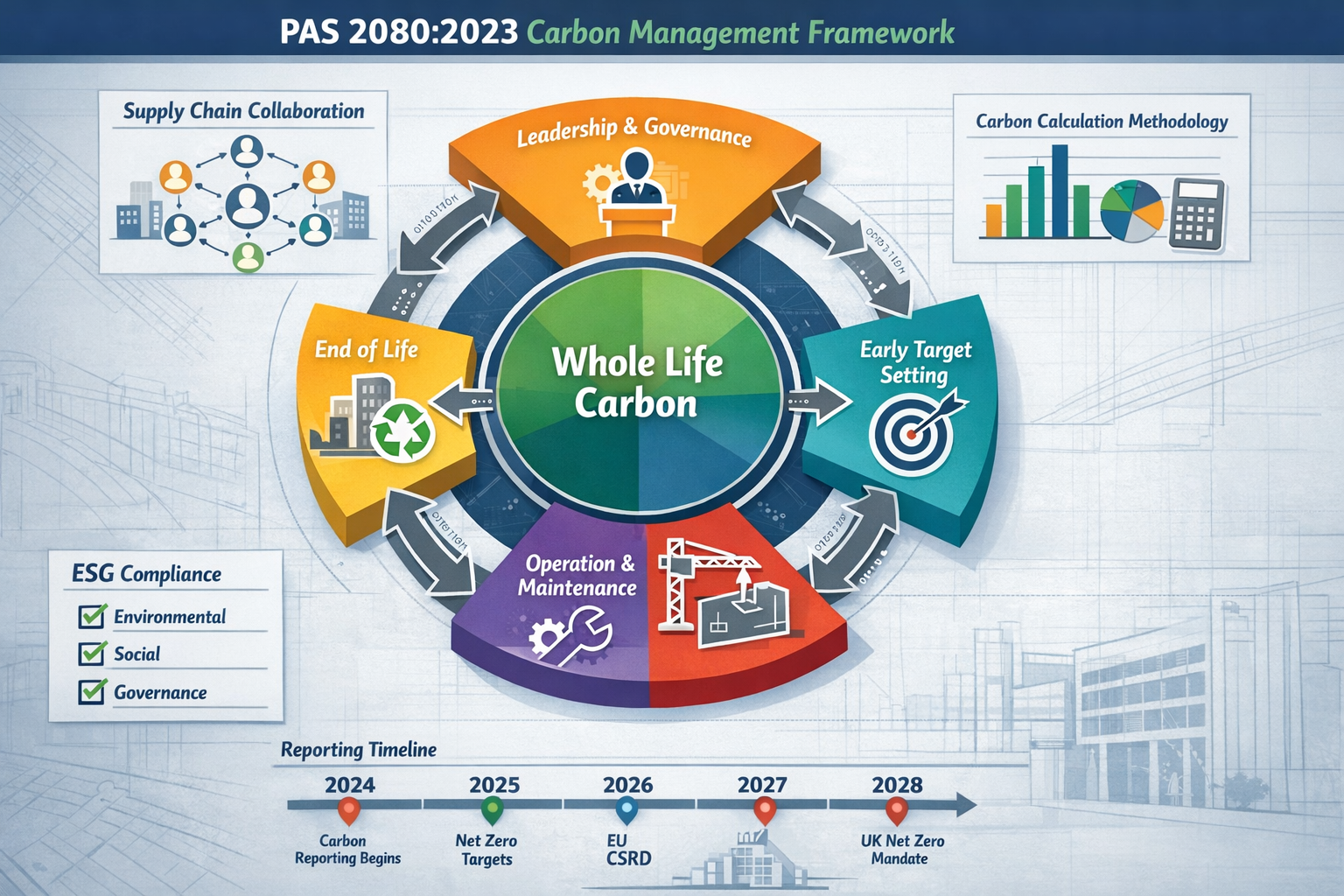
PAS 2080:2023 Management Framework
PAS 2080:2023 establishes the UK's specification for managing whole-life carbon in infrastructure and buildings[2]. Unlike RICS WLCA which focuses on calculation methodology, PAS 2080 provides the management framework for carbon reduction across project delivery.
The framework emphasizes five critical principles:
- Leadership and governance 🎯 – Senior commitment to carbon targets
- Early target-setting 📊 – Establishing carbon budgets before design begins
- Data quality and transparency 📈 – Accurate measurement and verification
- Supply chain collaboration 🤝 – Engaging contractors and manufacturers
- Continuous improvement 🔄 – Learning and adapting through project lifecycle
For chartered surveyors, PAS 2080 provides the governance structure that ensures carbon assessments translate into meaningful action rather than paperwork exercises[3].
RICS and ICE Harmonization
In a significant development, RICS and the Institution of Civil Engineers (ICE) harmonized their messaging on carbon assessment and management in 2024[9]. This collaboration ensures consistent application of both PAS 2080 management principles and RICS WLCA calculation standards across the construction sector, eliminating confusion between competing frameworks[3].
The harmonized approach recognizes that effective carbon management requires both accurate measurement (RICS WLCA) and systematic implementation (PAS 2080)[4].
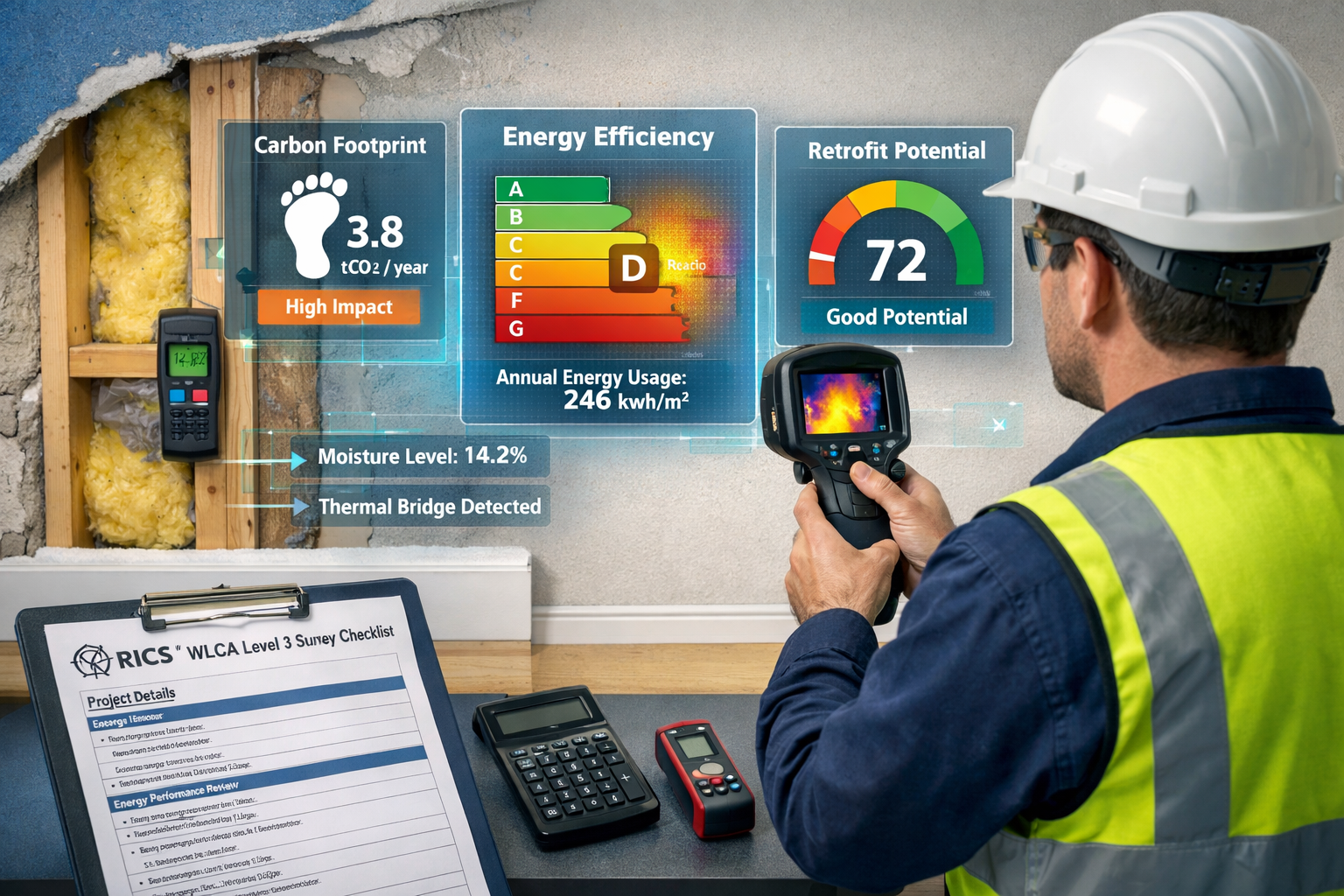
Integrating Whole Life Carbon Assessments in Building Surveys: RICS PAS 2080 Protocols for 2026 Net Zero Compliance
Why Level 3 Building Surveys Are Ideal Vehicles
Level 3 building surveys provide comprehensive property assessments that naturally align with whole life carbon evaluation requirements. Unlike basic homebuyer reports, Level 3 surveys already examine:
- Structural condition and materials – Essential for embodied carbon calculations
- Building fabric performance – Direct correlation to operational carbon
- Maintenance and repair needs – Informs lifecycle carbon stages B1-B5
- Retrofit potential – Identifies decarbonization opportunities
By embedding Whole Life Carbon Assessments in Building Surveys: RICS PAS 2080 Protocols for 2026 Net Zero Compliance, surveyors transform traditional condition reports into forward-looking sustainability roadmaps that protect client investments against emerging regulatory risks.
Practical WLCA Integration Checklist
Surveyors conducting RICS surveys can follow this systematic approach to incorporate whole life carbon assessment:
Pre-Survey Preparation 📋
- Review available EPCs, building plans, and construction documentation
- Identify building age, construction type, and major refurbishment history
- Gather utility consumption data (minimum 12 months if available)
- Confirm client objectives regarding sustainability and retrofit planning
- Determine appropriate WLCA scope (full assessment vs. simplified screening)
On-Site Carbon Assessment 🏗️
- Document primary construction materials (foundations, structure, envelope)
- Measure wall, floor, and roof U-values using thermal imaging where appropriate
- Assess glazing type, age, and thermal performance
- Evaluate heating, cooling, and ventilation systems efficiency
- Identify moisture issues that may indicate thermal bridging
- Photograph material conditions for embodied carbon database matching
- Note any existing renewable energy installations
Retrofit Potential Analysis 🔧
- Identify viable insulation upgrade opportunities (walls, loft, floors)
- Assess feasibility of low-carbon heating system replacement
- Evaluate window and door replacement carbon payback periods
- Consider renewable energy installation potential (solar PV, heat pumps)
- Calculate estimated carbon savings from each intervention
- Estimate capital costs and carbon ROI for priority measures
WLCA Calculation and Reporting 📊
- Use RICS-compliant carbon calculation tools (e.g., One Click LCA, IES)
- Calculate baseline whole life carbon (kgCO₂e/m²/year)
- Model post-retrofit carbon performance scenarios
- Compare results against LETI or RIBA 2030 Challenge benchmarks
- Document data sources, assumptions, and uncertainty ranges
- Prepare clear visual dashboards showing carbon hotspots
This checklist ensures surveyors systematically capture the information needed for robust carbon assessments while conducting standard building survey activities.
Data Quality and Tool Selection
The accuracy of Whole Life Carbon Assessments in Building Surveys: RICS PAS 2080 Protocols for 2026 Net Zero Compliance depends heavily on data quality and calculation tool selection. PAS 2080 emphasizes transparency about data sources and uncertainty[2].
Recommended data hierarchy:
- Primary data 🥇 – Actual product-specific Environmental Product Declarations (EPDs)
- Secondary data 🥈 – Industry average databases (ICE, RICS embodied carbon database)
- Tertiary data 🥉 – Generic estimates with documented assumptions
For existing buildings where original construction data is unavailable, surveyors should clearly document assumptions and provide sensitivity analysis showing how data uncertainty affects results[5].
Compliance Timeline and Regulatory Context
Understanding the regulatory timeline helps surveyors position carbon assessments appropriately:
| Date | Regulatory Milestone | Impact on Surveyors |
|---|---|---|
| July 1, 2024 | RICS WLCA 2nd edition mandatory[6] | All new WLCAs must follow updated standard |
| 2026-27 | Part Z mandatory WLCA reporting expected[1] | Building surveys should anticipate requirements |
| 2028 | Embodied carbon limits introduced[1] | Properties exceeding limits face compliance costs |
| 2030 | UK Net Zero Carbon Buildings Standard[1] | Combined operational and embodied limits |
Surveyors who integrate carbon assessment into building surveys now position clients ahead of these regulatory waves, enabling proactive rather than reactive compliance strategies.
Valuing Retrofit Potential Amid Rising ESG Demands
ESG Impact on Property Valuation
Environmental, Social, and Governance (ESG) criteria increasingly influence property investment decisions. Buildings with documented carbon performance and clear decarbonization pathways command valuation premiums while high-carbon properties face growing discounts[7].
Key ESG valuation factors include:
- Stranding risk 💸 – Properties unable to meet 2028 embodied carbon limits may become unlettable or unsaleable
- Operating cost trajectory 📉 – Low-carbon buildings offer predictable, lower energy costs
- Regulatory compliance ✅ – Documented WLCA compliance reduces transaction friction
- Tenant demand 🏢 – Commercial tenants increasingly require sustainable premises
- Financing access 💰 – Green mortgages and sustainability-linked loans favor low-carbon properties
Surveyors incorporating Whole Life Carbon Assessments in Building Surveys: RICS PAS 2080 Protocols for 2026 Net Zero Compliance provide clients with quantified ESG risk assessments that inform purchase decisions and price negotiations.
Retrofit Carbon ROI Analysis
Not all retrofit interventions deliver equal carbon reductions per pound invested. Effective carbon assessment prioritizes measures by carbon payback period rather than financial ROI alone.
Typical retrofit carbon effectiveness:
| Intervention | Carbon Saving | Capital Cost | Carbon ROI |
|---|---|---|---|
| Loft insulation | 🟢🟢🟢 High | 💰 Low | ⭐⭐⭐⭐⭐ Excellent |
| Wall insulation | 🟢🟢🟢 High | 💰💰 Medium | ⭐⭐⭐⭐ Very good |
| Heat pump installation | 🟢🟢 Medium-High | 💰💰💰 High | ⭐⭐⭐ Good |
| Triple glazing | 🟢 Medium | 💰💰💰 High | ⭐⭐ Fair |
| Solar PV | 🟢🟢 Medium | 💰💰 Medium | ⭐⭐⭐⭐ Very good |
Surveyors should model multiple retrofit scenarios showing cumulative carbon reduction and investment requirements, enabling clients to prioritize interventions that maximize both carbon savings and property value enhancement[10].
Reporting Carbon Assessment Results
Clear communication of carbon assessment findings is essential. Best practice reports include:
- Executive summary – Baseline carbon performance vs. benchmarks
- Visual carbon breakdown – Pie charts showing embodied vs. operational carbon
- Retrofit priority matrix – Interventions plotted by carbon impact vs. cost
- Compliance roadmap – Timeline showing path to 2028 and 2030 targets
- Valuation implications – Estimated impact on property value and marketability
- Uncertainty statement – Data quality assessment and sensitivity analysis
This structured approach transforms technical carbon data into actionable business intelligence that clients can use for investment decisions, property negotiations, and long-term asset management planning.
Supply Chain Collaboration
PAS 2080 emphasizes that effective carbon management requires collaboration across the supply chain[2]. For surveyors, this means:
- Engaging with contractors 🔨 – Verifying proposed retrofit carbon impacts
- Manufacturer engagement 🏭 – Obtaining EPDs for specified materials
- Client education 📚 – Building carbon literacy to support informed decisions
- Professional networking 🤝 – Sharing best practices with other surveying professionals
By positioning themselves as carbon assessment experts, surveyors become strategic advisors rather than transactional service providers, creating deeper client relationships and recurring revenue opportunities.
Practical Implementation Challenges and Solutions
Common Implementation Barriers
Surveyors adopting Whole Life Carbon Assessments in Building Surveys: RICS PAS 2080 Protocols for 2026 Net Zero Compliance frequently encounter these challenges:
Challenge 1: Limited historical data 🗂️
Solution: Use age-appropriate construction databases and document assumptions transparently. Secondary data sources like the ICE Embodied Carbon Database provide reasonable estimates for typical construction types.
Challenge 2: Client cost concerns 💷
Solution: Position WLCA as risk mitigation rather than additional cost. Demonstrate how carbon assessment protects against future regulatory penalties and valuation discounts that far exceed assessment fees.
Challenge 3: Software complexity 💻
Solution: Start with simplified screening tools before investing in comprehensive platforms. Many RICS-compliant tools offer tiered functionality matching surveyor experience levels.
Challenge 4: Time constraints ⏱️
Solution: Integrate carbon data collection into existing survey workflows rather than treating it as separate activity. The checklist provided earlier demonstrates how carbon assessment naturally extends standard Level 3 survey procedures.
Training and Professional Development
RICS members should pursue targeted carbon assessment training:
- RICS WLCA professional standard – Detailed study of calculation methodology[8]
- PAS 2080 implementation courses – Understanding management framework application[2]
- Carbon calculation software training – Hands-on tool proficiency
- Building physics fundamentals – Thermal performance and energy modeling basics
- ESG valuation principles – Connecting carbon performance to property value
Many chartered surveyors find that carbon assessment expertise opens new service lines including energy consultancy, retrofit project management, and ESG advisory services beyond traditional surveying.
Case Study: Victorian Terrace Retrofit Assessment
A practical example illustrates integration of Whole Life Carbon Assessments in Building Surveys: RICS PAS 2080 Protocols for 2026 Net Zero Compliance:
Property: 1890s solid-wall Victorian terrace, 120m², South London
Baseline carbon assessment:
- Embodied carbon (existing structure): 850 kgCO₂e/m²
- Operational carbon: 65 kgCO₂e/m²/year
- Total 60-year whole life carbon: 4,750 kgCO₂e/m²
Priority retrofit interventions identified:
- Internal wall insulation (90mm) – Reduces operational carbon 35%
- Loft insulation upgrade (300mm) – Reduces operational carbon 15%
- Air source heat pump – Reduces operational carbon 40%
- Secondary glazing – Reduces operational carbon 8%
Post-retrofit projection:
- Total 60-year whole life carbon: 2,980 kgCO₂e/m² (37% reduction)
- Investment required: £35,000
- Carbon payback period: 8 years
- Enhanced property value: £25,000-£40,000 (green premium)
This assessment enabled the buyer to negotiate a £15,000 purchase price reduction while planning a funded retrofit program that would ultimately increase property value by £25,000-£40,000—demonstrating how carbon assessment creates tangible financial value.
Future-Proofing Property Investments
Beyond 2026: The Evolving Regulatory Landscape
The UK's net zero trajectory will continue tightening building performance requirements beyond the 2026-27 mandatory reporting introduction:
2028 onwards: Embodied carbon limits will create compliance thresholds that properties must meet[1]. Buildings exceeding these limits may require expensive remediation or face restricted use permissions.
2030 target: The UK Net Zero Carbon Buildings Standard will combine operational and embodied carbon limits, creating comprehensive performance requirements[1].
Market differentiation: Properties with documented low-carbon performance and clear compliance pathways will increasingly separate from high-carbon competitors in valuation and marketability.
Surveyors who establish carbon assessment capabilities now position themselves as essential advisors throughout this transition, creating sustainable competitive advantages and recurring client relationships.
Integration with Other Survey Services
Carbon assessment naturally complements other specialized surveying services:
- Damp surveys – Moisture issues often indicate thermal bridging and energy loss
- Specific defect surveys – Targeted assessments can include carbon impact analysis
- Pre-purchase surveys – Carbon performance influences property negotiations
- Lease extension valuations – Long-term property value depends on sustainability compliance
By weaving carbon assessment throughout their service portfolio, surveyors create comprehensive value propositions that address clients' complete property needs while demonstrating forward-thinking expertise.
Conclusion
The integration of Whole Life Carbon Assessments in Building Surveys: RICS PAS 2080 Protocols for 2026 Net Zero Compliance represents both a regulatory imperative and a strategic opportunity for forward-thinking surveyors. With mandatory WLCA standards in effect since July 1, 2024, and Part Z Building Regulations expected around 2026–27, the time for preparation has passed—implementation is now essential.
Surveyors who successfully embed carbon assessment into Level 3 building surveys deliver measurable value to clients through:
✅ Risk mitigation – Identifying properties facing regulatory compliance challenges before purchase
✅ Investment optimization – Prioritizing retrofit interventions by carbon ROI
✅ Valuation enhancement – Documenting sustainability credentials that command market premiums
✅ Strategic planning – Creating clear pathways to 2028 embodied carbon limits and 2030 net zero targets
Actionable Next Steps
For surveyors:
- Complete RICS WLCA training and familiarize yourself with PAS 2080 management principles
- Select carbon calculation software appropriate to your practice size and client base
- Develop standardized WLCA integration checklists for your survey workflows
- Create client-facing carbon reporting templates that translate technical data into business intelligence
- Market your carbon assessment capabilities to differentiate your practice in competitive markets
For property professionals:
6. Request carbon assessments as standard components of building surveys on potential purchases
7. Use carbon performance data in price negotiations and investment decisions
8. Plan retrofit programs based on carbon ROI analysis rather than financial returns alone
9. Document sustainability improvements to capture green valuation premiums
The construction industry's transition to net zero is accelerating, and property professionals who master carbon assessment protocols today will lead tomorrow's sustainable building market. The frameworks are established, the regulatory timeline is clear, and the competitive advantages are significant—the only question remaining is how quickly you'll act.
For expert guidance on integrating whole life carbon assessments into your property strategy, consult with RICS-qualified surveyors who understand both traditional building assessment and emerging sustainability requirements. The future of property value is carbon-conscious, and that future begins with your next survey.
References
[1] Whole Life Carbon Net Zero And The 2028 Horizon – https://www.tsariley.com/news/whole-life-carbon-net-zero-and-the-2028-horizon/
[2] Pas 2080 Carbon Management For Energy Infrastructure One Click Lca – https://oneclicklca.com/en-gb/resources/articles/pas-2080-carbon-management-for-energy-infrastructure-one-click-lca
[3] Rics And Ice Harmonise Messaging On Carbon Assessment And Manage – https://www.rics.org/news-insights/rics-and-ice-harmonise-messaging-on-carbon-assessment-and-manage
[4] Wlca Delivering The Future Of Carbon Assessment In The Built Environment – https://www.rics.org/news-insights/wlca-delivering-the-future-of-carbon-assessment-in-the-built-environment
[5] Whole Life Carbon Assessment Wlca – https://blue-marble.co.uk/sustainability-guides/whole-life-carbon-assessment-wlca/
[6] Whole Life Carbon Assessment In Building Surveys Rics Pas 2080 2nd Edition And Valuation Resilience In 2026 – https://nottinghillsurveyors.com/blog/whole-life-carbon-assessment-in-building-surveys-rics-pas-2080-2nd-edition-and-valuation-resilience-in-2026
[7] Whole Life Carbon Assessments In 2026 Valuations Rics 2nd Edition Standards For Surveyors – https://nottinghillsurveyors.com/blog/whole-life-carbon-assessments-in-2026-valuations-rics-2nd-edition-standards-for-surveyors
[8] Whole Life Carbon Assessment – https://www.rics.org/profession-standards/rics-standards-and-guidance/sector-standards/construction-standards/whole-life-carbon-assessment
[9] Rics And Ice Harmonise Messaging On Carbon Assessment And Management – https://wholelifecarbon.com/article/rics-and-ice-harmonise-messaging-on-carbon-assessment-and-management
[10] Rics Whole Life Carbon Assessment Wlca Standard – https://netzerocompare.com/policies/rics-whole-life-carbon-assessment-wlca-standard