
{"cover":"Professional landscape format (1536×1024) hero image featuring bold text overlay 'Valuing Northern England Properties in 2026 Boom' in extra large 72pt white sans-serif font with dark shadow and semi-transparent navy overlay box, positioned in upper third. Background shows stunning aerial view of Northern England terraced housing rows and modern developments with Scottish highlands visible in distance, surveyor with tablet in foreground right examining property blueprints. Color scheme: deep navy blue, white, warm orange accents representing growth. High contrast, magazine cover quality, editorial style with professional photography aesthetic. Include subtle upward trending arrow graphics and regional map outlines of Scotland, Wales, and Northern England regions overlaid transparently.","content":["Detailed landscape format (1536×1024) image showing professional RICS chartered surveyor in high-visibility vest conducting exterior property inspection of traditional Northern England brick terraced house, holding digital tablet displaying property valuation software with comparable sales data visible on screen. Background shows row of similar properties with 'SOLD' signs, clear blue sky, modern measuring equipment including laser distance meter on tripod. Foreground includes clipboard with RICS survey forms and regional growth statistics chart showing +3% to +5% increases. Warm natural lighting, documentary photography style, sharp focus on surveyor and technology, depth of field effect.","Detailed landscape format (1536×1024) infographic-style image displaying split-screen comparison of UK regional property markets. Left side shows map of Scotland with Glasgow, Edinburgh, Perth highlighted in green with upward arrows and price tags showing £180k-£220k ranges. Right side shows Northern England regions (North East, North West, Yorkshire) and Wales with color-coded heat map indicating growth rates 2%-4%. Center features large data visualization bar chart comparing average prices: North East £196k, Wales £239k, Scotland regions £200k-£250k versus London £700k+. Clean professional design with icons representing houses, percentage symbols, calendar showing 2026, and quick-sale clock symbols indicating 2-week transaction times.","Detailed landscape format (1536×1024) image showing modern surveyor's office workspace with dual monitors displaying advanced property valuation software interfaces. Left screen shows detailed comparable sales analysis spreadsheet with North East property data, price adjustments columns, and RICS methodology frameworks. Right screen displays interactive regional market dashboard with real-time inventory levels, days-on-market statistics, and buyer demand indicators for Scotland, Wales, and Northern England. Desk includes printed valuation reports, RICS Red Book guidelines, calculator, regional market analysis documents, and coffee mug. Professional lighting, technology-focused composition, clean contemporary office aesthetic, papers showing micro-market variation data for Durham, Northumberland, and Scottish postal areas."]"}
The UK property market is experiencing a remarkable geographical shift in 2026. While London and the South East grapple with affordability challenges and stagnant growth, Northern England, Scotland, and Wales are emerging as the nation's strongest performers. For property surveyors, this transformation demands fresh valuation methodologies that account for rapid regional growth, compressed sales cycles, and fundamentally different market dynamics. Understanding how to accurately value properties in these booming markets has become essential for buyers, sellers, lenders, and investors navigating the 2026 landscape.
Valuing Northern England Properties in 2026 Boom: Surveyor Adjustments for Scotland, Wales and Regional Growth requires surveyors to recalibrate their approaches, incorporating local demand surges, supply balances, and RICS sentiment data to deliver accurate assessments in fast-moving markets.

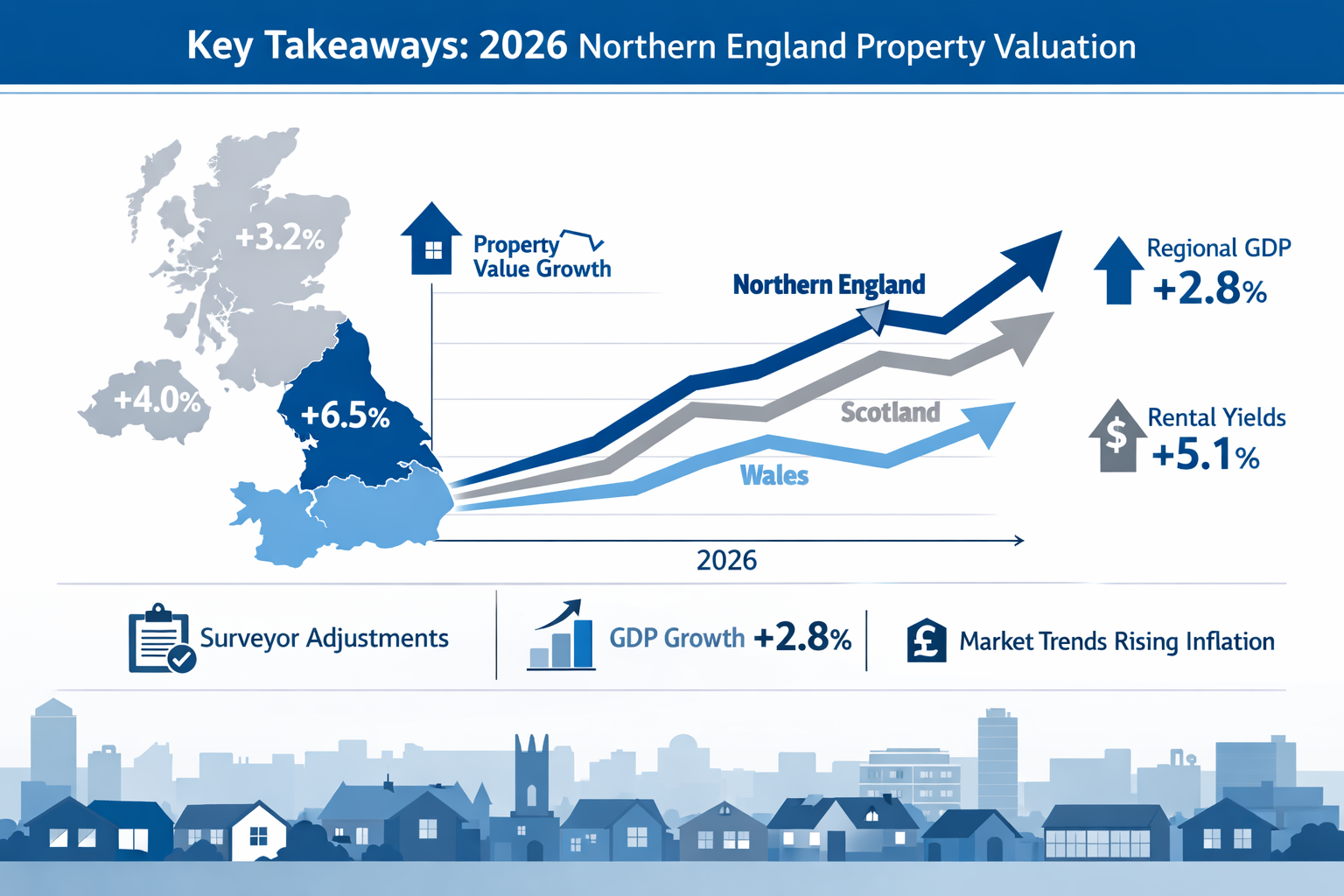
Key Takeaways
✅ Northern England, Scotland, and Wales are leading UK property growth in 2026, with forecasted annual increases of 2-4%+ compared to subdued Southern markets[1]
✅ The North East averaged £196,000 in early 2026, representing a 5% annual increase and positioning it as England's most affordable region[2]
✅ Properties in leading Northern markets sell in just over two weeks, compared to longer cycles in the South, requiring surveyors to adjust comparable selection timeframes[1]
✅ Regional price hierarchies show significant variation, from Durham at £166,000 to Northumberland at £235,000 within the North East alone[2]
✅ Affordability-driven buyer behavior is reshaping valuation fundamentals, with realistic pricing attracting broader participation and strengthening price resilience[1]
Understanding the 2026 Regional Property Boom
The Geographic Shift in UK Property Markets
The 2026 property landscape represents a fundamental departure from historical patterns. Zoopla's analysis of 120 UK postal areas identifies Motherwell, Glasgow, Paisley, Falkirk, Kirkcaldy, Edinburgh, Kilmarnock, Perth, Inverness, and Wigan as the highest-ranked markets, with forecasted annual price growth generally between 2% to over 4%[1]. This concentration of strong performers in Scotland and Northern England reflects a market responding to affordability pressures that have made Southern regions increasingly inaccessible.
The North-South price divergence has reached historic proportions. Average property values in Northern England and Scottish towns remain considerably below London and South East levels, with the North East positioned as the most affordable region in England and Wales at £196,000 compared to the national average of £351,000[1][2]. This £155,000 gap represents not just a price difference but a fundamental affordability advantage driving buyer migration and investment flows.
For surveyors working across regions, understanding these macro trends is essential context for individual property valuations. Why choose RICS surveyors becomes particularly relevant when navigating these complex regional variations.
Market Velocity and Transaction Dynamics
One of the most striking characteristics of the 2026 Northern boom is transaction velocity. Homes in leading Northern and Scottish markets are selling in just over two weeks on average, compared to longer transaction cycles in Southern regions[1]. This compressed timeframe reflects stronger buyer motivation, competitive bidding environments, and efficient deal completion.
The implications for property valuation are significant:
- Comparable sales data becomes outdated more quickly in fast-moving markets
- Time adjustments must account for rapid price appreciation
- Market condition adjustments require more frequent recalibration
- Inventory analysis must focus on current rather than historical listings
Price reduction prevalence provides another key indicator. Leading Northern and Scottish markets demonstrate resilient conditions with widespread discounting far less common than in Southern England, indicating sellers maintain asking prices more effectively[1]. When properties do sell below asking, the discounts are typically modest compared to Southern markets where significant reductions have become standard negotiating tools.
Valuing Northern England Properties in 2026: Core Methodology Adjustments
Comparable Sales Selection in High-Growth Markets
Traditional comparable sales analysis typically relies on transactions within the preceding 3-6 months. However, in markets experiencing 3-5% annual growth, this approach can systematically undervalue properties. Surveyors must implement time adjustments that accurately reflect appreciation rates specific to each micro-market.
Regional price hierarchy considerations are equally critical. Within the North East alone, Durham represents the most affordable area at £166,000 (84% of regional average), while Northumberland is the most expensive at £235,000 (120% of regional average)[2]. A surveyor valuing a property in Northumberland using Durham comparables without proper location adjustments would produce meaningless results.
Property type pricing variations add another layer of complexity:
| Property Type | North East Average | % of Regional Average |
|---|---|---|
| Detached | £357,000 | 182% |
| Semi-Detached | £188,000 | 96% |
| Terraced | £140,000 | 71% |
| Flats | £117,000 | 60% |
These variations demonstrate why property type must be carefully matched in comparable selection. A terraced house valued using semi-detached comparables would be overvalued by approximately 34%, while a flat valued against terraced comparables would be overvalued by 20%[2].
When finding the best local surveyor near you, ensure they demonstrate deep knowledge of these micro-market variations.
Supply and Demand Balance Analysis
The proportion of homes sitting unsold for more than six months remains modest in leading Northern markets, whereas parts of Southern England and London are seeing higher volumes of older listings that create downward pressure on values[1]. This inventory advantage represents a fundamental market strength that surveyors must quantify in their assessments.
Key supply-demand metrics for 2026 Northern valuations include:
📊 Days on Market (DOM): Average listing duration before sale acceptance
📊 Inventory Months: Current listings divided by monthly sales velocity
📊 List-to-Sale Ratio: Final sale price as percentage of original asking price
📊 New Listing Volume: Rate of fresh property introductions
📊 Absorption Rate: Speed at which available inventory is being purchased
The North East experienced 30,500 property sales in the February 2025–January 2026 period, representing a 19.5% decline (7,900 fewer transactions) year-over-year[2]. This transaction volume reduction might initially suggest market weakness, but when combined with price increases of 5%, it actually indicates market consolidation with stronger per-transaction values rather than expansion through volume.
For surveyors, this means:
✅ Fewer but higher-quality comparables are available
✅ Each transaction carries more analytical weight in valuation models
✅ Supply constraints support price resilience and appreciation forecasts
✅ Buyer competition remains robust despite lower overall transaction counts
RICS Valuation Standards for Regional Growth Markets
The RICS Red Book provides the professional framework for all property valuations, but its application requires careful interpretation in high-growth regional markets. Surveyors must balance historical data with forward-looking market indicators to produce valuations that reflect current market realities rather than outdated patterns.
"Higher mortgage costs have made pricing alignment with local incomes decisive; regions with realistic entry prices are attracting broader buyer participation and strengthening price resilience through distributed demand, whereas stretched affordability in Southern markets leads to hesitation and longer sales cycles."[1]
This affordability-driven buyer behavior fundamentally changes valuation assumptions. In Northern markets, demand is distributed across broader buyer segments rather than concentrated among high-income purchasers. This creates more stable market conditions and reduces volatility risk.
Understanding what to do before an RICS home survey helps buyers prepare for the valuation process and ensures accurate assessments.
Scotland and Wales: Distinct Market Characteristics
Scottish Property Market Valuation Considerations
Scotland's property market presents unique characteristics that require specialized surveyor knowledge. Glasgow, Edinburgh, Perth, and Inverness all feature in the top-performing markets for 2026, but each demonstrates distinct price points and buyer demographics[1].
Scottish legal differences significantly impact valuation methodology:
🏴 Offers over system: Properties marketed at minimum acceptable price rather than asking price
🏴 Sealed bid process: Competitive offers submitted without knowledge of competing bids
🏴 Surveys before offers: Buyers typically commission surveys before making offers
🏴 Binding offers: Accepted offers create legally binding contracts immediately
These procedural differences mean Scottish property valuations must account for:
- Premium above "offers over" price in competitive markets (typically 5-15%)
- Survey contingency absence requiring more conservative condition assessments
- Faster transaction certainty reducing market risk adjustments
- Regional variation in bidding intensity between urban and rural markets
Welsh Property Market Growth Dynamics
Wales presents a middle ground between Scottish and English markets, with an average property price of £239,000 positioning it between the North East (£196,000) and North West (£250,000)[2]. The Welsh market benefits from both lifestyle migration and local economic development.
Key valuation considerations for Welsh properties include:
✅ Coastal premium variations: Significant price differences between coastal and inland locations
✅ Language considerations: Welsh-speaking communities may have distinct buyer pools
✅ Tourism property dual-use: Many properties serve both residential and holiday let functions
✅ Rural connectivity: Broadband and transport links significantly impact values
✅ National Park proximity: Properties near Snowdonia, Brecon Beacons, or Pembrokeshire Coast command premiums
The Welsh Government's approach to second homes and holiday lets has created additional valuation complexity. Surveyors must understand local authority policies on occupancy restrictions and their impact on market values.

Practical Surveyor Adjustments for 2026 Regional Valuations
Time and Market Condition Adjustments
In markets experiencing 3-5% annual appreciation, time adjustments become critical. A comparable sale from six months ago requires approximately 1.5-2.5% upward adjustment to reflect current market conditions. However, this adjustment must be calibrated to specific micro-markets rather than applied uniformly.
Monthly adjustment calculation methodology:
- Identify regional annual appreciation rate from recent sales data (e.g., 4% for North East)
- Convert to monthly rate (4% ÷ 12 = 0.33% per month)
- Calculate months between comparable sale and valuation date (e.g., 5 months)
- Apply cumulative adjustment (0.33% × 5 = 1.65% upward adjustment)
For properties where you can renegotiate after a poor building survey result, these time adjustments must be carefully explained to support negotiation positions.
Location and Neighborhood Adjustments
Micro-market variation within regions requires sophisticated location adjustments. Durham at £166,000 versus Northumberland at £235,000 represents a 42% price differential within the same region[2]. Surveyors must quantify these differences through:
- Postal code analysis: Granular price data by specific postal sectors
- School catchment areas: Premium for properties in high-performing school zones
- Transport connectivity: Proximity to rail stations, motorways, and airports
- Employment centers: Distance to major employers and business parks
- Amenity access: Walkability scores and local facility availability
Property Condition and Modernization Adjustments
The age and condition of Northern England's housing stock requires careful adjustment. Many properties are Victorian or Edwardian terraced houses requiring modernization. Condition adjustments must reflect local market expectations rather than London standards.
Typical adjustment ranges for Northern markets:
| Condition Factor | Adjustment Range |
|---|---|
| Full modernization | +10% to +15% |
| Partial modernization | +5% to +10% |
| Original condition (good) | Baseline |
| Deferred maintenance | -5% to -15% |
| Significant defects | -15% to -30% |
Understanding common myths about property surveys helps both surveyors and clients approach condition assessments realistically.
Market Outlook and Forward-Looking Valuation Considerations
Sustainability of Regional Growth
The question facing surveyors in 2026 is whether current regional growth rates are sustainable or represent a temporary rebalancing. Several factors suggest medium-term sustainability:
💰 Affordability fundamentals remain strong: Northern regions continue offering entry points accessible to median-income households
💰 Remote work permanence: Hybrid working models allow location flexibility previously impossible
💰 Infrastructure investment: Government levelling-up initiatives continue supporting Northern development
💰 Demographic trends: Younger buyers priced out of Southern markets seeking alternatives
💰 Rental yield advantages: Northern properties offer superior yields attracting investor capital
However, risks include:
⚠️ Interest rate sensitivity: Higher mortgage costs disproportionately impact affordable markets
⚠️ Economic uncertainty: Regional employment vulnerability to economic downturns
⚠️ Supply response: New construction potentially increasing inventory and moderating prices
⚠️ Policy changes: Government intervention in housing markets creating regulatory risk
Integration of Technology and Data Analytics
Modern property valuation increasingly relies on automated valuation models (AVMs) and big data analytics. However, in rapidly changing regional markets, these tools require careful calibration and professional judgment overlay.
Best practices for 2026 regional valuations include:
✅ Hybrid approach: Combining AVM outputs with traditional comparable analysis
✅ Real-time data integration: Using current listing and sales data rather than lagged datasets
✅ Sentiment analysis: Incorporating RICS market sentiment surveys and local agent feedback
✅ Predictive modeling: Forward-looking adjustments based on pipeline developments and infrastructure projects
✅ Transparency: Clear documentation of adjustment rationale and data sources
Choosing between Level 2 and Level 3 surveys depends partly on market conditions and the complexity of valuation adjustments required.
Regional Variations Within Northern England
North East Market Characteristics
The North East represents England's most affordable region at £196,000 average, making it particularly attractive to first-time buyers and investors seeking yield[2]. The region's property market benefits from:
- Major regeneration projects in Newcastle, Sunderland, and Middlesbrough
- Strong university presence creating rental demand
- Coastal lifestyle appeal in areas like Tynemouth and Whitley Bay
- Heritage property stock offering character at accessible prices
However, surveyors must account for:
- Economic vulnerability to industrial sector changes
- Population decline in some former mining communities
- Property condition challenges in older housing stock
- Variable demand between urban centers and rural areas
North West and Yorkshire Markets
The North West averaged £250,000 and Yorkshire £238,000, positioning them above the North East but well below national averages[2]. These regions offer:
🏘️ Diverse urban centers: Manchester, Liverpool, Leeds, Sheffield providing employment and culture
🏘️ Strong transport links: Excellent motorway and rail connectivity
🏘️ Educational institutions: Multiple universities supporting rental markets
🏘️ Lifestyle balance: Urban amenities with countryside access
Valuation considerations include:
- City center premium: Significant price differences between urban and suburban locations
- Commuter belt dynamics: Properties within reasonable commute to major cities commanding premiums
- Regeneration area volatility: Emerging neighborhoods showing rapid appreciation but higher risk
- Property type preferences: Strong demand for family homes in good school catchments
Practical Guidance for Buyers and Sellers
For Property Buyers in Northern Markets
When purchasing in high-growth Northern regions, buyers should:
- Commission professional surveys early: In fast-moving markets, understanding what to do when your property offer has been accepted includes arranging surveys promptly
- Understand local micro-markets: Research specific neighborhoods rather than relying on regional averages
- Factor in modernization costs: Many Northern properties require updates; budget accordingly
- Consider future growth potential: Infrastructure projects and regeneration plans impact long-term values
- Work with local specialists: Surveyors with deep regional knowledge provide more accurate assessments
For Property Sellers in Regional Markets
Sellers can maximize values by:
✅ Timing sales strategically: Current market momentum favors sellers in most Northern locations
✅ Presenting properties optimally: Modest improvements can yield disproportionate value increases
✅ Pricing realistically: Overpricing risks extended marketing periods even in strong markets
✅ Providing documentation: Energy performance certificates, guarantees, and planning permissions add confidence
✅ Engaging quality surveyors: Professional valuations support asking prices and facilitate negotiations
Conclusion: Navigating the 2026 Regional Property Boom
Valuing Northern England Properties in 2026 Boom: Surveyor Adjustments for Scotland, Wales and Regional Growth represents both opportunity and challenge for property professionals. The geographic shift in UK property market strength demands sophisticated valuation methodologies that account for rapid appreciation, compressed transaction cycles, and significant regional variation.
The North East's £196,000 average, representing 5% annual growth, exemplifies the affordability-driven demand reshaping British property markets[2]. Scottish cities and Welsh communities are experiencing similar dynamics, with properties selling in just over two weeks and price reductions remaining uncommon[1]. These conditions require surveyors to recalibrate traditional approaches, incorporating real-time data, forward-looking adjustments, and deep micro-market knowledge.
Actionable Next Steps
For those navigating these dynamic regional markets:
🎯 Engage RICS-qualified surveyors with specific regional expertise and recent comparable knowledge
🎯 Request detailed adjustment explanations understanding how time, location, and condition factors were applied
🎯 Monitor local market indicators including days on market, inventory levels, and transaction volumes
🎯 Consider professional guidance for complex valuations in rapidly appreciating micro-markets
🎯 Stay informed on regional developments including infrastructure projects and policy changes affecting values
The 2026 regional property boom offers significant opportunities for buyers, sellers, and investors who understand the valuation complexities driving these markets. Professional surveyor expertise has never been more valuable in translating market dynamics into accurate property assessments that support confident decision-making.
Whether purchasing a £140,000 terraced house in Durham or a £235,000 property in Northumberland, understanding the surveyor adjustments that determine these valuations ensures fair pricing and successful transactions in Britain's most dynamic property markets.
References
[1] Why Northern England And Scotland Are Set To Lead Uk House Price Growth In 2026 – https://www.belvoir.co.uk/guides/news/why-northern-england-and-scotland-are-set-to-lead-uk-house-price-growth-in-2026/
[2] North East House Prices – https://www.plumplot.co.uk/North-East-house-prices.html