


The UK property market in 2026 presents a unique challenge for chartered surveyors and valuation professionals. With national forecasts predicting modest growth of just 2-5%, the days of dramatic double-digit increases have given way to a period of careful calibration. This stabilising market environment demands refined methodologies that can capture subtle uplifts while accounting for significant regional contrasts and persistent buyer caution. Understanding Valuation Techniques for Modest 2-5% Price Growth Properties: RICS Tools for 2026 Stabilising Markets has become essential for professionals seeking accurate, defensible valuations in an era of measured optimism.

Key Takeaways
- Updated RICS Red Book standards effective January 2025 provide reorganised valuation frameworks specifically suited for modest growth environments
- Regional market monitoring is critical as different UK areas experience varying growth rates within the 2-5% national forecast band
- ESG factors now play a mandatory role in commercial property valuations under the fourth edition standards effective April 2026
- Comparative market analysis requires greater precision when price movements are subtle, demanding robust data collection and adjustment techniques
- Professional valuers can leverage increased transaction volumes forecast for 2026 to build stronger comparable evidence databases
Understanding the 2026 Stabilising Market Context
The property market landscape in 2026 represents a significant shift from the volatility experienced in previous years. Market stabilisation doesn't mean stagnation—rather, it signals a return to predictable, sustainable growth patterns that require different analytical approaches than boom-or-bust cycles[4].
What Defines a Stabilising Market?
A stabilising market exhibits several key characteristics:
- Consistent transaction volumes with predictable seasonal patterns
- Moderate price movements typically between 2-5% annually
- Reduced speculation as investors focus on fundamentals rather than rapid appreciation
- Improved buyer confidence leading to more measured decision-making
- Lender stability with consistent mortgage availability and underwriting standards
The 2026 forecast indicates positive momentum across surveying and valuation sectors, with expected uplift in volumes across lending and surveys[5]. This increased activity provides valuers with richer datasets for comparative analysis—a crucial advantage when working with modest growth figures.
Regional Disparities Within National Trends
While national forecasts suggest 2-5% growth, successful valuation practice in 2026 requires systematic regional market monitoring[1]. The UK property market has never been truly homogeneous, but current conditions amplify these differences:
| Region | Typical Growth Range | Key Factors |
|---|---|---|
| London & Southeast | 2-3% | Affordability constraints, international investment |
| Northern England | 4-5% | Regeneration projects, relative affordability |
| Scotland | 3-4% | Stable employment, lifestyle migration |
| Wales | 3.5-4.5% | Remote work trends, tourism economy |
| Southwest | 2.5-3.5% | Retirement migration, second homes |
Understanding these regional variations is essential when selecting comparable properties and applying appropriate adjustments. A Red Book valuation must reflect local market conditions rather than relying solely on national averages.
RICS Red Book Updates: Structural Changes for 2026 Valuations
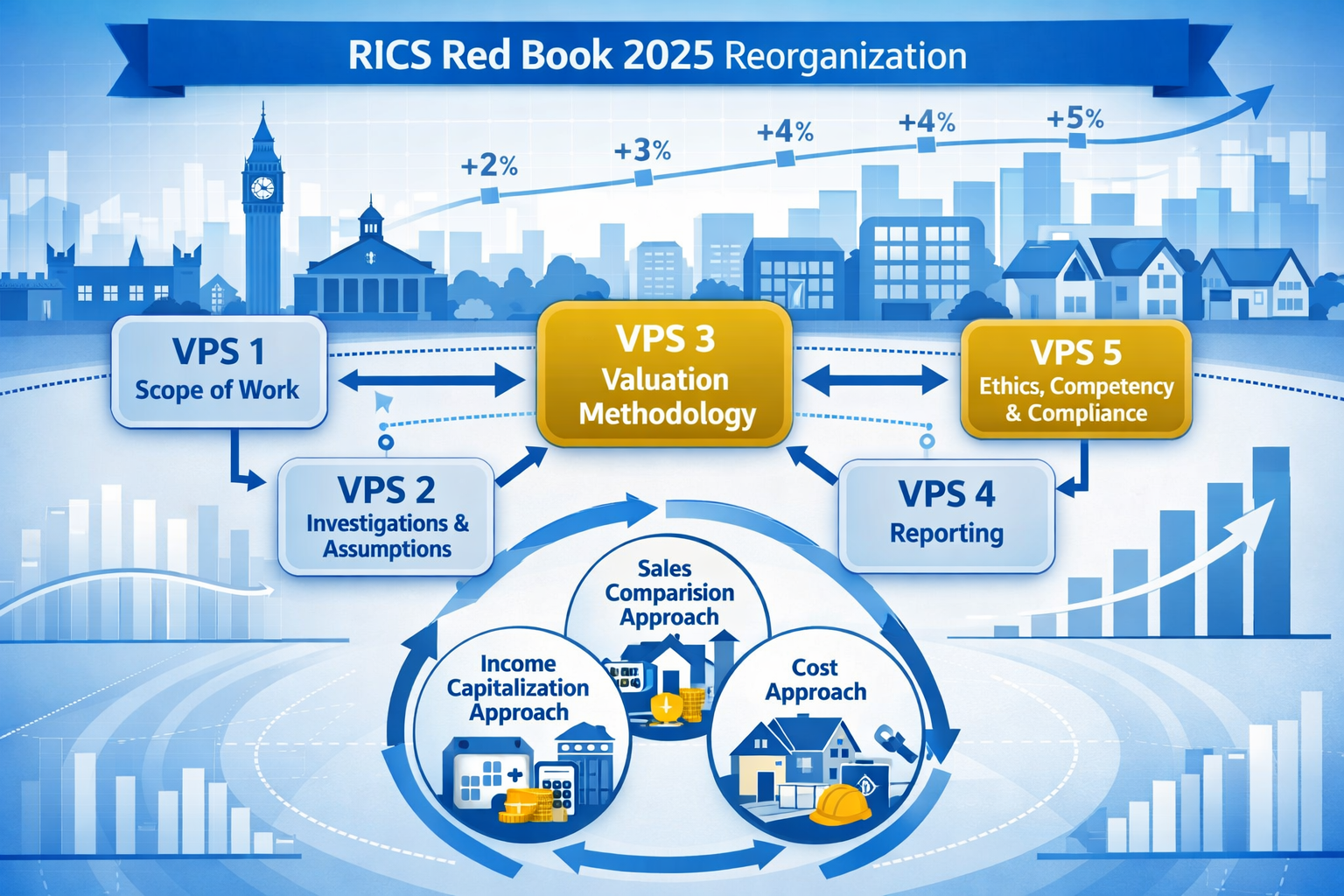
The Royal Institution of Chartered Surveyors (RICS) implemented significant structural changes to the Red Book (RICS Valuation – Global Standards) effective January 31, 2025, which directly impact how professionals approach Valuation Techniques for Modest 2-5% Price Growth Properties: RICS Tools for 2026 Stabilising Markets[2].
VPS Reorganisation: Enhanced Methodology Clarity
The most substantial change involves the reorganisation of Valuation Practice Statements (VPS). Previously, VPS 5 covered a broad range of valuation approaches. The updated structure splits this into:
- VPS 3: Valuation approaches and methods – Provides detailed guidance on the three primary valuation approaches (sales comparison, income capitalisation, and cost approach)
- VPS 5: Valuation models – Focuses specifically on the application and validation of valuation models and tools
This reorganisation offers particular benefits for modest growth markets:
✅ Greater precision in selecting appropriate methodologies for subtle price movements
✅ Clearer documentation requirements for valuation model assumptions
✅ Enhanced transparency when explaining valuation conclusions to clients
✅ Improved consistency across different valuation assignments
Applying the Sales Comparison Approach in Low-Growth Markets
The sales comparison approach remains the foundation for residential property valuation, but modest growth environments demand heightened attention to detail. Under the reorganised VPS 3, valuers must:
- Identify truly comparable properties with similar characteristics
- Apply time adjustments that accurately reflect 2-5% annual growth
- Document adjustment rationale with greater rigour
- Consider market conditions at the time of each comparable sale
When growth rates are modest, even small errors in time adjustments can significantly impact valuation accuracy. For example, if comparable sales occurred six months prior in a market experiencing 3% annual growth, the appropriate time adjustment is approximately 1.5%—a figure that requires careful calculation and justification.
Professional RICS building surveys provide essential condition information that affects these adjustments, particularly when comparing properties of different ages or maintenance standards.
Income Capitalisation for Investment Properties
For buy-to-let and commercial properties, the income capitalisation approach requires recalibration in modest growth markets. Key considerations include:
- Yield compression limits: With slower capital appreciation, yields may stabilise or even expand slightly
- Rental growth assumptions: Must align with the 2-5% capital growth environment
- Exit capitalisation rates: Require careful justification based on market evidence
- Cash flow projections: Should reflect realistic rental increases and void periods
The reorganised VPS 3 provides clearer guidance on documenting these assumptions, which is particularly valuable when valuations may be scrutinised in mortgage disputes or property disagreements.
Essential Valuation Techniques for Modest 2-5% Price Growth Properties: RICS Tools for 2026 Stabilising Markets

Accurate valuation in modest growth markets requires a refined toolkit of techniques specifically calibrated for subtle price movements. The following methodologies align with RICS standards while addressing the unique challenges of 2026's stabilising conditions.
Comparative Market Analysis (CMA) with Enhanced Precision
The comparative market analysis remains the cornerstone of residential valuation, but modest growth demands greater analytical rigour:
Data Collection Standards
- Minimum comparable sample size: 5-8 recent sales (within 6 months)
- Geographic proximity: Within 0.5-mile radius for urban areas, 2-mile radius for rural
- Property similarity: Match on at least 4 key characteristics (bedrooms, property type, age band, condition)
- Transaction verification: Confirm sale circumstances to exclude distressed or non-arm's length transactions
Adjustment Methodology
When price movements are modest, adjustment precision becomes critical. The paired sales analysis technique offers superior accuracy:
- Identify two properties that differ in only one characteristic
- Calculate the price difference attributable to that single feature
- Apply the derived adjustment percentage to subject property
- Repeat for multiple characteristic differences
- Aggregate adjustments to reach final valuation
For example, if two otherwise identical properties sold for £450,000 and £465,000, with the only difference being an additional bedroom, the adjustment for that feature is approximately 3.3% (£15,000 ÷ £450,000).
Time Adjustment Calculations for Low-Growth Environments
Accurate time adjustments are essential when working within Valuation Techniques for Modest 2-5% Price Growth Properties: RICS Tools for 2026 Stabilising Markets frameworks. The calculation methodology must account for:
Monthly Growth Rate Conversion
Annual growth rate: 3%
Monthly equivalent: (1.03)^(1/12) – 1 = 0.247%
For a comparable sale from 4 months prior:
Time adjustment: (1.00247)^4 – 1 = 0.99% ≈ 1%
Seasonal Adjustment Overlays
Modest growth markets still experience seasonal patterns. Spring typically sees 1-2% premium over winter months. Valuers must layer seasonal adjustments onto trend-based time adjustments:
- Base time adjustment: Reflects underlying market growth
- Seasonal adjustment: Accounts for time-of-year effects
- Combined adjustment: Multiplicative rather than additive approach
Quality and Condition Adjustments
Property condition significantly impacts value, particularly in markets where buyers scrutinise every aspect due to affordability constraints. A comprehensive homebuyers report provides the foundation for accurate condition adjustments.
Condition Rating Framework
| Condition | Description | Typical Adjustment |
|---|---|---|
| Excellent | Recently renovated, no repairs needed | +5% to +8% |
| Good | Well-maintained, minor cosmetic updates only | +2% to +4% |
| Average | Habitable, some updates recommended | Baseline (0%) |
| Fair | Requires modernisation, no structural issues | -5% to -8% |
| Poor | Significant repairs needed | -10% to -15% |
These adjustments should be supported by specific evidence from property inspections and recent comparable transactions showing the market's response to condition differences.
Location Micro-Analysis
Within broader regional trends, location micro-variations can significantly impact value. Factors requiring granular analysis include:
- School catchment areas: Premium of 3-7% for highly-rated schools
- Transport links: Properties within 10-minute walk of stations command 2-5% premium
- Environmental factors: Noise, air quality, green space access
- Development activity: Regeneration areas may outperform by 1-2% annually
Systematic regional market monitoring, as emphasised in current RICS guidance[1], enables valuers to quantify these location-specific factors with evidence-based adjustments.
ESG Integration in 2026 Valuation Practice
The fourth edition of RICS's global ESG standard for commercial property valuation takes effect April 30, 2026[3]. This represents a fundamental shift in how environmental, social, and governance factors must be reflected in valuation advice.
Mandatory ESG Considerations
For commercial properties, valuers must now systematically assess:
Environmental Factors
- Energy Performance Certificate (EPC) ratings and trajectory
- Climate risk exposure (flooding, overheating, storm damage)
- Embodied carbon and operational emissions
- Adaptation potential for net-zero requirements
Social Factors
- Accessibility and inclusive design features
- Community impact and stakeholder relationships
- Health and wellbeing provisions
- Local employment and economic contribution
Governance Factors
- Building safety compliance and certification
- Transparent ownership structures
- Maintenance and management quality
- Regulatory compliance track record
ESG Impact on Value in Modest Growth Markets
In stabilising markets with 2-5% growth, ESG factors can create significant value divergence:
- Premium properties (EPC A-B, strong ESG credentials): May achieve 4-5% growth
- Average properties (EPC C-D, basic compliance): Likely 2-3% growth
- Lagging properties (EPC E-G, poor ESG performance): Potential 0-1% growth or decline
This creates a "green premium" that valuers must quantify through comparable analysis of properties with different ESG characteristics. Understanding how RICS surveys help negotiate property prices becomes particularly relevant when ESG factors reveal value-impacting issues.
Technology and Data Tools for Enhanced Accuracy
Modern valuation practice increasingly relies on technology platforms that enhance accuracy in modest growth environments:
Automated Valuation Models (AVMs)
AVMs provide useful initial estimates but require professional oversight in 2-5% growth markets:
Strengths:
- Rapid processing of large comparable datasets
- Consistent application of adjustment algorithms
- Useful for portfolio-level analysis
Limitations:
- May lag in capturing subtle market shifts
- Limited ability to assess property-specific factors
- Reduced accuracy in heterogeneous markets
RICS guidance under the reorganised VPS 5 emphasises that AVMs should support rather than replace professional judgement, particularly when growth is modest and precision is critical.
Geographic Information Systems (GIS)
GIS technology enables sophisticated location analysis:
- Heat mapping of price movements at micro-market level
- Proximity analysis for amenities and transport
- Demographic overlays showing buyer demand patterns
- Environmental risk mapping for flood zones and pollution
Market Data Platforms
Subscription-based platforms provide essential comparable evidence:
- Land Registry data: Official transaction records with price paid
- Rightmove/Zoopla analytics: Asking prices, time on market, price reductions
- CoStar/EGi: Commercial property transactions and lease comparables
- Local authority planning: Development pipeline information
Practical Application: Case Study Approach
Consider a typical valuation scenario in 2026's stabilising market:
Subject Property: 3-bedroom semi-detached house, London suburb, built 1930s, good condition
Market Context: Local area experiencing 3.5% annual growth
Valuation Date: March 2026
Comparable Selection:
- Similar property sold December 2025 for £485,000
- Similar property sold January 2026 for £492,000
- Similar property sold February 2026 for £490,000
Time Adjustments:
- Comp 1: 3 months prior = 0.87% adjustment = £489,220
- Comp 2: 2 months prior = 0.58% adjustment = £494,854
- Comp 3: 1 month prior = 0.29% adjustment = £491,421
Condition Adjustments:
- Comp 1: Excellent condition (+3%) vs. subject (good) = -3% adjustment = £474,543
- Comp 2: Fair condition (-5%) vs. subject (good) = +5% adjustment = £519,597
- Comp 3: Good condition (0%) vs. subject (good) = 0% adjustment = £491,421
Location Adjustments:
- Comp 1: Slightly inferior location = +2% adjustment = £484,034
- Comp 2: Equivalent location = 0% adjustment = £519,597
- Comp 3: Superior location = -2% adjustment = £481,593
Adjusted Comparable Range: £481,593 – £519,597
Valuation Conclusion: £495,000 (mid-point with slight weighting toward Comp 3 as most similar)
This systematic approach, aligned with RICS VPS 3 methodology, demonstrates how multiple small adjustments compound to reach accurate valuations in modest growth markets.
Quality Control and Validation Processes
Professional standards demand robust quality control, particularly when margins are tight:
Internal Review Checklist
✅ Comparable verification: All sales confirmed through Land Registry
✅ Adjustment documentation: Each adjustment supported by market evidence
✅ Calculation accuracy: Mathematical checks on all adjustments
✅ Market consistency: Valuation aligns with local market trends
✅ ESG compliance: Environmental factors appropriately considered
✅ Red Book compliance: All VPS requirements satisfied
Peer Review Benefits
In modest growth markets, peer review provides valuable validation:
- Methodology verification: Confirms appropriate approach selection
- Adjustment reasonableness: Second opinion on adjustment magnitudes
- Market knowledge: Leverages collective experience of local conditions
- Risk mitigation: Reduces potential for errors in tight-margin environments
Communicating Valuation Conclusions to Clients
Effective communication becomes particularly important when explaining modest growth valuations to clients who may expect higher figures based on past market performance.
Report Structure Best Practices
Executive Summary:
- Clear valuation figure with confidence range
- Market context explanation (2-5% growth environment)
- Key value drivers and constraints
Methodology Section:
- Approach selection rationale
- Comparable property details with photographs
- Adjustment calculations with explanations
Market Analysis:
- Regional and local market trends
- Transaction volume and pricing data
- Forward-looking indicators
Limitations and Assumptions:
- Inspection scope and limitations
- Market condition assumptions
- Validity period
Managing Client Expectations
Clients in 2026 may need education about stabilising market dynamics:
- Historical context: Explain shift from rapid growth to sustainable rates
- Regional variations: Highlight how local area compares to national trends
- Investment perspective: Emphasise stability benefits over volatility
- Realistic projections: Provide evidence-based forward estimates
Understanding what to do when a property offer is accepted helps clients navigate the valuation process as part of broader transaction management.
Professional Development and Continuing Competence
The evolving standards and market conditions require ongoing professional development:
Essential Training Areas for 2026
- Updated Red Book standards: Understanding VPS reorganisation implications
- ESG valuation integration: Quantifying environmental factors
- Data analytics: Leveraging technology platforms effectively
- Regional market analysis: Developing local market expertise
- Communication skills: Explaining complex valuations clearly
RICS CPD Requirements
Chartered surveyors must maintain continuing professional development (CPD) records demonstrating:
- Minimum 20 hours annual CPD
- At least 10 hours in formal learning
- Regular review of technical standards updates
- Participation in professional networks and forums
Risk Management in Modest Growth Valuations
Professional indemnity considerations become heightened when margins are tight:
Common Valuation Risks
🔴 Over-reliance on AVMs: Automated tools may not capture subtle market nuances
🔴 Insufficient comparable evidence: Limited transactions in some micro-markets
🔴 Time adjustment errors: Compounding mistakes in low-growth calculations
🔴 Condition assessment gaps: Missing defects that impact value
🔴 Regional assumption errors: Applying national trends to local markets
Mitigation Strategies
- Expand comparable search radius when local evidence is limited
- Use multiple valuation approaches for cross-validation
- Document all assumptions with clear rationale
- Engage specialist inspectors for complex condition issues
- Maintain professional indemnity insurance with adequate coverage
Conclusion: Mastering Valuation in 2026's Measured Market
Valuation Techniques for Modest 2-5% Price Growth Properties: RICS Tools for 2026 Stabilising Markets represent a sophisticated professional discipline that demands precision, local knowledge, and adherence to evolving standards. The stabilising market environment of 2026 offers both challenges and opportunities for chartered surveyors and valuation professionals.
The reorganised RICS Red Book standards provide clearer methodological guidance, while the integration of ESG factors reflects the profession's evolution toward comprehensive value assessment. Regional market variations within the national 2-5% growth band require systematic monitoring and granular analysis to ensure accuracy.
Actionable Next Steps for Valuation Professionals
- Review updated Red Book standards: Ensure complete familiarity with VPS 3 and VPS 5 reorganisation
- Develop regional market intelligence: Establish systematic data collection for local markets
- Enhance ESG competence: Complete training on environmental factor quantification
- Invest in technology platforms: Leverage data tools for comparable analysis and market tracking
- Build quality control processes: Implement peer review and validation procedures
- Strengthen client communication: Develop clear reporting templates for modest growth contexts
- Maintain CPD compliance: Engage with ongoing professional development opportunities
For property buyers and investors, engaging qualified professionals who understand these refined techniques ensures accurate valuations that reflect true market value. Whether you're seeking a comprehensive building survey or specialised valuation advice, working with RICS-qualified surveyors provides confidence in an environment where precision matters more than ever.
The forecast uplift in transaction volumes throughout 2026[5] suggests increasing opportunities for valuers to refine their methodologies and build robust comparable databases. By embracing updated standards, leveraging technology appropriately, and maintaining rigorous analytical practices, valuation professionals can deliver the accuracy and reliability that clients, lenders, and the broader market require in this new era of measured, sustainable growth.
References
[1] Valuation Adjustments For Widening Regional Disparities Rics January 2026 Survey Insights For Surveyors – https://nottinghillsurveyors.com/blog/valuation-adjustments-for-widening-regional-disparities-rics-january-2026-survey-insights-for-surveyors
[2] Red Book Global – https://www.rics.org/profession-standards/rics-standards-and-guidance/sector-standards/valuation-standards/red-book/red-book-global
[3] Rics Publishes Fourth Edition Of Global Esg Standard For Commercial Property Valuation – https://www.lexisnexis.co.uk/legal/news/rics-publishes-fourth-edition-of-global-esg-standard-for-commercial-property-valuation
[4] Expert Witness Valuations In 2026s Stabilizing Market Rics Standards For Mortgage Disputes And Property Disagreements – https://nottinghillsurveyors.com/blog/expert-witness-valuations-in-2026s-stabilizing-market-rics-standards-for-mortgage-disputes-and-property-disagreements
[5] Surveying In 2026 Reform Recovery And Renewed Demand – https://www.lrg.co.uk/news-and-insights/surveying-in-2026-reform-recovery-and-renewed-demand/