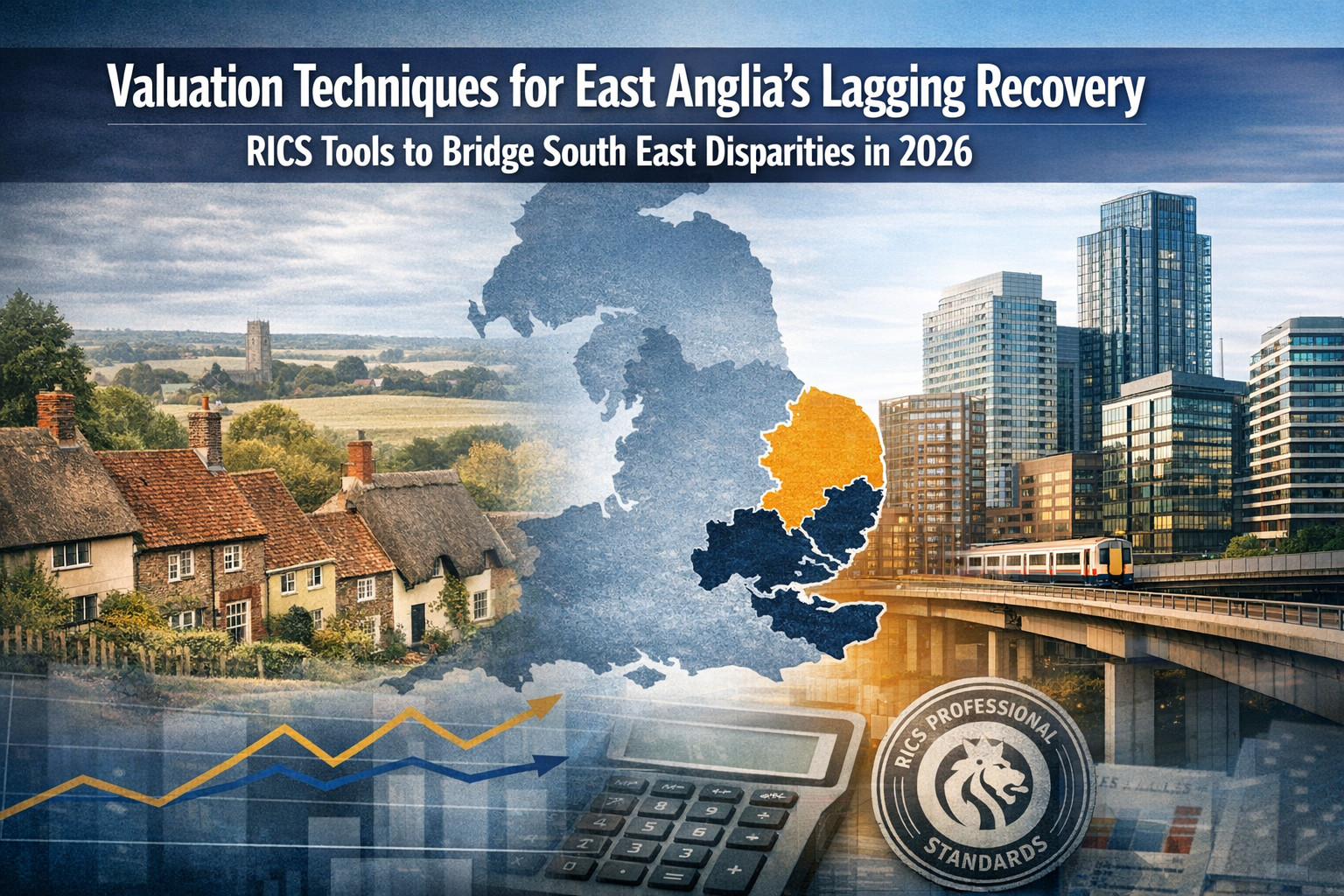
The UK property market in 2026 tells a tale of two nations. While northern regions celebrate robust growth, East Anglia faces mounting pressure with property values declining at rates that outpace the national average. For property professionals, investors, and homeowners navigating this challenging landscape, understanding the right valuation techniques for East Anglia's lagging recovery: RICS tools to bridge South East disparities in 2026 has become essential for making informed decisions.
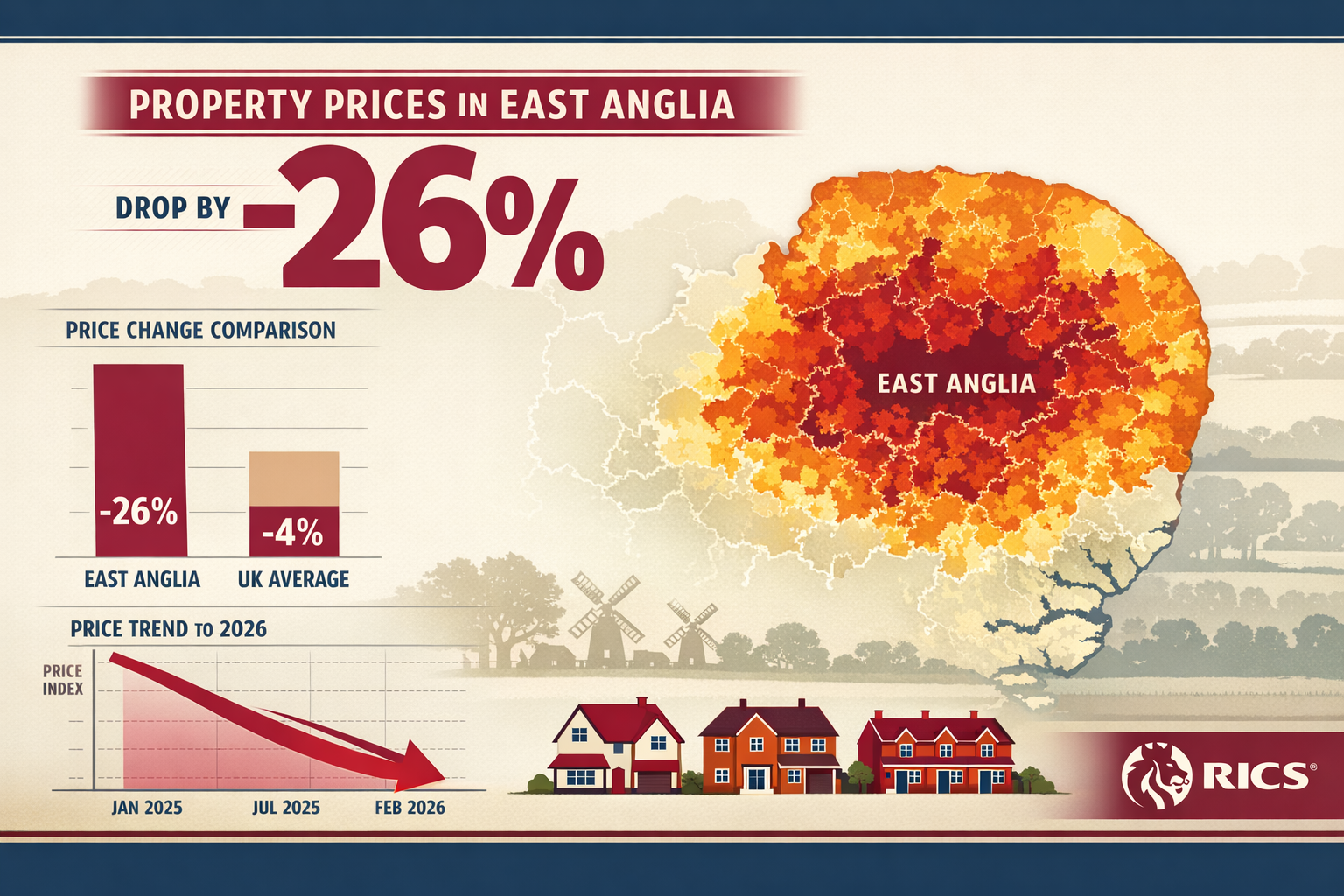
February 2026 data reveals a stark reality: East Anglia recorded a net balance of -26% in price pressure, significantly worse than the national average[3]. This regional disparity demands specialized approaches to property valuation—approaches that account for local market dynamics while maintaining professional standards. The Royal Institution of Chartered Surveyors (RICS) provides the framework and tools necessary to navigate these turbulent waters with confidence.
Key Takeaways
- East Anglia experienced -26% net price pressure in February 2026, requiring adjusted valuation methodologies compared to stronger northern markets
- RICS-backed comparable analysis must account for regional disparities, with Manchester showing +8.2% growth while East Anglia struggles
- Stock availability at 11-year highs creates buyer-favorable conditions that demand strategic valuation adjustments
- Income approach valuations gain importance as rental markets show 3% resilience despite sales market pressures
- Professional RICS surveys provide critical negotiation leverage in declining markets through detailed condition assessments
Understanding East Anglia's Market Position in 2026
The Regional Disparity Challenge
The North-South divide has intensified dramatically in 2026, creating unprecedented challenges for property valuers working across different UK regions. While Northern Ireland and Scotland continue experiencing rising prices, London and the broader South East—including East Anglia—show persistently negative readings[2]. This geographical split fundamentally changes how professionals must approach property valuation and assessment.
Manchester's remarkable 8.2% year-on-year property value surge stands in sharp contrast to London's struggling prime market as of January 2026[4]. For East Anglia, positioned between these extremes, the challenge becomes determining where local markets fit within this spectrum and adjusting valuation techniques accordingly.
East Anglia's Specific Market Indicators
The data paints a concerning picture for East Anglia's immediate prospects:
- Net price balance: -26% in February 2026[3]
- Price expectations: Dropped to -18% from -6% in just one month[3]
- Market sentiment: More negative than the headline national average
- Buyer activity: Stabilizing but cautious following sustained declines
These indicators suggest that valuation techniques for East Anglia's lagging recovery: RICS tools to bridge South East disparities in 2026 must incorporate downward pressure assumptions while maintaining objectivity and professional standards.
Why Traditional Comparables Fall Short
Standard comparable analysis—the backbone of residential valuation—struggles when regional markets diverge so dramatically. A property valued at £400,000 in Norwich cannot simply reference Manchester comparables showing 8% growth, nor can it ignore local market realities showing sustained decline.
The challenge intensifies when considering:
- Time adjustments: How to account for rapid monthly changes in sentiment
- Location premiums: Recalibrating traditional East Anglia versus London differentials
- Condition factors: Higher importance when buyers have abundant choice
- Negotiation leverage: Buyers increasingly demanding discounts in weak markets
Professional surveyors must therefore adopt more sophisticated approaches that blend multiple valuation methodologies while remaining grounded in RICS professional standards.
RICS Valuation Methodologies for Declining Markets
The Comparable Method with Regional Adjustments
The comparable method remains fundamental to residential valuation, but 2026's regional disparities demand careful refinement. RICS guidance emphasizes selecting truly comparable properties—similar in age, condition, location, and crucially, transaction timing.
Key adjustments for East Anglia in 2026:
| Adjustment Factor | Typical Range | East Anglia Consideration |
|---|---|---|
| Time adjustment | 0.5-1% monthly | Apply negative adjustments for recent sales |
| Location micro-markets | 5-15% | Increased variance within regions |
| Condition/modernization | 10-20% | Higher impact with abundant stock |
| Market conditions | Variable | Account for -26% net pressure |
When conducting building evaluations in East Anglia, professionals should prioritize comparables from the past 3-6 months rather than the traditional 6-12 month window. The rapid deterioration in sentiment means older comparables may overstate current values.
Income Approach: The Resilient Alternative
With rental markets showing 3% gains compared to early 2025[2], the income approach provides valuable validation for investment property valuations. This methodology calculates value based on income-generating potential rather than sales comparables.
Formula: Property Value = Net Operating Income / Capitalization Rate
For East Anglia properties in 2026:
- Rental growth: +3% provides stability anchor
- Yield compression: May offset some capital value decline
- Investor demand: Buy-to-let remains attractive in weak sales markets
- Long-term perspective: Smooths short-term volatility
This approach proves particularly valuable when advising clients on whether to sell in a declining market or hold for rental income. Professional property condition assessments become critical for calculating realistic maintenance costs that impact net operating income.
Cost Approach for Unique Properties
For distinctive properties lacking direct comparables—period homes, converted agricultural buildings, or architecturally significant structures common in East Anglia—the cost approach offers an alternative framework.
This methodology calculates:
- Land value (current market rate)
- Replacement cost (construction at current prices)
- Depreciation (physical, functional, external obsolescence)
- Final value = Land + (Replacement Cost – Depreciation)
In 2026's challenging market, the cost approach helps establish value floors—minimum prices below which selling becomes economically irrational for owners. This proves particularly useful when negotiating property prices in declining markets.
The Residual Method for Development Potential
Properties with development potential require specialized valuation considering both current use value and potential enhanced value. The residual method works backward from projected end value:
Residual Value = Gross Development Value – (Development Costs + Profit + Fees)
For East Anglia in 2026, this approach must account for:
- 📉 Reduced end values reflecting current market weakness
- 💰 Higher financing costs in uncertain markets
- ⏱️ Extended sales periods requiring larger contingencies
- 🏗️ Construction cost inflation squeezing margins
Implementing RICS Tools for Accurate East Anglia Valuations
RICS Red Book Standards in Practice
The RICS Valuation – Global Standards (Red Book) provides the professional framework ensuring consistency, transparency, and credibility. For East Anglia valuations in 2026, key Red Book requirements include:
Terms of Engagement: Clearly defining:
- Purpose of valuation (mortgage, sale, tax, investment)
- Basis of value (market value, investment value, fair value)
- Assumptions and special assumptions
- Limitations and restrictions
Market Value Definition: "The estimated amount for which an asset should exchange on the valuation date between a willing buyer and willing seller in an arm's length transaction, after proper marketing and where the parties had each acted knowledgeably, prudently and without compulsion."
This definition becomes particularly important when markets show distress. A -26% net price balance doesn't automatically mean 26% lower values—it reflects surveyor sentiment about direction rather than absolute change.
Leveraging RICS Market Surveys
RICS publishes monthly residential market surveys providing invaluable context for valuations. The February 2026 survey reveals[3]:
✅ New buyer enquiries: Stabilizing after sustained declines
✅ Agreed sales: Showing initial stabilization
✅ Stock levels: At 11-year highs favoring buyers
✅ Price expectations: Near-term dropping to -18%
Incorporating this market intelligence into valuation reports demonstrates professional awareness of broader trends affecting individual property values. When preparing home surveys, referencing RICS data strengthens credibility and provides context for clients.
Adjustment Factors for Local Market Conditions
Valuation techniques for East Anglia's lagging recovery: RICS tools to bridge South East disparities in 2026 must incorporate systematic adjustments reflecting local realities:
1. Market Conditions Adjustment
Apply negative adjustments to comparables from stronger market periods:
- Sales from Q3 2025: -3% to -5%
- Sales from Q4 2025: -2% to -3%
- Sales from Q1 2026: -1% to -2%
2. Negotiation Reality Factor
With stock at 11-year highs, buyers command significant negotiation power:
- Initial asking prices: Often 5-10% above achievable sale price
- Realistic marketing period: 12-16 weeks versus historical 8-12 weeks
- Price reductions: Expected on 60-70% of listings
3. Condition Premium Amplification
In buyer-favorable markets, property condition impacts value more significantly:
- Excellent condition: +10% to +15% premium
- Good condition: Baseline
- Fair condition requiring work: -15% to -25% discount
- Poor condition: -30% to -40% discount
Professional building inspections therefore become even more critical for accurate valuation in 2026's East Anglia market.
Technology-Enhanced Valuation Tools
Modern RICS professionals supplement traditional methods with technology:
🖥️ Automated Valuation Models (AVMs): Provide rapid initial estimates but require professional interpretation in volatile markets
📊 Comparative Market Analysis (CMA) Software: Streamlines comparable selection and adjustment
🗺️ Geographic Information Systems (GIS): Maps micro-market variations within regions
📱 Mobile Inspection Apps: Ensures comprehensive data capture during site visits
However, technology serves as a tool—not replacement—for professional judgment. The nuanced understanding required for valuation techniques for East Anglia's lagging recovery: RICS tools to bridge South East disparities in 2026 demands experienced human analysis.
Strategic Applications for Different Stakeholders

For Homebuyers: Maximizing Negotiation Leverage
East Anglia's challenging market creates unprecedented opportunities for informed buyers. Understanding valuation techniques enables strategic positioning:
Pre-Purchase Strategy:
- Commission independent RICS survey before making offers
- Research comparable sales from past 3-6 months
- Calculate realistic value accounting for condition issues
- Factor in 11-year high stock levels when negotiating
Negotiation Approach:
- Present evidence-based valuations supported by RICS methodology
- Highlight specific condition issues requiring remediation
- Reference broader market weakness (-26% net pressure)
- Propose realistic prices reflecting current market realities
Buyers who understand the difference between survey levels can select appropriate investigation depth for their circumstances. In declining markets, more comprehensive Level 3 surveys often justify their cost through enhanced negotiation leverage.
For Sellers: Realistic Pricing Strategies
Sellers face difficult decisions in 2026's East Anglia market. Professional valuation guidance helps avoid common pitfalls:
Pricing Psychology:
- ❌ Avoid: Pricing based on 2024-2025 peak values
- ❌ Avoid: Ignoring comparable evidence showing decline
- ✅ Do: Price competitively within current market range
- ✅ Do: Emphasize property condition and unique features
Market Positioning:
With price expectations at -18% for the near term[3], properties priced optimistically risk extended marketing periods and eventual price reductions—creating negative perception. Better to price realistically initially and achieve quicker sales.
Value Enhancement:
Before listing, address issues that building surveys typically identify:
- Damp or moisture problems
- Roof condition concerns
- Outdated electrical or heating systems
- Cosmetic improvements with high return-on-investment
For Investors: Identifying Opportunity in Adversity
Sophisticated investors recognize that declining markets create opportunities. Valuation techniques for East Anglia's lagging recovery: RICS tools to bridge South East Disparities in 2026 help identify undervalued properties with strong fundamentals.
Investment Criteria for 2026:
| Factor | Target Metric | Rationale |
|---|---|---|
| Gross yield | 6%+ | Compensates for capital risk |
| Rental growth potential | 3%+ annually | Matches current market trend |
| Location fundamentals | Strong employment, transport | Supports long-term recovery |
| Purchase discount | 15%+ below 2025 peak | Provides capital appreciation potential |
| Condition | Good to excellent | Minimizes immediate capital expenditure |
The 3% rental market growth[2] provides a buffer against capital value decline, making buy-to-let strategies viable even in weak sales markets. Professional property inspection guidance ensures investors understand true condition before committing.
For Lenders: Risk Management Through Accurate Valuation
Mortgage lenders face heightened risk in declining markets. Robust RICS-compliant valuations protect against over-lending:
Lender Valuation Priorities:
- Conservative comparable selection (recent, truly similar)
- Appropriate downward adjustments for market conditions
- Clear identification of risks and uncertainties
- Realistic forced-sale value estimates (typically 85-90% of market value)
Red Flags Requiring Caution:
- Properties on market for extended periods (12+ weeks)
- Multiple price reductions
- Significant condition issues
- Over-improvement relative to area
- Leasehold properties with short remaining terms
Understanding leasehold valuation complexities becomes particularly important when declining markets intersect with lease length concerns.
Bridging the Gap: Learning from Stronger Markets
Manchester's Success Factors
Manchester's 8.2% year-on-year growth[4] offers lessons for understanding East Anglia's challenges and potential recovery paths:
Manchester Advantages:
- 🏢 Economic diversification: Technology, media, professional services
- 🚄 Infrastructure investment: HS2 and Northern Powerhouse initiatives
- 🎓 Demographics: Young, growing population from universities
- 💼 Employment growth: Job creation supporting housing demand
- 💰 Affordability: Lower absolute prices attracting first-time buyers
East Anglia Challenges:
- More rural, dispersed economy
- Limited major infrastructure projects
- Aging demographic profile in some areas
- Higher absolute prices relative to local incomes
- Greater exposure to London market weakness
Adapting Northern Valuation Approaches
While East Anglia cannot simply replicate Manchester's conditions, valuation professionals can adapt successful approaches:
Micro-Market Analysis: Rather than treating East Anglia as homogeneous, identify pockets of strength:
- University towns (Cambridge, Norwich)
- Coastal locations with lifestyle appeal
- Commuter villages with good transport links
- Areas with employment growth
Future-Proofing Valuations: Consider long-term factors that may drive recovery:
- Remote work sustainability supporting rural locations
- Environmental quality and green space premium
- Relative affordability versus London
- Infrastructure improvements (rail electrification, road upgrades)
Professional surveyors working across multiple locations can leverage insights from stronger markets while respecting local conditions.
Practical Implementation: Case Study Approach
Case Study 1: Period Property in Rural Norfolk
Property: Detached Victorian farmhouse, 4 bedrooms, 0.5 acre
Challenge: Limited comparables, condition concerns, weak local market
RICS Valuation Approach:
-
Comparable method: Three sales within 5 miles, 6 months, adjusted for:
- Time (-3% for market deterioration)
- Size differences (+5% for additional land)
- Condition (-12% for deferred maintenance)
- Indicated value: £425,000
-
Cost approach: Validation check:
- Land value: £150,000
- Replacement cost: £350,000
- Depreciation: £75,000
- Indicated value: £425,000
-
Income approach: Investment perspective:
- Potential rental: £1,800 PCM (£21,600 PA)
- Net operating income: £18,360 (85% after costs)
- Capitalization rate: 4.5%
- Indicated value: £408,000
Final valuation: £420,000 (weighted toward comparable and cost approaches)
This multi-method approach provides confidence despite market uncertainty and limited data.
Case Study 2: Modern Development in Cambridge
Property: 2-bedroom apartment, new build, city center
Challenge: Developer pricing versus market reality, abundant competing stock
RICS Valuation Approach:
-
Comparable method: Focus on actual sales (not asking prices):
- Five recent sales in same development: £285,000-£305,000
- Adjust for floor level, parking, specification
- Indicated value: £295,000
-
Income approach: Strong rental market:
- Achievable rent: £1,400 PCM (£16,800 PA)
- Net operating income: £14,280 (85%)
- Capitalization rate: 4.8%
- Indicated value: £297,500
-
Developer pricing: £325,000 (asking price)
Analysis: Developer pricing 10% above market evidence. With stock at 11-year highs and -26% net price pressure, recommend offering £290,000-£295,000 with evidence supporting position.
Conclusion: Navigating East Anglia's Recovery with Professional Expertise
The valuation techniques for East Anglia's lagging recovery: RICS tools to bridge South East disparities in 2026 represent more than technical exercises—they provide essential navigation tools for one of the UK's most challenging regional property markets. With net price pressure at -26%, price expectations declining to -18%, and stock levels at 11-year highs, East Anglia demands sophisticated, evidence-based approaches that acknowledge current difficulties while maintaining professional rigor.
RICS methodologies—from adjusted comparable analysis to income approaches and cost validation—provide the framework for accurate valuations even amid market turbulence. The key lies in recognizing that no single approach suffices; rather, professional valuers must triangulate multiple methods, incorporate current market intelligence, and apply informed judgment to reach defensible conclusions.
Actionable Next Steps
For Property Professionals:
- 📚 Review RICS Red Book standards and recent market surveys
- 🔄 Update comparable databases with recent East Anglia transactions
- 🎯 Develop systematic adjustment frameworks for declining markets
- 📊 Incorporate rental market data into investment valuations
For Buyers and Sellers:
- 🔍 Commission professional RICS surveys before major decisions
- 📈 Research comparable evidence from past 3-6 months
- 💡 Understand valuation methodologies to negotiate effectively
- ⚖️ Balance current market weakness against long-term fundamentals
For Investors:
- 🎯 Target properties with 6%+ gross yields and strong rental potential
- 📍 Focus on micro-markets with employment and demographic strength
- 🏗️ Prioritize good condition properties minimizing immediate capital needs
- 📊 Model scenarios accounting for continued short-term weakness
The regional disparities defining 2026's UK property market will eventually moderate, but timing remains uncertain. Until recovery materializes, professional valuation expertise grounded in RICS standards provides the most reliable foundation for sound property decisions in East Anglia's challenging landscape.
For personalized guidance on property valuations and surveys in challenging markets, contact our experienced team of RICS-qualified professionals who understand both regional dynamics and technical valuation requirements.
References
[1] Uk Residential Market Survey January 2026 – https://www.rics.org/content/dam/ricsglobal/documents/market-surveys/uk-residential-market-survey/UK-Residential-Market-Survey_January-2026.pdf
[2] Uk Economy Property Update February 2026 – https://www.rics.org/content/dam/ricsglobal/documents/market-surveys/uk-economy-property-update-february-2026.pdf
[3] Uk Residential Market Survey February 2026 – https://www.rics.org/content/dam/ricsglobal/documents/market-surveys/uk-residential-market-survey/UK-Residential-Market-Survey_February-2026.pdf
[4] Navigating Widening North South Valuation Divides In 2026 Rics Techniques For Accurate Property Appraisals – https://nottinghillsurveyors.com/blog/navigating-widening-north-south-valuation-divides-in-2026-rics-techniques-for-accurate-property-appraisals