
{"cover":"Professional landscape format (1536×1024) hero image featuring bold text overlay 'Valuation Tactics for Scotland's 2026 Property Outperformance: RICS Methods to Capture Regional Gains' in extra large 72pt white sans-serif font with dark shadow and semi-transparent navy overlay box, positioned in upper third. Background shows stunning aerial view of Edinburgh's historic skyline transitioning to modern Glasgow financial district, with subtle overlay of property valuation charts and RICS certification badge. Color scheme: deep Scottish blue, white, gold accents. High contrast, magazine cover quality, editorial style with professional surveying aesthetic. Include subtle Scottish flag colors integrated into design elements.","content":["Detailed landscape format (1536×1024) illustration showing Scotland property market regional divergence with interactive map of Scotland divided into color-coded regions (Highlands, Central Belt, Borders, Islands) displaying percentage growth indicators, upward trending arrows in Edinburgh and Glasgow areas, comparative bar charts showing Scotland versus rest of UK performance metrics, RICS professional surveyor with tablet analyzing data in foreground, modern infographic style with clean lines, professional blue and gold color palette, data visualization elements including pie charts showing market share distribution across Scottish regions, subtle tartan pattern border accents","Comprehensive landscape format (1536×1024) technical diagram illustrating RICS valuation methodologies specifically for Scottish properties, split-screen composition showing three distinct valuation approaches: left panel displays comparable sales analysis with property photos and price comparison matrix, center panel shows contractor's basis method with decapitalisation rate calculations (4.6% and 2.9% clearly labeled), right panel features income capitalization approach with rental yield formulas, professional surveyor tools including measuring equipment and valuation documents, clean architectural blueprint aesthetic, navy blue headers, gold accent highlights, mathematical formulas overlaid on semi-transparent boxes, Scottish property examples including tenement flats and commercial buildings","Detailed landscape format (1536×1024) infographic showing ESG criteria impact on Scottish property valuations with large central EPC rating scale from A to G, color-coded energy efficiency bands (green for A, red for G), percentage value impact indicators beside each rating level, modern Scottish residential properties (traditional tenements and new builds) with floating EPC certificates, bar graph comparing price premiums for different EPC ratings in Scottish market, RICS sustainability guidelines checklist, professional green and blue color scheme representing environmental focus, clean data visualization with clear typography, icons representing solar panels, insulation, and energy efficiency measures specific to Scottish climate conditions"]"}

Scotland's property market is defying national trends in 2026, emerging as a standout performer while other UK regions struggle to gain momentum. As RICS data reveals stark regional differences across the United Kingdom, Scottish property values are demonstrating resilience and growth that demand specialized valuation approaches. Understanding the Valuation Tactics for Scotland's 2026 Property Outperformance: RICS Methods to Capture Regional Gains has become essential for surveyors, investors, and property professionals seeking to accurately assess and capitalize on this regional divergence.
The Scottish property landscape in 2026 presents unique opportunities and challenges. With the non-domestic property revaluation taking effect on 1 April 2026 and residential markets showing renewed confidence, surveyors must employ sophisticated methodologies that account for local market dynamics, regulatory frameworks, and emerging trends. This comprehensive guide explores the proven RICS-approved valuation tactics that enable professionals to justify premiums, identify value drivers, and deliver accurate assessments in Scotland's outperforming market.
Key Takeaways
✅ Scotland leads UK regional recovery: January 2026 RICS survey data confirms Scotland's distinct market conditions and outperformance compared to other UK regions, requiring tailored valuation approaches[1]
✅ Comparable sales analysis is critical: With regional price divergence accelerating, accurate comparable selection within Scottish submarkets ensures defensible valuations that reflect true market conditions
✅ RICS methodologies adapted for Scotland: Contractor's basis decapitalisation rates (4.6% standard, 2.9% for specific property types) and updated practice notes provide framework for the 2026 revaluation[2][5]
✅ ESG criteria increasingly impact values: Energy Performance Certificate (EPC) ratings now significantly affect Scottish property valuations, with lower-rated properties experiencing measurable price reductions[3]
✅ Local market indicators essential: Understanding Scottish-specific factors including skills shortages, infrastructure development, and regulatory changes enables more accurate value assessments[4]
Understanding Scotland's 2026 Property Market Outperformance
The Regional Divergence Phenomenon
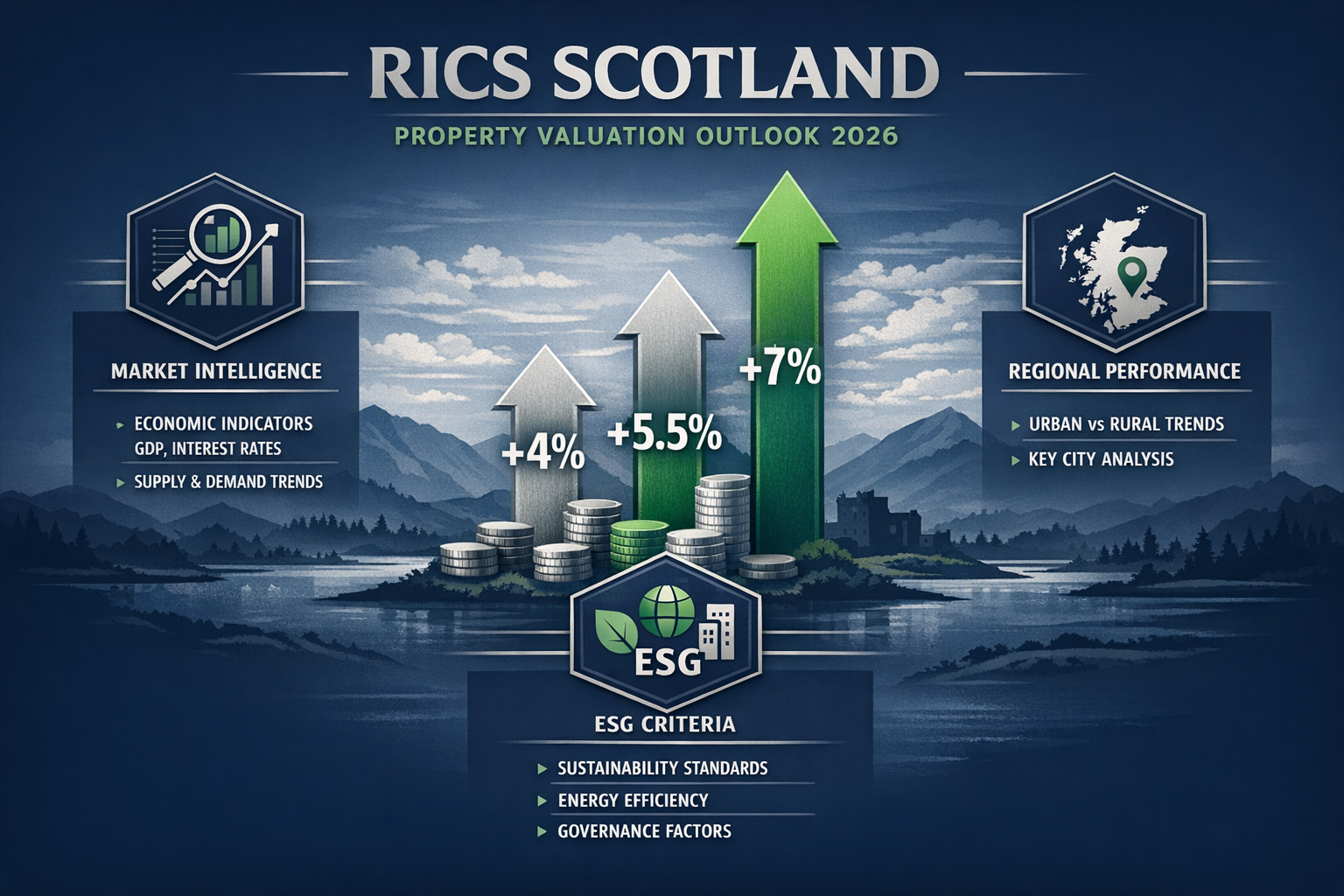
The UK property market in 2026 is characterized by unprecedented regional variation, with Scotland emerging as a clear outperformer. According to the January 2026 RICS UK Residential Market Survey, the market is showing "tentative signs that it may be turning a corner," but this recovery is far from uniform across regions[1]. Scotland's distinct market conditions reflect a combination of factors including stronger local economic fundamentals, housing supply constraints, and demographic shifts.
This regional divergence creates both opportunities and challenges for property valuers. Traditional valuation approaches that rely heavily on national benchmarks or broad UK-wide data fail to capture the nuances of Scotland's performance. Surveyors must recognize that Scotland operates as a distinct property market with its own drivers, constraints, and value determinants.
The Valuation Tactics for Scotland's 2026 Property Outperformance: RICS Methods to Capture Regional Gains must therefore begin with acknowledging this fundamental regional separation. Properties in Edinburgh, Glasgow, Aberdeen, and smaller Scottish markets each exhibit unique characteristics that demand localized analysis rather than one-size-fits-all approaches.
Key Drivers of Scottish Market Strength
Several factors contribute to Scotland's 2026 property market outperformance:
🏘️ Constrained supply dynamics: RICS warns that shortages of skilled professionals, particularly surveyors, are constraining housing supply across Scotland[4]. This supply-demand imbalance supports price growth and creates upward pressure on valuations.
📊 Infrastructure investment: Major infrastructure projects across Scotland are enhancing connectivity and attractiveness of previously undervalued areas, creating localized value uplift that requires careful assessment.
💼 Economic diversification: Scotland's economy has diversified beyond traditional sectors, with growth in technology, renewable energy, and financial services supporting employment and housing demand in key urban centers.
🌍 International appeal: Scotland's cultural heritage, educational institutions, and quality of life continue attracting international buyers and investors, particularly in prime Edinburgh and Glasgow markets.
The 2026 Revaluation Context
The Scottish non-domestic property revaluation taking effect on 1 April 2026 represents a critical milestone for commercial property valuations[2]. Based on a tone date of 1 April 2025, this revaluation provides a snapshot of market conditions and establishes the framework for rateable values across Scotland's commercial property stock.
For professionals working with RICS surveys, understanding the revaluation timeline and methodology is essential. The draft valuation roll was published on 30 November 2025, providing transparency into how Scottish Assessors have applied valuation principles across different property types[5].
The maintenance of decapitalisation rates at 4.6% (standard) and 2.9% (for educational, church, and healthcare properties) signals regulatory stability that supports consistent valuation approaches[2]. However, surveyors must still exercise professional judgment in applying these rates to individual properties based on specific circumstances.
RICS-Approved Valuation Methodologies for Scottish Properties
Comparable Sales Analysis: The Foundation of Accurate Valuation
Comparable sales analysis remains the gold standard for residential property valuation in Scotland's 2026 market. However, the effectiveness of this approach depends entirely on the quality, relevance, and recency of comparable evidence selected. In a market characterized by regional outperformance and local variation, selecting appropriate comparables requires both technical expertise and deep market knowledge.
Selecting Relevant Comparables in Scottish Markets
The first principle of effective comparable analysis is geographic proximity. In Scotland's diverse property landscape, values can vary significantly over short distances due to school catchment areas, transport links, neighborhood characteristics, and local amenities. Surveyors should prioritize comparables within the same postcode district or, ideally, the same neighborhood.
Time adjustments are particularly critical in 2026 given the market's recovery trajectory. Comparables from six months ago may not reflect current market sentiment, particularly in areas experiencing rapid appreciation. RICS guidance suggests adjusting for market movement when using comparables older than three months in dynamic markets.
Property characteristics must align closely with the subject property. In Scottish markets, specific features carry particular weight:
- Property type: Traditional tenement flats, Victorian villas, Georgian townhouses, and modern apartments each command different value premiums
- Condition and specification: Period features, modern upgrades, and energy efficiency improvements significantly impact values
- Outdoor space: Gardens, balconies, and terraces command substantial premiums in urban Scottish markets
- Parking provision: Off-street parking adds measurable value, particularly in Edinburgh and Glasgow city centers
Adjusting for Market Conditions
The Valuation Tactics for Scotland's 2026 Property Outperformance: RICS Methods to Capture Regional Gains require sophisticated adjustment techniques that account for Scotland's specific market dynamics. Surveyors should consider:
Supply-demand imbalances: In areas with acute housing shortages, properties with desirable characteristics may command premiums beyond what historical comparables suggest. The skills shortage constraining new development[4] intensifies this effect in certain Scottish submarkets.
Buyer sentiment shifts: The January 2026 RICS survey indicates that confidence is returning to the market, with expectations for sales and prices becoming "decisively more positive"[1]. This improving sentiment may justify upward adjustments to older comparable evidence.
Local market knowledge: Understanding micro-market trends within Scottish cities enables more accurate adjustments. Areas benefiting from new transport links, school improvements, or regeneration projects may be appreciating faster than broader market indicators suggest.
For professionals seeking comprehensive property evaluation approaches, integrating comparable analysis with other valuation methods provides additional validation and confidence in final value conclusions.
The Contractor's Basis Method for Specialized Properties
For properties without active markets or sufficient comparable evidence, the contractor's basis method (also known as the depreciated replacement cost method) provides an alternative RICS-approved approach. This method is particularly relevant for specialized properties in Scotland's 2026 revaluation.
Understanding Decapitalisation Rates
Scotland prescribes specific decapitalisation rates for contractor's basis valuations[2]:
| Property Type | Decapitalisation Rate | Application |
|---|---|---|
| Standard commercial/industrial | 4.6% | Most commercial properties, industrial units, retail premises |
| Educational properties | 2.9% | Schools, universities, training facilities |
| Churches and religious buildings | 2.9% | Places of worship, religious community centers |
| Healthcare facilities | 2.9% | Hospitals, clinics, care homes |
These rates remained unchanged from the 2023 revaluation, providing consistency and predictability for valuers and property owners. The lower rate for educational, church, and healthcare properties reflects their specialized nature, limited market, and public benefit characteristics.
Applying the Contractor's Method
The contractor's basis method involves several steps:
- Estimate replacement cost: Calculate the cost to rebuild the property to modern standards, including land value, construction costs, and professional fees
- Apply depreciation: Adjust for age, obsolescence, and condition to reflect the actual property rather than a hypothetical new build
- Apply decapitalisation rate: Convert the depreciated replacement cost to an annual value using the prescribed rate
- Consider local factors: Adjust for location-specific factors that might affect value
Scottish Assessors are responsible for applying appropriate decapitalisation rates when using the contractor's method[2], but private sector surveyors conducting valuations for other purposes should follow the same framework to ensure consistency with official valuations.
The 2026 Practice Notes published by Scottish Assessors provide detailed guidance on applying the contractor's basis method across different property types[5], offering valuable reference material for surveyors working on specialized properties.
Income Capitalization Approach for Investment Properties
For income-producing properties, the income capitalization approach provides a direct link between rental income and capital value. This method is particularly relevant for Scotland's commercial property market and buy-to-let residential sector.
Rental Value Assessment
Accurate rental value assessment forms the foundation of income capitalization. In Scotland's 2026 market, rental values reflect:
Tenant demand patterns: Strong employment growth in key sectors supports rental demand in Edinburgh, Glasgow, and Aberdeen, while smaller markets may show more modest rental growth
Regulatory environment: Scottish letting regulations, including rent controls in designated areas and tenant protection measures, affect achievable rents and investment yields
Property quality and specification: Modern, energy-efficient properties with strong EPC ratings command rental premiums, as discussed in the ESG section below
The 2026 Practice Notes include specific guidance on adjustment of rents to reflect market conditions, providing a framework that private sector valuers can adapt for investment property assessments[5].
Yield Selection and Application
Selecting appropriate yields requires understanding both property-specific factors and broader market conditions. In Scotland's 2026 market, yields reflect:
- Location quality: Prime Edinburgh and Glasgow locations command lower yields (higher capital values) than secondary locations
- Property type and condition: Modern, well-maintained properties with strong tenant covenants justify lower yields
- Market sentiment: The improving confidence noted in RICS data[1] supports yield compression in certain Scottish markets
- Risk factors: Properties requiring capital expenditure, facing regulatory challenges, or with uncertain tenant demand require higher yields
For investors and surveyors working with Red Book valuations, understanding yield selection in Scotland's distinct market environment ensures defensible investment valuations.
Capturing Regional Gains Through Local Market Intelligence
Leveraging Scottish-Specific Data Sources
The Valuation Tactics for Scotland's 2026 Property Outperformance: RICS Methods to Capture Regional Gains depend heavily on accessing and interpreting Scottish-specific market data. Unlike England and Wales, Scotland maintains distinct property registration and valuation systems that provide unique data sources.
Registers of Scotland
Registers of Scotland maintains comprehensive property transaction data, providing transparent evidence of actual sale prices across all Scottish property markets. This data offers several advantages:
✅ Complete coverage: All property transactions are recorded, providing comprehensive market evidence
✅ Price transparency: Actual sale prices are publicly available, eliminating estimation uncertainty
✅ Searchable database: Surveyors can efficiently identify relevant comparables by location, property type, and transaction date
✅ Historical trends: Long-term data enables analysis of price trends and market cycles
Effective use of Registers of Scotland data requires understanding how to filter and analyze transactions to identify truly comparable sales while excluding outliers, distressed sales, or transactions with special circumstances.
Scottish Assessors' Valuation Roll
The valuation roll maintained by Scottish Assessors provides rateable values for all non-domestic properties[2]. While these are not market values, they offer useful reference points for commercial property valuations and can help identify properties that may be over or under-valued relative to their assessed rateable values.
The draft valuation roll published on 30 November 2025[5] provides current rateable value assessments based on April 2025 market conditions, offering a snapshot of how independent assessors have valued Scotland's commercial property stock.
RICS Regional Market Data
The January 2026 RICS UK Residential Market Survey specifically identifies Scotland's distinct market conditions[1], providing valuable context for understanding regional performance. Surveyors should regularly review RICS regional data to understand:
- Sales activity trends: How transaction volumes in Scotland compare to other UK regions
- Price expectations: Whether market participants expect prices to rise, fall, or remain stable
- Stock levels: How property availability affects market dynamics
- Buyer enquiry patterns: Leading indicators of future market direction
Understanding Scottish Submarkets
Scotland's property market is not monolithic. Significant variation exists between and within Scottish cities, requiring granular local knowledge for accurate valuations.
Edinburgh Market Characteristics
Edinburgh's property market in 2026 exhibits several distinctive features:
🏛️ Heritage premium: Properties in the World Heritage Site areas of Old Town and New Town command substantial premiums for period features and historic significance
📚 Student demand: The city's universities create consistent rental demand in certain neighborhoods, supporting buy-to-let values
💼 Financial services employment: Edinburgh's status as a financial center supports demand for quality residential property among high-earning professionals
🎭 Tourism influence: Short-term letting regulations affect investment property values, with some areas showing higher yields due to regulatory constraints
Glasgow Market Dynamics
Glasgow's market presents different opportunities and challenges:
🏗️ Regeneration impact: Ongoing regeneration projects in areas like Finnieston and Merchant City create localized value uplift that requires careful assessment
🎨 Cultural appeal: Glasgow's cultural scene and lifestyle amenities attract young professionals, supporting demand in trendy neighborhoods
💰 Affordability advantage: Relative affordability compared to Edinburgh attracts first-time buyers and investors seeking better yields
🏢 Commercial diversity: A broad commercial property base including retail, office, and industrial creates diverse valuation requirements
Aberdeen and Regional Markets
Aberdeen and other Scottish markets each present unique characteristics:
⚡ Energy sector influence: Aberdeen's economy remains closely tied to energy sector performance, affecting both residential and commercial property values
🌾 Rural property dynamics: Scottish rural property markets operate differently from urban areas, with factors like agricultural potential, sporting rights, and lifestyle appeal affecting values
🏖️ Tourism-dependent areas: Highland and Island property markets reflect tourism economics, with seasonal variations and second-home demand influencing values
For surveyors working across multiple Scottish markets, understanding these submarket characteristics is essential for selecting appropriate comparables and making accurate value judgments.
Integrating Economic and Demographic Indicators
Valuation Tactics for Scotland's 2026 Property Outperformance: RICS Methods to Capture Regional Gains must incorporate broader economic and demographic analysis. Property values ultimately reflect the economic fundamentals that drive demand and support prices.
Employment and Income Trends
Employment growth in key Scottish sectors supports housing demand and rental values. Surveyors should monitor:
- Sector performance: Growth in technology, financial services, renewable energy, and other high-value sectors supports demand for quality housing
- Wage growth: Real income growth enables buyers to afford higher prices and supports rental affordability
- Unemployment rates: Low unemployment supports housing market confidence and reduces rental default risk
Population and Household Formation
Demographic trends drive long-term housing demand:
- Population growth: Net migration into Scottish cities supports housing demand, particularly in Edinburgh and Glasgow
- Household formation rates: Younger households forming supports demand for entry-level properties and rental accommodation
- Aging population: Growing numbers of older households create demand for accessible, low-maintenance properties
Infrastructure Investment
Infrastructure development creates localized value uplift that surveyors must identify and quantify:
- Transport improvements: New or improved rail, tram, or road links enhance connectivity and property values
- School quality: Changes in school performance or catchment areas significantly affect family housing demand
- Amenity development: New retail, leisure, or cultural facilities improve neighborhood attractiveness
Understanding these broader trends enables surveyors to identify areas likely to outperform or underperform broader Scottish market trends, improving valuation accuracy and identifying emerging opportunities.
ESG Criteria and Energy Efficiency in Scottish Valuations

The Growing Impact of Energy Performance Certificates
Energy Performance Certificates (EPCs) have evolved from administrative requirements to material value drivers in Scotland's 2026 property market. RICS research confirms that EPC ratings increasingly affect property values, with lower-rated homes showing larger price reductions and only EPC A ratings showing consistent positive market pricing[3].
This trend is particularly pronounced in Scotland due to several factors:
🌡️ Climate considerations: Scotland's colder climate makes energy efficiency more economically significant, with heating costs representing a larger proportion of household budgets
📜 Regulatory trajectory: Scottish Government policies on energy efficiency create expectations of future minimum standards, affecting demand for lower-rated properties
💚 Buyer preferences: Growing environmental awareness among Scottish buyers, particularly younger demographics, increases willingness to pay premiums for energy-efficient properties
Quantifying EPC Impact on Values
For surveyors conducting property evaluations, quantifying the value impact of EPC ratings requires careful analysis of comparable evidence. Research indicates:
EPC A properties: Command measurable premiums, particularly for flats where the relative rarity of A ratings creates scarcity value[3]
EPC B and C properties: Generally trade at market rates without significant premium or discount, representing the current market "norm"
EPC D and E properties: May experience modest discounts in competitive markets, particularly where buyers have alternative options with better ratings
EPC F and G properties: Face significant price reductions, reflecting both immediate energy cost concerns and future regulatory risk[3]
The magnitude of these impacts varies by property type, location, and market conditions. In Scotland's stronger markets, buyers may accept lower EPC ratings if other property characteristics are highly desirable, while in weaker markets, poor energy efficiency can render properties difficult to sell at any price.
Valuing Energy Efficiency Improvements
When valuing properties with recent energy efficiency improvements, surveyors must assess whether the capital expenditure translates to equivalent value uplift. Key considerations include:
Improvement type and quality: Professional installations of high-quality insulation, heating systems, or renewable energy systems generally add more value than DIY or budget solutions
EPC rating change: Improvements that move a property across rating boundaries (e.g., from E to D, or C to B) typically add more value than improvements within the same rating band
Payback period: Buyers increasingly consider the payback period for energy efficiency investments, with shorter paybacks supporting higher value attribution
Aesthetic impact: Some energy efficiency measures (like external wall insulation) can affect property appearance, potentially offsetting some value benefit
For properties requiring significant energy efficiency upgrades, surveyors should consider obtaining specific defect surveys to accurately assess the scope and cost of necessary improvements.
Future-Proofing Valuations for Regulatory Change
Scotland's evolving energy efficiency regulations create forward-looking value considerations. Surveyors must assess not just current EPC ratings but also:
📅 Regulatory timeline: Understanding when new minimum standards may take effect helps assess the urgency and cost of necessary upgrades
🏗️ Upgrade feasibility: Some properties face practical or economic barriers to achieving higher EPC ratings, creating potential value constraints
💰 Cost-benefit analysis: The relationship between upgrade costs and potential value uplift varies significantly by property type and location
🔮 Market expectations: Buyer and investor expectations about future regulations affect current willingness to pay for properties with different EPC ratings
This forward-looking approach ensures valuations reflect not just current market conditions but also reasonably foreseeable regulatory and market changes.
Professional Standards and Best Practices for Scottish Valuations
RICS Red Book Compliance
All professional valuations in Scotland must comply with RICS Valuation – Global Standards (the "Red Book"), which sets mandatory requirements for RICS members conducting valuation work. Key Red Book requirements particularly relevant to Scottish property valuations include:
Terms of Engagement
Clear terms of engagement must be agreed before commencing valuation work, specifying:
- Purpose of valuation: Whether for mortgage lending, taxation, financial reporting, or other purposes
- Basis of value: Market value, investment value, or other appropriate basis
- Assumptions and special assumptions: Any departures from standard valuation assumptions
- Inspection extent: Level of inspection to be undertaken
- Restrictions on use: Who may rely on the valuation and for what purposes
Valuation Approach and Methodology
The Red Book requires valuers to adopt appropriate methodology based on the property type and valuation purpose. For Scottish properties, this typically involves:
✅ Selecting the most relevant valuation method (comparable sales, income capitalization, contractor's basis, or combination)
✅ Gathering sufficient market evidence to support value conclusions
✅ Making appropriate adjustments for property-specific factors
✅ Considering all factors that would influence a purchaser's bid
✅ Documenting the valuation approach and reasoning
Reporting Requirements
Valuation reports must comply with Red Book minimum content requirements, including:
- Property description and location
- Tenure and tenancy details
- Inspection date and extent
- Valuation methodology
- Market commentary and evidence
- Value conclusion with appropriate caveats
- Compliance statement
For professionals seeking guidance on when formal Red Book valuations are necessary, resources on Red Book valuation requirements provide helpful context.
Continuing Professional Development
The rapidly evolving Scottish property market in 2026 demands ongoing professional development to maintain valuation competence. RICS members must complete mandatory CPD requirements, but effective surveyors go beyond minimum requirements to develop deep expertise in:
📊 Market data analysis: Interpreting transaction data, market surveys, and economic indicators to inform value judgments
🏴 Scottish property law: Understanding distinctive Scottish legal frameworks including feudal abolition remnants, title conditions, and leasehold reform
🌍 Sustainability and ESG: Staying current with energy efficiency regulations, valuation impacts, and emerging sustainability requirements
💻 Technology and data tools: Leveraging property technology, data analytics, and digital tools to enhance valuation accuracy and efficiency
The RICS Scotland Manifesto 2026 highlights the critical shortage of skilled surveyors across Scotland[4], emphasizing the importance of professional development to maintain market capacity and standards.
Quality Assurance and Peer Review
Quality assurance processes help ensure valuation accuracy and defensibility. Best practices include:
🔍 Internal review: Senior surveyors reviewing valuations prepared by junior colleagues before finalization
👥 Peer review: Independent review by another qualified surveyor for high-value or complex properties
📋 Checklist compliance: Using standardized checklists to ensure all relevant factors have been considered
📈 Post-valuation monitoring: Tracking how valuations compare to subsequent sale prices to identify systematic biases
For complex or contentious valuations, formal peer review by an independent RICS-registered valuer provides additional assurance and can help defend valuations if challenged.
Practical Application: Case Studies in Scottish Valuation
Case Study 1: Edinburgh Tenement Flat with Energy Efficiency Upgrade
Property: Two-bedroom tenement flat, Marchmont, Edinburgh
Challenge: Valuing recent energy efficiency improvements including new boiler, double glazing, and loft insulation that improved EPC rating from D to B
Valuation Approach:
- Comparable analysis: Identified six comparable sales of similar tenement flats in Marchmont within past six months
- EPC adjustment: Three comparables had EPC rating C, three had rating D; no rating B comparables available
- Market evidence: Analysis showed EPC C properties trading at approximately 2-3% premium to EPC D properties
- Adjustment rationale: Applied 4% premium for EPC B rating based on market evidence for C rating plus additional premium for rare B rating in traditional tenement stock
- Cost consideration: Verified that value uplift (approximately £12,000) exceeded improvement cost (£8,500), supporting economic rationality
Value Conclusion: £285,000 (compared to £275,000 base value for equivalent EPC D property)
This case demonstrates how Valuation Tactics for Scotland's 2026 Property Outperformance: RICS Methods to Capture Regional Gains must account for energy efficiency as a material value driver while ensuring adjustments are supported by market evidence.
Case Study 2: Glasgow Commercial Property Using Contractor's Basis
Property: Specialized healthcare facility, West End, Glasgow
Challenge: Limited comparable evidence due to specialized nature; required contractor's basis valuation for 2026 revaluation
Valuation Approach:
- Replacement cost: Estimated modern equivalent building cost at £2.8 million including land value
- Depreciation: Applied 15% depreciation for age and obsolescence (property constructed 2010, well-maintained)
- Depreciated replacement cost: £2,380,000
- Decapitalisation rate: Applied 2.9% rate prescribed for healthcare facilities[2]
- Annual value calculation: £2,380,000 × 2.9% = £69,020
Rateable Value: £69,000 (rounded)
This case illustrates proper application of Scotland's prescribed decapitalisation rates and the contractor's basis methodology for specialized properties without active markets.
Case Study 3: Aberdeen Investment Property with Yield Analysis
Property: Modern apartment building (12 units), Aberdeen city center
Challenge: Valuing investment property in market affected by energy sector volatility
Valuation Approach:
- Rental analysis: Current rents £850-950 per month per unit; market evidence supports sustainable rent of £900 per month
- Gross income: 12 units × £900 × 12 months = £129,600
- Vacancy and costs: Applied 8% deduction for vacancy and management costs = £119,232 net income
- Yield selection: Analyzed comparable investment sales showing yields of 6.5-7.5% for similar Aberdeen properties; selected 7.0% reflecting good condition and central location
- Capital value: £119,232 ÷ 0.07 = £1,703,314
Value Conclusion: £1,700,000 (rounded)
This case demonstrates income capitalization methodology adapted for Aberdeen's specific market conditions, with yield selection reflecting local investment market sentiment.
Technology and Innovation in Scottish Property Valuation
Digital Tools Enhancing Valuation Accuracy
Technology is transforming how surveyors conduct valuations in Scotland's 2026 market. Digital tools enhance accuracy, efficiency, and defensibility:
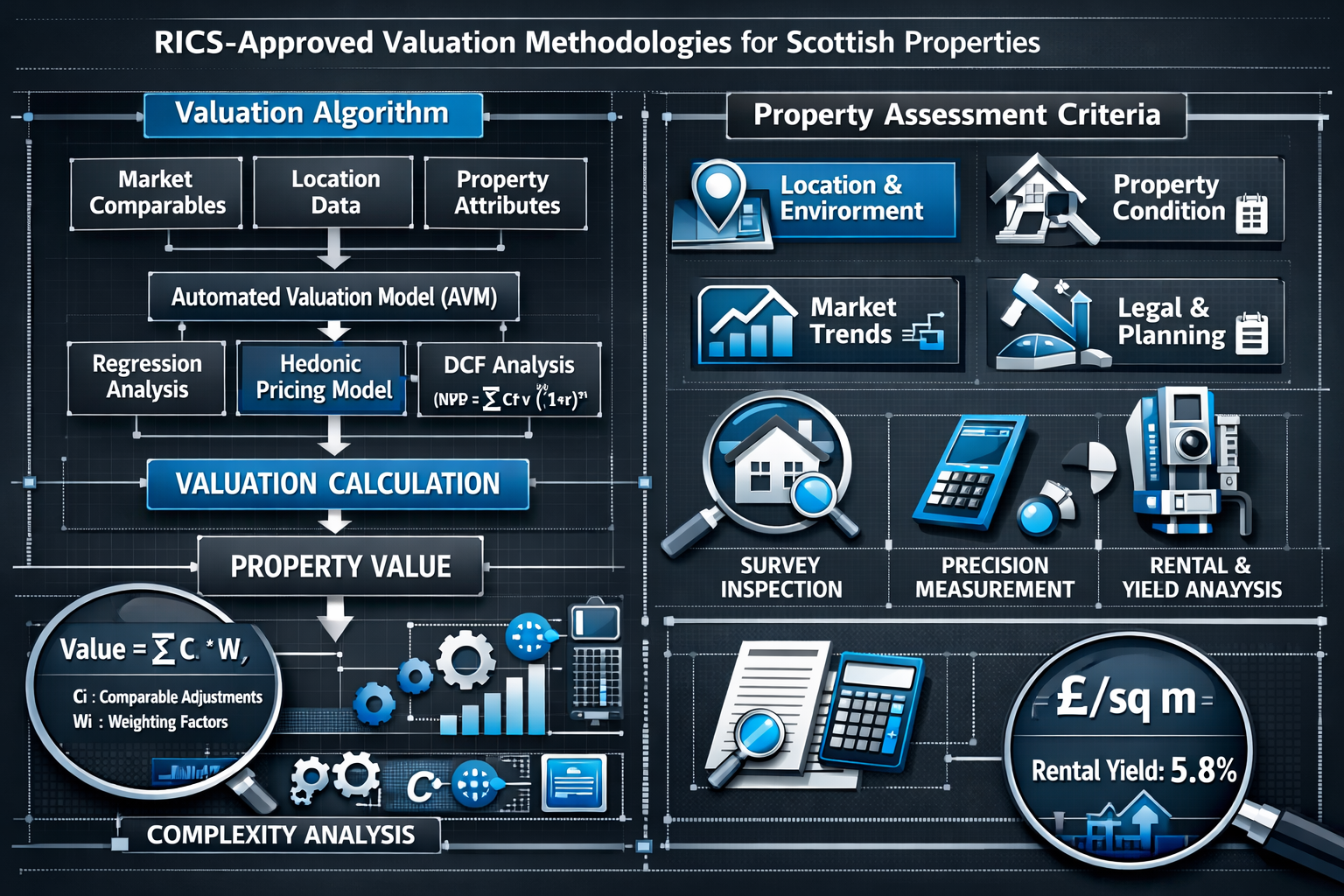
🖥️ Automated Valuation Models (AVMs): While not replacing professional judgment, AVMs provide useful reference points and help identify outliers in comparable analysis
📱 Mobile inspection apps: Enable surveyors to capture detailed property information, photographs, and measurements during site visits, improving report quality
📊 Data analytics platforms: Aggregate transaction data, market trends, and economic indicators to support evidence-based value conclusions
🗺️ GIS mapping tools: Visualize property locations, comparable sales, and local amenities to support location analysis
The most effective surveyors combine technology with professional expertise, using digital tools to enhance rather than replace human judgment and local market knowledge.
Remote Valuation Considerations
Remote and desktop valuations have become more common, but require careful consideration in Scotland's diverse property market:
Appropriate use cases: Desktop valuations may be suitable for:
- Portfolio valuations where individual property precision is less critical
- preliminary valuations subject to full inspection
- Properties in well-documented, homogeneous developments
- Monitoring valuations tracking known properties over time
Limitations and risks: Desktop valuations cannot:
- Identify property defects or condition issues
- Verify property specifications and measurements
- Assess location quality and neighborhood characteristics
- Detect unauthorized alterations or planning issues
For high-value properties or complex valuations, physical inspection remains essential. Services like monitoring surveys can supplement desktop approaches for ongoing property assessment.
Data Quality and Verification
Data quality fundamentally affects valuation accuracy. Surveyors must verify data from multiple sources and apply critical judgment:
✅ Transaction data verification: Confirm sale prices, dates, and circumstances through multiple sources
✅ Property specification confirmation: Verify floor areas, room counts, and features through inspection or reliable documentation
✅ Planning and regulatory checks: Confirm planning permissions, building regulations compliance, and any restrictions
✅ Title verification: Check ownership, tenure, and any title conditions affecting value
Poor data quality leads to inaccurate valuations, professional liability exposure, and market inefficiency. Investment in robust data verification processes pays dividends in valuation quality and defensibility.
Regulatory Environment and Compliance in Scottish Valuations
Scottish Property Law Distinctions
Scottish property law differs significantly from English law, creating specific considerations for valuations:
🏴 Land tenure: Scotland abolished feudal tenure in 2004, but some historical conditions may still affect properties
📜 Title conditions: Real burdens, servitudes, and other title conditions can significantly affect property value and use
🏘️ Common property: Tenement properties involve shared ownership of common parts, affecting maintenance obligations and costs
⚖️ Conveyancing process: Scottish conveyancing differs from English practice, affecting transaction timelines and risk allocation
Surveyors valuing Scottish properties must understand these legal distinctions and their value implications. Properties with unusual title conditions, access issues, or maintenance disputes may require specialist legal input to inform accurate valuations.
Leasehold Reform and Long Leases
While leasehold is less common in Scotland than England, long leases exist particularly for flats and some commercial properties. Recent and proposed reforms affect valuations:
- Ground rent restrictions: Limitations on ground rents affect investor returns and property values
- Lease extension rights: Tenant rights to extend leases affect landlord and tenant positions
- Service charge regulation: Controls on service charges impact net income for investment properties
For properties held on long leases, surveyors must understand the lease terms, ground rent obligations, service charge levels, and extension rights to accurately assess value.
Planning and Development Considerations
Planning status significantly affects property values, particularly for development sites and properties with alteration potential:
🏗️ Development potential: Properties with planning permission for extensions, conversions, or redevelopment command premiums reflecting development value
📋 Planning restrictions: Conservation area status, listed building designation, or restrictive planning policies may constrain development and affect values
🌳 Environmental designations: Flood risk, contamination, or environmental protection designations create value implications
Surveyors should verify planning status through local authority searches and consider how planning factors affect the property's highest and best use and corresponding value.
Conclusion: Implementing Effective Valuation Tactics for Scotland's 2026 Market
Scotland's property market outperformance in 2026 creates both opportunities and responsibilities for property professionals. The Valuation Tactics for Scotland's 2026 Property Outperformance: RICS Methods to Capture Regional Gains outlined in this guide provide a comprehensive framework for delivering accurate, defensible valuations that reflect Scotland's distinct market conditions.
Key Implementation Steps
Surveyors seeking to excel in Scotland's 2026 market should focus on:
1. Develop Deep Local Knowledge 🏴
- Invest time understanding Scottish submarkets and their distinct characteristics
- Build networks with local agents, solicitors, and other market participants
- Regularly review transaction data and market reports for Scottish regions
- Visit properties and neighborhoods to develop firsthand knowledge
2. Master RICS-Approved Methodologies 📊
- Ensure thorough understanding of comparable sales analysis, contractor's basis, and income capitalization approaches
- Stay current with Scottish-specific guidance including decapitalisation rates and practice notes
- Apply methodologies rigorously while exercising appropriate professional judgment
- Document valuation reasoning thoroughly to support conclusions
3. Integrate ESG and Sustainability Factors 🌍
- Assess EPC ratings and energy efficiency as material value drivers
- Quantify value impacts based on market evidence rather than assumptions
- Consider forward-looking regulatory changes in value assessments
- Advise clients on energy efficiency improvement value implications
4. Leverage Technology Appropriately 💻
- Use digital tools to enhance efficiency and data analysis
- Combine technology with professional expertise and local knowledge
- Verify data quality from multiple sources
- Recognize technology limitations and maintain professional judgment
5. Maintain Professional Standards ✅
- Ensure all valuations comply with RICS Red Book requirements
- Invest in continuing professional development to maintain competence
- Implement quality assurance processes including peer review
- Stay informed about regulatory changes and market developments
The Path Forward
As Scotland's property market continues to outperform other UK regions through 2026, the demand for skilled, knowledgeable surveyors will only intensify. The skills shortage already constraining the market[4] creates opportunities for professionals who invest in developing expertise in Scottish property valuation.
The regional divergence documented in RICS data[1] reinforces that national approaches and broad-brush methodologies cannot capture the nuances of local markets. Success in Scotland's 2026 market requires commitment to understanding regional and local dynamics, applying proven RICS methodologies rigorously, and exercising informed professional judgment.
For property investors, lenders, and other stakeholders, engaging qualified surveyors who understand Scotland's distinct market conditions ensures accurate valuations that support sound decision-making. Whether conducting comprehensive building surveys or specialized valuations, professional expertise grounded in local knowledge delivers the most reliable results.
Next Steps for Property Professionals
Immediate actions to implement these valuation tactics include:
✅ Review current valuation processes: Assess whether current approaches adequately account for Scottish market specifics and regional divergence
✅ Update comparable databases: Ensure access to current Scottish transaction data and market evidence from Registers of Scotland and other sources
✅ Enhance local market intelligence: Develop relationships with Scottish market participants and establish regular market monitoring processes
✅ Invest in professional development: Pursue CPD focused on Scottish property law, market dynamics, and emerging valuation issues including ESG factors
✅ Implement quality assurance: Establish peer review and quality checking processes to ensure valuation accuracy and defensibility
✅ Engage with RICS resources: Utilize RICS practice notes, market surveys, and guidance specific to Scottish property valuation
The Valuation Tactics for Scotland's 2026 Property Outperformance: RICS Methods to Capture Regional Gains represent more than technical methodologies—they embody a commitment to professional excellence, market understanding, and rigorous analysis that serves clients and supports efficient property markets. By implementing these approaches, surveyors contribute to accurate price discovery, informed decision-making, and ultimately, a more transparent and efficient Scottish property market.
Scotland's property market in 2026 offers significant opportunities for those equipped with the knowledge, skills, and professional standards to navigate its complexities. The time to implement these valuation tactics is now.
References
[1] Valuation Strategies For The 2026 Uk Housing Recovery Regional Price Divergence And Surveyor Tactics – https://nottinghillsurveyors.com/blog/valuation-strategies-for-the-2026-uk-housing-recovery-regional-price-divergence-and-surveyor-tactics
[2] Decapitalisation Rate 2026 Revaluation Final Business Regulatory Impact Assessment – https://www.gov.scot/binaries/content/documents/govscot/publications/advice-and-guidance/2025/05/decapitalisation-rate-2026-revaluation-business-regulatory-impact-assessment/documents/decapitalisation-rate-2026-revaluation-final-business-regulatory-impact-assessment/decapitalisation-rate-2026-revaluation-final-business-regulatory-impact-assessment/govscot:document/decapitalisation-rate-2026-revaluation-final-business-regulatory-impact-assessment.pdf
[3] Future Property Valuation Influence Esg Criteria Residential Buildings – https://www.rics.org/news-insights/future-property-valuation-influence-esg-criteria-residential-buildings
[4] Rics Scotland Manifesto 2026 Surveying Scotland – https://www.rics.org/news-insights/rics-scotland-manifesto-2026-surveying-scotland
[5] 2026 Practice Notes – https://www.saa.gov.uk/non-domestic-valuation/2026-practice-notes/
[6] Uk Residential Market Survey January 2026 – https://www.rics.org/content/dam/ricsglobal/documents/market-surveys/uk-residential-market-survey/UK-Residential-Market-Survey_January-2026.pdf