
The UK housing market is experiencing a dramatic split that surveyors cannot ignore. While property prices in Northern England and Scotland surge ahead with robust growth, London and the South face persistent stagnation and declining values. This regional divergence presents unprecedented challenges for property professionals who must now master location-specific valuation techniques to deliver accurate assessments and strategic advice.
Valuation Precision for Regional Price Divergence 2026: RICS Strategies for Northern Growth vs. Southern Stagnation has become essential knowledge for surveyors navigating this two-speed market. Understanding these regional dynamics isn't just about numbers—it's about recognizing fundamentally different market conditions that require tailored approaches to property assessment and investment timing.
Key Takeaways
✅ Northern regions (Scotland, Northern Ireland, North West) show sustained price growth with towns like Burnley recording the highest UK gains in 2025, while Southern markets (London, South East) face sharp declines of -42% and -32% respectively
✅ RICS surveyors must apply regionally-specific valuation methodologies, adjusting comparable evidence, market sentiment indicators, and growth projections based on local economic fundamentals rather than national averages
✅ Affordability constraints drive the North-South divide, with Southern markets experiencing nearly a decade of flat real-term growth while Northern markets benefit from stronger value propositions
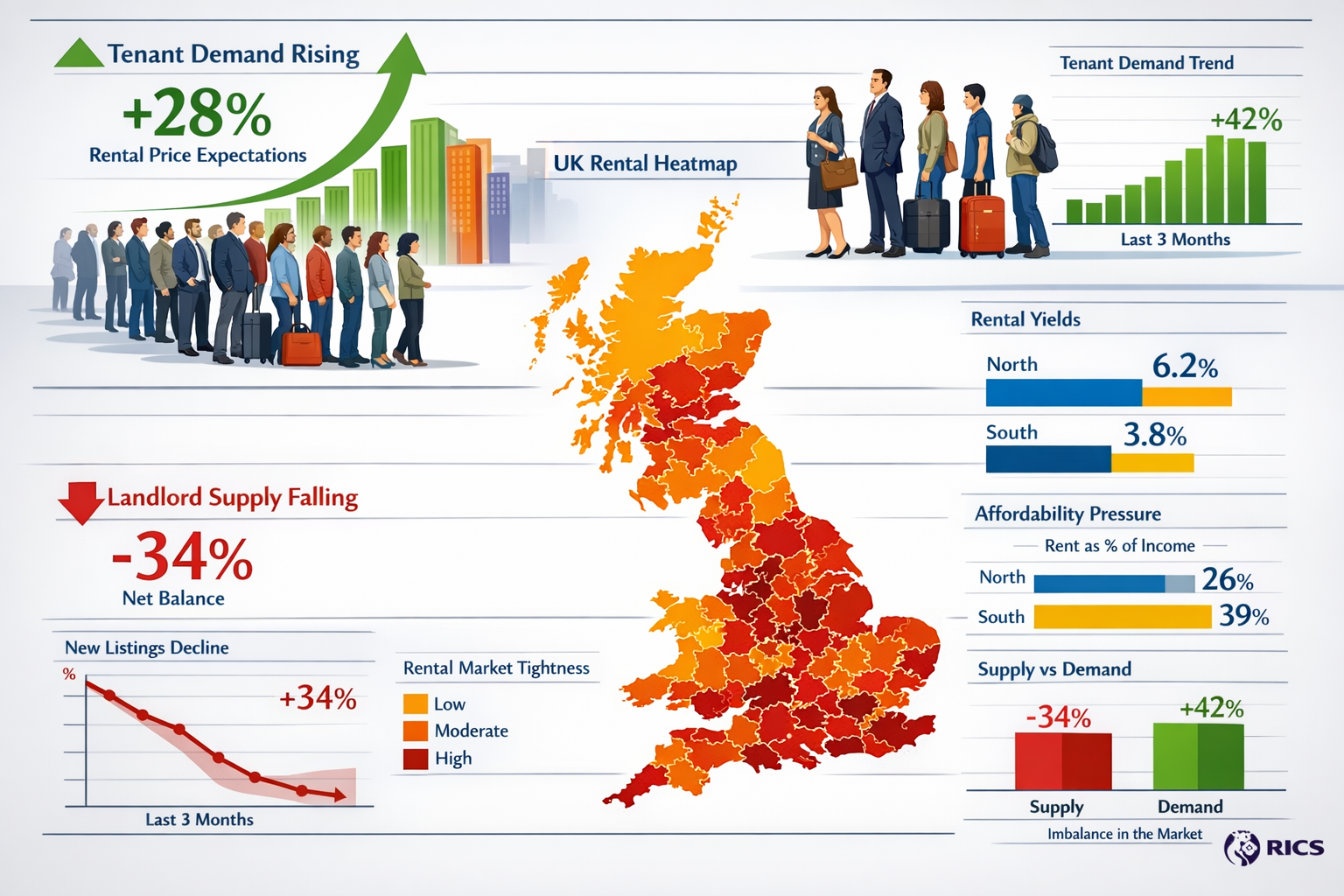
✅ Rental market dynamics show tenant demand increasing (+28% price expectations) while landlord supply remains constrained (-34% net balance), creating additional valuation complexity across all regions
✅ 12-month outlook has strengthened significantly to +43% positive sentiment, but regional variations remain stark, requiring surveyors to balance optimism with location-specific caution
Understanding the 2026 Regional Price Divergence Landscape
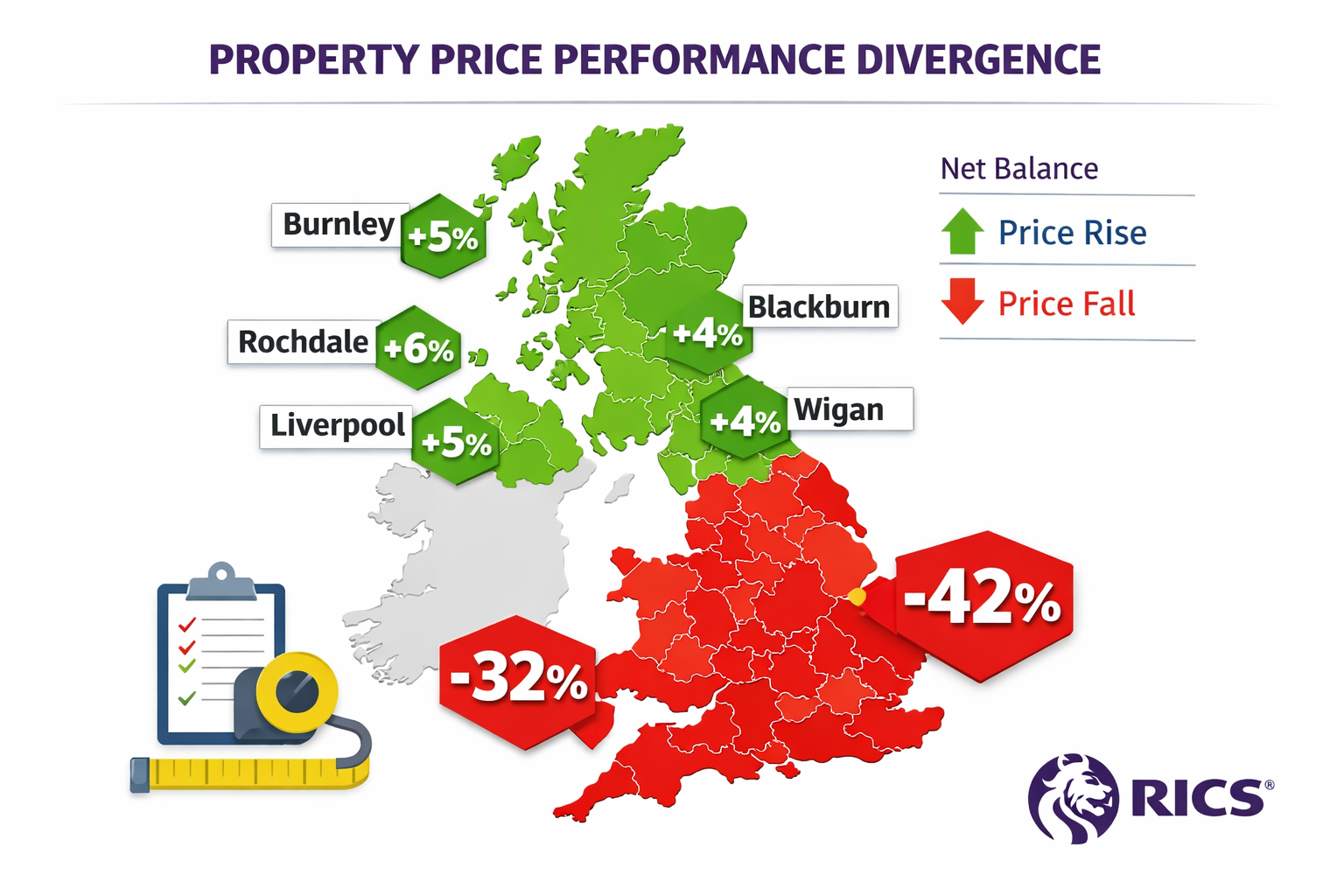
The UK property market in 2026 tells two distinctly different stories depending on geography. National house prices show a net balance of -10% for the past three months as of January 2026, marking significant improvement from -19% in October 2025.[1] However, this headline figure masks profound regional variations that demand surveyor attention.
Northern Markets: The Growth Engine
Scotland and Northern Ireland continue as the strongest regional performers with sustained upward price trends.[1][3] The North West and North of England have joined this growth trajectory, creating a Northern powerhouse that defies national pessimism.
Detailed analysis reveals specific towns driving this Northern surge:
| Town | Region | 2025 Price Growth |
|---|---|---|
| 🏆 Burnley | North West | Highest UK growth |
| Rochdale | North West | >4% gain |
| Blackburn | North West | >4% gain |
| Liverpool | North West | >4% gain |
| Wigan | North West | >4% gain |
These figures represent actual price increases in markets where affordability remains relatively strong and local economic fundamentals support continued demand.[2]
Southern Markets: Persistent Underperformance
In stark contrast, London, the South East, the South West, and East Anglia continue to lag the national average.[1][4] The numbers paint a challenging picture:
- London: -42% net balance (December 2025)
- South East: -32% net balance (December 2025)
- South West and East Anglia: Negative balances exceeding national average
These figures reflect ongoing affordability challenges that have created nearly a decade of flat or negative real-term price growth in Southern markets.[5] For surveyors conducting RICS building surveys in these regions, understanding this context is crucial for accurate valuation.
The Affordability Factor
The fundamental driver of Valuation Precision for Regional Price Divergence 2026: RICS Strategies for Northern Growth vs. Southern Stagnation lies in affordability. Southern markets, particularly London, have reached price points that exclude many buyers despite recent declines. Northern markets offer stronger value propositions, attracting both first-time buyers and investors seeking growth potential.
"Early signs that market conditions may be improving after a challenging period, though recovery will depend heavily on mortgage rate trajectories and macro confidence." — Simon Rubinsohn, RICS Chief Economist[1]
RICS Valuation Strategies for Regional Price Divergence 2026
Professional surveyors must adapt their methodologies to account for these regional variations. Traditional national-average approaches fail to capture the nuanced realities of today's bifurcated market. Here's how RICS professionals are refining their strategies.
Adjusting Comparable Evidence by Region
The cornerstone of accurate valuation lies in selecting appropriate comparable evidence. In 2026, this requires heightened regional awareness:
For Northern Growth Markets:
- ✔️ Prioritize recent transactions (last 3-6 months) as prices trend upward
- ✔️ Weight comparable evidence toward similar growth corridors
- ✔️ Account for positive momentum in adjustment calculations
- ✔️ Consider emerging infrastructure investments boosting specific areas
For Southern Stagnant Markets:
- ✔️ Extend comparable timeframe (6-12 months) due to slower transaction volumes
- ✔️ Apply downward adjustments for properties in oversupplied segments (particularly flats)
- ✔️ Recognize that asking prices may exceed realistic achievable values
- ✔️ Factor in extended marketing periods when advising clients
When conducting real estate appraisals, surveyors must document their regional adjustment methodology clearly, explaining to clients why Northern and Southern properties require different analytical frameworks.
Market Sentiment Integration
RICS survey data provides invaluable sentiment indicators that complement transactional evidence. As of January 2026:
- 12-month price expectations: +43% of respondents anticipate higher prices (most positive since February 2025)[1][3]
- Near-term sales expectations: +4% for next three months (cautious short-term outlook)[1]
- Long-term optimism: +35% (improving confidence)[1]
However, these national figures require regional interpretation:
Regional Sentiment Breakdown:
- Northern regions show stronger positive sentiment aligned with actual price performance
- London, South West, South East, and East Anglia display more negative balances than national average, though each has improved modestly[3]
Surveyors should integrate this sentiment data into their valuation reports, particularly when advising on investment timing or market entry strategies.
Property Type Considerations
The regional divergence extends to property types, with distinct performance patterns:
London Flat Market:
Major forecasters including Savills and Knight Frank project London house price growth of only around 1-2% in 2026, with flats continuing to underperform houses.[5] This contrasts sharply with UK average expectations of 2-4%.
Northern Houses:
Family homes in Northern growth towns benefit from:
- Strong local employment markets
- Relative affordability attracting relocating families
- Limited new supply in established neighborhoods
When conducting expert building evaluations, surveyors must account for these property-type variations within their regional assessments.
Rental Market Valuation Complexity
The rental sector adds another layer to Valuation Precision for Regional Price Divergence 2026: RICS Strategies for Northern Growth vs. Southern Stagnation. Tenant demand increased over the three months to January 2026, but landlord supply instructions remain firmly negative with a net balance of -34%.[1][3]
This supply-demand imbalance drives rental price expectations:
- +28% of respondents expect rental prices to rise in the near term (up from +16% previously)[1][3]
- Rental market displays "more resilient tone" alongside constrained supply
- Regional variations persist, with Southern markets facing acute supply shortages
For surveyors valuing investment properties or conducting lease extension valuations, rental market dynamics must inform yield calculations and future income projections.
Data-Driven Regional Analysis Tools
Modern RICS surveyors leverage advanced analytical tools to enhance regional precision:
📊 Quantitative Analysis Techniques:
- Geographic Information Systems (GIS) for spatial price pattern analysis
- Data analysis platforms tracking micro-market trends
- Quantitative analysis of transaction volumes by postcode sector
These tools enable surveyors to identify hyper-local variations within broader regional trends, delivering granular insights that generic national indices cannot provide.
Practical Applications: Advising Clients on Regional Investment Timing

Understanding Valuation Precision for Regional Price Divergence 2026: RICS Strategies for Northern Growth vs. Southern Stagnation enables surveyors to provide strategic investment guidance tailored to client objectives.
Northern Market Opportunities
For clients considering Northern investments, surveyors should highlight:
✅ Growth Potential:
- Burnley, Rochdale, Blackburn, Liverpool, and Wigan have demonstrated sustained growth[2]
- Affordability metrics remain favorable compared to earnings
- Infrastructure investments (transport links, regeneration projects) support continued appreciation
⚠️ Risk Factors:
- Ensure growth isn't driven solely by temporary factors
- Assess local employment stability and economic diversity
- Consider exit liquidity—Northern markets may have smaller buyer pools
Surveyor Recommendation:
When conducting surveys in Northern growth markets, emphasize the importance of building surveyor services to identify any structural issues that could undermine investment returns, particularly in older Victorian terraces common in these areas.
Southern Market Considerations
Southern markets require different strategic framing:
✅ Long-Term Value Retention:
- Despite current stagnation, London and South East maintain infrastructure advantages
- Quality of schools, transport, and amenities supports long-term demand
- Current weakness may present entry opportunities for patient investors
⚠️ Near-Term Challenges:
- Affordability constraints limit buyer pool expansion
- Flat market may persist for extended period (1-2% growth projections)[5]
- Higher entry costs increase opportunity cost versus Northern alternatives
Surveyor Recommendation:
For Southern properties, comprehensive property assessment becomes even more critical. Buyers paying premium prices cannot afford hidden defects or maintenance issues that erode already-modest appreciation potential.
First-Time Buyer Guidance
First-time buyers face particularly acute regional decisions in 2026:
Northern Strategy:
- Lower entry costs enable earlier market participation
- Growth trajectory may build equity faster
- Consider career mobility—will Northern location support long-term employment?
Southern Strategy:
- Higher costs delay entry but maintain proximity to major employment centers
- Flat appreciation means minimal "missing out" penalty for waiting
- Rental costs may justify buying despite high prices
Surveyors advising first-time buyers should recommend comprehensive building surveys regardless of region, as inexperienced buyers particularly need professional protection.
Buy-to-Let Investment Analysis
The rental market dynamics discussed earlier create distinct regional opportunities:
Northern Buy-to-Let:
- Lower purchase prices generate higher gross yields
- Growing tenant demand supports occupancy rates
- Capital appreciation potential adds to total returns
Southern Buy-to-Let:
- Lower gross yields due to high purchase prices
- Acute supply shortage supports rental growth
- Tenant demand remains robust despite affordability pressures
Key Valuation Consideration:
Surveyors must calculate net yields accounting for regional variations in:
- Maintenance costs (older Northern stock vs. newer Southern developments)
- Void periods (competitive Northern markets vs. supply-constrained South)
- Management fees and regulatory compliance costs
Portfolio Diversification Strategies
Sophisticated investors may pursue regional diversification to balance growth and stability:
🎯 Balanced Portfolio Approach:
- 40% Northern growth markets: Capital appreciation focus (Burnley, Liverpool, Manchester suburbs)
- 40% Southern stable markets: Income generation and long-term value retention (London zones 3-4, South East commuter towns)
- 20% opportunistic: Emerging areas showing early growth signals
This approach requires surveyors to provide consistent valuation standards across regions while acknowledging different risk-return profiles.
Navigating Regulatory and Professional Standards
RICS professionals must maintain rigorous standards while adapting to regional divergence.
Red Book Compliance in Divergent Markets
The RICS Valuation – Global Standards (Red Book) provides the framework for professional valuations. In 2026's divergent market, key compliance considerations include:
📋 Basis of Value:
- Clearly state whether valuation reflects Market Value, Investment Value, or other basis
- Regional market conditions may affect which basis is most appropriate
- Document assumptions about market liquidity and transaction timeframes
📋 Comparable Evidence:
- Demonstrate due diligence in sourcing regionally appropriate comparables
- Explain adjustments made for regional market conditions
- Justify timeframe selections (recent vs. extended) based on market activity levels
📋 Assumptions and Special Assumptions:
- Disclose any assumptions about future regional market performance
- Highlight uncertainties specific to regional economic conditions
- Avoid overly optimistic projections unsupported by evidence
Professional Liability Considerations
Regional divergence increases professional liability exposure:
⚠️ Risk Areas:
- Over-valuation in stagnant Southern markets: Clients may challenge valuations that don't reflect subsequent price declines
- Under-valuation in growth Northern markets: Sellers may claim lost value if conservative assessments prove too cautious
- Inadequate regional adjustment documentation: Failure to explain regional methodology invites challenges
🛡️ Protection Strategies:
- Comprehensive documentation of regional analysis methodology
- Clear communication of market uncertainty and regional variations
- Regular professional development on regional market dynamics
- Appropriate professional indemnity insurance coverage
Continuing Professional Development
RICS members must maintain current knowledge of regional market conditions through:
- Regular review of RICS UK Residential Market Survey monthly reports[1][3]
- Participation in regional property professional networks
- Analysis of local transaction data and market intelligence
- Understanding of regional economic indicators (employment, infrastructure investment, demographic trends)
Conclusion
Valuation Precision for Regional Price Divergence 2026: RICS Strategies for Northern Growth vs. Southern Stagnation represents more than a market observation—it demands fundamental shifts in surveyor methodology and client advisory approaches. The stark contrast between Northern growth markets (led by towns like Burnley, Rochdale, and Liverpool with gains exceeding 4%) and Southern stagnation (London at -42%, South East at -32%) creates a professional imperative for regionally-specific valuation techniques.
RICS surveyors must move beyond national averages and generic approaches. Success in 2026 requires:
✅ Rigorous regional comparable analysis that accounts for divergent price trajectories
✅ Integration of market sentiment data from RICS surveys alongside transactional evidence
✅ Property-type specific considerations recognizing that London flats face different dynamics than Northern family homes
✅ Rental market complexity with supply constraints (-34% net balance) driving price expectations (+28%)
✅ Strategic investment timing advice tailored to client objectives and regional opportunities
The improving 12-month outlook (+43% positive sentiment) offers cautious optimism, but regional variations remain the defining characteristic of this market. Surveyors who master these regional nuances will deliver superior value to clients navigating investment decisions in this two-speed market.
Actionable Next Steps
For Surveyors:
- Review your comparable evidence databases to ensure adequate regional coverage
- Develop standardized regional adjustment frameworks documented in valuation reports
- Subscribe to RICS monthly market surveys and regional property intelligence services
- Consider specialization in either Northern growth markets or Southern stable markets to build deep expertise
For Property Investors:
- Engage RICS-qualified surveyors with demonstrated regional expertise for your target market
- Request detailed regional market analysis as part of any building survey or valuation
- Align investment strategy with regional dynamics—growth in the North, income in the South
- Maintain flexibility to adapt as regional dynamics evolve through 2026
For Homebuyers:
- Recognize that regional market conditions significantly impact both purchase price and future appreciation
- Commission comprehensive professional surveys regardless of region—quality issues affect all markets
- Consider long-term lifestyle and career factors alongside pure financial metrics
- Work with surveyors who understand your specific regional market dynamics
The UK property market's regional divergence will likely persist through 2026 and beyond, driven by fundamental affordability differences. RICS professionals who embrace this complexity and develop sophisticated regional strategies will thrive in this challenging but opportunity-rich environment.
References
[1] Uk Resi Survey Jan 2026 Report Shows Early Signs Market Recovery Despite Caution – https://www.rics.org/news-insights/uk-resi-survey-jan-2026-report-shows-early-signs-market-recovery-despite-caution
[2] Uk Economy Property Update February 2026 – https://www.rics.org/content/dam/ricsglobal/documents/market-surveys/uk-economy-property-update-february-2026.pdf
[3] Uk Residential Market Survey January 2026 – https://www.rics.org/content/dam/ricsglobal/documents/market-surveys/uk-residential-market-survey/UK-Residential-Market-Survey_January-2026.pdf
[4] Uk Residential Survey Dec 2025 Confidence Rebound – https://www.rics.org/news-insights/uk-residential-survey-dec-2025-confidence-rebound
[5] London Property Market Predictions For 2026 – https://hardingsurveyors.co.uk/london-property-market-predictions-for-2026