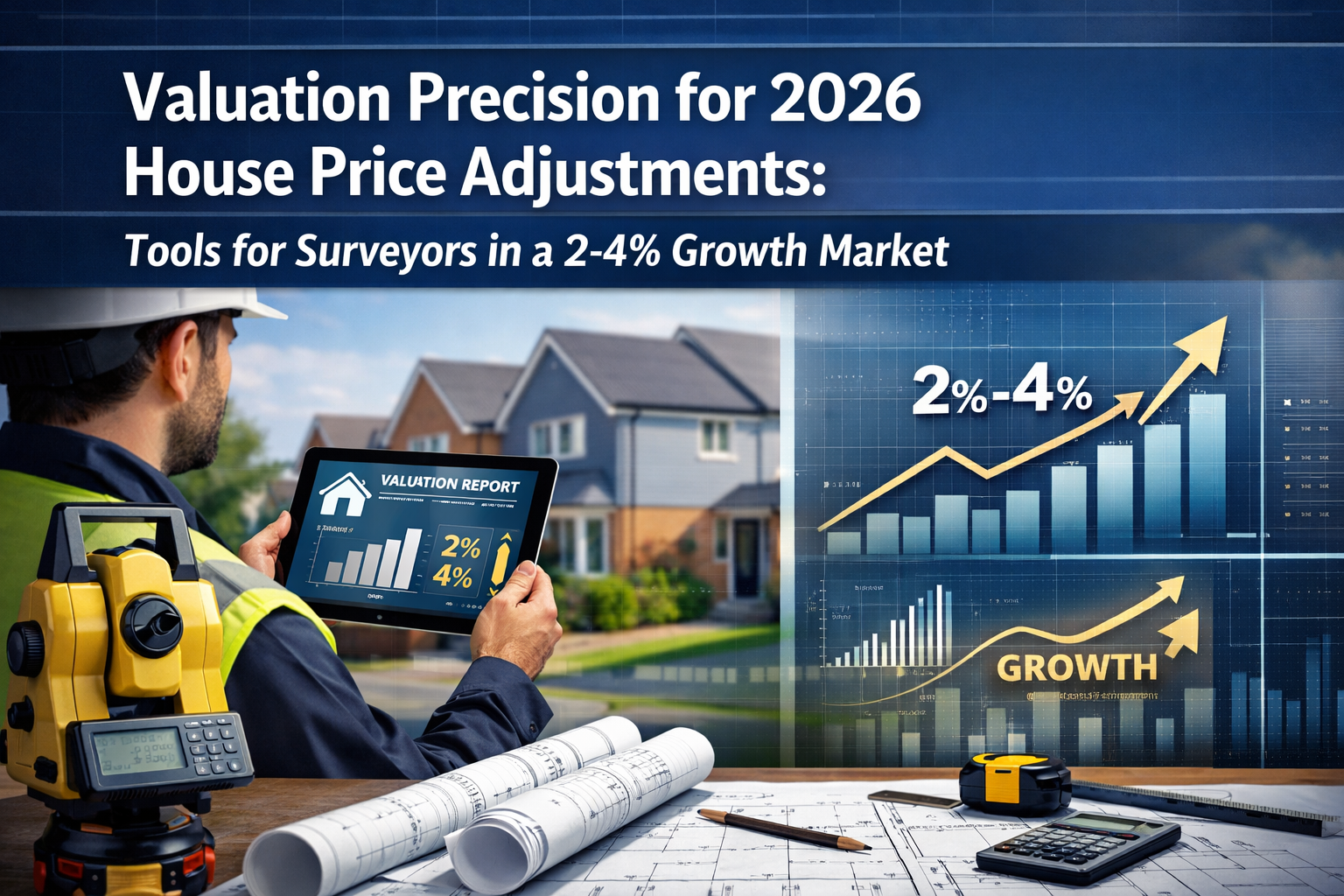
The property market in 2026 presents a unique challenge for surveyors: how do you maintain valuation accuracy when price growth hovers between modest gains and near-stagnation? With mortgage rates settling around 6.10% and median home prices expected to rise just 1% year-over-year in many markets, the margin for error has never been smaller.[2][5] For surveyors tasked with producing lender-compliant reports, Valuation Precision for 2026 House Price Adjustments: Tools for Surveyors in a 2-4% Growth Market isn't just a technical requirement—it's essential for protecting clients, lenders, and professional reputations.
Unlike the volatile swings of previous years, 2026's steady-state market demands refined methodologies that account for regional variations, subtle market shifts, and evolving RICS standards. This guide explores the essential tools and techniques that enable surveyors to deliver accurate valuations in this challenging environment.
Key Takeaways
- Market growth in 2026 remains modest, with national averages around 1% but regional variations creating 2-4% growth pockets that require careful analysis
- RICS-aligned valuation methods incorporating multiple data sources provide the precision needed for lender-compliant reports in low-growth markets
- Digital tools and technology enable surveyors to process comparative market data, adjust for property-specific factors, and document findings with greater accuracy
- Regional market variations across the UK mean surveyors must adapt methodologies to local conditions rather than applying blanket national trends
- Mortgage rate stabilization near 6% creates predictable buyer behavior patterns that inform more reliable valuation forecasts[2][6]
Understanding the 2026 Property Market Landscape

Current Market Conditions and Growth Projections
The 2026 housing market operates within tight constraints. Mortgage rates have stabilized at 6.10%, down from 6.86% a year earlier, but still significantly elevated compared to pre-2022 levels.[2] This rate environment creates predictable buyer behavior: cautious purchasing decisions, extended search periods, and heightened price sensitivity.
National forecasts suggest median home-sale prices will rise just 1% year-over-year, constrained by elevated mortgage rates and existing home prices.[5] However, this national average masks significant regional variation. London boroughs, commuter towns, and areas with strong employment growth may experience the 2-4% growth range, while other regions remain flat or decline slightly.
For surveyors, these conditions demand precision. A 2% valuation error in a rapidly appreciating market might go unnoticed; in 2026's modest growth environment, the same error could represent the entire year's price movement.
Why Valuation Precision Matters More in Low-Growth Markets
When property values increase 10-15% annually, small valuation discrepancies fade into the background. But when annual growth measures 2-4%, every percentage point counts. Consider these scenarios:
- Mortgage lending decisions hinge on loan-to-value ratios where a 2% valuation difference could determine approval
- Price negotiations become more contentious when buyers and sellers operate within narrow margins
- Professional liability increases when valuations are challenged in slow-moving markets where comparable sales are scarce
- Lender compliance requirements tighten as financial institutions seek greater certainty in uncertain markets
Understanding how an RICS survey can help negotiate property prices becomes crucial in this environment, where accurate valuations directly impact transaction outcomes.
Essential Tools for Valuation Precision for 2026 House Price Adjustments
Digital Valuation Platforms and Data Analytics
Modern surveying demands modern tools. Digital valuation platforms have evolved significantly, offering surveyors access to:
Comprehensive Market Data Sources 📊
- Land Registry price paid data with real-time updates
- Mortgage lending value indices
- Rental yield comparisons
- Historical price trends with granular geographic filtering
Automated Comparative Market Analysis (CMA)
These systems identify comparable properties based on multiple criteria: location, property type, size, condition, and transaction date. Advanced algorithms weight each comparable based on similarity and recency, producing more reliable baseline valuations.
Adjustment Calculators
Digital tools help surveyors apply systematic adjustments for property-specific factors:
- Square footage differences
- Condition variations
- Location premiums or discounts
- Recent improvements or defects
The key advantage lies in consistency and documentation. Digital platforms create audit trails showing how valuations were derived, essential for lender compliance and professional standards.
Geographic Information Systems (GIS) for Regional Analysis
Understanding Valuation Precision for 2026 House Price Adjustments: Tools for Surveyors in a 2-4% Growth Market requires recognizing that growth isn't uniform. GIS tools enable surveyors to:
- Map price movements across micro-markets
- Identify emerging value corridors near transport links
- Analyze demographic shifts affecting demand
- Overlay planning permissions and development projects
For example, areas near Crossrail stations may experience 3-4% growth while neighboring postcodes remain flat. GIS visualization makes these patterns immediately apparent, informing more accurate local adjustments.
Building Condition Assessment Technology
Physical property condition directly impacts valuation, and 2026 brings enhanced diagnostic tools:
Thermal Imaging Cameras 🌡️
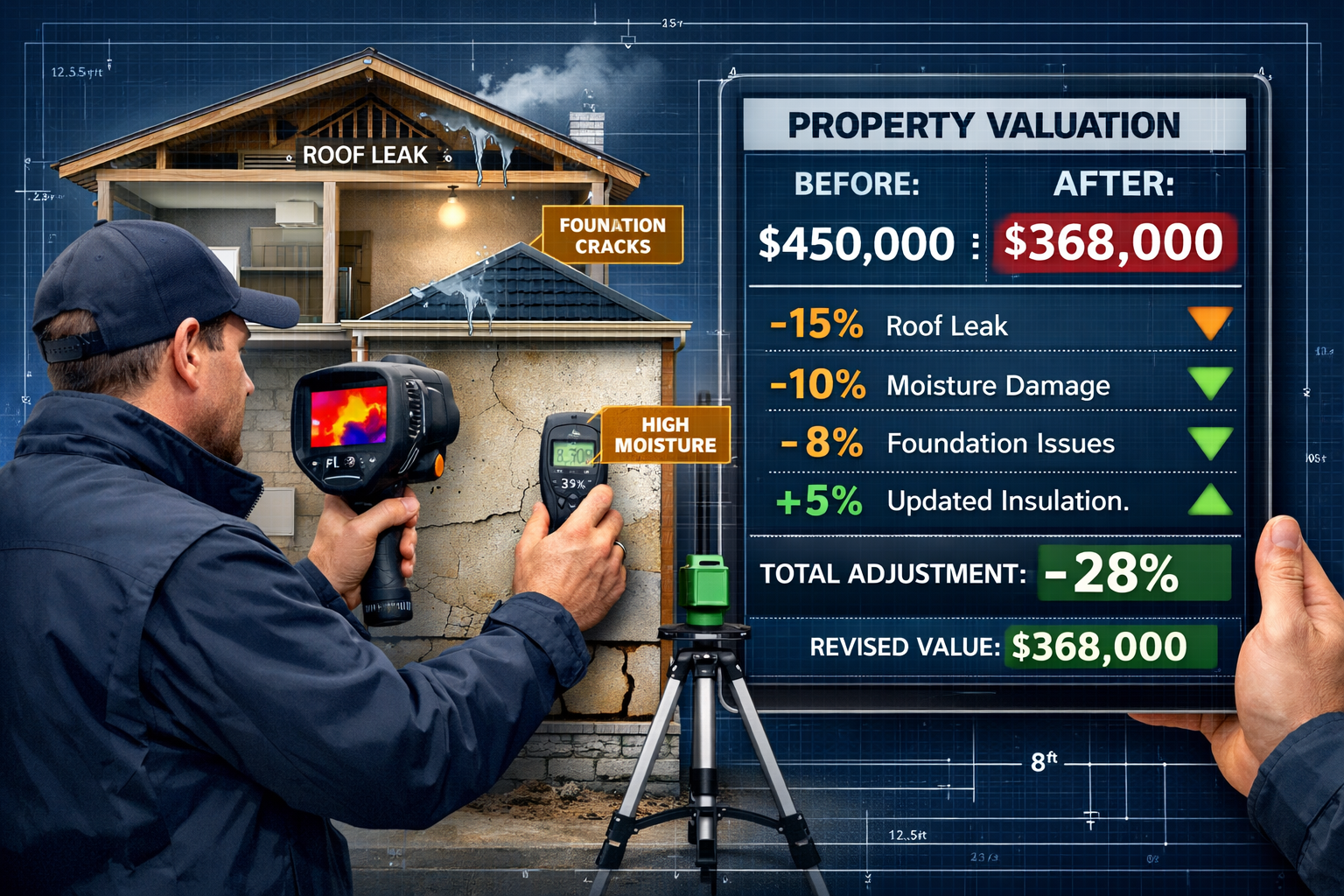
Reveal hidden defects affecting value: insulation gaps, moisture ingress, and structural issues invisible to visual inspection. These findings justify valuation adjustments that protect buyers and lenders.
Moisture Meters and Damp Detection
Essential for identifying issues requiring remediation. Damp surveys provide detailed assessments that inform accurate deductions from baseline valuations.
Laser Measurement Systems
Eliminate measurement errors that compound through calculations. Precise square footage figures ensure comparables are truly comparable.
Drone Technology
Provides comprehensive roof and elevation inspections without scaffolding, identifying defects that impact value while documenting property context and neighborhood characteristics.
When conducting structural surveys, these technologies enable surveyors to quantify repair costs accurately, supporting defensible valuation adjustments.
RICS-Aligned Methodologies for Accurate Price Adjustments
The Comparative Method with Enhanced Precision
The comparative method remains the foundation of residential valuation, but 2026 applications require refinement:
1. Comparable Selection Criteria
- Recency: Prioritize sales within 3-6 months in stable markets
- Proximity: Focus on properties within 0.5 miles unless market characteristics vary
- Similarity: Match property type, size (±15%), and condition closely
- Transaction type: Weight arm's-length sales over distressed or related-party transactions
2. Systematic Adjustment Framework
Create a standardized adjustment schedule:
| Factor | Adjustment Range | Basis |
|---|---|---|
| Location (per 0.1 mile) | ±0.5-2% | Local market analysis |
| Condition difference | ±2-8% | Repair cost estimates |
| Size variation (per 100 sq ft) | ±1-3% | Market preference data |
| Parking/garden | ±2-5% | Local amenity premiums |
| Period features | ±3-7% | Buyer demographic analysis |
3. Weighting Multiple Comparables
Never rely on a single comparable. Use 3-5 recent sales, applying weights based on similarity:
- Most similar comparable: 40% weight
- Second comparable: 30% weight
- Third comparable: 20% weight
- Fourth comparable: 10% weight
This approach reduces outlier impact while maintaining market responsiveness.
Investment Method for Rental Properties
For buy-to-let properties, the investment method provides valuation precision through yield analysis:
Calculation Framework:
- Determine market rent (£/month)
- Calculate gross annual rental income
- Deduct operating expenses (15-25% of gross rent)
- Apply appropriate yield rate (3-6% depending on location and property type)
- Derive capital value: Net Income ÷ Yield Rate
In 2026's market, yield compression in prime areas (London, major cities) contrasts with yield expansion in secondary locations. Surveyors must apply location-specific yields rather than national averages.
Residual Method for Properties Requiring Renovation
Properties needing significant work require the residual valuation method:
Formula:
Completed Value – (Renovation Costs + Professional Fees + Finance Costs + Profit Margin) = Current Market Value
This approach proves essential when expert building evaluation reveals substantial defects. Accurate cost estimation separates professional valuations from guesswork.
Implementing Valuation Precision for 2026 House Price Adjustments Across Regional Markets

London and Southeast England: Micro-Market Analysis
London's property market operates as dozens of distinct micro-markets. Surveyors working in areas from Wimbledon to Knightsbridge must recognize that postcode-level variations exceed national trends.
Key Considerations:
- Transport connectivity: Properties within 10-minute walk of Underground stations command 8-15% premiums
- School catchment areas: Primary school proximity can add 5-12% to values
- Conservation areas: Heritage designations create 3-8% premiums but also renovation restrictions
- New developments: Supply increases in areas like Hackney and Ealing may suppress nearby resale values
Outer London and Commuter Belt: Growth Corridors
Areas like Croydon, Wembley, and Essex towns (Chelmsford, Epping, Loughton) experience different dynamics:
Growth Drivers:
- Hybrid working patterns sustaining commuter town demand
- Relative affordability compared to inner London
- Family-sized housing stock
- Green space access
Valuation Adjustments:
Apply commute time premiums: properties offering sub-45-minute journeys to central London maintain value better than those requiring longer commutes.
Regional Variations: Adapting Methodology
Markets in Havering, Hillingdon, and Hornchurch demonstrate how local factors override national trends:
- Employment hubs: Proximity to major employers (airports, business parks) creates localized demand
- Regeneration projects: Planned infrastructure improvements justify forward-looking valuations
- Demographic shifts: Areas attracting young families versus retirees require different valuation approaches
Understanding which home survey is right for each property type in these diverse markets ensures appropriate investigation depth.
Advanced Techniques for Lender-Compliant Reports
Documentation Standards and Audit Trails
Lender-compliant valuations require transparent methodology documentation:
Essential Components:
- Comparable sales schedule with addresses, dates, prices, and adjustment rationale
- Adjustment calculations showing mathematical basis for each modification
- Market analysis summary explaining local trends and growth projections
- Condition assessment with photographic evidence and repair cost estimates
- Risk factors identifying market uncertainties or property-specific concerns
Digital platforms automatically generate these audit trails, but surveyors must verify accuracy and completeness.
Risk Assessment and Valuation Confidence Levels
In 2026's narrow-margin market, expressing valuation confidence becomes important:
Confidence Indicators:
- High confidence (±2%): Multiple recent comparables, stable market, standard property
- Medium confidence (±5%): Limited comparables, transitional market, some unique features
- Lower confidence (±8-10%): Few comparables, volatile market, unusual property
Lenders appreciate honest uncertainty assessment over false precision. When comparables are scarce, consider specific defect surveys to justify conservative valuations.
Handling Special Property Types
Certain properties challenge standard methodologies:
Leasehold Properties 🏢
Lease length dramatically affects value. Properties with sub-80-year leases require lease extension valuation expertise. Apply marriage value calculations and recognize that short leases can reduce values 20-40%.
Period Properties with Character Features
Victorian, Edwardian, and Georgian properties command premiums for original features but may have hidden defects. Balance aesthetic value against maintenance costs and modernization needs.
Properties with Structural Movement
Monitoring surveys establish whether movement is historic and stable or ongoing and progressive. Active movement may reduce values 10-30% depending on severity and repair costs.
Quality Assurance and Professional Development
Maintaining RICS Standards in Challenging Markets
The Royal Institution of Chartered Surveyors (RICS) sets professional standards that protect both practitioners and clients. In 2026's demanding market, understanding why to choose RICS surveyors reinforces the value proposition.
Key RICS Requirements:
- Independence: Valuations must be objective, free from conflicts of interest
- Competence: Surveyors should only value property types within their expertise
- Due diligence: Reasonable investigations and verification of information
- Clear reporting: Transparent methodology and assumption disclosure
Continuous Learning and Market Knowledge
Valuation Precision for 2026 House Price Adjustments: Tools for Surveyors in a 2-4% Growth Market requires ongoing education:
Essential Knowledge Areas:
- Local planning policy changes affecting development potential
- Mortgage market trends influencing buyer behavior
- Building regulation updates impacting retrofit and renovation costs
- Economic indicators predicting market direction
Surveyors should regularly review Land Registry data, attend RICS training sessions, and maintain networks with local estate agents, mortgage brokers, and fellow professionals.
Technology Adoption and Digital Competency
The surveying profession continues digitizing. Essential technological competencies include:
- Valuation software proficiency: Master platforms providing market data and analytical tools
- Digital photography and annotation: Document properties comprehensively
- Report generation systems: Produce professional, consistent documentation efficiently
- Data security protocols: Protect sensitive client and property information
Firms investing in technology gain efficiency advantages while maintaining quality standards.
Common Pitfalls and How to Avoid Them
Over-Reliance on Automated Valuation Models (AVMs)
While AVMs provide useful starting points, they cannot replace professional judgment. Algorithms struggle with:
- Unique property features
- Condition variations
- Micro-market dynamics
- Recent market shifts
Use AVMs as sense-checks rather than primary valuation tools. Significant discrepancies between AVM outputs and professional valuations warrant investigation, but professional judgment should prevail.
Insufficient Comparable Adjustment
The most common valuation error involves inadequate adjustment for differences between subject properties and comparables. Surveyors must:
- Systematically assess every material difference
- Apply market-derived adjustment percentages
- Document adjustment rationale clearly
- Avoid "gut feel" adjustments without supporting evidence
Ignoring Market Momentum
Static analysis of past sales misses market direction. In 2026, with existing home sales projected to increase 3% to 4.2 million units annually, demand patterns are shifting.[5] Surveyors must:
- Weight recent sales more heavily than older transactions
- Monitor market velocity (time on market, sale-to-list price ratios)
- Adjust for seasonal patterns
- Consider forward-looking indicators (mortgage applications, viewing activity)
Inadequate Property Inspection
Remote or cursory inspections miss defects that materially affect value. Even when conducting Level 2 surveys versus Level 3 surveys, thoroughness matters. Budget adequate time for inspections and use appropriate diagnostic tools.
Practical Implementation: Case Study Approach
Case Study 1: Victorian Terrace in Modest Growth Area
Property: 3-bedroom Victorian terrace, Wimbledon area
Market Context: Local growth 2.5% annually, stable demand
Valuation Approach:
- Identified 4 comparable sales within 0.3 miles, sold within 4 months
- Applied adjustments: +3% for superior condition, -2% for smaller garden, +1% for parking space
- Used thermal imaging to identify minor insulation issues (£2,000 repair cost)
- Weighted comparables based on similarity
- Final valuation: £685,000 (±3% confidence level)
Key Success Factor: Detailed condition assessment justified premium over standard comparable properties.
Case Study 2: Leasehold Flat with Short Lease
Property: 2-bedroom flat, 65-year lease remaining
Challenge: Standard comparables had 125+ year leases
Valuation Approach:
- Established baseline value assuming 125-year lease: £450,000
- Calculated lease extension cost: £35,000
- Applied marriage value discount: 50% of gain
- Factored buyer financing difficulty with short lease
- Final valuation: £385,000
Key Success Factor: Specialized lease extension valuation knowledge prevented over-valuation.
Case Study 3: Property with Structural Concerns
Property: 1930s semi-detached with visible cracking
Investigation Required:
- Structural survey revealing historic settlement (stable)
- Crack monitoring data from previous owner
- Structural engineer consultation
Valuation Approach:
- Baseline value (assuming no defects): £525,000
- Deduction for cosmetic repairs: £8,000
- Buyer perception discount: 5% (£26,250)
- Final valuation: £490,750
Key Success Factor: Distinguishing between historic stable movement and active structural problems prevented excessive devaluation while protecting lender interests.
Conclusion
Valuation Precision for 2026 House Price Adjustments: Tools for Surveyors in a 2-4% Growth Market represents both a challenge and an opportunity for property professionals. The modest growth environment eliminates room for error while demanding sophisticated analytical approaches that combine traditional surveying expertise with modern technology.
Success in this market requires:
✅ Embracing digital tools that enhance data access and analytical capabilities while maintaining professional judgment
✅ Applying RICS-aligned methodologies systematically, with transparent documentation supporting every valuation conclusion
✅ Understanding regional variations that create localized growth pockets within broader market trends
✅ Maintaining rigorous inspection standards using advanced diagnostic tools to identify condition issues affecting value
✅ Continuous professional development ensuring knowledge remains current with market dynamics, regulatory changes, and technological advances
Actionable Next Steps
For surveyors seeking to enhance valuation precision:
- Audit current methodology: Review recent valuations against actual transaction prices to identify systematic biases
- Invest in technology: Implement digital valuation platforms and diagnostic equipment appropriate to practice areas
- Develop regional expertise: Build deep knowledge of specific geographic markets rather than attempting broad coverage
- Strengthen documentation: Create standardized templates ensuring consistent, lender-compliant reporting
- Network actively: Maintain relationships with estate agents, mortgage brokers, and fellow surveyors to share market intelligence
- Pursue specialized training: Develop expertise in challenging property types (leasehold, period properties, structural issues)
The 2026 market rewards precision, professionalism, and adaptability. Surveyors who master the tools and techniques outlined in this guide will deliver valuations that protect clients, satisfy lenders, and uphold the profession's standards—regardless of whether growth measures 1%, 4%, or anywhere in between.
By combining time-tested valuation principles with modern analytical tools, surveyors can navigate even the most challenging market conditions with confidence, producing reports that stand up to scrutiny while serving the best interests of all parties involved in property transactions.
References
[1] Pipelinepress 01162026 – https://www.mortgagenewsdaily.com/opinion/pipelinepress-01162026
[2] Msr Market Monthly Update February 2026 – https://mct-trading.com/blog/msr-market-monthly-update-february-2026/
[5] Housing Market Predictions 2026 – https://www.redfin.com/news/housing-market-predictions-2026/
[6] Mortgage Rates February 25 2026 – https://www.bankrate.com/mortgages/analysis/mortgage-rates-february-25-2026/